
Month: November 2026
Blog

How to prepare your website for a traffic spike
Traffic spikes are not simply “more users.” An advertising campaign, product launch, or major sale changes how an ecommerce website behaves: more product images, search queries, inventory checks, cart updates, and payment requests arrive simultaneously. These components rarely scale at the same rate.
Preparing for website traffic spikes means forecasting demand, testing sustainable capacity, separating static delivery from dynamic operations, and establishing contingency controls before infrastructure reaches saturation.
Melbicom CDN– 40 Premium CDN PoPs – Coverage in 35 countries – 24/7 infrastructure support |

|
Addressing Sudden Traffic Spikes Starts With an Event Envelope
Forecasting visitor counts alone is insufficient. A shopper loading product images consumes bandwidth; searching products consumes application resources; checkout generates database writes and external payment requests.
Build two forecasts. The business forecast models advertising impressions, click-through rates, email schedules, geographic distribution, and promotion timing. The engineering forecast translates expected sessions into requests, bandwidth, database operations, and dependency calls.
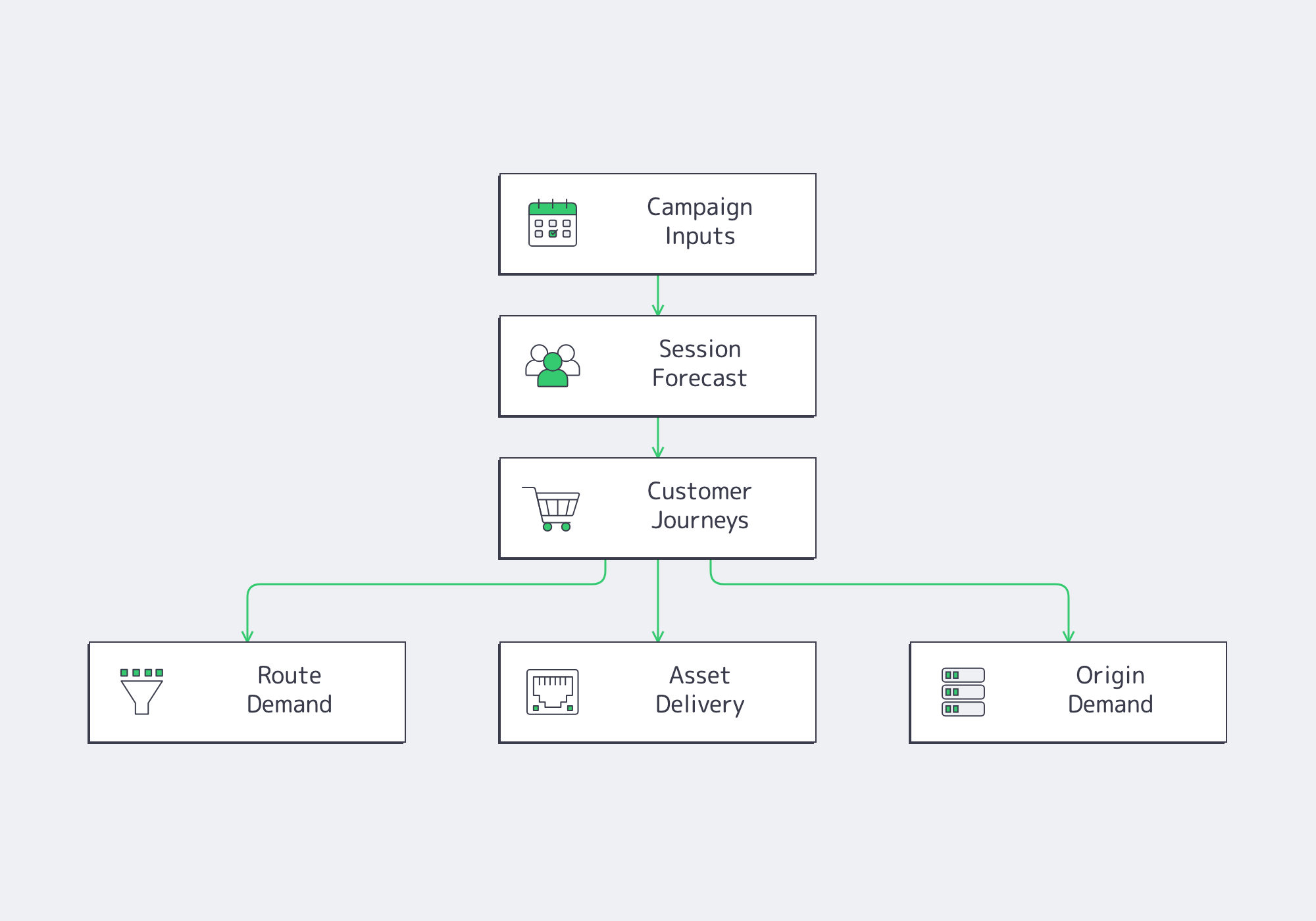
Three calculations establish the workload.
Route demand:
Average route RPS over interval Δt ≈ session starts per second during Δt × probability a session reaches the route × average route requests per reaching session
This estimates average route demand over a defined planning interval, assuming a reasonably stable arrival pattern and request mix. Actual request timing is distributed across user journeys, so short-lived peaks require measured timing profiles or simulations.
Delivery bandwidth:
Delivery bandwidth (bits/s) ≈ object requests per second × mean transferred object size (bytes) × 8
The calculation estimates application-payload bandwidth. It excludes protocol overhead and retransmissions.
Origin request demand:
Origin request rate ≈ non-cacheable request rate + eligible cacheable request rate × (1 − request-weighted cache-hit ratio)
This simplified estimate excludes additional origin work from revalidations, retries, purges, and other cache behavior. Request coalescing may reduce duplicate origin fetches. Calculate request-weighted cache hits separately from byte-hit ratios, and account for cold geographic regions.
Measure actual cache behavior rather than assuming it. Forecast at minute-level granularity because hourly averages can conceal bursts that overwhelm queues or connection pools.
Create expected, high-demand, and beyond-capacity scenarios. The final scenario identifies which operations must be limited if demand exceeds available resources.
When Do Traffic Forecasts Justify Additional Website Capacity Before Major Events?
Traffic forecasts justify additional website capacity when projected peak demand exceeds the load-tested sustainable capacity of any critical component while meeting latency, error-rate, and correctness targets. Additional capacity is also warranted when expected demand consumes operational headroom, exceeds dependency quotas, or leaves insufficient resources to tolerate a component failure.
Sustainable capacity is not the maximum throughput observed immediately before failure. It is the highest workload the system handles while maintaining acceptable performance.
Use this decision model:
Required event capacity (RPS) = upper-bound forecasted workload (RPS) + chosen operating headroom (RPS) + failure-domain allowance (RPS)
All terms must use the same units and request mix. Alternatively, compare forecast demand against the tested safe capacity remaining after a defined component failure.
Compare the requirement with:
Tested sustainable capacity = highest demonstrated workload that still meets the event's latency, error, correctness, resource, and dependency limits
If required capacity exceeds tested capacity, add resources or reduce the workload reaching the bottleneck.
Evaluate components individually. More application servers cannot compensate for exhausted database connections or payment API quotas. PostgreSQL's max_connections imposes a connection ceiling, and increasing it also increases resource allocation.
Forecast With an Uncertainty Budget
Headroom should reflect forecast accuracy, provisioning time, failure tolerance, and saturation behavior—not an arbitrary percentage.
Autoscaling also takes time. Application startup, cache warming, connection establishment, and load-balancer registration can delay usable capacity. Scaling application workers may also increase pressure on slower-scaling dependencies.
Start load testing early to allow for infrastructure provisioning, quota increases, application remediation, and repeat testing. Peak-event preparation guidance emphasizes allowing time to resolve architectural and capacity constraints before a major event.
Which Load Tests Expose Weaknesses in Static and Dynamic Website Components?
The most effective load tests combine warm-cache and cold-cache delivery scenarios with realistic browsing, search, cart, inventory, and checkout journeys. Ramp, sudden-spike, sustained-peak, and overload tests reveal different bottlenecks. Each test should evaluate p95/p99 latency, errors, resource saturation, cache behavior, and downstream dependency limits against predefined acceptance criteria.
Testing a homepage repeatedly cannot represent an entire ecommerce transaction.
Use production-informed request proportions and arrival patterns. Open-model arrival-rate testing schedules new iterations independently of response time. However, an iteration may represent a journey containing multiple HTTP requests, not one request.
Allocate sufficient virtual users and load-generator resources. Inspect achieved iteration rates and dropped iterations: a configured target does not prove the workload was delivered (k6 arrival-rate documentation).
Measure customer experience alongside infrastructure performance. Core Web Vitals defines good performance at the 75th percentile as LCP of 2.5 seconds or less, INP of 200 milliseconds or less, and CLS of 0.1 or less, evaluated separately for mobile and desktop. These browser-experience metrics are distinct from backend p95/p99 load-test criteria.
Load-Testing the Static Delivery Layer
Campaign imagery, JavaScript, CSS, fonts, and product media can generate substantial bandwidth demand.
Test both warm CDN caches and cold or partially populated caches. Newly published assets can produce concentrated origin requests even when existing content performs well.
Inspect Cache-Control headers, URL versioning, cache keys, request-weighted hit ratios, byte-hit ratios, and origin fetches (MDN HTTP caching documentation).
Melbicom's CDN supports configurable HTTP headers, real-time analytics, raw logs, and single or multiple origin pools. During static-layer testing, use header controls to establish which objects are eligible for caching, then compare CDN analytics and raw logs with origin traffic to identify cache misses and unexpected fetch demand. Where multiple origins are configured, test how the origin pool distributes requests under the projected workload.
Traffic Spikes in Dynamic User Journeys
Dynamic requests vary in cost. Product pages may trigger inventory, pricing, recommendation, and session calls.
Checkout may depend on payment, tax, and fraud systems.
Test browsing-heavy, conversion-heavy, low-stock, and authentication-intensive scenarios using representative data.
Exercise four conditions: gradual ramp-up, sudden arrival spikes, sustained peak load, and deliberate overload. The final test should establish whether the application rejects excess work predictably instead of cascading into failure.
A successful test demonstrates acceptable checkout latency, bounded queues, safe database utilization, and dependency requests within quota—not merely a high RPS figure.
Set acceptance criteria for each critical journey before testing. Compare the achieved workload with the forecast, and record the first component that violates its latency, error, correctness, or resource limit. Remediate that bottleneck and repeat the test.
Protecting Static and Dynamic Components
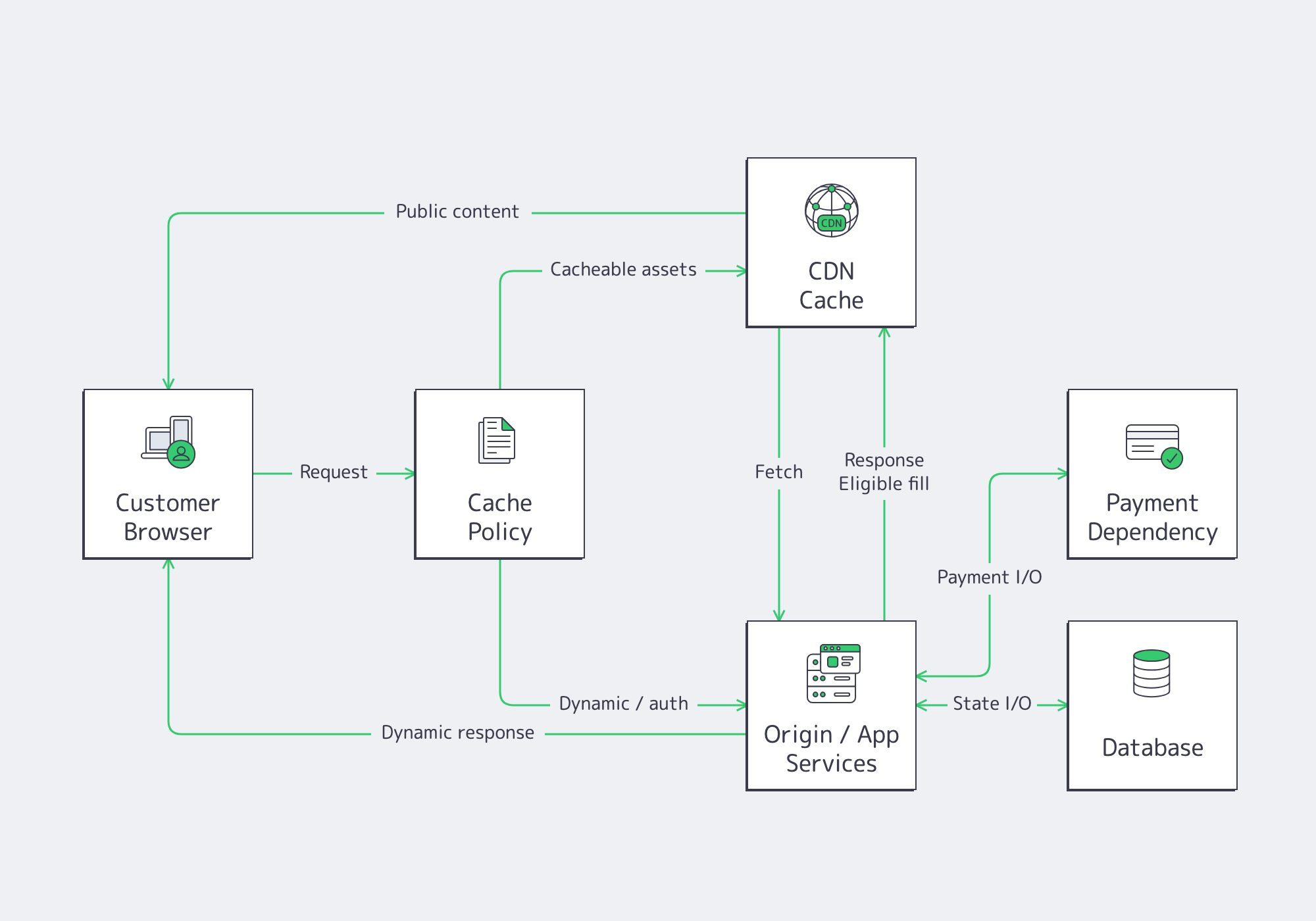
Classify website resources before allocating capacity. Public assets generally support shared caching; carts, authentication, individualized pricing, payments, and inventory mutations require appropriately protected dynamic processing.
| System surface | What to prove before launch | Warning signals |
|---|---|---|
| CDN/static assets | Cache reuse and peak delivery capacity | Cache misses, origin fetches, bandwidth saturation |
| Web/origin tier | Dynamic demand remains within tested limits | p99 latency, 5xx errors, resource saturation |
| Application services | Critical journeys sustain realistic request mixes | Worker exhaustion, timeouts |
| Database | Connections, queries, locks, and I/O remain safe | Pool waits, lock contention |
| Cache/session tier | Memory, hot keys, and connections tolerate concurrency | Evictions, latency spikes |
| Search/inventory | Campaign queries and stock reads remain responsive | Throttling, queue growth |
| Checkout/dependencies | Required integrations remain within quotas | Timeouts, declining completion |
| Observability/control plane | Operators can identify and mitigate bottlenecks | Missing metrics, delayed alerts |
Measure CDN offload in both requests and bytes. Caching large images can reduce bandwidth substantially while leaving numerous small API calls hitting the origin. Application-specific load testing determines whether a particular origin, database, or dependency can sustain the event.
How Should Contingency Plans Address Sudden Traffic Spikes During an Event?
Contingency plans should address sudden traffic spikes through predefined warning thresholds, mitigation actions, responsible operators, and recovery conditions. Controls should activate before critical resources saturate, prioritizing checkout, payment completion, and inventory integrity. Tested rate limits, bounded queues, retry budgets, and optional-feature shutdowns can preserve essential operations when demand exceeds sustainable capacity.
For each bottleneck, set warning and action thresholds using predictive signals such as connection-pool wait time, queue depth, p99 latency, or quota consumption.
Protect revenue-critical operations before optional recommendations, personalization, and background synchronization. Feature flags should enable tested degradation modes rather than emergency changes invented during an incident.
Apply admission controls selectively. Excess requests may receive 503 Service Unavailable, with Retry-After where appropriate, as defined by RFC 9110.
Clients should use bounded retries, backoff, and jitter where appropriate to avoid amplifying overload, but only when retry semantics are safe. Do not blindly replay order creation or payment operations after an uncertain outcome. RFC 9110, Section 9.2.2 requires evidence that a non-idempotent operation is effectively idempotent or that the original request was never applied before automatically retrying it. Google's overload-handling guidance explains how retries across multiple service layers can multiply downstream demand.
Separate capacity problems from functional failures. Checkout errors below tested demand may indicate deployment or payment faults rather than insufficient servers.
Freeze unnecessary production changes during the event. Restore optional features only after queues, connections, latency, and dependencies stabilize.
Run the Event as an Operating Window
Preparation should culminate in a controlled operating window covering the campaign launch, peak demand, and recovery.

After identifying bottlenecks, correct their causes and repeat testing. Adding frontend capacity can worsen database pressure if connection limits remain unchanged.
Use this launch checklist to turn the analysis into operational decisions:
- Forecast demand: Model minute-level arrivals, request mixes, bandwidth, geography, and dependencies. Reconcile projected demand against observed traffic as the campaign progresses.
- Prove capacity: Validate p95/p99 latency, errors, correctness, and resource limits. Establish explicit go/no-go criteria for the critical purchase journey.
- Separate workloads: Offload suitable static content while protecting dynamic state. Measure both request and byte offload to identify remaining origin pressure.
- Rehearse overload: Test warm and cold caches, traffic spikes, sustained peaks, and graceful degradation. Verify the load generator delivers the intended workload.
- Prepare contingency controls: Assign owners, thresholds, rate limits, retry budgets, and recovery criteria. Exercise mitigation actions before they are needed.
- Monitor business outcomes: Track checkout completion alongside infrastructure health. Use conversion and payment-success signals to distinguish customer impact from infrastructure utilization alone.
Addressing sudden traffic spikes is fundamentally about understanding where resources are consumed before demand exposes the weakest component. Forecasting, realistic testing, CDN offload, and rehearsed contingency controls turn a risky campaign into a measurable operating plan.
A successful launch is not simply one that avoids downtime. It is one in which essential customer journeys remain responsive, infrastructure stays within tested limits, and operators know exactly when to intervene.
Prepare Your CDN With Melbicom
Before your next campaign, product launch, or major sale, put repeatable-content delivery through the same readiness testing as the rest of your website.
Get expert support with your services
Blog

What is multi-CDN, and when is one provider no longer enough?
Multi-CDN sounds simple: use two content delivery networks instead of one. In practice, it means placing multiple independent CDN providers behind a traffic-steering layer that decides which network serves each user, region, or workload.
But more providers do not automatically mean better resilience. A second CDN may address regional performance gaps, delivery outages, or capacity constraints, but it also introduces another system to operate.
The real question is whether a second CDN solves a measurable delivery problem—or simply adds complexity.
Melbicom CDN– 40 Premium CDN PoPs – Coverage in 35 countries – 24/7 infrastructure support |
|
What Multi-CDN Means in Practice
A conventional CDN already distributes requests across multiple edge locations and network paths. Multi-CDN adds another decision layer: select an independent provider first, then let that provider handle internal routing.
This creates distinct failure domains, including edge infrastructure, network connectivity, caching systems, and provider control planes. But shared origins, authoritative DNS, authentication services, and steering infrastructure can remain common dependencies.
The distinction between provider selection and internal edge selection matters. A multi-CDN controller determines which provider receives a request, while the selected CDN independently determines which edge location serves it. Changing the traffic allocation between providers does not directly control either provider's internal routing.
Multi-CDN is a provider-selection architecture, not just another layer of load balancing.
How Does Multi-CDN Differ from Multiple Origins Within One CDN?
Multi-CDN uses two or more independent CDN providers with separate networks, caches, and control planes. Multiple origins within one CDN provide alternative backend sources but retain the same user-facing CDN. Origin redundancy protects against backend failures; multi-CDN can additionally reduce exposure to provider-specific delivery failures.
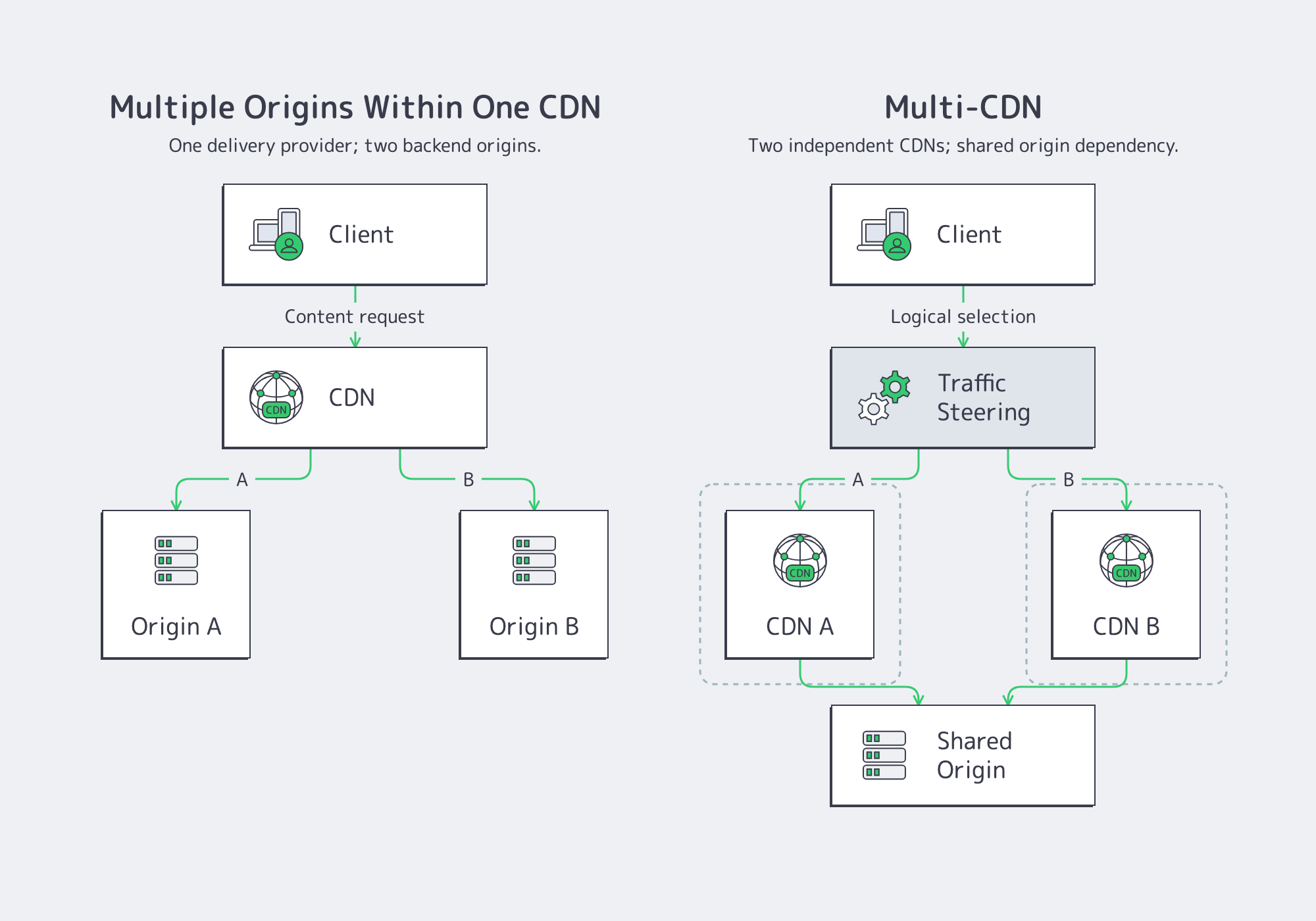
The distinction becomes clear when comparing request paths:
Multi-origin: Client → One CDN → Origin A or Origin B
Multi-CDN: Client → Traffic steering → CDN A or CDN B → Origin layer
The DASH-IF content-steering specification describes architectures where independent CDNs deliver identical content, often fetched from a shared origin.
For example, Melbicom CDN supports multiple origin pools for load balancing and failover.
Both approaches can coexist. Organizations should identify which failure domain needs protection before choosing an architecture. Adding a second CDN does not eliminate shared origin, DNS, authentication, or other upstream dependencies.
When Do Performance or Availability Gaps Justify Adding Another CDN Provider?
A second CDN becomes justified when repeated, provider-specific delivery failures threaten the service's latency SLO or availability error budget after application and origin causes are excluded. The decision requires evidence that an independent provider improves affected user journeys and can accept redirected traffic within the service's tested recovery window.
Regional Performance Can Change the Equation
A 2025 SMPTE Motion Imaging Journal study evaluated three anonymized commercial CDNs in a preliminary streaming testbed, demonstrating how delivery performance can differ by region and provider.
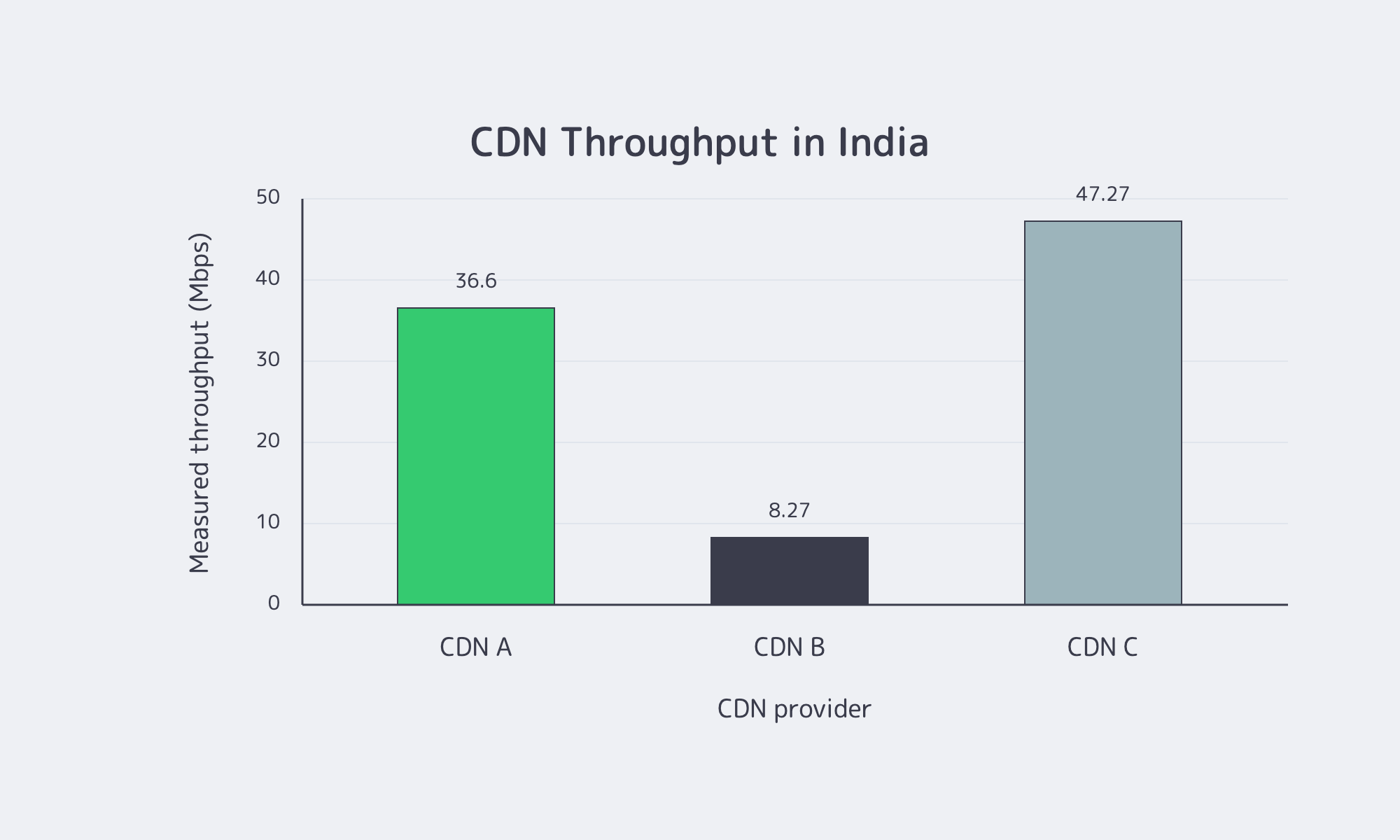
That variation shows why regional testing matters. An alternate provider may deliver better performance for one audience while offering little improvement elsewhere.
For a meaningful comparison, test the same content and workload across the access networks and regions that matter to the service. Compare user-facing latency, throughput, errors, and streaming quality rather than relying on global provider averages.
Availability and Capacity Matter Too
Multi-CDN becomes attractive when delivery outages consume a meaningful portion of the availability budget or when large releases, streaming events, and software downloads create substantial regional capacity requirements.
An alternate provider must demonstrate that it can absorb redirected traffic within the required recovery window, using the actual object or segment mix and realistic traffic volumes. A configured standby path alone does not establish failover readiness.
Cost may also justify diversification. A practical multi-CDN allocation model should account for provider rates, minimum volume commitments, historical usage, forecast demand, and the traffic assigned to each provider.
Base the decision on delivery economics—not merely the lowest advertised price.
Traffic Steering by Workload and Team
DNS steering suits websites, APIs, and downloads when DNS caching and connection behavior permit the required recovery time. HTTP redirection enables request-aware routing but requires a reachable redirect endpoint and another fetch. Client or manifest steering supports compatible streaming players. Greater steering precision generally demands stronger telemetry, testing, and operational expertise.
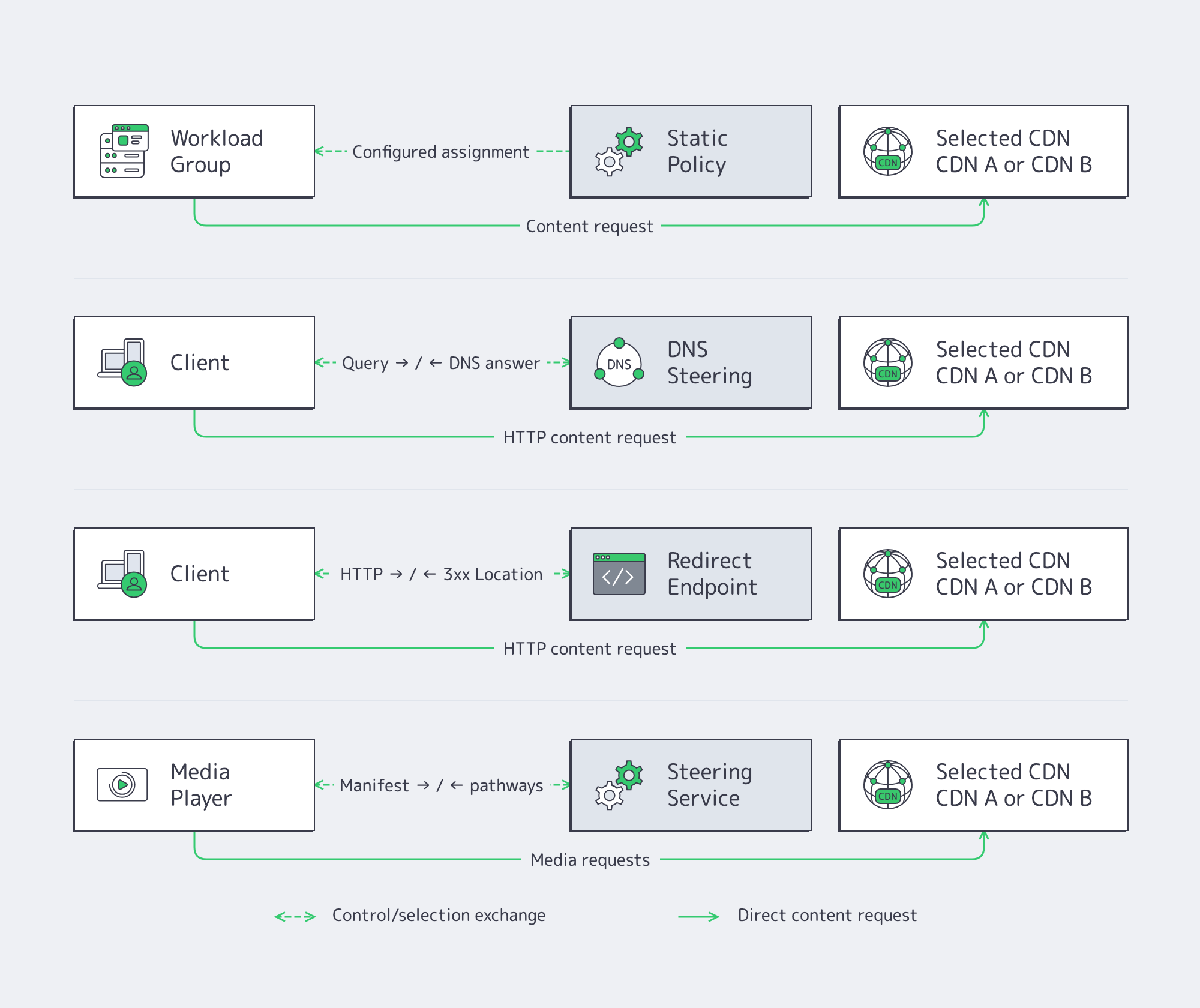
The IETF CDNI framework describes DNS- and HTTP-based redirection, while streaming specifications provide client-aware alternatives.
| Steering approach | Best fit | Main operational tradeoff |
|---|---|---|
| Static segmentation | Asset classes, hostnames, regions | Predictable and simple, but cannot automatically react to degradation without additional controls |
| DNS steering | Websites, APIs, downloads | Supports weighted and geographic routing, but DNS caching, existing connections, and client behavior affect traffic migration |
| HTTP redirection | Request-aware delivery decisions | Provides request context but requires a reachable redirect endpoint, an additional fetch, and careful authentication and method handling |
| Client or manifest steering | Compatible HLS/DASH streaming players | Supports player-aware pathway selection and potentially midstream switching, but requires compatible players, consistent media variants, and telemetry |
DNS is often the most accessible starting point. However, lowering DNS TTLs does not guarantee immediate failover.
RFC 1035 defines TTL as a DNS record's cache lifetime, while RFC 8767 permits resolvers to serve stale records under specified conditions. Failure detection, existing connections, and client behavior also influence recovery.
HTTP redirection offers request-level context, although RFC 9110 distinguishes redirect semantics and request-method handling. A 307 redirect preserves the request method when automatically followed, but redirects do not make unsafe retries safe.
For streaming, Apple's HLS content-steering guidance supports player-aware pathway selection, while the dash.js feature overview documents DASH content-steering support with remaining compliance updates. Implementation and switching behavior must be validated for the actual player population.
Building a Multi-CDN Strategy Around Telemetry
Provider health dashboards cannot fully describe user experience.
A failed DNS lookup or connection timeout may never appear in CDN server logs. The W3C Network Error Logging Working Draft defines client-side network failure reporting to address this visibility gap. It remains a draft, and reporting depends on client support.
Effective steering combines synthetic monitoring, real-user measurements, provider logs, and origin telemetry.
Measurements should distinguish geography, access network, content type, and time window. A healthy global average can conceal severe regional degradation.
Steering also requires stability. Sustained thresholds and hysteresis help prevent repeated switching caused by noisy measurements.
Finally, the steering controller itself becomes a dependency. Architects must establish predictable fallback behavior when telemetry becomes stale, the decision system is unavailable, or no provider is considered healthy.
The Operational Cost of Multi-CDN
Multi-CDN replaces one delivery configuration with multiple configurations that must behave consistently.
Cache keys, TTLs, compression, headers, authentication, and invalidation rules can differ between providers. The IETF CDNI metadata specification illustrates why consistent delivery policies require explicit coordination.
Independent caches also have independent states. A standby CDN might be technically available yet poorly prepared to serve an unfamiliar production working set. Cache splitting, cold fills, and sudden fallback bursts can increase origin traffic, potentially making shared origin capacity the next bottleneck.
Configuration drift creates additional risk. Two providers may both return 200 OK while delivering different cache behavior, headers, or authentication outcomes.
Operational teams therefore need shared observability, configuration testing, coordinated cache purging, and consistent incident procedures.
Traffic allocation adds another challenge. Consider a hypothetical service distributing 95% of normal traffic through CDN A and 5% through CDN B. The secondary provider is regularly exercised, but if CDN A fails, CDN B may need to handle the entire workload—20 times its normal traffic share. Testing must establish whether its caches, delivery capacity, and shared origins can sustain that transition.
The tradeoff is clear: provider independence reduces certain delivery dependencies while introducing orchestration, monitoring, and configuration overhead.
When Multi-CDN Is Worth the Effort
Multi-CDN is most compelling for global services experiencing measurable provider-specific weaknesses, especially across different regions and access networks.
Streaming platforms, large software distributions, game releases, and high-volume content services may benefit when traffic steering improves regional performance, peak capacity, or delivery resilience.
It is less convincing when a single CDN consistently meets latency and availability objectives, audiences are geographically concentrated, or most failures originate in applications and backend systems.
A second CDN also makes little sense when the engineering team lacks the monitoring needed to distinguish delivery failures from upstream problems.
Before adopting multi-CDN, apply five decision checks:
- Delivery impact: Is the performance or availability problem measurable, user-visible, and attributable to the CDN layer rather than a shared upstream dependency?
- Provider independence: Does another provider demonstrably improve delivery for affected regions, access networks, and workloads?
- Recovery capability: Can steering move traffic within the recovery window, accounting for DNS caching, existing connections, and client behavior?
- Capacity readiness: Can the alternate CDN handle realistic failover volumes without unacceptable cache misses, origin overload, or functional differences?
- Operational ownership: Can the team maintain cross-provider monitoring, configuration parity, incident response, and cost controls without introducing greater reliability risk?
Failing these checks does not necessarily mean the delivery architecture is inadequate. It may mean that one well-configured, well-measured CDN remains the better choice.
Build Your Multi-CDN Strategy on Evidence
Multi-CDN should be a response to measurable delivery limitations, not a default architectural upgrade. Its value comes from reducing provider-specific risks or improving outcomes that a single delivery network cannot consistently achieve.
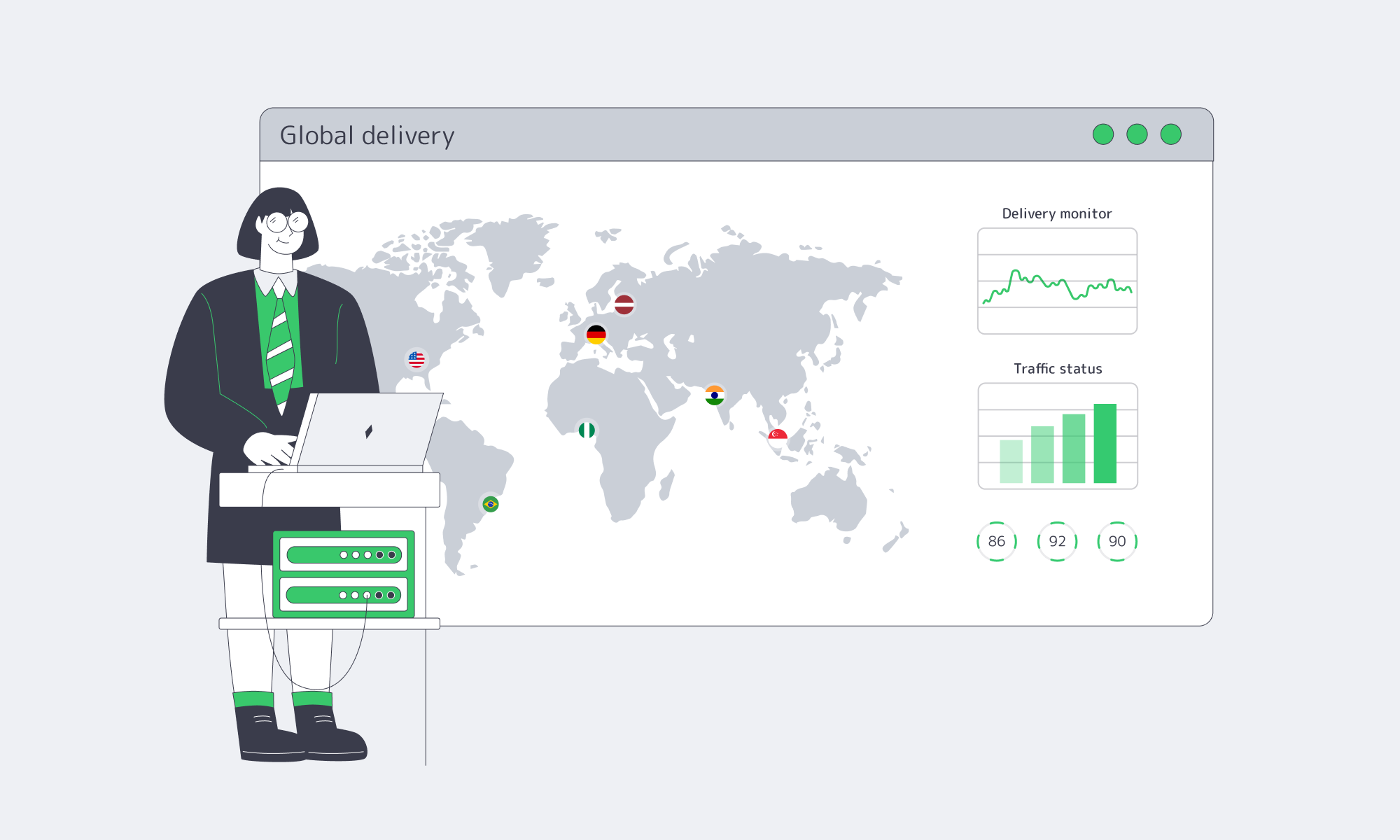
Start by identifying regional performance gaps, testing independent delivery paths, and validating realistic failover behavior. If the improvement outweighs the operational complexity, provider diversification becomes defensible.
That evaluation should include each provider's geographic footprint, traffic visibility, cache controls, delivery capabilities, and cost structure—not just edge counts.
Explore Melbicom CDN
Evaluate our delivery network, geographic routing, and traffic analytics against your regional performance and resilience requirements.
Get expert support with your services
Blog

CDN security explained: What a CDN protects and what it does not
A content delivery network (CDN) sits between users and origin infrastructure, handling connections, caching content, and enforcing supported delivery policies. That makes a CDN an important security layer—but not a complete defense.
TLS protects traffic in transit. Edge access controls restrict requests. Signed links gate content delivery. Additional services may mitigate DDoS attacks or filter malicious HTTP traffic. None automatically replaces application authentication, user authorization, or vulnerability management.
The purchasing challenge is straightforward: identify exactly what the CDN protects, then verify that protection against your requirements.
Melbicom CDN– Signed links per URL path – IP, country & rate-limit rules – Raw logs & real-time analytics |
|
CDN Security Boundaries
CDN security covers controls enforced along the delivery path: TLS termination, caching, request filtering, access restrictions, origin routing, and logging. Additional protection depends on the offering.
Application security remains separate.
Identity verification, object-level permissions, transaction validation, software patching and database protection require application-aware controls.
A secure CDN cannot compensate for missing authorization checks. Nor does HTTPS guarantee that cached content is safe to share.
The fundamental purchasing question is: Which security decisions can the CDN enforce, and which remain the application's responsibility?
How Do CDN Security Controls Protect Transport and Restrict Content Access?
CDN security controls protect transport through TLS and restrict delivery through edge policies, caching rules, and supported access mechanisms. Buyers should verify TLS 1.3 availability, encrypted origin connections, and explicit cache isolation. IP restrictions, signed links, and rate limiting provide additional controls when supported, but do not establish application-level user permissions.
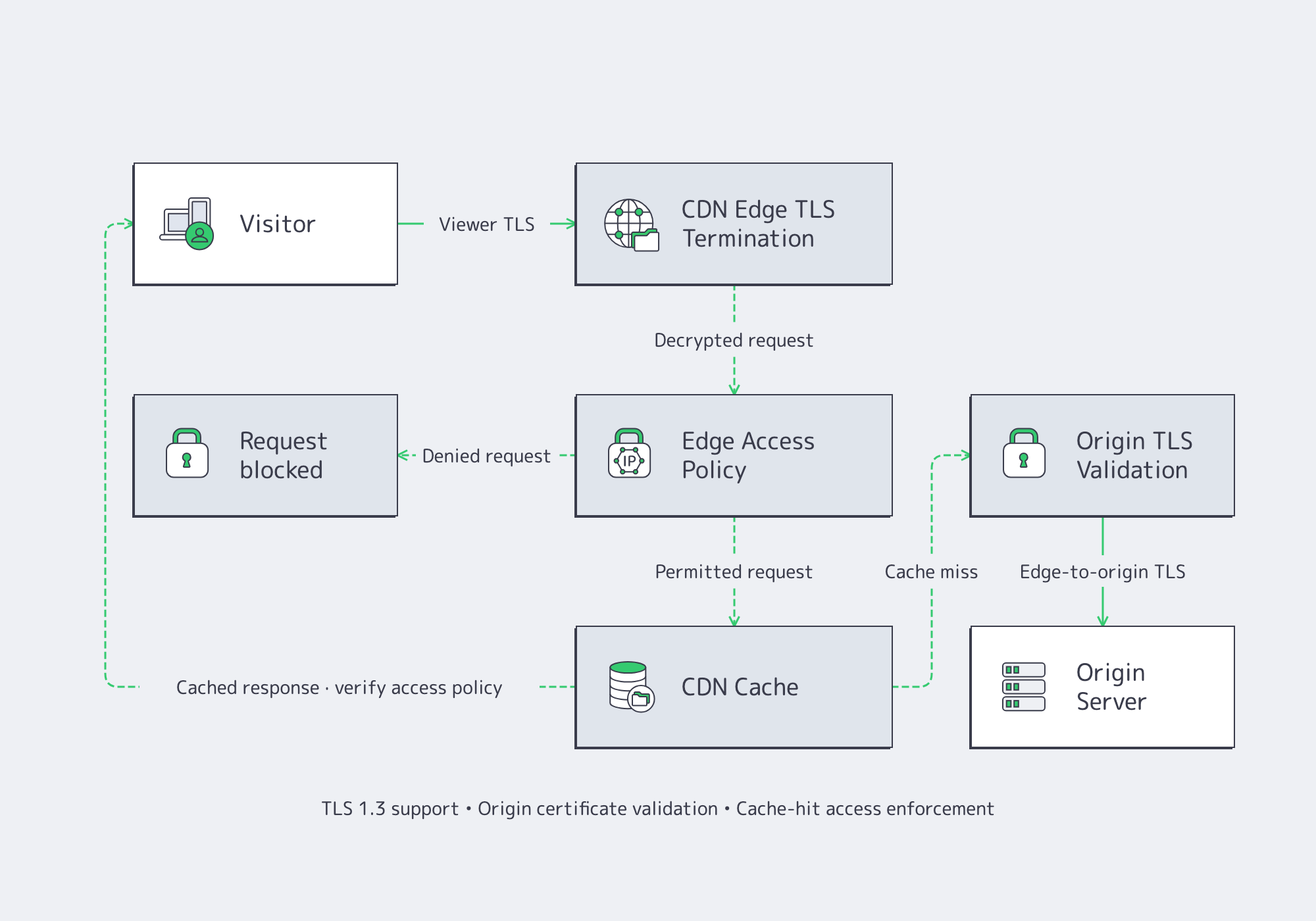
Viewer-to-edge and edge-to-origin TLS are separate connections; origin certificate validation is a conceptual CDN step during connection establishment.
Check Both TLS Connections
A CDN architecture can involve two encrypted connections: visitor-to-edge and edge-to-origin.
The IETF’s RFC 9846, which specifies TLS 1.3, describes protection against eavesdropping, tampering, and message forgery.
TLS termination lets the CDN process decrypted traffic; TLS therefore does not provide end-to-end secrecy from the CDN operator.
Buyers should verify both connections independently. HTTPS at the edge does not prove that origin traffic is encrypted or that origin certificates are validated.
Assess certificate ownership, renewal, expiry visibility and failure handling.
For certificate management, Melbicom’s CDN service supports automatic trusted certificates and customer certificate uploads.
A Secure CDN Can Gate Content Without Becoming the Identity System
Depending on the service, edge controls may restrict access by IP address, geography, request frequency, URL path, or cryptographic token. User-Agent matching does not authenticate a client, and geographic filtering does not establish legal compliance.
For request restrictions, Melbicom supports IP/CIDR, User-Agent, and geographic access rules, alongside per-IP and per-path rate limits. These controls can reduce unwanted requests.
Neither an IP rule nor a signed link determines whether a particular employee may download a confidential customer record.
OWASP’s Authorization Cheat Sheet emphasizes deny-by-default policies and permission validation on every request.
Cache Policy Is Part of CDN Security
Shared caching introduces another security boundary: users must not receive representations they are unauthorized to view.
RFC 9111 restricts shared caching of authenticated responses unless explicit directives permit it. It also distinguishes private, no-store, and no-cache: these directives have different storage and revalidation semantics.
OWASP’s cache-security guidance identifies cache poisoning, deception, and sensitive-data exposure as risks.
Buyers should establish cache-key behavior, handling of cookies and authorization headers, and whether CDN rules override origin directives. Cookies and signed query parameters do not automatically prevent caching; edge access checks on cache hits must also be verified.
Maximizing cache hit rates must never override access boundaries.
TLS, Signed Links and Authorization
TLS secures the communication channel, while signed links validate possession of a delivery token. Application authorization determines whether an authenticated user can access a particular object or perform an operation. Neither transport encryption nor token validity establishes business permissions; protected resources still require server-side authorization decisions based on identity and context.
TLS Authenticates Transport, Not User Permissions
HTTPS requests can still be unauthorized or malicious. TLS cannot decide account ownership, subscription status, tenant membership or permission to edit records.
Those decisions belong to the application, as described in OWASP’s access-control guidance.
Signed Links Are Delivery Capabilities
Signed URLs can provide constrained access to content, but anyone possessing a valid bearer-style link may be able to use it.
For protected content delivery, Melbicom supports per-path signed-link validation, with invalid tokens rejected using HTTP 403. Our CDN also supports optional client-IP and User-Agent binding to narrow usage conditions, while the application remains responsible for generating signed links.
Token expiry, scope, replay behavior, revocation and signing-secret rotation determine whether a delivery capability meets the workload’s access requirements.
For private documents, the application should authorize the user before issuing the delivery capability. OWASP’s multi-tenant security guidance recommends authorizing the exact object and operation before generating signed URLs.
The strongest architecture combines application authorization with constrained edge delivery rather than expecting either layer to perform both jobs.
CDN Security Limits
CDN security can overlap with additional protective services, but their availability and limitations must be evaluated independently.
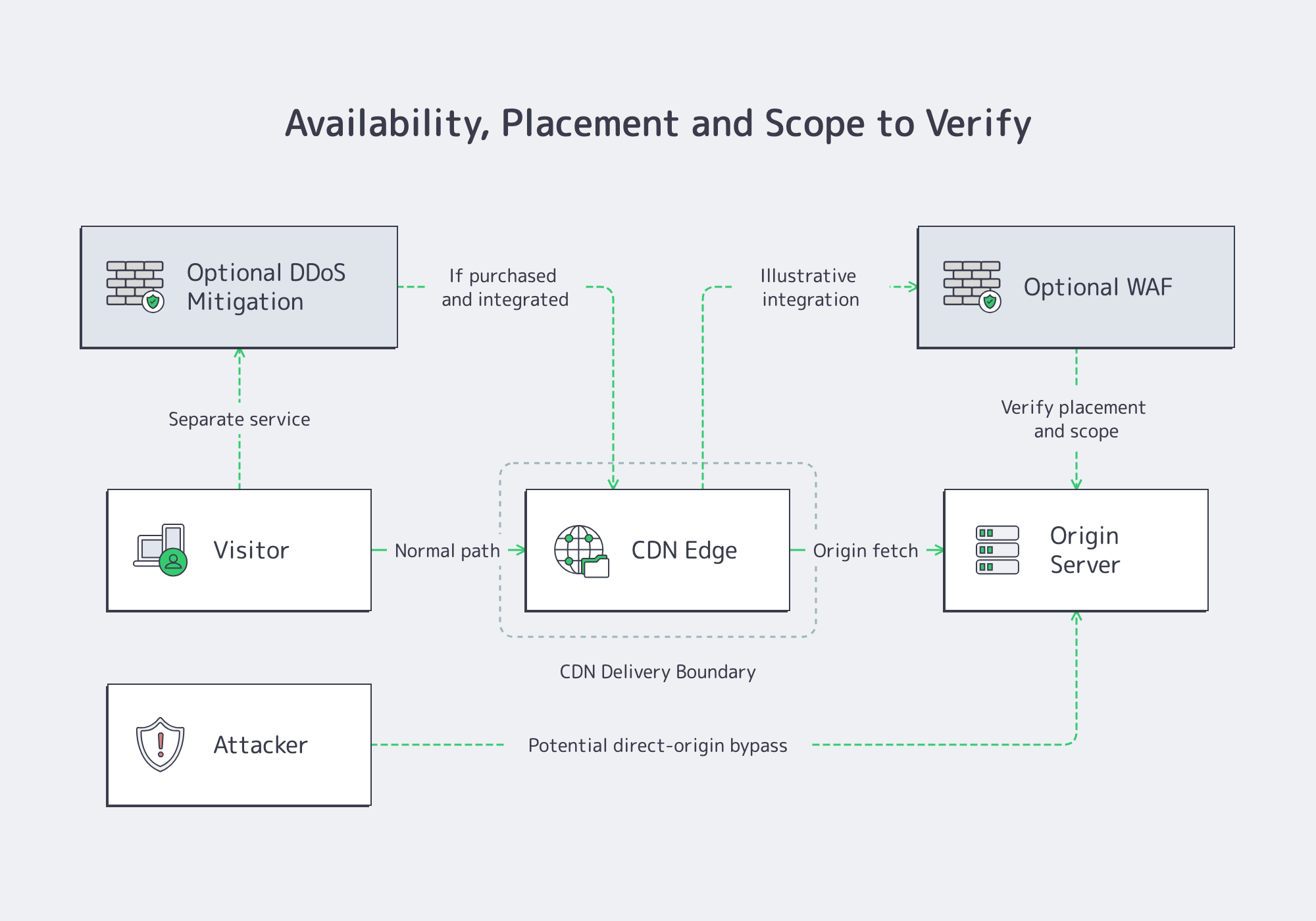
Dashed paths illustrate optional service integrations and potential direct-origin bypass; availability, placement and scope need service-specific verification.
CDN Delivery and DDoS Protection
Caching reduces origin requests for reusable content. It does not automatically mitigate network floods, connection exhaustion, or expensive application-layer requests.
Buyers should verify protected attack classes, mitigation triggers, traffic scope, telemetry, capacity constraints, and exclusions.
For workloads requiring attack mitigation beyond content delivery, Melbicom offers DDoS Protection as a separate service.
A WAF Cannot Enforce Every Business Rule
A WAF can identify or block recognizable malicious HTTP patterns. It cannot reliably determine whether a valid-looking transaction violates application-specific permissions.
OWASP’s security guidance distinguishes request filtering from application security.
WAF, bot protection, and API inspection should therefore be treated as separately verified capabilities—not assumed CDN inclusions.
Origin Exposure Remains a Risk
If attackers can reach an origin directly, they may bypass edge restrictions. Buyers should establish origin reachability, failover behavior, and how permitted CDN traffic is distinguished from direct requests.
Origin shielding can consolidate cache misses while allowing direct-origin access.
CDN dashboards and APIs also require appropriate administrative authentication, role separation, credential management, and auditability.
Evidence Buyers Should Request for Each Provider's CDN Security Capabilities
Buyers should request plan-specific documentation and observable tests for every CDN security requirement. Evidence should identify the protected resource, enforcement point, supported scope, and limitations. Prioritize TLS behavior, cache isolation, access controls, origin protection, logging, and separately offered mitigation services. Undocumented or untestable features should not satisfy mandatory purchasing criteria.
CDN Security Requirements
CISA’s secure technology procurement guidance recommends selecting technologies whose security properties can be verified. Apply that principle to every CDN requirement.
| Security Requirement | Purchasing Criterion | Evidence to Request |
|---|---|---|
| Edge TLS | TLS 1.3 and endpoint support | Protocol documentation and proposed handshake test |
| Origin encryption | Encrypted connections and certificate validation | Architecture diagram and proposed negative test |
| Certificates | Ownership, renewal, expiry visibility | Documentation and alerts |
| Cache isolation | No unauthorized cross-user sharing | Cache rules and proposed two-user tests |
| Access controls | Required IP, geographic, path, or rate policies | Plan matrix and proposed allow/deny tests |
| Signed links | Expiry, scope, replay, and revocation | Token specification and proposed failure tests |
| Origin protection | Direct-access restrictions and failover | Architecture review |
| DDoS mitigation | Attack classes, scope, capacity, exclusions | Service-specific documentation |
| WAF/bot protection | Availability and enforcement scope | Rules and proposed test evidence |
| Control-plane security | Administrative roles and credentials | Security documentation |
| Observability | Log fields, retention, and export | Sample logs and schema |
| Provider boundaries | Included, optional, separate, or unsupported features | Written capability matrix |
Evidence Should Include Negative Tests
Successful requests show functionality; rejections show enforcement.
Acceptance testing should verify that expired or invalid signed links fail, disallowed networks are blocked, invalid origin certificates produce documented behavior, and one authenticated user cannot receive another user’s private cached response.
NIST’s security assessment guidance supports examining and testing controls rather than relying solely on declarations.
Logging and Performance Require Validation
Useful CDN logs should expose request timing, hostname, status, cache behavior and relevant security decisions. Verify fields, retention and export latency.
For delivery visibility, Melbicom’s CDN offering includes real-time analytics and raw logs.
Performance acceptance tests should measure regional latency, cache hits and misses, and p95/p99 response times with intended security controls enabled.
CDN Security Purchasing Checklist
A CDN should protect the delivery functions it actually controls—not substitute for application security. The right purchasing decision identifies enforcement boundaries and assigns responsibility for remaining risks.

Before approving a provider, apply these practical checks:
- Map trust boundaries: Identify where TLS terminates, where authorization occurs, and which systems can access decrypted content.
- Prioritize sensitive workloads: Test private documents and authenticated responses before optimizing shared caching.
- Validate bypass resistance: Include direct-origin access, cache hits, and failover paths in acceptance testing.
- Separate service scopes: Record which protections are included, optional, separately purchased, or customer-owned.
- Define measurable acceptance criteria: Specify required logs, rejection behavior, and performance thresholds before deployment.
The result should be a traceable security model showing what is encrypted, restricted, cached, filtered, logged, and still exposed.
Choose the Right CDN Controls
Use your security requirements to compare Melbicom’s delivery controls, access policies and operational visibility.
Get expert support with your services
Blog

European Dedicated Server Providers: Compare Country Coverage, Support and Deployment Terms
Comparing European dedicated server providers requires more than checking available countries and advertised port speeds. A location may lack the required hardware, a 10 Gbps connection may carry a restrictive transfer allowance, and 24/7 support may exclude application recovery.
The useful comparison unit is the deployable offer: location, hardware, network terms, delivery timing, and operational responsibilities.
This guide examines European purchasing terms rather than country rankings or sovereignty considerations.
Melbicom in Europe– Tier III & IV DCs in Europe – 300+ Amsterdam configurations – Custom builds: 3–5 business days |
|
Which European Dedicated Server Providers Offer the Required Hardware and Locations?
Shortlist European dedicated server providers by required metro, matching hardware, documented port and transfer terms, and confirmed deployment availability.
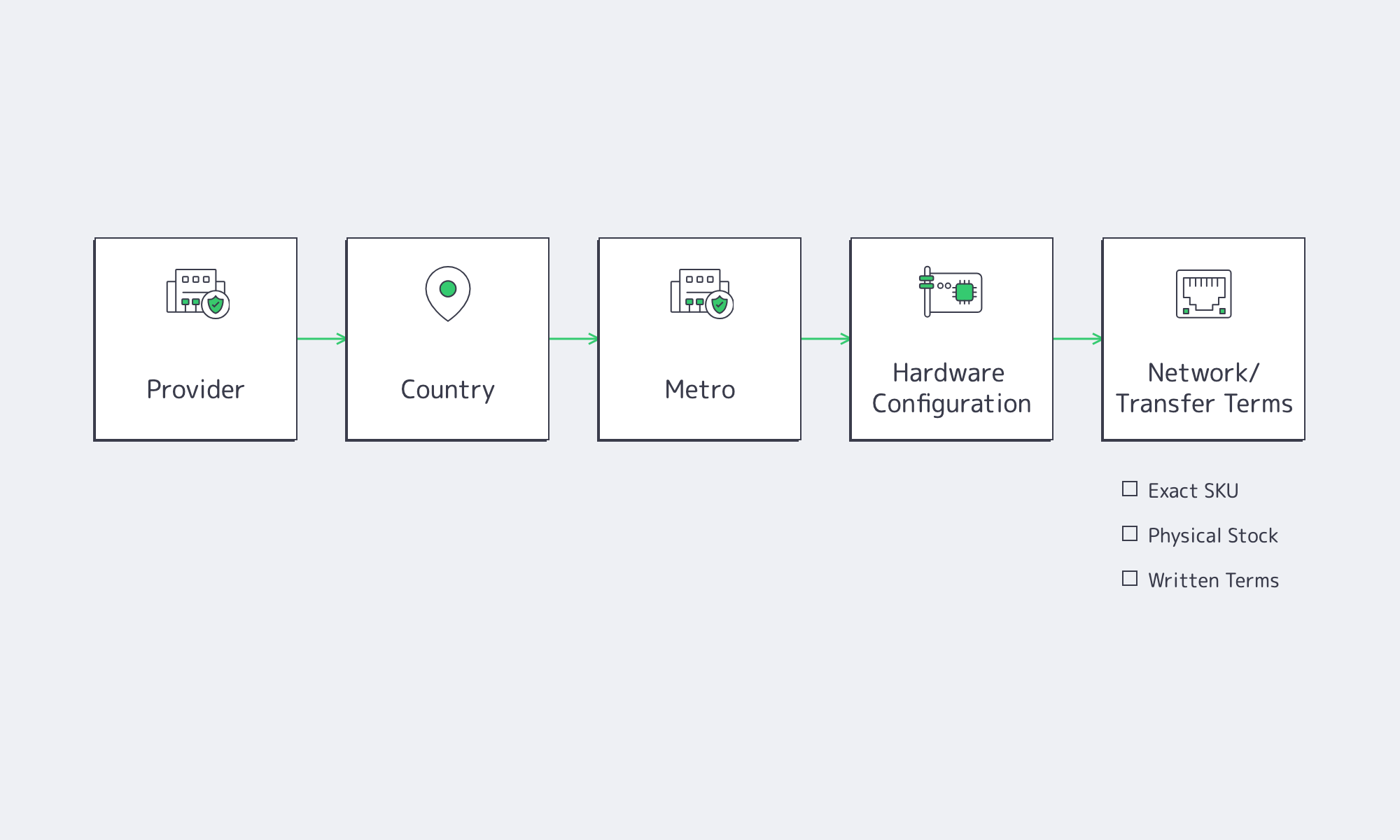
Verify provider, country, metro, hardware and network terms against the exact SKU, physical stock and written offer.
Match EU Hardware to the Metro
The comparison should follow one sequence:
Provider → Country → Metro → Hardware configuration → Network/transfer terms
A facility's maximum network capability does not establish the port speed of an available server. Likewise, a count of listed configurations does not establish how many physical machines can be deployed.
The following matrix uses Melbicom's European dedicated-server catalog to compare hardware families, memory ranges, location-level network ceilings, and the configuration details that matter when selecting a server.
EU Dedicated-Server Offer Matrix
| Country / Metro | Hardware and Network Options | Configuration Selection |
|---|---|---|
| Netherlands, Amsterdam | Two data centers; up to 200 Gbps per server. Intel Xeon, AMD Ryzen and EPYC options; 32–1536 GB RAM. 300+ listed configurations. | CPU, storage, ordered port, transfer model, matching-unit quantity. |
| Germany, Frankfurt | 2 Tier III & IV DCs in Frankfurt; up to 200 Gbps. Intel Xeon and AMD EPYC; 16–768 GB RAM. 200+ configurations. | Hardware, facility, ordered port, activation terms. |
| Spain, Madrid | Up to 40 Gbps. Intel Xeon E5 and E-series; 32–128 GB RAM. 90+ configurations. | Storage, capped or unmetered transfer, matching-unit quantity. |
| France, Paris | Up to 200 Gbps. Intel Xeon E-23xx and Scalable; 32–128 GB RAM. | Exact configuration, transfer and delivery terms. |
| France, Marseille | Up to 100 Gbps. Intel Xeon E-43xx and Scalable; 32–128 GB RAM. | Storage, capped or unmetered transfer, matching-unit quantity. |
| Italy, Palermo | Up to 40 Gbps. Intel Xeon E-22xx; 32–64 GB RAM. Six listed configurations. | Hardware match, storage and available port options. |
| Latvia, Riga | Up to 40 Gbps. Intel Xeon and AMD EPYC; 32–1152 GB RAM. | CPU, memory, storage, transfer and physical availability. |
| Bulgaria, Sofia | Up to 40 Gbps. Intel Xeon E-series and Scalable; 32–256 GB RAM. | Storage, selected port and transfer model. |
| Sweden, Stockholm | Live server location; up to 100 Gbps. | Configuration availability and deployment timing. |
| Lithuania, Vilnius | Up to 40 Gbps. Intel Xeon E5, E-series and Scalable; 32–512 GB RAM. 50+ configurations. | Hardware tier, storage, ordered port and traffic allowance. |
| Poland, Warsaw | Up to 200 Gbps. Intel Xeon E5, E-22xx and Scalable; 32–256 GB RAM. 47 configurations. | CPU, storage, ordered port, transfer and matching-unit quantity. |
For each shortlisted configuration, record support scope, remote-hands availability, hardware replacement procedures and written order terms.
Location alone does not determine application performance. Compare routing and latency using representative endpoints for the networks carrying the workload's traffic, including business-critical destinations. The resulting measurements are more useful than assuming a particular European metro will deliver the best path.
Deployment and Transfer Terms
Dedicated server deployment terms in Europe should distinguish ready-configuration activation, custom-build delivery, and failed-component replacement. Buyers should separately document ordered port speeds, transfer allowances, deployment start events, and contractual handoff conditions for each selected configuration.
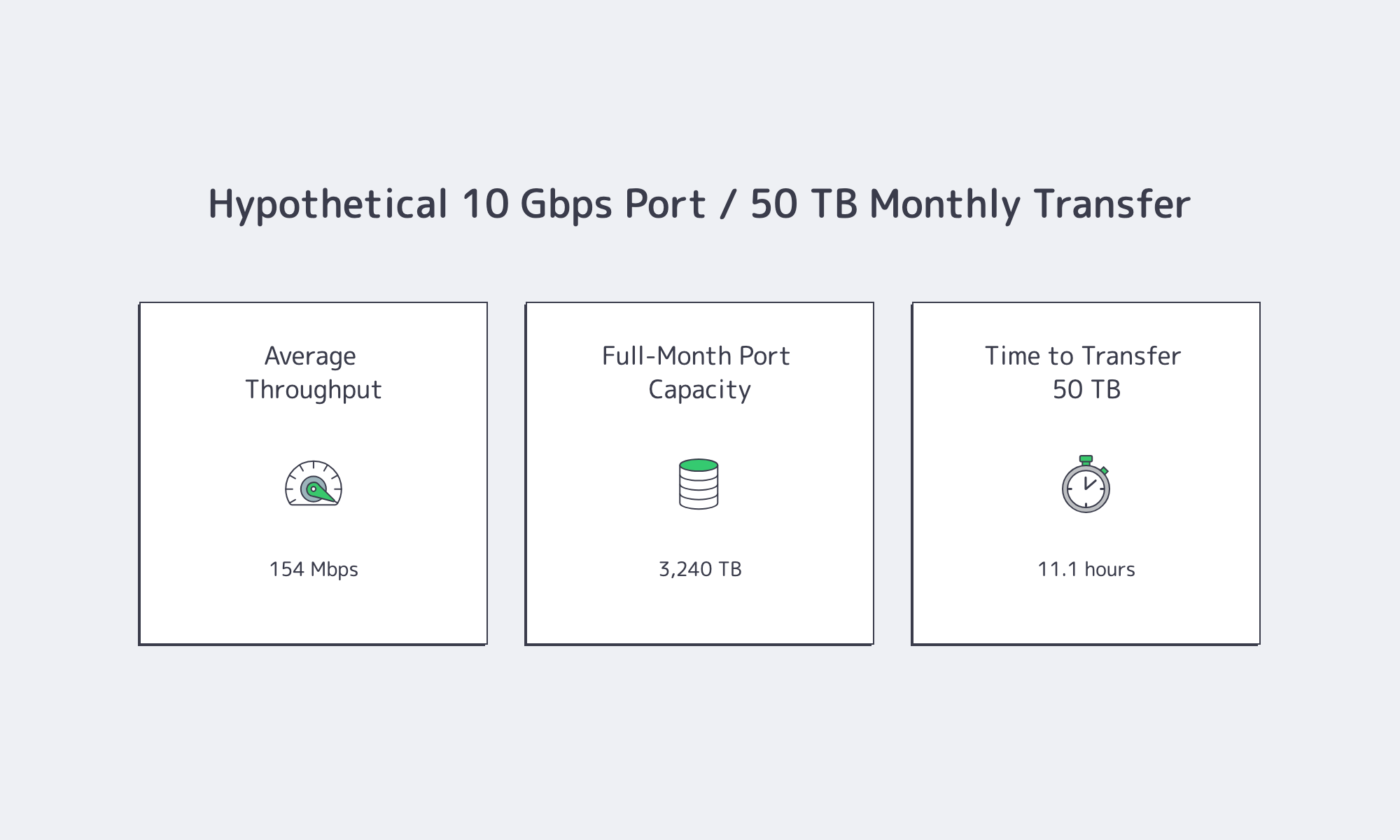
Calculations use decimal units and a 30-day month; port capacity and transfer time assume continuous 10 Gbps before protocol overhead.
Three Deployment Clocks
The first clock measures order-to-access time. Melbicom offers approximately two-hour delivery for ready-server configurations.
The second measures custom assembly and provisioning. Our custom server configurations are delivered in 3–5 business days.
The third measures replacement after hardware failure.
For Melbicom dedicated servers, initial installation and provisioning are fulfilled upon the customer's first successful connection, as defined in our services agreement. That differs from application readiness.
The three clocks should remain separate purchasing fields because initial provisioning, custom assembly, and hardware replacement represent different operational events.
Port Speed Is Not Transfer Volume
Melbicom's dedicated-server configurations include capped and unmetered transfer.
Consider a hypothetical 10 Gbps port with 50 TB monthly transfer.
Idealized arithmetic using decimal units, a 30-day month and continuous 10 Gbps line rate. Excludes protocol overhead and differences in provider traffic accounting.
A capped high-speed port may suit bursty applications; sustained-egress services require different economics. Record the complete network term as:
Port + Committed bandwidth + Transfer allowance + Burst/overage rules + Billing period
Melbicom's dedicated-server purchasing terms include a one-month minimum payment period without a required long-term commitment. Metered transfer billing cycles are prorated to the first of the month.
A complete quote should also identify setup and recurring charges, currency, applicable taxes, and cancellation notice requirements.
Verify Support, Remote Hands, and Hardware Replacement Responsibilities Before Shortlisting Providers
A European hosting support comparison must distinguish contact availability from included technical work, physical intervention, and customer recovery obligations. Melbicom provides 24/7 engineering support. Our included technical support covers server hardware and data-center connectivity, while customer software administration, backups, and data restoration remain separate responsibilities.
Compare European Hosting Support
Melbicom's support resources and contact channels cover engineering assistance with server reboots, OS reinstalls, BGP setup, and network troubleshooting.
Customer-installed software administration is separate unless otherwise agreed, and additional paid support is available under our services agreement.
Server Hardware Replacement in Europe
Melbicom provides free component replacement within 4 hours for our dedicated-server offering. Replacement components may have equivalent or improved specifications.
Hardware replacement and data recovery are distinct operations. Our team handles component replacement, while customers remain responsible for backups and restoring their data. Additional recovery assistance may be available as a separately agreed, chargeable service.
Remote hands requires similar precision. Buyers should establish whether cable reseating, console intervention, drive handling, and other physical tasks are included, chargeable, conditional, or unavailable.
Melbicom service claims are submitted through the Personal Account with issue details and attempted remedies. Preparing server identifiers, timestamps, diagnostics, and business-impact information beforehand reduces ambiguity during escalation.
Build the Shortlist Around Workload Evidence, Not Country Rankings
A useful shortlist starts with workload requirements and evaluates each documented offer against the same acceptance criteria.
Latency-Sensitive APIs
Prioritize CPU performance, SSD/NVMe storage, routing, and sufficient port capacity.
An acceptance protocol should measure p95 round-trip latency against the application's budget, track packet loss, and inspect evening-peak behavior across a representative business cycle. Select endpoints from networks carrying the most traffic and those serving business-critical customers.
Melbicom's data-center test endpoints can support preliminary path inspection when evaluating European server locations.
Sustained-Egress Origins
Calculate monthly transfer before choosing a port.
At a hypothetical continuous 500 Mbps, a workload generates approximately 162 TB over 30 days. A 50 TB allowance remains insufficient with a 10 Gbps port.
An acceptance test should specify throughput targets, endpoints, duration, traffic-accounting assumptions, and failure criteria before execution.
Stateful Databases and Analytics
Prioritize memory, CPU class, storage layout, and recovery design.
Set drive redundancy, backup frequency, restore goals and replacement duties.
Rapid Fleet Rollouts
For fleet purchases, request matching-unit counts, reservation conditions, and deployment schedules. Hardware consistency may matter more than the lowest individual-server price.
A catalog with multiple configuration choices does not establish how many identical physical machines are available in a particular metro.
Common Evidence Checklist
Apply one checklist to every offer:
- Hardware: Country, metro, CPU, RAM, drive configuration, matching-unit availability, and evidence date.
- Network: Ordered port, committed bandwidth, transfer model, accounting direction, burst and overage treatment, and billing period.
- Deployment: Order timestamp, access timestamp, ready-stock or custom-build commitment, dependencies, and fulfillment event.
- Support: Contact hours, included work, escalation channels, chargeable administration, and remote-hands scope.
- Replacement: Failure trigger, component-equivalence policy, replacement timing, backup ownership, and restoration procedure.
- Acceptance: Proposed endpoints, test duration, p50/p95/p99 targets where relevant, throughput thresholds, timestamp log, and responsible owner.
Keep documented offer specifications, proposed acceptance criteria, and actual test results as separate fields. This allows a purchasing decision to be revisited when hardware availability or commercial terms change.
Choosing European Dedicated Server Providers With Defensible Evidence
The strongest European dedicated-server shortlist compares deployable configurations rather than country names or headline bandwidth.

Hardware availability, network economics, delivery handoff, support scope, and recovery ownership must all align with the workload.
A consistent evidence matrix makes those decisions repeatable and identifies what remains unresolved before procurement approval.
The practical outcome is a shortlist that can be refreshed as inventory changes without losing the original technical and commercial rationale.
Choose European Dedicated Servers
Compare Melbicom’s European configurations against your hardware, location and traffic requirements, then plan deployment and support responsibilities.
Get expert support with your services
Blog

Bare Metal Hosting Providers: A Comparable 12-Month Quote for Production Workloads
A useful bare metal server hosting comparison starts with one question: What does the same production workload actually cost over 12 months?
Monthly server prices rarely tell the whole story. CPU performance, usable storage, transfer allowances, management responsibilities, hardware replacement, and cancellation terms can change the economics substantially.
Consider a Melbicom dedicated server configuration in Paris: Intel Xeon E-2356G, 32 GB RAM, one 480 GB SSD, a 10 Gbps port, and 50 TB monthly bandwidth for €124 per month. €124 × 12 = €1,488 in base subscription charges.
Here's how to turn that starting price into a defensible infrastructure budget.
Choose Melbicom– 21 Tier III & IV DCs worldwide – Workload-matched hardware – Custom builds: 3–5 business days |
|
How Should a Bare Metal Server Hosting Comparison Normalize 12-Month Quotes?
A bare metal server hosting comparison should fix the workload, server quantity, required location, 12-month service period, and operational responsibilities before evaluating prices. Normalize CPU performance, installed RAM, usable storage, port speed, transfer allowances, setup, management, replacement, and exit terms. Any mandatory cost or service condition that remains undisclosed must be marked unresolved, not assumed free.
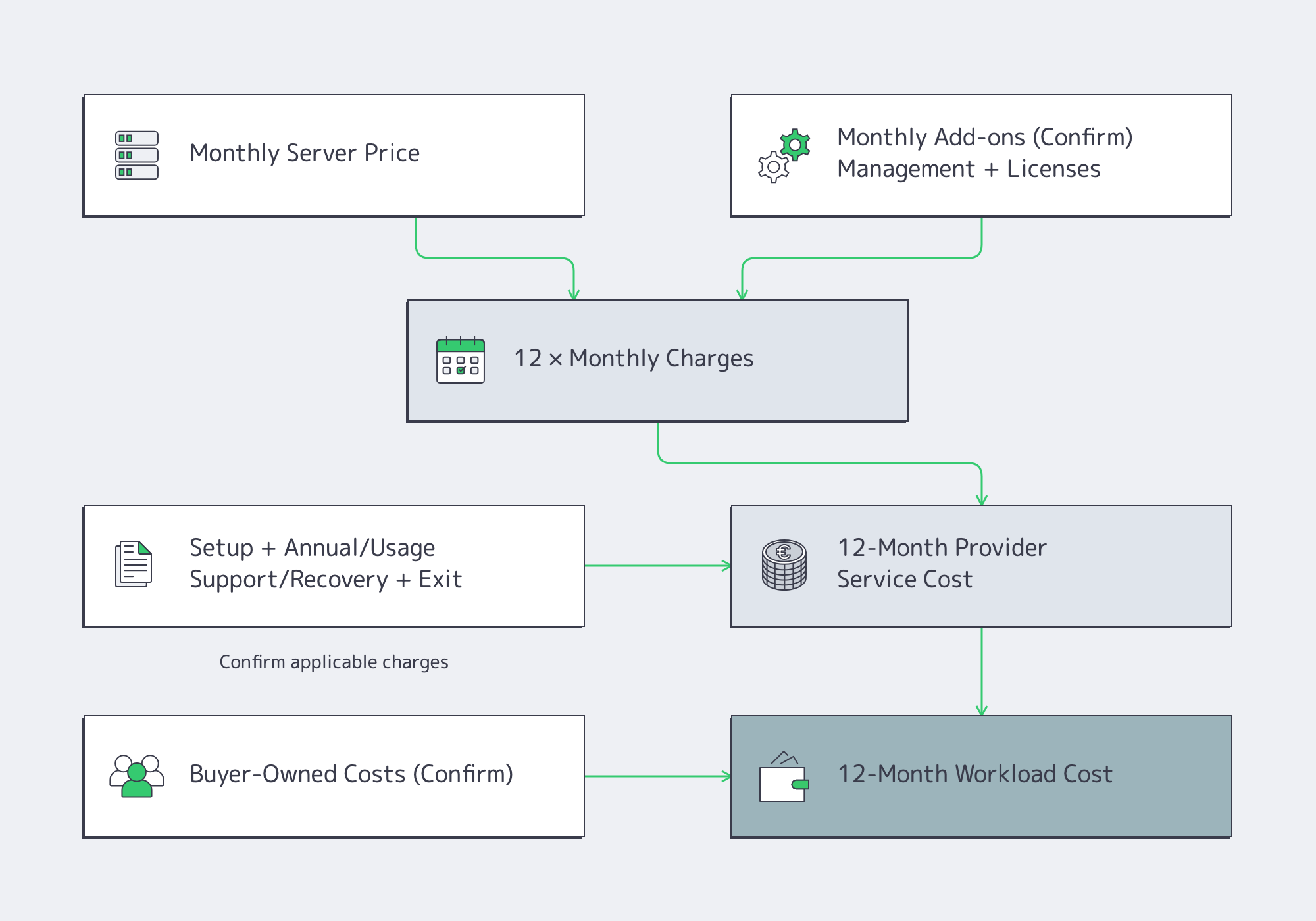
Add buyer-owned deployment, operations, backup, recovery and migration costs to the 12-month provider service cost to obtain the full workload cost.
Calculate two separate totals:
12-month provider service cost = 12 × (monthly server price + mandatory monthly add-ons + monthly management + monthly licenses) + optional one-time setup + annual or usage-based charges + separately chargeable support/recovery + documented end-of-term charges.
12-month workload cost = provider service cost + buyer-owned deployment, operations, backup, recovery, and migration costs.
Count each charge once. Included services must not be added again, and monthly fees must be multiplied by 12. Model taxes consistently across quotes.
For early cancellation, adjust actual service months, commitments, refunds and migration overlap. Keep hypothetical refunds out of the full 12-month baseline.
Every quote also needs a capture timestamp, configuration reference, location, currency, tax basis, billing cadence, validity period, and applicable terms.
For metered Melbicom dedicated servers, the initial invoice may cover the remaining portion of the current month plus the next full month. Normalize the actual service period to avoid double-counting prepaid time.
Match CPU Performance Across Server Quotes
The same core count does not guarantee equivalent performance. Melbicom's reference Xeon E-2356G has six cores, a 3.20 GHz base frequency, and up to 5.00 GHz maximum turbo frequency, according to Intel's processor specifications.
Prefer identical CPU models. Otherwise, require workload-specific testing or comparable results under controlled methodologies such as SPEC CPU2017. Logical thread counts and peak clock frequencies alone do not establish equivalent workload capacity.
Compare installed RAM rather than maximum supported memory. For storage, document drive count, media, redundancy, and usable capacity. A single 480 GB SSD is not equivalent to a mirrored pair.
Network allowances need similar discipline. A 10 Gbps port describes potential interface speed; 50 TB describes a monthly transfer allowance. Neither establishes sustained application throughput.
For each quote, confirm whether transfer accounting uses decimal TB or binary TiB, which traffic directions count, the applicable billing period, and what happens when the allowance is exhausted. Do not assume pooled allowances or a particular overage tariff.
Actual throughput depends on network conditions, as explained in RFC 6349's TCP throughput testing framework.
Compare Server Lifecycle Costs
Comparing setup, management, replacement, and exit costs requires matching operational responsibilities as carefully as hardware specifications. A charge qualifies as included only when written terms confirm the corresponding service. Document provisioning fees, maintenance scope, component replacement, recovery labor, cancellation conditions, and refunds before treating two offers as financially equivalent.
Setup and Hardware Replacement
Melbicom offers two-hour delivery for ready-to-go dedicated server configurations and custom configurations delivered in 3–5 business days.
Our dedicated server offering includes free defective-component replacement within 4 hours. Customer-data restoration remains the customer's responsibility.
A purchasing model should therefore separate physical replacement from application recovery, backup restoration, and engineering labor. Covered component replacement should not be counted as an additional charge without evidence that an exception applies.
Compare Management Fees and Exit Costs
The word managed is insufficient for budgeting.
Melbicom provides 24/7 infrastructure support. Our team handles server hardware and data-center connectivity, while customer software administration is separate. Additional configuration or maintenance assistance may incur charges.
Buyers should explicitly assign OS patching, database administration, monitoring, backups, and application recovery. Unpriced work remains a confirmation item.
Dedicated server exit costs require equally careful treatment. Under Melbicom's service agreement, customers may terminate through their Personal Account. Refunds are subject to unused-service-period rules, possible recalculation of advance-payment discounts, and payment-system fees.
Complete data exports and verify recovery from your copies before cancellation.
Model migration labor, temporary overlap, and any specifically quoted transfer charges separately. Optional licenses and additional equipment may also have billing and termination rules distinct from the base server.
Resolve Missing Service Terms
Resolve missing allowances and service boundaries before accepting a provider quote by requiring written confirmation of bandwidth accounting, overage treatment, provisioning charges, management responsibilities, replacement coverage, licenses, taxes, and cancellation terms. A quote with an unresolved mandatory field is not comparable, even when its CPU, RAM, storage, and advertised monthly price appear equivalent.
Define production acceptance before deployment. A proposed network test should record CPU SKU, installed RAM, drive inventory, interface speed, endpoints, UTC timestamps, RTT, MTU, tool version, and measured throughput.
Set acceptance thresholds from actual workload requirements: identify the application's busiest expected traffic period, define the throughput and latency needed during that period, and specify acceptable operational headroom. Test the network paths used by the workload, prioritizing major traffic sources and business-critical destinations.
Maintain a timestamp log for quote capture, terms verification, provisioning, inventory inspection, testing, and acceptance. Leave unexecuted events blank.
Production Workload Profiles for Comparable Dedicated Server Quotes
Use consistent request specifications rather than allowing the available catalog configuration to redefine the production requirement. The following are illustrative purchasing profiles.
- Balanced Application/API Node: Specify a Xeon E-2356G or workload-equivalent processor, 32 GB RAM, 480 GB SSD, 10 Gbps port, and 50 TB monthly transfer. This matches the Melbicom reference configuration closely. If local redundancy is mandatory, specify a mirrored-drive configuration instead.
- Transactional/Data Node: A proposed specification could require eight physical CPU cores, 64 GB RAM, two 960 GB NVMe drives in a mirror, providing 960 GB nominal mirrored capacity before filesystem overhead and reserves, and documented database-recovery ownership. Validate against representative transaction and storage workloads.
- Transfer-Heavy Origin Node: Start with expected monthly traffic and sustained throughput, then request 64 GB RAM, redundant NVMe storage, a 10 Gbps or faster port, and a documented high-volume or unmetered bandwidth configuration. Confirm applicable traffic and usage conditions rather than interpreting unmetered as unlimited application throughput.
Match the workload's required location and connectivity paths against Melbicom's data-center directory when selecting a server configuration.
Bare Metal Hosting Comparison Worksheet
Use this worksheet to obtain comparable dedicated server quotes. The Melbicom reference uses our €124/month configuration, with the base subscription price separated from additional cost fields.
| Quote Field | Normalization Requirement | Melbicom Reference |
|---|---|---|
| Location | Same required geography | Paris or Frankfurt |
| CPU | Same SKU or validated performance | Xeon E-2356G, 6 cores |
| RAM | Installed capacity | 32 GB |
| Storage | Drives, redundancy, usable capacity | 1 × 480 GB SSD |
| Port | Interface rate | 10 Gbps |
| Transfer | Allowance, accounting, overages | 50 TB/month; excess-use terms to confirm |
| Monthly price | Same currency and tax basis | €124 |
| 12-month base | 12 recurring charges | €1,488 |
| Setup | Fee and delivery timing | Fee confirmation required |
| Management | Included tasks and paid labor | Additional work may be chargeable |
| Replacement | Component versus data recovery | Hardware replacement included as described; recovery separate |
| Licenses | Optional charges and billing rules | Confirmation required |
| Exit | Cancellation, refunds, migration | Published terms apply |
| Evidence | Capture date, quote validity | Record applicable quote reference and validity |
Source: Melbicom’s dedicated server information, and service terms.
Use three statuses: verified, confirmation required, not equivalent.
A missing transfer allowance prevents comparison. A single SSD cannot satisfy a mandatory mirrored-storage specification. Different management responsibilities require financial normalization before approval.
For prepaid offers, capture discounts alongside cancellation and refund conditions. For fleet purchases, use the same server quantity and multiply only validated per-server costs, separately modeling shared operational expenses.
Do not combine unrelated catalog specifications into an imaginary SKU or label a known-price subtotal as total cost of ownership.
Evidence for a 12-Month Server Purchase
A credible bare metal server hosting comparison establishes workload equivalence before evaluating 12-month economics. The €1,488 Melbicom sample calculation provides a concrete starting point, while the complete production budget accounts for the additional costs identified in the worksheet.

Before approving capacity, preserve a complete purchasing record:
- Resolve unknowns before ranking offers. An unanswered mandatory fee, allowance, or responsibility prevents a defensible comparison.
- Reject hardware substitutions without evidence. Similar CPU labels or storage capacities do not establish equivalent production capability.
- Separate provider charges from internal costs. Keep engineering labor, backups, and migration expenses visible without attributing them incorrectly.
- Require acceptance evidence. Establish workload-specific pass/fail criteria before deployment and record results only after testing.
- Plan the exit before committing. Confirm export procedures, migration overlap, prepaid treatment and cancellation timing before agreeing the commercial terms.
This produces an auditable decision without unsupported price rankings.
Build Your 12-Month Server Budget
Compare Melbicom configurations against your hardware, location and traffic requirements, then confirm the service terms for your 12-month budget.
Get expert support with your services
Blog

Choosing a Solana RPC Host: Reproducible Request-Mix and NVMe Acceptance Tests
A Solana RPC hosting offer should pass more than a specification check. CPU, RAM, NVMe capacity, and network speed establish purchasing options, but they cannot prove that an endpoint will deliver fresh state under sustained load.
Solana’s RPC guidance recommends evaluating tail latency, errors, slot freshness, and WebSocket recovery. The purchasing challenge is turning those measurements into a reproducible acceptance test.
Solana RPC Servers– Dedicated compute – NVMe storage options – Regional deployment |
|
Start the Solana RPC Hosting Benchmark With an Acceptance Contract
Before testing, normalize each hosting offer by server city, CPU model, physical cores, RAM, NVMe model and quantity, storage layout, network port, traffic terms, OS, and price.
A quote worksheet establishes what is offered, not what performs. The acceptance sequence should be:
Offer normalization → identical deployment → fixed workload → recorded measurements → pass/fail gates → price comparison.
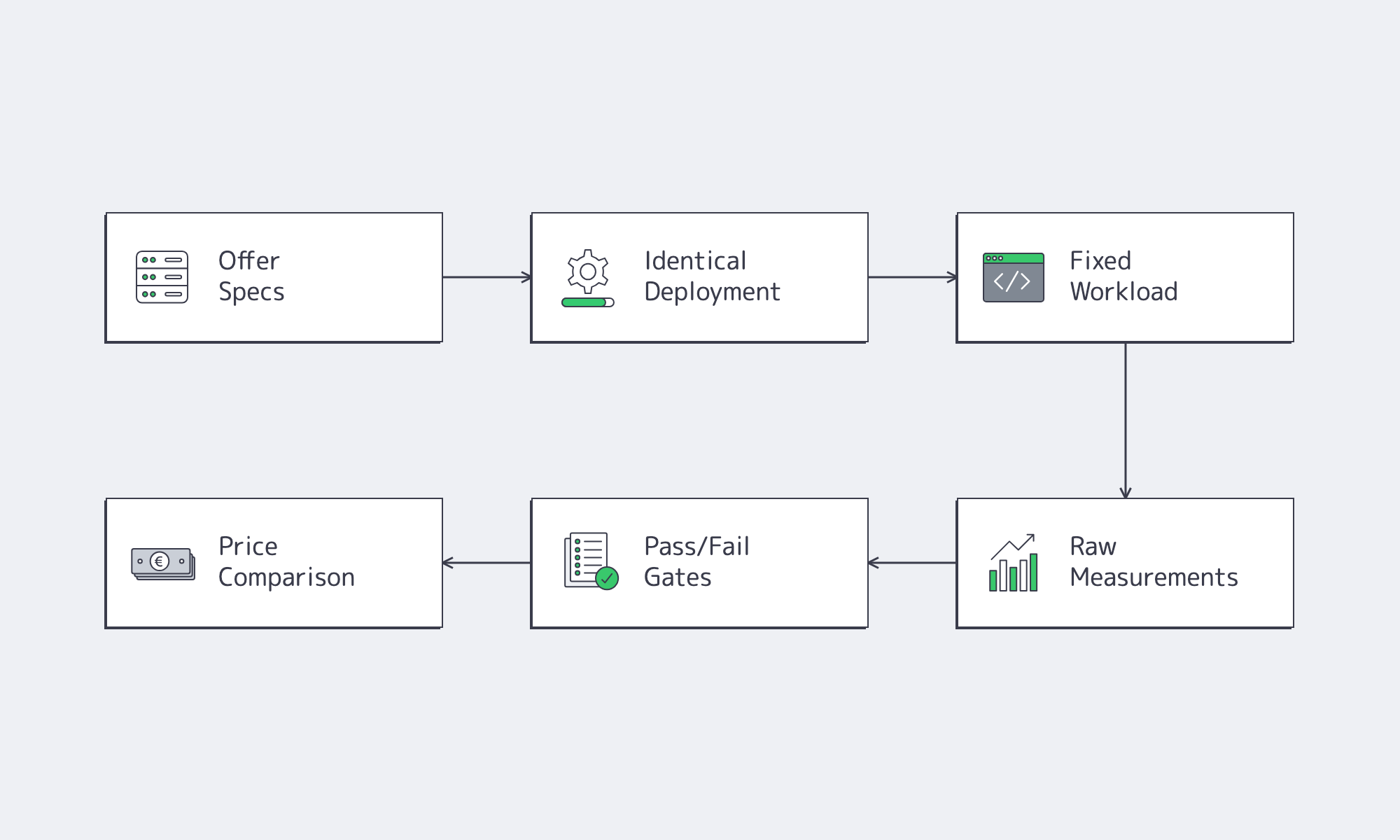
Choose acceptance thresholds from the application’s workload and operational requirements before testing, then hold them fixed across every shortlisted host. The fixture below demonstrates that process using one defined request mix and a set of example purchasing thresholds.
For freshness measurements, record slot differences and timestamps directly rather than converting slots to milliseconds using a fixed slot duration.
Which Request Settings Make a Solana RPC Hosting Benchmark Reproducible?
A reproducible Solana RPC hosting benchmark fixes RPC methods, payloads, commitment levels, client geography, arrival rate, concurrency, timeouts, and software versions before testing. Run three identical steady-state trials and a 24-hour finalist soak. Every shortlisted host must receive the same workload, with timestamped conditions, recorded generator capacity, and unchanged acceptance thresholds throughout the evaluation.
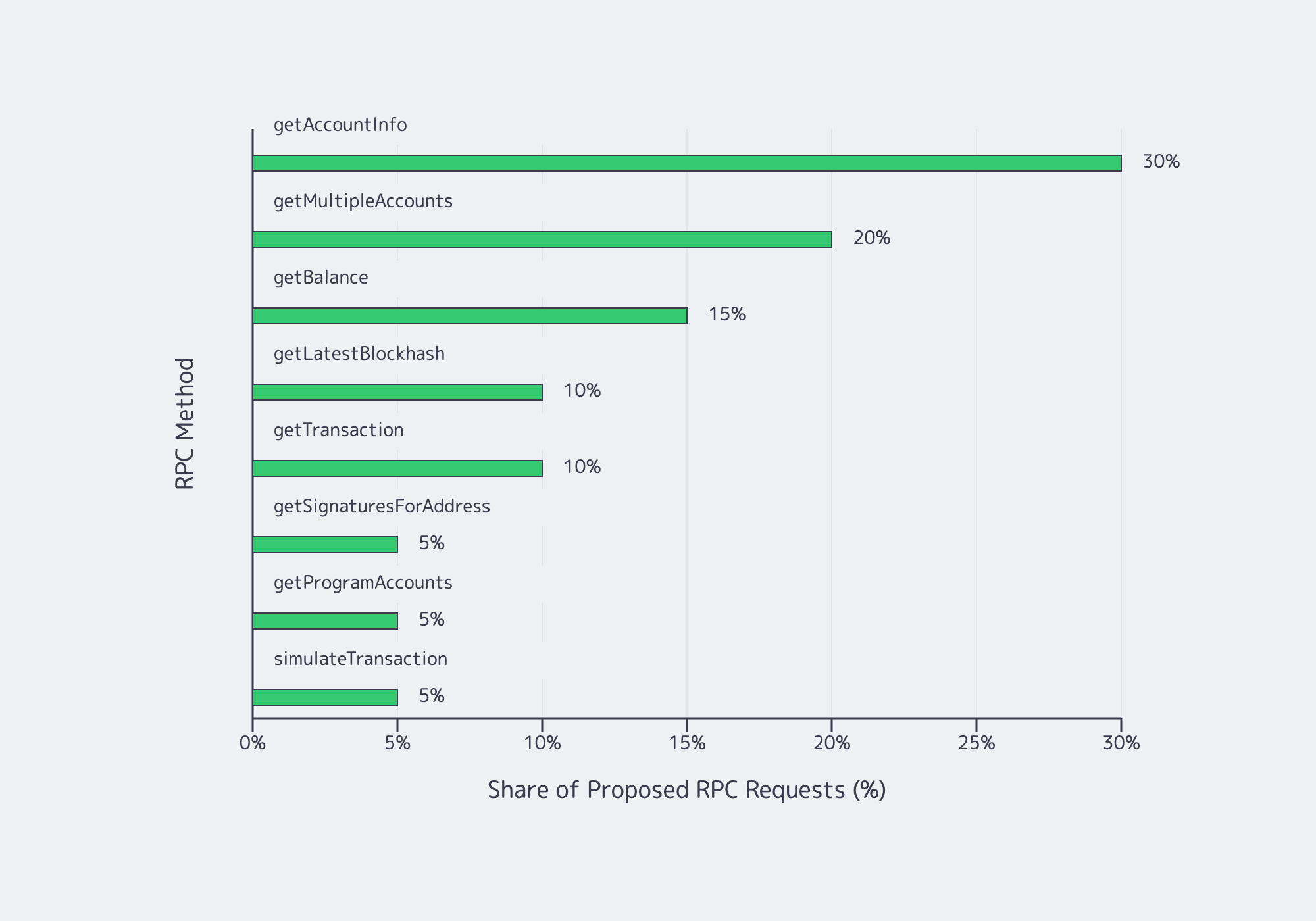
Solana RPC Request Mix Test
The example fixture combines lightweight reads, multi-account queries, historical lookups, heavier program queries, and transaction simulation.
Its fixed request distribution is 30% getAccountInfo, 20% getMultipleAccounts with 20 keys, 15% getBalance, 10% getLatestBlockhash, 10% getTransaction, 5% getSignaturesForAddress, 5% getProgramAccounts, and 5% simulateTransaction.
Use confirmed commitment except for getLatestBlockhash, which uses processed. Freeze encodings, filters, signatures, account keys, transaction templates, and response-size expectations. Solana’s RPC documentation explains why commitment settings cannot be treated as interchangeable. For getProgramAccounts, also freeze withContext, dataSlice, and minContextSlot if used; the latter sets a minimum context, not an exact historical slot.
The example manifest is:
fixture: solana-rpc-host-acceptance-v1
cluster: mainnet-beta

client:
  region: "<fixed-client-city>"
  generator_version: "<commit-sha>"

http:
  load_model: open_arrival
  target_rps: 500
  max_in_flight: 64
  request_timeout_ms: 5000
  keepalive: true
  warmup: 10m
  measured_steady_state: 45m
  repetitions: 3

  burst:
    target_rps: 1000
    max_in_flight: 128
    duration: 5m

  methods:
    getAccountInfo:
      weight: 30
      commitment: confirmed
      encoding: base64
    getMultipleAccounts:
      weight: 20
      accounts_per_request: 20
      commitment: confirmed
      encoding: base64
    getBalance:
      weight: 15
      commitment: confirmed
    getLatestBlockhash:
      weight: 10
      commitment: processed
    getTransaction:
      weight: 10
      commitment: confirmed
      encoding: json
      maxSupportedTransactionVersion: 0
    getSignaturesForAddress:
      weight: 5
      commitment: confirmed
      limit: 25
    getProgramAccounts:
      weight: 5
      commitment: confirmed
      withContext: true
      encoding: base64
      filters: "<frozen-filters>"
      dataSlice: "<frozen-slice>"
    simulateTransaction:
      weight: 5
      commitment: confirmed
      encoding: base64
      replaceRecentBlockhash: true
      sigVerify: false

corpus:
  path: corpus.json
  sha256: "<record-before-run>"

freshness_probe:
  interval: 1s
  commitment: processed

finalist_soak:
  duration: 24h
  target_rps: 500
  max_in_flight: 64
Use an open-arrival workload so slow responses do not silently reduce the offered request rate. As Grafana k6 explains, closed workloads can reduce throughput as response times increase. Record achieved arrivals, dropped iterations, and generator saturation. One iteration must represent one RPC request for iteration rates to equal request rates.
At 500 RPS, a 45-minute interval schedules 1.35 million requests. A method representing 5% receives 67,500 scheduled observations if the requested mix is achieved.
Preserve Timestamped Evidence
Use UTC timestamps for correlation and monotonic clocks for latency. Preserve raw samples or mergeable histograms, not averaged percentiles.
A minimal log schema is:
run_id,host_label,server_city,start_utc,
method,commitment,latency_us,http_status,
rpc_error,response_bytes,context_slot,
reference_slot,transport_error
Record software versions, configuration hashes, corpus checksums, timeouts, and unexpected JSON-RPC errors. Define whether latency includes connection establishment, and report successful-response percentiles alongside failures and timeouts.
HTTP 200 does not necessarily mean RPC success. Legitimate null responses must not automatically count as infrastructure failures; Solana documents such behavior for unavailable transactions.
Latency, Errors, Replay Lag, and NVMe Tests
A Solana RPC hosting benchmark should evaluate latency, errors, freshness, and sustained storage performance as separate acceptance gates. Define each gate from the application’s requirements, then apply the same limits to every host. A fast endpoint should not pass if stale state, failed requests, or unstable NVMe performance would prevent the application from operating correctly.
RPC p95/p99 Latency Testing
Report latency per method before calculating the mixed-workload distribution. A fast aggregate can conceal a failing expensive query.
Choose standard-read p95 and p99 limits from the application’s latency budget. Apply separate limits to expensive methods such as getProgramAccounts, whose response sizes and execution costs can differ substantially from simple account reads.
For Solana RPC freshness, query getSlot(processed) every second against synchronized, independent healthy references:
cluster_lag_slots =
median(reference_processed_slots)
– candidate_processed_slot
Preserve signed differences, including negatives, plus reference health and sampling timestamps. This measures relative RPC freshness, not internal replay completion.
Track the ingest-versus-processed-slot diagnostic separately:
ingest_processed_slot_delta =
max_shred_insert_slot – processed_slot
The signed delta is diagnostic because shred insertion and replay represent different states. Forks and sampling offsets can also affect interpretation. Ask for agreed internal replay telemetry if replay performance itself is a purchasing requirement.
A healthy getHealth response is insufficient: Solana’s health check depends on a configured slot-distance threshold.
Example Acceptance Matrix
The following matrix uses the workload defined above. Choose its example gates against the buyer’s application requirements before evaluating hosts.
| Gate | Example Test | Example Pass Criterion |
|---|---|---|
| Standard reads | Fixed mix, 500 RPS | p95 < 200 ms; p99 ≤ 500 ms |
| Mixed workload | 45-minute steady run; 1,000-RPS burst | Errors ≤ 0.1% steady, ≤ 0.5% burst; ordinary-method p99 ≤ 750 ms; getProgramAccounts p99 ≤ 2.5 s |
| RPC freshness | Processed-slot probes at 1 Hz | p99 positive lag ≤ 2 slots; no lag > 5 slots lasting ≥ 10 s |
| NVMe | 60-minute measured random I/O; 30-minute measured sequential write | Random-I/O p99 completion latency ≤ 5 ms; final throughput ≥ 90% of initial measured throughput; predefined I/O floors met; no new media errors or critical warnings |
| Reconnect | 100 controlled disconnect cycles | p95 first-attempt-to-all-acknowledgments ≤ 2 s; zero unreconciled gaps |
| Finalist soak | 24 hours at 500 RPS | All applicable mandatory gates pass |
Solana NVMe Acceptance Test
NVMe model names do not establish sustained performance. Use fio’s workload controls to fix queue depth, I/O size, read/write ratio, and duration.
Run the example only against isolated, preconditioned scratch storage, never a production ledger or accounts database. The four random-I/O jobs intentionally share the designated scratch file; document filesystem, RAID layout, firmware, and achieved queue depth.
# rpc-nvme-acceptance.fio
# EXAMPLE ACCEPTANCE WORKLOAD

[global]
filename=/srv/rpc-bench/fio-test.bin
size=256G
ioengine=libaio
direct=1
time_based=1
group_reporting=1
percentile_list=95:99:99.9
ramp_time=10m
write_bw_log=rpc-nvme-bandwidth
write_lat_log=rpc-nvme-latency
log_avg_msec=1000

[rand-mixed-4k]
rw=randrw
rwmixread=70
bs=4k
iodepth=32
numjobs=4
runtime=60m

[seq-write-1m]
stonewall
rw=write
bs=1m
iodepth=16
numjobs=1
ramp_time=10m
runtime=30m
With ten minutes of ramp-up per job section, the sequential test schedule takes approximately 110 minutes, excluding file preparation and preconditioning.
Compare the final ten measured minutes with the first ten after ramp-up using time-series logs. An aggregate fio summary cannot show degradation over time.
Record IOPS, bandwidth, p95/p99 completion latency, actual queue depth, CPU utilization, and temperature. Direct I/O bypasses normal buffered I/O where supported; it does not guarantee durable writes.
Set IOPS and bandwidth floors from the application’s storage workload before testing.
Capture NVMe health before and after, using a pinned nvme-cli version that supports the selected command:
sudo nvme list -o json > nvme-list.before.json
sudo nvme log smart /dev/nvme0 -o json \
  > nvme-smart.before.json

cat /proc/diskstats > diskstats.before.txt

fio rpc-nvme-acceptance.fio \
  --output-format=json \
  --output=fio-results.json

sudo nvme log smart /dev/nvme0 -o json \
  > nvme-smart.after.json

cat /proc/diskstats > diskstats.after.txt
The Linux NVMe documentation lists media errors, critical warnings, and thermal-management counters. New media errors or critical warnings fail the storage-health gate.
Validate Reconnect Behavior and Apply Pass/Fail Criteria to Shortlisted RPC Hosts
A shortlisted Solana RPC host should recover WebSocket subscriptions after controlled disconnections, restore notifications, and reconcile missed state over HTTP. Measure reconnect-to-resubscribe latency separately from total recovery time, and require every injected disconnect to end in a reconciled application state. Test recovery while the fixed HTTP workload is running.
Establish 20 persistent WebSocket connections with frozen subscriptions, including slotSubscribe. After five stable minutes, disconnect clients, wait five seconds, initiate reconnection, and re-register subscriptions.
Record four recovery intervals independently:
disconnect → handshake
first reconnect attempt → all acknowledgments
disconnect → first resumed notification
disconnect → HTTP reconciliation complete
The first, third, and fourth intervals include the intentional five-second hold. The example matrix’s two-second p95 gate applies only from the first reconnect attempt to all subscription acknowledgments, excluding that hold.
Repeat for 100 controlled cycles while the fixed HTTP workload is running. Verify new subscription IDs, resumed valid notifications, and completed reconciliation. Solana’s RPC guidance emphasizes that WebSocket notifications are not a durable event log, making HTTP reconciliation essential.
A connection reopening successfully does not prove that application state recovered.
Turn the Solana RPC Hosting Benchmark Into a Purchase Decision
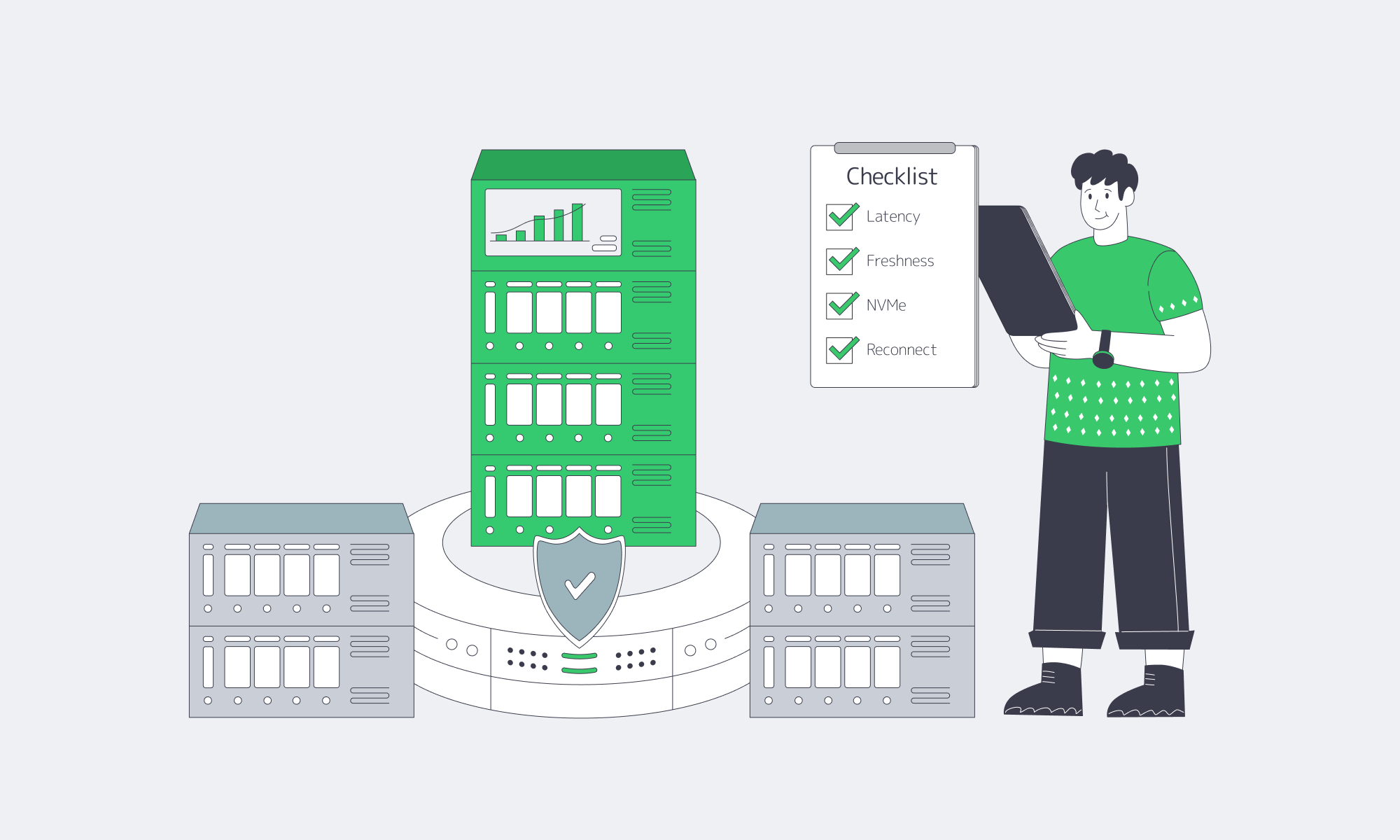
The strongest purchasing decision comes from rejecting failures before comparing costs. A low price cannot compensate for stale responses, excessive p99 latency, sustained storage degradation, or missing subscription state.
Use the acceptance results to make practical decisions:
- Reject inconsistent performance: A configuration that passes only one of three trials should not advance based on its best result.
- Investigate freshness independently: Low RPC latency with persistent slot lag calls for replay and ingestion diagnostics, not simply a faster network-port quote.
- Require sustained-storage evidence: Accept NVMe performance only when time-series data, health logs, and the agreed workload floors support it.
- Treat reconnect correctness as mandatory: Fast acknowledgments cannot compensate for missing application state.
- Compare costs after eligibility: Rank passing configurations by measured application-region latency, operational fit, and total cost.
This approach also supports expansion: a new location can be evaluated using the same fixture without reinventing the purchasing criteria.
Every acceptance report should preserve the offer worksheet, exact test conditions, raw logs, observed outcomes, and final gate decisions.
Choose a Solana RPC Server
Match CPU, RAM, NVMe, network, and location requirements to a Melbicom configuration, then run your acceptance fixture.
Get expert support with your services
Blog

AMD EPYC, Ryzen and Intel Xeon Hosting Providers: Compare Available Builds and Workload Fit
Choosing between AMD EPYC, Ryzen, and Intel Xeon dedicated servers requires more than comparing core counts and advertised clock speeds. The meaningful comparison is between complete configurations: processor generation, socket topology, installed memory, storage, network capacity, and deployment region.
The difference matters. A high-frequency Ryzen system might suit a latency-sensitive API, while a memory-intensive analytics engine could benefit from EPYC’s wider memory subsystem. A multi-socket Xeon configuration introduces NUMA considerations that can change application performance substantially.
This guide compares those architectural tradeoffs using Melbicom’s regional offerings and a reusable provider-selection framework. The goal is to identify which CPU and server configuration fits a workload’s actual bottleneck, then validate that choice before standardizing it across regions.
Compare CPU Builds– Ryzen, EPYC and Xeon – Memory and storage options – Regional configurations |
|
Which Dedicated Server Providers Offer AMD EPYC, Ryzen, and Intel Xeon Builds?
AMD Ryzen Xeon dedicated server providers should be evaluated by processor generation, regional availability, and complete hardware configuration. Compare exact CPU models, DIMM topology, storage, network specifications, and location-specific availability. Melbicom offers these CPU families across our infrastructure, with location-specific builds.
EPYC Ryzen Xeon Hosting Comparison: Dedicated Server CPU Generations
The matrix below compares complete Melbicom catalog configurations with regional processor options that require a configuration request. Catalog examples preserve the CPU, memory, storage, and network combination offered together. Regional SKU entries identify processor choices without implying a complete available build. Core and thread figures are per processor; actual socket population requires confirmation.
| Region and Evidence | CPU Generation and Build | Memory, Storage, and Network |
|---|---|---|
| Singapore | AMD Ryzen 9 9950X, Ryzen 9000, Zen 5, 16C/32T, 4.30 GHz base | 128 GB RAM; 2 × 3.84 TB NVMe; 10 Gbps, 50 TB allowance |
| Amsterdam | AMD Ryzen 9 7950X, Ryzen 7000, Zen 4, 16C/32T, 4.50 GHz base | 128 GB RAM; 15.36 TB advertised NVMe total across two drives; 10 Gbps, 50 TB allowance |
| Frankfurt | AMD EPYC 7402, EPYC 7002, 24C/48T, 2.80 GHz base | 128 GB RAM; 2 × 960 GB NVMe; 10 Gbps, 50 TB allowance |
| Frankfurt or Paris | Intel Xeon E-2356G, Xeon E-2300, 6C/12T, 3.20 GHz base | 32 GB RAM; 1 × 480 GB SSD; 10 Gbps, 50 TB allowance |
| Amsterdam and Riga | AMD EPYC 9575F, EPYC 9005, Zen 5 | RAM capacity and DIMM topology; storage; network port; availability |
| Singapore | AMD EPYC 9354P, EPYC 9004, Zen 4 | RAM capacity and DIMM topology; storage; network port; availability |
| São Paulo | Ryzen, Xeon, and EPYC family options | DDR5, NVMe, and 1/10/25/40 GbE options; exact build and reservation status to establish |
A configuration request specifies DIMM layout, memory speed, socket population where applicable, usable storage capacity, and delivery needs.
The processor generations matter because they expose different memory architectures. The EPYC 7402 supports eight DDR4 channels and can operate in one- or two-socket configurations. The EPYC 9354P is a single-socket processor with 32 cores, 64 threads, and 12 DDR5 channels.
The EPYC 9575F belongs to the Zen 5 generation, with 64 cores, a 3.3 GHz base frequency, and up to 5.0 GHz boost.
For a regional deployment, the useful question is which CPU SKU, memory population, storage layout, and network configuration can be supplied in the required city.
When an existing configuration does not meet those requirements, Melbicom offers custom dedicated-server configurations delivered and deployed in 3–5 business days.
Comparing Regional Offers Against Single-Thread Performance, Memory Bandwidth, and NUMA Requirements
CPU selection should follow the workload’s limiting resource. Ryzen is worth evaluating for sustained single-thread performance, while EPYC and suitable Xeon platforms offer different memory-bandwidth and scaling characteristics. Compare theoretical memory interfaces only after confirming installed DIMMs, then validate application throughput, tail latency, and NUMA locality using identical, documented test conditions.
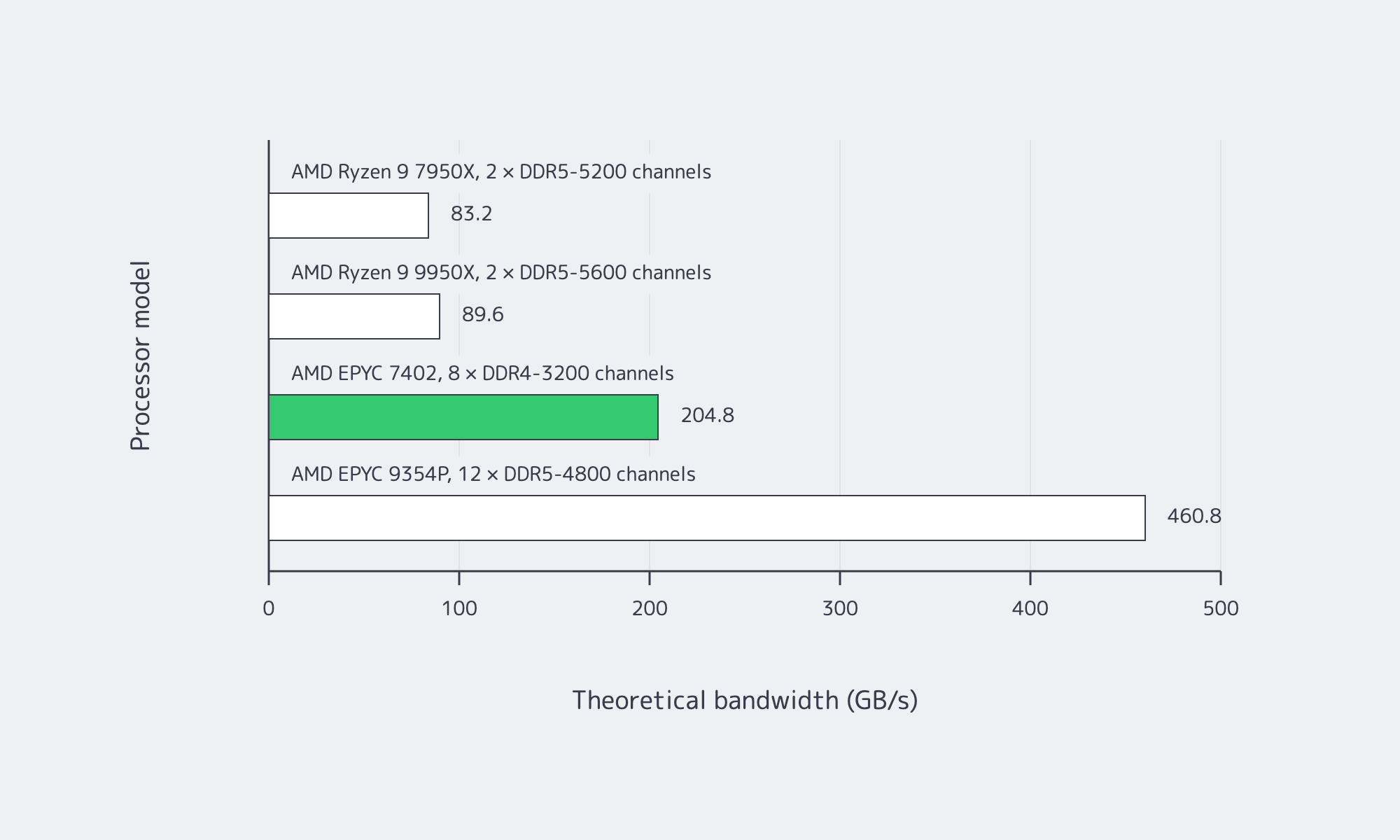
Single-Thread Performance and Boost Clocks
AMD’s Ryzen 9 9950X has 16 cores, 32 threads, a 4.3 GHz base, and up to 5.7 GHz boost.
The Ryzen 9 7950X has 16 cores, 32 threads, a 4.5 GHz base, and up to 5.7 GHz boost.
Intel’s Xeon E-2300 platform includes the E-2356G: 6 cores, 12 threads, up to 5.0 GHz.
These frequencies describe processor capabilities, not sustained application performance. Cache behavior, instruction mix, sustained frequency, and compiler optimizations can change the outcome.
For event-loop services, game simulation, or latency-sensitive APIs, compare application throughput at the required p95 and p99 latency. A processor with a higher advertised boost frequency is useful only if it benefits the workload under sustained load.
Calculate the Memory-Bandwidth Ceiling
Memory capacity and memory bandwidth are different constraints.
The Ryzen 9 9950X provides two DDR5 channels. At its specified DDR5-5600 rate for supported two-DIMM configurations, theoretical memory-interface bandwidth is:
2 channels × 5,600 MT/s × 8 bytes ÷ 1,000 = 89.6 GB/s
The Ryzen 9 7950X supports DDR5-5200 in specified two-DIMM configurations, producing a theoretical 83.2 GB/s.
The EPYC 7402 supports eight DDR4-3200 channels, giving a theoretical per-socket ceiling of 204.8 GB/s.
EPYC 9354P: 12 DDR5-4800 channels, with a theoretical 460.8 GB/s per socket.
For EPYC 9005, 12 channels operating at DDR5-6000 would provide 576 GB/s per socket. AMD also documents DDR5-6400 support for targeted customers and configurations; that higher rate should not be assumed for a particular server.
These figures are theoretical memory-interface ceilings, calculated from channel count × transfer rate × 8 bytes ÷ 1,000. They assume all specified channels are populated and operating at the stated rate. Sustainable bandwidth depends on DIMM population, configured frequency, memory-controller behavior, and access patterns.
AMD’s EPYC memory-population guidance explains why channel population matters. A server with sufficient total RAM may still provide less bandwidth than its processor’s theoretical interface ceiling if channels are not fully populated.
For memory-intensive applications, compare installed channel topology and measured sustainable bandwidth rather than total RAM alone. Ryzen ECC operation also depends on motherboard support and the actual configuration.
NUMA Testing: Topology Changes Results
NUMA matters when threads access memory outside the local domain.
A dual-socket Xeon system can incur cross-socket memory-access costs. EPYC platforms can expose multiple NUMA domains within a socket, depending on configuration.
AMD’s EPYC BIOS tuning guide documents NPS1, NPS2, and NPS4 configurations, corresponding to one, two, or four NUMA nodes per socket when LLC-as-NUMA is disabled.
Linux provides explicit NUMA memory-placement policies. Local versus remote allocation can materially affect memory-sensitive applications.
Single-socket systems should not automatically be assumed to expose one NUMA domain. Inspect the operating-system topology and determine whether the application keeps frequently accessed memory close to the threads using it.
Use Reproducible Workload Tests to Validate the Quoted CPU Configuration
A reproducible CPU qualification protocol must record exact hardware, software versions, memory topology, NUMA placement, and UTC timestamps before measuring performance. Use pinned single-thread and memory-bandwidth tools, followed by production workload replay. Acceptance thresholds should come from application requirements and validated baselines, not universal benchmark percentages or unverified processor specifications.
Proposed CPU Qualification Protocol
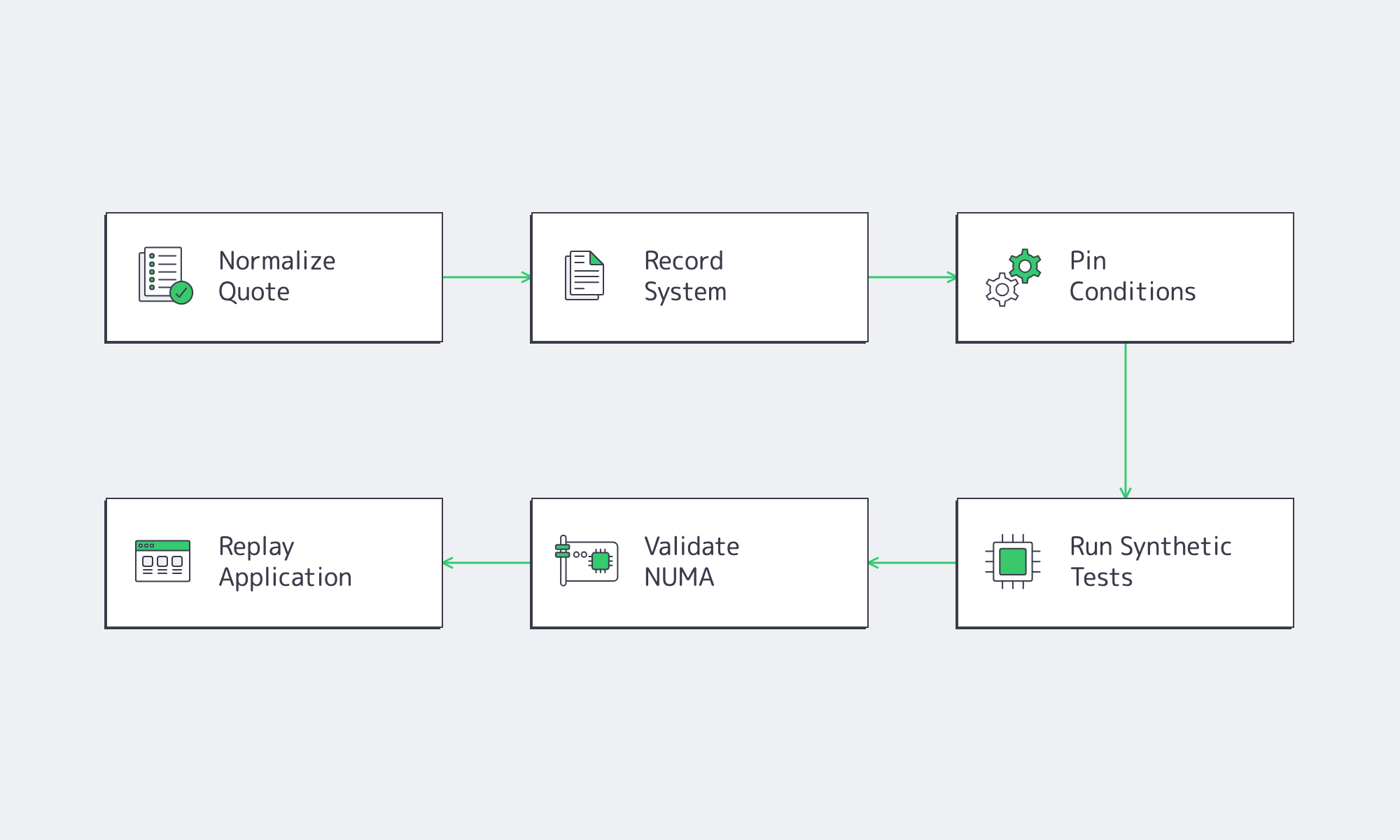
The proposed procedure separates hardware validation from application acceptance. Synthetic tests help identify configuration or performance anomalies; application replay determines whether a candidate meets production requirements.
Capture the processor SKU, socket count, physical core and logical thread count, BIOS, microcode, SMT status, operating system, kernel, frequency policy, DIMM layout, storage, and network configuration.
Record lscpu and numactl --hardware output plus relevant data from /sys/devices/system/node.
For single-thread validation, use a pinned sysbench 1.0.20 build, bind one worker with taskset, perform a warm-up, and collect ten fixed-duration runs as an initial sample. Preserve the command, binary checksum, frequency telemetry, and events per second.
For bandwidth, use the STREAM reference benchmark. Record the source checksum, compiler version, flags, array size, thread count, and affinity. Use arrays larger than aggregate cache and collect Copy, Scale, Add, and Triad results across at least five scored passes initially.
If run-to-run variability prevents a stable comparison, investigate changing host conditions and collect additional samples before drawing conclusions.
For NUMA systems, repeat STREAM with local-memory placement, remote-memory placement where supported, and the intended production policy. Record NPS settings on applicable EPYC configurations.
Keep storage from distorting CPU results; a pinned fio release can provide a separately controlled storage sanity check.
The proposed timestamp record should contain:
Protocol ID | City | Quote timestamp UTC | Test start/end UTC | CPU | DIMMs | NUMA/NPS | OS/kernel | Tool version/hash | Affinity | Duration | Median | Variability | Application buildDerive investigation triggers from repeated measurements of a validated, equivalent configuration. Establish the baseline’s normal variation under controlled conditions, account for measurement noise, and investigate deviations large enough to exceed that variation or threaten the application’s acceptance requirements.
The decisive test remains application replay with identical binaries, datasets, concurrency, warm-up conditions, and memory limits. Record throughput, p50/p95/p99 latency, and errors against workload-owned acceptance criteria.
Where standardized published CPU results are considered, SPEC CPU2017 run rules provide a separate methodology. Published controlled results should not be confused with processor specifications or results from the proposed workload tests.
From Quotes to Acceptance Criteria
A Ryzen 9 9950X configuration with 128 GB RAM cannot be assumed to deliver the same bandwidth as another 128 GB configuration without knowing its DIMM population and operating speed.
Likewise, an EPYC system with 512 GB DDR5 does not establish how many memory channels are populated.
A normalized provider request should connect the hardware specification to a workload-owned acceptance target: requests per second at an acceptable p99, jobs completed per hour, scan throughput, or concurrent workers without unacceptable contention.
The result is a configuration that can be evaluated against a specific production requirement rather than a processor-family label.
Match Workloads and Regional Builds
A practical EPYC Ryzen Xeon hosting comparison starts with workload profiles rather than processor rankings.
Single-thread-sensitive applications should shortlist high-frequency Ryzen and suitable Xeon configurations, then compare sustained application latency and throughput.
Memory-bandwidth-intensive applications, including analytical scans and in-memory processing, should compare STREAM results alongside actual application throughput. EPYC’s wider memory interface makes it a relevant candidate, not an automatic winner.
NUMA-sensitive databases and virtualization workloads need locality-aware tests. A higher core count is valuable only when additional threads can use memory without unacceptable remote-access penalties.
Independently partitionable workers may benefit from distributing processes across NUMA nodes, keeping their working sets local.
For regional fleets, qualify the CPU class first, then qualify each location’s actual build. Equivalent production outcomes matter more than identical processor labels.
Final Selection Rules for AMD Ryzen Xeon Dedicated Server Providers

A defensible CPU decision combines confirmed configuration evidence, memory topology, and reproducible workload validation. Provider comparisons should preserve missing fields rather than treating processor-family availability as proof of a deliverable build.
The essential rules are:
- Verify exact builds before ranking offers. A CPU, DIMM, storage, and network configuration prevents regional differences from becoming hidden variables.
- Use workload-specific metrics. Single-thread-sensitive services need latency and throughput validation; memory-intensive services need sustained bandwidth and application replay.
- Treat memory topology as part of the CPU decision. Total RAM capacity alone does not establish channel population, configured speed, or NUMA behavior.
- Reproduce the test environment. Pin software versions, workload inputs, affinity, memory placement, and run conditions before comparing results.
- Standardize on accepted outcomes. Regional hardware can differ while meeting the same application-level performance contract.
The strongest dedicated-server CPU choice is the one whose delivered configuration meets the workload’s measurable requirements—not the one with the most impressive specification sheet.
Explore Melbicom Dedicated Servers
Use our dedicated server catalog to shortlist suitable CPU models, memory capacities, storage layouts, and deployment locations.
Get expert support with your services
Blog

Dedicated Servers in Poland: How to Evaluate Warsaw for Production Workloads
Choosing a dedicated server in Poland for production workloads starts with a specific question: can a Warsaw deployment meet your application's performance, capacity, and recovery requirements?
This dedicated server Poland buyer guide focuses on five purchasing decisions: verified physical placement, network routes to target customers, hardware capacity, provisioning, and operational support. The objective is straightforward: approve Warsaw because a specific deployment meets measurable production targets, not because its location looks attractive on a map.
Warsaw Servers– Warsaw Tier III facility – Custom configurations – 24/7 engineer support |
|
What Should a Dedicated Server in Poland Deliver for Production Workloads?
A dedicated server in Poland should meet four production requirements: verified physical location, network performance within customer-specific latency and loss budgets, sufficient compute and storage capacity for peak demand and recovery, and provisioning and support processes aligned with operational deadlines. An offer that fails any critical requirement should not receive production approval.
Match the Workload Before Choosing Hardware
Different applications expose different infrastructure bottlenecks.
Latency-sensitive APIs and real-time services need predictable routing, adequate per-core CPU performance, and acceptable p95/p99 response times. Median latency alone can conceal congestion affecting critical transactions.
Stateful databases require RAM sized for the working set, predictable storage latency, sufficient IOPS, and replication or restoration paths that meet recovery objectives. A fast network cannot compensate for insufficient memory or slow disk writes.
High-throughput origins and distribution services depend on sustained transfer performance, not advertised NIC speed. Disk throughput, CPU utilization, concurrency, protocol overhead, and remote-network limits affect delivered capacity.
Virtualization, containers, CI, and analytics need balanced CPU, memory, and storage resources, with capacity reserved for workload displacement and maintenance.
Headroom must be explicit. For example, a policy targeting 25% spare installed network capacity requires dividing forecast demand by 0.75. A workload forecasting 6 Gbps therefore needs 8 Gbps of usable delivery capacity, after accounting for protocol overhead and other bottlenecks.
Warsaw: Location, Network, and Hardware
A Warsaw production server evaluation should verify the physical facility, measure routes from critical customer and dependency networks, and confirm the exact hardware available for deployment. Accept the location only when p95/p99 latency, packet loss, sustained throughput, capacity headroom, and delivery requirements satisfy thresholds defined before testing.

Verify the Physical Warsaw Location
According to the Uptime Institute's Tier Classification System, Tier III means concurrently maintainable infrastructure with redundant components and distribution paths. A facility classification does not guarantee application-level availability; a single server remains a single point of failure.
Melbicom's Warsaw data-center location carries a Tier III classification and has a network range of 1–200 Gbps per server.
For location-sensitive deployments, request documentary confirmation of the physical facility address, service delivery location, contracting entity, and any processing, backup, or administrative access locations material to contractual, audit, or residency requirements. IP geolocation, latency, or a country label alone cannot establish physical residency.
Verify the exact processor, core count, RAM, drives, network interface, ordered port speed, transfer terms, and available quantity.
Poland Network Testing: Measure Target Networks
Production network testing should target the autonomous systems carrying actual customers, APIs, replication traffic, and administrative access. Prioritize networks responsible for significant production traffic, then include networks serving business-critical customers or dependencies even when their traffic volume is smaller.
A practical starting point is a 48–72-hour observation window, sampling latency every one to five minutes and performing representative transfer tests separately. Include relevant busy periods and record UTC timestamps, source ASN and location, destination, address family, protocol, p50/p95/p99 RTT, packet loss, route changes, and throughput.
RIPE Atlas supports measurements from selected probes, while its Path Analysis tools help compare traceroutes over time. Select probes representative of actual customer networks; a Warsaw probe cannot represent every Polish access network.
The IETF's RFC 7680 defines a one-way packet-loss metric. Ping measures round-trip behavior; it cannot independently establish directional one-way loss. Unresponsive intermediate traceroute hops do not necessarily indicate destination packet loss.
Application throughput should be evaluated separately using representative workloads. Melbicom provides Warsaw test IP and a 1,000 MB download for initial connectivity checks.
For throughput testing, iperf3 requires authorized, cooperating client and server endpoints. Its default direction is client-to-server; -R reverses direction, and -J produces JSON output. Record endpoint specifications, software version, test duration, stream count, direction, and relevant network conditions. The IETF's RFC 6349 provides an Informational framework for TCP throughput testing.
Synthetic TCP throughput is not equivalent to sustained application throughput. A nominal 10 Gbps port does not guarantee 10 Gbps of usable application data transfer.
Traceroute has limitations: RFC 7276 explains that multipath forwarding and asymmetric routing complicate path interpretation. A forward traceroute does not reveal the reverse route. Where necessary, test both directions.
To establish acceptance criteria, start with the application's end-to-end response-time requirement. Allocate the response-time budget across application processing, dependencies, and network paths, accounting for how those stages interact under load. Then measure actual end-to-end p95 and p99 response times under representative concurrency, using per-stage telemetry to identify where latency accumulates rather than subtracting independently measured percentile values.
Determine acceptable packet loss by testing how loss affects application response times, error rates, retries, and recovery behavior across critical customer and dependency paths. Set the loss criterion at the level where the application can still meet its performance and recovery requirements.
Apply the same approach to failure and recovery conditions. Identify which customer and dependency paths must remain usable during a host failure, restoration, or traffic displacement, and test whether the resulting network behavior fits the recovery design.
A route passes by meeting workload requirements, not by having fewer hops.
Workload, Provisioning, and Support
Before approving a dedicated server offer, document peak concurrency, CPU and RAM demand, storage latency, network throughput, growth reserve, recovery objectives, delivery deadlines, and operational responsibilities. Require confirmation against the exact configuration and deployment quantity. Provisioning and support requirements should be translated into verifiable conditions before committing production workloads.
Provisioning Is a Production Constraint
Server provisioning and application readiness are separate stages. The customer must still deploy, configure, and validate the application before production traffic is moved.
A migration requiring twelve identical servers needs written confirmation of simultaneous availability. A recovery plan requiring replacement hardware within six hours cannot depend on a custom build taking several business days.
Confirm the configuration, quantity, provisioning category, delivery start conditions, order-specific delivery commitment, and host-readiness criteria before approving the rollout.
Melbicom's Poland dedicated-server offering provides a two-hour delivery window for ready configurations. Custom server builds take 3–5 business days.
Poland Hosting Service Requirements: Questions Providers Must Answer
Before production, assign responsibility for each failure scenario. Ask what evidence is needed for hardware faults, how to escalate network degradation, how replacement capacity is confirmed, and which recovery tasks the customer handles.
Backups, restore testing, and application recovery must be explicitly assigned rather than assumed to be provider-managed.
Use the following workload matrix to normalize configuration requests and define rejection criteria before selecting a server.
| Workload | Request and Verification | Reject When |
|---|---|---|
| Latency-sensitive API | Warsaw placement, CPU model, ordered port speed, target-ASN p95/p99 RTT and loss testing | Critical routes exceed latency or loss budgets |
| Stateful database | RAM, drive layout, storage latency, replica paths, backup and recovery tests | Storage or recovery misses workload targets |
| High-throughput origin | Ordered port, transfer terms, sustained application throughput, CPU and disk utilization | Delivered capacity falls below forecast demand and required installed-capacity reserve |
| Virtualization and mixed compute | CPU generation, RAM, storage I/O, failure-state capacity model | Peak or degraded-state utilization exceeds safety limits |
| Fleet deployment | Exact quantity, confirmed hardware availability, provisioning category, and delivery window | Required hardware cannot be committed within the rollout deadline |
Quote normalization should follow technical qualification. Changing the CPU generation, drive count, network port, transfer allowance, or delivery window changes the system being purchased—not merely its price.
Melbicom provides 24/7 infrastructure support covering server reboots, OS reinstalls, network troubleshooting, and hardware/network performance issues. Customers retain responsibility for administering their application and software environment under the applicable service terms.
A Dedicated Server in Poland Buyer Guide: Approve or Reject on Evidence
Warsaw is a viable candidate when a specific deployment meets the workload's requirements for physical placement, customer-network performance, hardware capacity, provisioning, and recovery.

The final workload checklist is:
- Location: Require documentary confirmation when physical placement, contracting jurisdiction, processing, or backup residency is material. Do not substitute IP geolocation for facility evidence.
- Routes: Prioritize customer and dependency ASNs by production impact. Record UTC timestamps, probe identity, p95/p99 RTT, loss, and route changes before approving critical paths.
- Capacity: Size CPU, RAM, storage, and network against forecast peak demand, then preserve an explicit fraction of installed capacity for growth or degraded operation.
- Recovery: Validate whether surviving infrastructure can absorb displaced workloads and whether restoration and replica catch-up fit the application's recovery objectives.
- Provisioning: Obtain written confirmation of the required hardware quantity and delivery conditions. Separate server handover from application readiness.
- Operations: Assign application, OS, backup, restoration, hardware, and network troubleshooting responsibilities before deployment.
- Go/No-Go: Reject configurations that miss critical buyer-defined thresholds, lack necessary documentary evidence, or depend on unconfirmed capacity.
A deployment should not pass because its median latency is excellent while p99 violates the application budget, or because its CPU meets requirements while replacement capacity remains unconfirmed.
The purchasing decision is ultimately an engineering decision: define the targets, gather evidence, and reject anything that cannot meet them.

Choose Warsaw Servers
Match a Warsaw dedicated-server configuration to your CPU, RAM, storage, traffic, and deployment requirements with help from Melbicom.