
Month: August 2025
Blog

Future-Proof iGaming with Global Dedicated Server Clusters
iGaming has seen a steep growth curve that is predicted to continue, with the online gambling market estimated at USD 97.7 billion in 2026 and projected to reach USD 202.8 billion by 2033.
However, despite the demands, scaling has a few caveats. The usage patterns are tricky to calculate with huge spikes in traffic that far exceed daily baselines during major events to contend with, as well as the near-zero tolerance that gamers have for delays. Mere millisecond shifts in latency dramatically affect user behavior, meaning that scalability relies less on procurement factors and more on architectural design.
To keep scalability future-proof, you need a forward-looking roadmap. For iGaming infrastructure on dedicated servers, that means horizontal clustering, low latency, planned server capacity, and automation for chaotic workloads. The goal is a scalable blueprint with modular resilience for AI, real-time analytics, and blockchain under realistic workloads.
Choose Melbicom— 1000+ ready-to-go servers — 21 Tier IV & III data centers — 40 CDN PoPs in 35 countries |
 |
Horizontal Clustering: The Bedrock of Scalable Dedicated Servers for iGaming
Scaling vertically requires ever-larger machines; realistically, it means finite headroom for most. The overprovisioning is often wasteful and creates single points of failure within the infrastructure that lead to longer maintenance windows and result in more downtime. By adding servers in parallel with horizontal clustering, you have a better alternative that intelligently balances traffic without wasting provisions, and failure is treated as a routine event rather than a deadly threat.
Horizontal clustering also lets you separate concerns into independently scalable pools. For iGaming operations, use this tier blueprint:
- For Web/API and game servers: Nodes remain as stateless as possible and are routed with L4/L7 load balancers. Game rooms and tables are partitioned through consistent hashing, and game nodes are added to the pool when a tournament starts. This prevents tuning and pushing a single box past its breaking point.
- For the data: Heavy reads are dealt with by blending read replicas, and writes are handled via clustering or sharding. The transaction integrity is protected by distributed SQL or sharded RDBMS patterns, and bet placement, settlement, and odds queries are easily handled regardless of the volume.
- Maintaining a low-latency state and messaging: In-memory caches and message queues help decouple spikes from the database’s critical path.
Operating in clusters boosts throughput and availability because health checks and load balancers can drain a single server should a failure be encountered, while the rest continue working. This means safer rollouts, as new builds can be hosted on a subset of nodes with blue-green deployment or canary setups. With a model that adds nodes to increase headroom, your capacity grows in alignment with growing demand, and there is no need for any redesigning, regardless of whether you need to scale from five thousand to fifty thousand concurrent users at a moment’s notice.
This blueprint is easy to start; Melbicom’s dedicated servers align cleanly. Melbicom offers 1000+ ready-to-go servers, with per-server bandwidth available up to 200 Gbps, helping you right-size the outlined tiers and keep headroom on hand to expand clusters as concurrency climbs.
Lower Latency and Regulatory Alignment
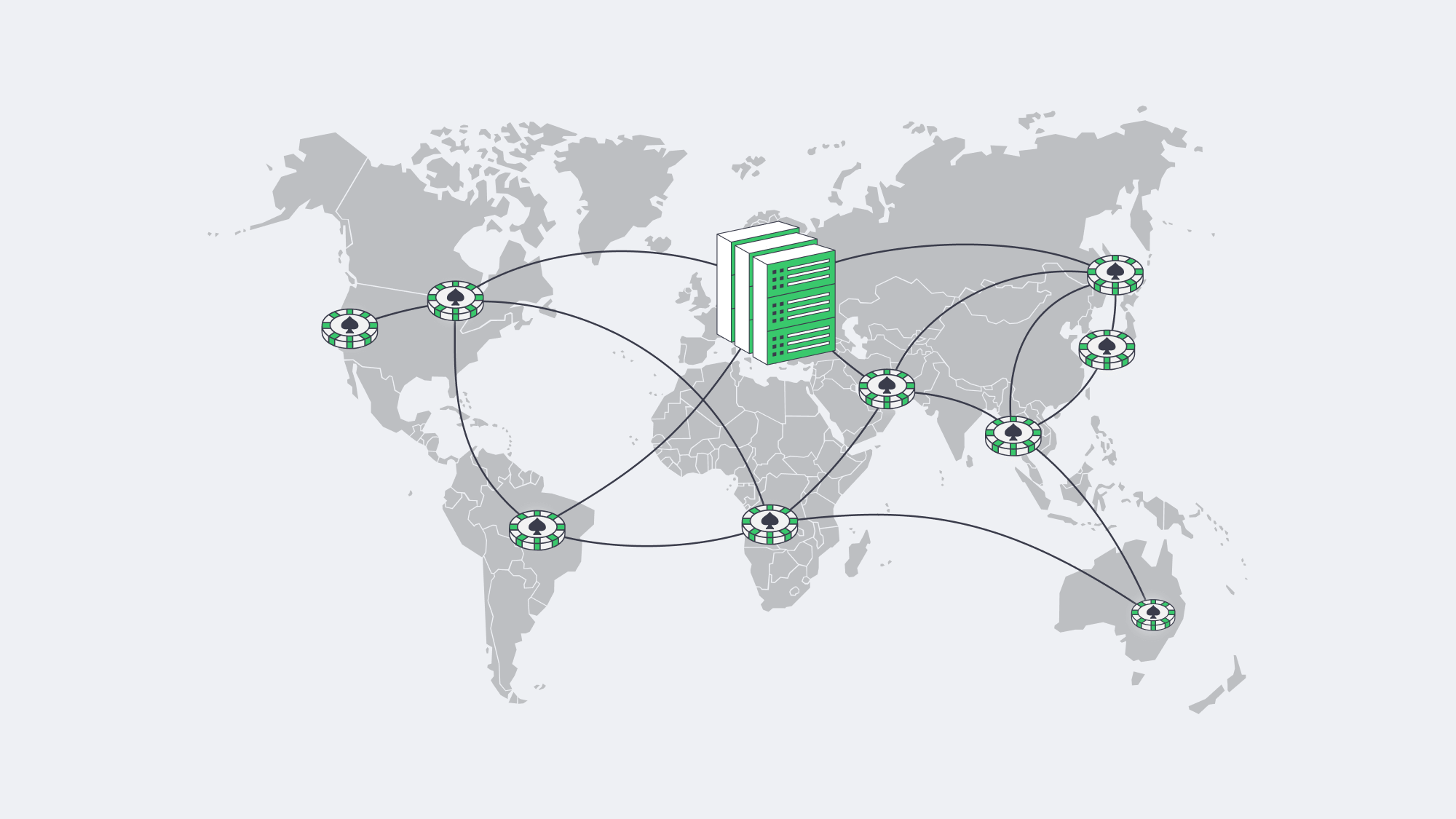
We often think of scaling in terms of “how much,” but “where” is just as important, especially in iGaming, with latency being a key concern. Physical distance equals delay; the longer the distance between a player and your servers, the more latency erodes conversion and churn. Gameplay and in-play betting should be instantaneous for all users, even if those at the table are located as far apart as Madrid, LA, and Singapore at the same time. To provide that globally, multi-regional deployment is vital to your infrastructure.
Design with regional hubs as your focus: Place your active clusters in key geographical regions (e.g., EU, US, APAC). DNS-based global load balancing or anycast can help ensure that a bet placed in Frankfurt resolves to Europe by default, whilst an Atlanta-based one lands in North America. Keep the data local to make compliance easier. Use active-active operation where possible to keep failover seamless and capacity steady.
Free the core cluster via CDN offload: Reduce origin loads and roundtrips by pushing static assets, media, and selected API responses to the edge. The Melbicom CDN spans 40 locations, ensuring that assets and streams terminate within proximity of the user, freeing up the core cluster and enabling the focus to be on latency-sensitive interactions.
Physical foundational considerations: High-capacity, well-peered networks in fault-tolerant facilities are needed to keep user experiences consistently sub-100 ms. Melbicom operates with a geo-redundant design with 21 data centers worldwide to support rapid transactions and recovery. Our data centers have redundant power and diverse network paths, reducing the risk that regional incidents cause prolonged downtime.
The big payoff of operating with regional hubs is that regional traffic peaks locally; spillover is caught by neighbors; for example, surges from the Champions League are handled by European clusters, the Americas absorb spikes caused by the NFL, while APAC handles weekend traffic.
Handling Surges Seamlessly with Automation and Server Capacity Planning
The iGaming market moves rapidly, and the supply and demand for server capacity are unpredictable, making it tough to keep up with through manual scaling. To keep ahead, automation and server capacity planning are vital; if not, you run the risk of last-minute scrambles that spoil UX.
Infrastructure as Code (IaC). You can smoothly expand clusters in planned windows to cover predictable surges with a ready-to-deploy inventory by provisioning and reimaging servers using code (Terraform/Ansible). At the same time, standardized images across nodes prevent configuration drift.
Elastic orchestration. Although physical servers don’t “pop” instantly, near-instant service-level elasticity can be achieved on dedicated hardware, comparable to cloud operation, by packaging services into containers, scheduling with a cluster manager, and autoscaling horizontal pods on CPU/memory/queue depth.
Autoscale through blending predictive and reactive triggers:
- Schedule rollouts for derbies, tourneys, and promotions.
- Set reactive triggers such as thresholds on error budgets, P95 latency, specific queue lengths, or cache hit rates.
- Avoid idle waste by automating graceful cooldowns when surges recede.
Close the loop with health checks and continuous load testing based on previous peak behavior, so traffic drains away from unhealthy instances and services before automation restarts capacity.
Through this method, you remain cost-aware at baseline, ruthless with headroom, and far more efficient than manually possible.
Build to Fail Safely with Modular, Resilient Architecture as a Backbone

As well as the hardware considerations, you have software architecture to think about if you truly want your scalability to remain future-proof. The benefits of a modular system as a backbone are: localized failure, rapid feature integration, and the ability to scale components independently.
Microservices and event-driven flows: Break down the individual platform services such as identity, wallet, risk, odds, settlement, game sessions, chat, bonus, and analytics. Use APIs and streams for communication. Publish event-driven actions such as “bet placed,” “odds updated,” or “game finished” to a durable bus; adding a fraud model or a loyalty engine is a plug-in, not a rewrite.
Isolation and fallbacks: Isolate each microservice so one failure cannot collapse the stack, then define fallbacks for each service. If chat slows, degrade it while bets proceed. If personalization times out, revert to defaults. These patterns reduce cascading degradation during partial service outages.
Redundancy should be throughout: Use primary/replica or clustered databases with automatic failover to make sure that no single data node, cache, or gateway is a lynchpin. Keep multiple instances of all stateless services and run hot spares for critical paths. Site-level incidents can be handled via active-active regions where possible, and if not, at the very least, hot standbys.
Harden your architecture design through regular testing: Run chaos drills in staging and practice region evacuation and database failover. This confirms load balancers honor health checks and rollback paths stay predictable.
Working this way protects revenue by reducing the risk of outages during the Super Bowl and accelerates delivery, giving your teams the confidence to deploy changes.
AI, Analytics, and Blockchain Readiness
As you scale and integrate new features, emerging workloads can disrupt operations. The safer practice is to architect ahead with a system ready for new demand.
For AI and real-time analytics, keep transactional paths clean (write bet → ack) while mirroring events to analytics clusters for separate processing.
Model scoring helps decide where to add a GPU dedicated server beside adjacent data streams. Keep analytics stacks as separate tenants so they scale independently and support model experiments without starving bet paths.
You should track P95 latency for real-time operational analytics, such as a dashboard for bet placement, queue times for settlement, cache hit ratios, and regional error budgets, to make sure automation responds rapidly to link breaks or traffic shifts.
Crypto wallets and provably fair gaming that rely on blockchain networks can face slow confirmations or transient unavailability. The solution is to have their gateways isolated behind queues to prevent stalling when awaiting confirmations. Integrate modularly to keep the core platform running smoothly regardless of any external network hiccups. Remember that fast NVMe stateful nodes require high-bandwidth links to sync heavy chains and state snapshots. At Melbicom, we offer uplinks with up to 200 Gbps per server.
Modularity also helps cover new interaction patterns. VR/AR tables, large-scale PvP pools, and social gameplay can all cause unpredictable surges. To cope, you need architecture that lets you place specialty services in regional hubs and add edge offload via CDN. WebSocket, HTTP/2, and other protocols should be tuned for connection at scale.
This architecture is more pragmatic in cost terms: with a disciplined baseline (e.g., 60–70% utilization) and planned surge capacity, you avoid overbuild and panic-buy cycles. Use the right-sized node types per tier, and reserve GPUs only for workloads that need them.
Further tips: To ensure rightsizing and detect anomalies early, you can leverage unified tracing, metrics analysis, and logs across tiers. Tie SLOs such as bet latency and odds freshness to automated actions and keep personal and wagering data in-region by default. That way, you replicate summaries rather than raw PII across borders, satisfying auditors.
iGaming Infrastructure Growth Patterns
Use this summary as a reference blueprint for iGaming architecture decisions:
- Operate horizontally from the get-go by deploying multiple web/API and game nodes with load balancers to help keep nodes as stateless as possible.
- Introduce caches and queues and utilize clustered databases with read replicas to help decouple the data path.
- Launch globally early by placing small but real clusters in your two most important regions, route by proximity through global load balancing, and keep the user data local to simplify compliance.
- Build IaC, golden images, and orchestrate your deployments with automation to scale. Predict known events and employ reactive triggers to allow for any unexpected surges.
- Ensure each tier has redundancy, test failovers, and add graceful degradation paths to protect against failure.
- Keep bet paths clean by supporting the core with analytics and AI to stream events and score models out-of-band, returning only the necessary signals.
- Observe to iterate, trim any waste, move bottlenecks, and use the data to inform the next scale-up.
Be sure to choose facilities and networks that won’t result in any bottlenecks. Melbicom’s dedicated servers are housed in 21 Tier IV & III data centers worldwide. The infrastructure is engineered for redundancy, and servers can provide connectivity up to 200 Gbps, which helps prevent sudden spikes from saturating the network when capacity is planned correctly.
Build for Sustained Global Performance
If you want to keep your iGaming scaling capabilities future-proof, then you need a disciplined architecture that is built to work in parallel and focused on proximity and automation. You can give your capacity more elasticity and resilience through horizontal clustering, which, paired with automation and server capacity planning, helps you cope with the chaotic traffic expectations. Global deployment supports low latency and fairness, helping to satisfy regulators, and failure containment is easier to deal with thanks to the modular nature of the blueprint. These architectural design choices work hand in hand to ensure your scaling is steady and smooth rather than episodic and make engineering for iGaming predictable despite the challenges that event days and release cycles can otherwise cause.
The result is a platform that is architecturally strong and resilient as opposed to simply bigger, which means surges can be absorbed more predictably, features launch faster, and the future integration of AI, analytics, and blockchain is less likely to disrupt core operations. Reaping the rewards of this architectural blueprint requires dedicated servers in global locations that are clustered, observable, and automated from the bootloader up to provide resilient iGaming infrastructure.
Launch Your iGaming Servers Today
Choose from 1000+ ready-to-go servers across 21 global data centers and scale with room to grow.
Get expert support with your services
Blog
Boosting Affiliate Conversions with High-Performance Dedicated Servers
Affiliate campaigns are hyper-sensitive to latency. A page that opens within two seconds and one that takes three seconds or more can make the difference between profit and loss. Google reports show that the probability of bounce increases by 32% as load time moves from 1s to 3s, and Google AdSense Help notes that 53% of visits are likely to be abandoned if pages take longer than 3 seconds to load. A Google/Deloitte speed study summarized on web.dev found that a 0.1-second improvement in mobile site speed increased conversion rates by 8.4% for retail sites and 10.1% for travel sites. Affiliates working on a per-click basis can translate those percentages into margin.
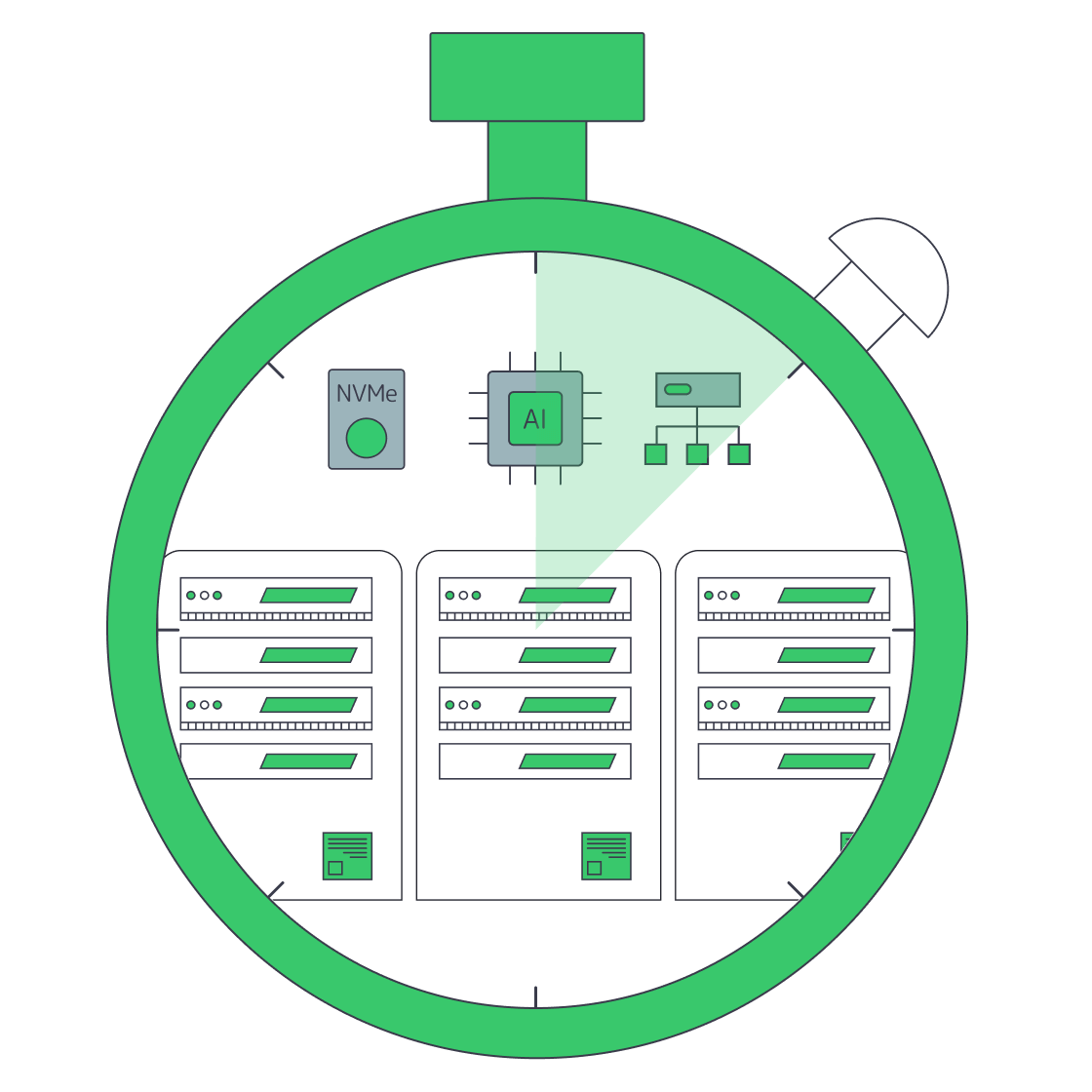
Modern infrastructure bridges that gap. The fastest deployments combine NVMe storage, multi-core CPUs with high amounts of RAM, and optimized high-throughput networks so that time to first byte is short and page rendering is never interrupted during campaign spikes. Performance-tuned dedicated servers pay off by sustaining throughput and consistent latency under real campaign load.
Choose Melbicom— 1000+ ready-to-go servers — 21 global Tier IV & III data centers — 40 CDN locations worldwide |
|
How Dedicated Servers Help Affiliate Marketing Convert More Clicks
The 2025–26-class hardware and networks are not just incremental upgrades; they change the architecture. NVMe on PCIe 4/5 removes the I/O bottlenecks that once made dynamic pages “feel” slow. NVMe drives will routinely achieve multi-GB/s sequential reads and writes (5,000 MB/s and higher in typical settings), whereas SATA remains capped at 600 MB/s—a limit that is easily saturated under concurrent requests. On the CPU front, dozens of physical cores and high-speed DDR4/DDR5 RAM enable servers to render templates, execute tracking/attribution logic and serve API requests in parallel without spiking tail latency. On the network side, bandwidth-intensive sites rely on high-capacity, dedicated 1–200 Gbps ports, intelligent peering, and global distribution mechanisms that keep p95/p99 response times tight even when audiences are far-flung across regions.
In the browser: The HTML renders more quickly, render-blocking assets arrive sooner, and an overworked origin does not block the main thread. Users see content earlier, engage earlier, and leave less often, which is the exact direction toward increased conversion rates. BBC reported that every extra second of load time costs them another 10 percent of users, showing how small delays compound into losses.

NVMe dedicated servers for low latency
NVMe’s advantage is not just headline throughput; it is low-latency, high-queue-depth I/O that keeps dynamic sites responsive under concurrency.
Consider an affiliate landing page that accesses a geo database, retrieves creative variants, and records a click ID before the content is painted above the fold. NVMe reduces storage-operation wait times toward microseconds rather than milliseconds across the request pipeline. The result is lower TTFB, lower LCP, and a greater likelihood that the user sees and responds to the CTA.
CPA network dedicated hosting
There is a different but related issue facing networks and platforms: high rates of redirects, attribution and postbacks are required 24/7.
A delay in the tracking hop frustrates the user even before they can see the merchant page. Dedicated servers with high numbers of cores and memory can absorb bursty redirect traffic and high-capacity NICs ensure that traffic does not queue on the wire. Keeping tracking latency minimal preserves conversion probability across all offers and geos; it also preserves trust in reported numbers, which is critical when affiliates bid hourly.
Minimize the time it takes to load an affiliate landing page (infrastructure first)
Infrastructure is often the quickest win in affiliate campaigns.
- Move origins closer to demand and cache as much as you can at the edge. A worldwide CDN reduces distances and round-trips; static content is served by edge nodes, leaving origin CPU to concentrate on dynamic tasks.
- Right-size compute at the peaks, not averages. Ample headroom avoids CPU-bound stalls that slow p95 latency during launches, email drops, and other high-value bursts.
- Employ new routing and protocols. Consolidated connections (HTTP/2/3), intelligent peering, and anycast DNS eliminate much handshaking overhead and path variability, which is often a hidden cause of extra seconds.
A quick comparison
| Lever | Modern capability (examples) | Conversion-side effect |
|---|---|---|
| Storage | NVMe on PCIe 4/5 exceeds 5,000 MB/s; SATA is limited to ~600 MB/s | Lower TTFB and faster DB-backed renders improve completion of key funnel steps. |
| Compute | 24–64+ cores with fast DDR4/DDR5 and generous caches | Handles concurrency during spikes; stable time-to-interactive. |
| Network & Edge | Dedicated 10–200 Gbps ports, global CDN in 40 locations across 35 countries | Shorter paths and higher throughput reduce bounce and keep users on page. |
Scaling Strategies for Peak Campaigns (without Slowing Down)
Outstanding campaigns can create traffic spikes that resemble an overload event. The playbook should scale capacity without compromising latency per request.
Vertical headroom + horizontal scale. Start with servers that have enough margin in CPU, RAM, and NIC bandwidth so the initial configuration will not slow down at 5x baseline. Then add replicas behind a load balancer to handle the next order of magnitude. With dedicated hardware, the environment is predictable—no noisy neighbors, consistent NUMA layout, and high port speeds.
Fast capacity activation. The historical objection to dedicated servers — slow provisioning — is less relevant when capacity is planned in advance. For example, Melbicom pre-stages 1000+ ready-to-go dedicated servers and typically brings servers online in about two hours, so additional capacity is in place when it’s needed during scheduled bursts or surprise viral moments.
Keep packets flowing. Spikes can make the NIC the bottleneck rather than the disk. Melbicom offers data center services with bandwidth up to 200 Gbps per server — useful when predictable, high-throughput delivery is important to scheduled launches.
Push static to the edge. At Melbicom, we pair origin servers with our own CDN in 40 locations across 35 countries. Campaign materials (images, CSS, JS, video clips) sit on the edge, while the origin focuses primarily on dynamic processing such as personalization and tracking. This keeps p95 and p99 latency steadier during high concurrency.
Global placement. Latency increases with distance; about 10 ms of round-trip time is added to each ~1,000 km. Melbicom has 21 international data center locations, so you can anchor origins close to traffic you are actually purchasing, and replicate into secondary regions as campaigns scale.
Operational preparedness. The operational side is also important: when you need to scale based on load-test results, the response time of the support team will determine how fast you can do it. Melbicom offers 24/7 technical support, and our control panel allows teams to modify capacity with ease.
Why a Good-Enough Shared Hosting Environment Is Not Good Enough
Shared machines and undersized VMs used to be the first point of call, but they often fail at scale due to resource contention and unpredictable latency. A neighboring tenant backing up or a burst of noisy processes can add hundreds of milliseconds of unpredictability to your requests — just when you launch a high-spend campaign. Modern dedicated environments remove that variability by giving you the entire CPU, memory channels, disk bus, and NIC with no local resource contention from other tenants. The lesson from high-volume affiliate traffic is direct: when conversions matter, infrastructure that is only “good enough” becomes expensive.
Affiliate Marketing Implementation Checklist

- Move stateful workloads to NVMe-based dedicated origins. Prioritize renderers, session stores and databases.
- Place origin servers close to users and front all static content with a CDN.
- Plan on headroom (CPU, RAM, bandwidth) so your p95 does not drift during peak.
- Perform a load test preflight and maintain an expansion path (pre-approved configs, DNS/balancer rules, warm replicas). Melbicom’s 1000+ ready-to-go servers and 2-hour activation make this a realistic standard practice.
- Metrics that count: TTFB, LCP and conversion rate by geo/ISP. Correlate latency to abandonment and adjust capacity based on it.
Milliseconds to Money: Infrastructure ROI

Conversion arithmetic is merciless. Every second of delay eats into sales; every millisecond saved adds margin to ROI. The most powerful lever available to an affiliate is the performance envelope of its origin — how fast it can accept connections, read from storage, render dynamic content, and push bytes over the wire at peak. NVMe storage eliminates I/O stalls; high-performance CPUs and RAM can absorb concurrency without latency whiplash; high-speed network ports, global placement, and CDN delivery reduce costly round-trip delays. That combination can convert paid clicks into engaged sessions and engaged sessions into revenue even when there is a surge in traffic. It is straightforward, and the data speaks: the fewer seconds, the fewer bounces, the more conversions.
Deploy High-Performance Servers
Choose from 1000+ ready-to-deploy dedicated servers and launch in as little as two hours.
Get expert support with your services
Blog

Dedicated Servers for iGaming Security and Compliance
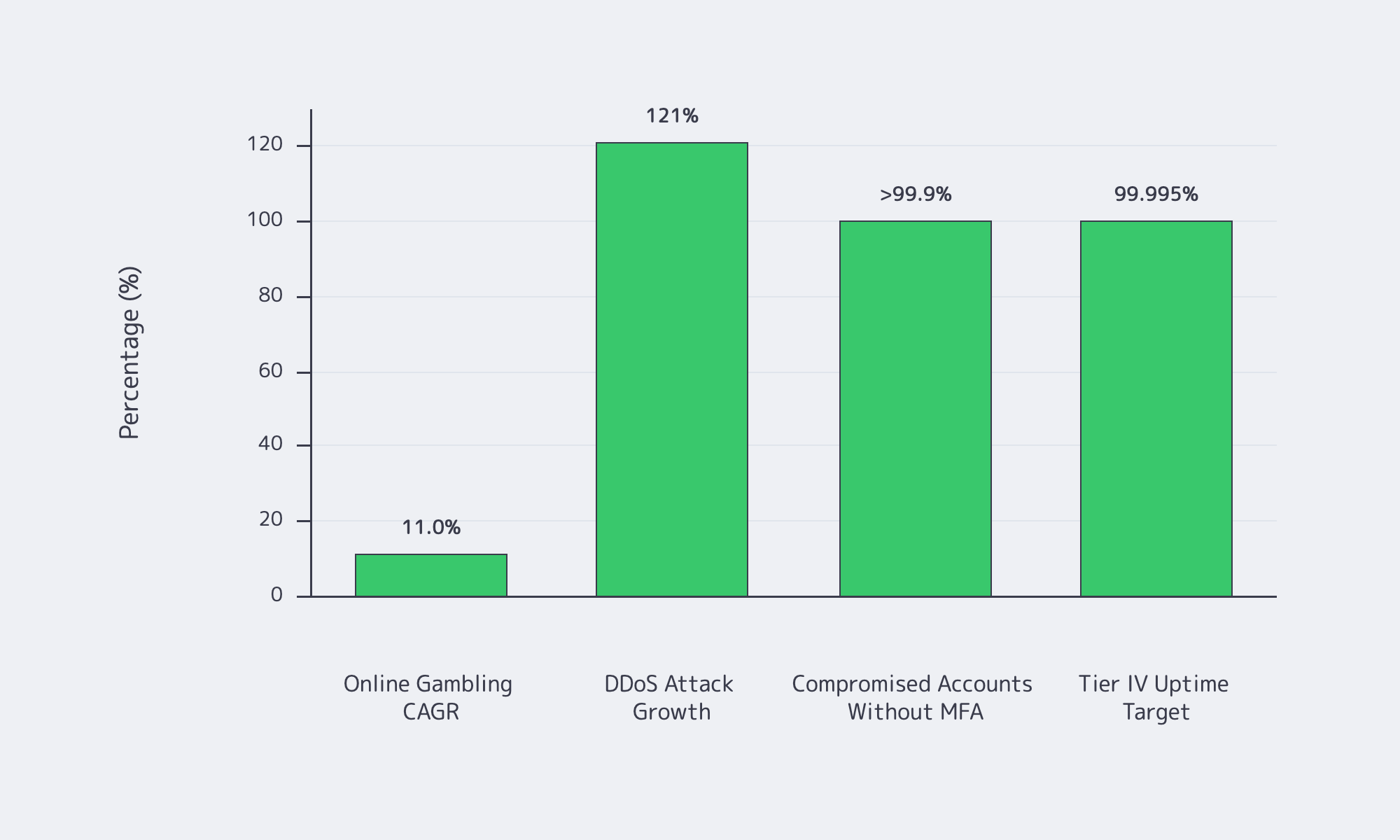
Online gambling has grown into a roughly $97.7 billion market in 2026 with projected double-digit growth. The upside is undeniable; so are the risks. DDoS pressure is escalating, too: attacks surged 121% in 2025, and Cloudflare ranked gambling and casinos and gaming as the third- and fourth-most attacked industries in Q4. The stakes aren’t just technical: the global average breach cost reached $4.4 million in IBM’s 2025 report. In this environment, compliance is inseparable from security, and both are inseparable from infrastructure choices. This guide explains how dedicated hosting anchors modern iGaming compliance and security—focusing on data sovereignty, robust controls (encryption, DDoS resilience, MFA), and audit-ready operations—while addressing emerging threats and evolving rules without dwelling on legacy practices.
Choose Melbicom— 1000+ ready-to-go servers — 21 Tier III/IV data centers — 40 PoPs in 35 countries |
|
Why Dedicated iGaming Hosting Is Different
iGaming compliance dedicated hosting is different because the server location, tenant isolation, access controls, and evidence trail all affect licensing risk. A compliant setup must keep regulated data in approved jurisdictions, separate critical gaming systems from shared infrastructure, and produce logs auditors can verify quickly.
- Data localization and sovereignty. Player and wagering data often must remain in-country. Dedicated servers make it straightforward to pin workloads to a specific jurisdiction when licenses bind compute and storage locally.
- Secure facilities and hardware. UK Gambling Commission guidance requires any server used in the gaming process to be housed securely, with audit trails and backup requirements. Facility standards matter: Tier IV and Tier III data centers signal fault tolerance and layered security aligned to audit checklists.
- Audit trails and accountability. Every financial transaction, gameplay event, change, and access attempt must be logged and retained. Auditors increasingly expect quick retrieval, forensic fidelity, and clear chains of custody.
- Availability and integrity. Uptime and data integrity are compliance issues. Tier IV’s 99.995% target—less than 30 minutes of annual downtime—illustrates the operational bar regulators and players implicitly expect.
- Privacy and data protection. iGaming platforms sit at the intersection of gambling rules and general data protection laws. Encryption, access control, and least-privilege practices are baseline, not “nice to have.”
How Dedicated Servers Meet iGaming Compliance at the Infrastructure Layer

Dedicated hosting is single-tenant by design: one operator, one physical machine. Full OS and network-stack control maps cleanly to compliance.
Data sovereignty you can prove. Operators select exact data centers for each workload—essential for satisfying in-country hosting mandates. Melbicom’s footprint (21 data center locations) lets teams place systems where licenses require, confining regulated data at the jurisdictional edge. When player latency also matters, coupling compute with CDN keeps content close without moving regulated data.
Auditability down to the serial number. Single-tenancy simplifies audits. You can provide hardware identifiers, rack placement, and access logs, and you can show who touched what, when. Disk-level evidence is far easier to produce when no other tenants share the device. On multi-tenant platforms, regulators often balk at black-box layers; on dedicated servers, you can show the physical chain of custody.
Control that fits the rulebook. Some jurisdictions require certified RNGs, specific crypto modules, or validated OS/database versions. Dedicated servers let engineering teams harden kernels, pin versions, and schedule patch windows around peak betting periods—without waiting for an abstracted cloud to expose the right knobs. That control extends to configuration baselines aligned to internal policy and external rules, and to evidence generation for audits.
Facility standards that check boxes. Ensuring dedicated servers are hosted within modern Tier IV or III data centers aligns infrastructure resilience with regulator expectations on integrity and availability.
Capacity without co-tenancy risk. iGaming traffic is spiky by nature—major events can multiply load in minutes. With up to 200 Gbps per-server bandwidth, Melbicom’s network helps absorb legitimate surges while giving room for upstream DDoS mitigation to work. The crucial point for compliance: performance during peaks protects fair-play guarantees and reduces operational incidents that can trigger reporting duties.
For teams that must defend design choices to both executives and auditors, this is the elevator pitch: dedicated servers make where data lives, who can access it, and how it’s safeguarded demonstrably clear.
Dedicated Server Security: Encryption, DDoS Resilience, MFA, and Continuous Monitoring

Build a minimal-trust path: edge → WAF → app tier → transaction services → databases, each on distinct servers or server groups. Enforce mutual TLS between tiers, bind secrets to hardware, and log every hop with integrity checks.
Encryption at rest and in transit. Full-disk encryption protects logs and databases if media are removed; app-level encryption protects the most sensitive tables. Keys should live in HSMs or secure modules under operator control. On the wire, TLS 1.3 with modern ciphers is the baseline. Some teams are already planning for post-quantum crypto in high-value paths. Dedicated servers let you choose libraries and rotate keys on your cadence.
DDoS resilience and network controls. Because gaming absorbs a disproportionate share of global DDoS, network design must assume sustained volumetric attacks and low-and-slow Layer-7 campaigns. Dedicated servers integrate with upstream scrubbing, anycast routing, and rate-limiting at the edge; coupling with a global CDN soaks static load at distance while keeping regulated data anchored. The objective is compliance-grade availability: stay up, stay fair, and log precisely what happened.
Access control with MFA everywhere. Least-privilege access, hardware-backed admin credentials, and per-service identities shrink the blast radius. MFA is one of the highest-leverage account controls: Microsoft reports that more than 99.9% of compromised accounts lack MFA. On dedicated servers you can enforce MFA for SSH/RDP, PAM, and back-office apps, tie privileges to change windows, and record every privileged session.
Continuous monitoring as a control, not an afterthought. SIEM pipelines pull logs from OS, runtime, database, and network layers; detections blend rules with ML to distinguish finals-night surges from credential-stuffing. Continuous vulnerability scanning and configuration compliance checks replace slow, point-in-time reviews. When something drifts—a weak cipher sneaks back in, a port opens unexpectedly—the system alerts and, where policy allows, auto-remediates. Paired with disciplined patch ops, this not only reduces risk but also yields audit-ready artifacts: evidence of controls working, in real time.
Fraud and game-integrity analytics at the host. Because you control the box, kernel-level agents can watch for tampering, RNG anomalies, or bot signatures without violating provider terms. That protects fairness and gives auditors telemetry for game-integrity checks.
Threats, Rules, and Modern Answers
The threat model is changing fast. Attackers now combine AI-enhanced social engineering (e.g., deepfake voice phish), double-extortion ransomware, and API abuse aimed at payments and game providers. They probe for software supply-chain weaknesses and attempt to manipulate outdated game logic. Meanwhile, regulators add jurisdictions and tighten expectations on reporting, retention, and transparency. The cost of getting it wrong—fines, lawsuits, license jeopardy—keeps rising.
Modern countermeasures fit naturally on dedicated infrastructure:
Zero Trust and segmentation by default. “Never trust, always verify” between services. Place player databases, transaction processors, and game engines on separate server groups; require identity-aware proxies and mutual authentication for every call. If one tier is compromised, it can’t pivot. Dedicated hosting makes these guarantees concrete because topology is fixed and inspectable.
Compliance as code. Express the rulebook—approved ciphers, closed ports, password and key policies, file integrity monitoring, retention windows—as machine-readable baselines. Agents verify and enforce continuously, not quarterly. Drift becomes a ticket or an automated fix. During audits, you hand over change histories and control effectiveness reports rather than screenshots.
Automated audit support and regulator visibility. On dedicated servers, evidence collection is programmable: access logs, change manifests, performance and availability metrics, and signed configuration snapshots can be generated on demand. Where a regulator requires near-real-time supervision, expose a tightly scoped read-only feed without handing over operational control.
Operational agility to keep pace with rules. When a market introduces new data handling or reporting requirements, dedicated environments let teams implement them immediately—no waiting for a multi-tenant platform to expose features. That agility matches a broader infrastructure shift: IDC notes that only 8–9% of companies plan full workload repatriation, while most repatriate specific workload elements such as production data, backup processes, and compute resources. In iGaming, that selective control translates directly into faster market entry and cleaner audits.
Auditor-Friendly Architecture Under Load
- Regional clusters for sovereignty. For each licensed market, deploy a jurisdiction-bound cluster: app/API, transaction services, and databases on dedicated servers inside the required borders. Keep PII and bet records local; replicate only what’s lawfully allowed, ideally in encrypted, minimized form.
- Global delivery without data sprawl. Use a CDN to cache static content worldwide and terminate traffic close to players, while keeping stateful workloads in the regulated region. This balances latency with sovereignty.
- Defense in depth with measurable controls. WAF and rate-limits at the edge; mutual TLS internally; FDE + HSM-bound keys at rest; SIEM-driven monitoring; and automated checks that produce CI/CD and runtime evidence.
- Capacity engineered for spikes. Size for “finals night,” not Tuesday morning. Melbicom’s per-server bandwidth headroom supports burst handling while upstream mitigation scrubs attack traffic. Overprovisioned, isolated tiers prevent a noisy app from starving the transaction path.
One Compliance-Security Problem

iGaming platforms don’t get to choose between speed, compliance, and safety—they must deliver all three. Dedicated hosting makes that tractable. By fixing data sovereignty at the infrastructure level, isolating critical services, and enforcing encryption, DDoS resilience, MFA, and continuous monitoring, teams reduce both the probability and the blast radius of failure. Just as important, single-tenant transparency makes audits faster and cleaner: where data lives, who accessed it, and what changed are questions the environment can answer with evidence.
Melbicom’s role in this picture is pragmatic. 1000+ ready-to-go servers placed in the right data centers satisfy localization; Tier III and Tier IV data centers align with resilience goals; up to 200 Gbps per-server bandwidth and 40 CDN PoPs across 35 countries support both peak traffic and robust edge defenses; and global reach enables jurisdiction-by-jurisdiction deployments. The result is an infrastructure posture that lets engineering prioritize fairness, availability, and trust—while compliance teams get the auditability they need.
Launch Your Dedicated Server
Deploy gaming-ready dedicated servers in your required jurisdiction today. Choose from 1000+ dedicated servers with Tier III & IV facilities, ready-to-go deployment, and up to 200 Gbps bandwidth.
Get expert support with your services
Blog

Evaluating Mobile App Hosting Server Costs: Budget for Growth
Mobile apps have gone from side projects to top-10 downloads overnight on the news cycle. The cost of infrastructure typically increases when adoption rises. A structured cost-projection model enables the founder to manage the growth rather than be a bill chaser. The discussion below outlines the four forces that drive the hosting bill, compares the three prevailing backend architectures currently available, and explains how FinOps practice and more advanced sustainability metrics turn raw infrastructure into competitive advantage.
Choose Melbicom— 1000+ ready-to-go servers — 21 Tier IV & III data centers — 40 CDN PoPs in 35 countries |
 |
How Much Does a Mobile App Hosting Server Cost and What Drives It?
A mobile app hosting server budget is driven less by total installs than by peak concurrent users, media volume, push fan-out, and regional latency requirements. Small apps can stay mostly cloud-based; once traffic becomes predictable, dedicated servers and CDN offload can improve unit economics by turning variable egress and compute into planned capacity.
| Driver | Why It Matters | Typical Cost Trigger |
|---|---|---|
| User concurrency | Determines CPU, memory, DB connections | Instance count, cluster size |
| Media weight | Images & video dominate traffic mix | Bandwidth and storage fees |
| Push traffic | Notifications create bursty loads | Elastic instances, queue capacity |
| Regional latency | Global users expect low RTT | Extra PoPs, data-sync overhead |
User concurrency
Your baseline fleet is determined by the peak concurrent sessions, not the monthly active users. Each node has a limit on the number of requests per second; when that is exceeded, a different server (or VM) is brought online. Repatriating a database-intensive load, 37signals saved nearly $2 million a year (Data Centre Dynamics), proving once again how fixed capacity flattens unit cost when concurrency goes above a few tens of thousands.
Media weight
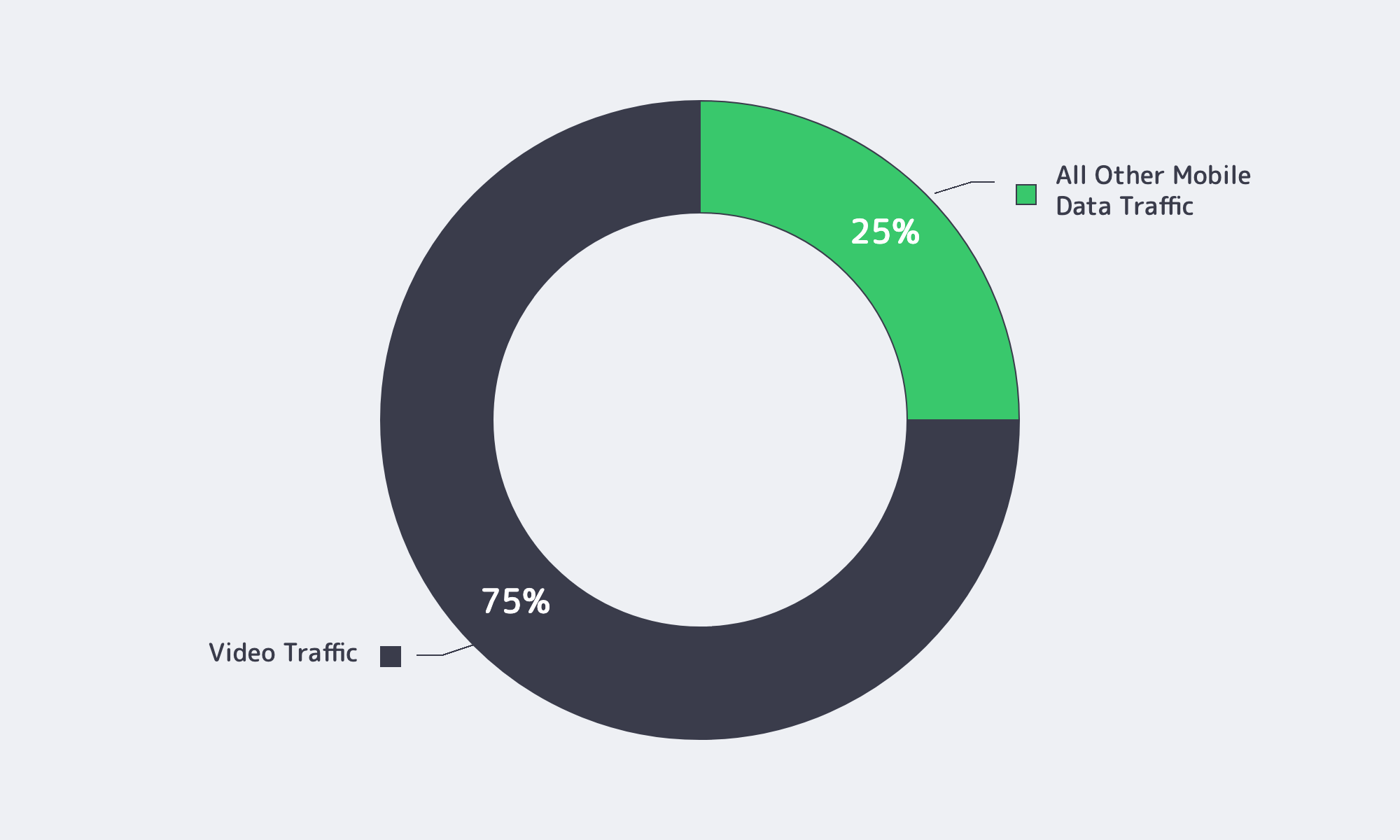
Video remains the largest mobile data driver, accounting for around 75% of all mobile data traffic at the end of 2025 (Ericsson Mobility Report). At cloud-list rates of $0.08–$0.12 per GB egress, 50 TB/month streaming translates to a $4,000–$6,000 line item. Dedicated servers can use unmetered ports; combining them with a CDN that offloads repeat hits can protect origin bandwidth and make egress costs easier to forecast before traffic spikes.
Push traffic
The average app user receives 46 push notifications per day (MobiLoud). A single fan-out of one million devices can increase backend load 10x within a minute. Cloud auto-scaling increases resiliency against downtime but is billed per second at the peak capacity. Hardware does not suffer surprise invoices, but either requires headroom provisioning or throttling queues.
Regional latency
Rule of thumb: each 100 km of fiber adds about 1 ms round-trip. For highly interactive app flows, sub-100 ms RTT is a practical planning target; an often-cited Amazon benchmark found that every 100 ms of latency could cost 1% in sales (GigaSpaces). Satisfying the threshold implies placing compute close to audiences or putting a CDN in front. Melbicom delivers 21 Tier IV and Tier III data centers, including Tier III & IV DCs in Amsterdam, plus 40 CDN PoPs across 35 countries, without the need to stitch together a patchwork of vendors.
Sample Cost Projection: 10 K vs 1 M MAUs
| Monthly Users | Hosting Model | Baseline Servers | Peak Cloud Nodes | Monthly Cost* |
|---|---|---|---|---|
| 10 K | Pure cloud | — | 8 | ≈ $2.9 k |
| 10 K | 1 dedicated + cloud burst | 1 | 2 | ≈ $2.0 k |
| 1 M | Pure cloud | — | 120 | ≈ $124 k |
| 1 M | 14 dedicated + CDN + burst | 14 | 20 | ≈ $66 k |
Assumptions: 150 requests per user / day; 500 MB media/user / month; 40 % CDN hit ratio; cloud egress $0.09/GB; dedicated bandwidth unmetered. Committed pricing: 1 mid-range server at $1.4 k/mo; 14 premium 32-core/200 Gbps servers at $4 k/mo each. Pure-cloud totals include managed DB, storage I/O, and monitoring charges.
Two lessons stand out
- Unit economics curve early. In this model, cloud is already more expensive than a single dedicated server at 10 k MAUs, and the difference widens rapidly beyond roughly 25 k MAUs.
- Media-intensive budgets are dominated by bandwidth. Offloading 40 percent of traffic to a CDN and pushing the rest through high-throughput dedicated ports can reduce total spend by approximately half when traffic gets heavy.
Choosing Among Today’s Hosting Options
Dedicated servers
Monthly physical machines work best when workloads are steady and predictable.
- Cost efficiency at scale. No premium per virtualization; the price per core decreases with the utilization.
- Consistent performance. Single tenancy prevents noisy-neighbor effects. Amsterdam ports scale up to 200 Gbps for heavy video traffic.
- Predictable budgeting. A single invoice; no surprise scale-outs.
Trade-offs: Capacity expands in step-function increments and requires lead time (Melbicom maintains 1000+ ready-to-go servers). Operating systems still need to be patched by Ops teams, and clustering has to be managed.
Autoscaling cloud fleets
The most popular launch pad remains the public cloud.
- Instant elasticity. Instances are ready in minutes, removed when idle; ideal to deal with viral spikes or A/B tests.
- Managed ecosystem. Databases, queues, observability through API.
- Granular billing. Pay by the second—until traffic slows down.
Drawbacks: Flexera’s 2026 State of the Cloud report estimates wasted cloud spend at 29%, while 63% of organizations now rely on FinOps teams to advise on, manage, or execute cloud cost optimization strategies (Flexera). Once a baseline is reached, dedicated hardware becomes less costly; a FinOps discipline is required.
Edge CDNs
Edge networks work around latency and reduce egress bills.
- Asset offload. Static media delivered close to users at predictable per-GB rates.
- Edge compute. Light scripts run near users for auth and personalization.
- Global reach, minimal footprint. Being able to have only one origin plus CDN can be cheaper on a per-user basis than multi-region backends.
Restrictions: stateful services still use central data stores, and per-request metering can become expensive as API calls move outward.
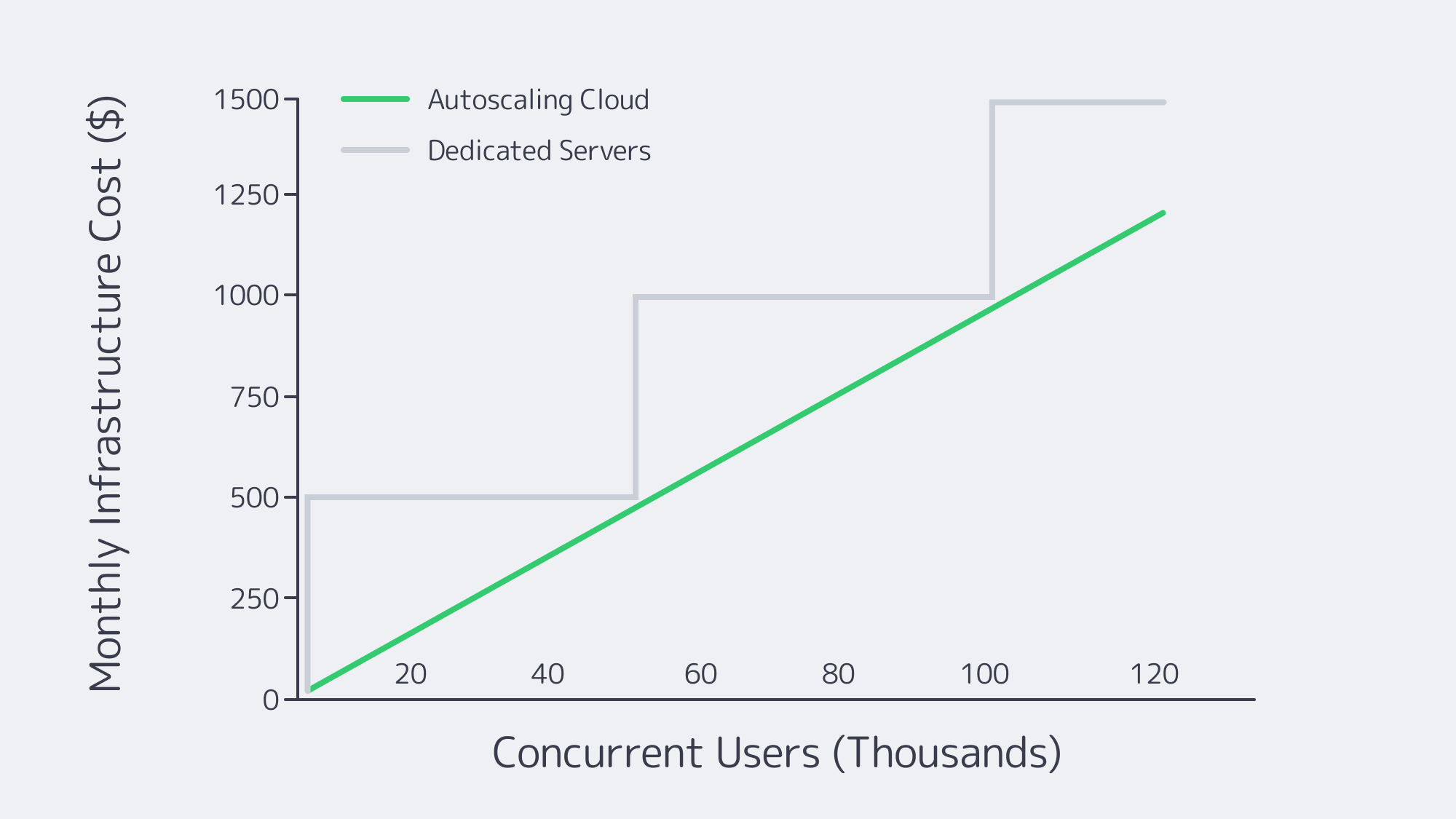
Cloud costs rise in lock-step with traffic; dedicated hosting spend climbs only when another server is added. Apps with high baselines hit break-even quickly.
Hybrid playbook in practice
Most rollouts begin all-cloud. At ~50 k DAU, the bill triggers a migration: the primary database and transcoder move to two dedicated boxes in Melbicom’s Amsterdam facility. Elastic cloud front ends continue to scale. A CDN layer serves/caches ~80 % of origin hits. Latency goes down, costs remain stable, growth persists—the prototypical hybrid pivot that every scale-focused founder should plan.
FinOps and Sustainability Governance
FinOps treats infrastructure as inventory: monitor usage, manage waste, and relate spend to revenue.
- Cost visibility. Tag resources, surface spend by feature.
- Continuous rightsizing. Turn off idle VMs, scale back oversized DBs, migrate consistent load to dedicated lower cost hardware.
- Smart commitments. Maintain a mix of reserved cloud, spot VMs and dedicated leases to achieve the best combination of flexibility and discounts.
- Automated schedules. Dev/test clusters that sleep during the night save 20-30 % of monthly charges.
Flexera’s 2026 State of the Cloud report estimates that 29% of IaaS and PaaS cloud spend is wasted and that 63% of organizations now rely on FinOps teams (Flexera).
The new multiplier is sustainability. Uptime Institute’s 2025 survey puts the weighted average annual PUE at 1.54, while many new high-latitude facilities in North America and Europe report PUEs of 1.3 or better (Uptime Institute). Equinix reported 96% renewable energy coverage across its retail IBX data centers in 2025 (Equinix). Compression of idle cycles, region selection, and aggressive use of caching reduce carbon and cost, now reported together as two KPIs.
From cost center to competitive edge
The FinOps dashboards that demonstrate the cost per push or carbon per signup, along with the latency charts, contribute to better code. Optimizing a single hot query can cut database spend by double-digit percentages; multiplied across microservices, those savings can fund entire feature sprints.
Sustainability planning is becoming more data-driven as well. For European workloads, the European Environment Agency now publishes country-level greenhouse gas intensity for electricity generation, and its 2025 update identified Sweden, Finland, and Luxembourg as the lowest-intensity EU producers in 2024 (European Environment Agency). Pairing those grid signals with latency, utilization, and infrastructure choices turns cost and carbon optimization into a sales opportunity rather than a compliance burden.
How to Future-Proof Your Mobile App Backend with a Hosting Server

The three attributes, cost, performance, and sustainability, are no longer in conflict. Plan your concurrency, media, push, and latency plots; forecast when cloud premiums sink their teeth; pre-provision bandwidth where video reigns; and deploy edge caches where RTT is critical. Hybrid architectures—dedicated servers in the steady core, cloud bursts at the peaks, CDN PoPs at the edges—provide applications with the runway to go viral without head-spinning invoices, provided FinOps keeps the spotlight on unit economics.
Spin Up a Dedicated Server Today
Deploy premium hardware with up to 200 Gbps ports and global CDN support, then keep hosting costs predictable as traffic grows.
Get expert support with your services
Blog

Dynamic BGP: Faster, Safer Networks for Growth
Organizations are spreading workloads across public clouds, edge equipment, and a wider array of data-center locations. In this environment, the routing model in place today can decide whether tomorrow’s network becomes a business engine or a bottleneck. Static routing still appears in many diagrams because it is visually clean: an engineer manually enters a next-hop address, commits the change, and the route takes effect. But adding a new subnet, signing a new carrier contract, or responding to an outage still requires another manual edit. According to Uptime Institute, nearly 40% of organizations have had a major outage caused by human error over the past three years, and 85% of those incidents stemmed from staff failing to follow procedures or from flawed processes. A 2016 Ponemon Institute/Vertiv benchmark put average data center downtime costs near $9,000 per minute. Manual static routing magnifies both risks by inviting errors and delaying recovery.
Choose Melbicom— 1000+ ready-to-go servers — 21 global Tier IV & III data centers — BGP sessions with BYOIP |
|
Dynamic routing with the Border Gateway Protocol (BGP) replaces that fragility with automation. Routers advertise what they can reach, learn what other routers can reach, and converge on the best policy-compliant path. In controlled designs, a link failure causes the advertisement to disappear and traffic to be redirected without a manual route edit. When a new site appears, its prefixes are distributed without opening tens of SSH sessions. The same protocol that exchanged roughly 1.2 million advertised IPv4 prefixes across the public Internet by early 2026, as shown in an APNIC analysis, can underpin a private fabric, delivering automated path discovery, policy control, and resilience. The next sections compare static routing’s manual overhead with BGP’s intelligence, quantify the resulting savings, and show how we at Melbicom make dynamic routing straightforward.
Where Static Routing Breaks at Scale
Static routes are manually configured statements that never change unless a human changes them (for example, “send 10.12.0.0/16 to 192.0.2.1”). That simplicity works on an access-switch floor that rarely changes. It becomes a maintenance marathon across a mesh of fifteen branch offices spanning two clouds and several partners:
- Manual blast radius. Adding a data-center VLAN may require updates across tens of routers. Each change can introduce a typo, missed hop, or ACL error, creating black holes that take hours to find and fix.
- No automatic failover. Losing a primary WAN circuit keeps traffic flowing into a dead end until an operator reprograms the path, adding minutes that reduce availability and user satisfaction.
- Zero policy intelligence. Static routing has no mechanism to favor lower-cost carriers at peak, pin voice traffic to low-jitter links, or direct European users to a PoP in the EU. Any adjustment needs another human input.
How the Border Gateway Routing Protocol Automatically Controls Resilience
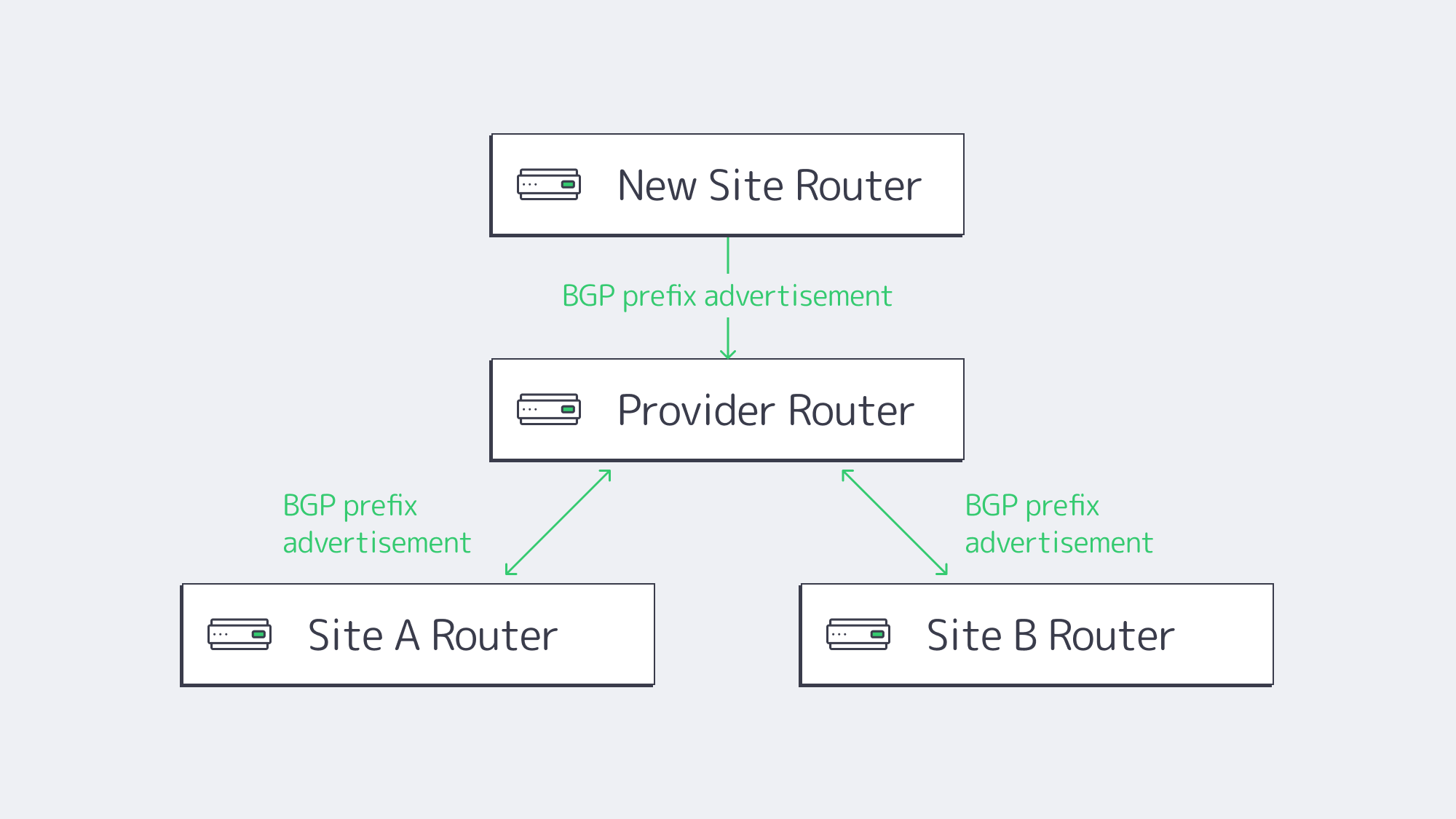
The Border Gateway Protocol assumes networks change and adapts by propagating updates and selecting new best paths. BGP speakers exchange reachability information and tag route announcements with policy attributes. Four capabilities explain why BGP scales where static routing breaks:
- Automated path discovery. As soon as a new prefix is announced, participating routers learn about it without spreadsheet scavenger hunts or midnight console sessions. Withdrawals propagate quickly, so failover in controlled designs can complete before users notice.
- Policy control. Local preference, MED, and communities let architects incorporate business intent, cap traffic on premium circuits, favor low-latency fiber, and guide partner flows through inspection stacks. These policies persist and continue to steer traffic even as the underlying physical paths change.
- Internet-scale resilience. BGP already operates at Internet scale, with more than one million publicly routed IPv4 prefixes. When BGP is paired with Bidirectional Forwarding Detection and sensible timers, many link failures can be detected in sub-second timeframes and rerouted according to policy.
- Observability. Session telemetry exposes flaps, path changes, and upstream anomalies that would otherwise be hidden behind static IP route lines, turning reactive firefights into proactive analytics.
BGP Latency and Cost Gains Across Sites
The advantages of BGP increase in multi-datacenter topologies. Imagine hubs in Los Angeles, Amsterdam and Singapore:
- Anycast service IPs. Each site advertises the same /24. Global routing sends users toward the topologically closest reachable instance, often improving round-trip time for European visitors compared with serving them from North America or Asia, without DNS changes. If the Amsterdam site goes offline, its BGP advertisement is withdrawn and traffic shifts to another advertised site in Los Angeles or Singapore.
- Active-active bandwidth. Two ISPs per site no longer need to operate as primary/backup waste. Local preference steers bulk traffic to lower-cost carriers while reserving premium links for latency-sensitive flows, increasing utilization and reducing billing spikes.
- Link-specific tuning. Loss and jitter monitoring systems can let route-optimization engines shift affected flows with more specific prefixes, keeping contracted gigabits productive and limiting burst charges.
Quick TCO Calculator: Static vs BGP
| Cost Component | Static Routing (Annual) | BGP Dynamic Routing (Annual) |
|---|---|---|
| Engineer labor for route changes | 50 changes × 1 h × $110 = $5 500 | 50 reviews × 0.1 h × $110 = $550 |
| Downtime from slow failover | 2 incidents × 20 min × $9 000 = $360 000 | 2 incidents × 1 min × $9 000 = $18 000 |
| Training & ASN fees | $0 | $4 000 |
| Five-year projection | >$1.8 M | < $120 k |
How to adapt: Enter your own number of incidents, outage minutes and labor rates. Replace the $9,000/min benchmark with your own revenue, productivity, and contractual costs. Many organizations pay back the BGP setup costs in the first avoided outage.
Implementation Notes for Safer Border Gateway Protocol Routing
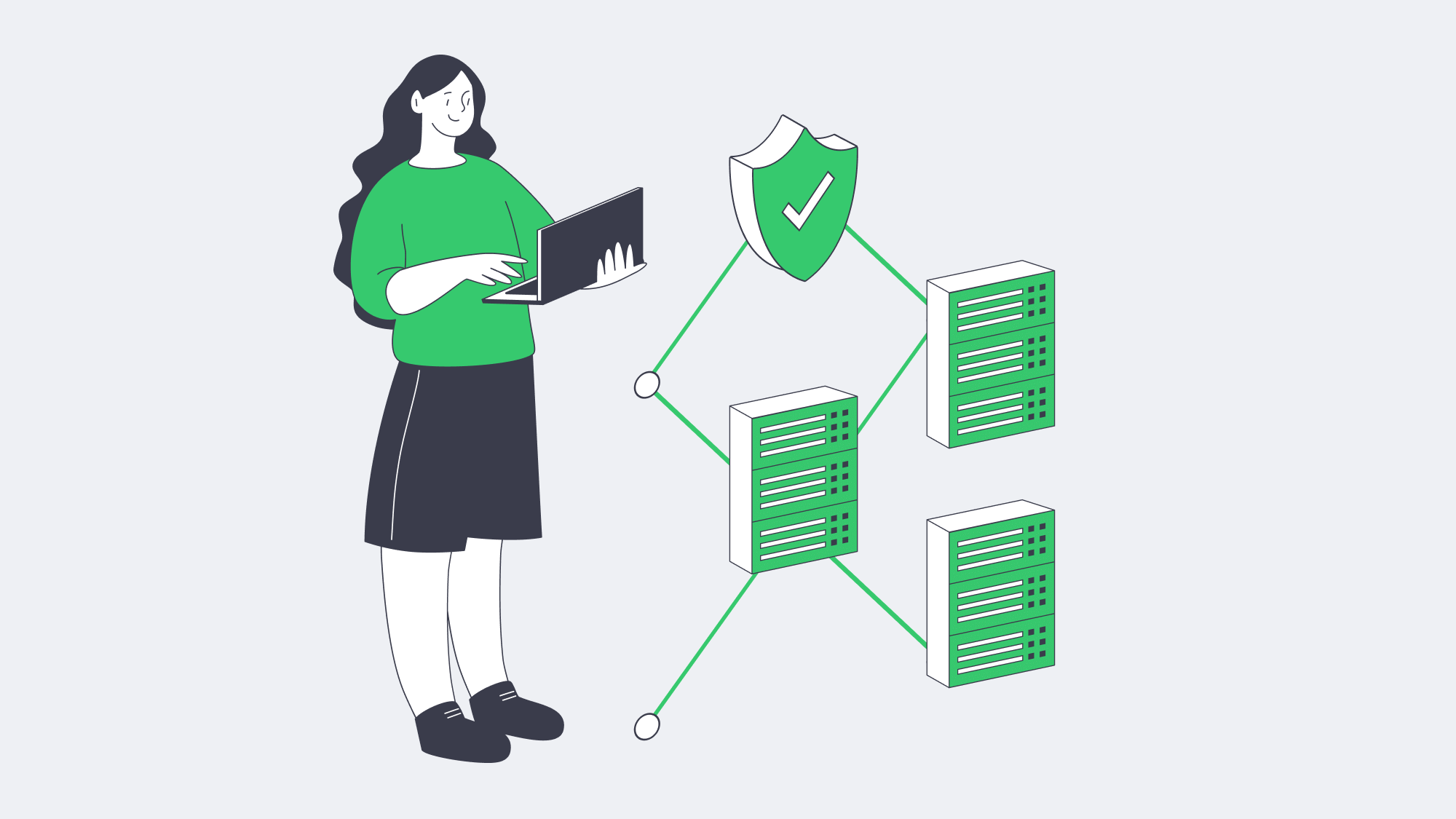
Implementing border gateway protocol routing is not as difficult as it may sound:
- Start at the edge. Connect your primary data centers to upstream providers while leaving the LAN on OSPF or static routing, a low-risk path to quick operational gains.
- Set guardrails. Use import/export filters to block route leaks and full-Internet tables; prefix limits and max-AS-path filters add inexpensive safeguards.
- Automate verification. Unexpected advertisements, flapping neighbors, and policy violations can be identified almost in real time by streaming telemetry, route monitors, and what-if tools.
Security fits in as well. Contemporary implementations combine RPKI origin validation, IRR-based filtering, prefix limits, and segmentation so route advertisements are validated, accepted prefixes stay within policy, and lateral movement is limited after compromise in one workload.
Melbicom Makes BGP a Checkbox
We at Melbicom take away the final obstacles. Dedicated servers and VPS plans support BGP sessions with default, full, or partial route availability. Our BGP Session service supports IPv4 and IPv6, BYOIP, BGP communities, and up to 16 prefixes—ideal for anycast footprints or multi-homed edge nodes. For VPS, pricing starts at $5/month with a 10€ setup fee; for dedicated servers, BGP sessions are free with setup waived. Sessions are available across our 21-site backbone, which includes Tier III & IV DCs in Amsterdam and Tier III sites across Europe, North America, Africa, and Asia, offering up to 200 Gbps per-server connectivity. Our 40-PoP CDN footprint across 35 countries can complement that routing design when applications also need edge caching, lower origin load, and regional redundancy. Our engineers are available 24×7 and fluent in BGP; we can advise prefix planning, policy tuning, and RPKI rollouts when required.
Dynamic Routing as a Strategic Advantage

Static routing was the right solution for some older problems; now it often compounds them. Each manual entry is both a cost and a liability, and the list expands with every new site, circuit, and microservice. The Border Gateway Protocol replaces that brittle spreadsheet with a living, policy-driven map that can heal around failures, reduce latency, and enforce cost controls in real time. In multi-datacenter designs, the gains are measurable: fewer manual edits, faster failover, fewer outage minutes, and infrastructure that scales by policy rather than late-night toil.
For leaders planning the next expansion, dynamic routing is not a luxury feature; it is the operating system of the network. The sooner your routers speak BGP, the faster your business can move at cloud speed.
Order Your BGP Session Now
Enable automatic resilience and traffic engineering with BGP sessions from Melbicom—available across our global backbone.
Get expert support with your services
Blog

Fortress-Like Security for Affiliate Networks on Dedicated Servers
Affiliate marketing’s growth has drawn a parallel boom in cyber risk. The signals are clear: current affiliate marketing statistics estimate that nearly 40% of affiliate traffic can be fraudulent, draining budgets and eroding attribution accuracy. At the same time, DDoS attacks more than doubled in 2025, reaching 47.1 million mitigated events in one major network’s telemetry and threatening tracking, landing pages, and API endpoints when they’re needed most. The result is revenue leakage at multiple layers—acquisition, conversion, and payout—unless the infrastructure is designed to resist modern attack patterns end-to-end.
Choose Melbicom— 1000+ ready-to-go servers — 21 global Tier IV & III data centers — 40 CDN PoPs across 35 countries |
|
The Attack Surface: From Fraudulent Traffic to Record DDoS Volumes
Bots and hostile automation now masquerade convincingly as human visitors, poisoning traffic quality, inflating conversions, and triggering phantom payouts. That near two-fifths fraud estimate isn’t a rounding error; it’s the difference between profitable media buying and unprofitable campaigns that look healthy in reporting but don’t cash-flow in reality. Adversaries also target the high-value niches—adult, crypto, iGaming—where even short outages can derail revenue. On the availability side, volumetric DDoS assaults now arrive at a pace that once qualified as rare “black swan” events, with 2025 attack volume more than doubling 2024 levels in major network telemetry. Affiliates that rely on instant redirects, postbacks, and real-time decisioning are uniquely exposed: if any link in the chain stalls, conversions evaporate, partners lose trust, and reputation suffers.
Historically, networks fretted over lower-grade nuisances—basic click fraud, crude scraper bots, trivial script injections. Those haven’t vanished, but they’re no longer the main story. The center of gravity has shifted to industrialized fraud operations and high-throughput denial attacks, demanding infrastructure, not just point tools, as the primary defense.
High-Performance Dedicated Servers for Affiliate Marketing: The Security Fortress
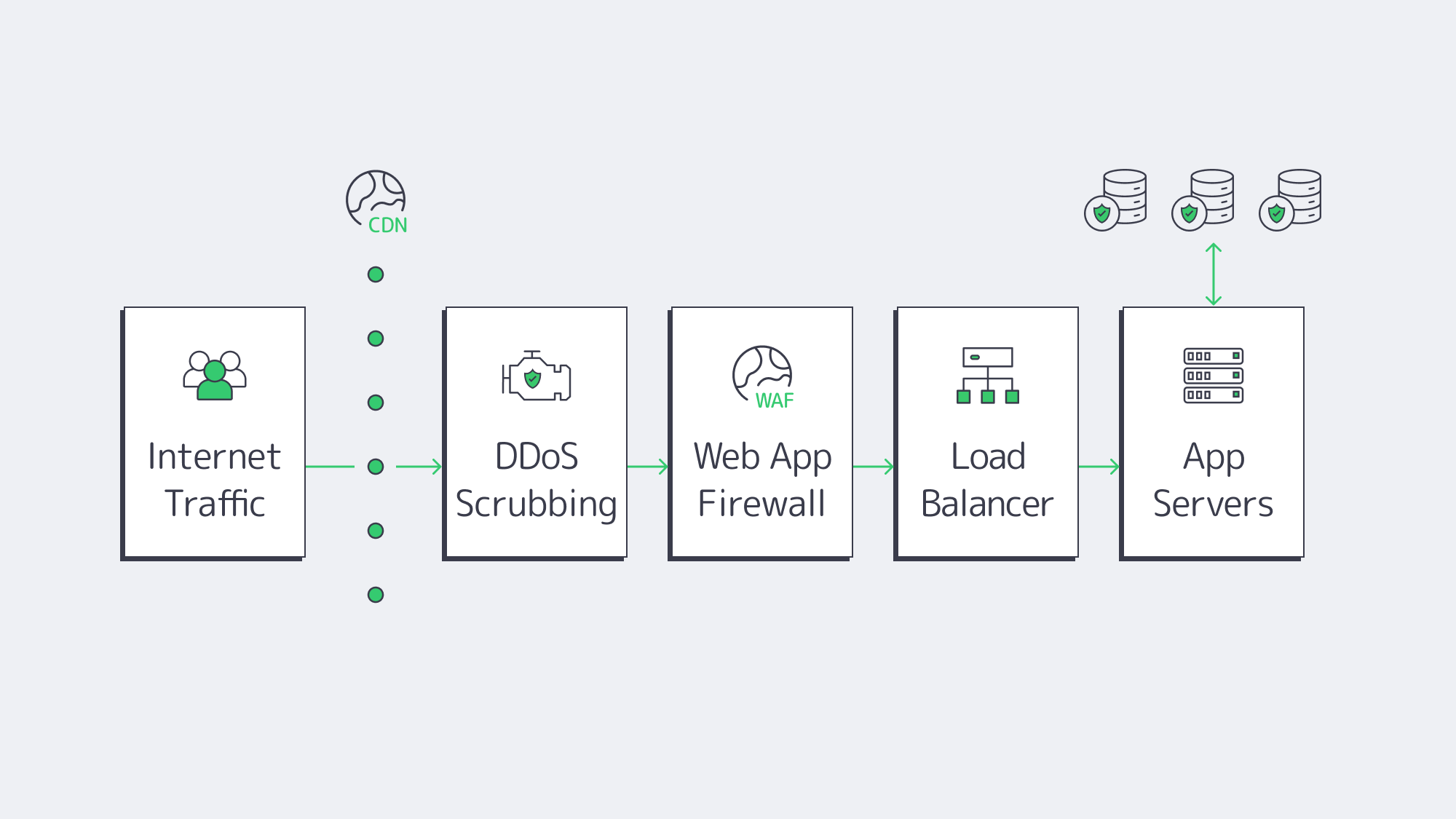
Dedicated servers provide the security posture affiliates increasingly need: isolation, transparency, and control. Single-tenant hardware means a smaller, well-defined attack surface and the freedom to set aggressive policies without worrying about noisy neighbors or cross-tenant risk. More importantly, the dedicated model lets you compose defenses in layers—network, transport, application, and data—so that no single tactic (or single failure) topples the stack.
DDoS mitigation that protects revenue growth
At fortress scale, protection must start upstream—before malicious floods hit your web stack. Network-level scrubbing, rate-limiting, and anomaly detection absorb volumetric surges so legitimate click-throughs, logins, and tracking calls continue to flow. In practice, that means: clean ingress pipes, consistent latency, and far fewer “brownout” conversions during hostile peaks. With 2025 attack volume more than doubling year over year, always-on mitigation is now table stakes rather than an optional add-on.
For placement strategy, geographic distribution matters. Deploying nodes in multiple facilities creates air-gaps between failure domains and gives you more vantage points to shift traffic when a region is targeted. Melbicom operates 21 global data centers featuring Tier IV and Tier III halls—and per-server capacity up to 200 Gbps—enabling high-bandwidth configurations that resist and reroute hostile traffic without sacrificing user experience.
WAF and bot controls: Gatekeeping the app layer
A modern Web Application Firewall (and associated bot management) filters the subtler threats—credential stuffing against login portals, injection attempts on tracking or admin APIs, and fake sign-ups that skew CPA economics. On dedicated servers you can tune rulesets for your actual traffic patterns (e.g., known publisher IP ranges or geo allowlists), deploy deception endpoints, and enforce stricter policies without collateral damage to other tenants—because there aren’t any.
Encryption and key security: Seal the inner core
Strong TLS at the edge and encryption at rest across click logs, conversion tables, and payment records cut off a whole class of regulatory and breach risk. Dedicated environments simplify key management—HSMs, TPM-backed stores, and tight OS-level hardening—so that even if someone touches the storage, they don’t touch the data.
Multi-server redundancy: No single point of failure
Affiliate workflows are chains: source click → redirect → landing page → conversion → postback → payout. Redundancy ensures a break in one link doesn’t snap the chain. Active-active clusters and multi-region failover keep redirectors and tracking online when you’re under duress or during maintenance windows. When combined with a CDN footprint of 40 POP across 35 countries, static assets and cached pages stay close to users while origin traffic stays controlled and predictable.
Performance as Protection: Speed That Preserves Conversions
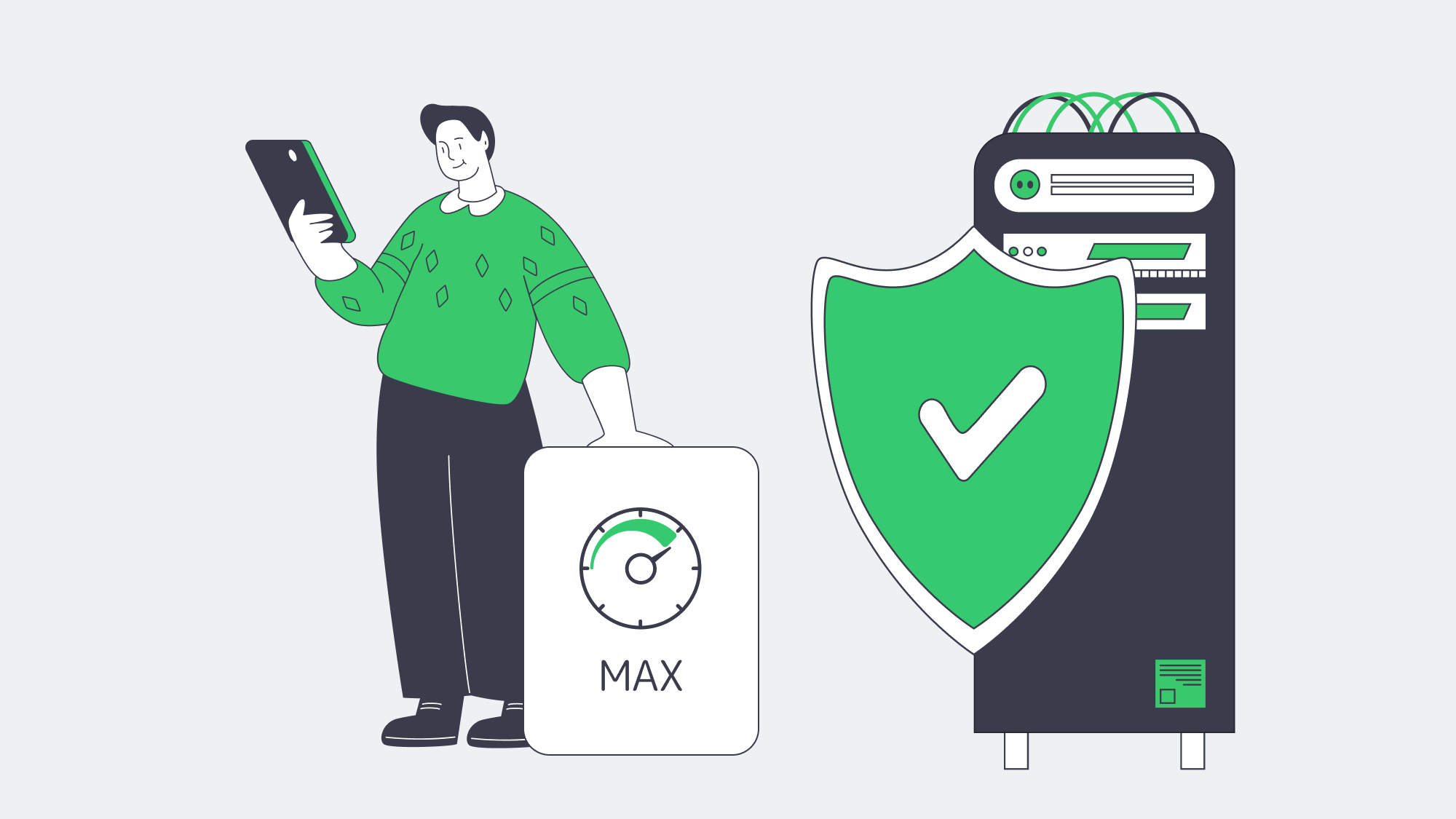
Security hardening must not slow the business. Properly built, fast dedicated hosting for CPA networks delivers the opposite: security and speed. Capacity at the NIC, kernel tuning for high-concurrency HTTP, and modern TLS offload keep latency low while defenses stay engaged. The payoff is tangible: fewer rage-quits on mobile, healthier quality scores, and steadier EPC when campaigns surge.
Reduce affiliate landing-page load times
Reducing time-to-first-byte and keeping render paths lean is itself a fraud- and DDoS-resilience tactic: the less time each session spends in the funnel, the less exposure to synthetic traffic stalls and cascade failures. Caching at the CDN edge plus small, fast origins minimizes origin load under attack and keeps human users moving.
NVMe servers for conversion-rate optimization
For heavy read/write workloads—offer catalogs, stats dashboards, event streams—NVMe storage on dedicated servers cuts I/O wait to a sliver, ensuring tracking writes and analytics reads don’t contend. That throughput headroom preserves consistency under peak loads, which is when campaigns make or lose their ROI.
AI-Driven Detection and Adaptive Controls
Static rules alone can’t keep pace with shifting bot behavior and novel L7 attacks. Affiliates are layering AI-driven threat detection on top of the fortress: models that learn publisher baselines, session dynamics, and conversion semantics, then flag or throttle anomalies in real time. Examples include: collapsing traffic from low-reputation ASNs, quarantining bursts of “too-perfect” user agents, or pausing payouts on statistically impossible conversion paths pending review. Pair that with Zero Trust inside the private network—mutual TLS for services, short-lived tokens, device posture checks for operator consoles—and lateral movement becomes much harder even if a credential leaks.
Critically, AI-assisted controls should be integrated with automated incident response: trigger a geo-shift to a clean region, rotate keys, or ratchet WAF strictness for an affected route—without waiting for a human. On dedicated servers you control the knobs, so playbooks can touch kernel parameters, traffic-steering policies, or CDN rules quickly. The result is a system that learns and adapts as adversaries evolve.
Quick Reference: Threats to Controls
| Threat (typical symptoms) | Revenue risk | Fortress control (dedicated-friendly) |
|---|---|---|
| Volumetric DDoS (timeouts, 5xx spikes) | Lost clicks/conversions; chargebacks | Upstream scrubbing, per-region traffic steering, high-bandwidth uplinks, multi-region origins. |
| Bot fraud (fake clicks/sign-ups) | Wasted budget; polluted attribution | WAF + bot management tuned to traffic patterns; behavioral scoring; allowlists for partners. |
| Credential abuse / panel takeover | Offer hijacks; payout fraud | MFA, device binding, strict rate limits, Zero Trust service mesh; encrypted secrets storage. |
| Origin saturation (flash crowds + attack) | Slow pages; SEO penalties; EPC drop | CDN with 40 CDN PoPs across 35 countries, edge caching; NVMe origins; autoscaling playbooks and request shedding. |
Where Melbicom Fits: The Infrastructure You Control, The Outcomes You Can Trust

The strategic lesson is straightforward: security and performance must be architected—not bolted on. Dedicated servers give you the isolation to run strict policies, the capacity to absorb hostile spikes, and the control to automate incident response. Deployed across multiple regions, with a WAF in front and encryption in depth, your network becomes hard to disrupt and easy to scale. That’s how you protect revenue even as adversaries escalate.
Melbicom aligns to that blueprint. Melbicom operates 21 data centers worldwide, including Tier IV and Tier III facilities, with per-server bandwidth options up to 200 Gbps for traffic-heavy platforms. A CDN with 40 points of presence across 35 countries reduces global latency, and 24/7 support helps teams act quickly when conditions change. These are the ingredients to build the fortress once—and keep it modern as threats evolve.
Order Your Dedicated Server
Secure your affiliate infrastructure with high-performance dedicated servers from Melbicom.
Get expert support with your services
Blog

Reduce Latency With Melbicom’s Multi-Region Servers
PMA study, U.S. affiliate marketing spending rose from $9.1 billion in 2021 to $13.62 billion in 2024, a 14.42% CAGR. That budget pressure makes latency more expensive as campaigns expand beyond traditional data hubs into regions such as the Indian subcontinent and West Africa, where Nigeria alone represents a 200-million-plus market. However, those new clicks arrive with a tough technical ceiling for performance marketers because distance induces latency. For distant origins, extra round trips can push mobile landing pages past the three-second threshold where Google says 53% of visits are likely to be abandoned. When every redirect and pixel fire counts, mere milliseconds can cost revenue: the link has been quantified as “+100 ms = –1% sales” by Amazon engineers, as reported by GigaSpaces.
Choose Melbicom— 1000+ ready-to-go servers — 21 Tier III/IV data centers — 35-country CDN, 40 PoPs |
|
Adding extra CPU is no longer the strategic solution; instead, you have to focus on combating the distance and moving “closer to the click.” At Melbicom, we close that gap with dedicated servers distributed across continents, serving as origins, plus a 40-PoP CDN to help affiliate networks deliver lower-latency user experiences from Los Angeles to Singapore or from Warsaw to Nigeria.
How Do Global Dedicated Server Locations Reduce Latency for Affiliate Platforms?
Global dedicated server locations reduce latency for affiliate platforms by moving dynamic landing pages, click redirects, trackers, and postback endpoints closer to the visitor. That shortens round-trip time before a CDN can help and limits how often mobile users wait through distant DNS, routing, and origin-response delays.
Latency also boils down to physics and routing. Light in fiber travels at a maximum of ~66 µs per 10 km, and that baseline is typically doubled or even tripled by circuitous paths. An AFRINIC-hosted latency study found that many West and Central African in-country paths exceeded 150 ms, with some above 350 ms, while Microsoft’s Azure telemetry reports roughly 200–233 ms P50 RTTs between an India region and common U.S. regions. Affiliate funnels add more round-trip operations from tracker to geo-router before the landing page, which is what can push the total wait time beyond the three-second mark.
Table 1 – The true price of distance
| Hosting setup | RTT pattern for Lagos visitors | Affiliate-funnel risk* |
| Single EU server (Frankfurt) | Longer cross-border path before the origin responds | More delay on redirects, tracking calls, and dynamic landing pages |
| Lagos local server (Melbicom LOS1) | Local Nigerian origin path | Baseline for West Africa testing |
*Actual conversion impact depends on page weight, device mix, carrier routing, and the number of tracking or redirect hops in the funnel.
Even a conservative 100–150 ms latency reduction can matter when it removes multiple handshake, redirect, and origin-response delays from a paid click path. In performance marketing, that difference can separate profitable from break-even campaigns when paid traffic is scaling.
Latency Headwinds in Emerging Markets
- Subscriber surges over weak paths: Over 160 million Africans gained broadband internet access between 2019-2022, according to the World Bank, but many African paths still detour through remote interconnection hubs; AFRINIC-hosted latency research found intercontinental routes averaging around 200 ms while intra-continental routes were typically 50-150 ms.
- Mobile user impatience: Nigeria alone has around 163 million internet users, many of whom connect primarily via mobile devices, according to Trade.gov. Mobile users are often more impatient, meaning every millisecond counts.
- Rich payloads. The heavy JavaScript bundles demanded by popularly accessed services such as crypto dashboards, iGaming lobbies, video segments, and adult HD streams choke narrowband links.
Why Single-Server Hosting No Longer Competes
Once upon a time, a lone data center based somewhere like Amsterdam or Los Angeles was “global enough,” but with modern expansion, it is a liability. The long routes are detrimental to SEO, there is often higher waste in terms of ad spending, and a single server means a single point of failure. An additional CPU at that same site improves nothing for distant visitors. Affiliates that neglect to geo-split their origins in today’s market are essentially risking conversion leaks.
Cross-Border Data-Center Network Architecture for Affiliate Campaigns
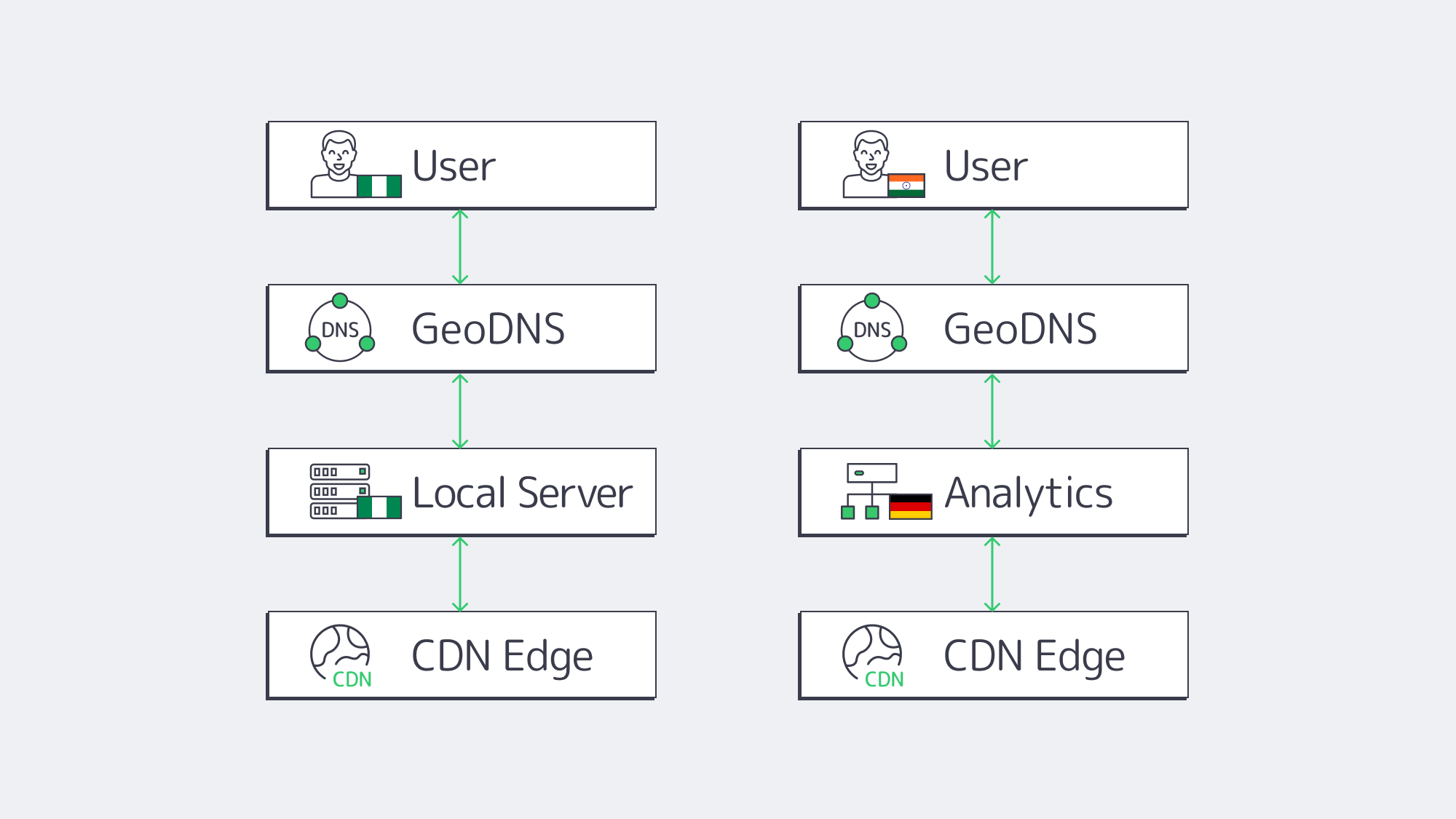
Melbicom supports this architecture with 21 Tier III/IV sites across Africa, Asia, Europe, North America, and South America. Its portfolio includes 1000+ ready-to-go servers, bandwidth up to 200 Gbps per server, a 14+ Tbps backbone, and two-hour activation.
- West Africa, Lagos: Local presence reduces the need to serve Nigeria’s 200 million-plus market and neighboring West African traffic from Europe.
- South Asia, Mumbai: Regional origin placement keeps domestic users on shorter paths, while public telemetry shows India-to-U.S. round trips can exceed 200 ms. The India location sits near major IXPs for regional routing.
- Mediterranean transit, Palermo: The quality scores for North African and Middle Eastern routes improve by up to 80%, thanks to Palermo’s cable-landing position that trims latency by 15–35 ms.
At Melbicom, we can stitch these locations into a multi-region dedicated-server mesh for affiliate marketers using GeoDNS or anycast-style routing patterns that steer traffic to the nearest live node. Real-time portal metrics help flag regional spikes, making it easier to scale horizontally without moving the workload onto shared cloud.
Low-Latency Hosting Beyond the US and Europe
Traditionally, hosting in Los Angeles for the U.S. and Amsterdam for Europe was the general consensus. That still covers core revenue, but growth has headed south and east. For game studios, crypto exchanges, live-play tables, or order-book feeds, Atlanta, Palermo, Mumbai, and Lagos give campaign teams regional origin options for North America, the Mediterranean/Gulf corridor, South Asia, and West Africa instead of stretching every redirect chain from one hub.
Multi-Region Server Benefits
Each Melbicom location uses the same control panel and API, so campaign teams can spin up test servers quickly in any region. We also provide free 24/7 support, enabling campaign architects to do the following:
- Split funnels, keeping heavy personalization or analytics in a single hub by running tracking and click-redirects on light, regional CPU nodes.
- Isolate spikes locally, meaning spikes and overloads such as a weekend iGaming tourney in one region won’t affect another.
- Store data within its respective borders, e.g., EU user data inside EU racks, North American data in Los Angeles, without rewriting app logic.
How Do CDNs and Multi-Region Dedicated Origins Work Together?
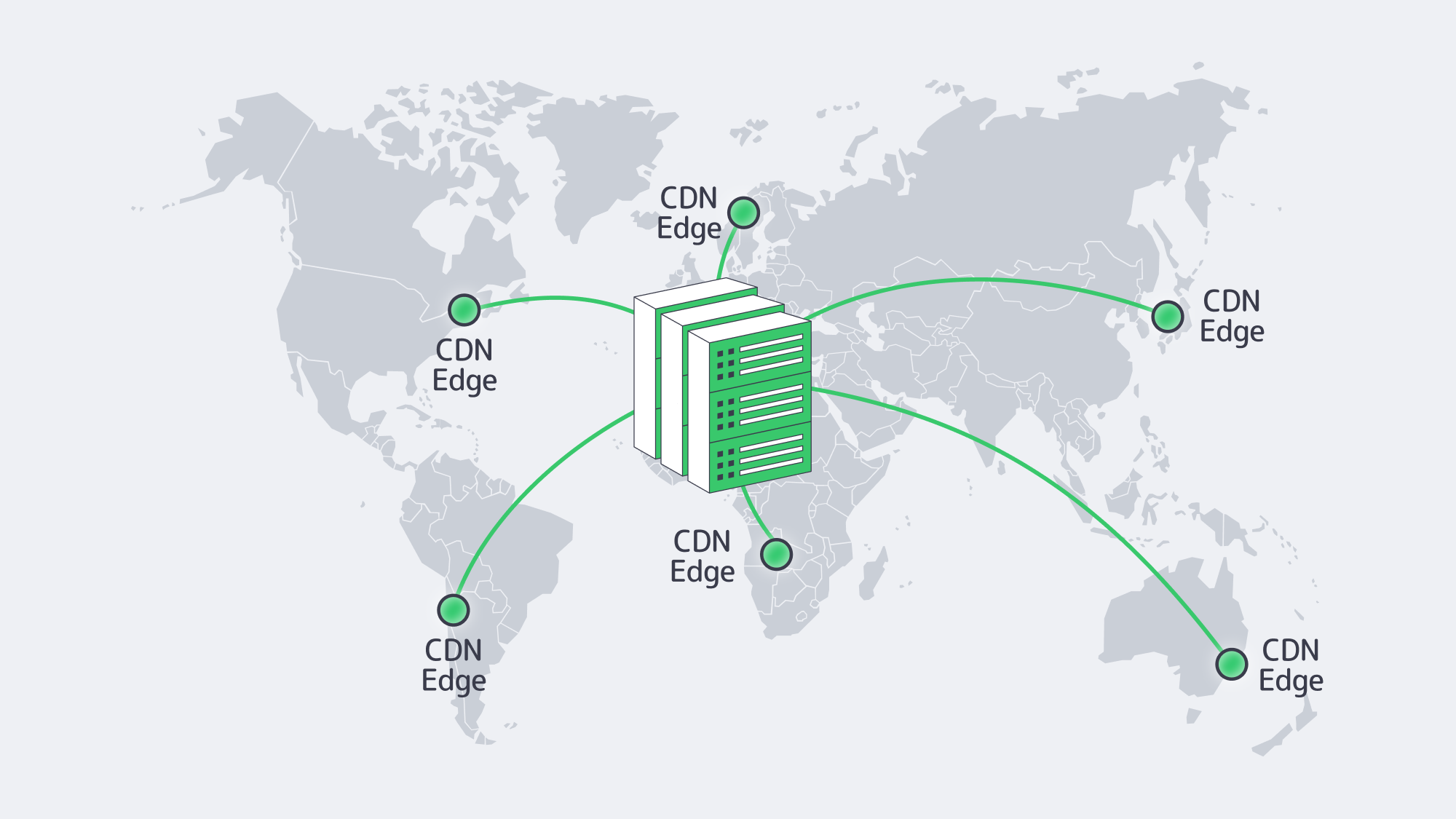
CDNs and multi-region dedicated origins work together by splitting the workload: CDN edges cache static assets near users, while regional dedicated origins answer dynamic requests, redirects, and tracking calls closer to the market. For affiliate campaigns, that pairing reduces origin trips, improves first render, and keeps heavy creative delivery off application servers.
Melbicom’s 40-PoP CDN spans 35 countries across 6 continents and supports geographic request routing, prefetching, one-click cache purge, origin server pooling, and real-time analytics. It is well-suited for landing-page assets, JavaScript bundles, creative libraries, and 4K preview clips because the edge can absorb large static payloads while regional origins handle uncached and dynamic work.
Where a Melbicom CDN PoP and dedicated origin sit in the same city, such as Lagos, local origin placement helps cache-miss traffic avoid unnecessary transoceanic backhaul. That is the practical value of pairing edge caching with multi-region origins: static assets are served from the nearest edge, while cache misses and dynamic calls have a nearby origin instead of a distant default hub.
Together, the CDN and regional origins form a simpler delivery fabric: engineers cache static assets at the edge, keep dynamic responses near users, and reduce paid-traffic waste without redesigning the full application.
Outrunning the Click with Dedicated Servers

Global affiliate marketing was once gated by creative factors and compliance mandates, but today it is being gated by physics. As new users come online, they will expect instant experiences, which means the single-server blueprint has had its heyday. If you don’t want to watch conversions drain away with every extra round trip, then you need to look to infrastructure that helps accelerate growth, not throttle it. Melbicom provides servers and CDN edges close to emerging audiences, helping affiliate infrastructure support growth rather than throttle it.
Get low-latency hosting today
Deploy a performance-tuned dedicated server in any of Melbicom’s 21 global data centers and reach your audience in milliseconds.
Get expert support with your services
Blog

Choosing Dedicated Server Storage: HDD, SSD, or NVMe?
Storage speed, scale, and cost are the lifeblood of modern infrastructure. When you’re tuning an AI training cluster, pushing multi-gigabit video streams, or safeguarding years of company records, the decision to use hard disk drives (HDDs), SATA solid-state drives (SSDs), or NVMe SSDs will determine both user experience and bottom-line economics. In this concise reference, we compare the three media in terms of latency, IOPS, reliability, power consumption, and cost-per-terabyte, then align them with the workloads that consume the most dedicated-server storage.
Choose Melbicom— 1000+ ready-to-go servers — 21 Tier III/IV data centers — 40 CDN PoPs across 35 countries |
|
From HDD to NVMe: Storage Evolution
Data centers were dominated by spinning disks until post-2018 price declines made flash viable at scale. SATA SSDs removed mechanical delay and cut access time to microseconds instead of milliseconds. NVMe links flash directly to PCIe, eliminating the final SATA bottleneck with 64,000 parallel queues and multi-gigabyte-per-second throughput. The goal is to combine media intelligently, not pick one winner.
How Do HDD, SSD, and NVMe Compare on Latency, IOPS, and Throughput?
| Storage Type | Typical Random-Read Latency | 4 KB Random IOPS | Max Sequential Throughput |
|---|---|---|---|
| HDD (7,200 RPM) | 4–6 ms | 170–440 | ≈ 150 MB/s (up to 260–275 MB/s peak on outer tracks) |
| SATA SSD (6 Gbps) | 0.1 ms | 90,000–100,000 | ≈ 550 MB/s |
| NVMe SSD (PCIe 4.0) | 0.02–0.08 ms | 750,000–1,500,000 | 7,000 MB/s |
Latency
The seek and spin delay of a hard drive is roughly two orders of magnitude slower than flash. In high-touch apps, such as transactional databases, virtual-machine hosts, and API backends, that delay is repeated across millions of operations and can become the bottleneck users perceive.
IOPS
A few hundred random operations per second is the maximum sustained by an HDD, and one busy table scan can consume it. SATA SSDs reach roughly 90,000 IOPS, while PCIe 4.0 NVMe drives surpass 750,000 and premium models approach or exceed 1 million IOPS. For workloads that generate thousands of simultaneous I/O threads, NVMe is the only interface that maintains shallow queue depths and high CPU utilization.
Throughput
Bandwidth matters most to sequential tasks such as backup jobs, video streaming, and model checkpointing. A 1 TB data set can be transferred by one NVMe SSD at 7 GB/s in less than three minutes, whereas it takes almost two hours to do the same with an HDD. The difference is even larger on PCIe 5.0, where enterprise drives can exceed 14 GB/s.
Which Storage Is Most Reliable—and How Do DWPD Ratings Matter?

Both HDDs and enterprise SSDs claim mean time between failures in the millions of hours, but the modes of failure are different:
- HDDs have mechanical wear, vibration sensitivity, and head crashes. They often provide SMART warnings before failure; failed platters can sometimes be imaged by labs.
- SSDs have no moving parts and can show lower annualized failure rates in some fleets, but flash cells have finite program/erase endurance. Enterprise models express endurance as drive writes per day (DWPD); read-intensive TLC models are commonly around 0.3 DWPD over five years, while mixed- or write-intensive SKUs can provide 1–3 DWPD or more. They rarely recover gracefully after controller or NAND failure.
Practical takeaway: mirror or RAID any media that stores irreplaceable data, over-provision SSD space on write-heavy workloads, and keep drive bays cool to extend drive life.
How Do HDD, SSD, and NVMe Compare on Energy Use and Cost per TB?
An enterprise HDD often idles around 5–6 W, while SSD power varies widely by capacity, form factor, and performance tier. A high-end NVMe drive can draw 10 W or more under sustained load, but it also finishes many jobs much faster. Consider work-done-per-watt instead: NVMe delivers far higher IOPS-per-joule, while large HDDs remain strong in capacity-per-watt. SNIA notes that device-level power comparisons can flip when workload, transfer size, and storage architecture change, so archival designs should evaluate watts per terabyte and access pattern rather than idle watts alone (SNIA).
Cost follows the same pattern, even though exact street prices move weekly. HDDs remain the lowest media-cost option for petabyte-scale capacity, SATA SSDs occupy the middle ground, and enterprise NVMe still carries a premium for latency, IOPS, endurance, and PCIe lanes. Electricity, rack space, and cooling can narrow the gap, especially with dense SSDs, but media cost remains the biggest lever in bulk dedicated server storage.
Which Storage Fits Each Server Workload?
Dedicated server storage should match media to workload heat: NVMe for latency-sensitive AI, transactional logs, and high-concurrency VMs; SATA SSD for mixed read/write services and cache layers; and HDD for bulk archives, backups, and sequential media libraries where cost per terabyte matters more than response time.
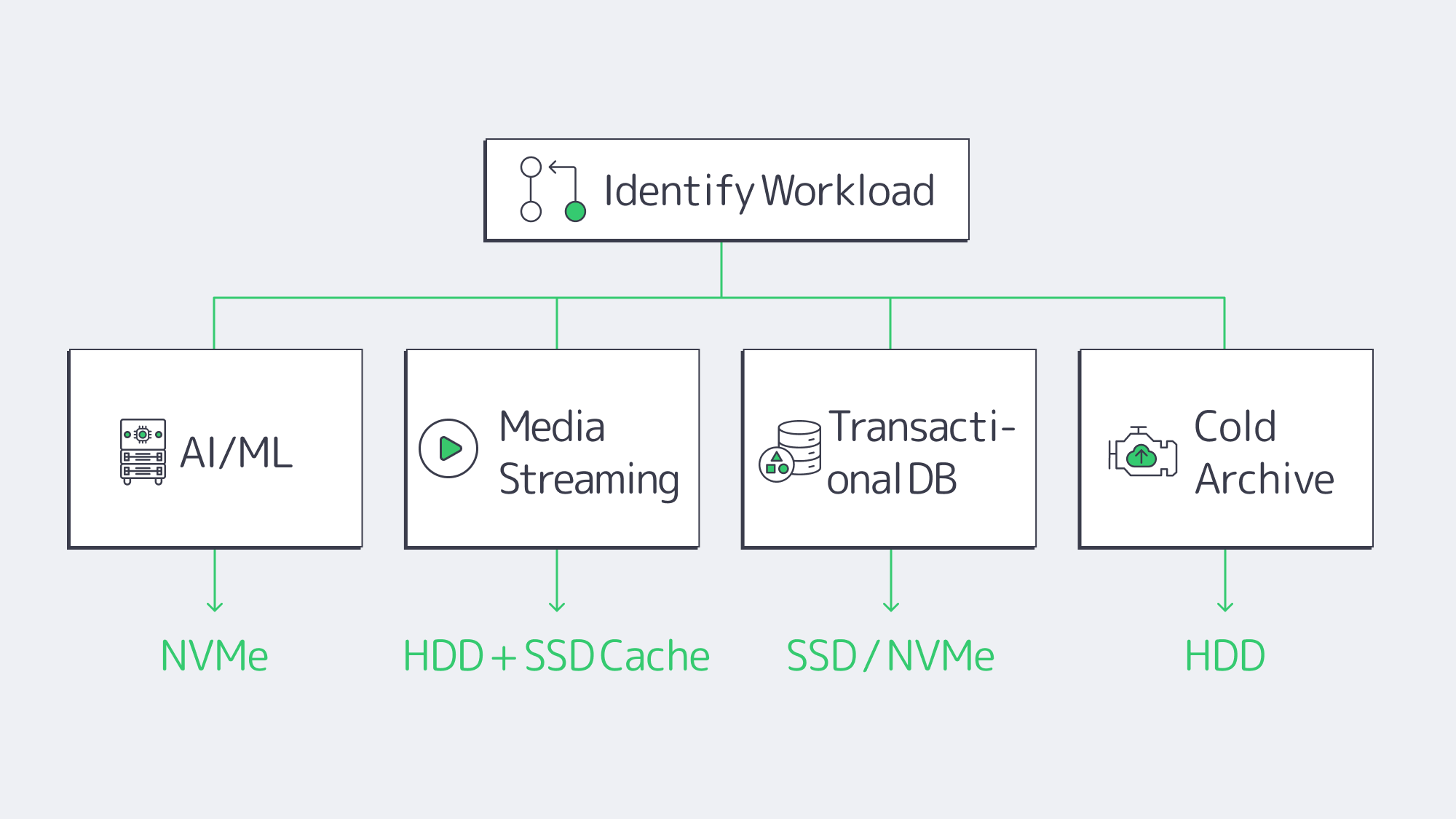
AI / Machine Learning / HPC
GPUs can sit idle while waiting for tensor data, and every millisecond of idle time costs money. NVMe microsecond latency and 7 GB/s reads help keep pipelines full. Training volumes too large for pure flash can stage active subsets on NVMe and leave the long tail on HDD or in object storage. PCIe 4.0 is now sufficient for many pipelines; PCIe 5.0 doubles the headroom for next-generation models with wider data footprints.
Media Streaming & CDN Origins
Streaming video is largely sequential. HDDs in RAID can provide enough bandwidth for 4K streams when file requests are mostly sequential. Concurrency changes the math: hundreds of viewers accessing different files simultaneously create random seeks. A hybrid origin uses SSD caching in front of HDD capacity to balance performance and cost. Pair disks with high-bandwidth NICs; Melbicom dedicated servers support per-server port speeds up to 200 Gbps so the network does not become the storage bottleneck.
Transactional Databases & Enterprise Apps
Each commit writes to a log; each index lookup is a random access. In this pattern, transactions per second are constrained by the 5 ms latency of HDDs. SATA SSD is a starting point, and NVMe delivers tens of thousands of TPS with predictable sub-millisecond response. For write intensities greater than 1 DWPD, use high-endurance SKUs. Mirror at least two NVMe drives for durability without giving up read performance.
Archives, Backups, and Cold Data
Cold data is measured in dollars instead of microseconds. Helium-filled, multi-terabyte HDDs still provide capacity at low cost per gigabyte. Sequential backup windows fit disk strengths, and restore time is usually scheduled rather than interactive. For off-site copies, add tape or S3-compatible object storage; Melbicom SFTP and S3 services provide durable SMB-friendly targets.
NVMe over Fabrics and PCIe 5.0

NVMe over Fabrics: NVMe over Fabrics extends the NVMe low-latency protocol over Ethernet, Fibre Channel, InfiniBand, or RDMA, narrowing the gap between direct-attached and networked storage. Latency overheads are often in the tens of microseconds—insignificant in many apps—making it feasible to pool flash at rack scale. The technology is now within reach of mid-sized stacks, with deployments booting servers off remote NVMe volumes and using converged 25–100 GbE switches.
PCIe 5.0: PCIe 5.0 doubles the bandwidth per lane of Gen4. Current enterprise drives can reach about 14 GB/s reads and roughly 2.7–3 million random-read IOPS, a level that would have matched small all-flash arrays only a few years ago.
How to Build a Tiered Storage Stack
All-flash or all-disk is seldom the smartest storage architecture. Use NVMe for ultra-hot datasets, SATA SSD for mixed workloads, and high-capacity HDD for economical depth. This three-tier system preserves responsiveness for critical applications, feeds GPUs, and protects budgets. From a practical point of view:
- Size NVMe pools for AI staging, OLTP logs, and latency-sensitive VMs.
- Pin SSD caches to HDD sources for media libraries and hot/cold analytics tiers.
- Store immutable archives on helium HDDs or off-server object buckets.
- Validate dedicated servers have modern PCIe lanes and at least 10 Gbps networking so storage isn’t gridlocked.
Melbicom supports these hybrid designs with 1000+ prebuilt servers across 21 Tier III and Tier IV data centers and per-server port speeds up to 200 Gbps.
Conclusion

Choosing storage for a dedicated server is an exercise in aligning performance thresholds with business goals. NVMe pushes latency and IOPS, SATA SSD balances speed and cost, and HDDs remain the affordable capacity option. With a clear view of each medium’s behavior across streaming, transactions, and archival workloads, you can design a tiered stack that meets today’s needs and scales toward an NVMe over Fabrics future.
Configure Your Dedicated Server
Choose from 1000+ prebuilt servers, add NVMe or HDD, and scale bandwidth up to 200 Gbps.
Get expert support with your services
Blog

Cheapest Dedicated Server Hosting in India: Low-End Risks
If your budget is restrictive or you are starting a new company, the promises of the cheapest dedicated server hosting in India are more than appealing. India’s data center sector is expanding quickly: installed data center capacity has nearly tripled since 2020, reaching roughly 1.5 GW by mid-2025, and it is projected to keep growing. Along with that boom have come the irresistible rock-bottom prices advertised by countless providers. However, these reel-you-in headline prices are rarely what they seem.
What lies beneath the shiny offer is often a compromise rather than a promise. The networks are typically oversubscribed, and the MSAs are little more than boilerplate on closer inspection. When you consider the support gaps, the total cost of ownership (TCO) rises considerably. Value-oriented providers such as Melbicom can host dedicated servers in India at an accessible entry price without forcing the same tradeoffs, but it is important to know what is myth and what is reality, so let’s take a look.
Choose Melbicom— Dozens of ready-to-go servers — Tier III-certified DC in Mumbai — 40 CDN PoPs |
|
Initial Appeal Wears Thin
Many hosts market themselves as the “best dedicated server hosting in India,” and some cut-rate plans are advertised at unusually low monthly prices. This is often used to lure in startups, but servers are not commodities, and you get what you pay for, which might be dated CPUs, mismatched memory, or throttled bandwidth. All of those issues can create performance and reliability problems as soon as real growth starts.
What Cheap Dedicated Servers in India Hide
The hidden costs of cheap dedicated servers in India usually appear as slower hardware, shared or throttled bandwidth, weak uptime language, and limited support. A low monthly price only works if the server can sustain the workload; otherwise, early scaling, outage recovery, and engineer time can erase the initial savings.
Outdated Hardware Slashes Performance Per Euro
Cheaper providers may reuse processors from older fleets, meaning you could be relying on hardware that is several generations behind. The “16 cores” listed in the specs can be misleading: a higher-clock modern 8-core CPU can outperform a legacy 16-core setup on latency-sensitive workloads. Older setups are usually more limited in cache, PCIe lanes, storage options, and power efficiency, which risks I/O bottlenecks, longer workloads, higher memory use, and forced premature scaling. A better-specified CPU may cost more initially, but if it delays scale-out and improves performance per euro, it can quickly compensate for the monthly savings promised by a bargain deal.
The “Unlimited” Bandwidth Tactic
While the advertised port may be genuine, uplink contention is another selling point that is often oversold. The promise of unlimited bandwidth doesn’t mean much when dozens of tenants are competing for transit at peak hours. Another favorite is the 1 Gbps burst pitch, which is less useful if the provider has only a few gigabits of upstream capacity available during busy periods. For real-time applications, variable throughput is often enough to hurt user experience. At Melbicom, Mumbai servers use dedicated links up to 40 Gbps per server in a Tier III facility.
Bare-Bones MSAs and Uptime Risk
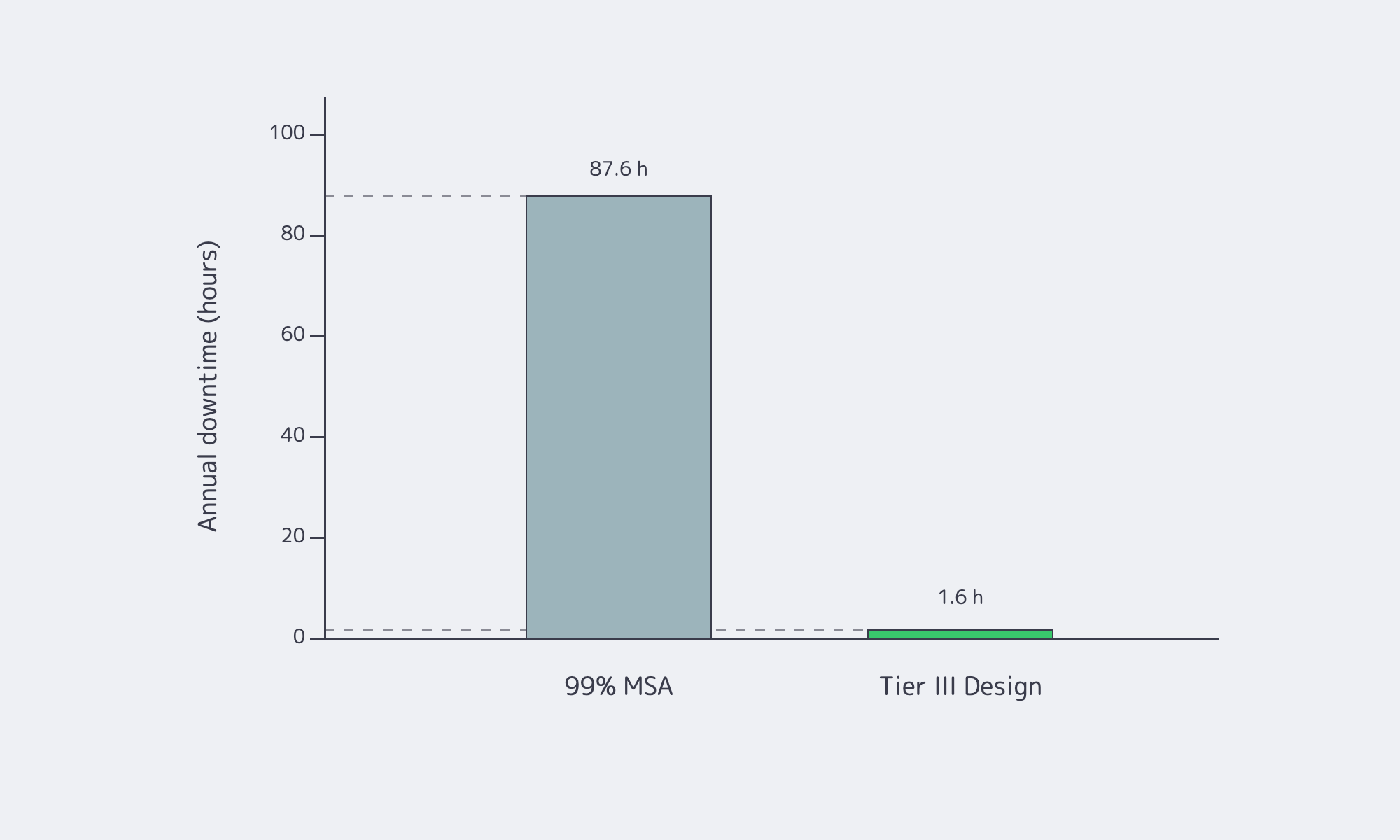
The MSAs of low-end hosts rarely exceed a page and may promise nothing more than “best-effort” network availability, amounting to about 99 % uptime—in other words, 87.6 hours of downtime annually. In contrast, Tier III engineering design is commonly modeled at about 99.982 % availability, or roughly 1.6 hours of annual downtime. When every hour offline affects conversion and churn metrics for a subscription-based business, the uptime language is a major risk. Current outage-cost research focuses heavily on large enterprises, but the underlying lesson applies to SaaS startups as well: even one or two serious incidents can erase a year of headline hosting savings after lost transactions and support load are counted.
The Bottom Line: You can protect your revenue in the long run with stronger MSA terms, redundant power, effective cooling, and multi-homed fiber, all of which matter more than the lowest advertised price.
Limited Support Means Inevitable Labor Costs
Support is another area that is often lacking with a bargain host; support hours may be restricted, routed through email queues, or sold as an add-on, which creates unexpected costs when a kernel panic strikes at an unsociable hour. You also lose valuable development time when your team has to act as its own data center technician, a cost that is rarely factored into the spreadsheet.
With Melbicom, you get 24/7 engineer support and free component replacements in 4 hours, so you can focus on shipping product instead of remote-hands tickets.
Cheap Server TCO: Side-by-Side View
| Factor | Ultra-Cheap Server | Quality Dedicated Server |
|---|---|---|
| Hardware age | 5–7 yrs old; refurbished | Documented server-grade hardware |
| Guaranteed bandwidth | Shared uplink; variable | Dedicated ports up to 40 Gbps in Mumbai |
| Annual downtime ceiling | 99 % in MSA ≈ 87.6 h | Tier III design ≈ 1.6 h |
| Support model | Email queue or paid | 24/7 support |
| Likely hidden cost | Scaling early, outage losses, DIY troubleshooting | Predictable opex, faster scale-up |
With a long-term view that factors in traffic growth, incident response, and early hardware refresh, a bargain server can cost more than a mid-tier server over a three-year period even if the invoice starts lower.
Summarizing the Myths Versus the Reality
- All “16-core” servers perform equally: Modern lower-core CPUs can beat legacy 16-core parts on many workloads, so generation and clock speed decide results.
- Unlimited bandwidth means smooth, reliable networks: Throughput is often throttled or inconsistent at peak hours when networks are oversubscribed.
- 99 % uptime is sufficient: 99 % equates to about 87.6 hours offline each year, which can lower brand trust and hurt recurring revenue.
- Support is an optional extra: Nothing burns developer hours quite like troubleshooting in the dark. Rapid 24/7 help is essential.
How Melbicom Reduces Dedicated Server Hosting Risk in India
- Dozens of Mumbai-based ready-to-go configurations with documented Intel CPU options, DDR4 RAM, and a global footprint of 21 data centers, including Mumbai, for edge use cases.
- Mumbai servers offer up to 40 Gbps bandwidth from a Tier III facility.
- English-speaking support is available around the clock, with free component replacements in 4 hours when required.
- 40 CDN PoPs across 35 countries for static acceleration.
By choosing Melbicom, founders get one provider for round-the-clock support, predictable performance, and India-to-global growth.
Cutting Corners: A Risky Strategy
User experience is crucial for startups hoping to build brand recognition and trust. If your pages lag, or your users experience intermittent outages, growth becomes less likely. Customers are used to instantly responsive content, especially when an India-hosted workload serves international audiences. So while it can be tempting to cut corners as a founder with a low budget, you need to weigh whether that euro “saved” outweighs the economic risks of missed conversion opportunities, churn, and engineering distraction.
Ultimately, the calculus flips when you examine TCO and consider value rather than sticker price: a well-built server starting at €230 monthly can outperform an €80 bargain offer that requires double-purchased capacity, racks up downtime losses, and consumes administrators’ attention.
Conclusion: Looking Beyond Headline Stickers in Search of Sustainable Value

The promises of ultra-low pricing grab attention, but the savings unravel under scrutiny. Realistic workload demands, traffic growth, and downtime have to be factored in. Modern hardware, dedicated network capacity, clear MSA terms, and around-the-clock expertise bring value to the table that bargain-basement deals often cannot meet. If you are ambitious about founding and scaling on a lean budget, securing a partner with documented hardware, dedicated bandwidth, clear support terms, and live human support for an accessible price is the safer answer.
Launch Your Mumbai Dedicated Server
Secure enterprise-grade hardware, up to 40 Gbps bandwidth, and 24/7 live support—all at a predictable monthly price.
Get expert support with your services
Blog

Why Germany Became Europe’s Always-On Data Hub
One reason Germany has become the nerve center of European infrastructure is that each of its hosting layers, legal, electrical, environmental, and network, is designed to meet the needs of risk-averse organizations that cannot afford downtime or data privacy errors. GDPR-hardened compliance, Tier III-class availability design, and aggressive green-power regulation mean Germany dedicated server hosting can provide the control and continuity multinational businesses demand.
We explore the three pillars that make Germany the most logical destination to deploy mission-critical workloads below, and we lean on a short retrospective of the early 2000s colocation boom to help with the context before zooming in on the unparalleled carrier-hotel ecosystem in Frankfurt.
Choose Melbicom— 200+ ready-to-go servers — Tier III & IV DCs in Frankfurt — 40 CDN locations |
|
GDPR-Hardened Compliance Meets Tier III Availability Design
Data hosted within Germany remains subject to German and EU data-protection law, including the General Data Protection Regulation. Keeping processing, administration, and routine access inside the EEA can reduce transfer-mechanism work for EU-only architectures, although any access or onward transfer to a third country still needs an appropriate GDPR basis such as standard contractual clauses. (European Commission)
Operational resilience would hardly matter without legal strength. Many German facilities serving enterprise hosting are built around redundant power, cooling, and carrier paths, and Tier III-certified sites are designed for concurrent maintainability: planned maintenance can be performed without taking IT operations offline. (Uptime Institute) The reliability ethos can be traced to the early 2000s colocation boom in the country, when Frankfurt first became the default interconnection point in Europe, and has only grown more serious as workloads have shifted from Web 1.0 to real-time analytics and video. It is now possible to have hardware maintenance done routinely when it is convenient and with no interruption to service, and the stability of the national grid provides an additional buffer against brownouts for data centers.
Melbicom reinforces this resilience model in Germany through Tier III & IV DCs in Frankfurt and up to 200 Gbps network capacity per server.
Outcome: Enterprises are able to align Germany deployments with demanding availability objectives, without automatically overlaying costly secondary infrastructure.
How Do Germany’s Energy-Efficiency Rules Lower OpEx for Dedicated Servers?
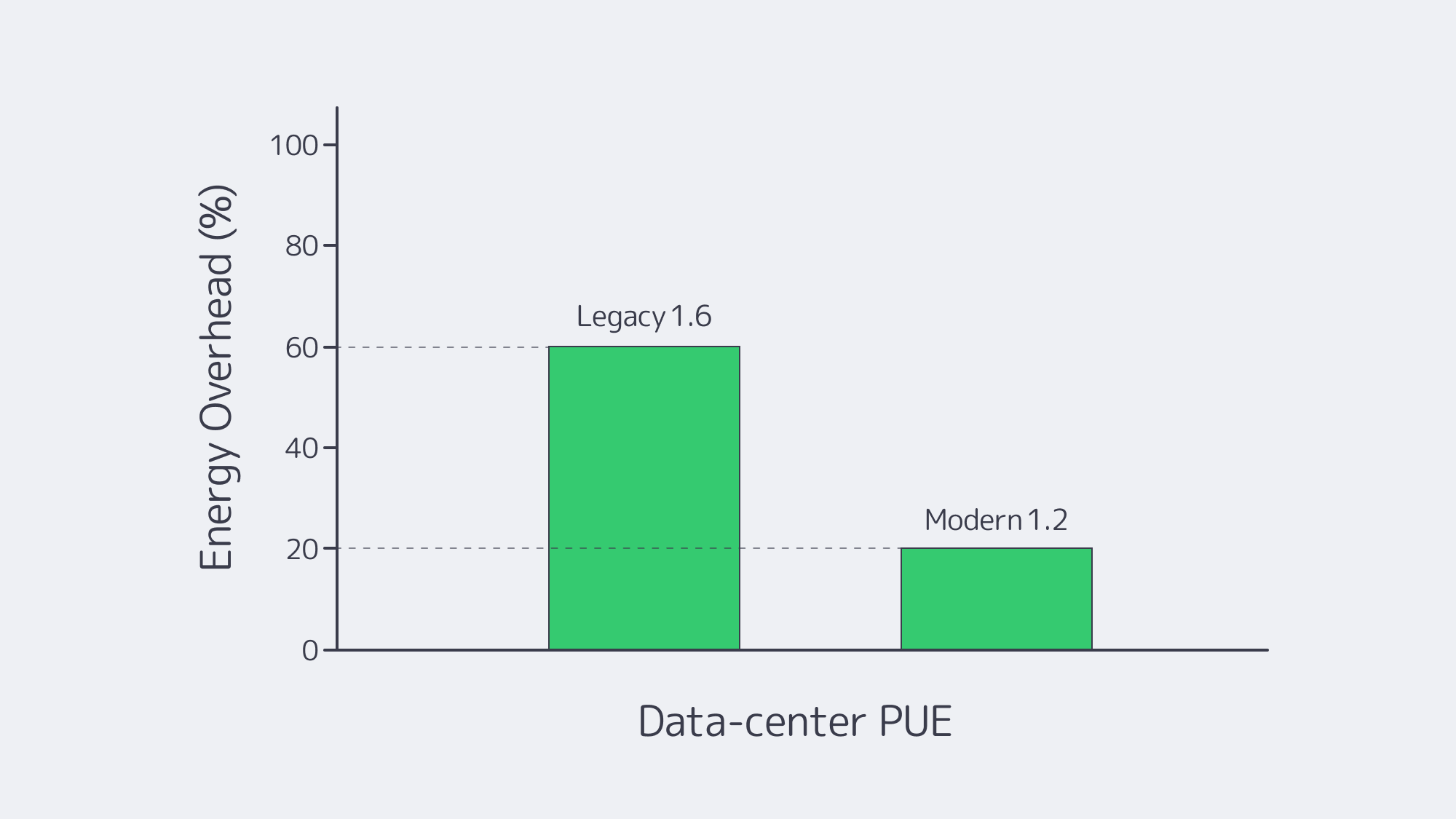
Compliance and uptime don’t pay the electric bill. Germany, however, has the technical rigor coupled with industry-leading sustainability economics that lead to long-term cost savings. A 2024 German Datacenter Association impact report found that 88 % of the power used by German colocation facilities was renewable, and 69 % of operators had secured one or more power-purchase agreements to hedge pricing and carbon risk. (German Datacenter Association)
Even more pressure and opportunity are added by policy. Under the current Energy Efficiency Act, data centers that begin operation on or after July 1, 2026 must achieve a power-usage effectiveness (PUE) of 1.2 or lower, while existing facilities must reach 1.5 from July 2027 and 1.3 by July 2030. A 2026 draft amendment would relax some PUE thresholds, so operators should treat the exact compliance path as moving while the efficiency pressure remains durable. (White & Case, Taylor Wessing) That pressure encourages operators to use direct-to-chip liquid loops, modular cooling, and waste-heat reuse where the workload and facility design justify them. Reducing PUE from 1.6 to 1.2 can cut total facility energy demand by approximately 25 percent for the same IT load, while reducing non-IT energy overhead from 60 percent to 20 percent.
For Melbicom, the practical takeaway is configuration choice: Germany dedicated server plans run in Tier III & IV DCs in Frankfurt with 200+ ready-to-go servers and network capacity up to 200 Gbps per server, so energy-aware infrastructure does not require giving up high port-speed options.
How Do Frankfurt’s DE-CIX and IXPs Improve Latency and Redundancy?
GDPR is the legal moat and Frankfurt is the performance engine of Germany. The city is also home to DE-CIX Frankfurt, which set a new all-time record of 18.73 Tbit/s on December 9, 2025. (DE-CIX) More than 1,000 local, regional, and global networks peer there, so any tenant can access Tier 1 transit, hyperscale clouds, SaaS platforms, and eyeball ISPs instantly. (DE-CIX) In latency-sensitive services, trading platforms, multiplayer gaming, and collaborative design, deployment of a Germany dedicated server in Frankfurt can reduce latency by tens of milliseconds over trans-Atlantic links.
To explain why planning for redundancy in Germany begins in Frankfurt, it is worth examining the current IT-load concentration across the largest FLAPD hubs in Europe:
| Hub | IT-Load Capacity (MW), Q2 2025 |
|---|---|
| London | 1,134 |
| Frankfurt | 1,020 |
| Paris | 616 |
| Amsterdam | 570 |
Source: German Datacenter Association Datacenter Outlook Germany 2025/26, using CBRE Research data. (germandatacenters.com)
Such figures explain why carrier hotels in Frankfurt along Kleyerstrasse remain one of Europe’s most important interconnection clusters. But capacity is not the complete redundancy picture. Germany also has a dense ring of regional Internet-exchange points (IXPs): Berlin (BCIX), Munich, Hamburg, and the Ruhr, which provide additional options for keeping national traffic local or routing around a single metro dependency. BCIX has linked providers in the capital since 2002, underscoring how deeply distributed peering is embedded in the national infrastructure. (bcix.de)
For enterprise architects, the practical design pattern is simpler: deploy the primary stack in Frankfurt, use GSLB and routing-aware failover for traffic steering, and place warm standby capacity in another approved European location only when the workload can leave Germany. That architecture fits with the backbone of Melbicom, which spans 21 global Tier III and Tier IV data centers, 29 IXP peering hubs, 23 transit partners, and 40 CDN PoPs across 35 countries. We provide up to 200 Gbps per server in Frankfurt, supporting resilient routing and CDN-assisted delivery designs for Germany-hosted workloads.
What Future Trends Will Shape Dedicated Server Hosting in Germany?
The strategic rationale for German dedicated server hosting will only grow as EU data-sovereignty expectations and AI inference workloads raise demand for dense, efficient infrastructure. JLL’s 2025 EMEA report lists London with 302 MW and Frankfurt with 279 MW in the development pipeline, showing that supply is expanding but still tight. (JLL) Energy law deadlines, even if amended, will keep driving additional jumps in cooling efficiency. The fact that Germany sits at the nexus of North-South and East-West fiber paths helps keep latency-sensitive 400 GbE-era, immersive, and AI-inference applications close to major population centers in Europe.
When a firm considers where to run its next compliance-sensitive workload, the calculus is becoming quite simple: sovereignty, uptime, and OpEx all come together in Germany, especially when a hosting provider can combine all these variables into a single infrastructure plan.
Why Germany Is a Smart Choice for Dedicated Server Hosting

Germany has a trifecta that is hard to find: GDPR-aligned data control, Tier III-class reliability, and energy-efficiency regulation that increases pressure on wasteful infrastructure over time. DE-CIX Frankfurt—Europe’s largest internet exchange by traffic—anchors a nationwide mesh of regional IXPs, giving architects more routing and failover options. The heritage of the early colocation boom lives on in the design philosophies that consider downtime a taboo, as well as new sustainability requirements that make the hardware you install today affordable and socially acceptable in the future.
Deploy Dedicated Servers in Germany
Choose from 200+ ready-to-go servers with up to 200 Gbps ports, hosted in Tier III & IV DCs in Frankfurt.