
Blog
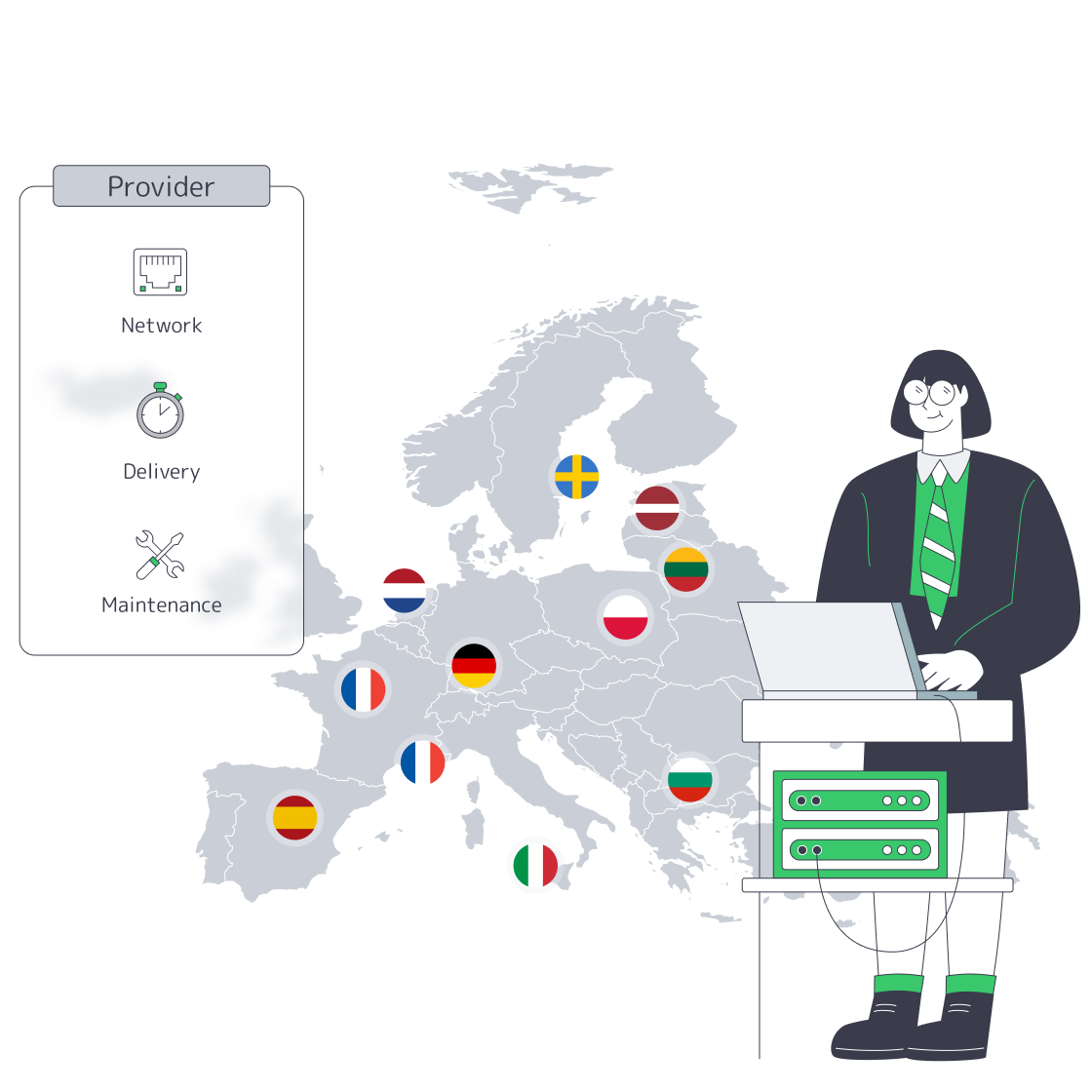
European Dedicated Server Providers: Compare Country Coverage, Support and Deployment Terms
Comparing European dedicated server providers requires more than checking available countries and advertised port speeds. A location may lack the required hardware, a 10 Gbps connection may carry a restrictive transfer allowance, and 24/7 support may exclude application recovery.
The useful comparison unit is the deployable offer: location, hardware, network terms, delivery timing, and operational responsibilities.
This guide examines European purchasing terms rather than country rankings or sovereignty considerations.
Melbicom in Europe– Tier III & IV DCs in Europe – 300+ Amsterdam configurations – Custom builds: 3–5 business days |

|
Which European Dedicated Server Providers Offer the Required Hardware and Locations?
Shortlist European dedicated server providers by required metro, matching hardware, documented port and transfer terms, and confirmed deployment availability.
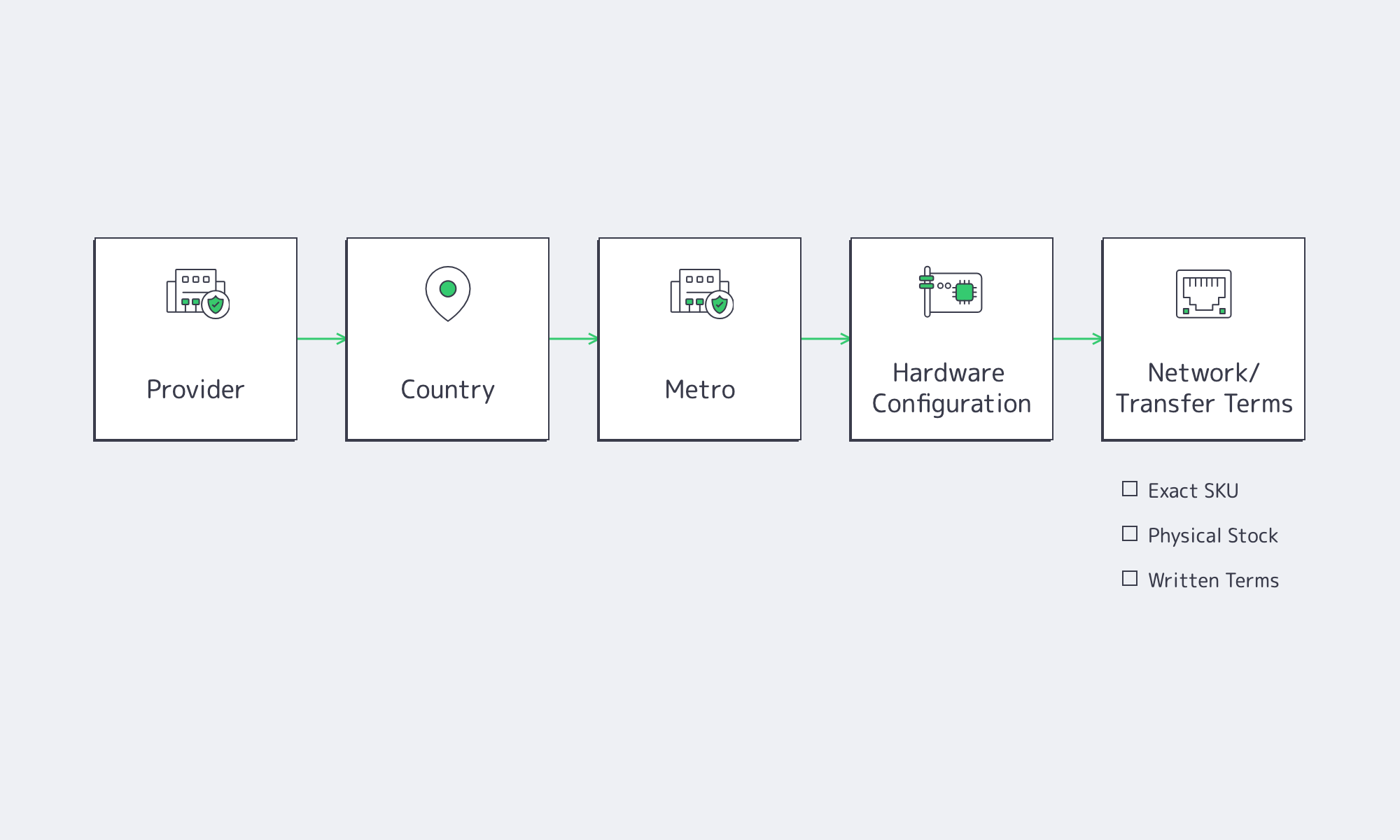
Verify provider, country, metro, hardware and network terms against the exact SKU, physical stock and written offer.
Match EU Hardware to the Metro
The comparison should follow one sequence:
Provider → Country → Metro → Hardware configuration → Network/transfer terms
A facility's maximum network capability does not establish the port speed of an available server. Likewise, a count of listed configurations does not establish how many physical machines can be deployed.
The following matrix uses Melbicom's European dedicated-server catalog to compare hardware families, memory ranges, location-level network ceilings, and the configuration details that matter when selecting a server.
EU Dedicated-Server Offer Matrix
| Country / Metro | Hardware and Network Options | Configuration Selection |
|---|---|---|
| Netherlands, Amsterdam | Two data centers; up to 200 Gbps per server. Intel Xeon, AMD Ryzen and EPYC options; 32–1536 GB RAM. 300+ listed configurations. | CPU, storage, ordered port, transfer model, matching-unit quantity. |
| Germany, Frankfurt | 2 Tier III & IV DCs in Frankfurt; up to 200 Gbps. Intel Xeon and AMD EPYC; 16–768 GB RAM. 200+ configurations. | Hardware, facility, ordered port, activation terms. |
| Spain, Madrid | Up to 40 Gbps. Intel Xeon E5 and E-series; 32–128 GB RAM. 90+ configurations. | Storage, capped or unmetered transfer, matching-unit quantity. |
| France, Paris | Up to 200 Gbps. Intel Xeon E-23xx and Scalable; 32–128 GB RAM. | Exact configuration, transfer and delivery terms. |
| France, Marseille | Up to 100 Gbps. Intel Xeon E-43xx and Scalable; 32–128 GB RAM. | Storage, capped or unmetered transfer, matching-unit quantity. |
| Italy, Palermo | Up to 40 Gbps. Intel Xeon E-22xx; 32–64 GB RAM. Six listed configurations. | Hardware match, storage and available port options. |
| Latvia, Riga | Up to 40 Gbps. Intel Xeon and AMD EPYC; 32–1152 GB RAM. | CPU, memory, storage, transfer and physical availability. |
| Bulgaria, Sofia | Up to 40 Gbps. Intel Xeon E-series and Scalable; 32–256 GB RAM. | Storage, selected port and transfer model. |
| Sweden, Stockholm | Live server location; up to 100 Gbps. | Configuration availability and deployment timing. |
| Lithuania, Vilnius | Up to 40 Gbps. Intel Xeon E5, E-series and Scalable; 32–512 GB RAM. 50+ configurations. | Hardware tier, storage, ordered port and traffic allowance. |
| Poland, Warsaw | Up to 200 Gbps. Intel Xeon E5, E-22xx and Scalable; 32–256 GB RAM. 50+ configurations. | CPU, storage, ordered port, transfer and matching-unit quantity. |
For each shortlisted configuration, record support scope, remote-hands availability, hardware replacement procedures and written order terms.
Location alone does not determine application performance. Compare routing and latency using representative endpoints for the networks carrying the workload's traffic, including business-critical destinations. The resulting measurements are more useful than assuming a particular European metro will deliver the best path.
Deployment and Transfer Terms
Dedicated server deployment terms in Europe should distinguish ready-configuration activation, custom-build delivery, and failed-component replacement. Buyers should separately document ordered port speeds, transfer allowances, deployment start events, and contractual handoff conditions for each selected configuration.
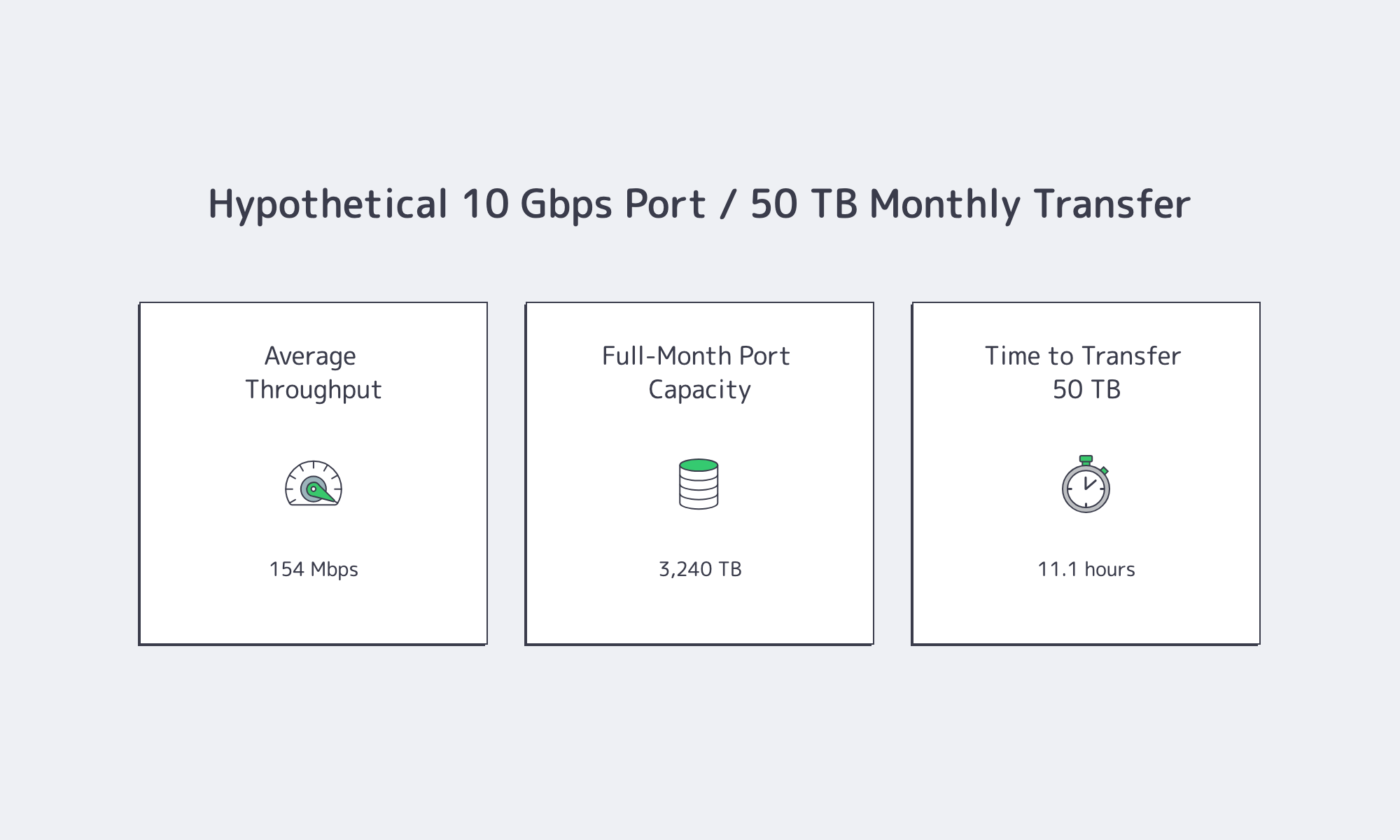
Calculations use decimal units and a 30-day month; port capacity and transfer time assume continuous 10 Gbps before protocol overhead.
Three Deployment Clocks
The first clock measures order-to-access time. Melbicom offers approximately two-hour delivery for ready-server configurations.
The second measures custom assembly and provisioning. Our custom server configurations are delivered in 3–5 business days.
The third measures replacement after hardware failure.
For Melbicom dedicated servers, initial installation and provisioning are fulfilled upon the customer's first successful connection, as defined in our services agreement. That differs from application readiness.
The three clocks should remain separate purchasing fields because initial provisioning, custom assembly, and hardware replacement represent different operational events.
Port Speed Is Not Transfer Volume
Melbicom's dedicated-server configurations include capped and unmetered transfer.
Consider a hypothetical 10 Gbps port with 50 TB monthly transfer.
Idealized arithmetic using decimal units, a 30-day month and continuous 10 Gbps line rate. Excludes protocol overhead and differences in provider traffic accounting.
A capped high-speed port may suit bursty applications; sustained-egress services require different economics. Record the complete network term as:
Port + Committed bandwidth + Transfer allowance + Burst/overage rules + Billing period
Melbicom's dedicated-server purchasing terms include a one-month minimum payment period without a required long-term commitment. Metered transfer billing cycles are prorated to the first of the month.
A complete quote should also identify setup and recurring charges, currency, applicable taxes, and cancellation notice requirements.
Verify Support, Remote Hands, and Hardware Replacement Responsibilities Before Shortlisting Providers
A European hosting support comparison must distinguish contact availability from included technical work, physical intervention, and customer recovery obligations. Melbicom provides 24/7 engineering support. Our included technical support covers server hardware and data-center connectivity, while customer software administration, backups, and data restoration remain separate responsibilities.
Compare European Hosting Support
Melbicom's support resources and contact channels cover engineering assistance with server reboots, OS reinstalls, BGP setup, and network troubleshooting.
Customer-installed software administration is separate unless otherwise agreed, and additional paid support is available under our services agreement.
Server Hardware Replacement in Europe
Melbicom provides free component replacement within 4 hours for our dedicated-server offering. Replacement components may have equivalent or improved specifications.
Hardware replacement and data recovery are distinct operations. Our team handles component replacement, while customers remain responsible for backups and restoring their data. Additional recovery assistance may be available as a separately agreed, chargeable service.
Remote hands requires similar precision. Buyers should establish whether cable reseating, console intervention, drive handling, and other physical tasks are included, chargeable, conditional, or unavailable.
Melbicom service claims are submitted through the Personal Account with issue details and attempted remedies. Preparing server identifiers, timestamps, diagnostics, and business-impact information beforehand reduces ambiguity during escalation.
Build the Shortlist Around Workload Evidence, Not Country Rankings
A useful shortlist starts with workload requirements and evaluates each documented offer against the same acceptance criteria.
Latency-Sensitive APIs
Prioritize CPU performance, SSD/NVMe storage, routing, and sufficient port capacity.
An acceptance protocol should measure p95 round-trip latency against the application's budget, track packet loss, and inspect evening-peak behavior across a representative business cycle. Select endpoints from networks carrying the most traffic and those serving business-critical customers.
Melbicom's data-center test endpoints can support preliminary path inspection when evaluating European server locations.
Sustained-Egress Origins
Calculate monthly transfer before choosing a port.
At a hypothetical continuous 500 Mbps, a workload generates approximately 162 TB over 30 days. A 50 TB allowance remains insufficient with a 10 Gbps port.
An acceptance test should specify throughput targets, endpoints, duration, traffic-accounting assumptions, and failure criteria before execution.
Stateful Databases and Analytics
Prioritize memory, CPU class, storage layout, and recovery design.
Set drive redundancy, backup frequency, restore goals and replacement duties.
Rapid Fleet Rollouts
For fleet purchases, request matching-unit counts, reservation conditions, and deployment schedules. Hardware consistency may matter more than the lowest individual-server price.
A catalog with multiple configuration choices does not establish how many identical physical machines are available in a particular metro.
Common Evidence Checklist
Apply one checklist to every offer:
- Hardware: Country, metro, CPU, RAM, drive configuration, matching-unit availability, and evidence date.
- Network: Ordered port, committed bandwidth, transfer model, accounting direction, burst and overage treatment, and billing period.
- Deployment: Order timestamp, access timestamp, ready-stock or custom-build commitment, dependencies, and fulfillment event.
- Support: Contact hours, included work, escalation channels, chargeable administration, and remote-hands scope.
- Replacement: Failure trigger, component-equivalence policy, replacement timing, backup ownership, and restoration procedure.
- Acceptance: Proposed endpoints, test duration, p50/p95/p99 targets where relevant, throughput thresholds, timestamp log, and responsible owner.
Keep documented offer specifications, proposed acceptance criteria, and actual test results as separate fields. This allows a purchasing decision to be revisited when hardware availability or commercial terms change.
Choosing European Dedicated Server Providers With Defensible Evidence
The strongest European dedicated-server shortlist compares deployable configurations rather than country names or headline bandwidth.

Hardware availability, network economics, delivery handoff, support scope, and recovery ownership must all align with the workload.
A consistent evidence matrix makes those decisions repeatable and identifies what remains unresolved before procurement approval.
The practical outcome is a shortlist that can be refreshed as inventory changes without losing the original technical and commercial rationale.
Choose European Dedicated Servers
Compare Melbicom’s European configurations against your hardware, location and traffic requirements, then plan deployment and support responsibilities.