
Month: March 2026
Blog
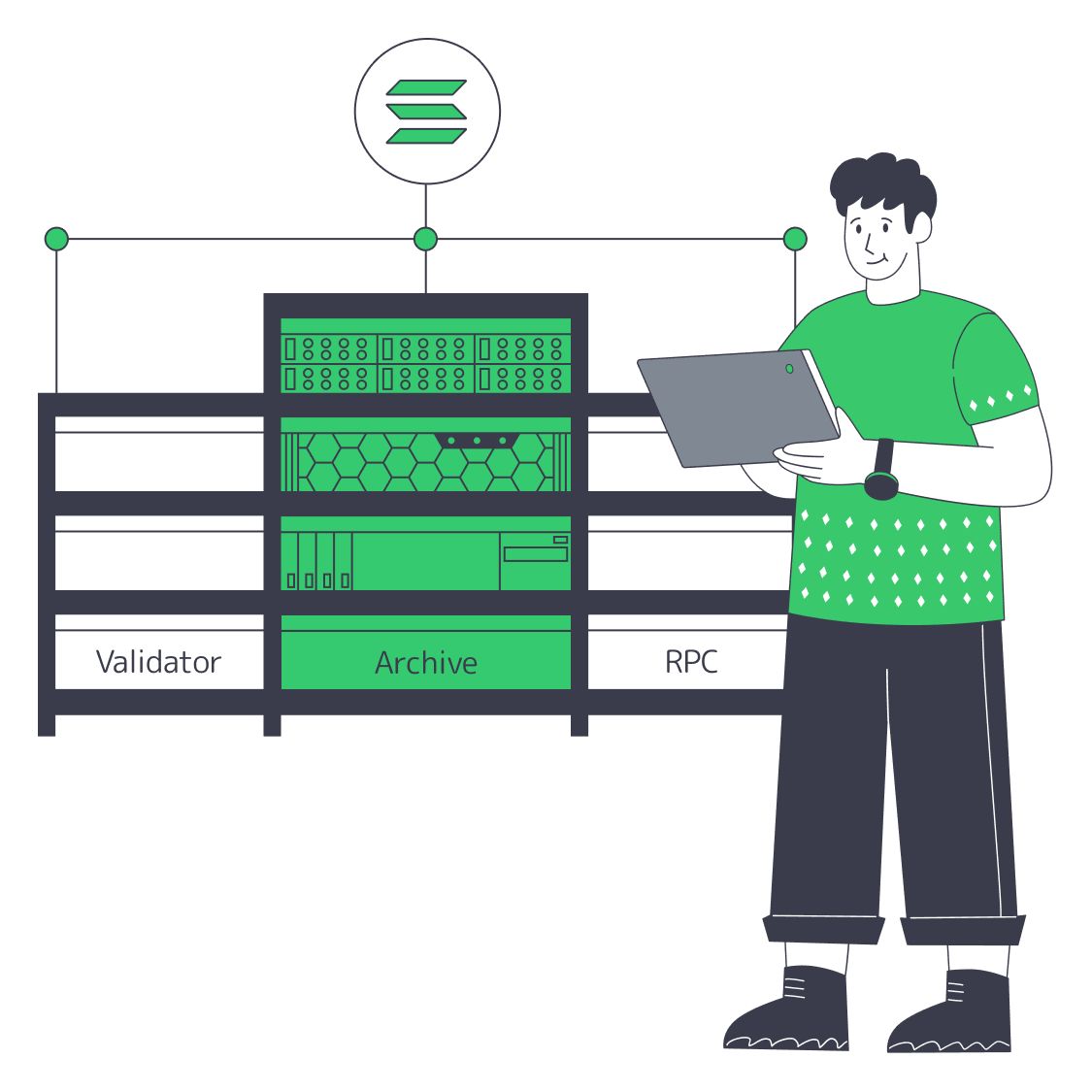
Build Stable Solana Validator, RPC, and Archive Nodes
Solana behaves less like a generic daemon and more like a real-time system under sustained write pressure. With roughly 400ms slots, the margin for CPU jitter, NIC queueing, storage stalls, and replay lag is tiny. In production, the breakage point is usually tail latency, burst handling, and resource contention—not average throughput.
That is why node hosting is effectively protocol design. Solana’s own guidance says production on virtualized platforms is possible but usually harder to keep stable than single-tenant infrastructure. For multi-region validator and RPC fleets, Melbicom aligns with that model: Melbicom runs 21 Tier III and Tier IV data centers, supports ports up to 200 Gbps per server depending on location, and pairs dedicated servers with a network built around 23 transit providers and 29 IXPs plus BGP sessions when stable endpoints matter.
Best Servers for Web3 & Crypto— 1000+ ready-to-go servers — Custom configs in 3–5 business days — 21 global Tier IV & III data centers |
 |
How Solana Validator, RPC, and Archive Node Requirements Differ
Validators, RPC nodes, and archive nodes run the same client, but each role stresses a different subsystem. Validators are constrained by consensus-time networking and replay. RPC nodes add query concurrency and indexing pressure. Archive designs are really history-retention architectures, where long-term storage economics matter as much as CPU or RAM.
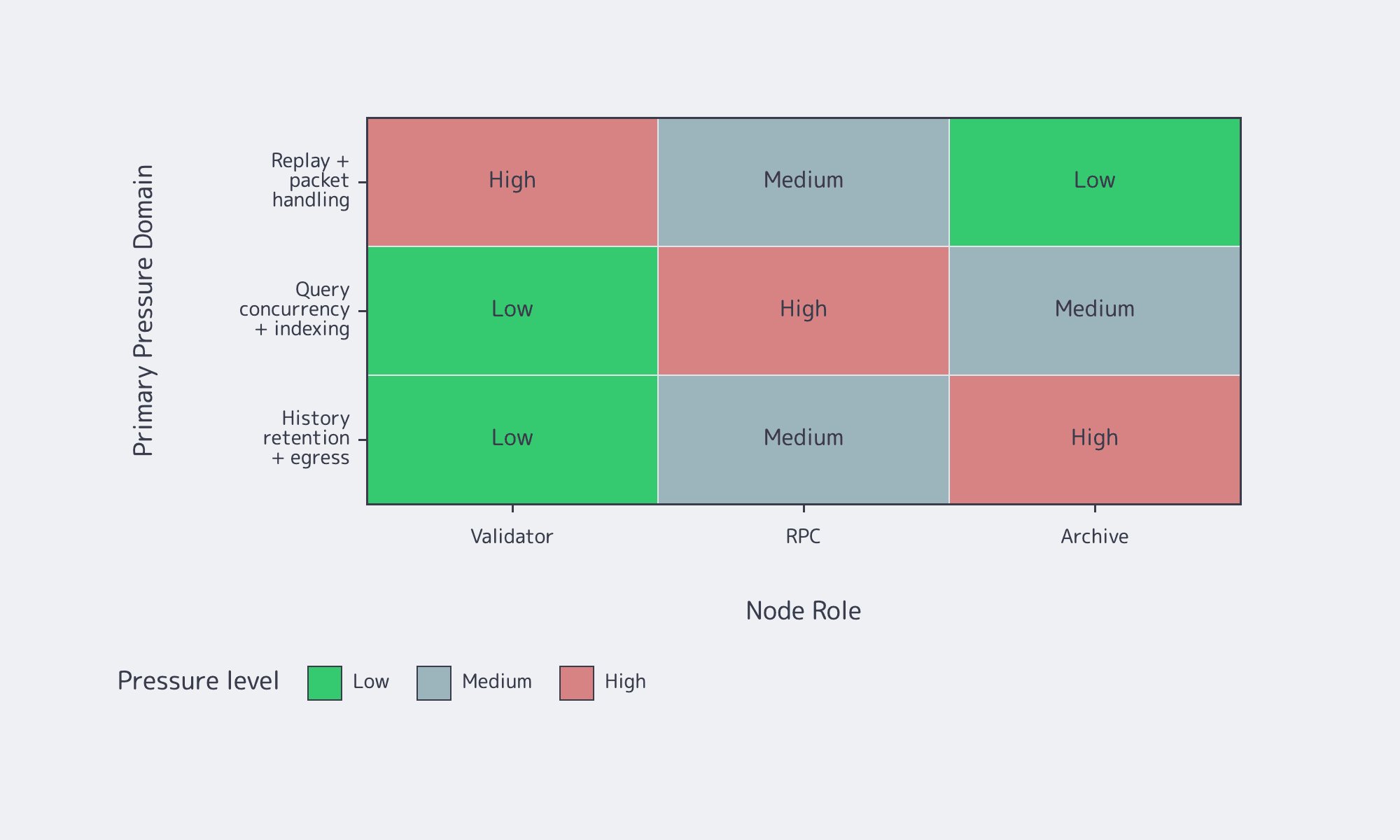
A validator is the consensus-facing machine. An RPC node usually runs with --no-voting and spends its budget on JSON-RPC, WebSockets, simulation, and indexes; Solana’s docs explicitly discourage combining full RPC and voting on one production host. “Archive” is less a formal node class than an operator pattern: either keep more history locally, or offload older ledger data into a historical backend such as Bigtable.
Production Baseline by Role
| Role | Main bottleneck | Practical production baseline |
|---|---|---|
| Consensus validator | Replay, packet handling, vote-path stability | Fast CPU with AVX2 and SHA extensions, roughly 12 cores / 24 threads or more, 256GB+ RAM, separate NVMe for accounts and ledger, and at least 1 Gbit/s symmetric networking, with 10 Gbit/s preferred. |
| Full Solana RPC node | Query concurrency, indexing, and deeper history | Similar CPU class with more headroom, often 16 cores / 32 threads or better, 512GB+ RAM if all account indexes are enabled, separated NVMe tiers, and enough network capacity to absorb both chain sync and client traffic. |
| Archive / warehouse pattern | Storage economics and historical reads | Hot-path compute similar to RPC, but paired with a long-term historical backend or very large local storage footprint. The main planning question is how far back queries must go and what that retention costs over time. |
The bottleneck moves with the role: validators are consensus-time systems, RPC nodes are user-time systems, and archive designs are storage-and-egress systems. That is the core reason one-size-fits-all Solana infrastructure usually fails.
What Production-Grade Solana Node Hosting Needs for Storage, RAM, & Failover
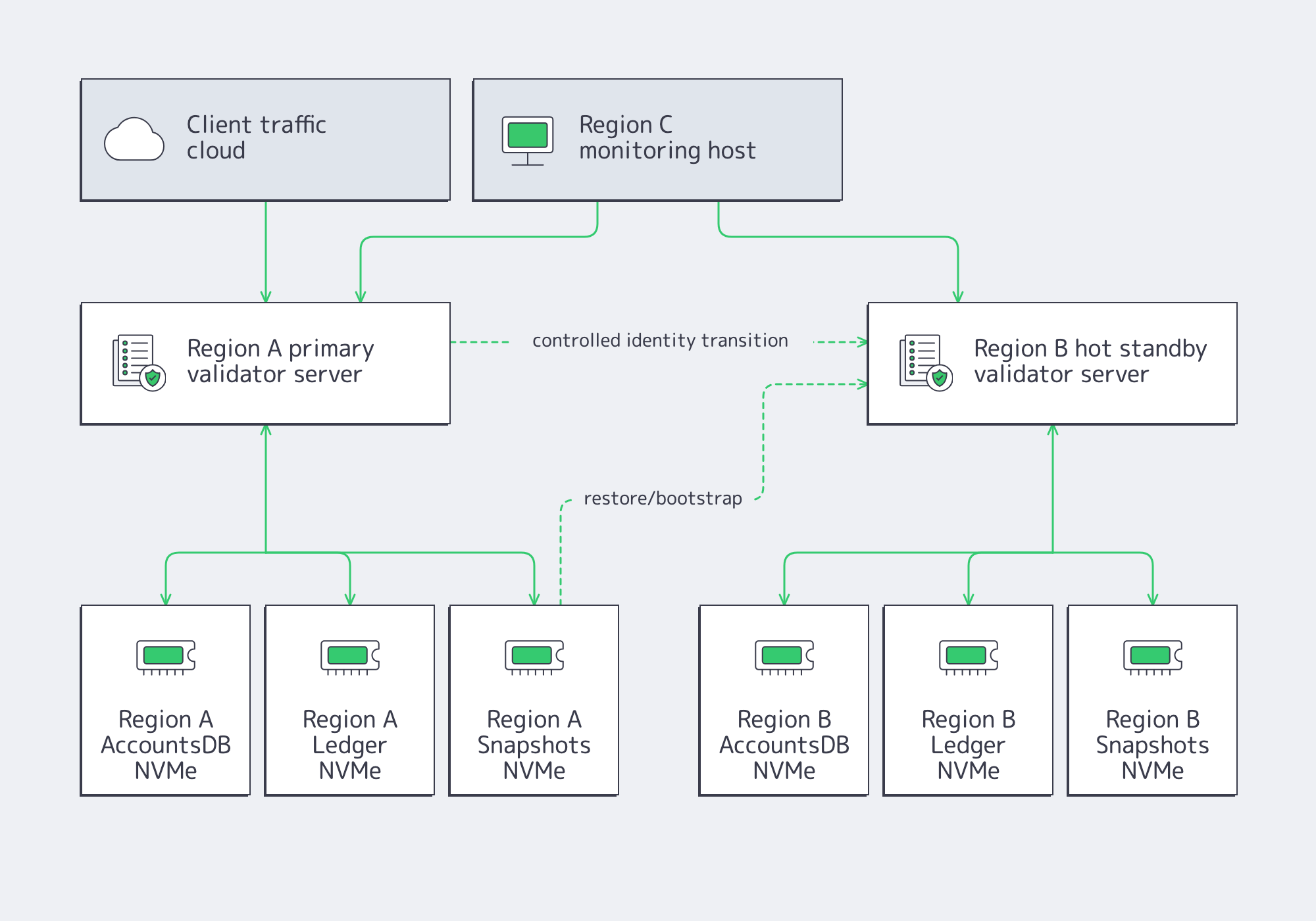
Production-grade Solana node hosting starts with isolation. Put AccountsDB, ledger, and snapshots on different NVMe devices; size RAM around your indexing plan, not a generic server tier; keep clean symmetric bandwidth and predictable routing; and treat failover as a routine operating pattern, not an incident-only playbook.
Storage Architecture: Separate NVMe or Accept Self-Inflicted Throttling
The official requirements are blunt because Solana is storage-sensitive. A practical plan is:
- AccountsDB NVMe for latency-sensitive random reads and writes
- Ledger NVMe for sustained writes, compaction, and cleanup
- Snapshots NVMe for bootstrap and recovery traffic
That separation matters because snapshots are full-state artifacts, not tiny exports. The AccountsDB deep dive describes them as compressed archives that must be decompressed, unpacked, and memory-mapped before the node can resume. Put snapshot traffic on the same disk as hot state and the box starts competing with its own recovery path.
Memory, Network, and Failover
RAM planning is an indexing decision. Solana’s baseline is 256GB+, but the official guidance moves to 512GB+ when you want all account indexes. Network planning is similar: the requirement is not just “fast internet,” but stable p99 packet handling across gossip, repair, and QUIC-based ingress, with 1 Gbit/s symmetric service as the floor + 10 Gbit/s preferred.
For validators, the two-machine failover pattern remains the safest model:
- Primary validator in Region A
- Hot standby validator in Region B
- Independent monitoring host in Region C
- Controlled identity transition using the identity-symlink and tower-file workflow
For RPC, failover is about endpoint continuity more than validator identity. That is where Melbicom’s BGP session service, global footprint, and networking layer become useful: routing changes are cleaner, state movement is easier to plan, and ports scale high enough that failover does not have to mean immediate bandwidth compromise.
Operations Essentials That Keep Nodes Alive Under Real Traffic
Production stability on Solana is operational. Snapshots need provenance and storage discipline. Monitoring has to track freshness, not just process uptime. Release cadence matters because software changes frequently. Security still matters, but it should match the role of the machine.
- Snapshots: use trusted peers and know how quickly you can restore without saturating hot disks. Solana’s exchange guide documents
-known-validatorand when-no-snapshot-fetchhelps preserve continuity. - Monitoring: run watchtower-style monitoring from a separate host and alert on replay lag, block-height drift, and delinquency.
- Upgrade cadence: stage, fail over, upgrade, and roll back if needed. Do not treat in-place patching as a maintenance strategy.
- Security: patch regularly, avoid running as root, minimize exposed ports, and keep sensitive keys off the validator.
- Data-plane scaling: when analytics becomes a real workload, move it off generic polling; indexing guidance increasingly points operators toward Geyser-based streaming.
When Dedicated Solana RPC Infrastructure Makes More Sense Than Managed RPC
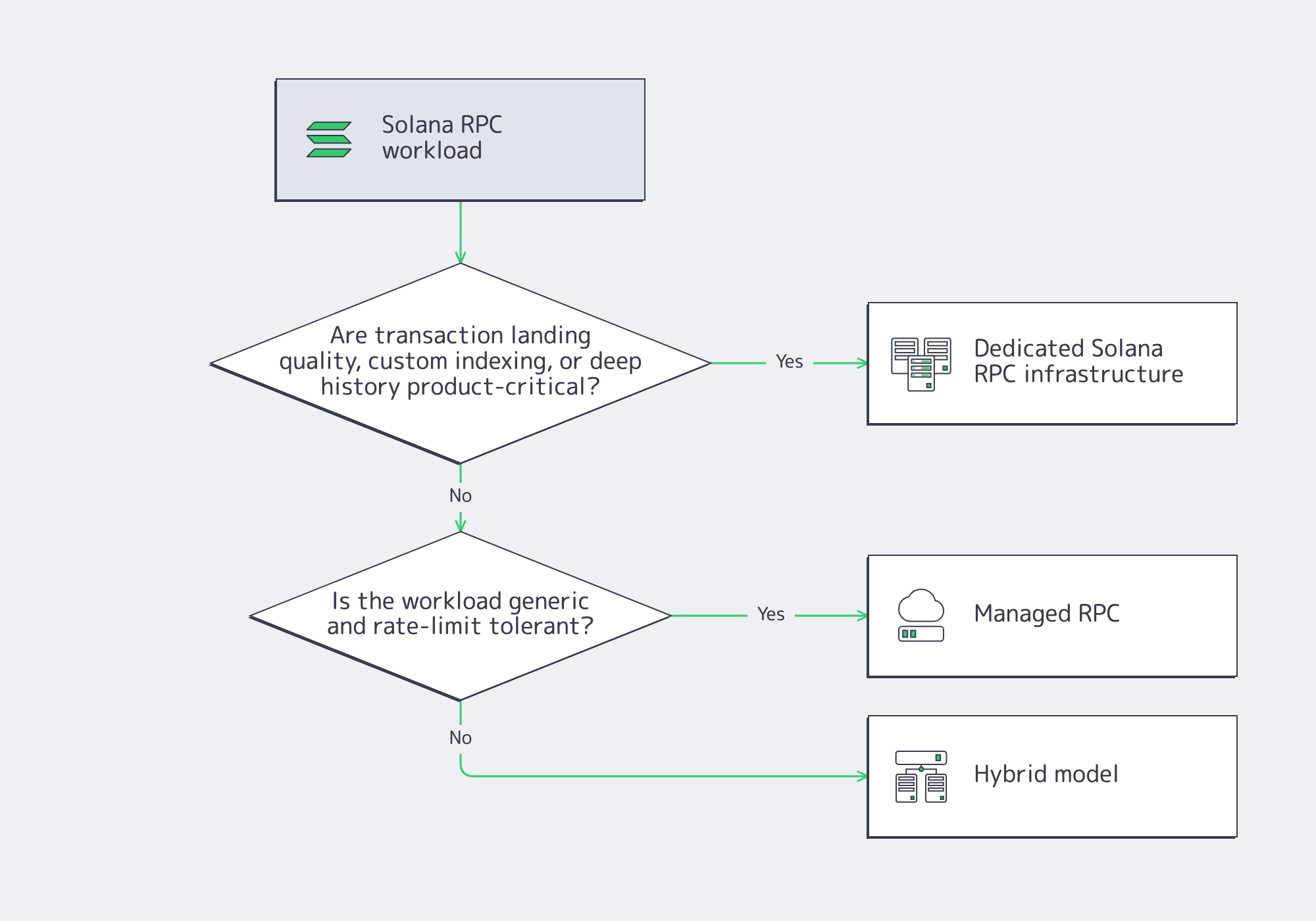
Dedicated Solana RPC infrastructure makes sense when failure-mode control matters more than convenience. If transaction landing under congestion, custom indexing, stable routing, or stream-based ingestion is part of the product, a shared endpoint becomes a constraint. Managed RPC is easier to start with; dedicated RPC is safer once the workload becomes specific, spiky, or operationally expensive to misroute.
The Real Question Is Control of Failure Modes
Solana’s retry guidance documents several common RPC failure modes: backends in the same pool can drift, rebroadcast queues can overflow, and user-visible failures often look like “RPC is broken” even when the process is technically up. If you operate the fleet, you can isolate sendTransaction traffic from heavy reads, choose indexing depth, and decide which nodes are allowed to absorb expensive history queries.
Where a Solana RPC Node Benefits Most From Dedicated Infrastructure
A dedicated Solana RPC node becomes more compelling when one of three things is true: transaction landing quality is a customer-facing issue, downstream systems need low-latency streaming and indexing, or capacity planning has to be deterministic instead of rate-limit-driven. In each case, the value is not just speed. It is control over queueing, routing, memory budgets, and method mix.
Buy vs. Build: What You Actually Pay For
Self-hosted RPC buys control over hardware class, NVMe layout, routing, observability, and upgrade timing. It also buys responsibility for release testing, snapshot strategy, and on-call response. Managed RPC buys simplicity and faster setup, but it usually gives up some control over metering, historical depth, and tail-latency behavior during network-wide spikes. A hybrid often works best: dedicated RPC for critical paths, managed access for less sensitive workloads.
Costs and Service-Level Checklist for Solana Node Hosting
Operating cost on Solana is mostly infrastructure cost, plus recurring protocol overhead for validators. RPC nodes add RAM, IOPS isolation, and client-serving headroom. Archive patterns move the cost center again toward long-term storage, read amplification, and egress. That is why cost modeling should follow role separation, not node count alone.
Internal Checklist for Treating a Node Like a Service
- Separate roles before you scale: keep voting, public RPC, and deep-history workloads from competing for the same box.
- Budget RAM for indexes, not headlines: account indexing and historical query depth should decide memory size, not generic “blockchain server” tiers.
- Protect the write path: split AccountsDB, ledger, and snapshots across separate NVMe devices before you add more CPU.
- Rehearse failover, don’t just document it: a standby validator, external monitoring, and controlled identity movement should be tested, not assumed.
- Measure service quality by freshness and landing rate: process uptime is not enough if replay lags or
sendTransactionsuccess degrades under burst traffic. - Keep upgrades boring: release cadence, rollback discipline, and trusted snapshot sources are operational features, not afterthoughts.
Design Around Role Clarity & Recoverability
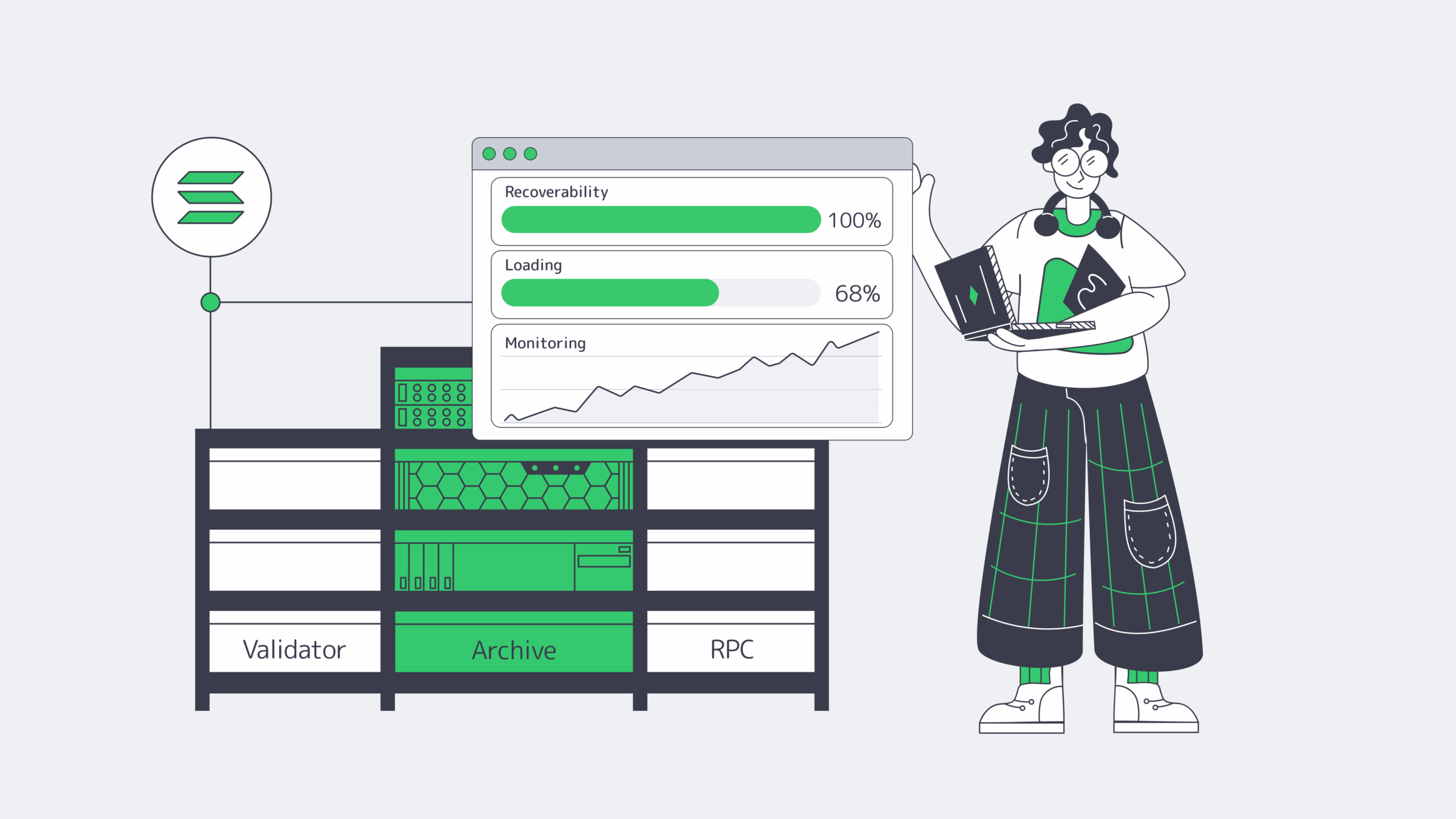
The right question is not “How large a server do I need?” but “Which failure mode am I paying to avoid?” Validators, RPC nodes, and archive designs all run the same software, yet each turns a different subsystem into the bottleneck. Good production architecture works when roles are separated, NVMe is separated, monitoring is externalized, and failover is rehearsed before a region or disk actually fails.
That is also where the managed-versus-self-hosted decision gets clearer. If the workload is generic, managed RPC can be enough. If it is latency-sensitive, history-heavy, or tightly coupled to transaction landing and endpoint stability, dedicated infrastructure is usually the more honest design.
Deploy Solana on Dedicated Servers
Run validators, RPC, and archive nodes on high-bandwidth dedicated servers across 21 global data centers. Configure AMD EPYC, RAM, NVMe, and ports up to 200 Gbps for stable, low-latency performance.
Get expert support with your services
Blog
Pragmatic Cloud Repatriation for Hybrid, Low-Risk Migrations
The public cloud is still expanding, but infrastructure strategy is no longer about moving everything in one direction. It is about placing each workload where its unit economics, latency profile, and control requirements make sense, then preserving the option to move again. Gartner forecasts worldwide public-cloud end-user spending reaching roughly $723 billion and points to hybrid as the mainstream operating model, with data synchronization becoming a central challenge.
The FinOps Foundation likewise reports survey data covering more than $69 billion in cloud spend and shows cost governance widening from cloud-only optimization into a broader Cloud+ model spanning SaaS, licensing, and private infrastructure. Even the repatriation signal is selective: Flexera says only 21% of cloud workloads have been repatriated. That is the point. Repatriation is not a belief system. It is portfolio engineering for workloads whose physics, risk, and spend profile no longer match public-cloud billing.
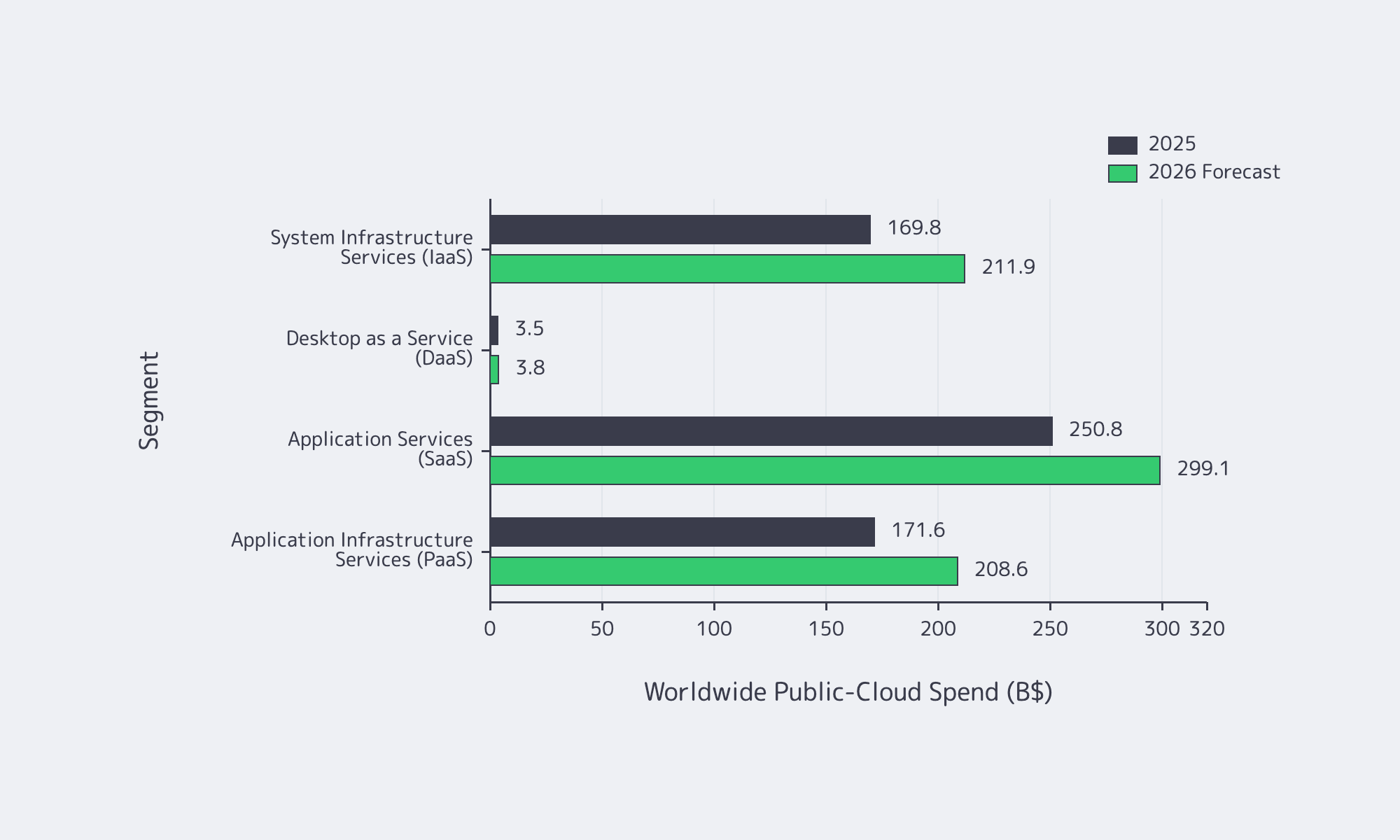
Public Cloud Spend by Segment, Baseline vs. Forecast. Source: Gartner.
How to Identify Which Workloads Are Good Candidates for Cloud Repatriation
Start by scoring each workload on five signals: steady utilization, data gravity, latency sensitivity, sovereignty or compliance demands, and egress pain. Then apply hard disqualifiers, including proprietary managed-service dependence, extreme burstiness, or global edge requirements. The aim is selective placement inside a hybrid estate, not a theatrical cloud exit.
A practical decision framework still does two jobs:
- Identify workloads where dedicated infrastructure improves unit economics, control, and performance predictability.
- Screen out false positives where cloud elasticity, managed-service coupling, or globally distributed execution still wins.
Steady utilization: the shape that breaks pay-as-you-go
Always-on services are where cloud pricing often stops matching workload physics. The signal is simple: utilization charts that look like a skyline, not a seismograph. If the baseline is flat, peaks are small, and the service is sized to a known SLO, the right comparison is steady-percentile unit cost, not list price and not burst pricing. This is where dedicated servers usually become economically legible.
Choose Melbicom— 1000+ ready-to-go servers — Custom builds in 3–5 business days — 21 Tier III/IV data centers |
 |
Data gravity, latency, and egress pain
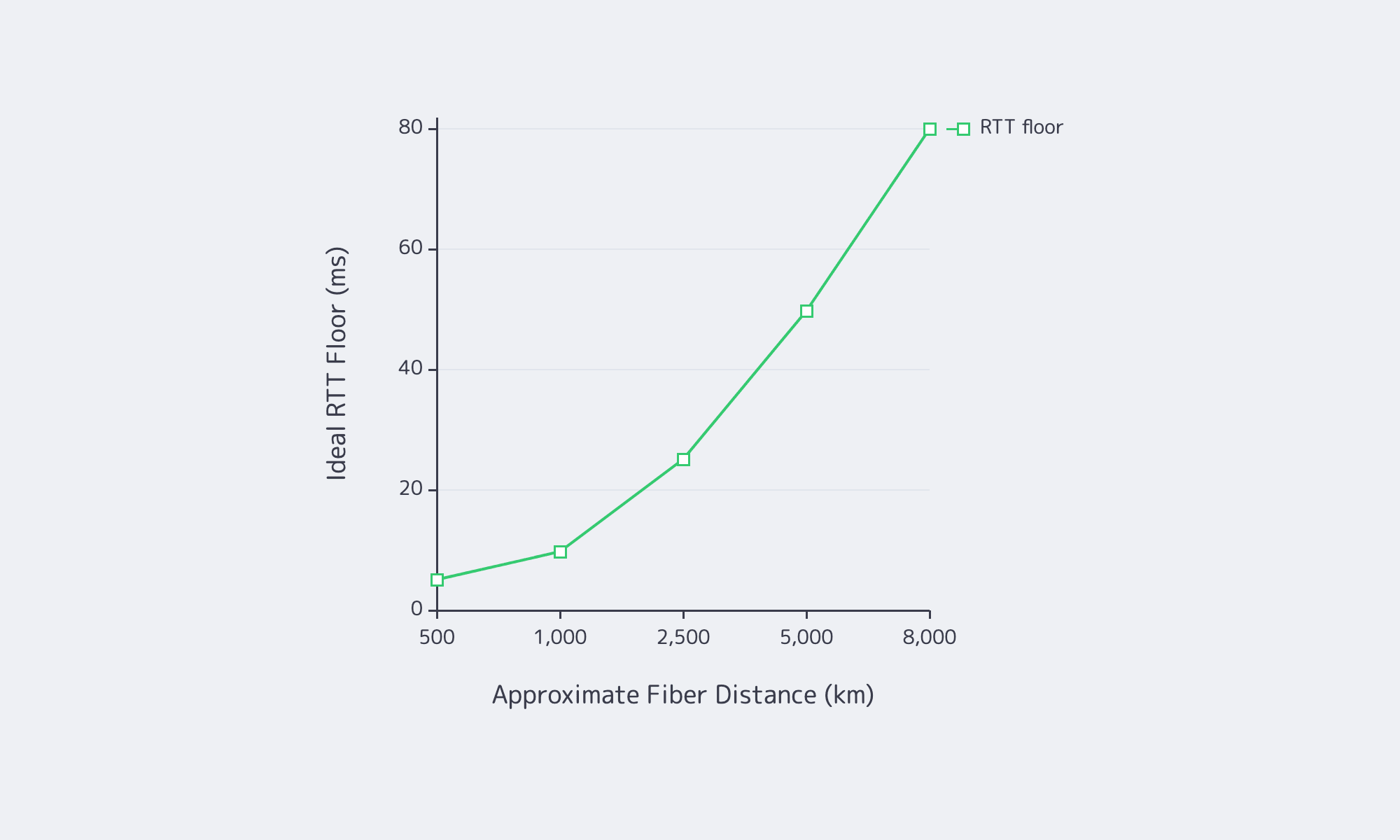
Some workloads become expensive not because compute is special, but because the dataset has become the platform. Computer Weekly, citing Wasabi research, reports that 47% of cloud-storage billing is tied to data and usage fees, including operations, retrieval, and egress, and that more than half of respondents exceeded budget. Add distance to the problem and it gets physical fast: a useful rule of thumb is about 5 ms one-way per 1,000 km in fiber. If analytics pipelines, customer exports, partner feeds, or real-time APIs are constantly moving data across regions or out of cloud, the motion itself becomes the tax.
Sovereignty, compliance, and the disqualifiers
For regulated systems, the question is rarely whether cloud is secure. It is whether your team can prove residency, control boundaries, access lineage, and reversibility on demand. CIO’s coverage of repatriation argues that exit plans need to be designed and evidenced through rehearsals, tests, and audit artifacts, not waved away in architecture diagrams.
Treat these as hard disqualifiers, or at least hybrid-only constraints:
- Heavy dependence on proprietary managed primitives that require system redesign rather than migration
- Extreme burstiness or uncertain growth where infrastructure overprovisioning will cost more than elasticity
- Global edge requirements that would force you to rebuild a footprint you cannot yet operate safely
How to Model the Cost of Moving Workloads from Cloud to Dedicated Infrastructure
Model repatriation in three layers: run costs, change costs, and risk costs. Compute, storage, and network matter, but so do staffing, platform tooling, dual-run overhead, and downtime exposure. The real comparison in cloud vs dedicated servers is billing shape plus operating load, not a simplistic server-bill-versus-cloud-bill spreadsheet.
Cloud vs dedicated servers: the real comparison is billing shape and operating load
This is where finance and platform teams usually talk past each other. The useful questions are: do you want variable unit cost or predictable unit cost for this workload shape, and which environment meets the SLO with less operational drag? Flexera reports that multi-cloud adoption sits around 89%, which means many estates already pay an invisible tax in duplicated tooling, cross-environment data movement, and fragmented accountability. The surprise charges tend to sit below the waterline: API calls, retrieval, telemetry, and day-to-day egress.
A cost model table that finance and platform teams can both live with
Use this as a working baseline.
| Cost component | How to model it | Forecast breaker |
|---|---|---|
| Compute run cost | Dedicated server costs by environment, plus growth headroom, compared against the cloud commitments the workload already uses | Teams compare against an optimized cloud future state but fund repatriation as if change is free |
| Storage run cost | Primary, replica, backup, and snapshot or object-storage retention | Storage is not just GB-month; operations, retrieval, and data path design can dominate |
| Network and data movement | Internet transit, private connectivity, and recurring north-south and east-west traffic | Egress is rarely a one-time migration event; it often becomes a chronic operating cost |
| Platform tooling | Observability, CI/CD, artifact storage, secrets, and security tooling | Dual-run often inflates license counts and telemetry volume precisely when budgets are under the most scrutiny |
| Labor and on-call | Permanent run staffing plus temporary migration staffing and incident coverage | Repatriation creates a temporary two-platform problem; underfunding it turns migrations into incident factories |
| Migration and risk buffer | Discovery, dependency mapping, rehearsals, cutover windows, rollback reserves, and downtime exposure | Programs budget for the final cut, then discover too late that rehearsal cadence is what made rollback real |
Where Melbicom fits into the cost model
Melbicom becomes relevant when the dedicated layer has to be forecastable as well as technically usable. We offer 1000+ ready-to-go dedicated server configurations, custom builds in 3–5 business days, and deployment across 21 Tier III and Tier IV data centers globally, which is exactly what matters when a team needs production-like replicas, dual-run capacity, and a migration calendar that does not reopen procurement every week.
How to Execute Cloud Repatriation with Low Downtime and Rollback Protection
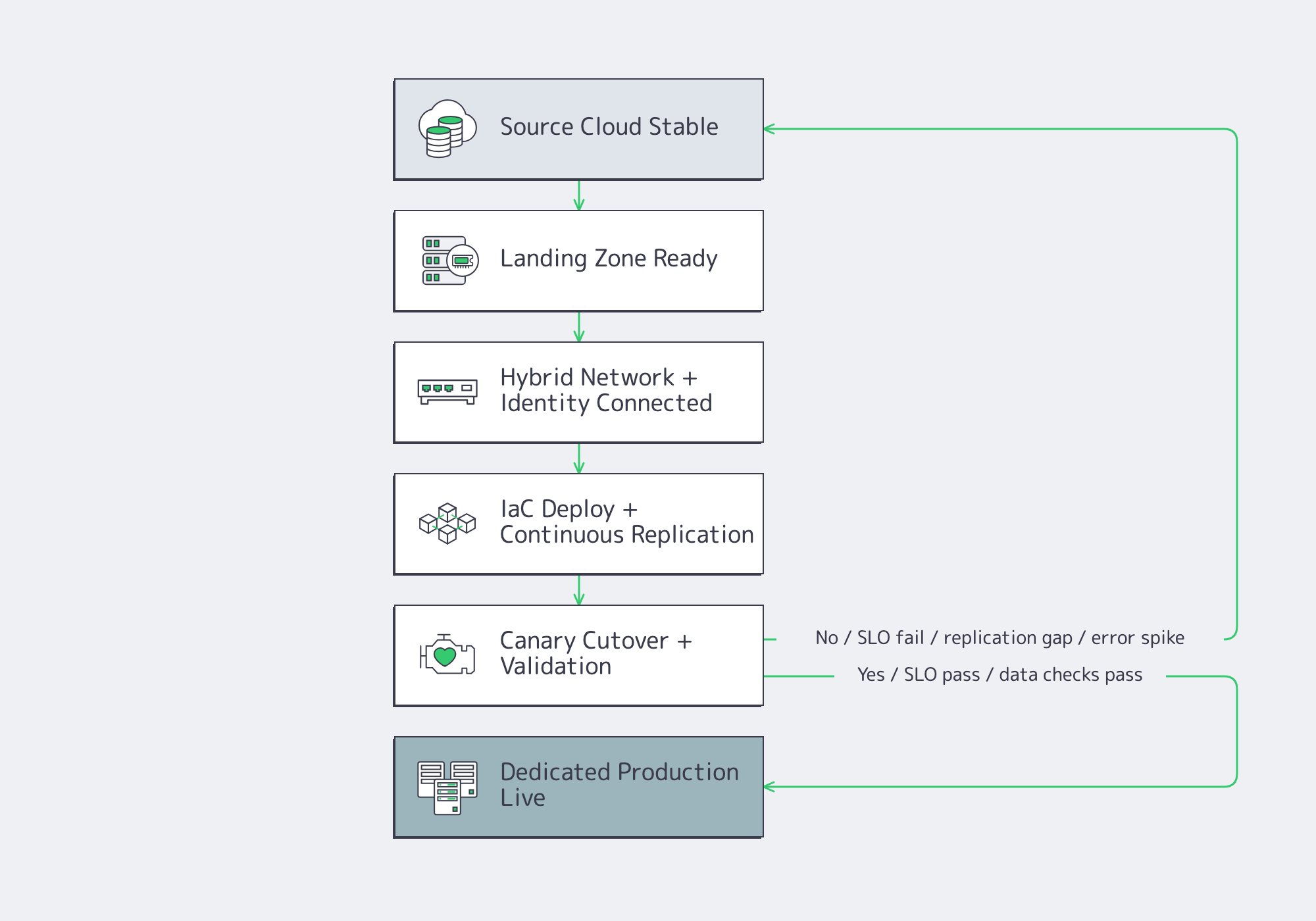
Execute repatriation as a reliability program. Build the landing zone first, connect it cleanly, automate it with infrastructure as code, replicate data continuously, shift traffic progressively, observe both environments at once, and keep rollback technically viable until production behavior proves the new placement is safe.
Build the landing zone like a product, not a rack
The target environment should arrive with a tenancy model, identity integration, image baselines, secrets handling, artifact storage, and backup strategy already defined. This is why control surfaces matter. Melbicom’s platform includes an API, a control panel, and isolated management access over VPN, which makes automation and failure recovery far less improvised than the old ticket-and-spreadsheet model.
Networking and traffic steering: plan for hybrid, not a cliff-edge
The safest cutovers do not flip traffic like a switch. They stage it. Start with replication paths that can tolerate real data volume, move to canaries, then small slices of production traffic, and keep the old path healthy until the new one proves itself. For internet-facing migrations, Melbicom supports BGP sessions that help preserve IP continuity for allowlists, partner integrations, and route control. Where origin load or geographic spread is the risk, Melbicom’s CDN can reduce exposure during staged cutovers.
IaC, data sync, observability, and rollback
Infrastructure as code is the foundation of believable rollback. If the target cannot be rebuilt cleanly, rollback becomes an argument instead of an action. For stateful systems, low-downtime execution usually means continuous replication, a narrow freeze window, validation gates, and explicit rollback triggers. During dual-run, standardized telemetry matters: OpenTelemetry gives teams one way to compare traces, metrics, and logs across both environments. Keep backups and rollback artifacts in neutral storage; Melbicom’s S3-compatible storage helps separate recovery data from the cutover substrate.
Key Takeaways That Keep Cloud Repatriation Pragmatic
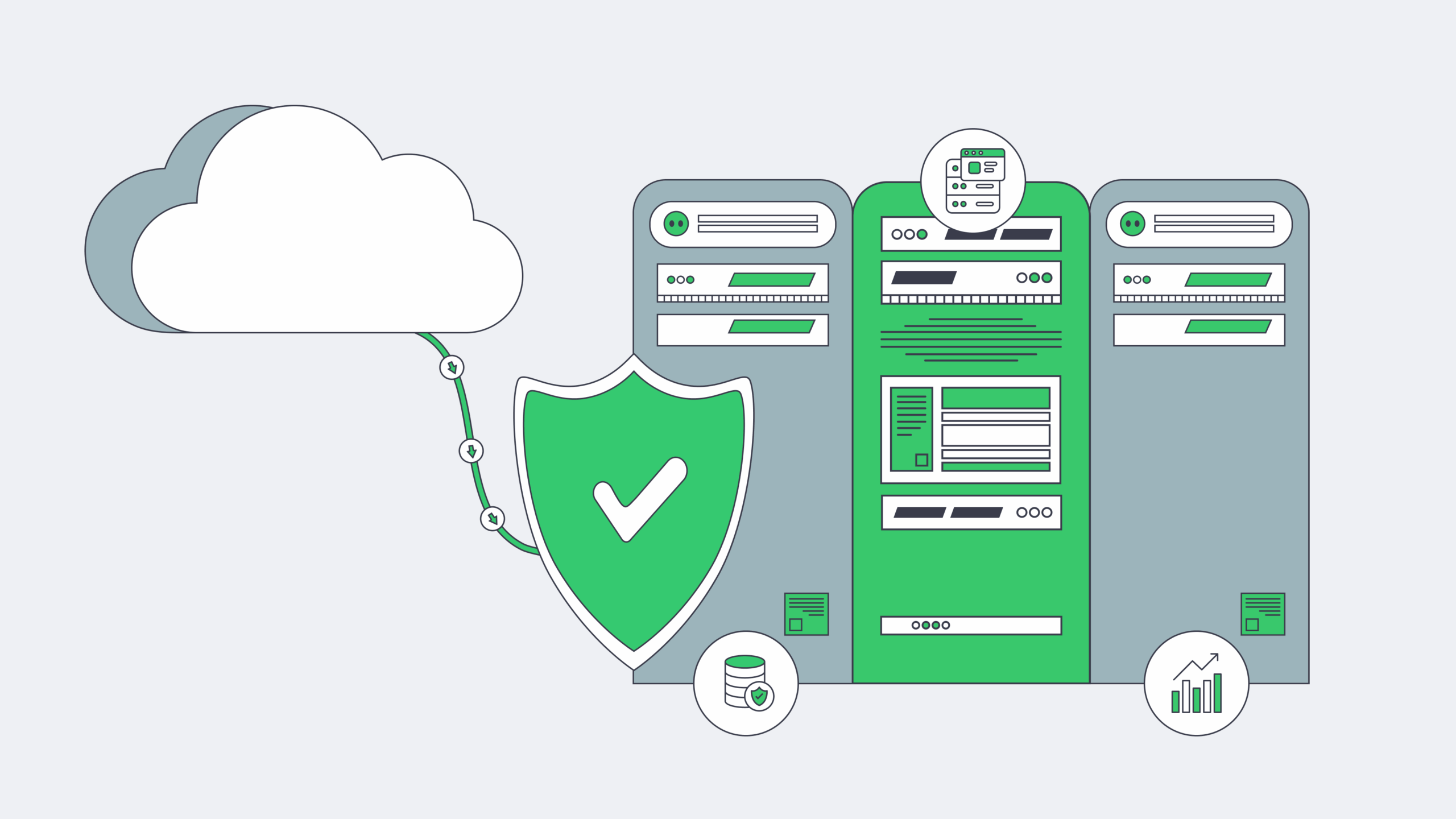
The modern repatriation playbook is not “leave cloud.” It is “move the steady core, keep the elastic edge, and preserve reversibility.” That means candidate selection based on workload shape and data motion, cost models that count labor and tooling, and execution plans built like reliability engineering rather than relocation.
The business case gets easier to defend when the economics are steady enough to be visible. Ahrefs’ widely cited estimate of roughly $400 million in avoided IaaS spend over three years is an outlier, but the lesson holds: long-running workloads punish vague placement decisions.
- Rank your candidates by workload shape and data motion together as either signal alone can mislead.
- Fund dual-run and rollback rehearsals as planned work, not contingency overhead.
- Default to hybrid placement: move steady cores deliberately, and keep bursty or edge-heavy components where elasticity still pays.
Plan Cloud Repatriation with Melbicom
Run hybrid migrations on predictable, dedicated infrastructure. Get 1000+ server configs, rapid custom builds, 21 global data centers, BGP support, and CDN reach to stage traffic safely.
Get expert support with your services
Blog

Beyond Hardware: Total Cost Of Dedicated Servers
Dedicated server price is no longer just hardware: the monthly fee reflects power, network, IP, support, and contract economics. Similar CPU/RAM servers can produce different invoices once bandwidth, renewals, remote hands, or extra IPs enter the picture.
Uptime Institute reports rack densities rising into the 7–9 kW range, while modern servers can draw several hundred watts under load. TeleGeography says global internet bandwidth grew 23%. More density and traffic make the “server as a box” view outdated.
Choose Melbicom— 1000+ ready-to-go servers — Custom builds in 3–5 business days — 21 Tier III/IV data centers |
|
What Drives Dedicated Server Pricing Beyond CPU and RAM
CPU and RAM explain the base server, not the full bill. Storage performance, bandwidth accounting, interconnection quality, IP usage, support scope, and contract flexibility create the biggest pricing gaps—and the costs that compound fastest as deployments grow.
Dedicated Server Prices and Why Storage Is No Longer “Just Disk”
Storage is now priced by latency as much as capacity. SATA 6 Gb/s tops out around 600 MB/s; NVMe is built for lower latency under parallel load. That makes NVMe right for DBs, caches, queues, and write-heavy logging—but an expensive mistake for cold data.
Melbicom’s S3-compatible storage changes that sizing math. Keep NVMe for the hot working set, then move snapshots, artifacts, and cold content to object storage. Pay for fast storage only where speed changes outcomes.
Server Prices and Why the Network Is the Bill
Most budget mistakes start with a category error:
- A port is capacity, measured in Gbps.
- Transfer is volume, measured in TB or by a metered model.
Those are not the same. “Unmetered” also does not automatically mean unconstrained. TeleGeography shows weighted-median 100 GigE transit pricing falling at about a 12% compound annual rate across key cities over a recent three-year span.
Melbicom’s live dedicated server catalog filters configurations by CPU, CPU brand, RAM, storage, bandwidth, transfer, GPU, and data center. That is how quotes should be read: know whether throughput is guaranteed (Melbicom’s case) or “up to,” how overages are billed, and whether mid-cycle provisioning changes the first invoice.
Location, Peering, IPs, Support, and Term
Location pricing is partly geography and mostly interconnection. High Performance Browser Networking uses a rule of thumb of 200,000,000 meters per second for light in fiber.
Then come the quiet line items. ARIN documents the depletion of the free IPv4 pool, so additional addresses can become expensive at scale. Remote hands often sit outside the monthly fee. A good first-term number can become a bad long-term number if bandwidth, IPs, or support work are repriced. Melbicom’s BGP session service matters here because BYOIP and routing flexibility can reduce renumbering and migration cost when infrastructure changes.
How to Compare Dedicated Server Quotes Without Missing Hidden Costs
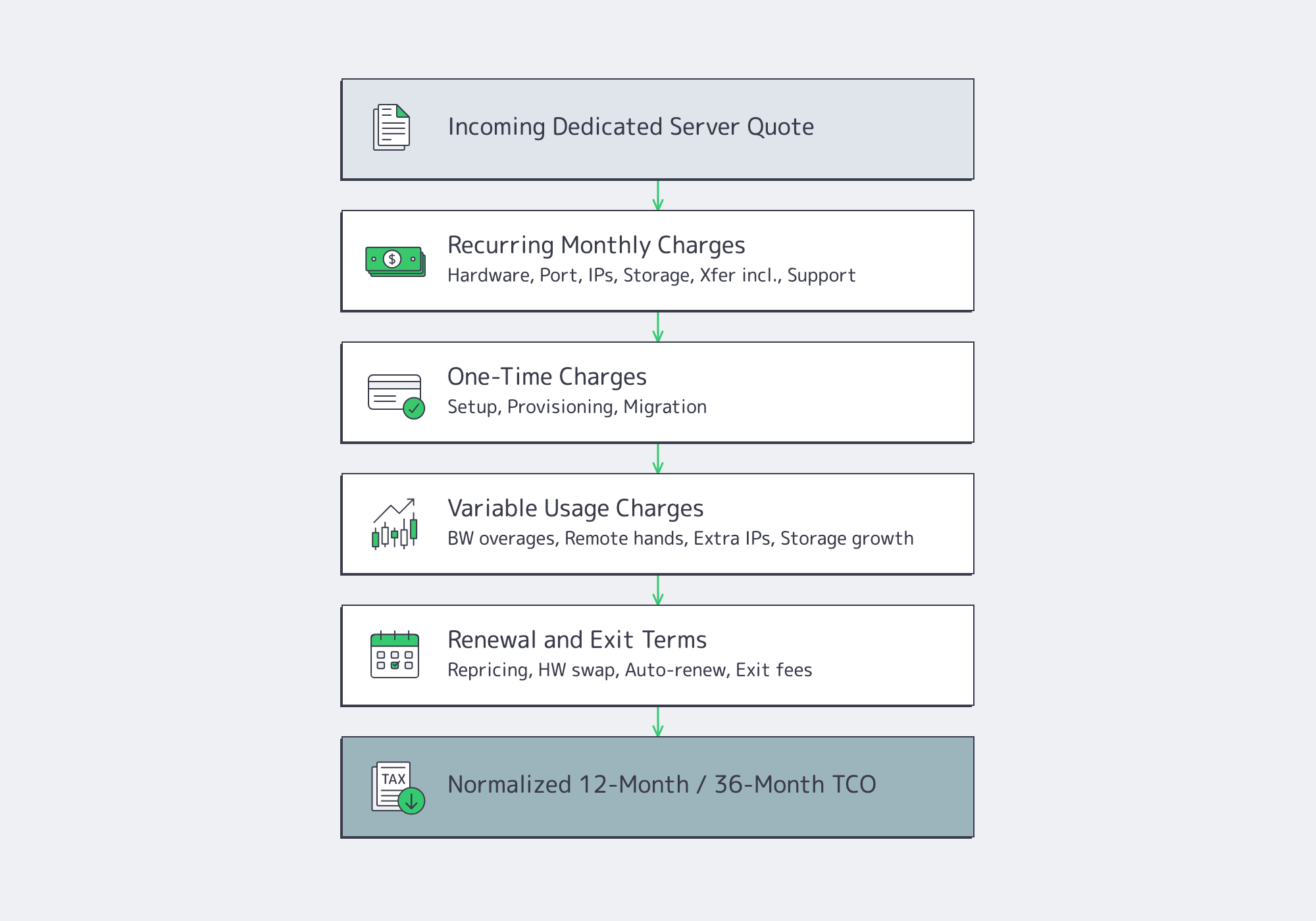
The only sound way to compare dedicated server quotes is to force each one into the same ledger: recurring charges, one-time fees, variable usage, and renewal mechanics. Without that normalization, the cheapest line item on day one often becomes the most expensive deployment over the term.
A simple quote-normalization framework:
- Recurring monthly charges: hardware, port, included transfer, IPs, storage, support, management.
- One-time charges: setup, provisioning, migration, install labor, cross-connects.
- Variable charges: bandwidth overages, extra IPs, remote hands, storage growth, burst events.
- Renewal mechanics: term, repricing language, auto-renewal, hardware swap terms, exit conditions.
| Cost Driver | How It Appears on Quotes | What to Clarify |
|---|---|---|
| CPU and licensing | CPU model, cores, threads | Are you paying for cores your workload—or your software licenses—cannot use? |
| RAM and storage | GB RAM, NVMe/SSD/HDD, x TB | Is premium local storage being used for cold data that belongs in object storage? |
| Port and bandwidth | 1/10/25/100 Gbps, unmetered, included TB | Is throughput guaranteed, how are overages billed, and is billing prorated mid-cycle? |
| Location and interconnection | Region or data center | Does the site have the peering depth and network headroom the workload needs? |
| IPs, support, and term | Included IPs, support tier, contract | How are additional IPs, remote hands, after-hours work, and renewal pricing handled? |
Two traps are especially expensive. First, oversized CPUs can inflate software licensing. Microsoft’s Windows Server rules are core-based with minimums per physical server, so extra headroom can also mean extra license spend. Second, network-heavy workloads become hard to forecast if CDN and object storage are treated as “later” optimizations. Melbicom’s CDN reaches 40 CDN PoPs in 35 countries and makes egress offload modelable instead of anecdotal.
How to Build a TCO Model for Dedicated Servers at Scale
A durable TCO model has three layers: fixed monthly spend, variable utilization costs, and change-or-risk costs. That structure reflects how dedicated servers behave in production, where traffic spikes, extra IPs, support work, licensing effects, and migration events often explain more spend than the server’s headline monthly rate.
Start with three buckets:
- Fixed monthly spend: server MRC, port, baseline transfer, included IPs, standard support, baseline storage.
- Variable utilization spend: bandwidth overages, extra IPs, storage growth, premium support, remote hands.
- Change and risk costs: setup, migrations, hardware refreshes, emergency work, and outage impact.
That third bucket is not theoretical. Uptime Institute says one in five impactful outages cost more than $1 million. The International Energy Agency estimates data centers use about 415 TWh of electricity, or roughly 1.5% of global demand, with consumption growing around 12% annually over the prior five years. Even when power is embedded in the provider’s price, those constraints still flow into server economics.
Use a unit-cost lens: cost per 1,000 requests, cost per TB served, cost per active tenant, or whichever metric maps infrastructure cost to delivered value. If spend rises while output stays flat, the problem is usually oversizing.
Dedicated Server Price Optimization Through Sizing Tips That Prevent Overpaying
The most common dedicated server pricing mistake is not paying too much per server. It is buying the wrong shape. Use a few simple rules:
- Fit CPU to the real bottleneck. Single-thread latency and throughput workloads do not scale the same way.
- Size RAM for the working set, not the full dataset.
- Use NVMe for hot paths; push cold data to lower-cost storage.
- Treat port speed as risk control for peak traffic, not a vanity metric.
- Use CDN offload to reduce origin egress and avoid oversized ports.
- Choose location for latency and routing efficiency, not just compliance.
Melbicom makes those trade-offs easier to model because the relevant levers are explicit: dedicated servers, data center locations, CDN, S3 storage, and BGP support sit in the same commercial ecosystem. That matters because reducing TCO is often about using the right adjacent service—not just buying a bigger server.
Dedicated Server Price Checklist Before You Sign
Before you approve a quote or renewal, use these rules of thumb:
- Separate port size from transfer volume and model both against normal traffic and peaks.
- Treat extra CPU cores as a licensing decision, not just a performance upgrade.
- Keep NVMe for hot data and move backups, snapshots, and logs to cheaper tiers.
- Price the full contract path: setup, renewal, extra IPs, remote hands, and exit costs.
- Choose location by latency, peering depth, and bandwidth ceiling—not by map alone.
Conclusion: Model the Full Operating Cost, Not the Sticker Price
Dedicated server price only looks simple when the quote hides the expensive parts. In reality, total cost is driven by storage latency choices, bandwidth accounting, interconnection depth, IP consumption, support scope, and how much optionality the contract preserves when traffic, routing, or architecture changes. The smartest buy is rarely the lowest monthly line item. It is the deployment shape that stays efficient when assumptions move.
Treat dedicated servers as a system, not a SKU. Normalize the quote, measure cost against the output your environment actually produces, and use services like CDN, object storage, and BGP to avoid solving every problem with a larger server and a fatter port.
Compare dedicated server pricing now
See configurations, ports, and transfer options across global data centers. Filter by CPU, RAM, storage, and bandwidth to model total cost before you buy.
Get expert support with your services
Blog
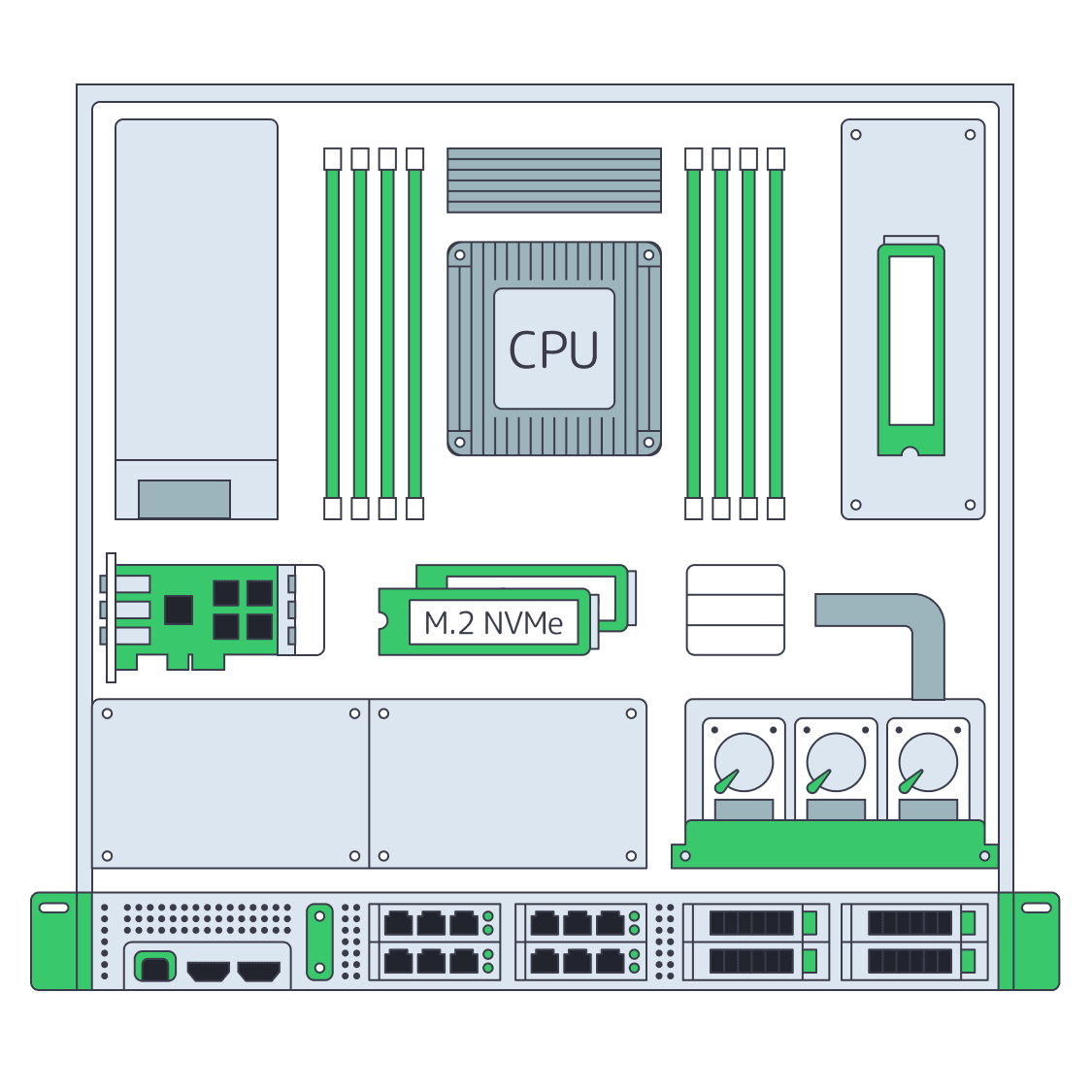
Spec Dedicated Servers From Workload, Not the Catalog
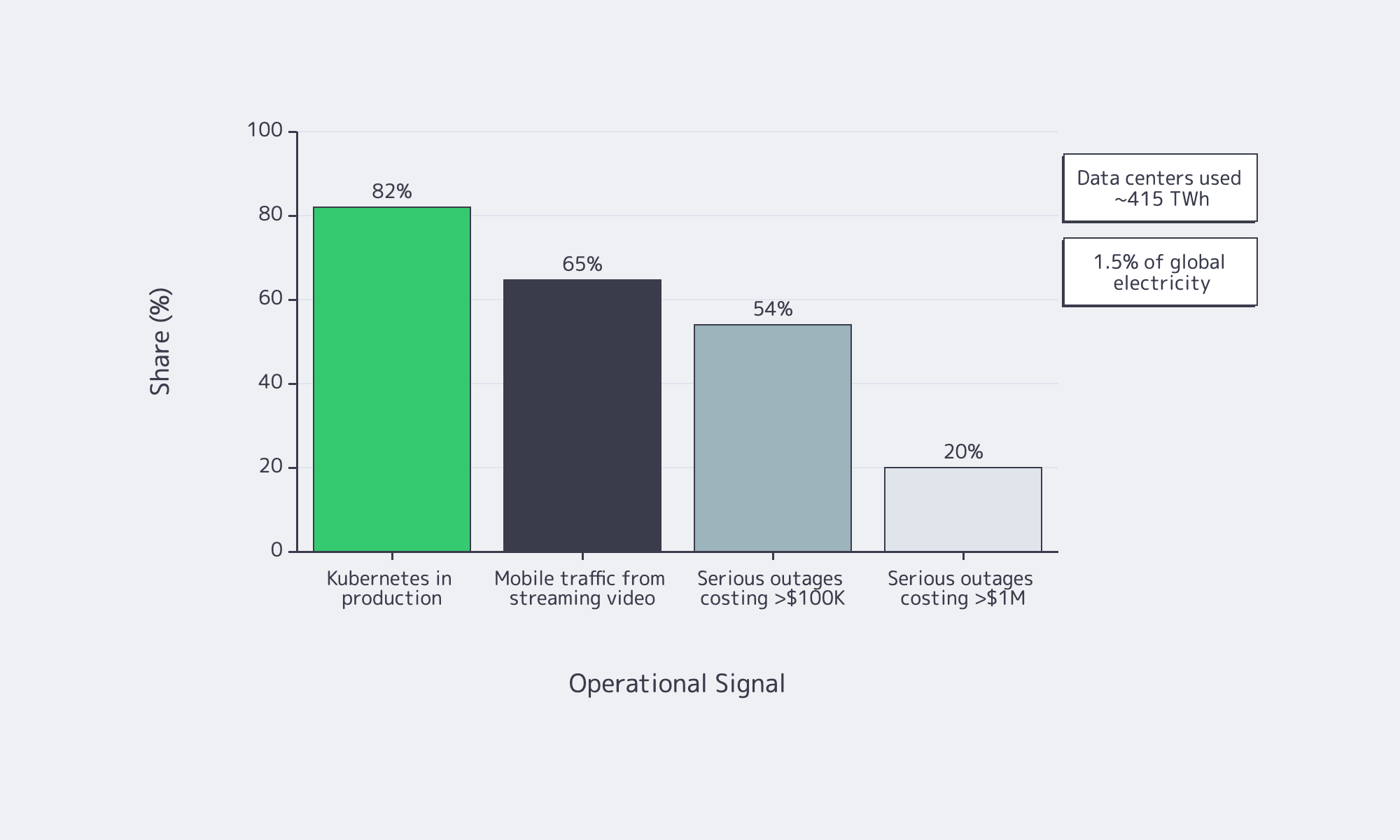
Dedicated server buying is no longer a catalog exercise—the IEA says data centers used about 415 TWh, 1.5 percent of global electricity consumption, while Uptime Institute reports that 54 percent of recent serious outages cost more than $100,000 and one in five topped $1 million. Overbuild and you waste power; underbuild and you buy downtime.
Server models work best as a bill of materials tied to workload behavior: what stays in RAM, what commits to storage, what bursts on the network, and how the machine fails and recovers. That is where Melbicom becomes useful: dedicated servers, BGP, IP-KVM, high-bandwidth ports, CDN, and S3-compatible storage.
Choose Melbicom— 1000+ ready-to-go servers — Custom builds in 3–5 business days — 21 Tier III/IV data centers |
|
Why Server Models Are Changing
A server model used to mean a prebuilt configuration. Now it is an engineering pattern: workload, constraints, BOM, and acceptance test. Current platforms offer more PCIe, DDR5 bandwidth, and NVMe headroom, but they also punish bad topology; a weak WAL device or undersized NIC can erase the benefit of a headline CPU.
Software is more distributed by default. CNCF says 82 percent of container users run Kubernetes in production, which makes east-west traffic and control-plane storage first-order concerns. Global Internet Phenomena reports streaming video is more than 65% of mobile traffic by volume, so port speed and routing are now application-design decisions.
How to Spec a Dedicated Server from Workload Requirements
Start with the workload, not the catalog. Define latency, throughput, growth, and failure targets; map them to CPU time, memory residency, storage latency, and network headroom; then write the server as roles—compute, RAM tier, NVMe layout, NICs, remote management, and redundancy—with acceptance tests attached from day one.
Server Hardware Signals That Map Cleanly to Sizing
Start with p50/p95/p99 latency, burst shape, concurrency, working-set size, growth, and RPO/RTO. CPU hot spots tell you whether you need clocks or cores. Working-set fit sets the RAM tier. Commit behavior tells you whether storage latency matters more than throughput. Replication and client fan-out set the NIC floor.
Two paths deserve special attention. PostgreSQL reminds us that commits depend on WAL reaching durable storage, which is why a separate low-latency log device still matters on write-heavy databases. etcd is equally blunt: disk write latency dominates cluster behavior, so SSD-class storage is mandatory for heavier control planes.
How to Choose CPU, RAM, NVMe, and Network Config for a Custom Server Build
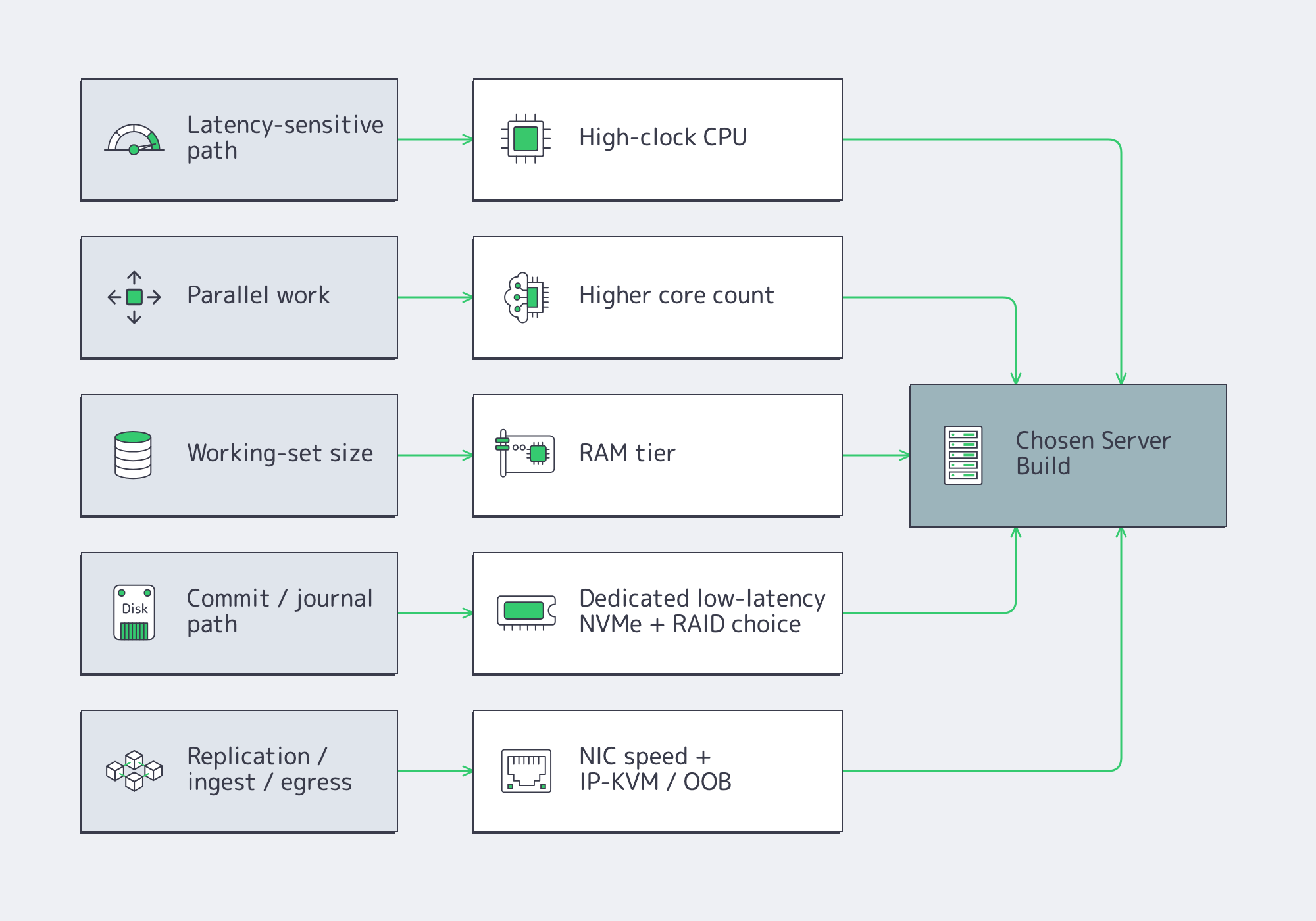
Choose parts by removing the bottleneck that actually limits the application. Fast clocks help latency-sensitive paths, more cores help parallel work, RAM keeps the hot set off disk, NVMe layout controls tail latency, and the right NIC plus out-of-band access makes both peak traffic and failure recovery survivable.
CPU Server Hardware: Cores Versus Clocks
Fewer, faster cores usually win when the critical path is request latency, locking, compression, crypto, or commit coordination. More cores pay off when the workload scales cleanly across workers: analytics scans, encoding, indexing, or heavy parallel query execution. The wrong CPU often shows up first as tail latency or stalled background work, not as obvious saturation.
Memory Tiers and Server Hardware Headroom
Think in three bands: fits in RAM, almost fits, and does not fit. The first delivers stable latency. The second can sometimes be rescued with better caching or hot-set pinning. The third usually means redesign or sharding. Faster memory helps bandwidth, but it does not fix a hot path that is larger than the practical DRAM budget.
Storage Server: NVMe Layout and RAID Strategy
NVMe is the default for serious latency-sensitive roles, but layout matters more than brand. Mirror the boot volume. Isolate WAL, journals, or metadata onto their own low-variance devices when commit frequency is high. Use RAID10 where mixed read/write latency matters; use capacity-oriented protection where rebuild behavior matters more. NVMe ZNS is worth watching for sequential-write-heavy systems as it can reduce write amplification.
Network, Remote Management, and Redundancy
The NIC is both a performance part and a recovery tool. Size port speed from real replication, rebalance, ingest, and egress numbers; small-packet systems may be packet-rate bound before bandwidth-bound. If routing control matters, Melbicom’s BGP service supports BYOIP, IPv4/IPv6, communities, and full, default, or partial routes. Melbicom’s network design allows isolated IP-KVM access plus vPC/802.3ad and VRRP. Melbicom’s wider platform spans 23 transit providers, 29 IXPs, and port ceilings up to 200 Gbps by location, so the facility choice can change the BOM almost as much as the NIC.
Ready-to-Copy Server Models for Modern Dedicated-Server Workloads
These are starting points, not SKU dumps. Treat them as copy-ready roles that map to current catalog shapes rather than frozen part numbers.
| Workload | What Matters Most | Copy-Ready Starting Spec |
|---|---|---|
| OLTP database | Commit latency, cache hit rate | High-clock single-socket CPU; hot-set RAM; RAID1 boot; dedicated NVMe WAL; NVMe RAID10 data; dual 25/100 GbE if replication is heavy; OOB console. |
| Cache node | RAM residency, packet rate | Fast-clock CPU with enough cores for network and background tasks; high ECC RAM; RAID1 boot; optional dedicated NVMe if persistence is enabled; 25/100 GbE when refill or large-object traffic is high. |
| Storage node | Rebuild behavior, metadata latency | Moderate-core CPU; RAM for metadata and recovery; RAID1 boot; NVMe for DB/WAL or metadata; capacity SSD/HDD tier for bulk data; 25/100 GbE sized to backfill windows; explicit recovery plan. |
| Kubernetes node | Pod density, image/log I/O | Balanced core count; moderate-to-high RAM; RAID1 boot; NVMe for images, logs, and local volumes; keep control plane and etcd on low-latency storage; 25 GbE floor when east-west traffic is substantial. |
| Blockchain node | Sync I/O, state growth | Strong single-thread plus enough cores for validation and indexing; high RAM for state caches; RAID1 boot; large NVMe data tier; redundant layout if resync time is unacceptable; higher-bandwidth ports for sync and clients; BGP if IP stability matters. |
| Streaming origin / packager | Ingest bursts, segment egress | High-clock CPU or GPU-assisted transcode where needed; 128-256 GB RAM; RAID1 boot; NVMe cache or origin tier; 25/100/200 GbE sized from concurrent streams and bitrate ladder; pair with CDN so repeat reads leave origin. |
Two caveats keep these profiles honest. Cache persistence is optional. Storage clusters still rise or fall on metadata and DB/WAL placement; Ceph continues to recommend SSD/NVMe tiers even when bulk data sits on larger drives. For streaming, push repeat reads out to Melbicom’s CDN, which spans 40 CDN PoPs in 35 countries
What a Provider-Ready RFP for a Dedicated Server Build Should Include
A provider-ready RFP should let two engineers arrive at the same build without a sales call. That means a measured workload summary, explicit CPU/RAM/storage/network roles, routing and management requirements, acceptance tests, and location constraints written clearly enough to quote, rack, and verify on delivery day.
- Workload summary: role, software stack, refresh cycle.
- Performance targets: throughput, p95/p99 latency, burst model, data growth.
- CPU and RAM: clocks-versus-cores priority, memory target, ECC, headroom policy.
- Storage: boot, log/WAL/journal, data, scratch roles, RAID, endurance.
- Network: port speed, number of ports, bonding, IPv4/IPv6, peak transfer.
- Routing and management: BGP/BYOIP, route type, communities, out-of-band console.
- Acceptance tests: fio profile, network throughput, burn-in window, topology validation.
- Location: required metro or region, residency constraints, term, migration dates.
Before you approve the quote, make sure it explicitly names:
- core count and clock bias
- RAM target and headroom policy
- NVMe role separation
- NIC speed and routing requirements
- out-of-band recovery path and redundancy assumptions
A Good Server Spec Is a Deployable Document
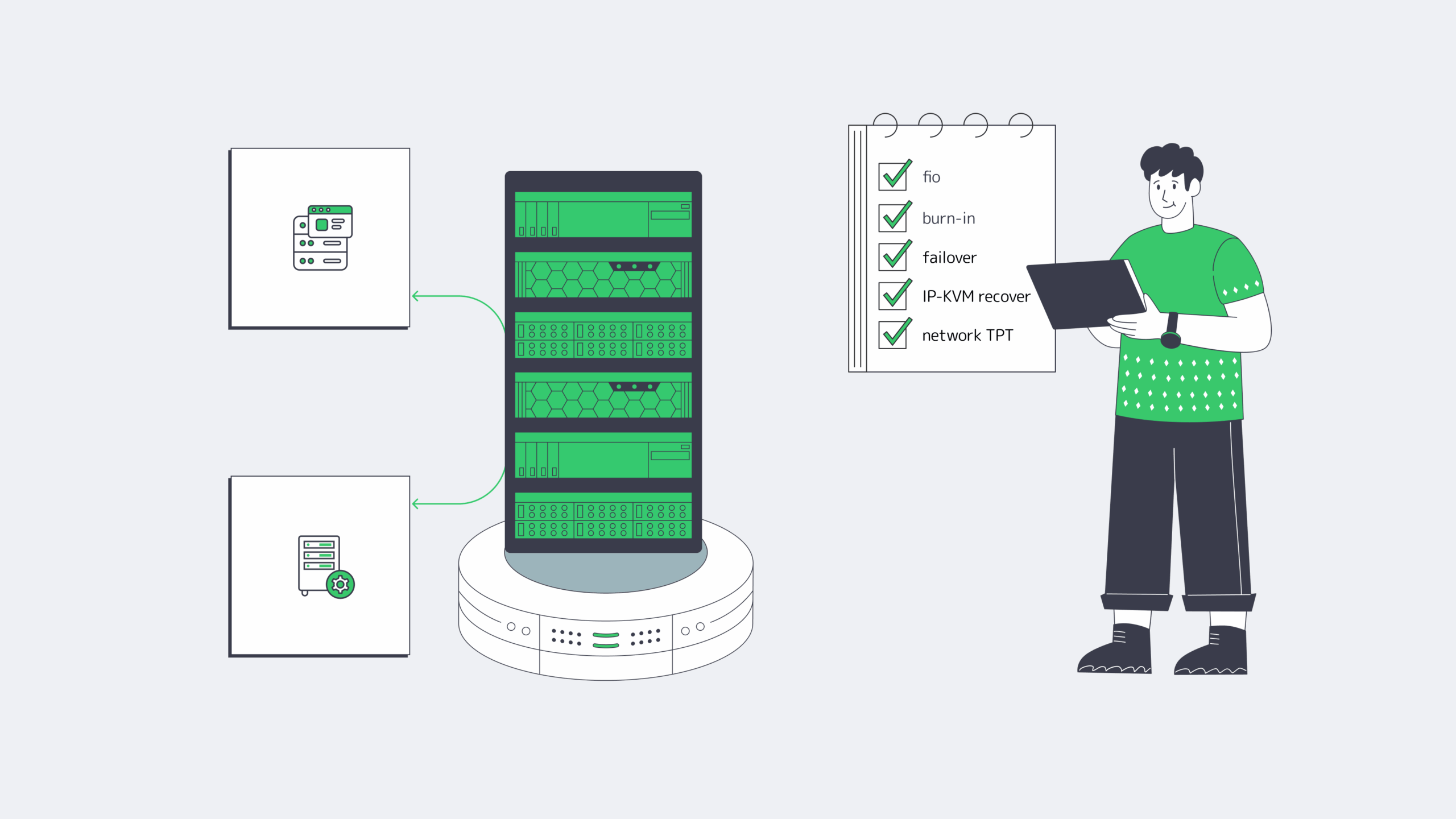
The point of a server model is not elegance. It is to turn workload behavior into a machine you can buy, test, recover, and scale when traffic, data size, or replication patterns change. If the BOM cannot explain the CPU, RAM tier, NVMe layout, NIC, and management path, it is still too vague.
Provider fit is the same test. The quote should mirror the workload: drive roles, port ceilings by location, routing options, and a deployment window you can plan around.
- Buy NIC speed for failure and backfill windows, not quiet-hour averages.
- Separate commit and metadata paths from bulk data before you add more CPU.
- Make IP-KVM, RAID layout, and burn-in tests part of the quote, not an afterthought.
- Treat location as a hardware variable: port ceilings and interconnection depth change the best build.
Build a Custom Server with Melbicom
Get a custom build aligned to your workload—CPU, RAM, NVMe, NICs, and BGP options—with delivery in 3–5 business days across 21 Tier III/IV data centers and ports up to 200 Gbps.
Get expert support with your services
Blog
1Gbps Reality: Goodput, Bottlenecks, And Upgrade Cues
A 1Gbps port still lands in the sweet spot for production infrastructure: fast enough for serious web traffic, predictable for monthly planning, and affordable. But the number on the order form is line rate, not guaranteed application payload. That gap matters more now because HTTPS is effectively default on the public web, median home pages are still measured in multi-megabytes, and modern DDoS campaigns operate at scales far beyond a single server port.
So the real question is not “Is 1Gbps fast?” It is: how much can a dedicated server 1Gbps setup move over a month, which workloads fit, which ones hit the wall, and when does a port upgrade solve the problem rather than just move it?
Dedicated Server 1Gbps Reality Check: Line Rate Is Not Monthly Payload
A 1Gbps Ethernet port is a wire-speed number. Your users see goodput, not line rate. Ethernet framing, IP and TCP headers, TLS, retransmits, congestion control, and proxy overhead all shave usable payload before the application sees a byte. As a planning rule, treating about 928 Mbps as a clean TCP ceiling without jumbo frames is more honest than budgeting around a perfect 1,000 Mbps.
That distinction is why a port can be “dedicated” and still disappoint. User experience is often capped first by CPU used for encryption and proxying, disk I/O serving cold files, connection handling under concurrency, or latency over longer paths.
How Much Traffic a 1Gbps Dedicated Server Can Realistically Handle per Month
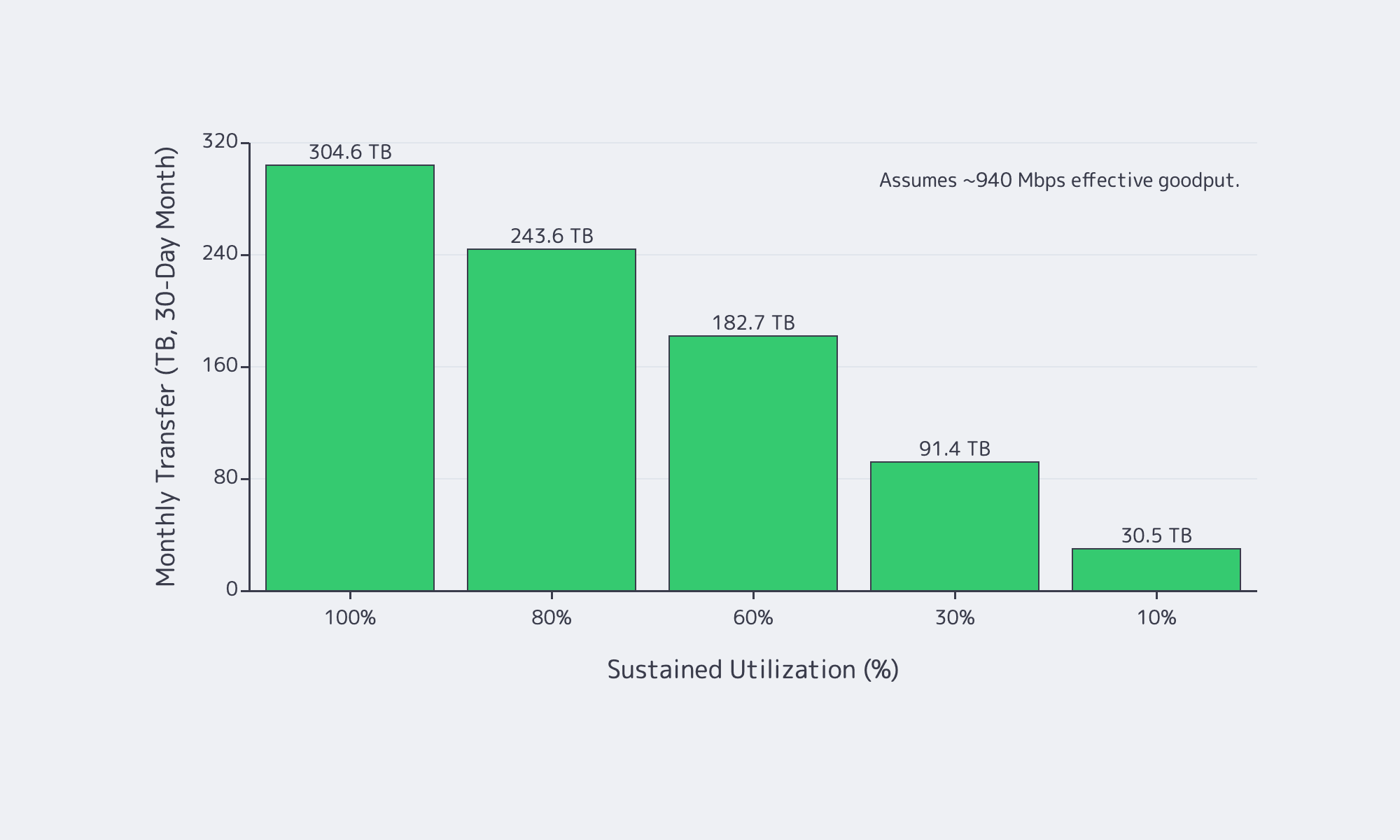
In practice, a 1Gbps port tops out at about 324 TB/month in perfect math, but realistic TCP goodput is closer to 928–940 Mbps, so plan around roughly 300 TB/month at full sustained utilization—and much less once burstiness, retransmits, and headroom enter the picture.
If a link could run at exactly 1,000,000,000 bits per second for a full 30-day month, it would move about 324 TB, or about 295 TiB. But nobody should buy a port on perfect math. A safer model is to treat about 940 Mbps as the top end of realistic sustained TCP payload and then scale monthly transfer by average utilization, not by peak screenshots.
| Sustained Utilization | Effective Goodput | Monthly Transfer (30-Day) |
|---|---|---|
| 100% | 940 Mbps | 304.6 TB |
| 80% | 752 Mbps | 243.6 TB |
| 60% | 564 Mbps | 182.7 TB |
| 30% | 282 Mbps | 91.4 TB |
| 10% | 94 Mbps | 30.5 TB |
Two numbers matter more than the headline maximum. First, average utilization decides the month. Second, maintenance-window math matters. A 1Gbps link is about 125 MB/s at line rate and roughly 117 MB/s at 940 Mbps payload, so moving 1 TB in ideal conditions still takes about 2.4 hrs. It is a hard constraint when larger transfers must finish before morning.
Which Workloads Fit 1Gbps Dedicated Bandwidth and Which Outgrow It
1Gbps is comfortable for web apps, APIs, SaaS platforms, backups, and regional delivery when caching is healthy and transfer windows are controlled. It starts to break when the origin serves many large files, high-bitrate video, or time-sensitive bulk data that cannot be shifted off-peak.
For interactive web applications, bandwidth is often not the first ceiling. Latency, cache efficiency, and compute matter more. Even so, pages are not lightweight: the HTTP Archive Web Almanac puts the median home page at about 2.86 MB on desktop and 2.56 MB on mobile. That is why a 1Gbps dedicated server works well as an origin when it is focused on dynamic responses and cache misses instead of every image, script, font, download, and backup artifact. Melbicom’s S3 Storage also helps here because it is AWS S3-compatible storage rather than a reason to keep treating the origin like a file warehouse.
Where 1Gbps starts to run out is simple: large objects times high concurrency times tight time windows. That is why downloads, patch distribution, regional file delivery, and streaming pressure a 1Gbps port so quickly. YouTube’s current live guidance still puts 1080p and 4K streams in the single-digit to tens-of-megabits range, and Ericsson says global mobile data traffic reached 200 EB per month with video accounting for 76 percent of it. If your origin mostly answers requests, 1Gbps is usually healthy. If your origin mostly ships bytes, you will outgrow it faster than you think.
This is where Melbicom’s CDN matters: keeping static files and large downloads on a delivery layer with 40 CDN PoPs across 35 countries makes a 1Gbps origin feel much larger.
Choose Melbicom— Unmetered bandwidth plans — 1000+ ready-to-go servers — 21 Tier III & IV DCs; 40 CDN PoPs |
|
Dedicated Server 1Gbps Bottlenecks That Usually Appear Before the Port Saturates
A bandwidth graph does not tell you which subsystem is failing. In many production environments, the first hard wall appears before the NIC ever gets close to 1Gbps.
Why a 1Gbps dedicated server can be CPU-bound before it is bandwidth-bound
Encryption is baseline now, not optional overhead. Google says HTTPS navigations climbed into the 95–99 percent range and then plateaued, while W3Techs currently puts HTTP/3 usage at 38.5 percent of websites. A server handling TLS termination, compression, reverse proxying, and app logic can run out of CPU long before it runs out of port speed.
Why a 1Gbps dedicated server can be I/O-bound before it is download-bound
A 1Gbps link can sustain roughly 100+ MB/s of payload. If the server is repeatedly serving cache-cold assets, large downloads, or backup data from local disks, storage throughput and latency become the real limiter. Slow downloads with a half-empty network graph are often an I/O story, not a bandwidth story.
Why a 1Gbps server can look “full” at 300 Mbps
High-concurrency APIs and proxy tiers often fail on connection handling first. Linux still documents the default ephemeral port range as 32768–60999, and connection tracking has its own scaling behavior around bucket sizing and active flow counts. Accept queues, file descriptors, and state tables can all break a service while bandwidth looks moderate.
Why DDoS changes bandwidth planning
Modern attacks routinely exceed anything a single server port can absorb. Cloudflare’s latest reporting includes a 31.4 Tbps record attack and HTTP floods above 200 million requests per second. The right lesson is not “buy a bigger port.” It is “do not force a single origin port to absorb internet-scale abuse.”
How to Decide When 1Gbps Should Be Upgraded to 10Gbps
Move past 1Gbps when utilization stays high for hours, backup or replication windows slip, or large-object concurrency turns peaks into constant pressure. But upgrade bandwidth only after checking CPU, disk I/O, connection limits, and traffic offload; otherwise a faster port just exposes a different bottleneck.
Use this decision tree:
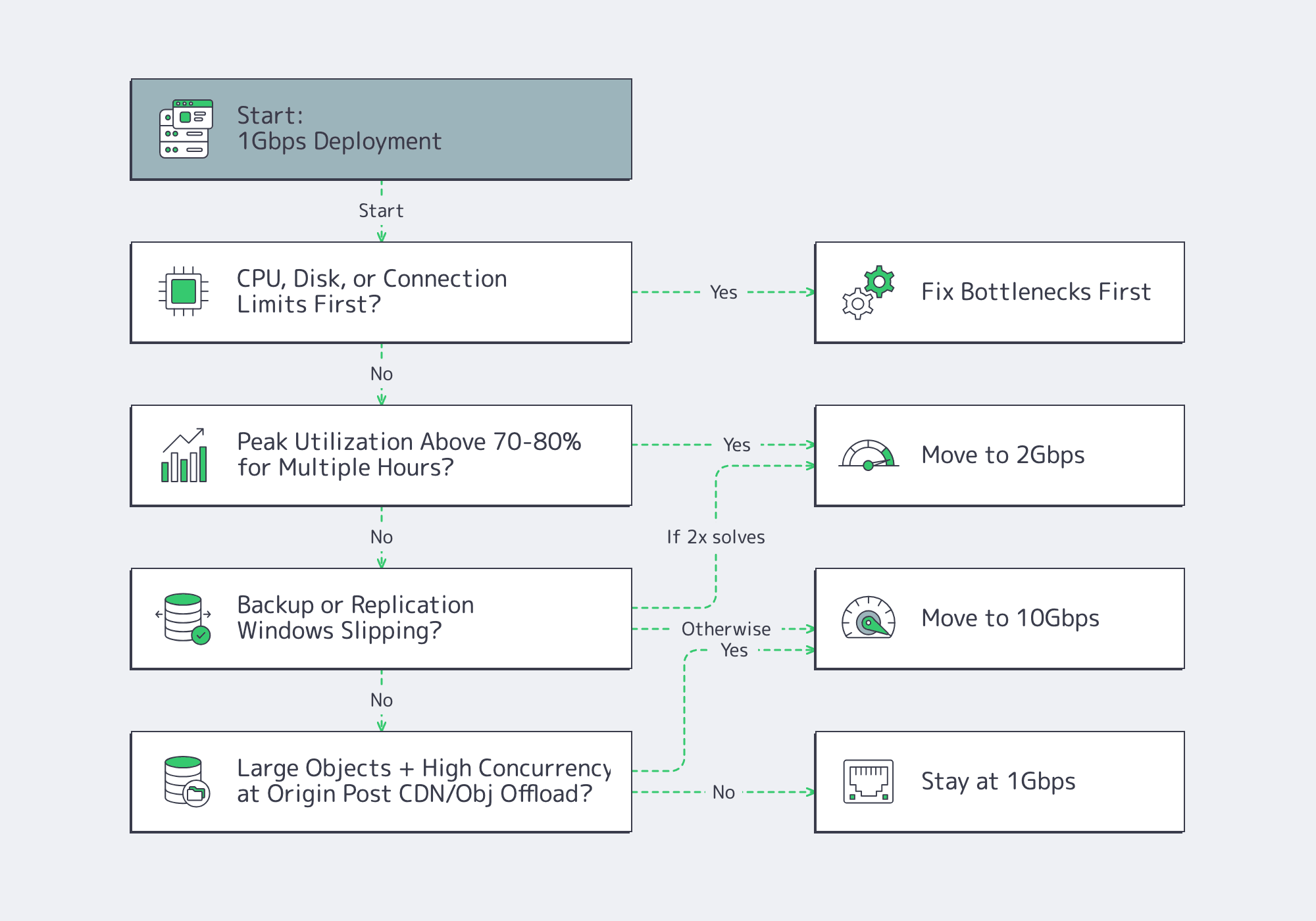
That step-up path matters because a port upgrade only helps if the node can keep up. Melbicom’s live public catalog already pairs 1, 10, 100, and 200 Gbps offers with current Ryzen 7 9700X and EPYC 7402 NVMe-based servers, which is the right kind of alignment between hardware and bandwidth tiers rather than abstract bandwidth labels.
- Model 1Gbps bandwidth against monthly goodput and peak-hour headroom, not order-form line rate.
- Treat CPU, disk, conntrack, and ephemeral ports as first-class capacity metrics; a half-empty NIC graph can still hide a full server.
- Offload large static objects, backup traffic, and regional delivery paths before buying more port speed; upgrade only when the line itself is the limiting resource.
Buy Bandwidth for the Month You Actually Run, Not the Peak Graph You Screenshot
A 1Gbps port is a strong choice when monthly transfer stays inside realistic goodput math, concurrency is controlled, and origin bandwidth is not wasted on content better served from a CDN or object store. The mistake is assuming 1Gbps solves a CPU problem, a storage problem, or a distribution problem.

We at Melbicom see the best results when teams treat bandwidth as one layer of a delivery stack. Keep the origin focused on dynamic work, push large files outward, and upgrade the port only when utilization, time windows, and concurrency say the line itself has become the constraint.
Scale beyond 1Gbps with Melbicom
Upgrade from 1Gbps to 10–200 Gbps on Ryzen and EPYC servers. Keep origins for dynamic content and offload static files to CDN or S3-compatible storage.
Get expert support with your services
Blog

Decoding Unlimited Dedicated Server Offers: Ports & Policies
“Unlimited” bandwidth is one of hosting’s most abused phrases because it tries to sound like both a pricing model and a technical guarantee. One promise says your bill will not spike with every extra terabyte. The other says the network will carry sustained load without a quiet intervention later. Those are not the same thing.
Market Reality: Why Unlimited Dedicated Server Pricing Exists
Providers can offer flat-fee “unlimited” plans because bandwidth is bought upstream as capacity and because most customers do not run hot all month. A small minority account for a disproportionate share of traffic, a pattern visible in operator discussions and in the broader market. TeleGeography reports continued IP transit price erosion in major hubs, with 100 GigE now standard and 400 GigE appearing. At the same time, Sandvine extrapolates global internet traffic at roughly 33 exabytes per day across 6.4 billion mobile and 1.4 billion fixed subscriptions. “Unlimited” is real business math. It becomes risky when the contract assumes you will never behave like the port you bought.
What “Unlimited Dedicated Server” Really Means in Hosting Offers
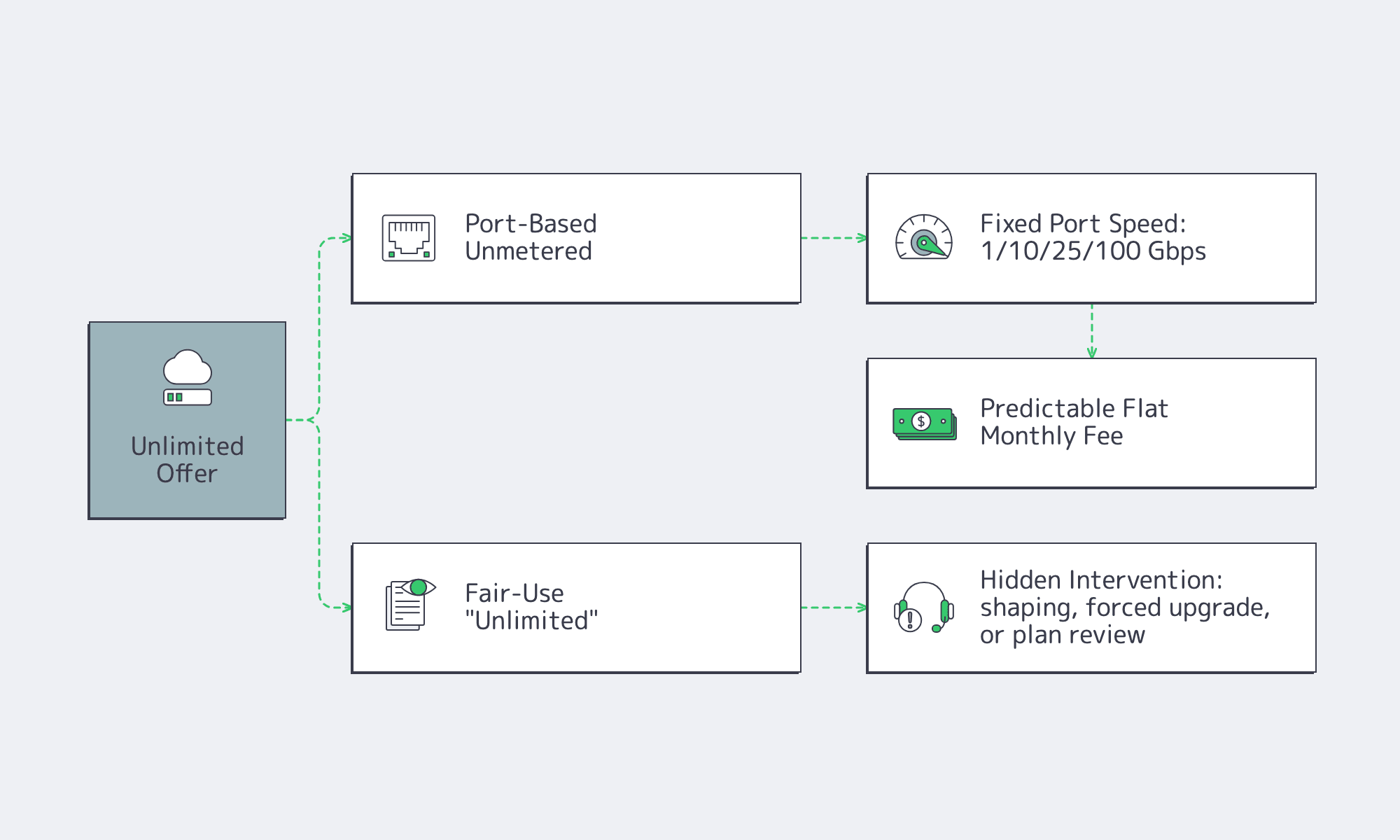
An unlimited dedicated server offer is almost never infinite bandwidth. In practice, it means either the provider stopped billing by TB and is selling access to a fixed port speed, or it is selling a flat monthly headline while keeping the right to intervene under fair-use language. The entire buying decision is figuring out which version you are actually being sold.
The physical ceiling is always the port: 1 Gbps, 10 Gbps, 25 Gbps, 100 Gbps, or higher. That is why “unmetered dedicated server” is usually the more useful phrase. It does not pretend data is infinite; it says volume is not billed separately, while throughput is limited by the port rate.
A simple reality check: a 1 Gbps port sustained for a 30-day month moves roughly 324 TB before overhead. A 10 Gbps port moves traffic on a multi-petabyte scale. So the core question is not whether a provider says “unlimited.” It is whether sustained use near line rate is treated as normal.
Choose Melbicom— Unmetered bandwidth plans — 1000+ ready-to-go servers — 21 Tier III & IV DCs; 40 CDN PoPs |
|
Unmetered Dedicated Server: Port Speed Is the Real Ceiling
Port-based unmetered is the clean version. You buy a defined port speed, the monthly price is flat, and normal use does not trigger a punitive conversation just because you actually use the port.
The other version is “unlimited until fair use.” The ad says unlimited, but the terms reserve the right to shape traffic, force an upgrade, or redefine your workload as “non-standard” once it becomes expensive.
We at Melbicom offer guaranteed bandwidth and backbone capacity. That matters because the network behind the offer is the real product.
How Fair-Use Policies, Shaping, and Throttling Affect “Unlimited” Server Plans
Fair-use language is not automatically a problem; the risk appears when it replaces measurable bandwidth terms. In practice, throttling usually means shaping or policing that appears once your traffic changes the provider’s cost, congestion, or abuse profile. If the trigger is undefined, the headline stops being an operating guarantee.
The most common red flags are consistent across the market:
- sustained near-line-rate use that breaks the provider’s utilization assumptions;
- DDoS exposure or collateral filtering on busy networks;
- traffic profiles with high packets per second, many small packets, or heavy UDP;
- inbound-heavy patterns that look different from classic “mostly outbound” hosting;
- encrypted transport such as QUIC and HTTP/3, where RFC 9000 makes clear that packet payloads are protected, reducing classification and pushing enforcement toward blunter rate-based controls.
The abuse backdrop is real. ENISA’s threat landscape says DDoS accounted for about 76.7% of recorded incident types in its dataset. That does not mean your traffic is malicious. It means many providers now design first for survivability, and fuzzy terms can turn that posture into customer-visible throttling.
How to Compare Unlimited, Unmetered, and 95th-Percentile Bandwidth Models
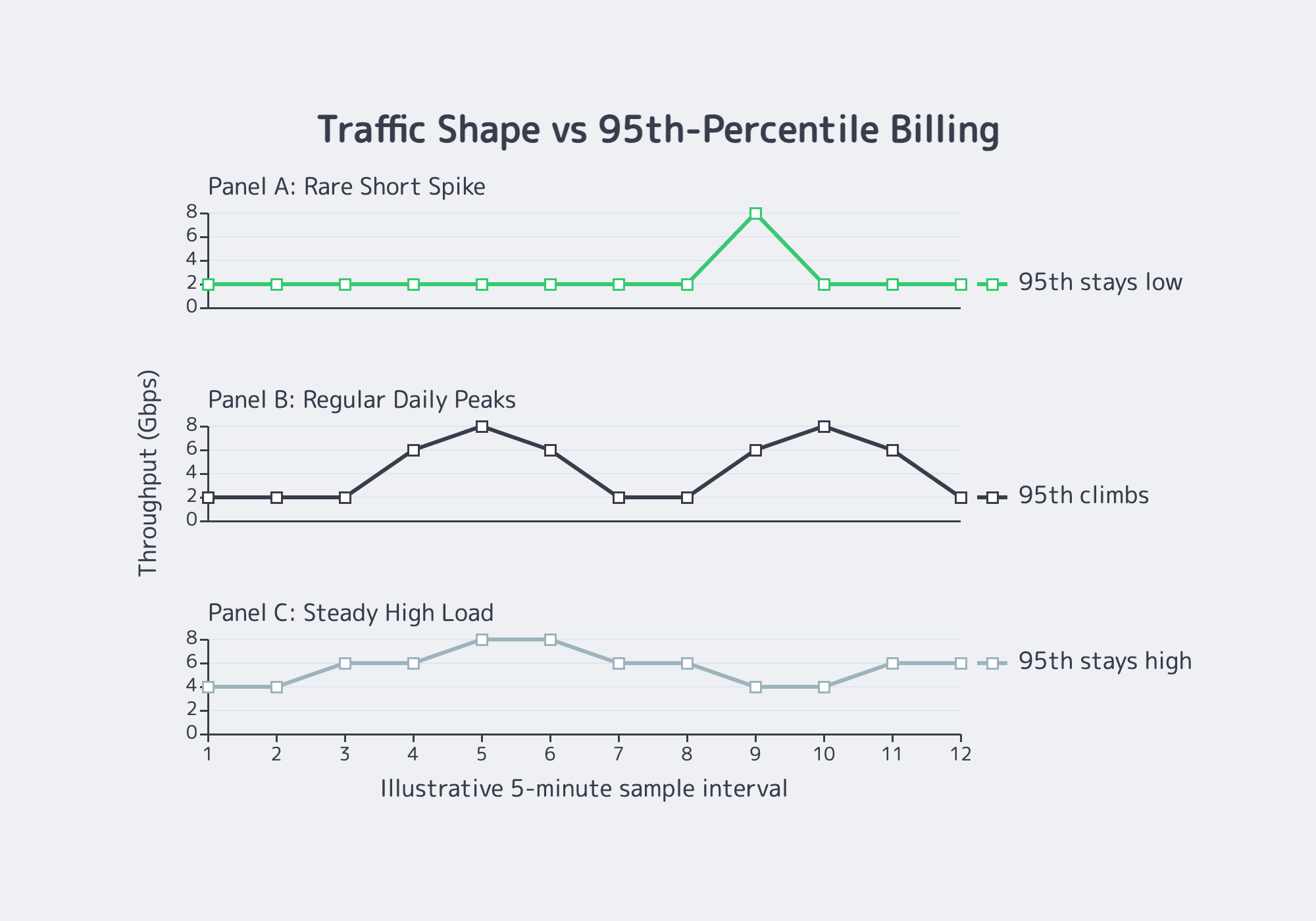
Ignore the adjective and compare the meter. Unlimited, unmetered, and 95th percentile can all ride on the same physical port, but they create very different cost and throttling risks. The safe comparison is the rule that determines when more traffic changes your bill or triggers a network response.
Think of the options this way:
| Model | How It Works | Where Buyers Get Burned |
|---|---|---|
| Port-based unmetered | Flat monthly fee tied to a defined port speed. No per-TB billing; throughput is capped by the port. | Trouble starts when the provider quietly assumes you will not sustain heavy utilization. |
| “Unlimited” until fair use | Flat monthly headline plus discretionary thresholds such as “excessive” or “impacts others.” | You cannot model either performance or cost because the real limit is hidden. |
| 95th percentile | Traffic is sampled, the top 5% of samples are discarded, and the remaining peak becomes the bill. | Repeated “bursts” stop being bursts and become your normal bill. |
| Committed rate with policing | You buy X Mbps and the network enforces it. | Predictable, but inflexible; spikes require overprovisioning or upgrades. |
A quick way to sanity-check 95th percentile is to ask whether your peaks are rare events or daily behavior. Equinix’s enterprise billing documentation describes 95th percentile as a burst-billing model, not a flat rate.
If you spike for a short launch window, the model can work well. If you run hot every afternoon, the percentile climbs with you.
Contract and Technical Checklist for Predictable Bandwidth
This is where expensive surprises hide. Your contract should define sustained-use expectations, the billing method, intervention triggers, and renewal mechanics in plain language. Words like “excessive” or “non-standard” are not harmless if they are undefined.
Ask four things before you sign: is sustained port utilization allowed, and what counts as “sustained”; is billing flat-rate, 95th percentile, or a committed rate with overage; what happens first if traffic is flagged + what happens at renewal if your pattern stays the same?
Traffic mix belongs in that conversation too. Two customers can both use 2 Gbps and create very different network load. Sandvine notes the growing importance of upstream traffic from backups, file sharing, and user uploads. If your workload is upload-heavy, UDP-heavy, or event-driven, say so early and get the answer in writing.
Designing for Predictability: Modern Ways to Reduce Bandwidth Surprises
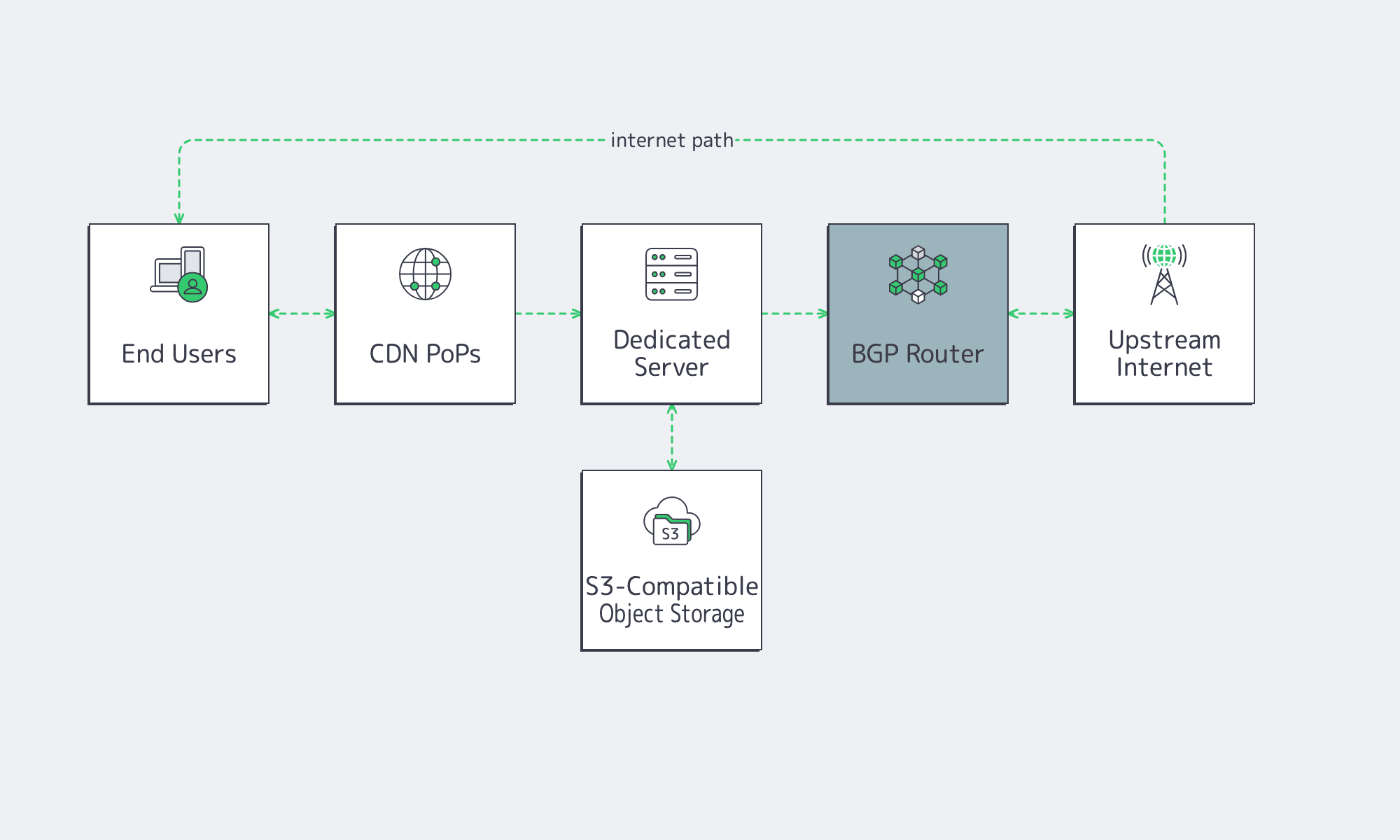
Bandwidth predictability is also an architecture question. TeleGeography says direct connections and caching have a localizing effect on traffic, which is one reason CDN and regional distribution still matter.
That is where Melbicom’s stack becomes relevant. Melbicom’s CDN spans 40 PoPs in 35 countries and offers unlimited requests with bandwidth-based pricing options. Melbicom’s S3-compatible object storage can help separate origin compute from bulk object delivery. BGP sessions are available in every data center for predictable routing and BYOIP. On the network side, Melbicom has a 14+ Tbps backbone tied into 23 transit providers and 29 IXPs. Those are the kinds of facts that make “unlimited” testable.
The Right Way to Buy “Unlimited”
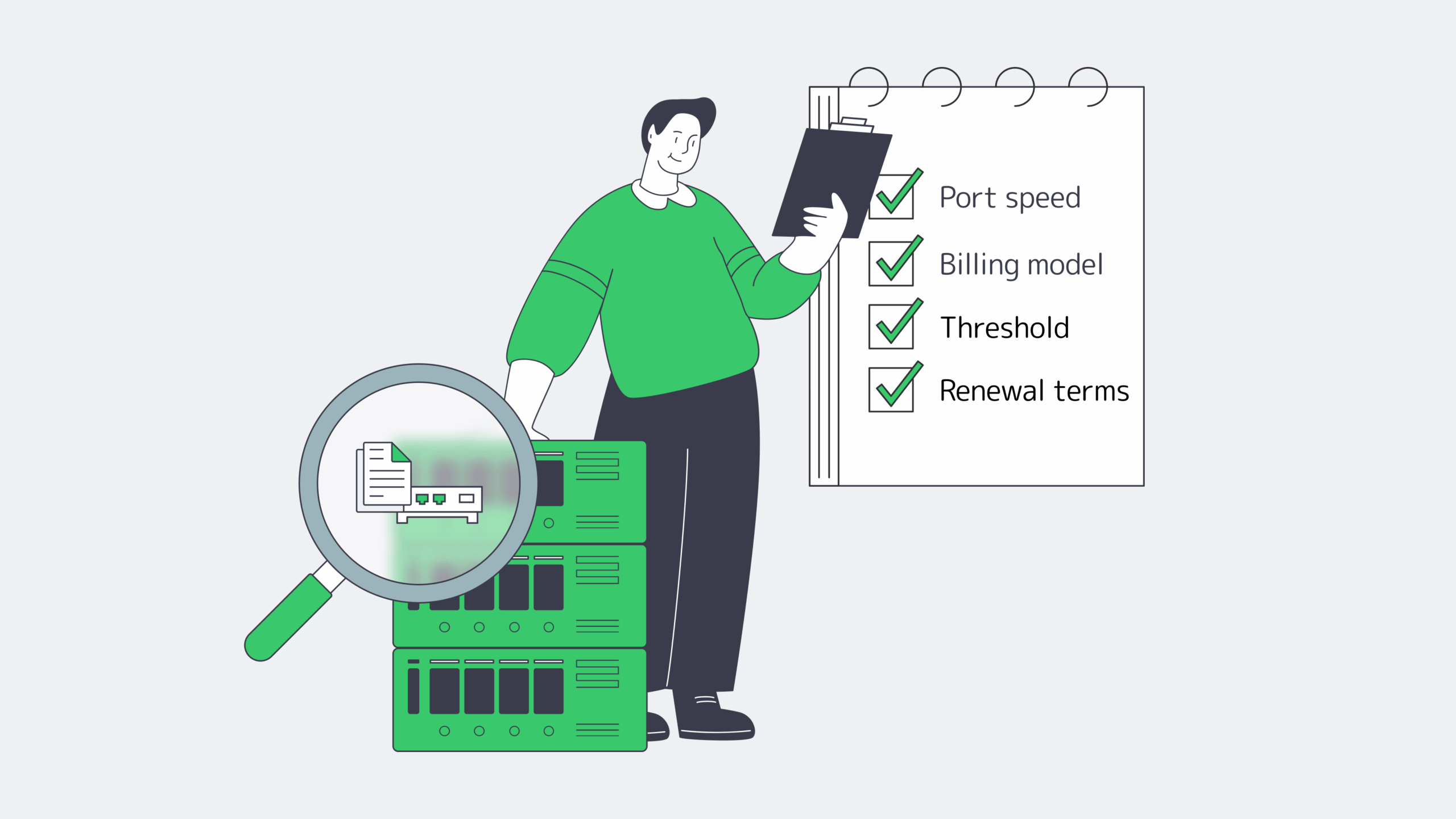
The safest way to evaluate an unlimited dedicated server offer is to treat “unlimited” as branding and ask what is actually being sold: a flat port, a burst-billed percentile, a committed rate, or a fair-use plan with discretionary enforcement. Once that is clear, the decision becomes operational instead of emotional.
Use this filter before you commit:
- treat “unlimited” as packaging until the port, meter, and intervention policy are explicit;
- match the billing model to your traffic shape, because steady high throughput and bursty peaks are not the same purchase;
- require written thresholds for shaping, policing, abuse review, and renewal;
- include upstream mix, packet profile, and protocol behavior in the pre-sales discussion;
- leave headroom in ports and architecture so the first sign of growth is not the first throttling event.
That checklist does not slow the buying process. It makes the result safer. When a provider can answer those questions directly, “unlimited” stops being a slogan and starts acting like infrastructure you can plan around.
Get predictable bandwidth now
Choose unmetered ports or committed rates across global locations. Pair with CDN, S3 storage, and BGP to reduce throttling risks and keep costs predictable.
Get expert support with your services
Blog

Validate 10Gbps Dedicated Server Line-Rate Performance
A “10Gbps” port is not a guarantee. It is a systems claim that has to survive CPU scheduling, PCIe topology, kernel queues, storage I/O, and transit design. That matters because traffic keeps climbing: the ITU recently estimated roughly 6 zettabytes of annual fixed-broadband traffic and 1.3 zettabytes of mobile-broadband traffic, and Sandvine’s latest application data shows how heavily usage now skews toward bandwidth-intensive delivery (source).
Annual Broadband Traffic by Access Type:

Why a 10Gbps Unmetered Dedicated Server Is a System Design Problem
A 10Gbps unmetered dedicated server only performs as advertised when every stage of the path can sustain that rate. “Unmetered” usually removes per-terabyte billing, not contention, shaping, or design limits, so the real metric is repeatable throughput with acceptable jitter, loss, and latency under load.
That is why line rate can collapse in practice. “Unmetered” hosting usually means a port and a policy model, not infinite headroom (example).
What Hardware Bottlenecks Limit Sustained 10Gbps Throughput on Dedicated Servers

Sustained 10Gbps throughput is limited by four usual suspects: PCIe bandwidth to the NIC, single-thread CPU headroom on hot flows, kernel queue and offload behavior, and the storage path feeding or absorbing data. If any one of those falls behind, the “10Gbps” label becomes a best-case moment instead of an operating baseline.
NIC + PCIe Topology for a 10Gbps Dedicated Server
A capable NIC on a weak PCIe path is the fastest route to disappointment. PCIe 3.0’s bandwidth jump over PCIe 2.0 matters because slot generation and width can be the reason a 10GbE interface stalls below line rate. NIC manuals are explicit about slot requirements (example), and platforms such as AMD EPYC emphasize high lane counts for the same reason.
CPU Single-Thread Ceilings and Per-Flow Reality
Many teams over-index on total core count. The catch is that a single TCP flow, encryption path, or userspace process can still pin one core first. That is why single-stream tests often underfill 10Gbps while multi-stream tests look healthier, a pattern practitioners regularly report when troubleshooting 10GbE upgrades (discussion). Test both: one tells you what a real session can do, the other tells you what the platform can do.
Kernel Queues, Offloads, and the Packet Plumbing
At 10Gbps, the OS path matters. Check these first:
- Are receive or transmit queues dropping packets?
- Are interrupts collapsing onto one busy core?
- Are offloads and ring sizes sensible for the workload?
Tools like ethtool exist for this layer, and vendor documentation explains why checksum offload, TSO/GSO, interrupt moderation, and ring sizing reduce per-packet CPU cost. Linux buffer ceilings are not the same as defaults.
NVMe Read/Write Paths: The Hidden Limiter in Network Problems
A lot of “network” failures are storage failures in disguise. At 10Gbps, large-object delivery can require roughly 1+ GB/s of sustained storage throughput once overhead is included, and concurrent writes from logs or cache churn can introduce jitter if they share the same NVMe path. That is one reason to keep archive behavior off the hot path; Melbicom’s S3-compatible object storage is useful when you need to separate storage roles instead of forcing one delivery node to do everything.
Choose Melbicom— Unmetered bandwidth plans — 1000+ ready-to-go servers — 21 Tier III & IV DCs; 40 CDN PoPs |
|
How to Verify Line-Rate Performance on a 10Gbps Unmetered Dedicated Server
To verify line-rate performance on a 10Gbps unmetered dedicated server, prove three things in sequence: the host can hit line rate in controlled conditions, it can hold that rate long enough to expose drift, and it can repeat the result across real network paths. That is the mindset behind RFC 6349: throughput testing is a method, not a screenshot.
A practical plan starts with three questions:
- Can the server and NIC hit line rate in controlled conditions?
- Can the system sustain TPT long enough to expose thermal, IRQ, or buffering issues?
- Does performance still hold outside the provider’s immediate neighborhood?
Start With a Clean, Controlled Baseline
Begin locally or within the same metro. If the box cannot move bits there, WAN testing only adds ambiguity. ESnet’s iPerf guidance uses the same pattern: parallel streams, longer runs, interval output, and reverse testing.
| # On receiveriperf3 -s# On sender: multi-stream, longer run, 1s intervaliperf3 -c <server_ip> -P 8 -t 120 -i 1 # Reverse directioniperf3 -c <server_ip> -P 8 -t 120 -i 1 -R |
Use Linux endpoints when possible; Microsoft has warned that iPerf3 on Windows can be misleading in some cases. Do not stop at a burst.
Test UDP Separately When Jitter Matters
TCP can hide timing problems behind retransmits and backoff. If delay variation matters, test UDP explicitly. RFC 3393 and RFC 5481 are useful references because they treat jitter as a measurable delay-variation problem, not a hand-wavy complaint.
| # Start lower, then step upiperf3 -c <server_ip> -u -b 2G -t 60 -i 1iperf3 -c <server_ip> -u -b 8G -t 60 -i 1 |
Confirm TCP Windowing and Buffer Headroom on Wide Paths
Fast long-distance TCP is gated by bandwidth-delay product. If buffers are too small, the server underfills the pipe even when the hardware is fine. Linux’s tcp(7) and RFC 7323 are the right references: window scaling and autotuning only work when the system has enough headroom to use them.
How to Test Oversubscription, Jitter, and Real-World TPT Before Choosing a Provider
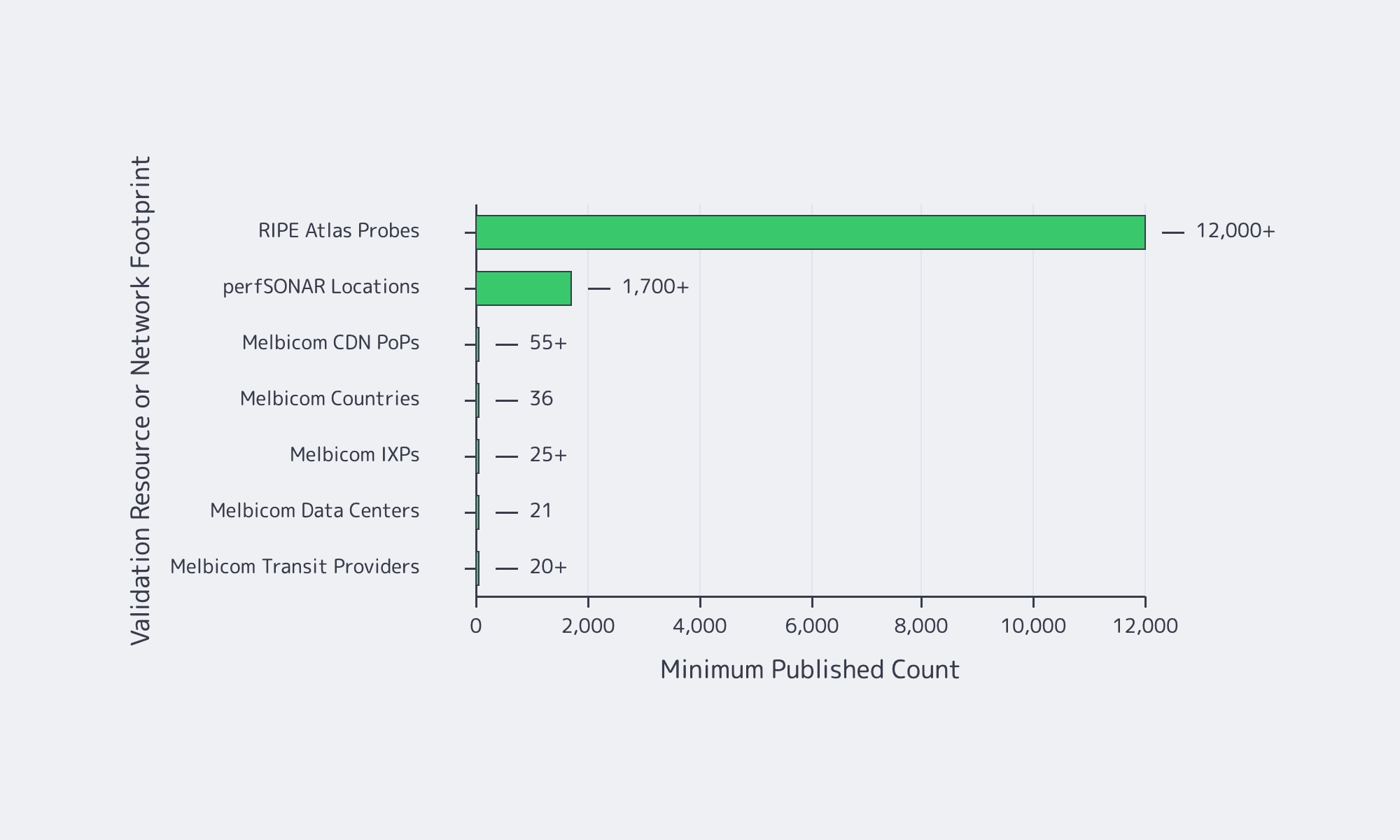
The tests that expose oversubscription and weak transit are the ones a provider cannot easily stage-manage: multi-region runs, multiple source networks, long-enough durations, and measurements taken during busy hours. The goal is not a flattering peak number. It is repeatable performance when the path is congested, asymmetric, or both.
Throughput Tests That Are Hard to Game
For realism, test across different geographies, different networks, and different times of day. Add infrastructure the provider does not control. RIPE Atlas offers more than 12,000 probes for path and latency checks. For multi-domain throughput troubleshooting, perfSONAR’s training material describes deployments in 1,700+ locations, and pScheduler shows how those tests are orchestrated (reference).
Jitter and Queueing: Proving Stability, Not Just Bandwidth
At high utilization, latency is often the first thing to break. That shows up in operator discussions on Hacker News and in newer IETF work. RFC 9341 describes alternate marking for measuring live loss, delay, and jitter, while RFC 9330 sets out the L4S architecture for lower queueing latency at high TPT. Hitting 10Gbps is not enough if the tail turns ugly.
Provider Questions That Reveal Oversubscription and Weak Transit
Ask whether the service is sold as guaranteed bandwidth without ratios. Ask how much transit and peering diversity exists. Ask whether external test files and test IPs are published. Ask whether BGP sessions are available if routing control matters. Melbicom makes that diligence easier because Melbicom publishes bandwidth tiers and test files, and BGP session capabilities, so you can validate the path rather than trust a sales claim.
Reference Server Builds for Predictable 10Gbps Egress
A reference build shows which components cannot be underspecified when 10Gbps is the baseline. Treat these as validation-oriented shapes, then map them to current inventory and location-specific bandwidth before ordering.
| Workload Pattern | Reference Build Focus | What to Validate Before Scaling |
|---|---|---|
| High-throughput streaming origin or large-file delivery | High-clock CPU, clean PCIe layout, NVMe for hot content, correct NUMA affinity | Sustained multi-stream TCP, single-stream ceiling, UDP jitter under load, disk read stability during concurrent writes |
| CDN cache or software distribution mirror | NVMe capacity and endurance, strong read plus concurrent-write behavior, enough RAM for page cache | Throughput during cache fill and eviction, queue drops, peering diversity, multiple external source networks |
| Real-time APIs and RPC endpoints with heavy egress | Stable CPU scheduling, low-jitter path, tuned queues, balanced interrupts, buffer headroom | Tail latency under load, route asymmetry, peak-hour behavior, TCP window scaling on longer RTT clients |
10Gbps Unmetered Dedicated Server: Verification Checklist
Reliable 10Gbps buying discipline looks like this:
- Buy the test plan before the port: define duration, regions, stream counts, and acceptable jitter ahead of time.
- Separate host proof from network proof: first prove the box can move data locally, then prove the provider can move it across real paths.
- Treat jitter as a first-class failure mode: a link that peaks at 10Gbps but blows out tail latency is still the wrong answer for real-time delivery.
- Ask location-specific questions: per-server bandwidth, transit mix, public test files, and BGP policy should vary by site, and you should know how.
Conclusion

A 10Gbps unmetered dedicated server is not validated by a product page. It is validated when the server holds line rate in controlled tests, repeats the result across real paths, and stays stable when storage, CPU, and kernel behavior are under pressure.
That is why provider due diligence matters as much as hardware choice. Buyers should demand transparent network details, test points, clear answers on contention, and operational data to build a repeatable test plan before moving production traffic.
Deploy 10Gbps Unmetered Servers
Validate sustained 10Gbps line rate with tested builds, real-path checks, and location-specific bandwidth. Launch faster on Melbicom with predictable egress and transparent network details.
Get expert support with your services
Blog

Dedicated Server Bandwidth: Plan Ports, Not Bills, For Viral Demand
Traffic does not rise smoothly anymore; it spikes. A live event, a product launch, a software update, or a sudden API surge can turn outbound throughput into a bottleneck in minutes. Sandvine’s Global Internet Phenomena Report estimates total internet traffic at roughly 33 exabytes per day across fixed and mobile networks, while Ericsson says mobile networks alone now carry 200 exabytes per month, with video still dominant.
A dedicated server with unmetered bandwidth has become a control surface for high-traffic systems: single-tenant hardware, a known port speed, and a fixed monthly cost instead of a bill that inflates every time demand does.
Choose Melbicom— Unmetered bandwidth plans — 1000+ ready-to-go servers — 21 Tier III & IV DCs; 40 CDN PoPs |
|
Dedicated Server Unmetered Bandwidth and What “Unlimited” Actually Buys You
A dedicated server with unmetered bandwidth does not mean infinite throughput. It usually means you are no longer billed per GB transferred; instead, you buy a defined port speed and can use that capacity continuously without per-GB overage surprises. In practice, that turns traffic growth from a billing problem into a capacity-planning problem.
In hosting, “bandwidth” mixes two different ideas: port speed, which is instantaneous throughput, and data transfer, which is monthly volume. The unmetered part changes the economics. You stop paying for every TB and start engineering around a known ceiling.
Unmetered Dedicated Server vs. Metered Transfer
An unmetered dedicated server makes sense when traffic is bursty, event-driven, or difficult to forecast. A metered model may expose a large port, but every surge also becomes a financial event. For modern delivery stacks, that can turn success into overhead.
A brief historical note: the old problem was hard bandwidth caps and punitive overages. The modern problem is whether the port, backbone, and routing path can sustain demand without throttling, congestion, or billing shock.
Cost Certainty and Budget Control When Traffic Spikes
The real value of unmetered bandwidth is not “cheap data.” It is cost certainty during the exact moments when your system is already under operational stress. A fixed monthly bill removes one variable from launch planning, premiere planning, and incident response, so traffic spikes stay an engineering problem instead of becoming a finance problem too.
This matters most for workloads that push heavy outbound traffic: adaptive video segments, software binaries, online gaming patches, recordings, exports, large SaaS payloads, or user-generated assets. Peaks are no longer unusual. AppLogic’s summary of the Global Internet Phenomena report describes live events as traffic “earthquakes” that can hit several times normal usage.
The user-facing penalty for underprovisioning is clear. In a Carnegie Mellon quality-of-experience study, buffering ratio had the strongest negative effect on engagement; for live content, even small increases in buffering reduced viewing time.
Unthrottled Performance during Viral Events Hinges on Ports, Routing, and Caching
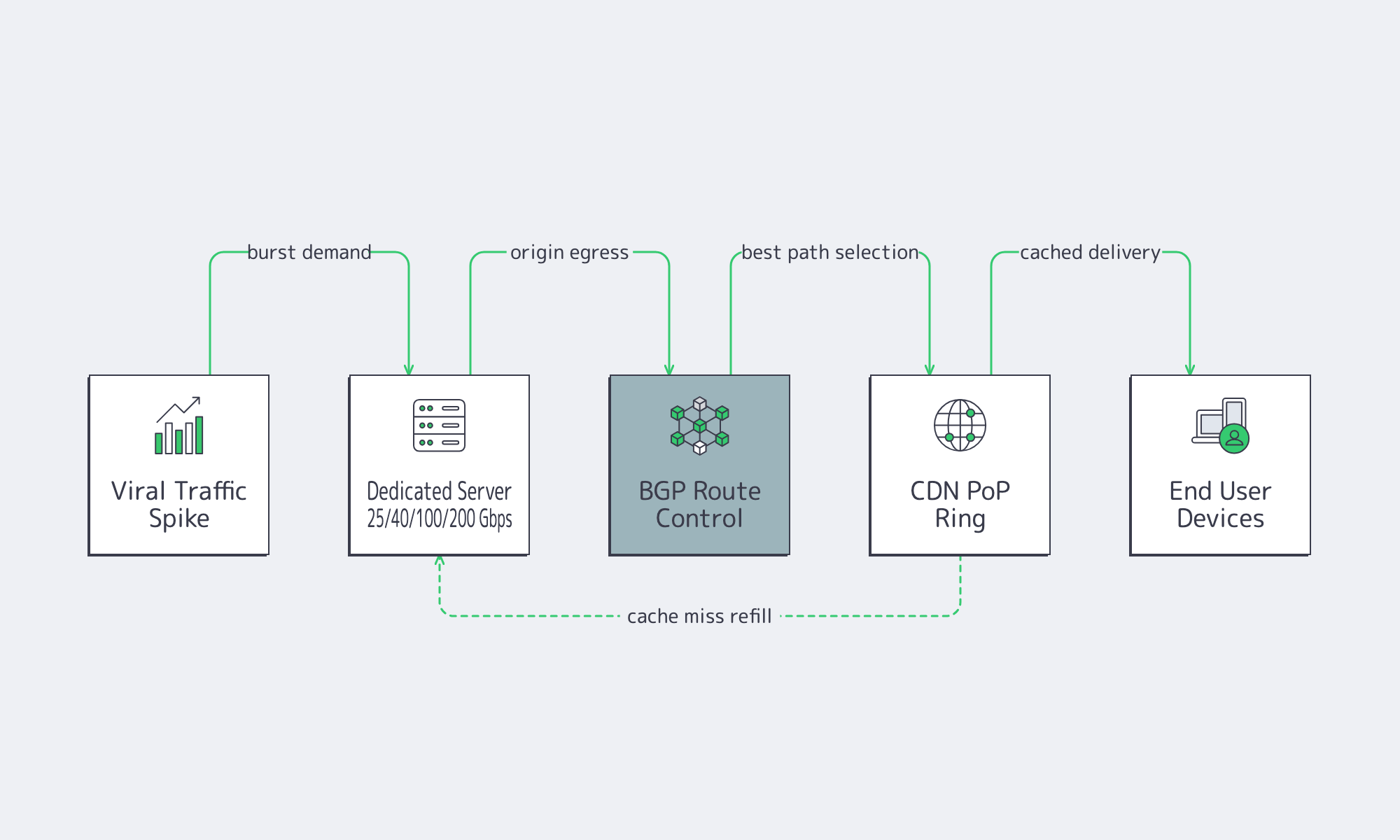
“Unthrottled” is not a marketing switch. It is the outcome of having enough port capacity, a network that can deliver that capacity under load, and a delivery architecture that keeps your origin from becoming the bottleneck. During viral events, all three matter at once.
The choke points are server egress, upstream path quality, and origin load. Even with caching in front, origins still get hit during cache-miss storms and release waves. Ethernet Alliance’s summary of IEEE 802.3bs shows how 200 GbE and 400 GbE became standardized Ethernet classes; by 2026, providers such as Melbicom can credibly expose dedicated ports in 25, 40, 100, and 200 Gbps classes for heavy workloads, depending on location.
Dedicated Server Hosting Unmetered and the Network Checklist
If you are evaluating dedicated server hosting unmetered, the right question is not “Is it unlimited?” The right question is whether the provider can keep delivery stable when concurrency jumps, cache efficiency drops, or a single event turns your quiet origin into the hottest endpoint in the stack.
The checklist is practical: port tiers that map to real concurrency, route control when you need stable ingress and egress, and a CDN footprint that reduces long-haul hops and origin load. RFC 4271 still matters because BGP policy keeps reachability predictable across regions. Melbicom’s CDN spans 40 PoPs across 35 countries to keep repeated content closer to users.
Affordable Unmetered Dedicated Servers
For high-traffic projects, “affordable” does not mean the lowest sticker price. It means buying bandwidth in a way that prevents both overage shocks and quality collapse. The cheapest plan on paper is often the expensive one in practice if it breaks the first time demand spikes.
The traffic mix makes that obvious. Sandvine shows video as the largest downstream category across regions, roughly in the low-40s to high-40s percent range, while file delivery remains a major traffic class in several markets. Those are exactly the patterns that punish per-TB billing during releases, updates, and live events.
Unmetered still does not change physics. Port speed is the real control knob.
| Port Speed (Gbps) | Theoretical Max per Day (TB) | Theoretical Max per 30 Days (PB) |
|---|---|---|
| 1 | 10.8 | 0.32 |
| 10 | 108 | 3.24 |
| 40 | 432 | 12.96 |
| 100 | 1,080 | 32.4 |
| 200 | 2,160 | 64.8 |
At 40 Gbps and above, metered transfer stops looking like a small variable and starts looking like a structural risk. Gartner projects data-center systems spending will exceed $650 billion in 2026.
Melbicom’s affordability angle is capacity you can actually plan around: 1000+ ready-to-go server options in stock, custom builds in 3–5 business days, unmetered options with guaranteed throughput, and a network footprint described in current commercial-page language as a 14+ Tbps backbone with 23 transit providers and 29 IXPs. Layered with 40 CDN PoPs in 35 countries and BGP sessions with BYOIP, that is the difference between “we got popular” and “we need to explain the bill.”
How to Size Unmetered Servers without Guesswork
The fastest way to misbuy bandwidth is to size around averages. High-traffic systems fail at the peak, not in the monthly mean. A better approach starts with peak concurrency, converts that into required egress, and adds enough headroom to preserve quality when the burst arrives.
For adaptive delivery, the math is simple: concurrency multiplied by average delivered bitrate gives you the egress target. That is why larger port tiers exist. If your event model says 60 Gbps sustained, a 10 Gbps port is not a growth path; it is the bottleneck you are about to hit.
A Throughput Sketch for Peak Events
Below is a simple back-of-the-envelope model for event sizing:

What to Do with That Sizing Result
Once you have a peak target, the next steps are operational:
- Choose a port tier with explicit headroom. If your model lands near 35 Gbps, a 40 Gbps port may work; if it lands near 70 Gbps, 100 Gbps is the safer class; for especially bursty delivery, 200 Gbps becomes relevant.
- Put unmetered bandwidth where bursts are hardest to smooth: origin delivery during premieres, large file distribution, and cache-miss-heavy launch windows.
- Offload repeated assets aggressively. A CDN lowers origin egress, trims long-haul latency, and buys you stability during the first wave of demand.
- Keep endpoints stable when compute moves. Melbicom’s BGP sessions and BYOIP support matter here because route control is a tool for migrations and multi-region designs.
Key Takeaways
- Model bandwidth from peak concurrency and delivered bitrate, not from monthly averages.
- Buy headroom at the port layer; the cost of unused capacity is usually lower than the cost of degraded quality at peak.
- Put unmetered bandwidth on origin, release, and export tiers where bursts are hardest to predict and hardest to cache away.
- Treat CDN offload and BGP-based route control as part of the same design problem as server bandwidth.
- Recheck the economics once sustained egress reaches double-digit Gbps; that is usually where fixed monthly pricing starts to beat transfer-based surprises.
Why Dedicated Server Unmetered Bandwidth Is Now a Strategic Buy

For modern high-traffic systems, unmetered dedicated infrastructure solves two problems at once: it caps financial uncertainty and raises the performance ceiling when demand turns nonlinear. You are not buying “unlimited internet.” You are buying a monthly cost you can model, a port you can design around, and a delivery path that does not flinch when a launch or viral event lands.
That is why this category keeps moving upmarket. When providers can pair single-tenant hardware with global caching, route control, and dedicated ports up to 200 Gbps, unmetered bandwidth stops being a checkbox and becomes an architectural choice for services that cannot afford buffering, throttling, or billing surprises.
Scale bandwidth with fixed monthly pricing
Get single-tenant servers with unmetered ports up to 200 Gbps, global CDN offload, and BGP sessions with BYOIP. Build around predictable performance and costs for launches and viral events.