
Blog

How to prepare your website for a traffic spike
Traffic spikes are not simply “more users.” An advertising campaign, product launch, or major sale changes how an ecommerce website behaves: more product images, search queries, inventory checks, cart updates, and payment requests arrive simultaneously. These components rarely scale at the same rate.
Preparing for website traffic spikes means forecasting demand, testing sustainable capacity, separating static delivery from dynamic operations, and establishing contingency controls before infrastructure reaches saturation.
Melbicom CDN– 40 Premium CDN PoPs – Coverage in 35 countries – 24/7 infrastructure support |

|
Addressing Sudden Traffic Spikes Starts With an Event Envelope
Forecasting visitor counts alone is insufficient. A shopper loading product images consumes bandwidth; searching products consumes application resources; checkout generates database writes and external payment requests.
Build two forecasts. The business forecast models advertising impressions, click-through rates, email schedules, geographic distribution, and promotion timing. The engineering forecast translates expected sessions into requests, bandwidth, database operations, and dependency calls.
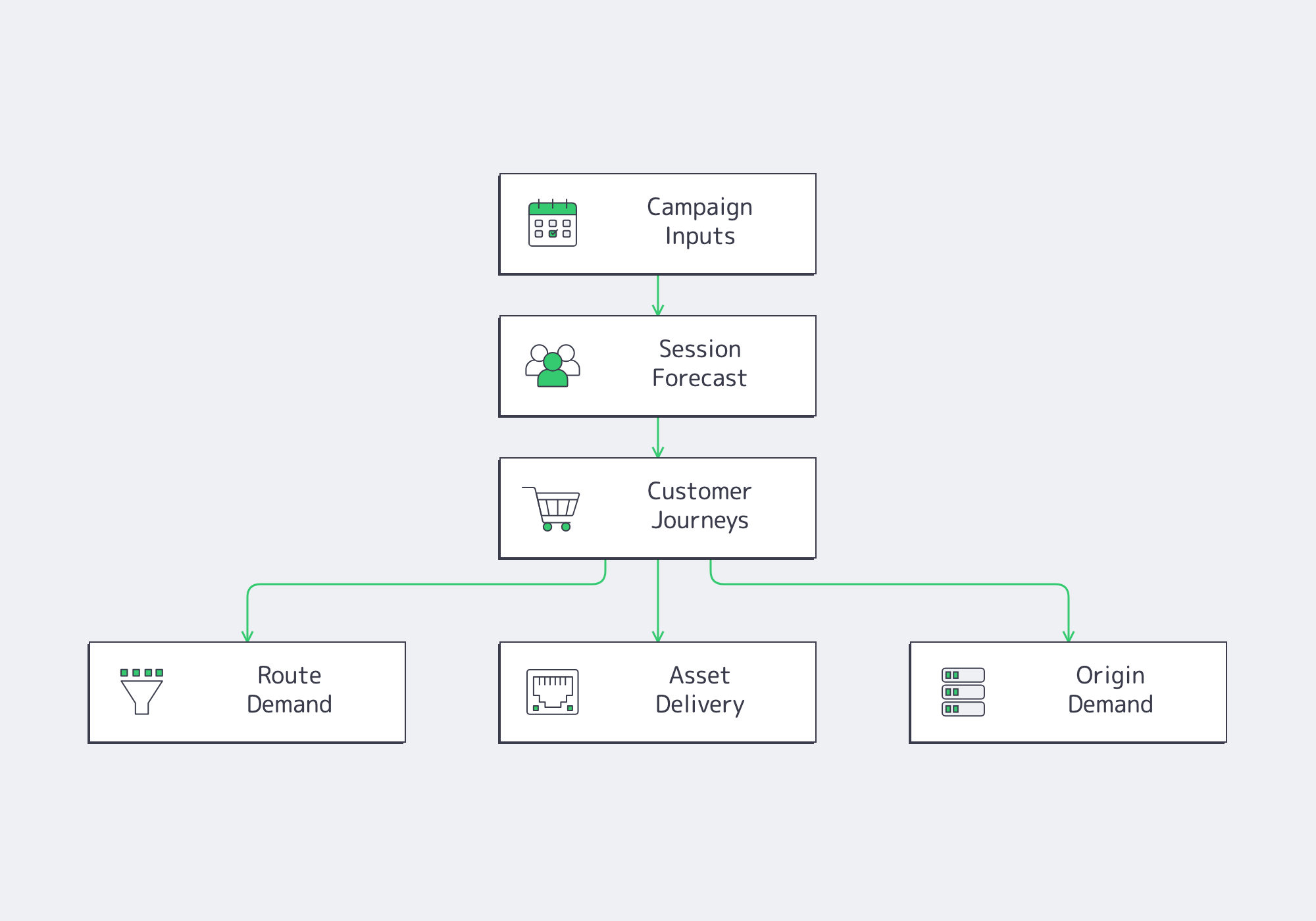
Three calculations establish the workload.
Route demand:
Average route RPS over interval Δt ≈ session starts per second during Δt × probability a session reaches the route × average route requests per reaching session
This estimates average route demand over a defined planning interval, assuming a reasonably stable arrival pattern and request mix. Actual request timing is distributed across user journeys, so short-lived peaks require measured timing profiles or simulations.
Delivery bandwidth:
Delivery bandwidth (bits/s) ≈ object requests per second × mean transferred object size (bytes) × 8
The calculation estimates application-payload bandwidth. It excludes protocol overhead and retransmissions.
Origin request demand:
Origin request rate ≈ non-cacheable request rate + eligible cacheable request rate × (1 − request-weighted cache-hit ratio)
This simplified estimate excludes additional origin work from revalidations, retries, purges, and other cache behavior. Request coalescing may reduce duplicate origin fetches. Calculate request-weighted cache hits separately from byte-hit ratios, and account for cold geographic regions.
Measure actual cache behavior rather than assuming it. Forecast at minute-level granularity because hourly averages can conceal bursts that overwhelm queues or connection pools.
Create expected, high-demand, and beyond-capacity scenarios. The final scenario identifies which operations must be limited if demand exceeds available resources.
When Do Traffic Forecasts Justify Additional Website Capacity Before Major Events?
Traffic forecasts justify additional website capacity when projected peak demand exceeds the load-tested sustainable capacity of any critical component while meeting latency, error-rate, and correctness targets. Additional capacity is also warranted when expected demand consumes operational headroom, exceeds dependency quotas, or leaves insufficient resources to tolerate a component failure.
Sustainable capacity is not the maximum throughput observed immediately before failure. It is the highest workload the system handles while maintaining acceptable performance.
Use this decision model:
Required event capacity (RPS) = upper-bound forecasted workload (RPS) + chosen operating headroom (RPS) + failure-domain allowance (RPS)
All terms must use the same units and request mix. Alternatively, compare forecast demand against the tested safe capacity remaining after a defined component failure.
Compare the requirement with:
Tested sustainable capacity = highest demonstrated workload that still meets the event's latency, error, correctness, resource, and dependency limits
If required capacity exceeds tested capacity, add resources or reduce the workload reaching the bottleneck.
Evaluate components individually. More application servers cannot compensate for exhausted database connections or payment API quotas. PostgreSQL's max_connections imposes a connection ceiling, and increasing it also increases resource allocation.
Forecast With an Uncertainty Budget
Headroom should reflect forecast accuracy, provisioning time, failure tolerance, and saturation behavior—not an arbitrary percentage.
Autoscaling also takes time. Application startup, cache warming, connection establishment, and load-balancer registration can delay usable capacity. Scaling application workers may also increase pressure on slower-scaling dependencies.
Start load testing early to allow for infrastructure provisioning, quota increases, application remediation, and repeat testing. Peak-event preparation guidance emphasizes allowing time to resolve architectural and capacity constraints before a major event.
Which Load Tests Expose Weaknesses in Static and Dynamic Website Components?
The most effective load tests combine warm-cache and cold-cache delivery scenarios with realistic browsing, search, cart, inventory, and checkout journeys. Ramp, sudden-spike, sustained-peak, and overload tests reveal different bottlenecks. Each test should evaluate p95/p99 latency, errors, resource saturation, cache behavior, and downstream dependency limits against predefined acceptance criteria.
Testing a homepage repeatedly cannot represent an entire ecommerce transaction.
Use production-informed request proportions and arrival patterns. Open-model arrival-rate testing schedules new iterations independently of response time. However, an iteration may represent a journey containing multiple HTTP requests, not one request.
Allocate sufficient virtual users and load-generator resources. Inspect achieved iteration rates and dropped iterations: a configured target does not prove the workload was delivered (k6 arrival-rate documentation).
Measure customer experience alongside infrastructure performance. Core Web Vitals defines good performance at the 75th percentile as LCP of 2.5 seconds or less, INP of 200 milliseconds or less, and CLS of 0.1 or less, evaluated separately for mobile and desktop. These browser-experience metrics are distinct from backend p95/p99 load-test criteria.
Load-Testing the Static Delivery Layer
Campaign imagery, JavaScript, CSS, fonts, and product media can generate substantial bandwidth demand.
Test both warm CDN caches and cold or partially populated caches. Newly published assets can produce concentrated origin requests even when existing content performs well.
Inspect Cache-Control headers, URL versioning, cache keys, request-weighted hit ratios, byte-hit ratios, and origin fetches (MDN HTTP caching documentation).
Melbicom's CDN supports configurable HTTP headers, real-time analytics, raw logs, and single or multiple origin pools. During static-layer testing, use header controls to establish which objects are eligible for caching, then compare CDN analytics and raw logs with origin traffic to identify cache misses and unexpected fetch demand. Where multiple origins are configured, test how the origin pool distributes requests under the projected workload.
Traffic Spikes in Dynamic User Journeys
Dynamic requests vary in cost. Product pages may trigger inventory, pricing, recommendation, and session calls.
Checkout may depend on payment, tax, and fraud systems.
Test browsing-heavy, conversion-heavy, low-stock, and authentication-intensive scenarios using representative data.
Exercise four conditions: gradual ramp-up, sudden arrival spikes, sustained peak load, and deliberate overload. The final test should establish whether the application rejects excess work predictably instead of cascading into failure.
A successful test demonstrates acceptable checkout latency, bounded queues, safe database utilization, and dependency requests within quota—not merely a high RPS figure.
Set acceptance criteria for each critical journey before testing. Compare the achieved workload with the forecast, and record the first component that violates its latency, error, correctness, or resource limit. Remediate that bottleneck and repeat the test.
Protecting Static and Dynamic Components
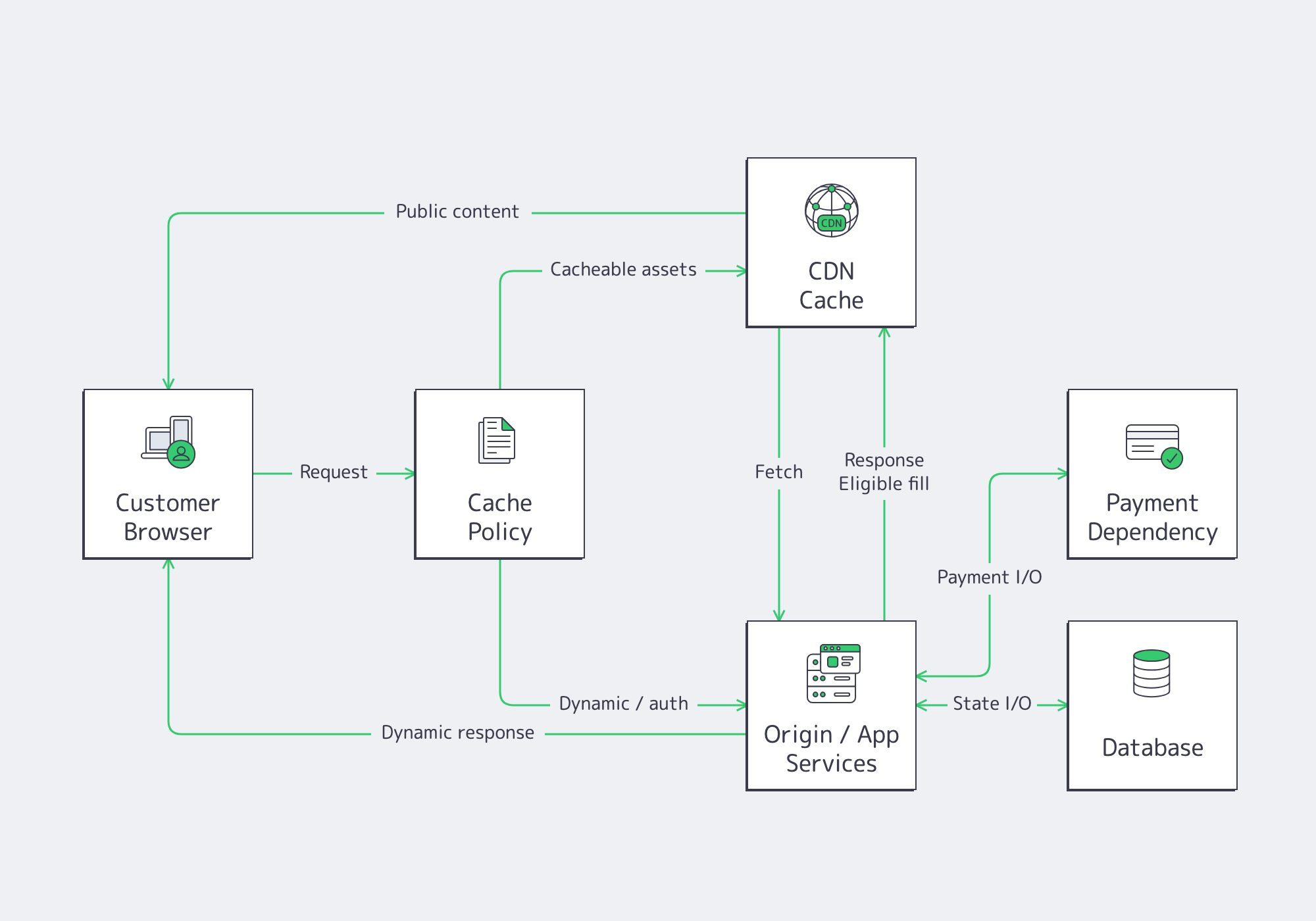
Classify website resources before allocating capacity. Public assets generally support shared caching; carts, authentication, individualized pricing, payments, and inventory mutations require appropriately protected dynamic processing.
| System surface | What to prove before launch | Warning signals |
|---|---|---|
| CDN/static assets | Cache reuse and peak delivery capacity | Cache misses, origin fetches, bandwidth saturation |
| Web/origin tier | Dynamic demand remains within tested limits | p99 latency, 5xx errors, resource saturation |
| Application services | Critical journeys sustain realistic request mixes | Worker exhaustion, timeouts |
| Database | Connections, queries, locks, and I/O remain safe | Pool waits, lock contention |
| Cache/session tier | Memory, hot keys, and connections tolerate concurrency | Evictions, latency spikes |
| Search/inventory | Campaign queries and stock reads remain responsive | Throttling, queue growth |
| Checkout/dependencies | Required integrations remain within quotas | Timeouts, declining completion |
| Observability/control plane | Operators can identify and mitigate bottlenecks | Missing metrics, delayed alerts |
Measure CDN offload in both requests and bytes. Caching large images can reduce bandwidth substantially while leaving numerous small API calls hitting the origin. Application-specific load testing determines whether a particular origin, database, or dependency can sustain the event.
How Should Contingency Plans Address Sudden Traffic Spikes During an Event?
Contingency plans should address sudden traffic spikes through predefined warning thresholds, mitigation actions, responsible operators, and recovery conditions. Controls should activate before critical resources saturate, prioritizing checkout, payment completion, and inventory integrity. Tested rate limits, bounded queues, retry budgets, and optional-feature shutdowns can preserve essential operations when demand exceeds sustainable capacity.
For each bottleneck, set warning and action thresholds using predictive signals such as connection-pool wait time, queue depth, p99 latency, or quota consumption.
Protect revenue-critical operations before optional recommendations, personalization, and background synchronization. Feature flags should enable tested degradation modes rather than emergency changes invented during an incident.
Apply admission controls selectively. Excess requests may receive 503 Service Unavailable, with Retry-After where appropriate, as defined by RFC 9110.
Clients should use bounded retries, backoff, and jitter where appropriate to avoid amplifying overload, but only when retry semantics are safe. Do not blindly replay order creation or payment operations after an uncertain outcome. RFC 9110, Section 9.2.2 requires evidence that a non-idempotent operation is effectively idempotent or that the original request was never applied before automatically retrying it. Google's overload-handling guidance explains how retries across multiple service layers can multiply downstream demand.
Separate capacity problems from functional failures. Checkout errors below tested demand may indicate deployment or payment faults rather than insufficient servers.
Freeze unnecessary production changes during the event. Restore optional features only after queues, connections, latency, and dependencies stabilize.
Run the Event as an Operating Window
Preparation should culminate in a controlled operating window covering the campaign launch, peak demand, and recovery.
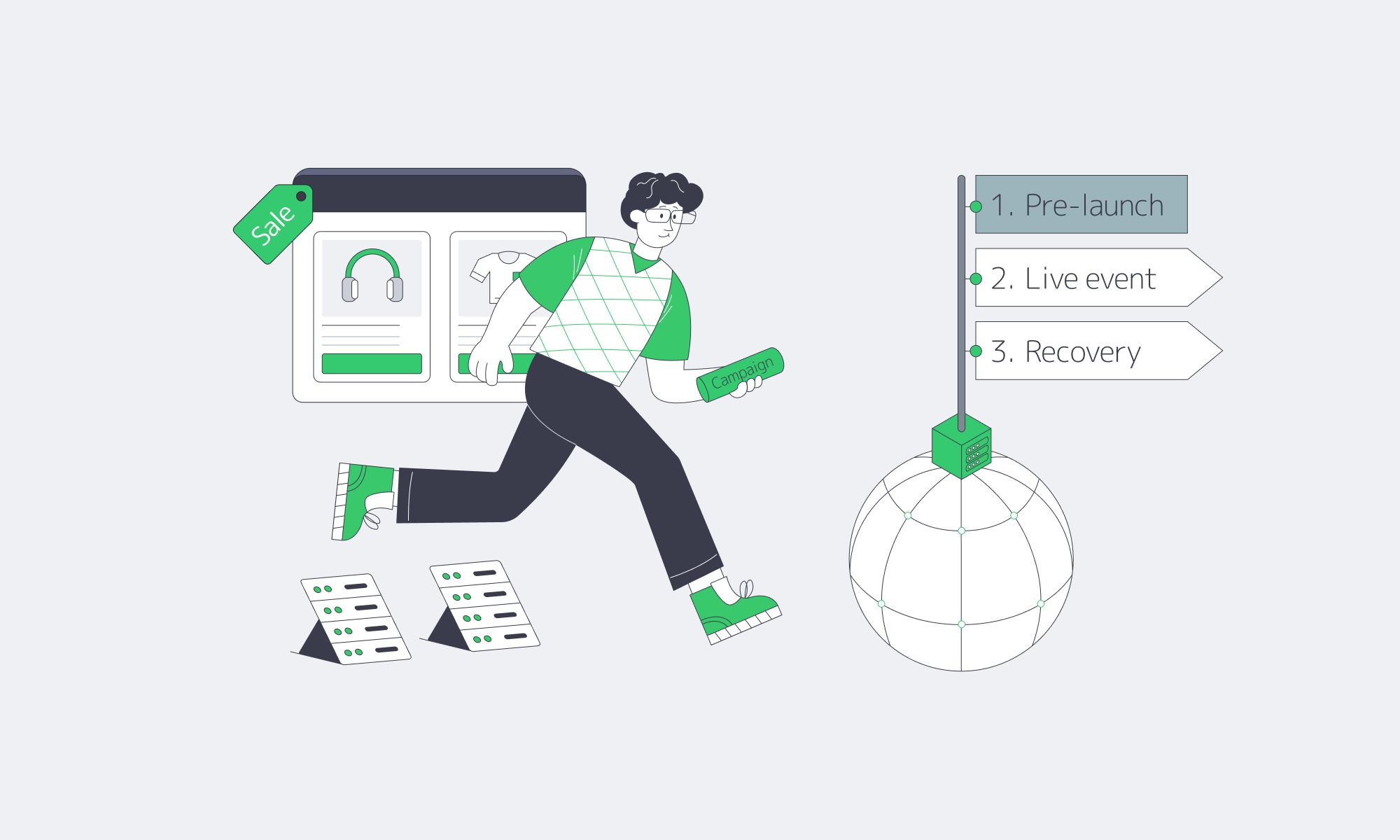
After identifying bottlenecks, correct their causes and repeat testing. Adding frontend capacity can worsen database pressure if connection limits remain unchanged.
Use this launch checklist to turn the analysis into operational decisions:
- Forecast demand: Model minute-level arrivals, request mixes, bandwidth, geography, and dependencies. Reconcile projected demand against observed traffic as the campaign progresses.
- Prove capacity: Validate p95/p99 latency, errors, correctness, and resource limits. Establish explicit go/no-go criteria for the critical purchase journey.
- Separate workloads: Offload suitable static content while protecting dynamic state. Measure both request and byte offload to identify remaining origin pressure.
- Rehearse overload: Test warm and cold caches, traffic spikes, sustained peaks, and graceful degradation. Verify the load generator delivers the intended workload.
- Prepare contingency controls: Assign owners, thresholds, rate limits, retry budgets, and recovery criteria. Exercise mitigation actions before they are needed.
- Monitor business outcomes: Track checkout completion alongside infrastructure health. Use conversion and payment-success signals to distinguish customer impact from infrastructure utilization alone.
Addressing sudden traffic spikes is fundamentally about understanding where resources are consumed before demand exposes the weakest component. Forecasting, realistic testing, CDN offload, and rehearsed contingency controls turn a risky campaign into a measurable operating plan.
A successful launch is not simply one that avoids downtime. It is one in which essential customer journeys remain responsive, infrastructure stays within tested limits, and operators know exactly when to intervene.
Prepare Your CDN With Melbicom
Before your next campaign, product launch, or major sale, put repeatable-content delivery through the same readiness testing as the rest of your website.