
Month: August 2026
Blog

German Dedicated Server: How to Choose Sovereign EU Bare Metal Without Lock-In
A German rack is not sovereignty by itself—Frankfurt may simplify data residency and Central European routing, but it does not reveal who administers the server, where support data travels, how prices change, or whether the workload can move.
The European Commission’s October 2025 Cloud Sovereignty Framework evaluates legal, operational, supply-chain, technology, security, and compliance controls. For bare metal, the real question is whether the buyer can verify control, predict the bill, measure performance, and leave.
German Servers– 200+ Frankfurt configurations – Tier III & IV DCs in Frankfurt – Up to 200 Gbps per server |
 |
Sovereignty for a German Dedicated Server
A sovereign German dedicated server should give the buyer documented control over jurisdictional exposure, administrative access, technical architecture, and exit. German location is one relevant fact, not the whole answer. The workload should remain reproducible on standards-based infrastructure without proprietary tooling or undocumented support practices.
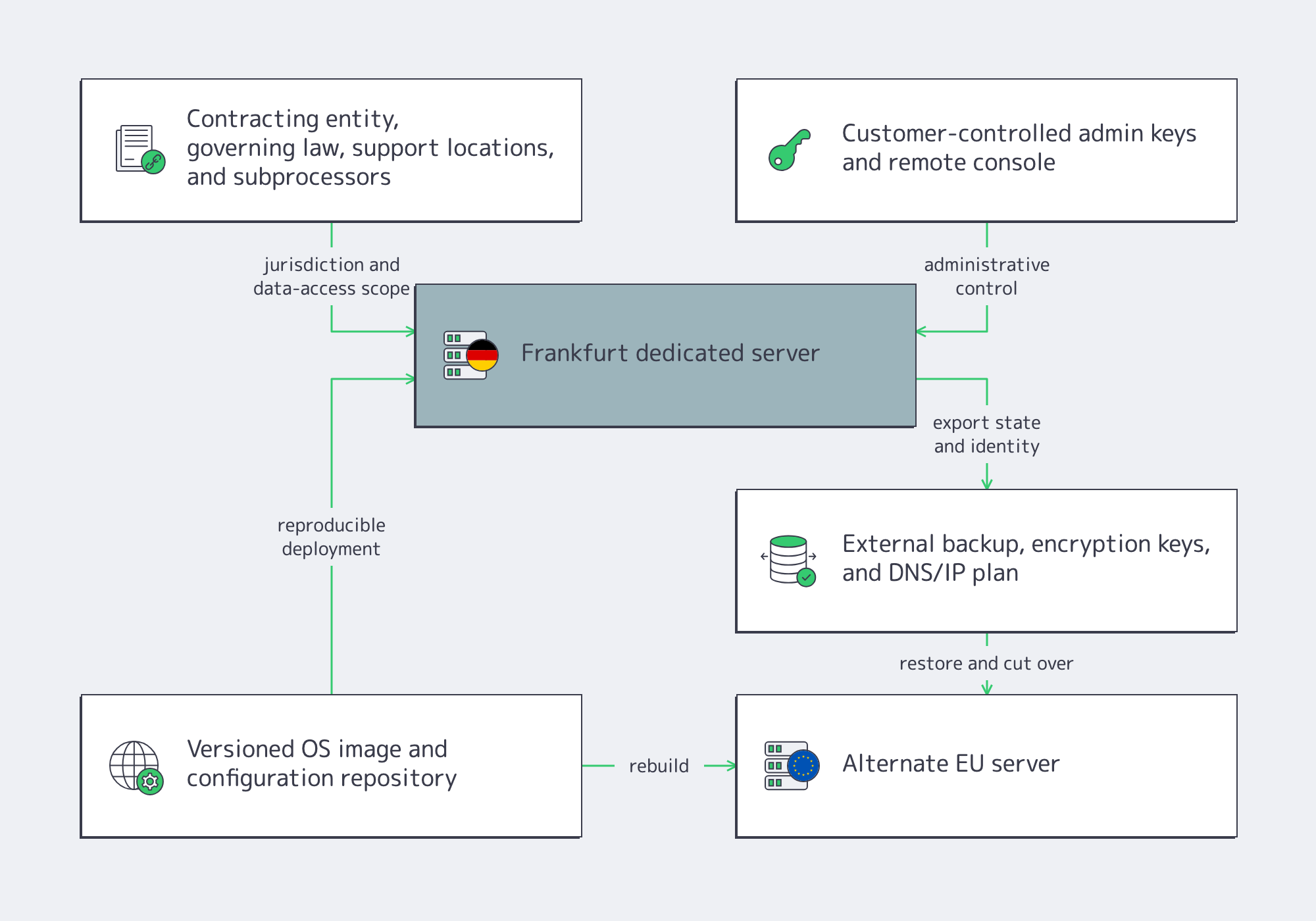
Start with entities, not coordinates: identify the contracting company, data-center operator, support locations, subprocessors, governing law, and every jurisdiction touching customer or diagnostic data. Map production data, backups, monitoring, authentication logs, support attachments, and console metadata.
Operational control means customer engineers can reinstall the OS, restore data, rotate credentials, update routing, and recover monitoring from customer-owned artifacts. Technology control favors standard operating systems, documented automation, independent DNS, and portable VM or container formats. Supply-chain control requires named components, substitution rules, and a replacement path.
Where German Dedicated Server Buyers Face Lock-In and Cost Risk
Lock-in is highest when deployment automation, backups, addressing, or commercial terms cannot travel with the workload. A useful acceptance test is restoring a production-sized dataset and starting a canary service elsewhere within 24 hours, using customer-controlled artifacts and documented fees rather than a proprietary control plane or an engineer’s memory.
Technical lock-in starts with undocumented builds and configuration drift. Data lock-in appears when backups cannot be restored independently or keys remain provider-controlled. Operational lock-in hides in monitoring, secrets, access lists, and recovery procedures trapped in a provider portal.
Network lock-in is expensive because provider-assigned addresses spread into firewall rules, partner allowlists, certificates, webhook destinations, and documentation. RFC 5887 explains why IPv4 and IPv6 renumbering remains difficult. DNS helps only when applications use names consistently and TTLs are lowered before cutover.
Customer-controlled address space and BGP can reduce renumbering exposure but add registry, filtering, monitoring, and routing work. Melbicom offers BGP Session as a separate service. For Frankfurt deployments, confirm address arrangements, routing policy, and operational responsibilities before ordering.
Commercial flexibility is separate. Verify contract duration, cancellation, renewal, traffic commitments, address charges, setup fees, price-change rights, and overlap costs. Short commitments reduce contractual exposure, not migration work.
The EU Data Act, applicable since September 12, 2025, offers a benchmark for covered data-processing services. It generally limits transition periods to 30 days, caps initiation notice at two months, preserves at least 30 days for retrieval, and prohibits switching charges from January 12, 2027. Scope depends on the service.
Price shocks need an exit model. A 12% increase on a €1,000 monthly deployment adds €1,440 annually. Model 10%, 20%, and 30% increases, then add migration labor and one or two months of parallel infrastructure.
Germany vs. Netherlands Bare-Metal Hosting
Germany is usually stronger when German users, domestic processing requirements, or Frankfurt-centered partners dominate; the Netherlands can provide better westbound paths and geographic diversity. Decide with at least seven days of identical testing, comparing p95 latency, route changes, sustained throughput, and peak-window packet loss, with a provisional loss gate below 0.1%.
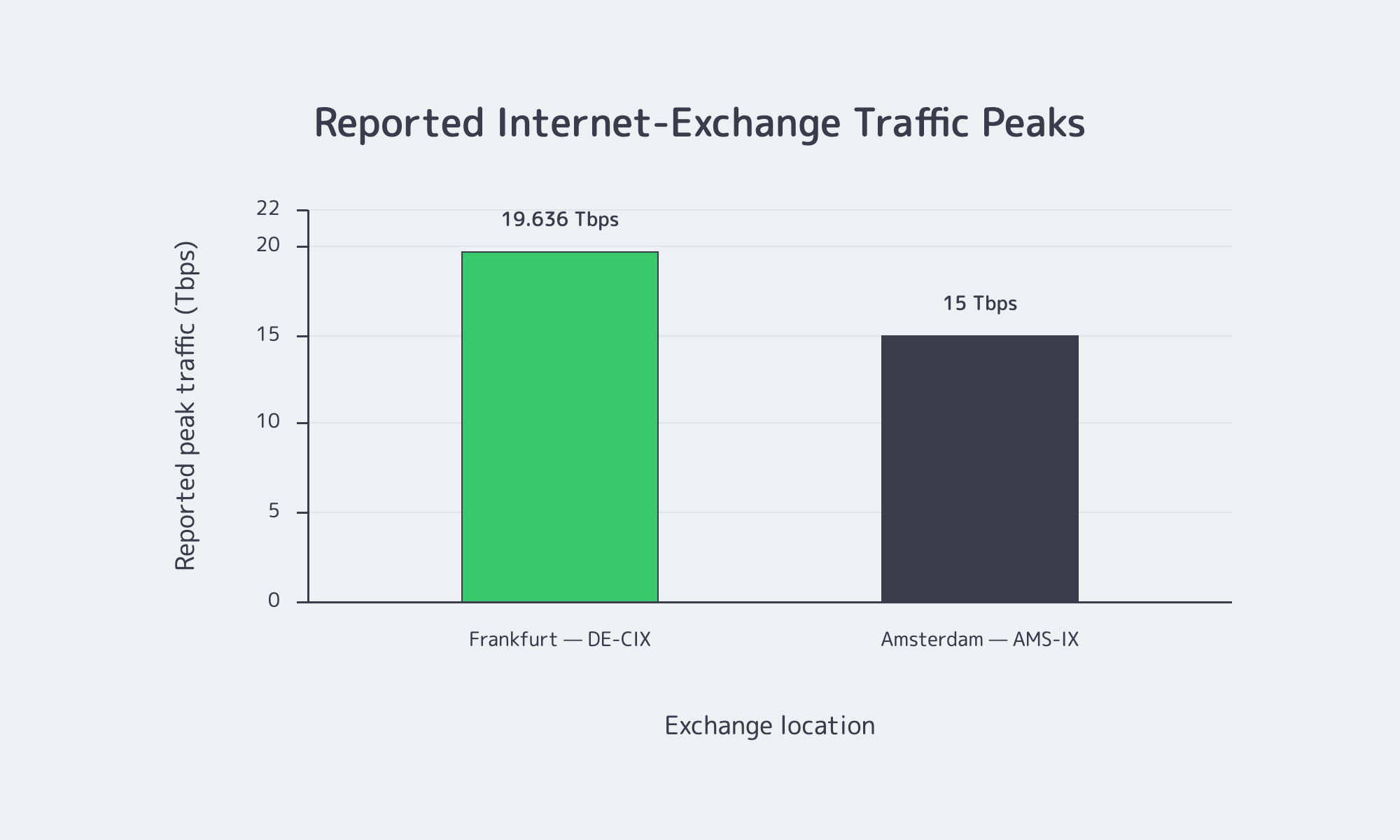
Exchange scale is context, not application evidence. DE-CIX reported a Frankfurt peak of 19.636 Tbps and access to more than 1,000 networks in July 2026. AMS-IX reported a 15 Tbps peak in April 2026, plus 35.66 exabytes and 902 connected networks in 2025. Neither guarantees the best route.
| Decision factor | Germany and Frankfurt signal | Netherlands and Amsterdam signal |
|---|---|---|
| Primary users | Strong for Germany and Central Europe | Strong for the Netherlands and westbound Europe |
| Compliance scope | Can satisfy German-location policies after transfer checks | EU and GDPR jurisdiction, but not Germany-specific residency |
| Interconnection | Large exchange and carrier ecosystem | Major international exchange ecosystem |
| Resilience role | Natural Germany-centered primary | Useful recovery or second-production location |
| Acceptance test | Seven days from representative networks | Same build, payloads, window, and telemetry |
Measure p95 and p99 RTT, packet loss, jitter, route changes, TCP and TLS setup, time to first byte, and sustained bidirectional transfers. Use real API calls and large transfers, not only pings. Treat 0.1% as a procurement gate, not a universal rule.
Melbicom provides 200+ Frankfurt configurations and 300+ Amsterdam configurations. Melbicom offers Tier III & IV DCs in Frankfurt and Tier III & IV DCs in Amsterdam. Deploy the same customer-controlled OS build and observability stack in both, subject to hardware availability, and compare real paths.
A dual-site design helps only when replication delay is acceptable and failover is rehearsed. An untested destination is not a recovery environment.
GDPR, Frankfurt Connectivity, and Portability Checks before Migration
Before migration, verify the processor chain, map every international transfer, test Frankfurt routes from real user and partner networks, and prove that images, data, keys, logs, DNS, and addressing can move. Do not cut over until a timed rehearsal meets the recovery objective and the contract defines return, retention, deletion, and audit evidence.
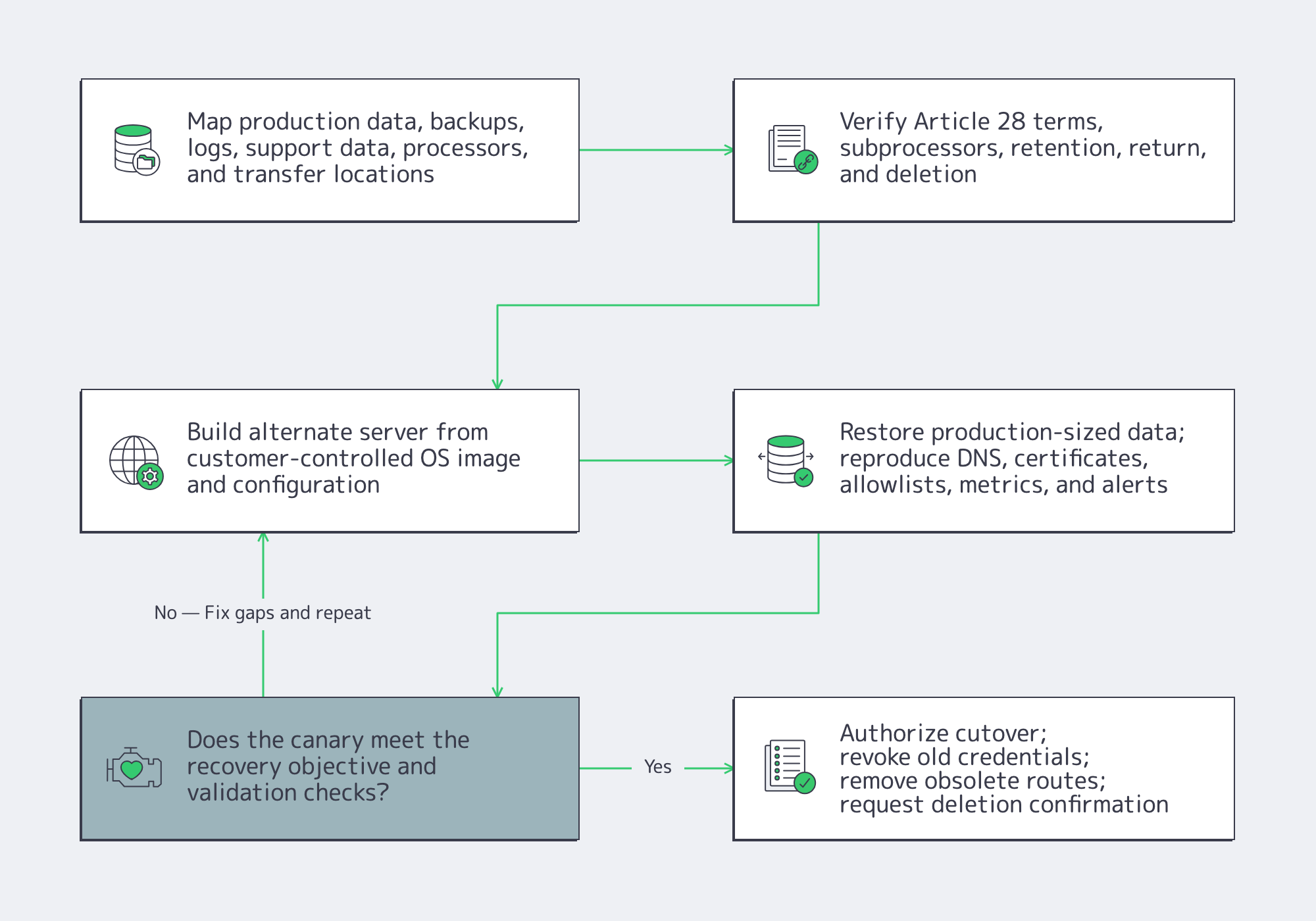
German storage does not complete GDPR compliance. Article 28 requires processor guarantees, a binding agreement, and subprocessor controls. Article 44 covers third-country transfers; Article 32 requires risk-based security, resilience, restoration, and testing. Support tickets or diagnostics processed abroad still matter.
For each data category, record processors, locations, retention, transfer mechanism, and deletion path. Cancellation alone does not prove deletion.
Portability testing should cover:
- Installation: Start from a customer-controlled operating-system image or automated build and confirm that the target hardware supports it.
- Configuration: Version packages, users, jobs, firewall rules, mounts, certificates, secrets, monitoring agents, and manual steps.
- State: Time snapshot creation, transfer, verification, restore, database recovery, and application validation—not copy speed alone.
- Identity and operations: Find hard-coded addresses, lower DNS TTLs early, reproduce certificates and allowlists, and verify equivalent metrics and alerts.
- Exit: Validate returned data, revoke old credentials, remove obsolete routes, limit overlap, and obtain applicable deletion confirmation.
Melbicom’s network footprint includes 29 IXPs and 23 transit providers. Frankfurt options span Intel and AMD processors, 16–768 GB of RAM, and per-server networking up to 200 Gbps. Buyers should still test the ordered port, destinations, and sustained throughput in both directions.
How to Control Hardware Availability, Price Increases, and Support Risk
Treat catalog availability, current inventory, reserved allocation, and replacement stock as four different states. Before scheduling migration, confirm exact quantity, component layout, acceptable substitutions, delivery window, and failure-replacement path. Then stress-test the full price and support model against scarcity, material increases, and a realistic outage rather than trusting a product card or chat badge.
Gartner forecast worldwide server spending to grow 36.9% in 2026, with data-center-system spending above $650 billion. A quote should identify CPU model and generation, memory layout, drive model and usable capacity, redundancy, NIC capability, port speed, and substitution rules. For fleets, confirm simultaneous allocation and spare capacity.
Across our infrastructure, Melbicom provides 1000+ ready-to-go configurations, including 200+ Frankfurt options. Custom server configurations are delivered in 3–5 business days. Cutover planning should still wait for confirmation of the exact Frankfurt quantity, storage layout, substitutions, and delivery window.
Eurostat reported €0.2264 per kWh for medium non-household consumers in Germany in the second half of 2025, versus an EU average of €0.1837. This does not predict hosting prices, but buyers should document fees, currency, renewal mechanics, and increase triggers. A 60- to 90-day notice target gives many teams time to benchmark, reserve hardware, transfer data, and run overlap.
Test support with a failed drive, unreachable server, routing anomaly, or suspected instability. Uptime Institute’s 2026 outage analysis found that 57% of respondents’ most recent major outages cost more than $100,000, and one in five exceeded $1 million. Melbicom provides 24/7 support, but buyers should establish evidence requirements, authorization, escalation, status cadence, hardware procedures, and failover triggers before production.
A Low-Lock-In German Server Standard
A German server should pass seven proofs before it becomes difficult to replace: documented sovereignty and subprocessors; measured Frankfurt routes; allocated hardware and substitution rules; a total-cost model with 10%, 20%, and 30% stress cases; tested support escalation; a production-sized restore within the recovery objective; and a documented return-and-deletion path.
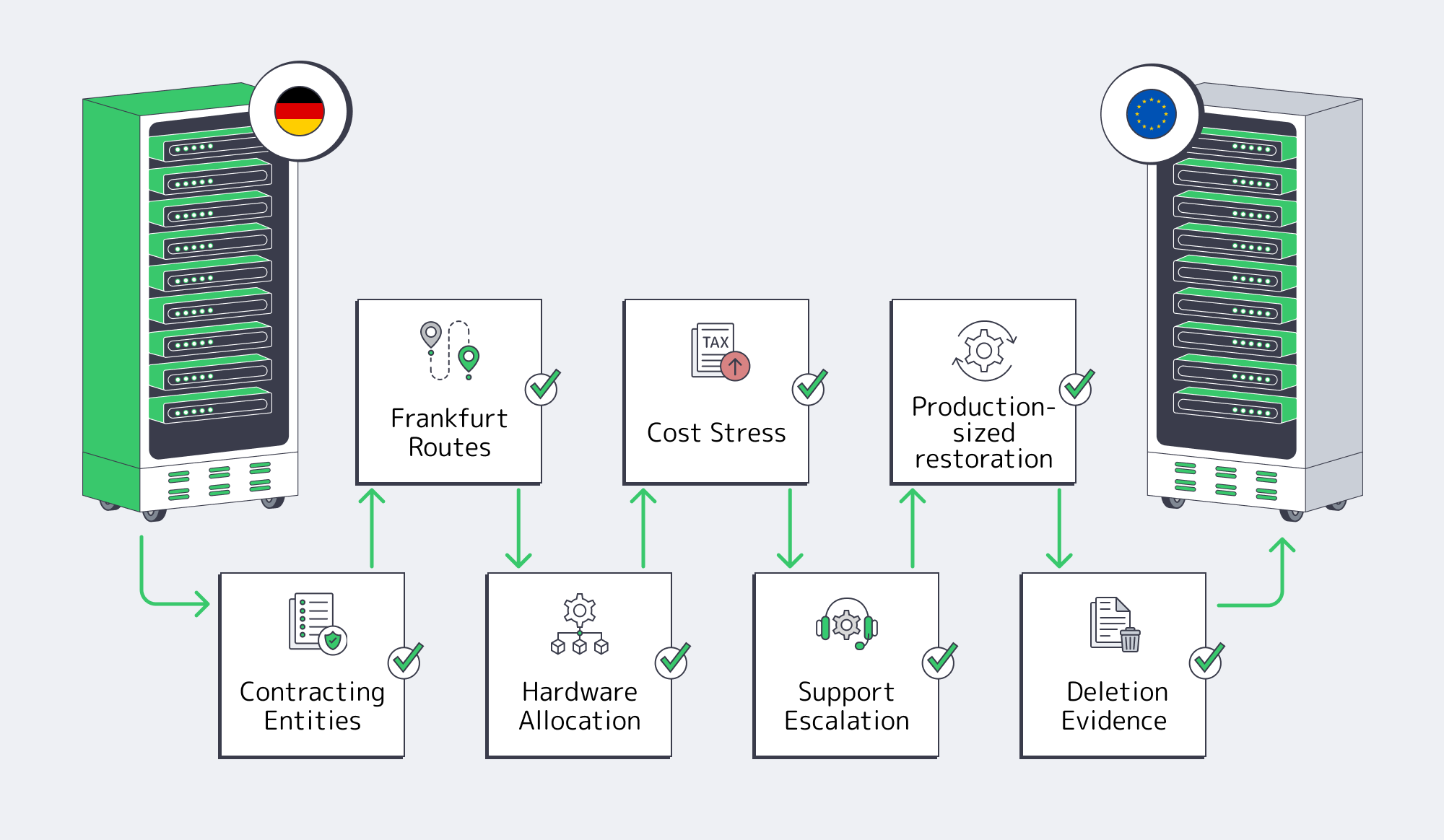
These controls do not require an elaborate abstraction platform. Standard operating systems, independent DNS, customer-controlled automation, external backups, portable addressing where justified, explicit contracts, and recovery drills do most of the work. The sequence is straightforward: benchmark the location, verify the data chain, reserve hardware, model the bill, test support, and rehearse the exit.
A German dedicated server should earn its place through measured routes, verifiable data handling, allocated hardware, predictable terms, usable support, and a demonstrated path out. Physical location reduces exposure; portability prevents it from becoming a trap. That is when comparing Melbicom’s Frankfurt options becomes a technical procurement step.
Choose a Portable German Server
Compare 200+ Frankfurt configurations, facility tiers, bandwidth, and recovery-friendly infrastructure against your sovereignty and exit checks.
Get expert support with your services
Blog
Japan Server: Choosing the Right Infra for Low-Latency Local Workloads
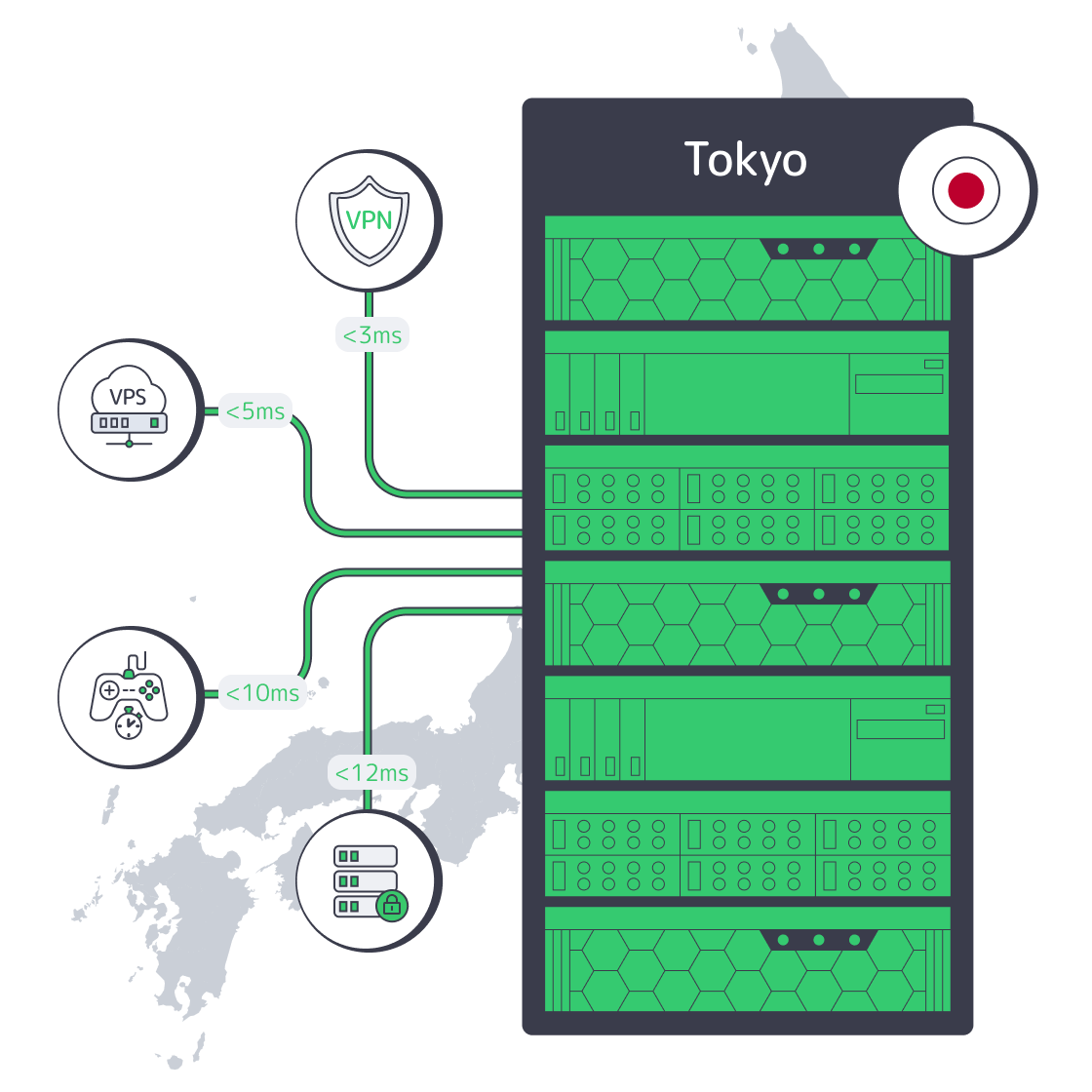
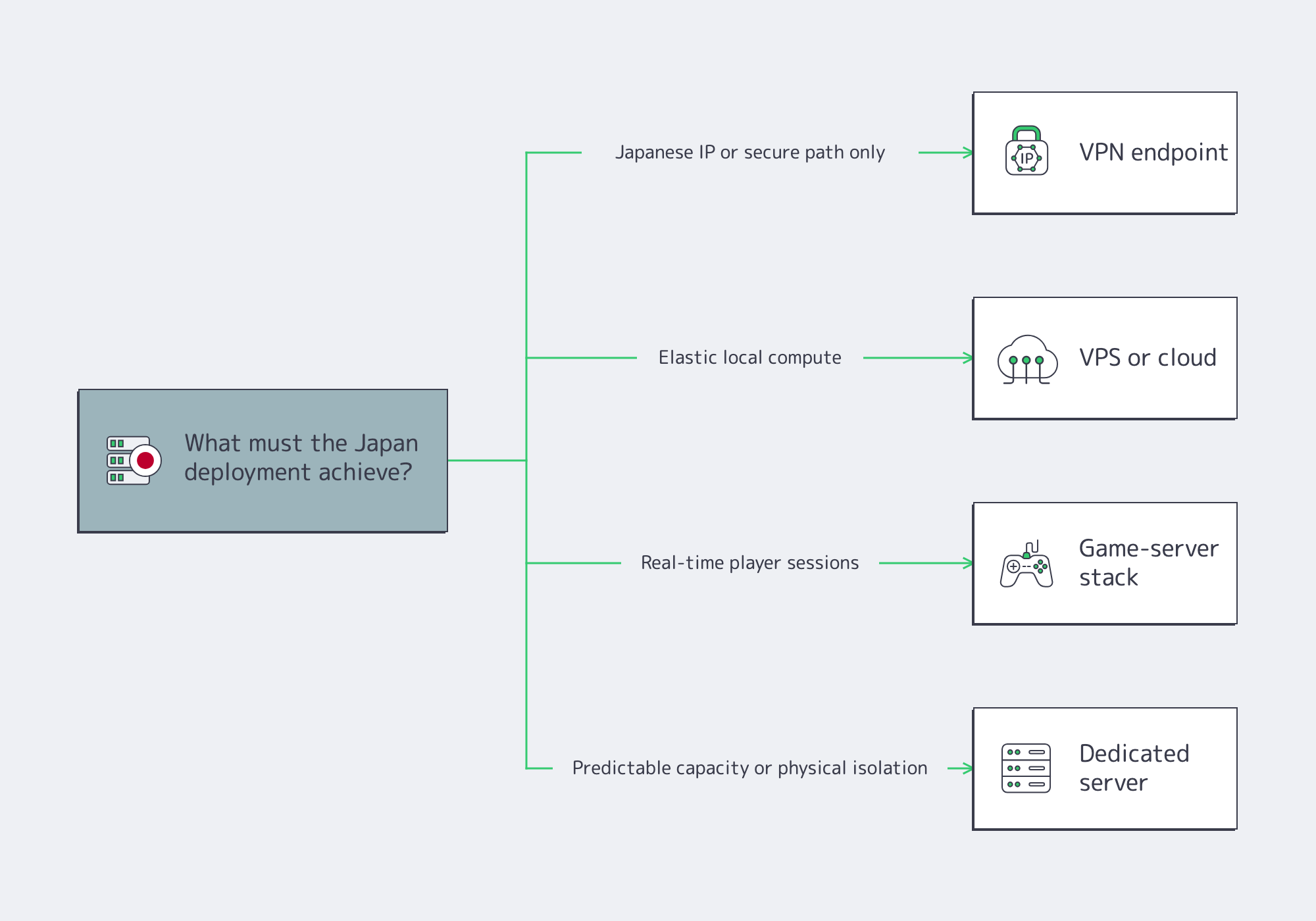
“Japan server” query usually describes four different infrastructure goals. One buyer needs a Japanese IP address. Another wants game sessions closer to players. A third needs virtual compute in Tokyo. A fourth requires a dedicated physical server with predictable resources and a clear isolation boundary.
Treating those needs as interchangeable leads to poor architecture decisions. A VPN changes network identity without moving the workload. A VPS relocates compute but still uses virtualized infrastructure. A game server describes an application role rather than a hardware category. A dedicated server provides exclusive physical resources but requires more deliberate capacity planning.
Japan’s internet usage makes local performance relevant for many services. The Japan Statistical Handbook reports that 85.6% of people aged six and older had used the internet during the preceding year, with usage above 90% across every age group from 13 through 69. The practical question is not whether Japan has substantial digital demand. It is which parts of a system must run close to Japanese users.
Japan Servers– 14 Tokyo configurations – Tier III Tokyo facility – Up to 100 Gbps per server |
|
Japan Server Meaning for Buyers
A Japan server search usually hides one of four requirements: obtaining a Japanese egress IP, hosting real-time sessions near players, deploying virtual compute, or reserving a physically isolated machine. Choose by outcome: VPN for network identity, VPS or cloud for virtual capacity, game hosting for session latency, and dedicated infrastructure for predictable resources and isolation.
A Japan VPN is primarily a network-path and egress-identity tool. It creates an encrypted tunnel with a Japanese source address when terminated in Japan. It does not relocate application, database, game, or file-processing workloads.
That makes a VPN appropriate for secure administration, regional behavior testing, private connectivity, or access through a Japanese IP. It does not lower application latency if the workload remains on another continent.
A Japan VPS places virtual compute inside a Japanese data center. It can be a practical starting point for APIs, development environments, proxies, control-plane services, smaller databases, and regional application components. It provides a persistent operating-system environment without requiring a physical machine.
A VPS should not automatically be equated with a full cloud platform. The NIST cloud definition includes on-demand self-service, pooled resources, rapid elasticity, broad network access, and measured service. A conventional VPS may provide virtual compute without all of those operational characteristics.
A Japan game server is an application role, not a server class. Matchmaking, authoritative simulation, persistence, telemetry, voice, and content delivery can run on separate systems. The underlying capacity may be virtual, cloud-based, or dedicated.
Latency requirements vary by game, but they can be unforgiving. An ACM latency survey found that delays below 100 milliseconds can already affect tasks such as target selection and steering. Genre, input model, tick rate, and compensation design determine how much delay is acceptable.
A Japan dedicated server is a single-customer physical machine located in Japan. It is the relevant interpretation when sustained CPU performance, exclusive memory and storage resources, predictable capacity, deeper operating-system control, or a physical workload-isolation boundary matter.
Dedicated hardware is not automatically faster than every virtual instance. Poor routing, insufficient capacity, or a badly configured application can still produce weak performance. Its central distinction is that unrelated virtual tenants do not share the machine’s physical compute allocation.
Comparing Japan Server Options
The right Japan server class follows the workload’s bottleneck rather than the product label. Use a VPN when the application stays elsewhere, VPS or cloud when provisioning speed and elasticity matter, game-server architecture when packet timing drives experience, and dedicated hardware when sustained load, broader control, or physical single-customer isolation outweigh elasticity.
| Buyer Intent | Best-Fit Option | Deciding Tradeoff |
|---|---|---|
| Obtain a Japanese IP or secure a network path | Japan VPN endpoint | Changes routing and source address without necessarily relocating the workload |
| Launch local compute quickly or absorb irregular demand | Japan VPS or cloud instance | Faster provisioning, with virtualized and potentially pooled physical resources |
| Keep real-time sessions close to Japanese players | Japan game-server architecture | The workload still requires a VPS, cloud, or dedicated capacity decision |
| Run steady, sensitive, or performance-variable workloads | Japan dedicated server | Physical resource isolation and control, with more capacity planning |
The most important distinction is between what the system does and what it runs on. VPN describes a secure network overlay. Game server describes an application role. VPS, cloud, and dedicated server describe ways to supply compute.
Virtual infrastructure is often the rational starting point for a regional API, test environment, monitoring node, low-volume backend, or service with uncertain demand. It allows local deployment without committing to an entire physical system.
That advantage becomes less significant when the workload is consistently busy. If a service consumes stable CPU, memory, storage I/O, and network capacity around the clock, predictable physical resources may matter more than the ability to create and delete instances rapidly.
The difference is especially important for authoritative game simulation. Average CPU utilization can hide scheduling delays that create missed ticks or unstable processing times. Teams should benchmark session density, p95 processing time, and p99 processing time instead of comparing only total vCPU counts.
Dedicated infrastructure also provides a clearer fit when licensing, audit scope, security policy, or internal risk classification requires a physical single-customer boundary. Virtualization can deliver strong logical isolation, but dedicated hardware removes cross-customer hypervisor sharing from the compute layer. Neither model automatically secures the operating system or application.
Latency, Control, Compliance, and Isolation Checks for Japan Hosting
Evaluate Japan hosting against four written acceptance tests: latency from representative Japanese access networks, the administrative controls the team requires, the data-handling obligations that apply, and the isolation boundary defined by the threat model. A location should fail procurement if it misses any mandatory threshold, regardless of its headline port speed.
Latency must be measured rather than inferred from a map. Physical proximity reduces theoretical propagation delay, but real traffic follows routing policies, peering relationships, transit availability, congestion, and failure conditions.
Japan has a substantial local interconnection ecosystem. JPNAP reports hundreds of connected autonomous systems, more than 8 Tbps of peak traffic, and interconnection facilities across several areas. Those figures establish the scale of the market; they do not guarantee that every Tokyo provider has equally effective routes to every access network.
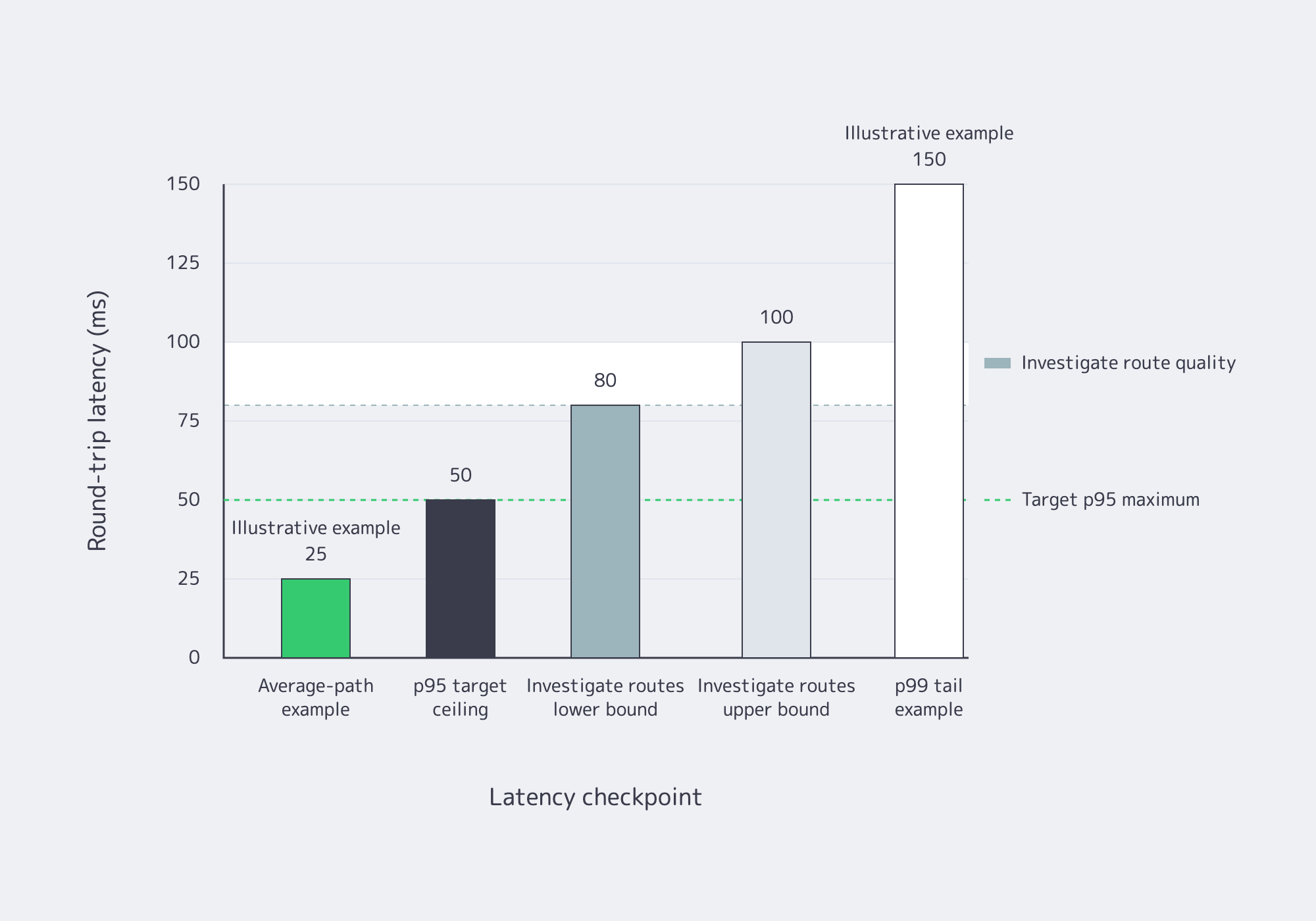
Average ping is not enough. The IETF performance-metrics registry distinguishes round-trip delay, one-way delay, packet loss, and packet-delay variation because each reveals different failure modes. A 25-millisecond average can still fail when p99 reaches 150 milliseconds or brief loss triggers retransmissions.
For action-heavy multiplayer workloads, a reasonable procurement screen is to target p95 player-to-server round-trip time below roughly 50 milliseconds for the primary Japanese cohort and investigate routes approaching 80–100 milliseconds. This is an operating target, not a universal gaming standard. Competitive systems may need less, while slower-paced applications may tolerate more.
Transactional applications require a different calculation. A 30-millisecond round trip may be negligible for one request but material when a user action creates several sequential authentication, database, and API exchanges. Measure end-to-end task time with network delay, server processing, cache behavior, and database latency.
Control requirements must also be explicit. Root access to a virtual machine does not provide control over the host, hypervisor, physical storage topology, or network interface. A dedicated server exposes a broader system boundary, but the buyer must still confirm operating-system installation procedures, recovery access, reinstall options, firewall ownership, and division of operational responsibilities.
Compliance is not created by a Tokyo address. Japan’s Act on the Protection of Personal Information governs how covered organizations handle personal information. The Personal Information Protection Commission emphasizes access controls, protection against unauthorized access, appropriate third-party handling, purpose limitation, and organizational, human, physical, and technical safeguards.
A Japan-based server can support a data-residency requirement by keeping selected processing and storage in Japan. It does not prove that backups remain in scope, support access is controlled, retention is appropriate, subprocessors are governed, or cross-border transfers use the required legal mechanisms.
Isolation must follow the threat model. A virtual machine provides logical separation through virtualization controls. A dedicated server assigns the physical machine to one customer. Neither protects an unpatched OS, exposed credential, insecure pipeline, or unsafe application tenant boundary.
Benchmarking a Japan Server
Benchmark from representative Japanese networks with realistic application traffic over several days. Measure median, p95, and p99 performance while separating network delay from DNS, TLS, application processing, database access, storage queues, and resource contention. The result should be a repeatable acceptance report, not a favorable screenshot from one short ping test.
Testing solely from Europe or North America says little about performance for users in Japan. Test from the fixed and mobile access networks that matter commercially.
Run measurements for at least seven days so the sample includes Japanese business hours, evening consumer peaks, weekends, temporary route changes, and maintenance periods. A short test during an uncongested interval can hide packet loss, queue buildup, and tail-latency spikes.
Use more than ICMP. Add TCP connection tests on the production port, TLS-handshake measurements for encrypted services, UDP tests for real-time applications, and complete application transactions.
Measure DNS lookup, TCP establishment, TLS negotiation, time to first byte, server processing, total response time, upload and download throughput, retransmissions, packet loss, and delay variation separately. Low ping with a slow first byte usually points toward compute, application, database, or storage delay rather than distance.
For game workloads, correlate network round-trip time with simulation duration, missed ticks, session concurrency, garbage-collection pauses, database calls, and outbound packet queues. This distinguishes routing problems from CPU scheduling or application problems.
Test under expected production load and then exceed the forecast by a controlled margin. Record how tail latency changes as CPU, memory, storage, and network resources approach saturation. Performance at 10% utilization does not predict stability at 70%.
Use traceroute or MTR-style observations from several access networks, but do not treat hop count as a quality score. The objective is to identify persistent routing detours, route changes, packet loss, and differences between access providers.
We at Melbicom provide a test endpoint and downloadable file through our data-center page. The Tokyo facility is Tier III, with network options ranging from 1 to 100 Gbps per server. Still, we recommend buyers to measure the achievable path and application performance from their own target networks before deployment.
Bandwidth must be sized from the workload model rather than the largest available port. Estimate peak concurrent users, per-session bitrate, protocol overhead, replication, backups, software distribution, and growth headroom. Then identify whether port speed, transfer allowance, storage reads, packet processing, or CPU is the constraint.
Japan Workload Placement Paths
Begin with the narrowest component that genuinely requires Japanese proximity. Keep network identity, static delivery, application execution, databases, and real-time state as separate decisions. Move additional systems into Tokyo only when measurements show that remote dependencies, resource contention, or isolation requirements prevent the workload from meeting its latency and operational targets.
When the requirement ends at a Japanese source IP, private administrative path, or regional behavior test, use a VPN. Do not relocate the production stack unless application measurements justify local compute.
When Japanese users interact directly with an API, authentication service, websocket endpoint, website backend, or real-time application, move the latency-sensitive execution path into Tokyo. Static assets can be cached separately, but a CDN does not relocate game state, database transactions, or dynamic logic.
For deployments with uncertain demand, begin with VPS or cloud infrastructure and define migration triggers in advance. Useful triggers include sustained CPU pressure, rising p99 processing time, memory exhaustion, storage-I/O contention, rapid cost growth, or a new requirement for physical isolation.
For game workloads, place the authoritative simulation near the player population and separate it from noncritical work. Analytics, backups, build pipelines, and batch processing do not necessarily require the same latency tier. If simulation-time variation increases under virtualized contention, or stable demand can fill a physical system, dedicated capacity becomes easier to justify.
For databases, identify where writes originate and which consistency model the application requires. Moving an application server to Tokyo while leaving every synchronous database call overseas can add long-haul delay to each transaction. Local performance depends on the full critical path, not the frontend.
For regulated workloads, map primary storage, replicas, backups, logs, monitoring, crash dumps, support access, analytics exports, and subprocessors before choosing the machine. Decide which data must remain in Japan, which data may cross borders, and which controls govern every transfer.
Melbicom’s Japan dedicated-server configurations are deployed in the Tier III Tokyo location. Current Tokyo inventory has 14 configurations, including Intel Xeon options.
The facility supports network options from 1 to 100 Gbps per server.
When the ready configurations do not fit the workload, custom server configurations are delivered in 3–5 business days. Melbicom provides 24/7 support; customers still own OS, application, capacity, security, and incident-response planning.
The Japan Server Buying Checklist
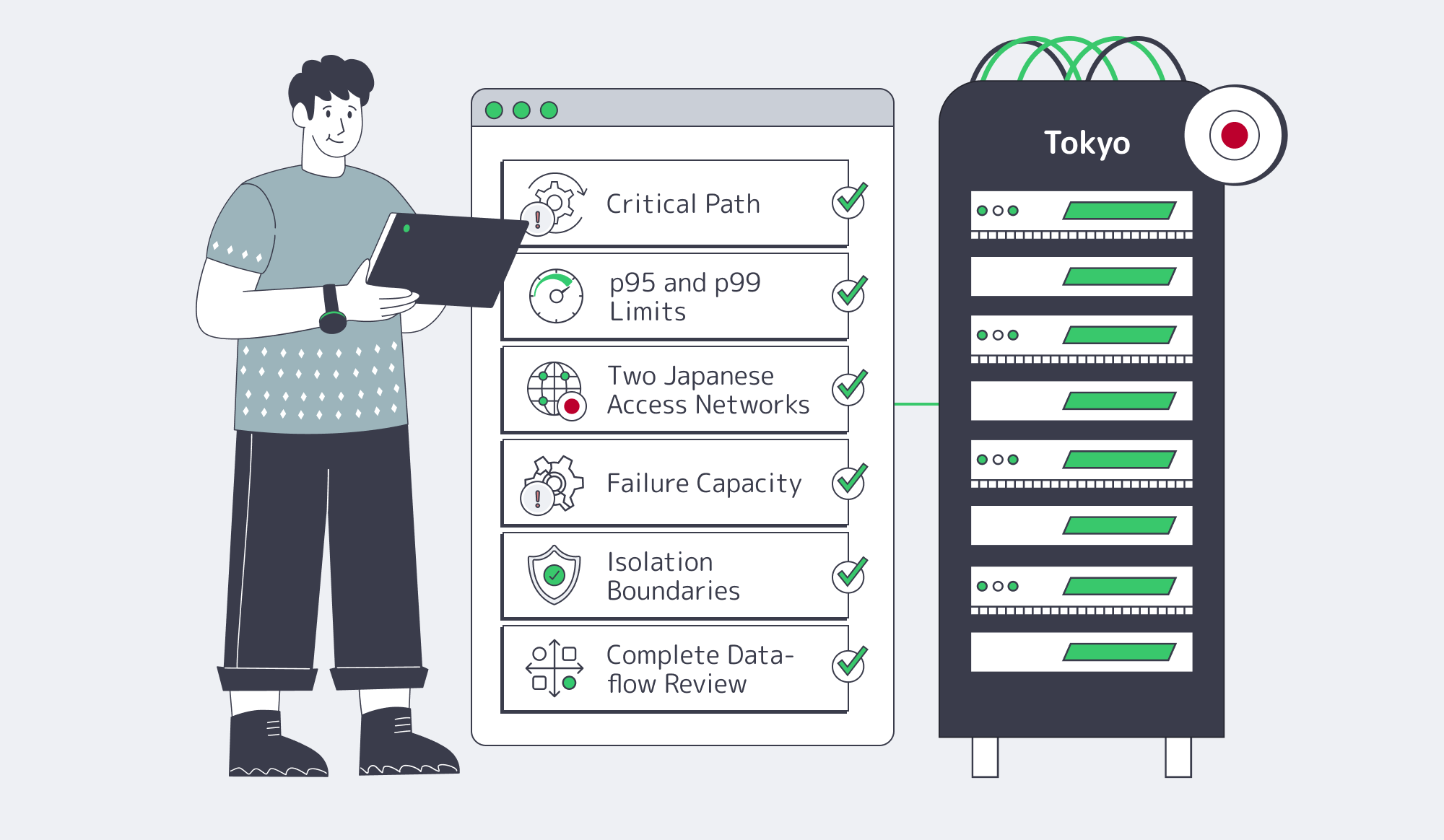
The correct conclusion is not that one infrastructure class wins. It is that “Japan server” intent can be reduced to measurable decisions about network identity, workload location, elasticity, real-time performance, administrative control, and physical isolation. Procurement should begin with acceptance thresholds and architecture boundaries rather than a location filter alone.
Turn those measurements into a deployment decision:
- Keep the first Tokyo deployment limited to the latency-sensitive path; move supporting systems only when dependency tracing proves material delay.
- Create migration triggers before launch, including maximum p95 and p99 processing time, resource saturation thresholds, storage-queue limits, and acceptable packet loss.
- Test at least two Japanese access-network paths so a favorable route from one provider does not hide poor connectivity from another.
- Reserve failure capacity and benchmark what remains with one application node, database replica, or network path offline.
- Treat physical isolation as one control within a broader security model that also covers identities, patching, secrets, backups, logging, and deployment access.
- Review the full data flow after every architecture change because a new analytics export, backup target, or support workflow can alter the original residency and compliance assessment.
A VPN is the right answer when the requirement ends at the network edge. VPS or cloud infrastructure fits services that benefit from fast provisioning, elasticity, and a smaller starting footprint. A game server must be sized around packet timing and simulation behavior. A dedicated server fits workloads that need sustained local capacity, broader control, predictable physical resources, and a single-customer compute boundary.
The word “Japan” narrows the geography. Benchmarking and workload design determine the infrastructure.
Test Japan Server Routes
Use Melbicom’s Tokyo test endpoint to compare routes, ready configurations, and custom builds delivered in 3–5 business days.
Get expert support with your services
Blog
Dedicated Server in US: How to Choose the Right Region and Hardware
A U.S. server footprint maps workloads to regions. Put latency-sensitive compute near request sources, keep data near ingestion paths, and place recovery capacity outside the primary failure domain. Define latency, RTO, and RPO before comparing hardware.
U.S. Servers– 28 Atlanta configurations – 28 Los Angeles configs – 24/7 infrastructure support |
|
How to Choose a U.S. Server Region
Choose a dedicated server in U.S. regions from measured P95 and P99 latency, packet loss, jitter, and route stability—not geography alone. Keep P95 network RTT within roughly 30–40 percent of the application’s end-to-end target, then validate bandwidth economics, compliance eligibility, hardware headroom, and an independent recovery location.
Map traffic by metro, access network, volume, transferred bytes, and criticality. Lower-volume traffic may still carry more revenue or risk.
RIPE NCC’s measurements from more than 10,000 vantage points show why observation beats geolocation. Its estimate—about 1 millisecond of RTT per 100 kilometers—is a physical floor, not a guarantee; routing, filtering, and geolocation errors affect results.
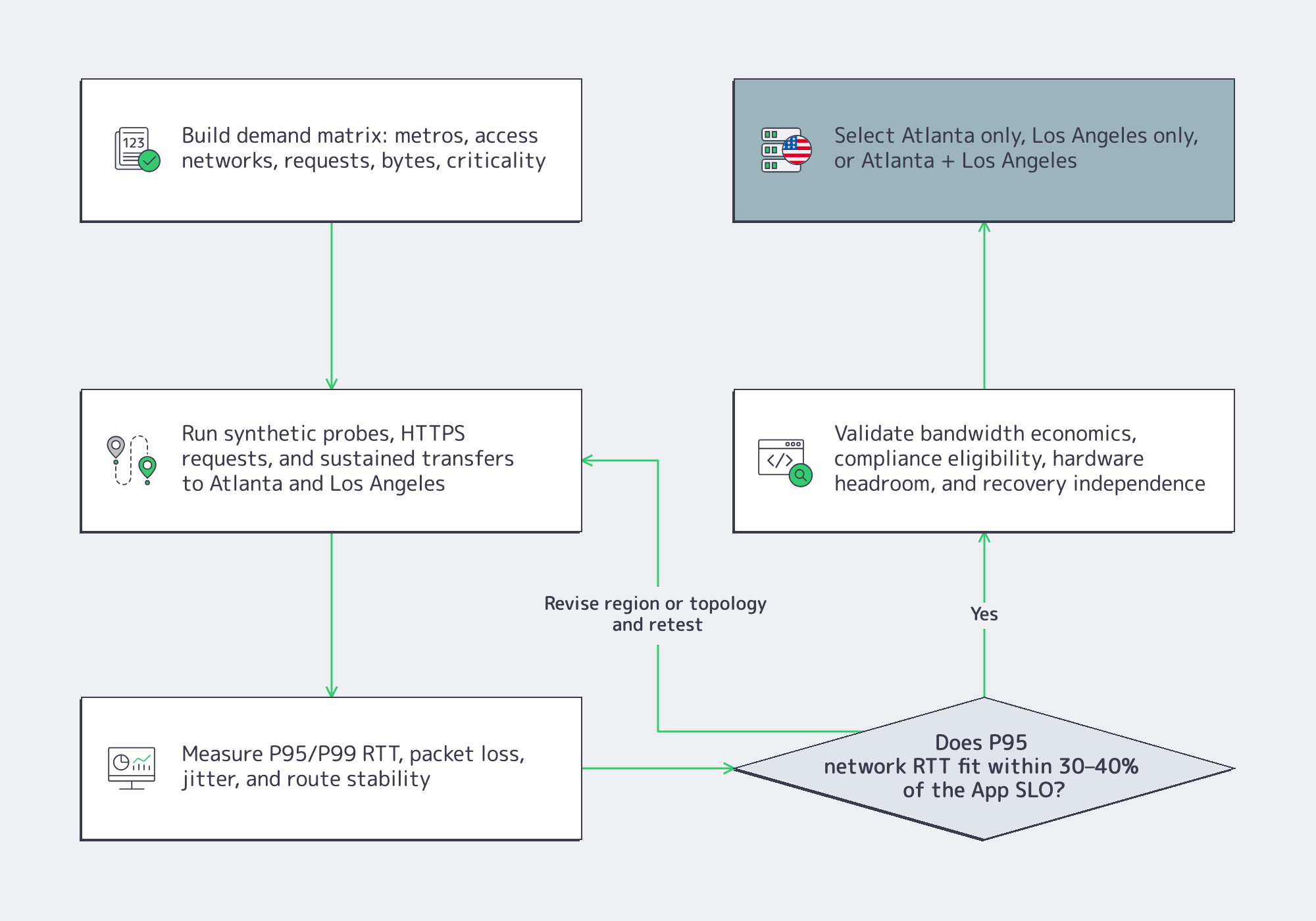
Combine synthetic probes with application timing. ICMP misses DNS, TLS, queueing, backend calls, and last-mile behavior, so test HTTPS requests and sustained transfers.
Melbicom’s U.S. footprint consists of Atlanta and Los Angeles. Both are Tier III locations, with per-server network capacity up to 200 Gbps in Atlanta and 200 Gbps in Los Angeles. Benchmark both before choosing one region or an east-west pair.
U.S. East, Central, or West Hosting
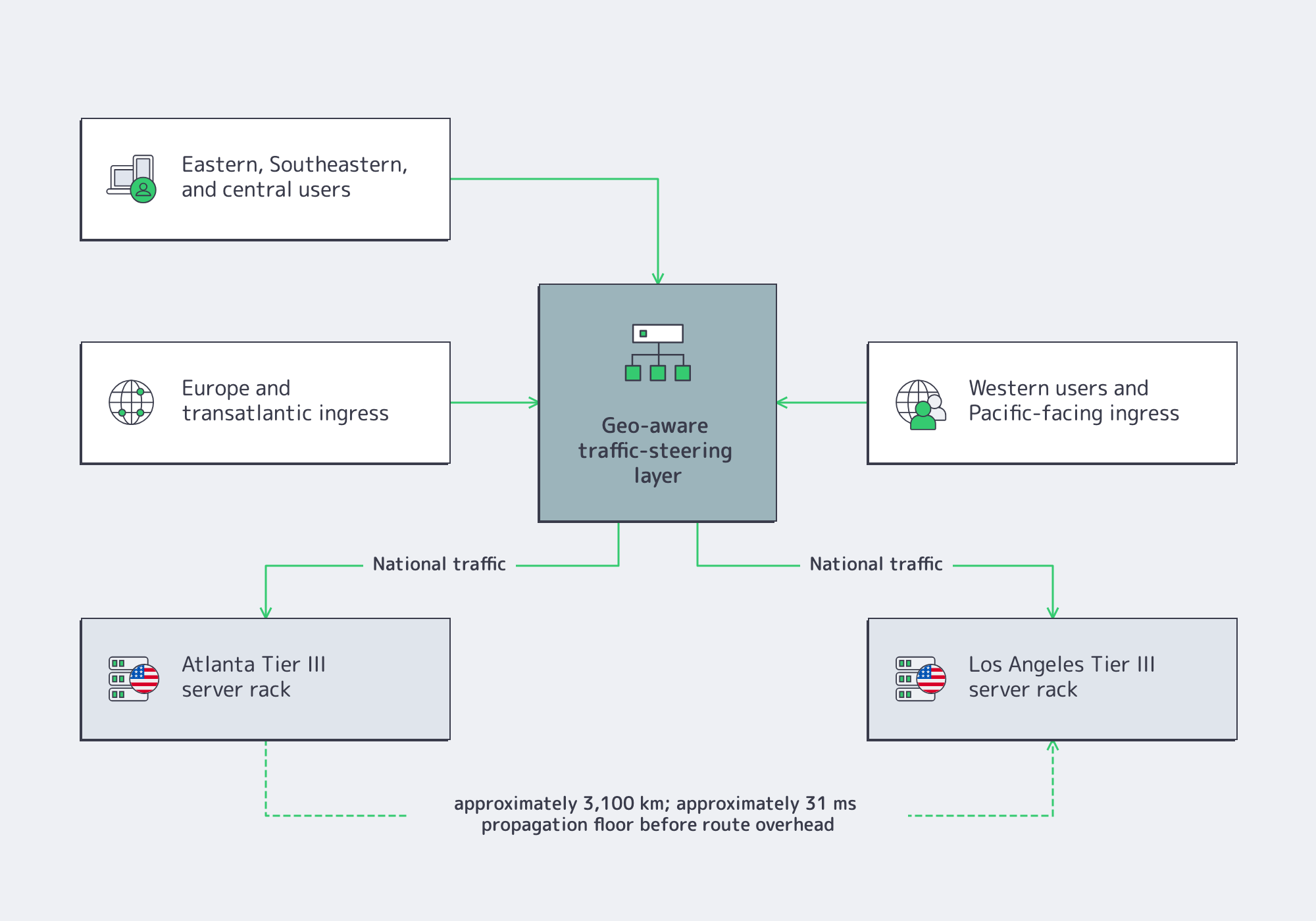
East or Southeast is the first candidate for east-heavy and transatlantic traffic; West fits western and Pacific-facing demand; Central is a compromise for balanced, moderately latency-sensitive workloads. For national interactive services, two regions often outperform one midpoint when traffic can be routed locally and state can be replicated without synchronous cross-country writes.
| Regional footprint | Best-fit workload pattern | Main tradeoff to validate |
|---|---|---|
| East or Southeast, such as Atlanta | Eastern and Southeastern users, transaction APIs, regional SaaS | West Coast latency plus storm, power, and carrier dependencies |
| Central U.S. | Balanced national demand, back-office systems, batch workloads | Average distance may still produce mediocre tail latency to both coasts |
| West, such as Los Angeles | Western users, media workflows, Pacific-facing delivery | East Coast latency plus seismic, wildfire, power, and telecom risks |
| Atlanta and Los Angeles | National interactive applications, regional steering, disaster recovery | Replication cost, consistency choices, duplicated capacity, and operational complexity |
Test Atlanta for eastern and central networks and Los Angeles for western and Pacific-facing flows. Because Melbicom has no central U.S. location yet, compare a single-region deployment with an Atlanta–Los Angeles topology.
The cities are roughly 3,100 kilometers apart. RIPE’s estimate implies a floor near 31 milliseconds RTT; real routes add distance and queueing. Synchronous cross-region commits add WAN delay to every write, so low-latency systems usually need local commits, asynchronous replication, regional leaders, or partitioned ownership.
Build the Latency Budget First
Latency accumulates across connection setup, network RTTs, queueing, execution, storage, dependent services, serialization, and return transit: End-to-end latency = connection overhead + network RTTs + queueing + application time + data-service time + serialization.
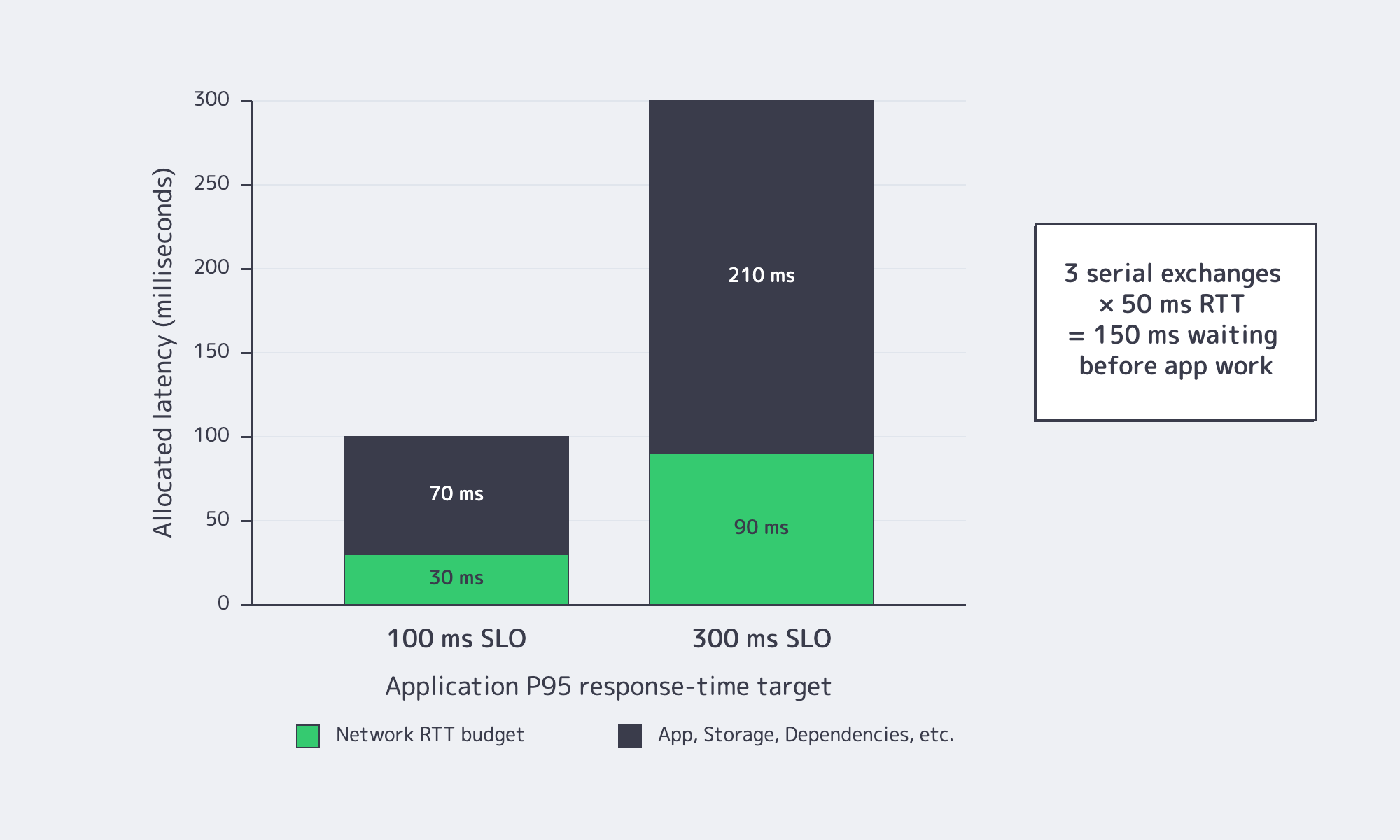
Three serial round trips over a 50-millisecond route consume about 150 milliseconds before useful work. Connection reuse, fewer chained calls, local caches, and co-located dependencies can outperform a processor upgrade.
Allocate the network a defined share of the SLO. A 100-millisecond P95 target might reserve 30 milliseconds for transit; a 300-millisecond application might reserve 90. Interactive APIs should optimize tail RTT, real-time services must include jitter and loss, and bulk transfer should prioritize sustained throughput.
Sizing U.S. Dedicated Server Hardware
Size a dedicated server in the U.S. around the resource that limits production: per-core speed for serial paths, core count for parallel workers, RAM for the active working set, SSD latency and endurance for write-heavy systems, and NIC capacity for sustained transfer. After representative load tests, retain 25–40 percent operating headroom.
CPU and Memory
High per-core performance matters for serial paths; more cores suit parallel workers. Track per-core utilization, run queues, throttling, and P99 latency because low average CPU can hide one saturated thread.
RAM must cover application state, database buffers, cache, guests, containers, and agents without sustained swapping. Include the load a surviving region must absorb.
Melbicom’s U.S. ready pool is asymmetric. Atlanta offers Intel Xeon E5 v4 and E5-2650 configurations with 64–128 GB RAM. Los Angeles adds first-generation Xeon Scalable systems and offers 128–256 GB RAM. Match the workload to the pool, or define a custom configuration—delivered in 3–5 business days—before committing.
Storage and Network
Choose storage by IOPS, write latency, throughput, endurance, and failure model—not capacity alone. SNIA explains TBW and DWPD and notes that write amplification changes real wear. Writing 3 TB daily to a 3.84 TB SSD is about 0.78 DWPD before amplification. Mirroring is not backup.
A fast NIC helps only when CPU, storage, buffers, and peers can fill it. RFC 6349’s bandwidth-delay product shows why: 10 Gbps at 60 milliseconds requires about 75 MB in flight; 40 Gbps requires about 300 MB. Window scaling, encryption, packet rate, and the remote endpoint can become bottlenecks.
Melbicom’s broader catalog contains 1000+ ready-to-go configurations, but U.S. options must be checked by region. Confirm CPU overhead, storage throughput, transfer policy, and failover demand before selecting a port rate.
Bandwidth, Compliance, and Failover Requirements to Validate
Document sustained throughput, transfer accounting, mitigation behavior, compliance responsibilities, backup locations, RTO, RPO, and traffic shifting. A port speed or “protected” label does not define the service boundary.
At continuous full utilization for 30 days, theoretical decimal transfer reaches 324 TB at 1 Gbps, 3.24 PB at 10 Gbps, 12.96 PB at 40 Gbps, and 64.8 PB at 200 Gbps. These are ceilings before protocol overhead and route limits. Include replication, backups, failover, retransmissions, and attack traffic.
For Melbicom’s U.S. locations, the upper per-server network option is up to 200 Gbps in Atlanta and 200 Gbps in Los Angeles (custom configurations). Ready-to-go configurations include 1–40 Gbps bandwidth choices with 50 TB or unmetered transfer plans. Compare unmetered servers with metered options using expected sustained utilization.
Melbicom provides DDoS protection, but requirements should specify attack classes, detection thresholds, mitigation time, protected scope, clean-traffic capacity, false-positive handling, telemetry, and escalation. ASD guidance updated in June 2026 recommends agreeing mitigation capacity, costs, monitoring and shutdown thresholds, and pre-approved actions with the provider. Reachability does not guarantee application recovery.
A U.S. server does not create compliance. For ePHI, HHS requires an appropriate business associate agreement and clear allocation of HIPAA responsibilities. PCI DSS v4.0.1 was published in June 2024; 51 of 64 new v4.x requirements became effective March 31, 2025 (PCI SSC). Replicas, backups, logs, and administrative paths can expand scope.
RTO defines recovery time; RPO defines tolerable data loss. Sub-15-minute RTO and sub-five-minute RPO generally require provisioned capacity, continuous replication, health-aware steering, and rehearsed procedures. A second server satisfies neither without current data, configuration, secrets, routing, monitoring, dependencies, and tested operators.
Multi-Region Failover for Real Failures
Choose cold, warm, hot active-passive, or active-active operation from RTO, RPO, and consistency requirements. Stateless services are easiest to distribute. Stateful systems need one writer, regional leaders, partitioned data, asynchronous replicas, consensus, or application-level reconciliation.
Separate correlated hazards. NIST SP 800-34 recommends alternate sites far enough apart to avoid common hazards, with equivalent controls, tested recovery, and telecommunications that avoid shared failure points. FEMA’s National Risk Index compares communities across 18 natural hazards and can inform—not certify—regional risk analysis.
Check DNS, certificates, secrets, deployments, monitoring, identity, upstream data, and staff access for shared failure domains. Measure replication lag in time and bytes, and design failback before the secondary accepts writes.
Traffic steering needs a failure model. DNS switching depends on caching. BGP can preserve a service prefix, but convergence does not restore application state; endpoint changes in DNS-based designs can break existing connections (RFC 8678). Melbicom’s BGP Session service can be incorporated into customer-controlled routing designs, while health criteria and application recovery remain workload decisions.
Remove the primary region’s production path during exercises. Verify detection, capacity, data freshness, traffic movement, and failback under peak load, replication lag, stale state, management-path loss, and shared deployment failure. Melbicom’s CDN, with 40 CDN PoPs across 35 countries, can reduce cacheable origin traffic but cannot replace writable application recovery.
Choose Footprints by Failure Domain
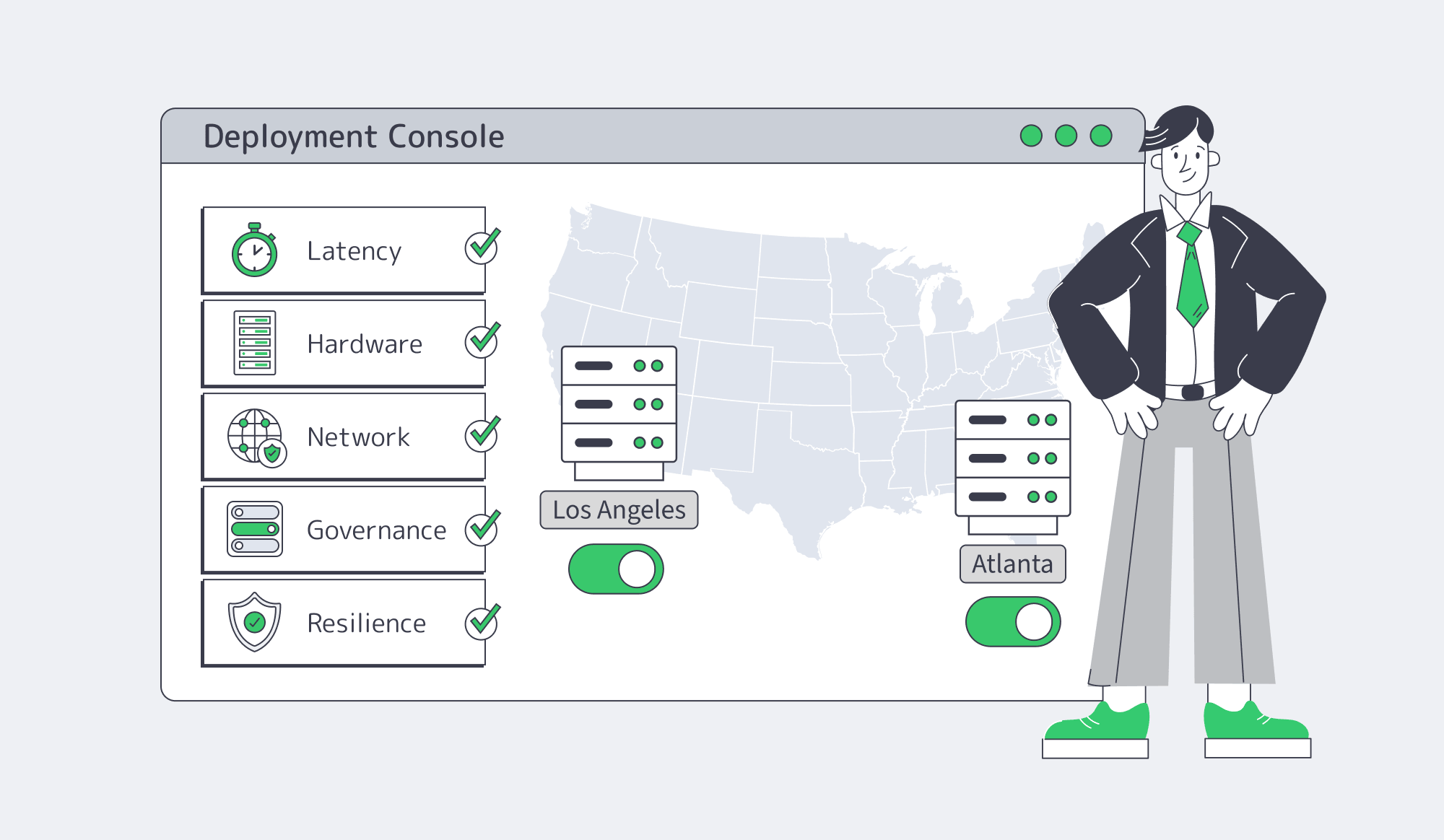
The right dedicated server in the U.S. satisfies a measured deployment model. Treat Atlanta and Los Angeles as separate operating regions, then confirm that latency, hardware headroom, usable throughput, compliance scope, RTO, RPO, traffic steering, and failback meet explicit objectives.
Apply these decision rules before comparing configurations:
- Use one U.S. region only when eastern and western tail latency fits the workload and recovery permits delayed promotion.
- Distribute stateless reads before writable state; avoid synchronous cross-country writes unless the added RTT is acceptable.
- Size the secondary for failover traffic, not its normal standby load.
- Treat the location’s published per-server maximum as a ceiling until storage, CPU, transport windows, and transfer policy prove usable throughput.
- Keep regulated data out until contracts, controls, and procedures cover it.
- Test failback and shared-dependency failures, not only one server’s loss.
Once those constraints are fixed, compare Atlanta and Los Angeles against the measured workload and recovery model.
Choose Your U.S. Server Footprint
Compare Atlanta and Los Angeles dedicated servers, bandwidth options, and ready-to-go configurations against your measured latency and failover targets.
Get expert support with your services
Blog
Tokyo Dedicated Server: Build the APAC Hot Path Without Overpaying
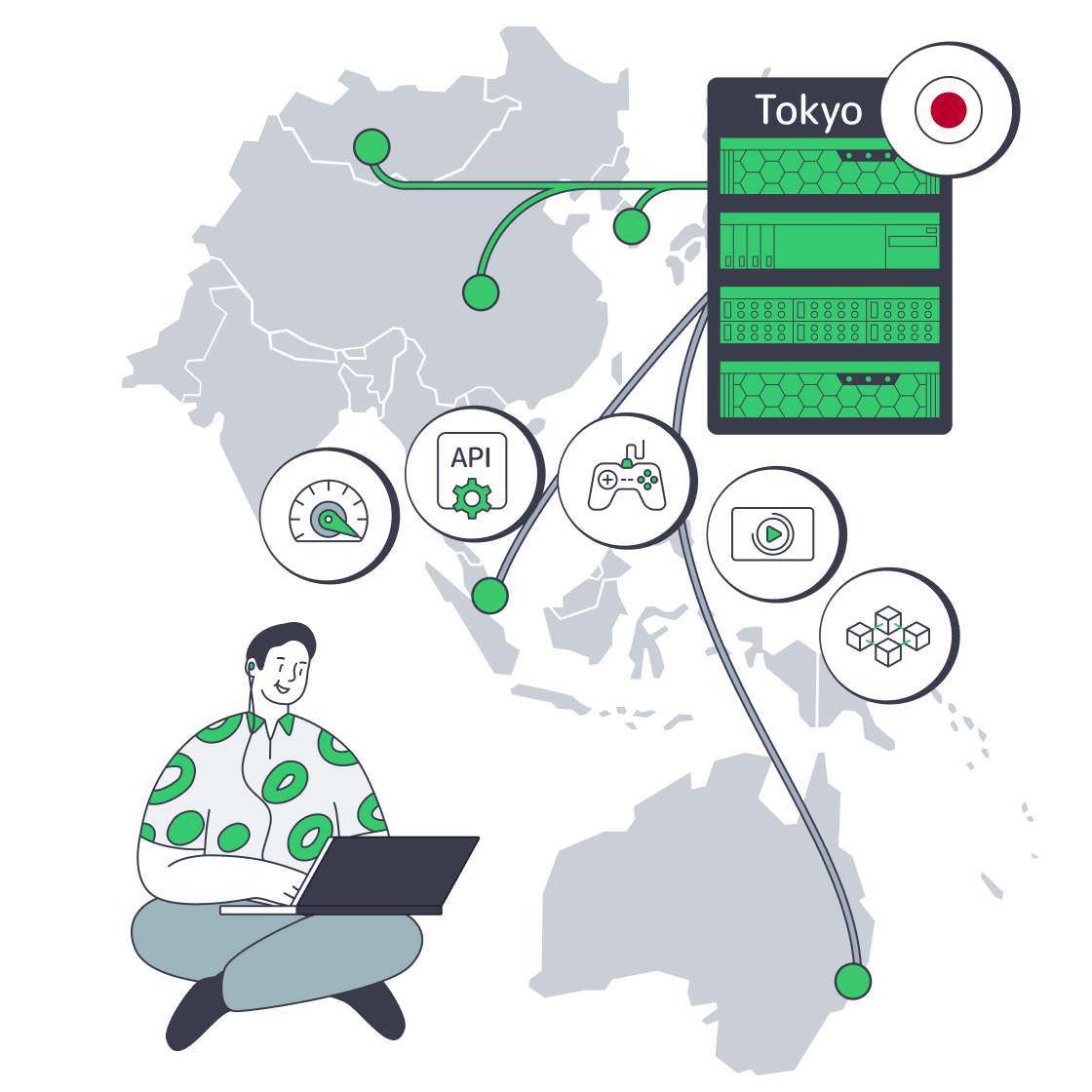
Map distance alone does not determine APAC latency; peering, transit, congestion, and BGP policy do. Tokyo belongs on the hot path—a game update, API call, media feed, RPC request, or blocking write—only when measurements show an advantage.
JPNAP reports more than 8 Tbps of peak traffic, 290+ connected networks, and 29 interconnection locations: deep domestic interconnection, not guaranteed routing. JPNAP Melbicom’s Tokyo dedicated server location provides a test IP and 1,000 MB object. The Tokyo network supports up to 100 Gbps per server, while orderable server bandwidth currently spans 1–40 Gbps with 50 TB or unlimited traffic.
Tokyo Hosting– Tokyo up to 100 Gbps – 1-40 Gbps orderable bandwidth – 24/7 infrastructure support |
|
When Tokyo Should Be the APAC Hot Path
A Tokyo dedicated server should be the APAC hot path when Japan and nearby Northeast Asian users generate most latency-sensitive demand and production-shaped tests show a durable 15–20 ms p95 round-trip advantage over the fallback region. Promote Tokyo only when it survives peaks and outweighs replication, operational, and recovery costs.
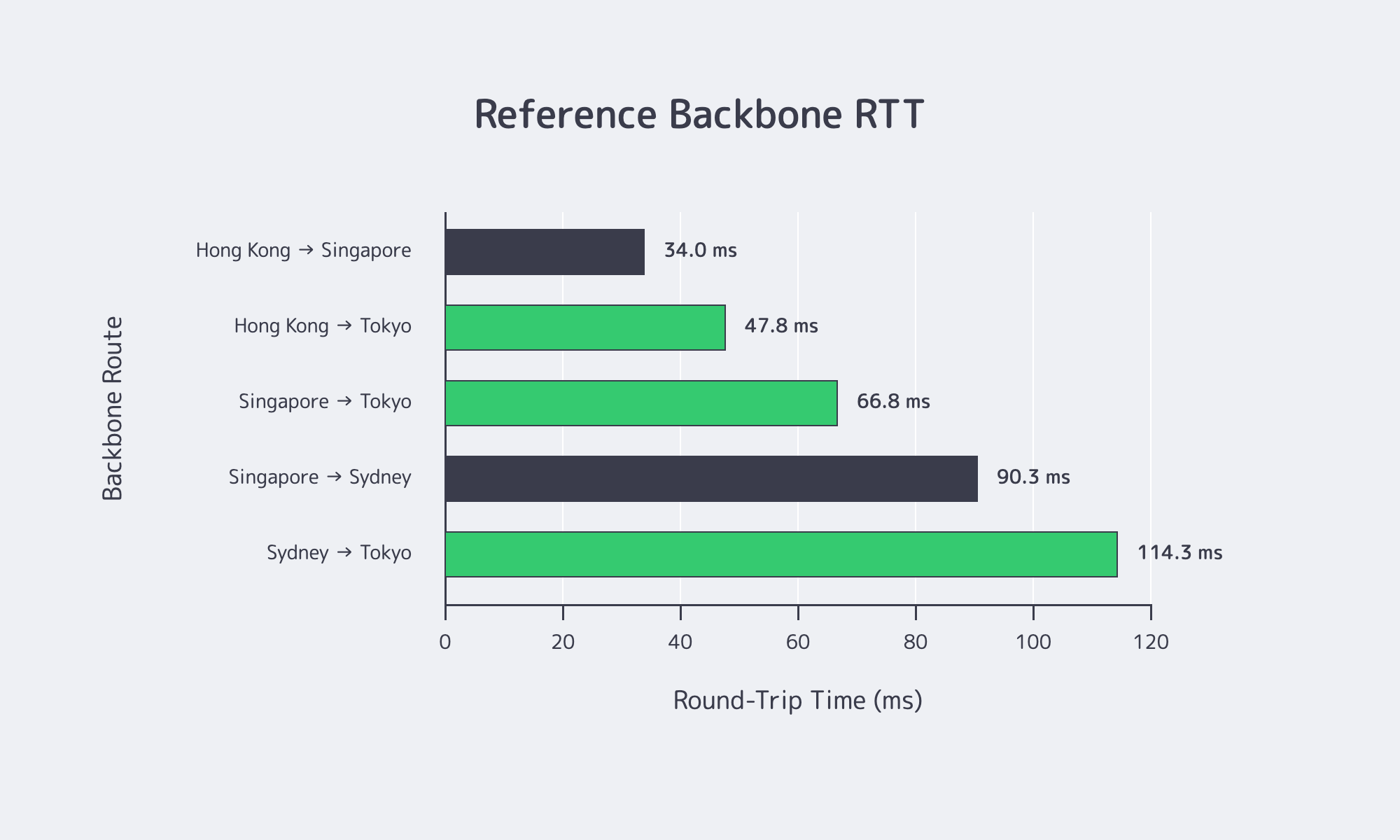
A five-millisecond average gain can disappear inside mobile scheduling, TLS, queues, or database work. A persistent 15–20 ms p95 gain matters when serialized calls pay regional delay repeatedly. Weight by revenue, abandonment risk, and write sensitivity—not volume.
June 2026 backbone measurements show why “APAC latency” is not one number. Verizon
Tokyo need not win every market. It works when Japanese demand dominates, writes remain local, and farther-south users use caching or stateless tiers. Place ingress, execution, and authoritative state separately.
Tokyo vs. Singapore Workload Placement
Tokyo should lead for Japan-centered and Northeast Asia-heavy traffic; Singapore should lead for Southeast Asia-heavy demand. Use seven days of p50, p95, and p99 application measurements from target networks. A persistent 15 ms p95 advantage can change placement economics; a five-millisecond edge rarely justifies another region.
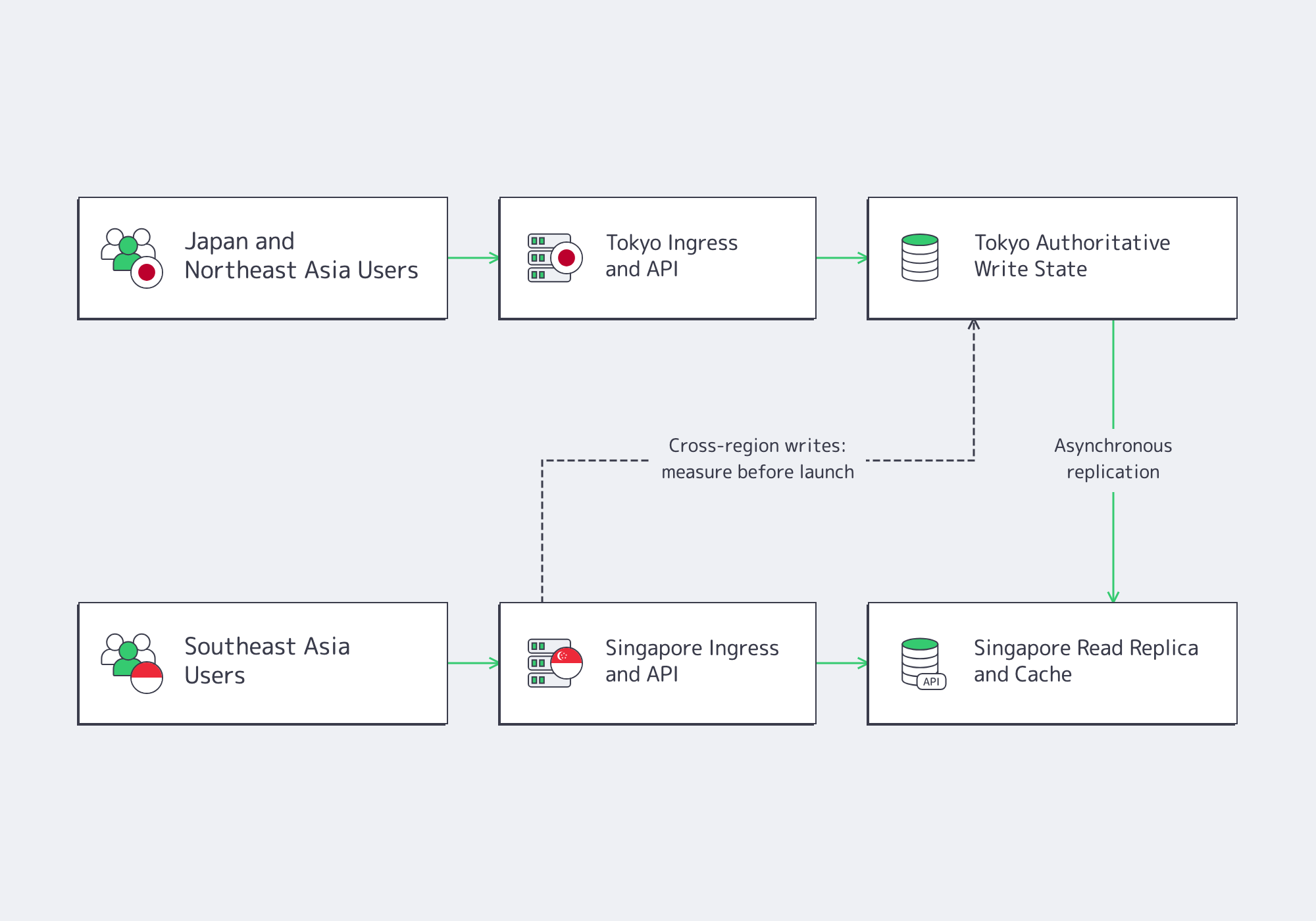
Compare which city removes more delay from the valuable dependency chain. Serial cross-region authentication, risk checks, inventory, and commits make users pay repeatedly. Put authoritative state where writes originate; replicate read models, public content, and analytics asynchronously.
| Workload | Tokyo-primary signal | Working launch gate |
|---|---|---|
| Interactive APIs | Valuable writes or sessions originate in Japan | Durable p95 application advantage from target networks |
| Trading-adjacent systems | Japanese data, counterparties, or users dominate | Data rights confirmed; internet latency excluded from execution assumptions |
| Multiplayer gaming | Dense Japanese or Northeast Asian cohort shares state | RTT, jitter, loss, and tick-budget targets pass at peak |
| Live and on-demand media | Contribution or origin processing is in Japan | Ingest, transcode, storage, and origin egress survive bursts |
| Web3 nodes and RPC | Clients or useful peers cluster in Northeast Asia | CPU, memory, storage, sync, and network tests pass under catch-up load |
| Regional failover | Japan is revenue-critical | Recovery objectives pass without synchronous WAN dependencies |
Measure DNS, setup, TLS, authentication, queues, storage, and downstream calls. Test by autonomous system across mobile, broadband, offices, VPN exits, and gateways. Because BGP paths can be asymmetric, track round-trip loss; the IETF counts failure in either direction. RFC 6673
When neither city wins, run stateless APIs in both and partition state by tenant, session, or geography. In mobile gaming, place apps by combined player latency; ingest media in Tokyo and distribute through caches.
Workload Fit: Trading-Adjacent Apps, Gaming, Media, and Web3
A Tokyo dedicated server is not a generic “Asia server.” Its value depends on each workload’s latency budget, traffic shape, state model, and failure mode. Dedicated hardware reduces contention, but routes, storage, queues, protocols, and application architecture still determine Tokyo production performance.
Trading-Adjacent Apps. Tokyo fits market-data normalization, analytics, APIs, risk, and reporting near Japanese infrastructure. It is not exchange co-location. JPX reports approximately 60 microseconds one-way through an access point and three microseconds in its co-location area—another class from an internet server.
Market-data rights are prerequisites: JPX says real-time data generally requires contracts and redistribution requires permission.
Gaming. At 60 Hz, one tick lasts about 16.7 ms; tens of milliseconds can span several ticks. Test real UDP traffic, bursts, matchmaking, voice, and evening routes—not ICMP alone. The IETF identifies low, stable latency as critical. RFC 9318
Run authoritative matches near Tokyo players while identity, commerce, and telemetry use suitable paths. Evaluate Melbicom’s game development hosting with match-level evidence.
Media. Tokyo is strongest when the first mile is in Japan: contribution, ingest, encoding, packaging, or origin storage. At a 12 Mbps reference bitrate for high-frame-rate 1080p SDR, 10,000 viewers imply 120 Gbps of video egress before audio, overhead, retransmissions, or margin. YouTube guidance
Use Tokyo streaming servers as origins and Melbicom’s CDN for fan-out across 40 PoPs in 35 countries, including Tokyo. HLS adaptive delivery follows RFC 9317.
Web3. Storage and I/O govern sync, pruning, state access, and recovery; CPU and memory affect execution; upload stability affects propagation. EIP-7870’s proposal-level reference configurations recommend 4 TB NVMe, 32–64 GB RAM, and 50/15 to 100/50 Mbps for selected Ethereum roles. EIP-7870
Validate sync, catch-up, state-heavy RPC, peer churn, restore, and sustained upload. Melbicom’s Web3 server hosting supplies the dedicated infrastructure layer; protocol documentation determines the final configuration.
Route Testing, Bandwidth, and Data Governance Checks before Launch
Before launch, test from the access networks, protocols, packet sizes, and peak-hour windows the application will use; size bandwidth from p95 throughput plus burst margin; and map every personal-data flow. A practical gate is seven days of testing, under 0.1% sustained loss, and at least 30% port headroom under representative load.
Start with 203.190.0.130 and the 1,000 MB object, then repeat from the provisioned server. Probe customer networks. Collect p50, p95, and p99 RTT, loss, jitter, DNS, TCP or QUIC setup, TLS, time to first byte, request duration, and throughput.
Use traceroute as a time series. RIPE Atlas TraceMON correlates latency and loss with route, BGP, IXP, and AS changes; LatencyMON compares ping, DNS, TLS, and HTTP.
Test single-flow and parallel throughput. RFC 6349 warns that access-port provisioning cannot guarantee end-to-end TCP performance and emphasizes bandwidth-delay product.
10 Gbps × 70 ms RTT ≈ 87.5 MB in flight
Required port capacity ≈ peak useful application throughput ÷ target utilization
A 6 Gbps workload at 70% utilization implies 8.6 Gbps, making 10 Gbps rational. For sustained replication or media, Tokyo unmetered servers replace a transfer allowance with the selected port as the primary capacity boundary.
Melbicom’s network uses 29 IXP peering hubs and 23 transit partners. That diversity helps shortlist Tokyo; route tests validate the client path.
Governance follows data beyond the server: access, support exports, logs, backups, CDN processing, analytics, snapshots, developer copies, and failover replicas. Japan’s PPC identifies APPI as the core framework; only the Japanese legal text has legal effect. PPC
The 2026 APPI amendment passed on July 10 and was promulgated on July 17; most provisions will take effect on a date set by Cabinet Order within two years of promulgation, with secondary rules pending. Record the current compliance basis and assign ownership for reviewing them.
Regional Failover without Two Hot Paths
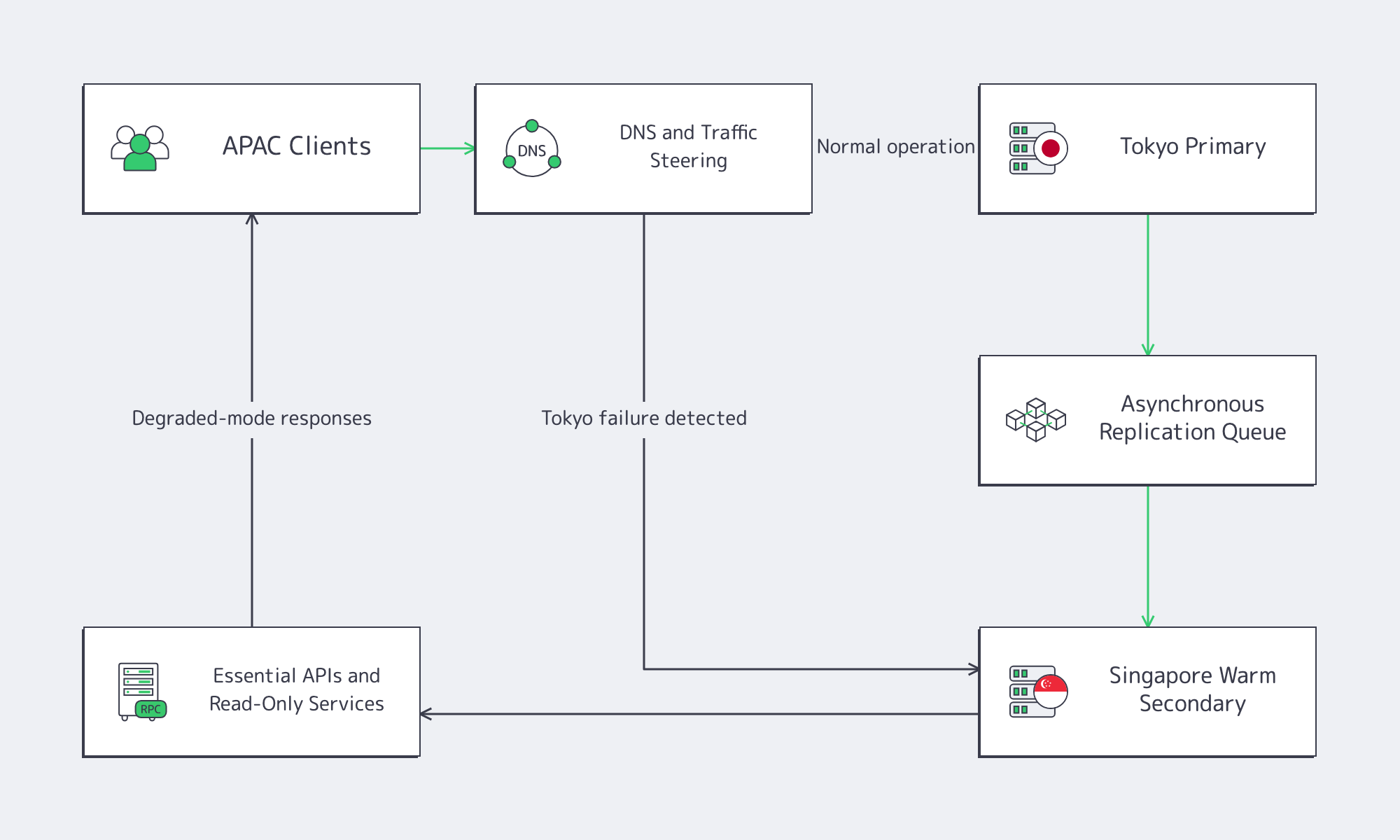
A Tokyo-primary service does not need a second region mirroring every feature at full scale. Size the secondary around the recovery point objective, recovery time objective, degraded-mode plan, and critical transaction set. A warm secondary protects the business while analytics and lower-value functions pause, queue, or become read-only.
Define RPO and RTO first. Asynchronous replication usually fits latency-sensitive systems because synchronous cross-region commits add WAN delay to every write. Rebuild artifacts, copy public data, and invalidate sessions; apply stricter durability to balances, entitlements, and user content.
Test detection, traffic steering, capacity, consistency, retries, and failback at production load. Standbys can fail under connection storms, cache misses, recovery, or queued jobs.
Melbicom operates 21 Tier III and Tier IV data centers, including Tier III locations in Tokyo and Singapore. vMesh can be evaluated for private server-to-server connectivity. Choose recovery through route tests, governance, and drills, and keep Tokyo authoritative only for data that benefits from Tokyo.
The Tokyo Dedicated Server Buying Decision
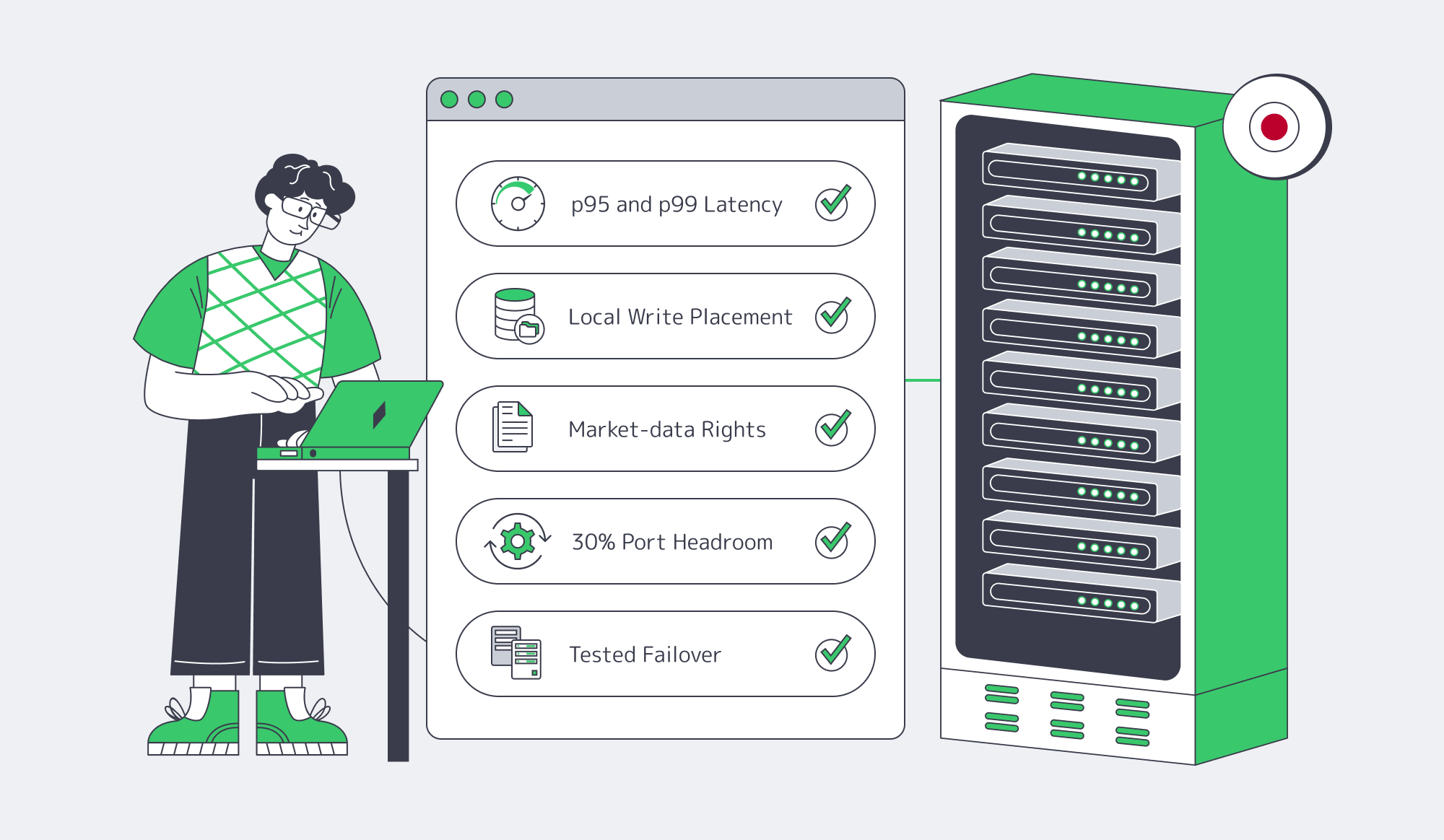
Tokyo should be primary when named access networks reach it consistently, high-value requests improve at the tail, critical state can remain local, and regional failure can be survived without putting every normal request across a wide-area link. It should not be selected as a generic APAC badge or justified by headline port speed alone.
Use these operating gates before committing budget:
- Weight p95 and p99 by revenue-bearing request class so cacheable traffic does not dominate the location decision.
- Keep write-heavy dependencies on the Tokyo hot path; use asynchronous replication unless the recovery point objective requires otherwise.
- Separate exchange-connected execution from internet-delivered analytics and APIs, and confirm market-data rights before ingest.
- Reserve at least 30% port headroom and test single-flow and aggregate throughput during Japanese peak hours.
- Define degraded mode, failover authority, and failback steps before sizing secondary capacity.
Build Your Tokyo Hot Path
Compare Tokyo dedicated servers, bandwidth options, and ready-to-go configurations against your measured APAC latency targets.
Get expert support with your services
Blog
Dedicated Server Ethereum: Paying with ETH for Production Bare Metal
Paying a hosting invoice with ETH can fit an Ethereum-native treasury. But production infrastructure is a recurring dependency involving invoice clocks, gas, confirmations, reconciliation, renewals, and capacity planning—not a single wallet action.
Uptime Intelligence’s 2026 outage analysis found that 57% of respondents’ most recent major outages cost more than $100,000, while one in five exceeded $1 million. A healthy server can still be threatened by payment failure.
Ethereum Hosting– ETH and crypto billing – Up to 200 Gbps per server – 24/7 infrastructure support |
|
How Do Dedicated Server Ethereum Payments Work for Bare-Metal Hosting?
Dedicated server Ethereum payments convert a provider invoice into time-bound on-chain settlement. Verify the network, recipient, exact ETH amount, and quote expiry; send the invoice amount without subtracting gas; record the transaction hash; and wait for the provider’s crediting threshold. Reject any flow that leaves confirmation or underpayment rules undefined.
The invoice is the source of truth. Record its ID, quoted amount, expiry, recipient, network, and completion rule. “ETH” alone does not identify the rail: Mainnet uses chain ID 1, while other EVM networks use different IDs. A valid address on the wrong chain can still produce an unusable payment. Hyperledger Besu explains the distinction.
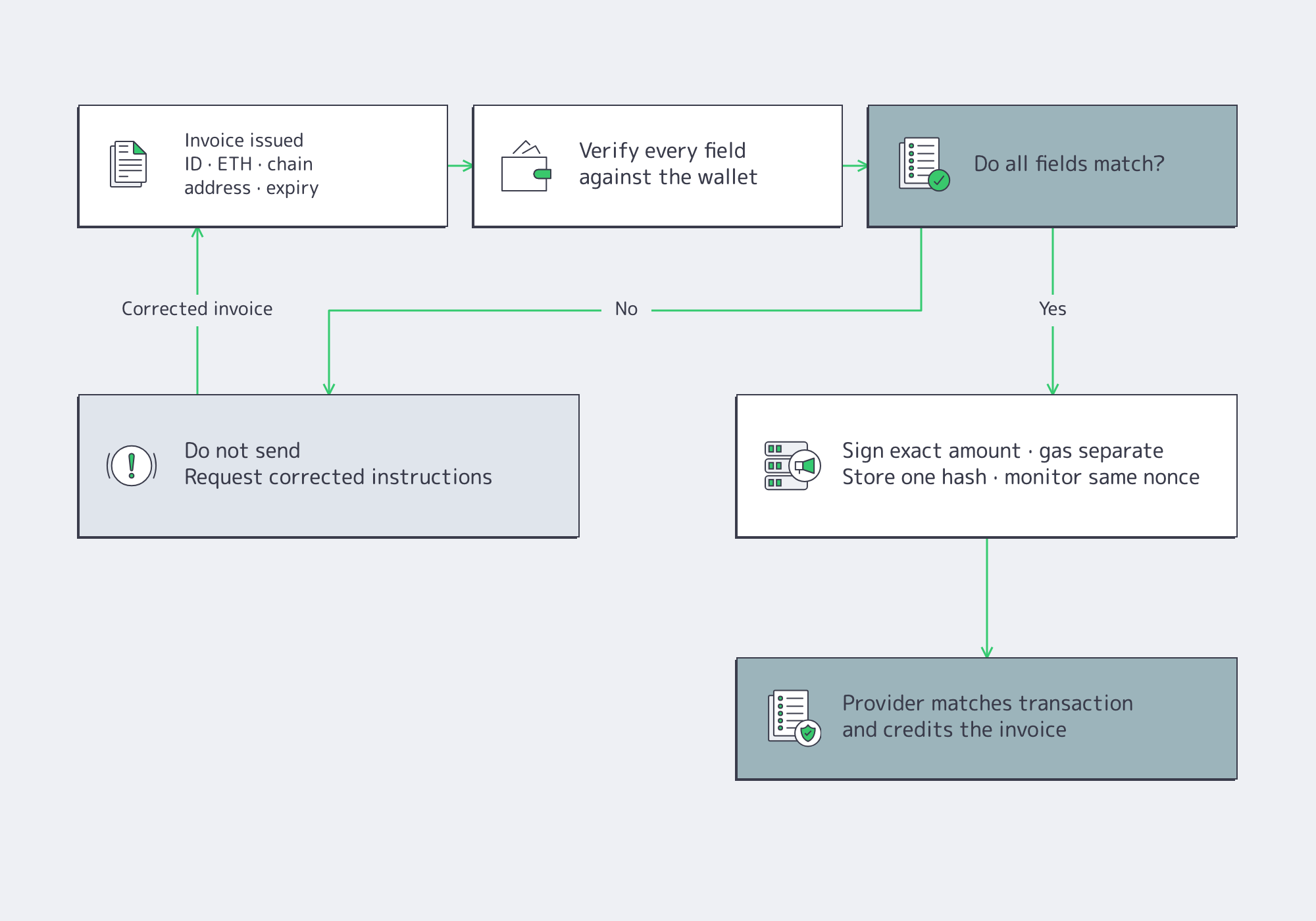
Fund the invoiced transfer value and gas separately. Ethereum.org states that a native transfer normally consumes 21,000 gas; contract checkout can require more.
Required Wallet Balance = Invoice Amount + Maximum Expected Transaction Fee
Maximum Expected Fee ≈ 21,000 × maxFeePerGas
The transaction hash is technical, not commercial, proof. The Ethereum JSON-RPC receipt shows inclusion, addresses, gas, and execution status; it does not prove provider credit. Store both. Once an invoice has a hash, monitor that transaction or replace it with the same nonce instead of sending a duplicate.
What Should Buyers Compare Across ETH Gas, Confirmations, Invoices, and Renewals?
Gas, confirmations, invoices, and renewals form one operating system. Production procurement requires exact invoice matching, an explicit chain ID, a documented crediting rule, monitored pending transactions, and settlement at least 24 hours before cutoff—or 72 hours when multisig approvals, exchange withdrawals, or weekend staffing can delay broadcast.
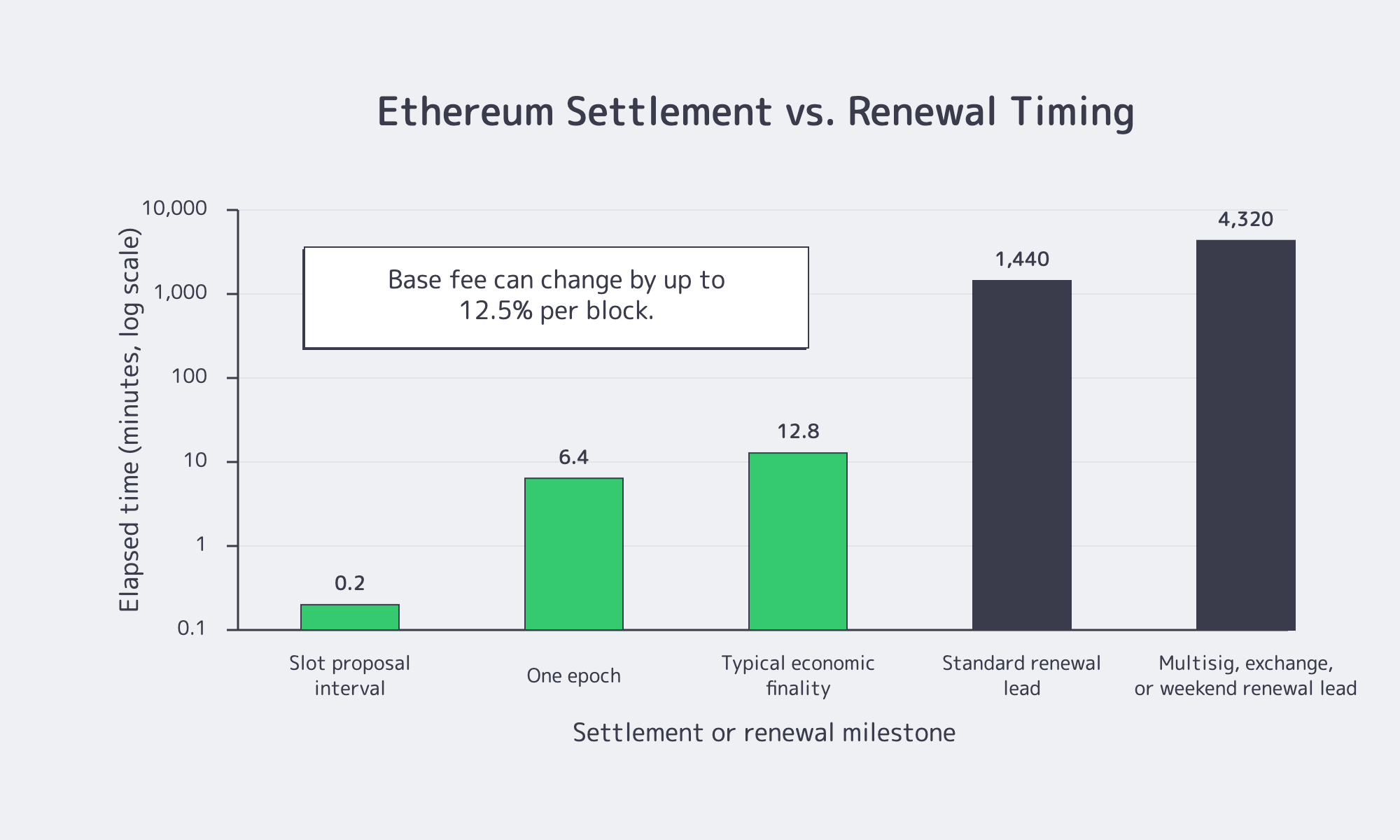
EIP-1559 separates the base fee, priority fee, and maximum fee cap. The base fee can move by up to 12.5% per block, so minimizing a small fee can expose a larger order to timing risk. Use a current estimate and increase urgency near the deadline. Contract checkout may consume more than 21,000 gas and can revert while spending gas.
Inclusion, confirmation, and finality differ. Ethereum proposes slots every 12 seconds; 32 slots form an epoch; economic finality normally arrives after roughly two epochs, or about 12.8 minutes, under normal participation. The procurement question is not “How many confirmations?” but “At what chain state does the provider credit the invoice?”
- Operational threshold: when the order, balance, or renewal is credited.
- Accounting threshold: when finance treats the transfer as economically final.
Renewal lead time should exceed protocol finality because approvals, withdrawals, quote regeneration, matching, and provider posting add delay. Reconciliation should bind the asset, invoice, Ethereum transaction, and provider credit. Preserve the quote, expiry, chain ID, addresses, hash, amount, gas cost, on-chain status, and credit time. Define handling for expired quotes, underpayments, and overpayments.
Ethereum Payment for Web3 Infrastructure
Ethereum payment fits when treasury already holds liquid ETH, finance can reconcile on-chain receipts to fiat-denominated invoices, and operations can settle before renewal deadlines. It can remove conversion and banking steps, but gas variability, quote expiry, potentially unrecoverable wrong-network transfers, and custody approvals require tighter controls than a casual wallet payment.
The strongest fit has three characteristics:
- Treasury holds ETH liquidity beyond staking, payroll, tax, and runway reserves.
- The organization can approve, broadcast, monitor, and replace transactions without an external withdrawal queue.
- Finance and operations share one view of issuance, approvals, broadcast, and credit.
ETH is weaker when budgets are entirely fiat, invoices exceed liquid ETH, immediate fiat certainty is mandatory, or staff use personal wallets. The quoted amount changes with exchange rates; gas changes with blockspace demand. Multisig and hardware signing must be reflected in renewal lead time.
Ethereum Workload Requirements
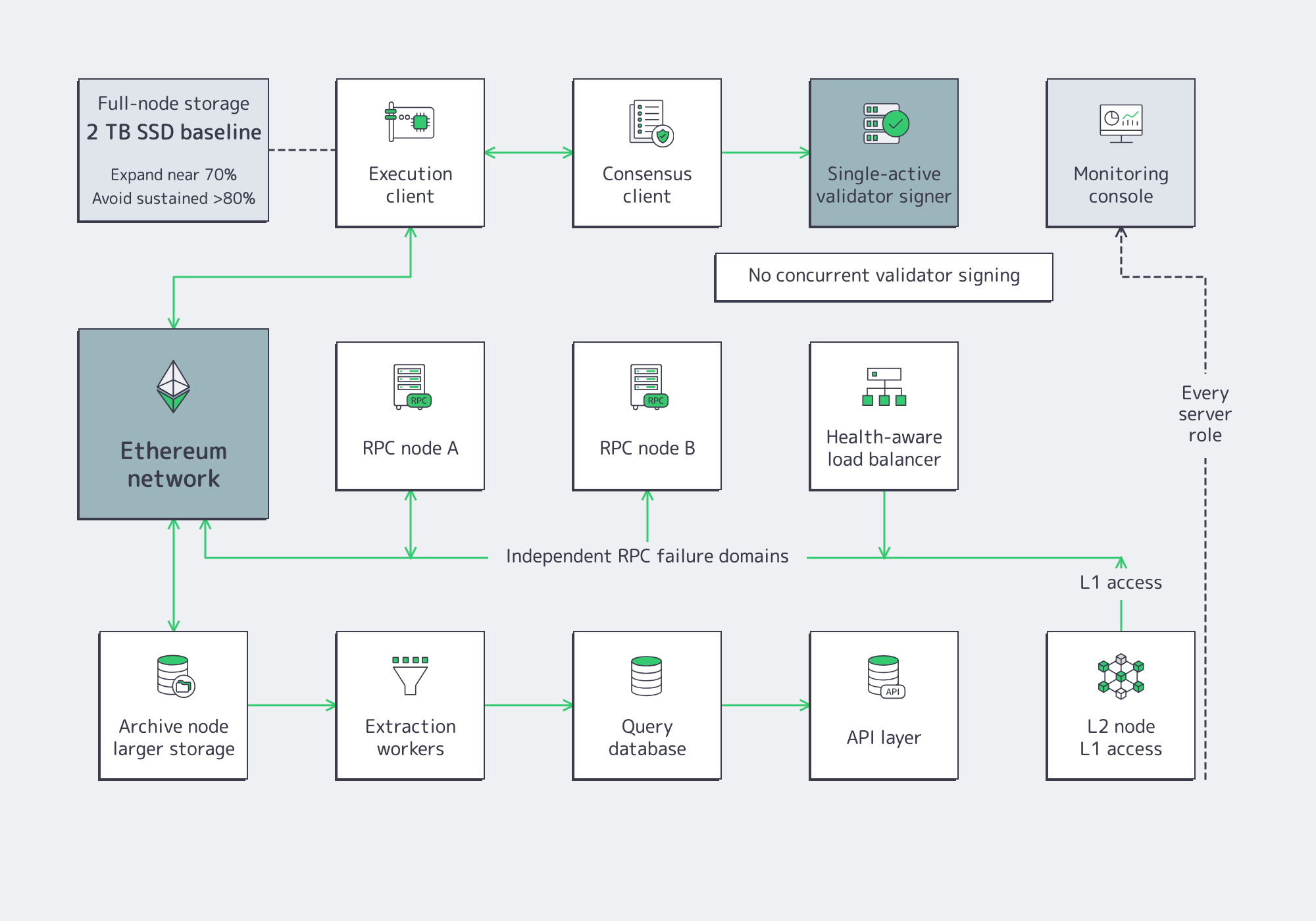
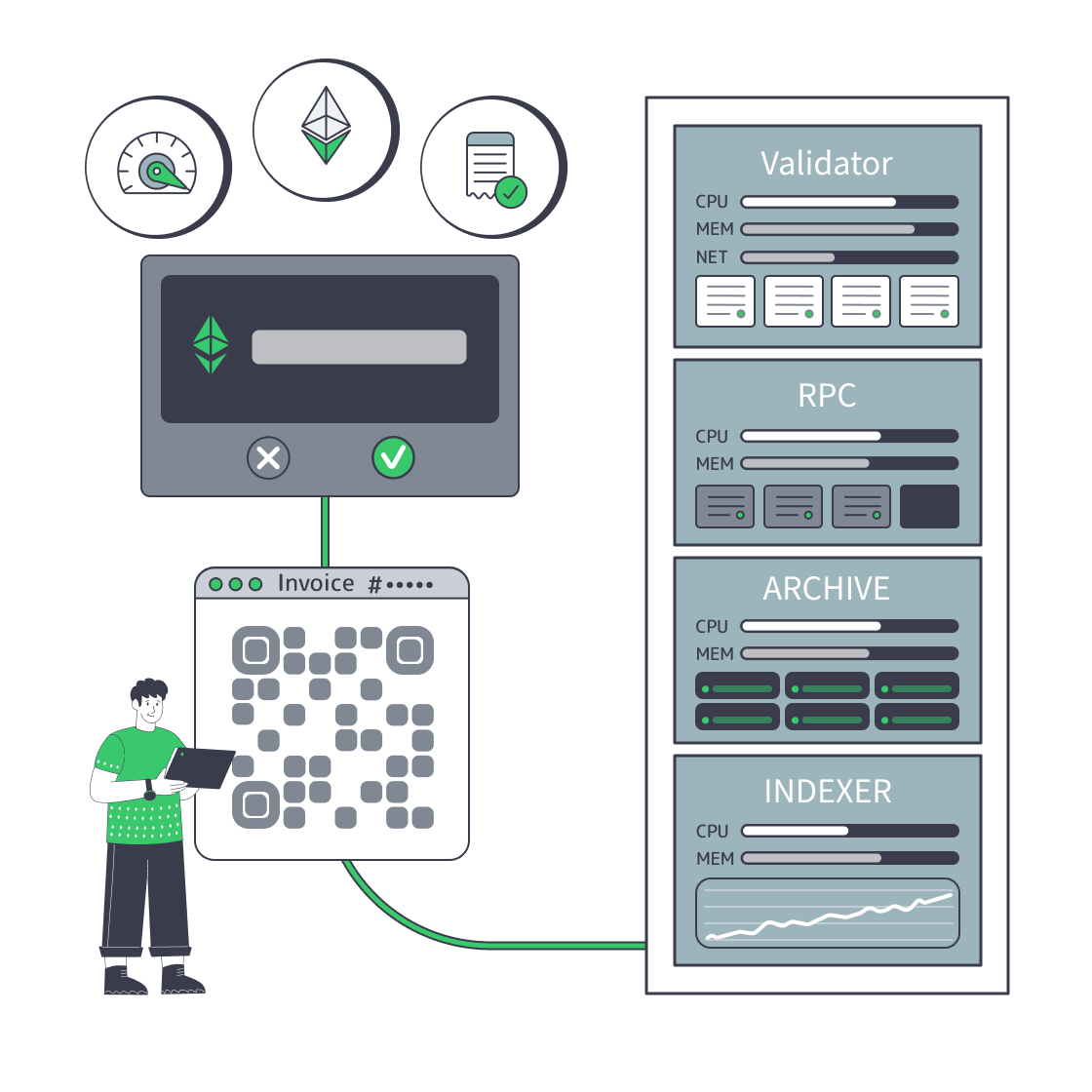
Payment method should not distract from workload fit. A production Ethereum node combines execution and consensus clients; validator deployments add signing duties. Production fleets should separate roles by blast radius, storage behavior, query load, and security sensitivity.
- Validators: isolate signing from public RPC spikes, archive queries, indexer backfills, and compaction. Measure how many validators one host failure affects. Keep failover single-active and synchronize slashing-protection data; copying keys to an uncontrolled hot standby can create double-signing risk.
- RPC nodes: need latency consistency, headroom, health-aware routing, and at least two maintained backends without one shared failure domain. Calls, traces, simulations, and WebSockets create uneven demand.
- Full and archive nodes: are not interchangeable. Geth’s guidance starts a full node plus consensus client at a 2 TB SSD; archive state needs far more. Plan for growth, migrations, snapshots, and recovery. As an operating policy, begin expansion near 70% sustained storage utilization and avoid remaining above 80%.
- Indexers and L2 systems: may depend more on NVMe IOPS, database memory, workers, and upstream L1 access than minimum node specifications. Separate node, extraction, database, and API layers. Nethermind documents L2 dependencies.
Client diversity is another control. Ethereum.org recommends minority clients because one defect can affect a large network share. The Ethereum Foundation’s July 2026 analysis described more than five production client implementations and roughly $76 billion in ETH securing the protocol. Diversity requires tested alternatives and upgrade runbooks.
Scaling Dedicated Server Ethereum Infrastructure Beyond the First Node
The first node proves synchronization. Production scale must survive maintenance, workload growth, client defects, renewal, and regional failure. A larger single host postpones saturation but does not remove single-client, single-region, single-endpoint, or single-payment dependencies.
Start with role separation and recovery. A standby matters only when it has current data, compatible versions, validated configuration, monitored health, and a tested cutover. Validator recovery also requires single-active signing and synchronized slashing-protection data. Initial synchronization can take days, so replacement capacity should be pre-staged. Snapshots help only when restoration is tested.
Multi-region design should follow user and protocol paths. RPC may prioritize latency; validators need stable peer connectivity; archive and indexing may prioritize storage economics. Uptime Intelligence also found external fiber and connectivity incidents becoming more prominent, so redundancy must cover the route to the server.
Scale against chain-head lag, disk latency, storage growth, RPC queues, p95 and p99 latency, errors, memory, throughput, and restart time. Payment operations must scale too: consolidate due dates, keep an asset register, and make invoice access, signing, and credit verification redundant. Hold the quoted amount plus at least twice the estimated maximum fee; the buffer supports replacement, not overpayment.
A Production Procurement Scorecard
| Decision Area | Production-Ready Criterion | Failure Mode to Prevent |
|---|---|---|
| ETH payment | Invoice defines chain, address, amount, expiry, and credit rule | Wrong-chain or unmatched payment |
| Gas | Amount and gas are separate; pending transfers are replaceable | Underpayment or duplication |
| Confirmation | Inclusion, credit, and accounting finality are distinct | Treating broadcast as payment |
| Reconciliation | Invoice, receipt, service period, and credit are linked | Conflicting finance and operations records |
| Renewal | Settlement starts 24 or 72 hours early | Administrative lapse |
| Sizing | CPU, RAM, NVMe, network, growth, sync, and role are modeled | Minimum hardware in production |
| Fleet resilience | Roles, clients, regions, endpoints, signing paths, and payment owners are distributed | One failure or concurrent signing event disabling the fleet |
Practical recommendations:
- Complete renewal only after provider credit; monitor both on-chain and billing states.
- Use a 24-hour lead time, or 72 hours for multisig, exchange, or weekend approvals.
- Reserve the exact invoice amount plus replacement-fee headroom; never reduce the transfer to fund gas.
- Keep validator failover single-active and preserve slashing-protection state.
- Scale on chain-head lag, disk growth, latency percentiles, and tested recovery time—not average CPU alone.
ETH Payment in the Availability Design
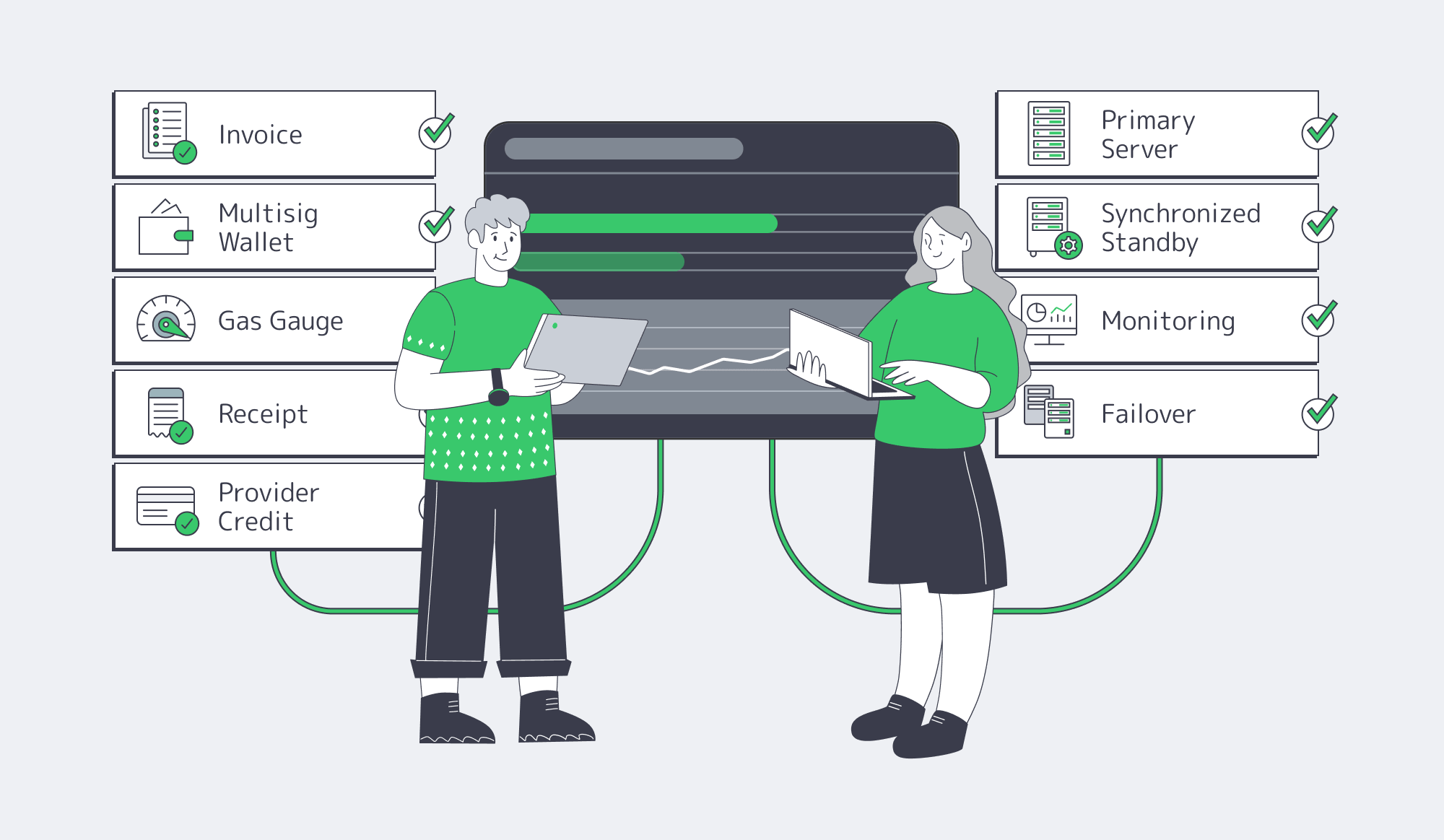
Paying for a dedicated server with ETH works when the payment rail shares the same operating model as monitoring, failover, capacity management, and incident response. The transfer may settle in minutes; the surrounding system must reliably issue invoices, approve funds, handle congestion, reconcile records, and renew infrastructure for years.
The same discipline should guide server selection. Separate validator, RPC, archive, indexing, and application roles; measure saturation; and design technical and treasury failover before the first node becomes critical. Verify payment instructions and infrastructure together.
Pay for Production Hosting with ETH
Review cryptocurrency billing options for new servers and renewals before your next infrastructure deadline.
Get expert support with your services
Blog
Dedicated Windows Server: Guide for RDP, ASP.NET, and MSSQL Workloads
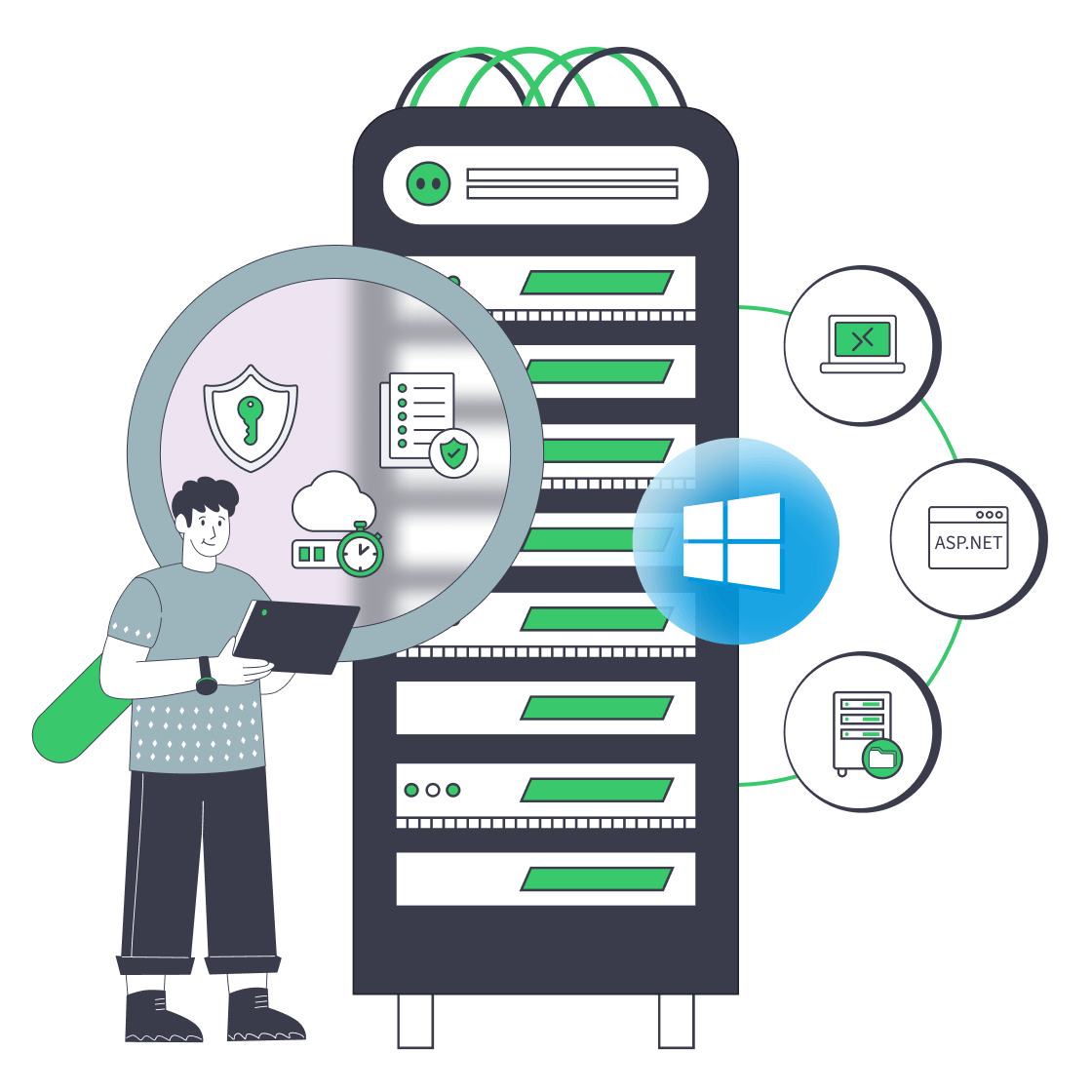
A Windows dedicated server is not simply a larger VPS. It changes the operating model by giving one organization exclusive control over processor resources, memory, storage, Windows configuration, remote access, and application deployment. That control improves predictability only when it is backed by measured workload data, clear licensing, secure administration, and tested recovery procedures. The right purchase starts with evidence from the existing environment—not hardware specifications alone.
Windows Servers– 1000+ ready-to-go servers – 21 Tier III/IV data centers – 24/7 infrastructure support |
|
Dedicated Window Server Search Intent
A search for “dedicated window server” almost always means a Windows dedicated server for RDP, IIS, ASP.NET, or SQL Server. The correct buying trigger is sustained workload pressure: repeated CPU saturation, memory pressure, storage latency, RDP delays, or application tail latency during normal peak operation—not hardware alone.
Performance isolation is the primary advantage. Dedicated hardware removes cross-tenant resource contention and provides complete operating-system control, but it does not fix inefficient SQL queries, poorly tuned applications, storage bottlenecks, or distant deployment locations. Microsoft’s SQL Server troubleshooting guidance recommends diagnosing storage, application behavior, and query design before blaming hardware.
Administrative control is equally important. Teams often require specific Windows roles, IIS modules, .NET runtimes, SQL Server features, certificates, scheduled tasks, and security policies. A dedicated server allows those components to be managed consistently while we provide infrastructure operations such as server reinstallation, dashboard management, IPMI/KVM access, and 24/7 support. Windows architecture, applications, backups, monitoring, and recovery remain the customer’s responsibility unless managed services are explicitly agreed.
Choose the Windows Server version before choosing the processor. Application compatibility—not hardware marketing—should determine whether Windows Server 2025 or Windows Server 2022 is appropriate.
Windows Dedicated Server Versus VPS for RDP, ASP.NET, and SQL Server
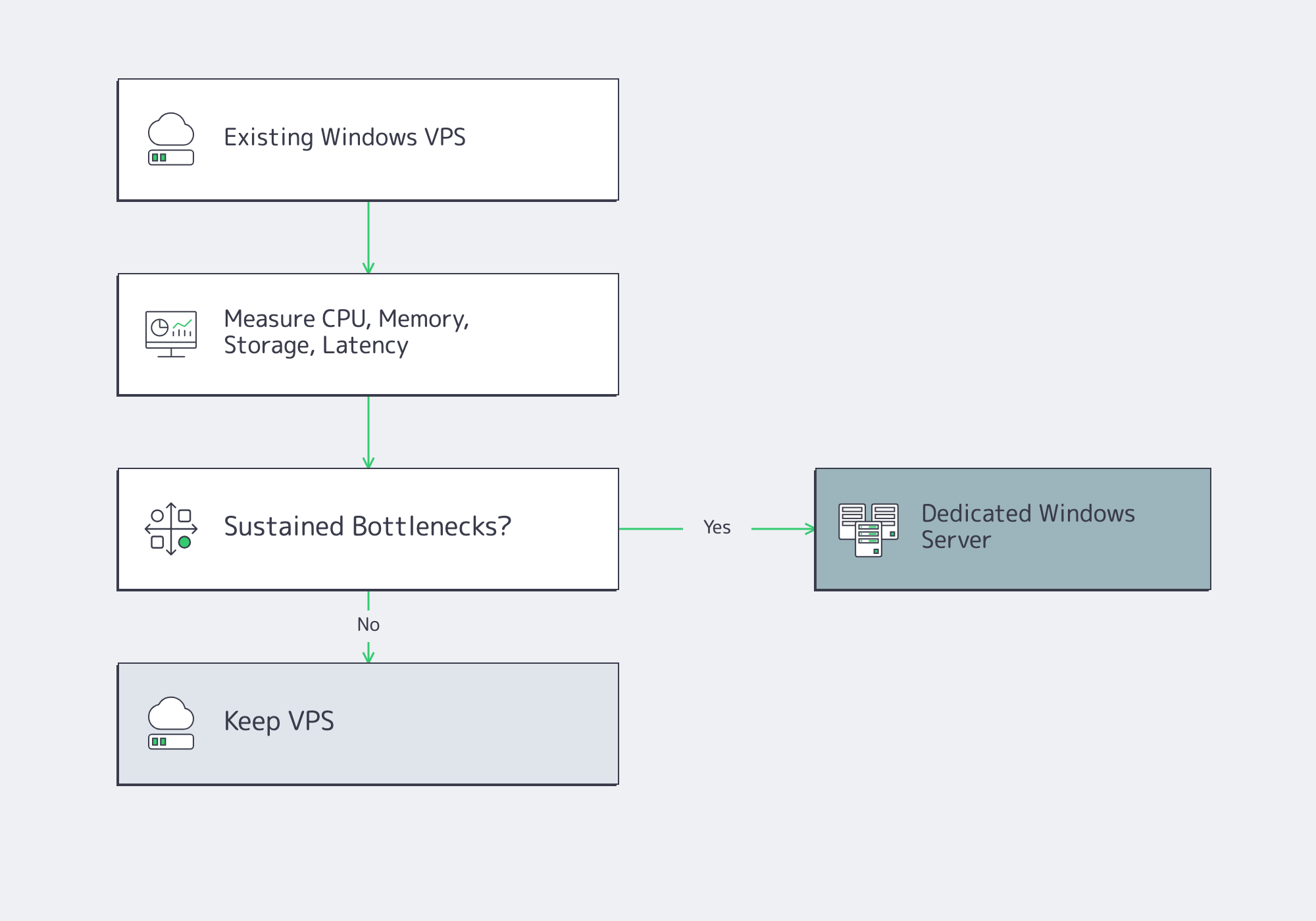
A VPS remains sensible when utilization is modest, rapid resizing is valuable, and occasional performance variation is acceptable. A dedicated server becomes the better option when sustained production workloads repeatedly exceed performance objectives despite tuning.
| Decision Area | VPS Remains Suitable | Dedicated Server Becomes Appropriate |
|---|---|---|
| Compute | Low or intermittent utilization | Sustained CPU or memory pressure |
| SQL Server | Stable storage latency | Persistent storage waits after tuning |
| RDP | Small administrative workload | Many concurrent interactive users |
| ASP.NET | Light or distributed workloads | Large applications requiring full OS control |
| Operations | Fast scaling is priority | Predictable performance and hardware control matter |
RDP Is a User-Density and Latency Problem
RDP capacity should be planned around peak concurrent users rather than total employee count. Measure real application behavior, working memory, login performance, storage activity, and interactive latency during business peaks, not generic sizing formulas.
Location matters as much as server size. Microsoft’s Azure Virtual Desktop guidance recommends keeping round-trip latency below approximately 150 ms where practical for interactive workloads. Test from actual office and remote-user locations rather than from an administrator’s connection.
Licensing must also be separated from performance. Windows Server permits two administrative remote sessions, while multi-user desktop environments require Remote Desktop Session Host together with the appropriate RDS CALs.
Size ASP.NET by Application Profile
ASP.NET applications should be sized using realistic production traffic, authentication, logging, caching, encryption, and database activity rather than synthetic benchmarks.
Benchmark throughput alongside p95 and p99 latency, CPU utilization, garbage collection, memory growth, request queues, and runtime counters. Microsoft provides dotnet-counters to collect live application metrics, making measured profiling more reliable than processor specifications alone.
Higher clock speed benefits workloads dominated by serial execution, while additional cores help when multiple requests execute simultaneously. The application profile—not CPU branding—should determine processor selection.
SQL Server Hardware and Licensing
SQL Server frequently drives the move to dedicated infrastructure because performance depends on CPU scheduling, memory available to the buffer pool, storage latency, tempdb behavior, transaction logs, concurrency, and backup throughput.
Start with measurements rather than hardware assumptions:
- Current database size and projected growth
- Peak concurrent connections
- CPU utilization
- Memory pressure
- SQL wait statistics
- Storage latency
- Backup and restore duration
Memory often delivers greater performance gains than indiscriminately adding processor cores because larger buffer pools reduce physical disk reads.
Licensing complicates processor selection. SQL Server may be licensed per core, making a smaller number of faster cores financially preferable to many slower cores for some workloads. Finalize the SQL licensing model before selecting processor hardware.
Sizing a Windows Dedicated Server
Successful sizing produces an acceptance test rather than a shopping list.
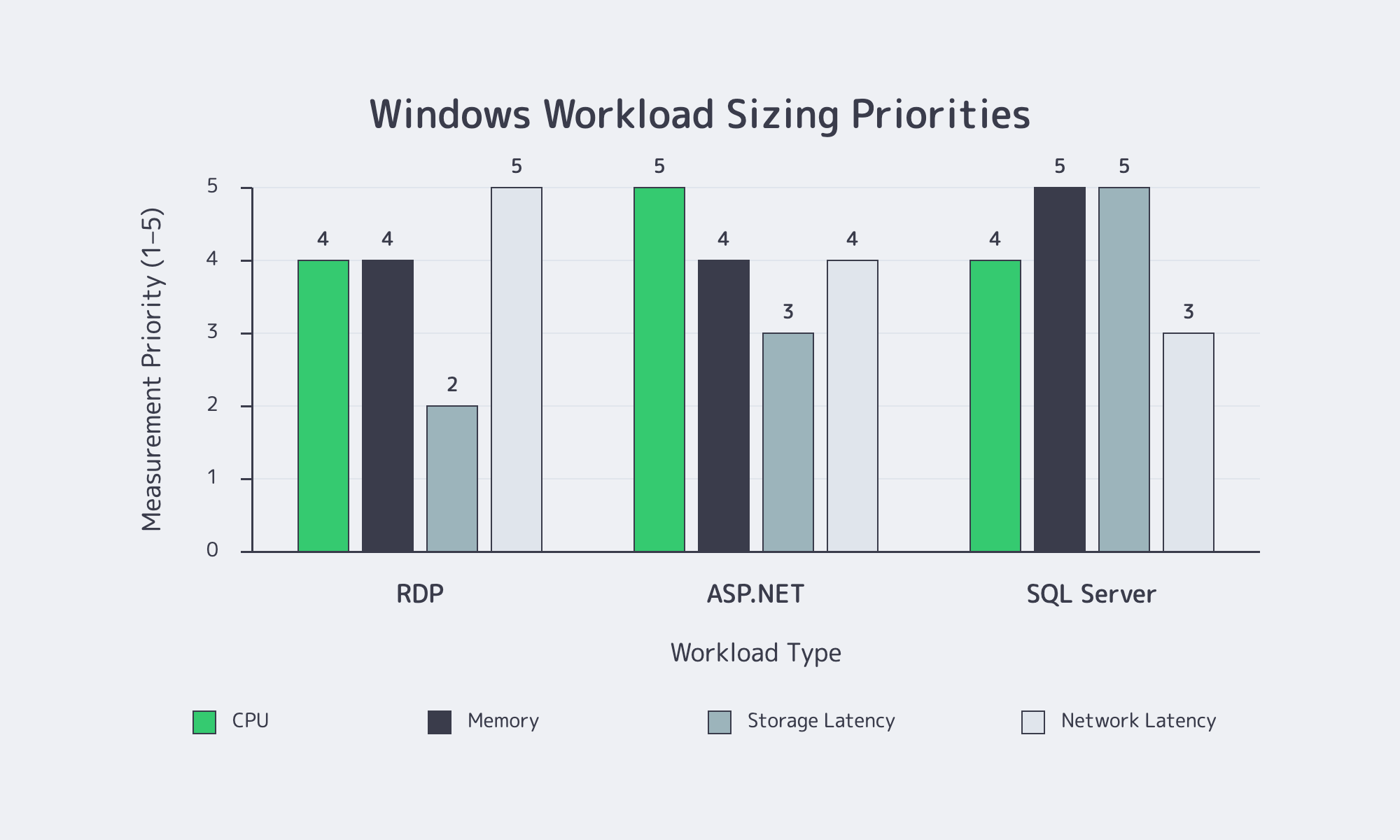
For RDP, measure realistic concurrent sessions, application launches, profile loading, and interactive responsiveness.
For ASP.NET, test realistic production traffic long enough to expose memory growth, garbage collection, scheduled jobs, and storage behavior.
For SQL Server, collect measurements across complete business cycles, not isolated peaks.
When evaluating hardware:
- Match processor characteristics to measured bottlenecks.
- Size memory from observed working sets instead of arbitrary ratios.
- Select storage according to latency, endurance, redundancy, and recovery requirements.
- Place infrastructure close to users and dependent systems because bandwidth cannot compensate for physical distance.
Melbicom offers 1000+ ready-to-go dedicated server configurations, custom configurations delivered in 3–5 business days, infrastructure across 21 Tier III and Tier IV data centers, up to 200 Gbps per-server bandwidth, and IPMI/KVM access. Those options allow Microsoft workloads to be matched to processor, memory, storage, and location requirements without assuming one hardware profile fits every deployment.
Licensing, Security, Backup, and Remote Access Checks Before Buying
Before purchasing, require a written bill of materials identifying:
- Windows Server edition and version
- Physical processor cores
- Windows CALs
- RDS CALs
- SQL Server licensing
- Backup responsibilities
- Restore procedures
- Out-of-band management
A quotation stating only “Windows included” is insufficient.
Windows Server licensing depends on physical cores, edition, virtualization design, and deployment model. SQL Server licensing should be documented separately, including edition, version, licensing model, failover rights, and disaster-recovery considerations.
Remote administration deserves the same attention as production applications. RDP should not be exposed directly to the public Internet. CISA recommends placing remote administration behind VPNs or zero-trust gateways, requiring MFA, limiting administrative access, enabling logging, and protecting privileged accounts.
Out-of-band IPMI/KVM access solves different problems from RDP because it remains available even when Windows itself is unavailable. It should therefore be protected with equally strong authentication and access controls.
Backups are only complete after successful restoration. Define recovery objectives before designing backup schedules, keep recovery copies separate from the production server, and regularly restore into isolated environments to verify application functionality rather than simply validating backup files.
Migrating From a Windows VPS Without Importing Its Bottlenecks
Migration is an opportunity to rebuild the environment rather than clone existing problems.
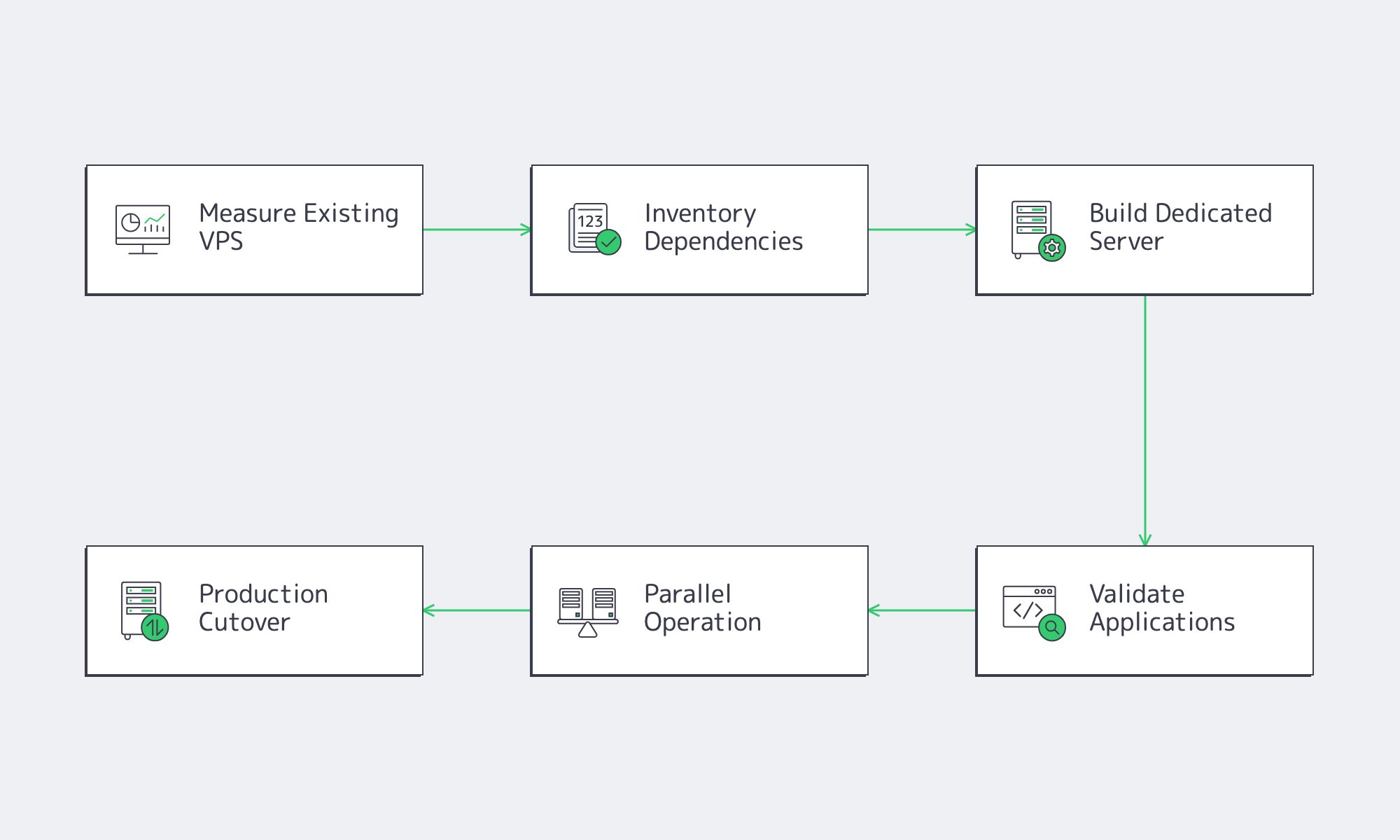
Start by collecting a baseline covering: CPU utilization, memory usage, storage latency, SQL wait statistics, ASP.NET latency, RDP concurrency, backup duration, restore duration.
Next, inventory every dependency, including Active Directory integration, certificates, service accounts, IIS configuration, SQL components, scheduled tasks, firewall rules, monitoring, backup software, and external integrations.
Build the dedicated server from a supported Windows installation, apply updates, establish monitoring and security baselines, verify remote management, then deploy applications from controlled release artifacts rather than copying existing installations.
Run VPS and dedicated environments in parallel whenever possible, synchronize changing data, validate production workloads, and define rollback criteria before migration.
The Purchase Decision: Control, Measured Headroom, and a Recoverable System
A Windows dedicated server should be purchased as a production platform rather than an oversized VPS. Hardware decisions should be tied directly to measured workloads, licensing should be documented before deployment, security controls should protect every management interface, and recovery should be demonstrated through successful restoration exercises.
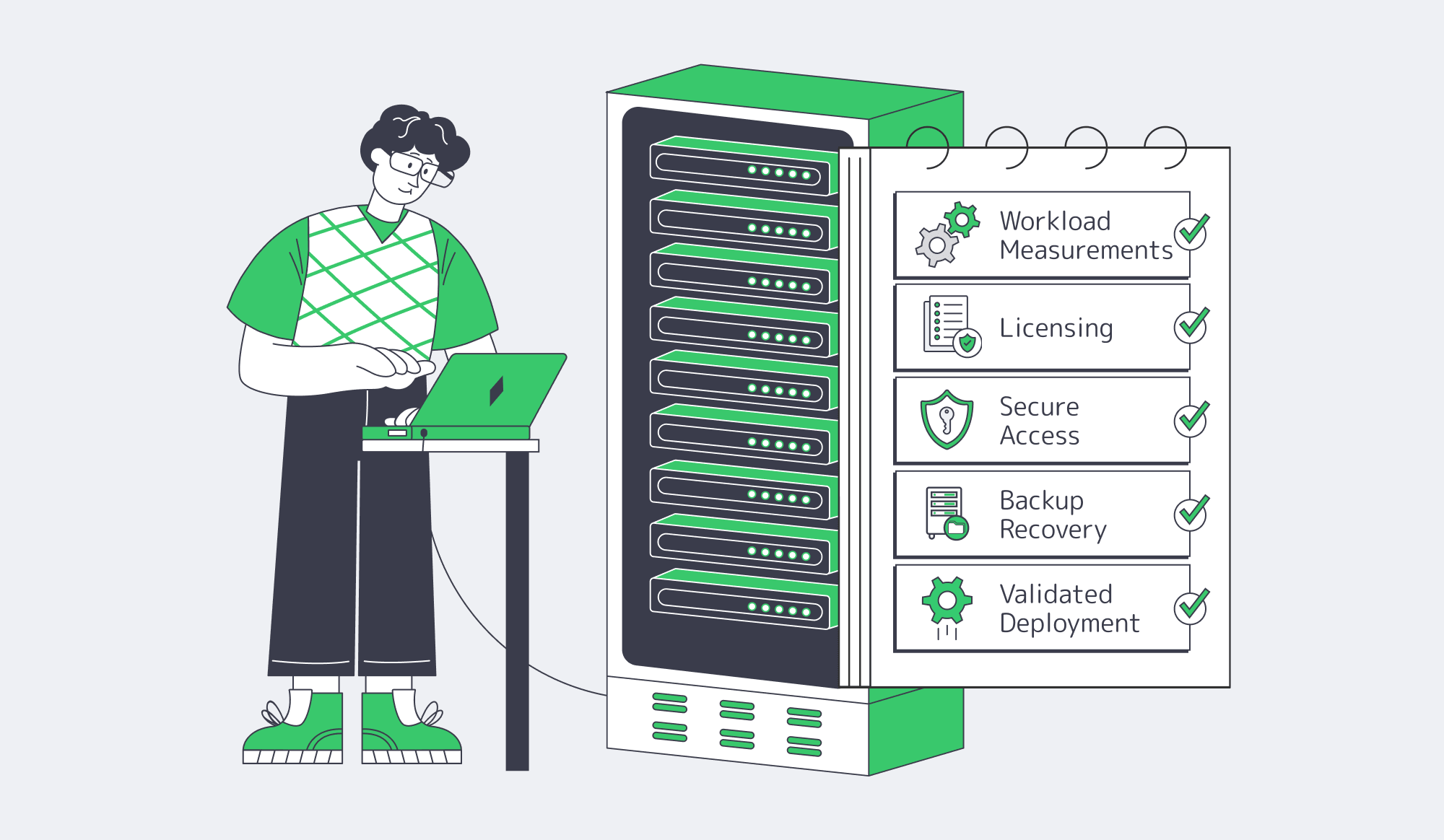
Before approving the purchase, confirm these migration gates:
- Peak production workload has been measured over representative periods.
- Candidate hardware passes load testing with documented headroom.
- Windows, RDS, and SQL licensing are documented in writing.
- RDP and out-of-band management use protected access paths.
- Backup restoration has been successfully tested.
- Data-center location has been validated from real user locations rather than administrative tests alone.
Practical Evaluation Priorities
Before comparing providers or hardware, focus on the engineering questions that have the greatest long-term impact:
- Measure workload behavior before selecting CPU, memory, or storage.
- Validate latency from user locations, not only from the data center.
- Treat Windows, RDS, and SQL Server licensing as separate procurement decisions.
- Verify backup restoration, not just backup completion.
- Keep infrastructure sizing, application tuning, and operational ownership separate.
Explore Dedicated Windows Server Options
Match Windows workloads to 1000+ ready-to-go server configurations, custom builds, 21 data centers, and up to 200 Gbps per-server bandwidth.