
Blog

CDN security explained: What a CDN protects and what it does not
A content delivery network (CDN) sits between users and origin infrastructure, handling connections, caching content, and enforcing supported delivery policies. That makes a CDN an important security layer—but not a complete defense.
TLS protects traffic in transit. Edge access controls restrict requests. Signed links gate content delivery. Additional services may mitigate DDoS attacks or filter malicious HTTP traffic. None automatically replaces application authentication, user authorization, or vulnerability management.
The purchasing challenge is straightforward: identify exactly what the CDN protects, then verify that protection against your requirements.
Melbicom CDN– Signed links per URL path – IP, country & rate-limit rules – Raw logs & real-time analytics |

|
CDN Security Boundaries
CDN security covers controls enforced along the delivery path: TLS termination, caching, request filtering, access restrictions, origin routing, and logging. Additional protection depends on the offering.
Application security remains separate.
Identity verification, object-level permissions, transaction validation, software patching and database protection require application-aware controls.
A secure CDN cannot compensate for missing authorization checks. Nor does HTTPS guarantee that cached content is safe to share.
The fundamental purchasing question is: Which security decisions can the CDN enforce, and which remain the application's responsibility?
How Do CDN Security Controls Protect Transport and Restrict Content Access?
CDN security controls protect transport through TLS and restrict delivery through edge policies, caching rules, and supported access mechanisms. Buyers should verify TLS 1.3 availability, encrypted origin connections, and explicit cache isolation. IP restrictions, signed links, and rate limiting provide additional controls when supported, but do not establish application-level user permissions.
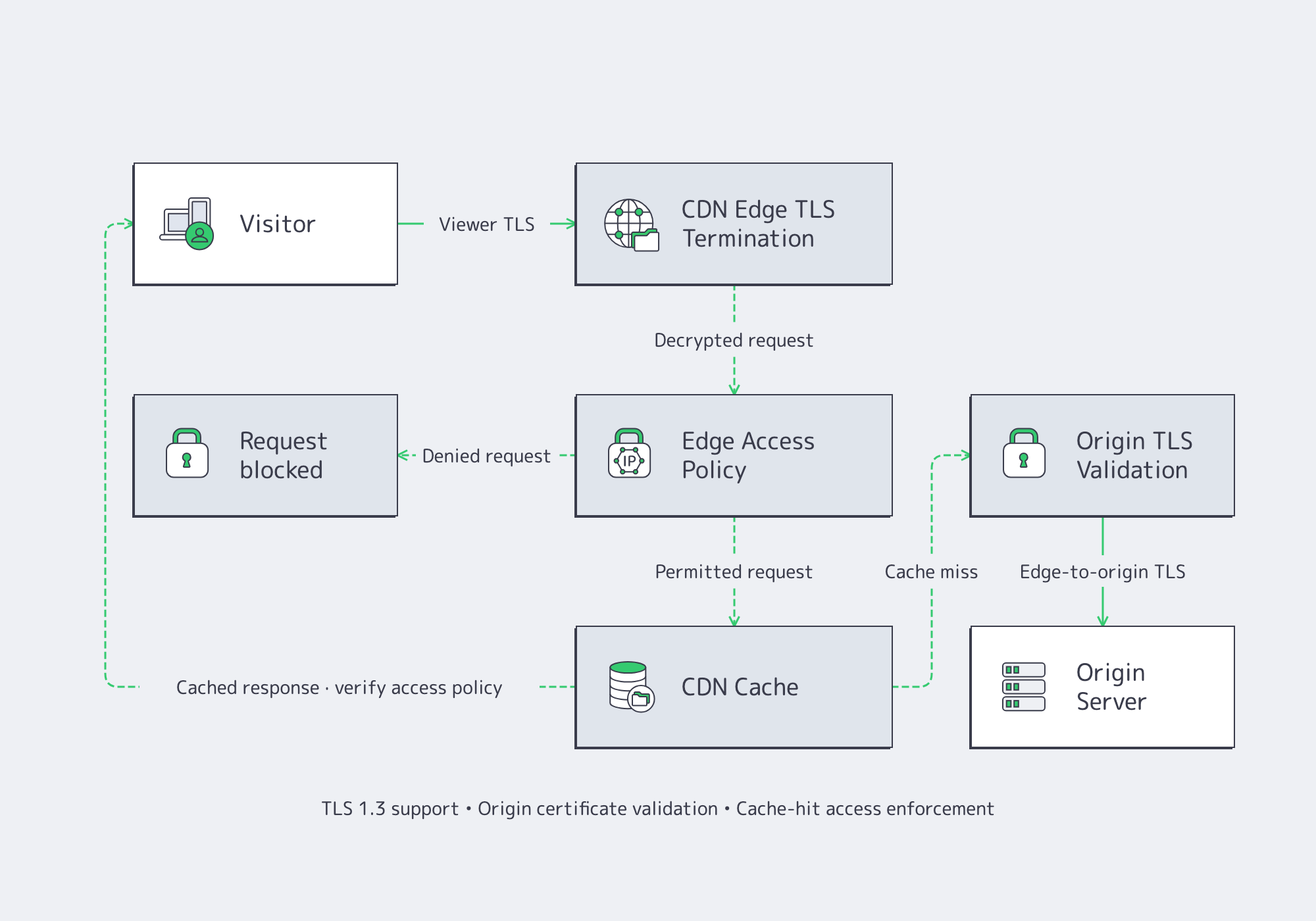
Viewer-to-edge and edge-to-origin TLS are separate connections; origin certificate validation is a conceptual CDN step during connection establishment.
Check Both TLS Connections
A CDN architecture can involve two encrypted connections: visitor-to-edge and edge-to-origin.
The IETF’s RFC 9846, which specifies TLS 1.3, describes protection against eavesdropping, tampering, and message forgery.
TLS termination lets the CDN process decrypted traffic; TLS therefore does not provide end-to-end secrecy from the CDN operator.
Buyers should verify both connections independently. HTTPS at the edge does not prove that origin traffic is encrypted or that origin certificates are validated.
Assess certificate ownership, renewal, expiry visibility and failure handling.
For certificate management, Melbicom’s CDN service supports automatic trusted certificates and customer certificate uploads.
A Secure CDN Can Gate Content Without Becoming the Identity System
Depending on the service, edge controls may restrict access by IP address, geography, request frequency, URL path, or cryptographic token. User-Agent matching does not authenticate a client, and geographic filtering does not establish legal compliance.
For request restrictions, Melbicom supports IP/CIDR, User-Agent, and geographic access rules, alongside per-IP and per-path rate limits. These controls can reduce unwanted requests.
Neither an IP rule nor a signed link determines whether a particular employee may download a confidential customer record.
OWASP’s Authorization Cheat Sheet emphasizes deny-by-default policies and permission validation on every request.
Cache Policy Is Part of CDN Security
Shared caching introduces another security boundary: users must not receive representations they are unauthorized to view.
RFC 9111 restricts shared caching of authenticated responses unless explicit directives permit it. It also distinguishes private, no-store, and no-cache: these directives have different storage and revalidation semantics.
OWASP’s cache-security guidance identifies cache poisoning, deception, and sensitive-data exposure as risks.
Buyers should establish cache-key behavior, handling of cookies and authorization headers, and whether CDN rules override origin directives. Cookies and signed query parameters do not automatically prevent caching; edge access checks on cache hits must also be verified.
Maximizing cache hit rates must never override access boundaries.
TLS, Signed Links and Authorization
TLS secures the communication channel, while signed links validate possession of a delivery token. Application authorization determines whether an authenticated user can access a particular object or perform an operation. Neither transport encryption nor token validity establishes business permissions; protected resources still require server-side authorization decisions based on identity and context.
TLS Authenticates Transport, Not User Permissions
HTTPS requests can still be unauthorized or malicious. TLS cannot decide account ownership, subscription status, tenant membership or permission to edit records.
Those decisions belong to the application, as described in OWASP’s access-control guidance.
Signed Links Are Delivery Capabilities
Signed URLs can provide constrained access to content, but anyone possessing a valid bearer-style link may be able to use it.
For protected content delivery, Melbicom supports per-path signed-link validation, with invalid tokens rejected using HTTP 403. Our CDN also supports optional client-IP and User-Agent binding to narrow usage conditions, while the application remains responsible for generating signed links.
Token expiry, scope, replay behavior, revocation and signing-secret rotation determine whether a delivery capability meets the workload’s access requirements.
For private documents, the application should authorize the user before issuing the delivery capability. OWASP’s multi-tenant security guidance recommends authorizing the exact object and operation before generating signed URLs.
The strongest architecture combines application authorization with constrained edge delivery rather than expecting either layer to perform both jobs.
CDN Security Limits
CDN security can overlap with additional protective services, but their availability and limitations must be evaluated independently.
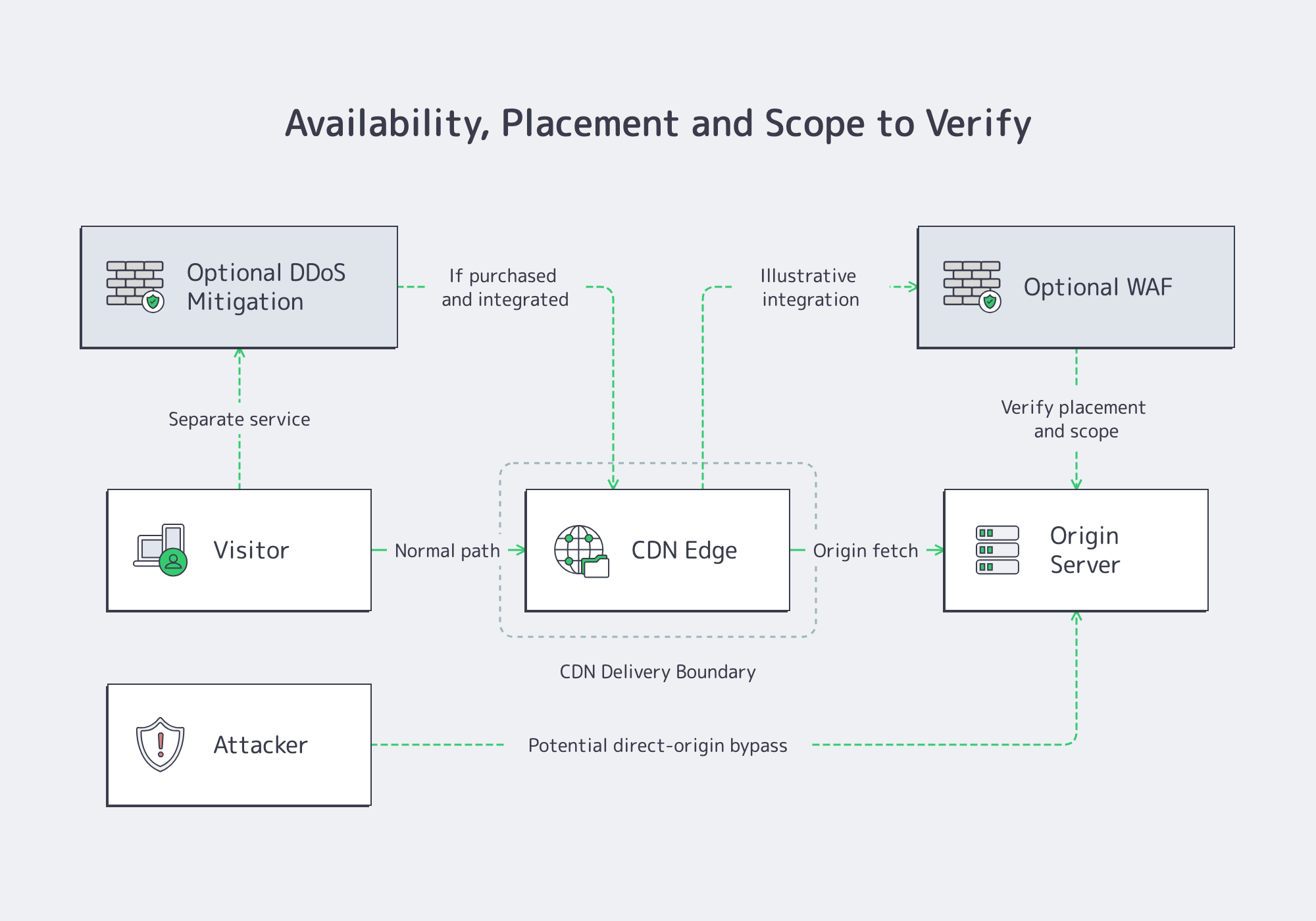
Dashed paths illustrate optional service integrations and potential direct-origin bypass; availability, placement and scope need service-specific verification.
CDN Delivery and DDoS Protection
Caching reduces origin requests for reusable content. It does not automatically mitigate network floods, connection exhaustion, or expensive application-layer requests.
Buyers should verify protected attack classes, mitigation triggers, traffic scope, telemetry, capacity constraints, and exclusions.
For workloads requiring attack mitigation beyond content delivery, Melbicom offers DDoS Protection as a separate service.
A WAF Cannot Enforce Every Business Rule
A WAF can identify or block recognizable malicious HTTP patterns. It cannot reliably determine whether a valid-looking transaction violates application-specific permissions.
OWASP’s security guidance distinguishes request filtering from application security.
WAF, bot protection, and API inspection should therefore be treated as separately verified capabilities—not assumed CDN inclusions.
Origin Exposure Remains a Risk
If attackers can reach an origin directly, they may bypass edge restrictions. Buyers should establish origin reachability, failover behavior, and how permitted CDN traffic is distinguished from direct requests.
Origin shielding can consolidate cache misses while allowing direct-origin access.
CDN dashboards and APIs also require appropriate administrative authentication, role separation, credential management, and auditability.
Evidence Buyers Should Request for Each Provider's CDN Security Capabilities
Buyers should request plan-specific documentation and observable tests for every CDN security requirement. Evidence should identify the protected resource, enforcement point, supported scope, and limitations. Prioritize TLS behavior, cache isolation, access controls, origin protection, logging, and separately offered mitigation services. Undocumented or untestable features should not satisfy mandatory purchasing criteria.
CDN Security Requirements
CISA’s secure technology procurement guidance recommends selecting technologies whose security properties can be verified. Apply that principle to every CDN requirement.
| Security Requirement | Purchasing Criterion | Evidence to Request |
|---|---|---|
| Edge TLS | TLS 1.3 and endpoint support | Protocol documentation and proposed handshake test |
| Origin encryption | Encrypted connections and certificate validation | Architecture diagram and proposed negative test |
| Certificates | Ownership, renewal, expiry visibility | Documentation and alerts |
| Cache isolation | No unauthorized cross-user sharing | Cache rules and proposed two-user tests |
| Access controls | Required IP, geographic, path, or rate policies | Plan matrix and proposed allow/deny tests |
| Signed links | Expiry, scope, replay, and revocation | Token specification and proposed failure tests |
| Origin protection | Direct-access restrictions and failover | Architecture review |
| DDoS mitigation | Attack classes, scope, capacity, exclusions | Service-specific documentation |
| WAF/bot protection | Availability and enforcement scope | Rules and proposed test evidence |
| Control-plane security | Administrative roles and credentials | Security documentation |
| Observability | Log fields, retention, and export | Sample logs and schema |
| Provider boundaries | Included, optional, separate, or unsupported features | Written capability matrix |
Evidence Should Include Negative Tests
Successful requests show functionality; rejections show enforcement.
Acceptance testing should verify that expired or invalid signed links fail, disallowed networks are blocked, invalid origin certificates produce documented behavior, and one authenticated user cannot receive another user’s private cached response.
NIST’s security assessment guidance supports examining and testing controls rather than relying solely on declarations.
Logging and Performance Require Validation
Useful CDN logs should expose request timing, hostname, status, cache behavior and relevant security decisions. Verify fields, retention and export latency.
For delivery visibility, Melbicom’s CDN offering includes real-time analytics and raw logs.
Performance acceptance tests should measure regional latency, cache hits and misses, and p95/p99 response times with intended security controls enabled.
CDN Security Purchasing Checklist
A CDN should protect the delivery functions it actually controls—not substitute for application security. The right purchasing decision identifies enforcement boundaries and assigns responsibility for remaining risks.

Before approving a provider, apply these practical checks:
- Map trust boundaries: Identify where TLS terminates, where authorization occurs, and which systems can access decrypted content.
- Prioritize sensitive workloads: Test private documents and authenticated responses before optimizing shared caching.
- Validate bypass resistance: Include direct-origin access, cache hits, and failover paths in acceptance testing.
- Separate service scopes: Record which protections are included, optional, separately purchased, or customer-owned.
- Define measurable acceptance criteria: Specify required logs, rejection behavior, and performance thresholds before deployment.
The result should be a traceable security model showing what is encrypted, restricted, cached, filtered, logged, and still exposed.
Choose the Right CDN Controls
Use your security requirements to compare Melbicom’s delivery controls, access policies and operational visibility.