
Blog

What is multi-CDN, and when is one provider no longer enough?
Multi-CDN sounds simple: use two content delivery networks instead of one. In practice, it means placing multiple independent CDN providers behind a traffic-steering layer that decides which network serves each user, region, or workload.
But more providers do not automatically mean better resilience. A second CDN may address regional performance gaps, delivery outages, or capacity constraints, but it also introduces another system to operate.
The real question is whether a second CDN solves a measurable delivery problem—or simply adds complexity.
Melbicom CDN– 40 Premium CDN PoPs – Coverage in 35 countries – 24/7 infrastructure support |

|
What Multi-CDN Means in Practice
A conventional CDN already distributes requests across multiple edge locations and network paths. Multi-CDN adds another decision layer: select an independent provider first, then let that provider handle internal routing.
This creates distinct failure domains, including edge infrastructure, network connectivity, caching systems, and provider control planes. But shared origins, authoritative DNS, authentication services, and steering infrastructure can remain common dependencies.
The distinction between provider selection and internal edge selection matters. A multi-CDN controller determines which provider receives a request, while the selected CDN independently determines which edge location serves it. Changing the traffic allocation between providers does not directly control either provider's internal routing.
Multi-CDN is a provider-selection architecture, not just another layer of load balancing.
How Does Multi-CDN Differ from Multiple Origins Within One CDN?
Multi-CDN uses two or more independent CDN providers with separate networks, caches, and control planes. Multiple origins within one CDN provide alternative backend sources but retain the same user-facing CDN. Origin redundancy protects against backend failures; multi-CDN can additionally reduce exposure to provider-specific delivery failures.
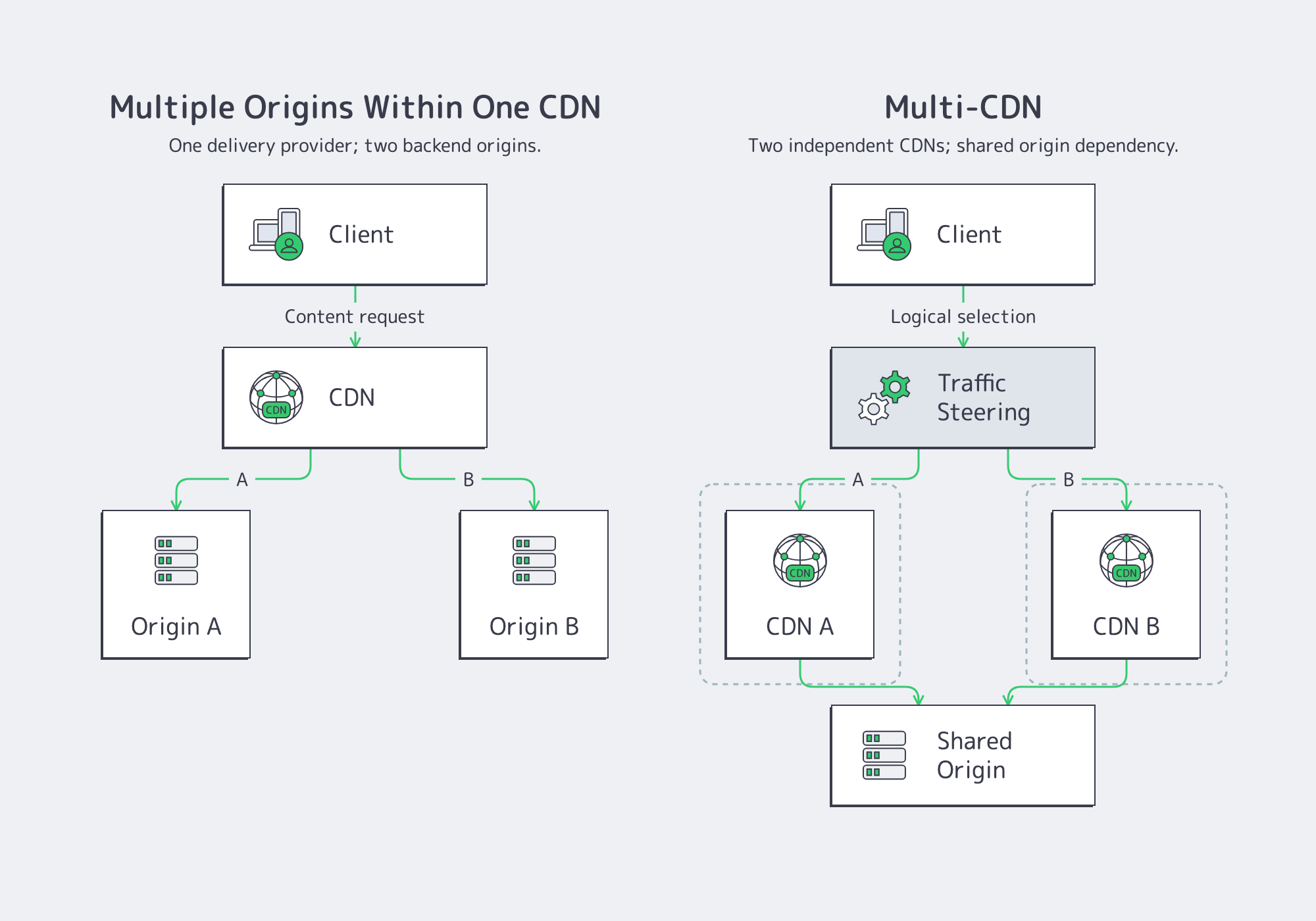
The distinction becomes clear when comparing request paths:
Multi-origin: Client → One CDN → Origin A or Origin B
Multi-CDN: Client → Traffic steering → CDN A or CDN B → Origin layer
The DASH-IF content-steering specification describes architectures where independent CDNs deliver identical content, often fetched from a shared origin.
For example, Melbicom CDN supports multiple origin pools for load balancing and failover.
Both approaches can coexist. Organizations should identify which failure domain needs protection before choosing an architecture. Adding a second CDN does not eliminate shared origin, DNS, authentication, or other upstream dependencies.
When Do Performance or Availability Gaps Justify Adding Another CDN Provider?
A second CDN becomes justified when repeated, provider-specific delivery failures threaten the service's latency SLO or availability error budget after application and origin causes are excluded. The decision requires evidence that an independent provider improves affected user journeys and can accept redirected traffic within the service's tested recovery window.
Regional Performance Can Change the Equation
A 2025 SMPTE Motion Imaging Journal study evaluated three anonymized commercial CDNs in a preliminary streaming testbed, demonstrating how delivery performance can differ by region and provider.
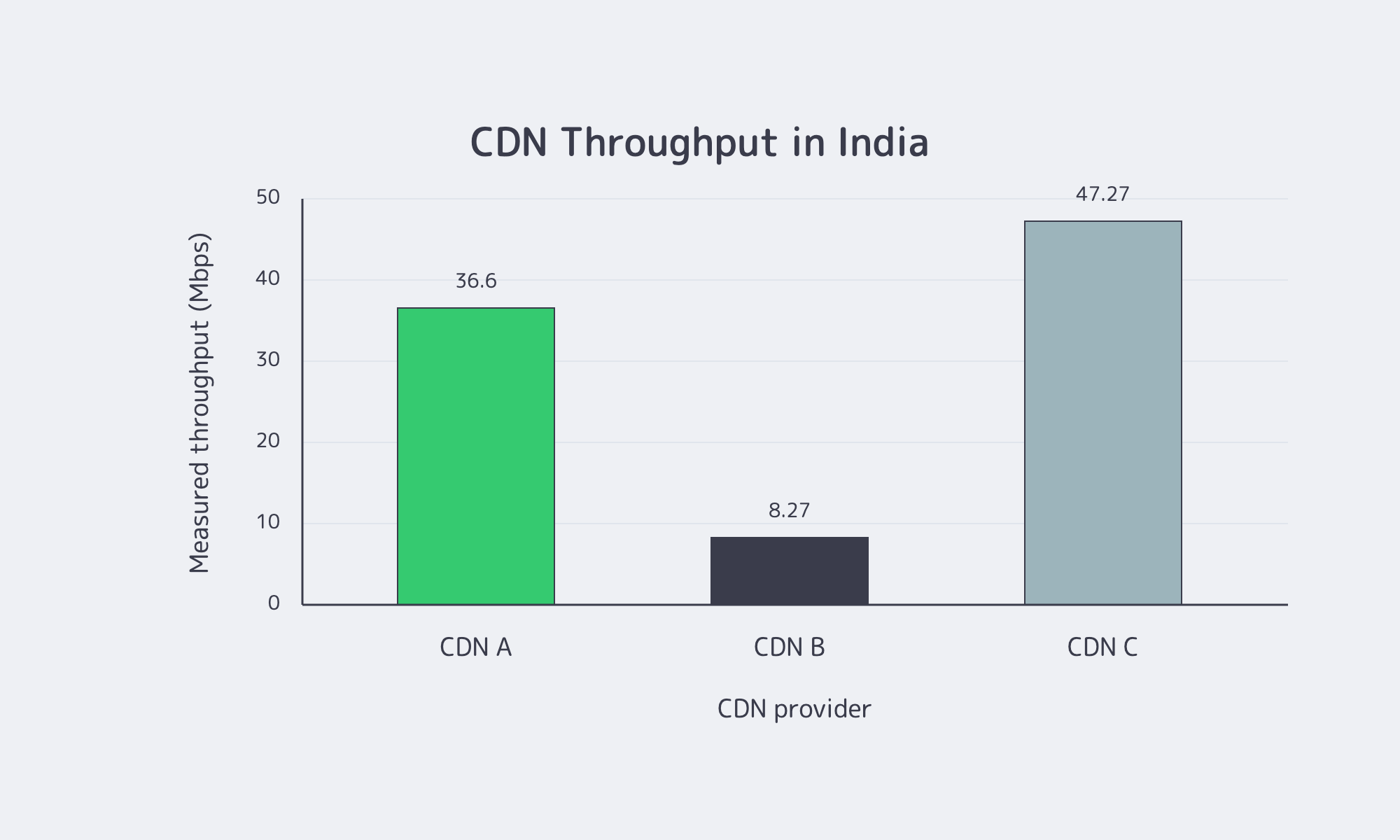
That variation shows why regional testing matters. An alternate provider may deliver better performance for one audience while offering little improvement elsewhere.
For a meaningful comparison, test the same content and workload across the access networks and regions that matter to the service. Compare user-facing latency, throughput, errors, and streaming quality rather than relying on global provider averages.
Availability and Capacity Matter Too
Multi-CDN becomes attractive when delivery outages consume a meaningful portion of the availability budget or when large releases, streaming events, and software downloads create substantial regional capacity requirements.
An alternate provider must demonstrate that it can absorb redirected traffic within the required recovery window, using the actual object or segment mix and realistic traffic volumes. A configured standby path alone does not establish failover readiness.
Cost may also justify diversification. A practical multi-CDN allocation model should account for provider rates, minimum volume commitments, historical usage, forecast demand, and the traffic assigned to each provider.
Base the decision on delivery economics—not merely the lowest advertised price.
Traffic Steering by Workload and Team
DNS steering suits websites, APIs, and downloads when DNS caching and connection behavior permit the required recovery time. HTTP redirection enables request-aware routing but requires a reachable redirect endpoint and another fetch. Client or manifest steering supports compatible streaming players. Greater steering precision generally demands stronger telemetry, testing, and operational expertise.
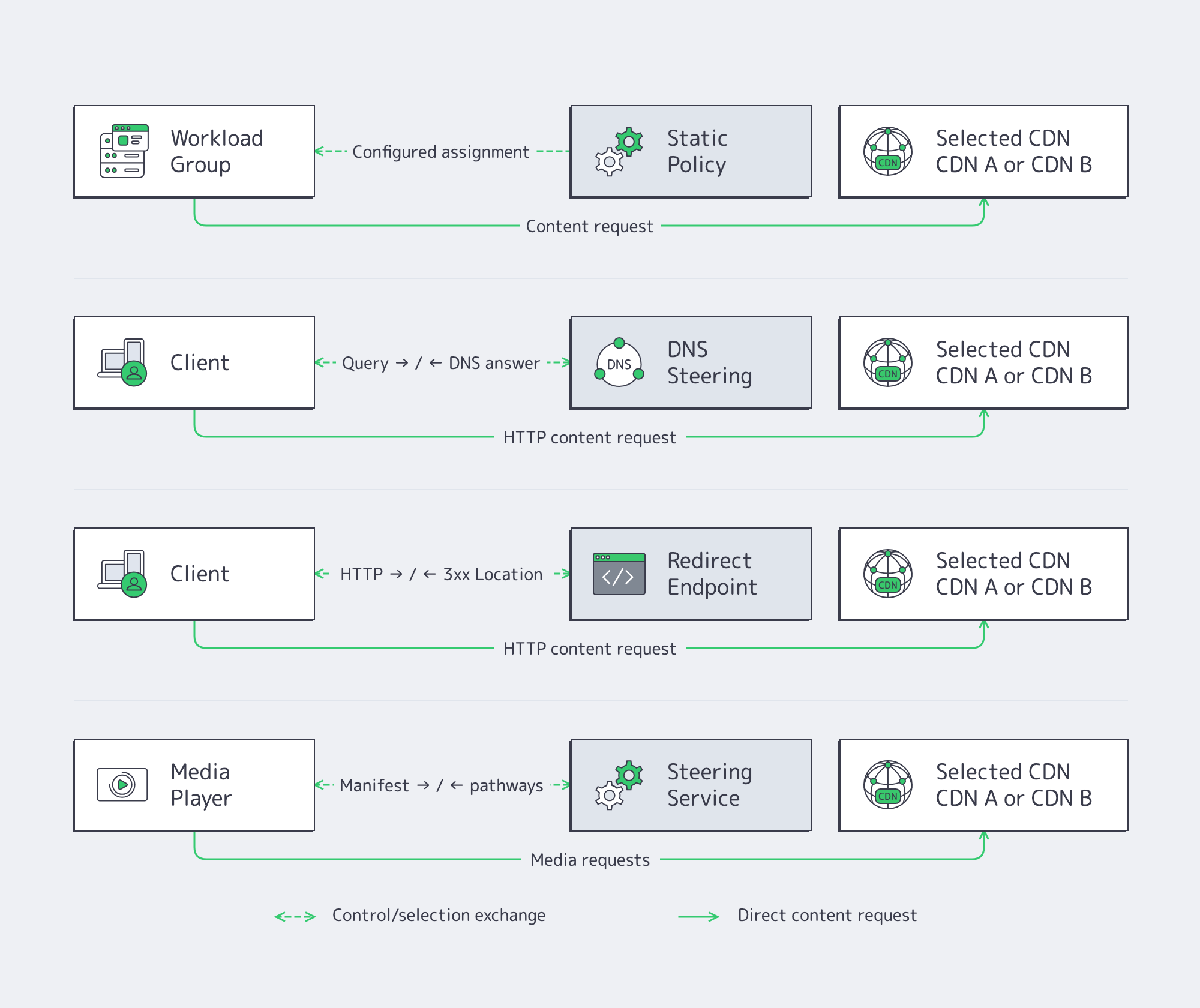
The IETF CDNI framework describes DNS- and HTTP-based redirection, while streaming specifications provide client-aware alternatives.
| Steering approach | Best fit | Main operational tradeoff |
|---|---|---|
| Static segmentation | Asset classes, hostnames, regions | Predictable and simple, but cannot automatically react to degradation without additional controls |
| DNS steering | Websites, APIs, downloads | Supports weighted and geographic routing, but DNS caching, existing connections, and client behavior affect traffic migration |
| HTTP redirection | Request-aware delivery decisions | Provides request context but requires a reachable redirect endpoint, an additional fetch, and careful authentication and method handling |
| Client or manifest steering | Compatible HLS/DASH streaming players | Supports player-aware pathway selection and potentially midstream switching, but requires compatible players, consistent media variants, and telemetry |
DNS is often the most accessible starting point. However, lowering DNS TTLs does not guarantee immediate failover.
RFC 1035 defines TTL as a DNS record's cache lifetime, while RFC 8767 permits resolvers to serve stale records under specified conditions. Failure detection, existing connections, and client behavior also influence recovery.
HTTP redirection offers request-level context, although RFC 9110 distinguishes redirect semantics and request-method handling. A 307 redirect preserves the request method when automatically followed, but redirects do not make unsafe retries safe.
For streaming, Apple's HLS content-steering guidance supports player-aware pathway selection, while the dash.js feature overview documents DASH content-steering support with remaining compliance updates. Implementation and switching behavior must be validated for the actual player population.
Building a Multi-CDN Strategy Around Telemetry
Provider health dashboards cannot fully describe user experience.
A failed DNS lookup or connection timeout may never appear in CDN server logs. The W3C Network Error Logging Working Draft defines client-side network failure reporting to address this visibility gap. It remains a draft, and reporting depends on client support.
Effective steering combines synthetic monitoring, real-user measurements, provider logs, and origin telemetry.
Measurements should distinguish geography, access network, content type, and time window. A healthy global average can conceal severe regional degradation.
Steering also requires stability. Sustained thresholds and hysteresis help prevent repeated switching caused by noisy measurements.
Finally, the steering controller itself becomes a dependency. Architects must establish predictable fallback behavior when telemetry becomes stale, the decision system is unavailable, or no provider is considered healthy.
The Operational Cost of Multi-CDN
Multi-CDN replaces one delivery configuration with multiple configurations that must behave consistently.
Cache keys, TTLs, compression, headers, authentication, and invalidation rules can differ between providers. The IETF CDNI metadata specification illustrates why consistent delivery policies require explicit coordination.
Independent caches also have independent states. A standby CDN might be technically available yet poorly prepared to serve an unfamiliar production working set. Cache splitting, cold fills, and sudden fallback bursts can increase origin traffic, potentially making shared origin capacity the next bottleneck.
Configuration drift creates additional risk. Two providers may both return 200 OK while delivering different cache behavior, headers, or authentication outcomes.
Operational teams therefore need shared observability, configuration testing, coordinated cache purging, and consistent incident procedures.
Traffic allocation adds another challenge. Consider a hypothetical service distributing 95% of normal traffic through CDN A and 5% through CDN B. The secondary provider is regularly exercised, but if CDN A fails, CDN B may need to handle the entire workload—20 times its normal traffic share. Testing must establish whether its caches, delivery capacity, and shared origins can sustain that transition.
The tradeoff is clear: provider independence reduces certain delivery dependencies while introducing orchestration, monitoring, and configuration overhead.
When Multi-CDN Is Worth the Effort
Multi-CDN is most compelling for global services experiencing measurable provider-specific weaknesses, especially across different regions and access networks.
Streaming platforms, large software distributions, game releases, and high-volume content services may benefit when traffic steering improves regional performance, peak capacity, or delivery resilience.
It is less convincing when a single CDN consistently meets latency and availability objectives, audiences are geographically concentrated, or most failures originate in applications and backend systems.
A second CDN also makes little sense when the engineering team lacks the monitoring needed to distinguish delivery failures from upstream problems.
Before adopting multi-CDN, apply five decision checks:
- Delivery impact: Is the performance or availability problem measurable, user-visible, and attributable to the CDN layer rather than a shared upstream dependency?
- Provider independence: Does another provider demonstrably improve delivery for affected regions, access networks, and workloads?
- Recovery capability: Can steering move traffic within the recovery window, accounting for DNS caching, existing connections, and client behavior?
- Capacity readiness: Can the alternate CDN handle realistic failover volumes without unacceptable cache misses, origin overload, or functional differences?
- Operational ownership: Can the team maintain cross-provider monitoring, configuration parity, incident response, and cost controls without introducing greater reliability risk?
Failing these checks does not necessarily mean the delivery architecture is inadequate. It may mean that one well-configured, well-measured CDN remains the better choice.
Build Your Multi-CDN Strategy on Evidence
Multi-CDN should be a response to measurable delivery limitations, not a default architectural upgrade. Its value comes from reducing provider-specific risks or improving outcomes that a single delivery network cannot consistently achieve.
Start by identifying regional performance gaps, testing independent delivery paths, and validating realistic failover behavior. If the improvement outweighs the operational complexity, provider diversification becomes defensible.
That evaluation should include each provider's geographic footprint, traffic visibility, cache controls, delivery capabilities, and cost structure—not just edge counts.
Explore Melbicom CDN
Evaluate our delivery network, geographic routing, and traffic analytics against your regional performance and resilience requirements.