
Blog

Bare Metal Hosting Providers: A Comparable 12-Month Quote for Production Workloads
A useful bare metal server hosting comparison starts with one question: What does the same production workload actually cost over 12 months?
Monthly server prices rarely tell the whole story. CPU performance, usable storage, transfer allowances, management responsibilities, hardware replacement, and cancellation terms can change the economics substantially.
Consider a Melbicom dedicated server configuration in Paris: Intel Xeon E-2356G, 32 GB RAM, one 480 GB SSD, a 10 Gbps port, and 50 TB monthly bandwidth for €124 per month. €124 × 12 = €1,488 in base subscription charges.
Here's how to turn that starting price into a defensible infrastructure budget.
Choose Melbicom– 21 Tier III & IV DCs worldwide – Workload-matched hardware – Custom builds: 3–5 business days |

|
How Should a Bare Metal Server Hosting Comparison Normalize 12-Month Quotes?
A bare metal server hosting comparison should fix the workload, server quantity, required location, 12-month service period, and operational responsibilities before evaluating prices. Normalize CPU performance, installed RAM, usable storage, port speed, transfer allowances, setup, management, replacement, and exit terms. Any mandatory cost or service condition that remains undisclosed must be marked unresolved, not assumed free.
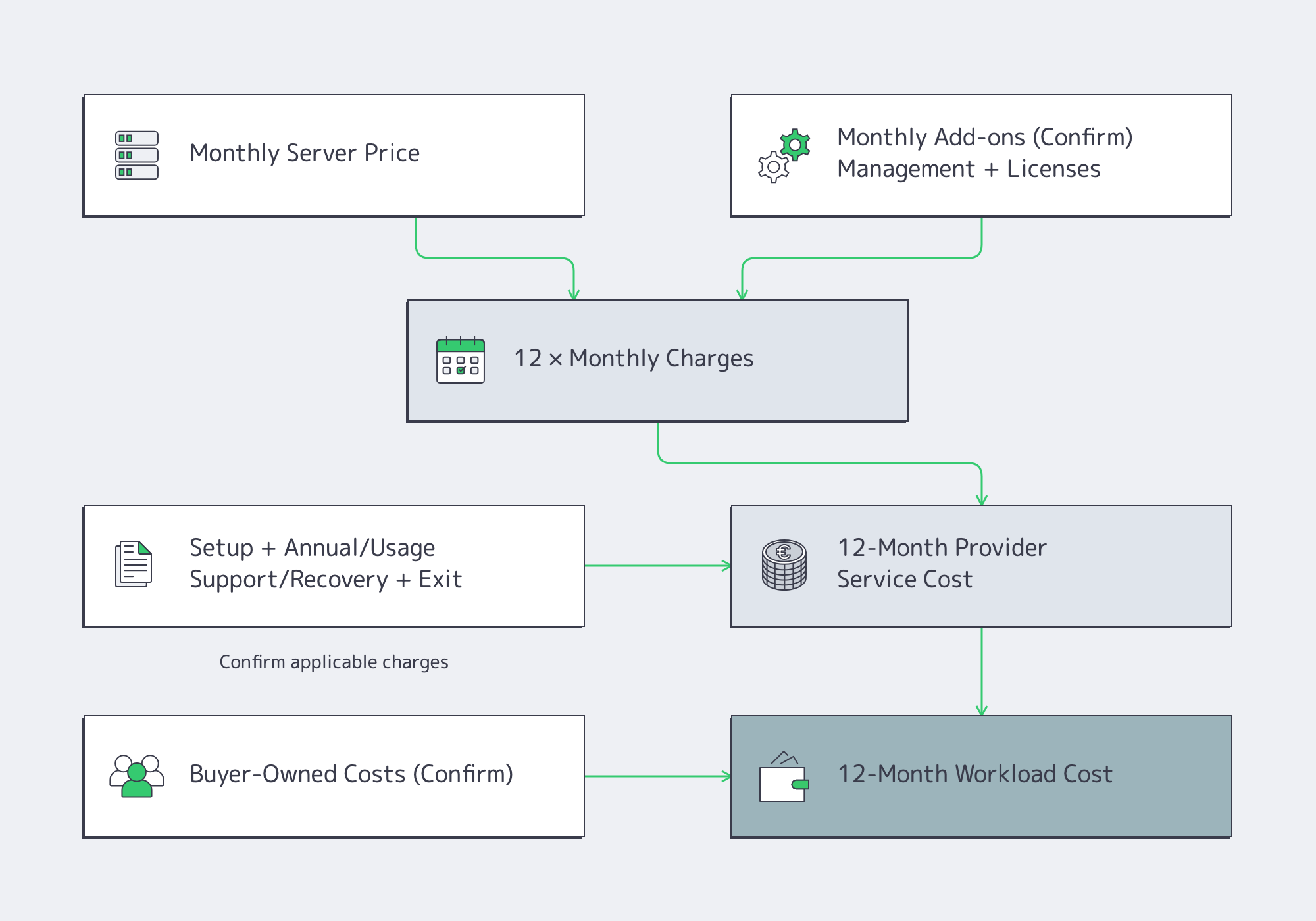
Add buyer-owned deployment, operations, backup, recovery and migration costs to the 12-month provider service cost to obtain the full workload cost.
Calculate two separate totals:
12-month provider service cost = 12 × (monthly server price + mandatory monthly add-ons + monthly management + monthly licenses) + optional one-time setup + annual or usage-based charges + separately chargeable support/recovery + documented end-of-term charges.
12-month workload cost = provider service cost + buyer-owned deployment, operations, backup, recovery, and migration costs.
Count each charge once. Included services must not be added again, and monthly fees must be multiplied by 12. Model taxes consistently across quotes.
For early cancellation, adjust actual service months, commitments, refunds and migration overlap. Keep hypothetical refunds out of the full 12-month baseline.
Every quote also needs a capture timestamp, configuration reference, location, currency, tax basis, billing cadence, validity period, and applicable terms.
For metered Melbicom dedicated servers, the initial invoice may cover the remaining portion of the current month plus the next full month. Normalize the actual service period to avoid double-counting prepaid time.
Match CPU Performance Across Server Quotes
The same core count does not guarantee equivalent performance. Melbicom's reference Xeon E-2356G has six cores, a 3.20 GHz base frequency, and up to 5.00 GHz maximum turbo frequency, according to Intel's processor specifications.
Prefer identical CPU models. Otherwise, require workload-specific testing or comparable results under controlled methodologies such as SPEC CPU2017. Logical thread counts and peak clock frequencies alone do not establish equivalent workload capacity.
Compare installed RAM rather than maximum supported memory. For storage, document drive count, media, redundancy, and usable capacity. A single 480 GB SSD is not equivalent to a mirrored pair.
Network allowances need similar discipline. A 10 Gbps port describes potential interface speed; 50 TB describes a monthly transfer allowance. Neither establishes sustained application throughput.
For each quote, confirm whether transfer accounting uses decimal TB or binary TiB, which traffic directions count, the applicable billing period, and what happens when the allowance is exhausted. Do not assume pooled allowances or a particular overage tariff.
Actual throughput depends on network conditions, as explained in RFC 6349's TCP throughput testing framework.
Compare Server Lifecycle Costs
Comparing setup, management, replacement, and exit costs requires matching operational responsibilities as carefully as hardware specifications. A charge qualifies as included only when written terms confirm the corresponding service. Document provisioning fees, maintenance scope, component replacement, recovery labor, cancellation conditions, and refunds before treating two offers as financially equivalent.
Setup and Hardware Replacement
Melbicom offers two-hour delivery for ready-to-go dedicated server configurations and custom configurations delivered in 3–5 business days.
Our dedicated server offering includes free defective-component replacement within 4 hours. Customer-data restoration remains the customer's responsibility.
A purchasing model should therefore separate physical replacement from application recovery, backup restoration, and engineering labor. Covered component replacement should not be counted as an additional charge without evidence that an exception applies.
Compare Management Fees and Exit Costs
The word managed is insufficient for budgeting.
Melbicom provides 24/7 infrastructure support. Our team handles server hardware and data-center connectivity, while customer software administration is separate. Additional configuration or maintenance assistance may incur charges.
Buyers should explicitly assign OS patching, database administration, monitoring, backups, and application recovery. Unpriced work remains a confirmation item.
Dedicated server exit costs require equally careful treatment. Under Melbicom's service agreement, customers may terminate through their Personal Account. Refunds are subject to unused-service-period rules, possible recalculation of advance-payment discounts, and payment-system fees.
Complete data exports and verify recovery from your copies before cancellation.
Model migration labor, temporary overlap, and any specifically quoted transfer charges separately. Optional licenses and additional equipment may also have billing and termination rules distinct from the base server.
Resolve Missing Service Terms
Resolve missing allowances and service boundaries before accepting a provider quote by requiring written confirmation of bandwidth accounting, overage treatment, provisioning charges, management responsibilities, replacement coverage, licenses, taxes, and cancellation terms. A quote with an unresolved mandatory field is not comparable, even when its CPU, RAM, storage, and advertised monthly price appear equivalent.
Define production acceptance before deployment. A proposed network test should record CPU SKU, installed RAM, drive inventory, interface speed, endpoints, UTC timestamps, RTT, MTU, tool version, and measured throughput.
Set acceptance thresholds from actual workload requirements: identify the application's busiest expected traffic period, define the throughput and latency needed during that period, and specify acceptable operational headroom. Test the network paths used by the workload, prioritizing major traffic sources and business-critical destinations.
Maintain a timestamp log for quote capture, terms verification, provisioning, inventory inspection, testing, and acceptance. Leave unexecuted events blank.
Production Workload Profiles for Comparable Dedicated Server Quotes
Use consistent request specifications rather than allowing the available catalog configuration to redefine the production requirement. The following are illustrative purchasing profiles.
- Balanced Application/API Node: Specify a Xeon E-2356G or workload-equivalent processor, 32 GB RAM, 480 GB SSD, 10 Gbps port, and 50 TB monthly transfer. This matches the Melbicom reference configuration closely. If local redundancy is mandatory, specify a mirrored-drive configuration instead.
- Transactional/Data Node: A proposed specification could require eight physical CPU cores, 64 GB RAM, two 960 GB NVMe drives in a mirror, providing 960 GB nominal mirrored capacity before filesystem overhead and reserves, and documented database-recovery ownership. Validate against representative transaction and storage workloads.
- Transfer-Heavy Origin Node: Start with expected monthly traffic and sustained throughput, then request 64 GB RAM, redundant NVMe storage, a 10 Gbps or faster port, and a documented high-volume or unmetered bandwidth configuration. Confirm applicable traffic and usage conditions rather than interpreting unmetered as unlimited application throughput.
Match the workload's required location and connectivity paths against Melbicom's data-center directory when selecting a server configuration.
Bare Metal Hosting Comparison Worksheet
Use this worksheet to obtain comparable dedicated server quotes. The Melbicom reference uses our €124/month configuration, with the base subscription price separated from additional cost fields.
| Quote Field | Normalization Requirement | Melbicom Reference |
|---|---|---|
| Location | Same required geography | Paris or Frankfurt |
| CPU | Same SKU or validated performance | Xeon E-2356G, 6 cores |
| RAM | Installed capacity | 32 GB |
| Storage | Drives, redundancy, usable capacity | 1 × 480 GB SSD |
| Port | Interface rate | 10 Gbps |
| Transfer | Allowance, accounting, overages | 50 TB/month; excess-use terms to confirm |
| Monthly price | Same currency and tax basis | €124 |
| 12-month base | 12 recurring charges | €1,488 |
| Setup | Fee and delivery timing | Fee confirmation required |
| Management | Included tasks and paid labor | Additional work may be chargeable |
| Replacement | Component versus data recovery | Hardware replacement included as described; recovery separate |
| Licenses | Optional charges and billing rules | Confirmation required |
| Exit | Cancellation, refunds, migration | Published terms apply |
| Evidence | Capture date, quote validity | Record applicable quote reference and validity |
Source: Melbicom’s dedicated server information, and service terms.
Use three statuses: verified, confirmation required, not equivalent.
A missing transfer allowance prevents comparison. A single SSD cannot satisfy a mandatory mirrored-storage specification. Different management responsibilities require financial normalization before approval.
For prepaid offers, capture discounts alongside cancellation and refund conditions. For fleet purchases, use the same server quantity and multiply only validated per-server costs, separately modeling shared operational expenses.
Do not combine unrelated catalog specifications into an imaginary SKU or label a known-price subtotal as total cost of ownership.
Evidence for a 12-Month Server Purchase
A credible bare metal server hosting comparison establishes workload equivalence before evaluating 12-month economics. The €1,488 Melbicom sample calculation provides a concrete starting point, while the complete production budget accounts for the additional costs identified in the worksheet.

Before approving capacity, preserve a complete purchasing record:
- Resolve unknowns before ranking offers. An unanswered mandatory fee, allowance, or responsibility prevents a defensible comparison.
- Reject hardware substitutions without evidence. Similar CPU labels or storage capacities do not establish equivalent production capability.
- Separate provider charges from internal costs. Keep engineering labor, backups, and migration expenses visible without attributing them incorrectly.
- Require acceptance evidence. Establish workload-specific pass/fail criteria before deployment and record results only after testing.
- Plan the exit before committing. Confirm export procedures, migration overlap, prepaid treatment and cancellation timing before agreeing the commercial terms.
This produces an auditable decision without unsupported price rankings.
Build Your 12-Month Server Budget
Compare Melbicom configurations against your hardware, location and traffic requirements, then confirm the service terms for your 12-month budget.