
Blog
Web3 Hosting Providers: Compare Validator, RPC and Indexer Support
Web3 hosting providers face three distinct infrastructure challenges. Validators perform consensus duties where failures can trigger financial penalties. RPC nodes serve API requests under demanding latency and concurrency requirements. Indexers process blockchain data into searchable databases, with heavy storage and ingestion demands.
The right hosting decision depends on protocol requirements, workload isolation, recovery ownership, and regional availability—not a generic “blockchain-ready” label.
Melbicom provides dedicated Web3 infrastructure for these workloads, while customers retain responsibility for blockchain software, keys, monitoring, and application recovery.
Dedicated Servers– 1100+ ready-to-go configs – Custom server builds – 24/7 infrastructure support |

|
Which Web3 Hosting Providers Support Validator, RPC, and Indexer Workloads?
Web3 hosting providers support validators, RPC nodes, and indexers when their infrastructure meets each workload's compute, memory, storage, networking, and geographic requirements. The essential selection criterion is compatibility with current protocol and client guidance, plus sufficient recovery headroom.
Compare Validator Hosting and Signing Safety
A validator hosting service comparison must evaluate both performance and signing safety.
Ethereum validators face penalties for missed duties and potentially more severe slashing consequences for contradictory consensus messages. Recovery procedures must therefore prevent conflicting signing by multiple validator instances. Ordinary downtime and slashable behavior are distinct risks, as explained in Ethereum's consensus documentation.
Hardware requirements vary substantially between networks.
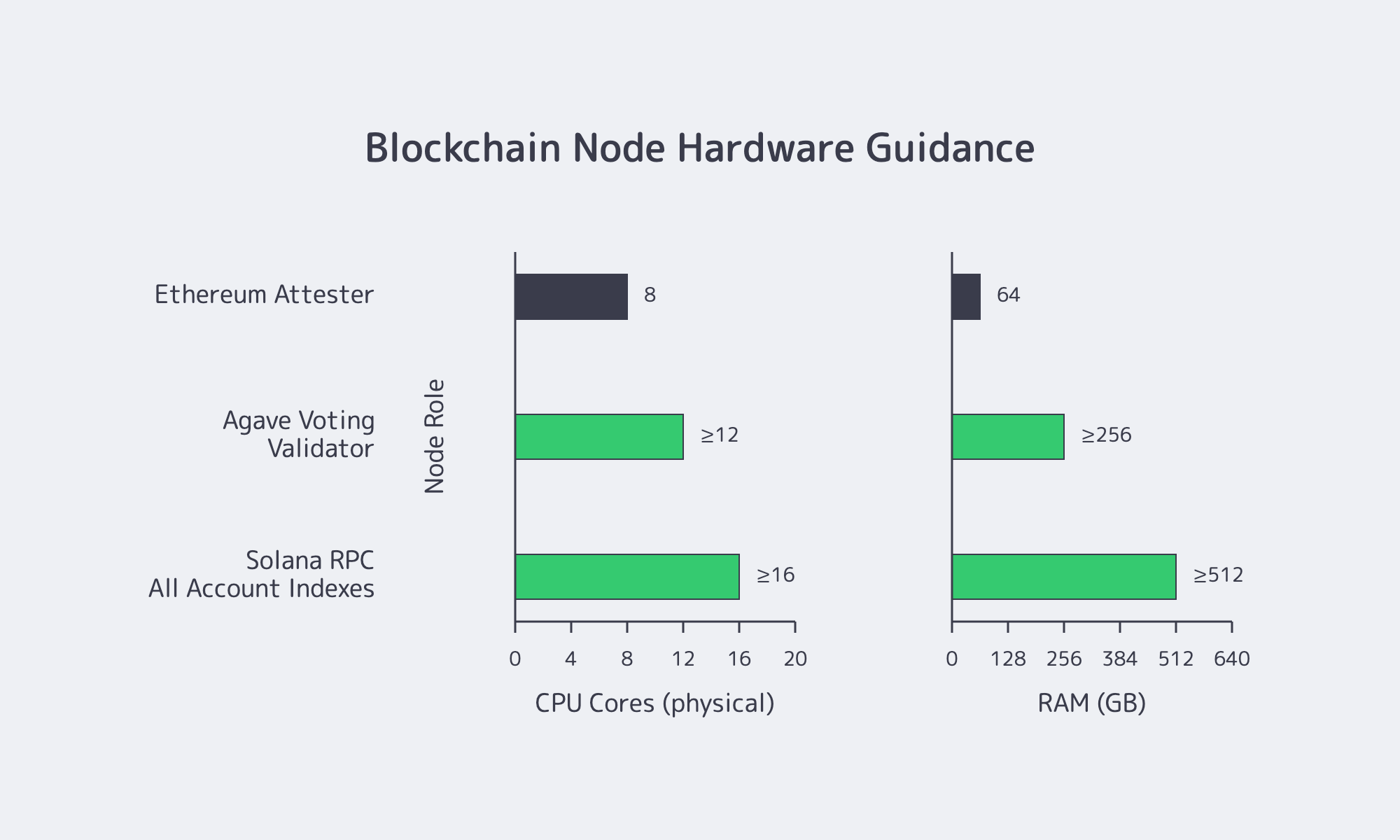
EIP-7870 is a living, informational Ethereum hardware recommendation—not a mandatory protocol minimum. For an attester, it recommends 8 cores/16 threads, 64 GB RAM, 4 TB NVMe, and 50 Mbps download/25 Mbps upload. Local block builders have higher network recommendations of 100 Mbps download/50 Mbps upload.
Solana needs more resources. Agave's hardware guidance recommends at least 12 cores/24 threads and 256 GB RAM for voting validators, with separate NVMe allocations:
- Accounts: at least 1 TB.
- Ledger: at least 1 TB.
- Snapshots: at least 500 GB.
Agave specifies symmetric connectivity of 1 Gbps for unstaked nodes and at least 2 Gbps for staked nodes, with 10 Gbps available bandwidth recommended.
These role-specific requirements provide the starting point for selecting CPU, memory, NVMe layout, and connectivity. The configuration must also accommodate synchronization and recovery without creating unsafe signing conditions.
RPC and Indexer Hosting: Performance Bottlenecks
RPC infrastructure prioritizes request throughput, concurrency, historical access, and response latency.
Agave recommends at least 16 cores/32 threads for Solana RPC configurations. Enabling all account indexes can raise memory requirements to 512 GB or more. Its RPC documentation discourages combining voting-validator and RPC responsibilities on one machine.
An RPC procurement specification should measure peak requests per second, method distribution, p95/p99 latency, subscription concurrency, and historical-query depth.
Indexers have different bottlenecks: sustained ingestion, database writes, secondary indexes, compaction, and historical backfills.
The choice of ingestion method also affects latency. Solana's indexing documentation distinguishes Geyser-based streaming from WebSocket subscriptions. For procurement, the useful test is whether the chosen ingestion path can maintain the application's required data freshness during peak activity and recovery.
Indexing capacity should be calculated from retained records, schema complexity, write amplification, and rebuilding requirements. Heavy backfills should not compete with production RPC requests for storage I/O.
Bare Metal Versus Managed Services: Duties and Recovery Ownership
Customer-operated dedicated infrastructure leaves blockchain clients, operating-system and protocol upgrades, keys, monitoring, backups, and recovery procedures under customer control. Managed delivery may transfer selected responsibilities, but only when explicitly defined. The critical distinction is recovery ownership: who detects failures, restores blockchain state, prevents unsafe validator failover, and confirms that services are operational again.
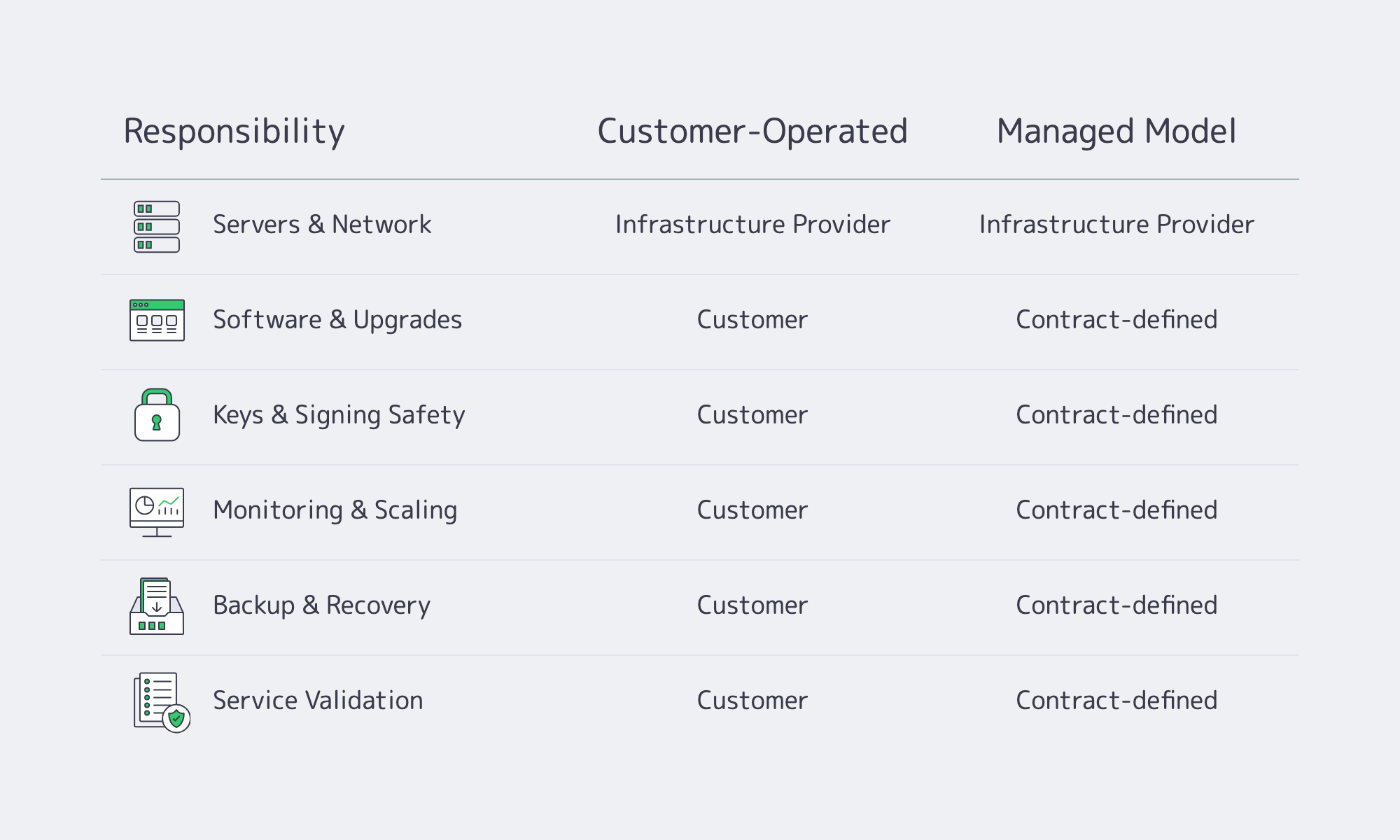
In Web3 terminology, bare metal commonly describes dedicated physical infrastructure.
Managed Blockchain Hosting Responsibilities: Define the Recovery Boundary
Melbicom supplies and supports the physical server and network infrastructure. Customers operate their blockchain workloads, including software installation, configuration, monitoring, scaling, and recovery.
A managed service model may include some of these functions, but the term “managed” alone establishes no specific blockchain responsibility.
Recovery ownership should be evaluated by workload.
Validators: The responsible operator must identify failures, preserve signing safety, restore client state, and confirm safe consensus participation. On Ethereum, conflicting signing can create slashing risk; restarting a validator is not inherently slashable.
RPC nodes: Recovery ends when the endpoint is synchronized and can successfully serve its required methods—not when replacement hardware boots.
Indexers: Recovery requires consistent database state, completed replay or backfill, and verification that no transaction records were missed.
For every operational function, procurement teams should establish who detects the problem, who executes recovery, and who validates the result. In a customer-operated deployment, that means planning application recovery separately from physical infrastructure support.
Web3 Storage, Regions and Payments
Before shortlisting Web3 hosting offers, verify usable storage capacity and I/O performance, actual server availability in the required city, and supported payment methods. A suitable configuration must accommodate active blockchain data, historical retention, and recovery overhead. Global infrastructure figures alone cannot establish local inventory, application latency, or eligibility to pay with Bitcoin.
Web3 Bare Metal Storage for Recovery
Storage procurement should account for more than the current blockchain database.
A practical sizing model is:
Required storage = active state + retained history + index expansion + database overhead + recovery workspace + growth reserve.
Recovery workspace includes temporary write-ahead logs, compaction space, rebuild files, and snapshots where applicable. These components must be sized for the selected protocol, client, retention policy, and recovery procedure.
Ethereum's node documentation distinguishes minimum hardware requirements from recommendations. Its recommended configuration references EIP-7870, which specifies 4 TB NVMe for an Ethereum full node and reference storage performance around 500 MB/s sequential throughput, 50,000 random 4K read IOPS, and 15,000 random 4K write IOPS.
Solana's separate accounts, ledger, and snapshot allocations demonstrate why total disk capacity alone is insufficient. Available SSD capacity also does not establish sustained IOPS, write endurance, or recovery time.
For active blockchain state, choose local storage that meets the protocol's I/O requirements. For snapshots and recovery artifacts, Melbicom offers S3-compatible object storage in Amsterdam alongside our dedicated storage servers. Object storage supports recovery workflows; active state still needs local NVMe.
Verify Server Regions and Availability
Start with workload geography rather than a provider's location count.
For validators, prioritize connectivity to relevant blockchain peers and the placement of recovery infrastructure. For RPC, identify where the largest share of requests originates, then include business-critical user regions. For indexers, consider proximity to the data source and the systems consuming indexed results.
Next, match those locations to actual server configurations.
Melbicom's data-center page provides the starting point for selecting a server city. Our dedicated-server configurations can then be evaluated against the workload's CPU, memory, storage, and bandwidth requirements.
Location-level hardware differences matter. Amsterdam has RAM options reaching 1,536 GB, Frankfurt up to 768 GB, and Singapore up to 576 GB. These options help shortlist memory-intensive RPC nodes requiring 512 GB or more.
A practical selection sequence is to identify the required region, filter configurations by the protocol's hardware guidance, check the storage layout, and establish the capacity needed for recovery or expansion.
Network evaluation should follow the same workload-specific approach. Measure latency and throughput from candidate locations to the blockchain peers, upstream data sources, and API users that matter most. Record p95 and p99 latency under representative load rather than relying on geographic proximity alone.
Our team can help select a location and configuration that fits these requirements. The resulting shortlist should contain complete server configurations, not just preferred cities.
Confirm Payment Eligibility Before Procurement
Melbicom's accepted payment methods include Visa, Mastercard, PayPal, UnionPay, Alipay, and cryptocurrency payments via BitPay.
For BitPay payments on dedicated servers, customers must complete the initial payment using another available method as part of mandatory KYC. Bitcoin through BitPay can then be used for renewals and new service orders.
Treasury teams should account for this initial-payment requirement and the applicable invoice details when planning procurement.
Web3 Hosting Requirements Worksheet
The worksheet turns technical specifications into procurement decisions.
Protocol compatibility, safe recovery, and required geography should be mandatory acceptance criteria. Capacity headroom, provisioning flexibility, and total operating cost can then determine the preferred configuration.
| Requirement | Evidence to Collect | Decision Rule |
|---|---|---|
| Workload role | Validator, RPC, indexer, archive, database | Create separate configurations |
| Protocol | Chain, client, version, node role | Meet current official guidance |
| CPU and RAM | Cores, threads, working-set memory | Preserve peak and recovery headroom |
| Active storage | Capacity, NVMe performance, endurance | Meet role-specific I/O requirements |
| History and indexes | Retention, archive depth, database schema | Size separately from active state |
| Recovery storage | Snapshots, WAL, rebuilds, compaction, growth | Support recovery without disk exhaustion |
| Network | Throughput, peer latency, p95/p99 RTT | Validate actual routes and load |
| Region | Server city, residency, recovery location | Confirm orderable capacity |
| Validator safety | Keys, signer state, failover controls | Prevent unsafe duplicate signing |
| RPC performance | Peak QPS, methods, latency, subscriptions | Meet measured endpoint targets |
| Indexer performance | Ingestion, writes, replay, queries | Isolate disruptive backfills |
| Operating ownership | Hardware, OS, clients, keys, monitoring, upgrades | Assign an accountable owner per task |
| Recovery objective | Detection, restoration, synchronization, validation | Measure usable service restoration |
| Availability | Exact hardware and replacement capacity | Verify current city inventory |
| Payment | First-order method, KYC, Bitcoin eligibility | Confirm checkout requirements |
| Total cost | Compute, storage, bandwidth, recovery, labor | Compare complete operating cost |
This worksheet keeps selection focused beyond headline specifications.
A configuration with sufficient CPU but inadequate storage endurance is not suitable. Neither is a geographically attractive server that cannot meet the required memory specification or recovery objective.
Choosing Web3 Hosting Providers by Workload, Not Marketing Category
Validator, RPC, and indexer fleets require different infrastructure decisions.
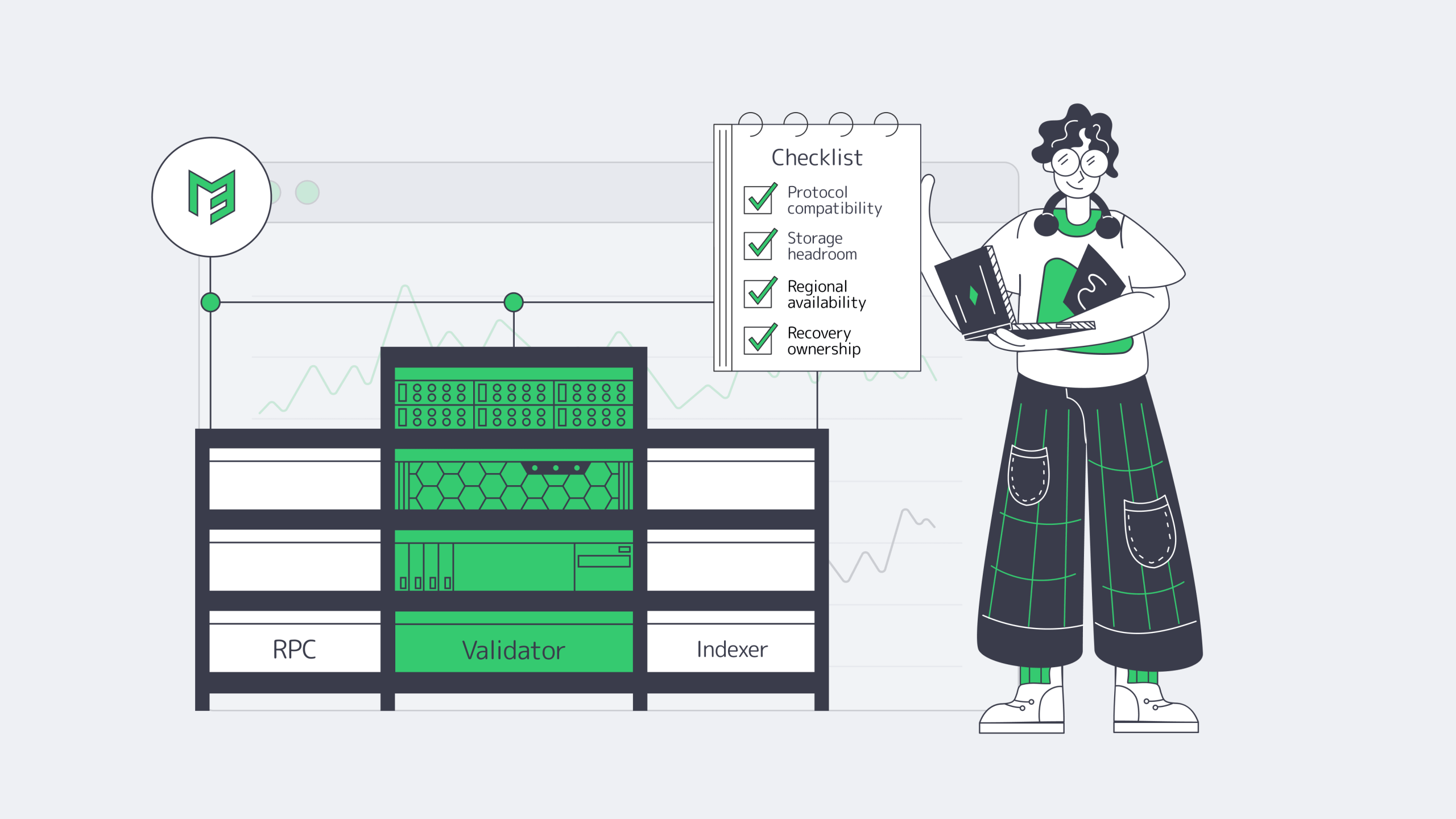
Validators prioritize protocol compliance and safe signing. RPC nodes prioritize endpoint throughput and latency. Indexers prioritize sustained data processing, retention, and reliable rebuilding.
The strongest procurement process combines hardware qualification with explicit operating responsibilities, realistic recovery requirements, verified geographic availability, and workable payment arrangements.
Before committing to production capacity, apply three practical checks:
- Test recovery, not just normal operation. Confirm that validators can resume safely, RPC nodes return to usable synchronization, and indexers restore query-consistent data.
- Validate complete configurations in the target city. CPU, memory, storage, bandwidth, and replacement capacity must be available together.
- Assign operational ownership before deployment. Every critical monitoring, upgrade, backup, failover, and recovery task needs an accountable operator.
These checks turn infrastructure selection into a measurable engineering decision.
Plan Your Web3 Deployment
Use the requirements worksheet to select Melbicom hardware and locations for your validators, RPC nodes, and indexers. Our team can help match each configuration to your workload.