
Blog
Dedicated Server in US: How to Choose the Right Region and Hardware
A U.S. server footprint maps workloads to regions. Put latency-sensitive compute near request sources, keep data near ingestion paths, and place recovery capacity outside the primary failure domain. Define latency, RTO, and RPO before comparing hardware.
U.S. Servers– 28 Atlanta configurations – 35 Los Angeles configs – 24/7 infrastructure support |
 |
How to Choose a U.S. Server Region
Choose a dedicated server in U.S. regions from measured P95 and P99 latency, packet loss, jitter, and route stability—not geography alone. Keep P95 network RTT within roughly 30–40 percent of the application’s end-to-end target, then validate bandwidth economics, compliance eligibility, hardware headroom, and an independent recovery location.
Map traffic by metro, access network, volume, transferred bytes, and criticality. Lower-volume traffic may still carry more revenue or risk.
RIPE NCC’s measurements from more than 10,000 vantage points show why observation beats geolocation. Its estimate—about 1 millisecond of RTT per 100 kilometers—is a physical floor, not a guarantee; routing, filtering, and geolocation errors affect results.
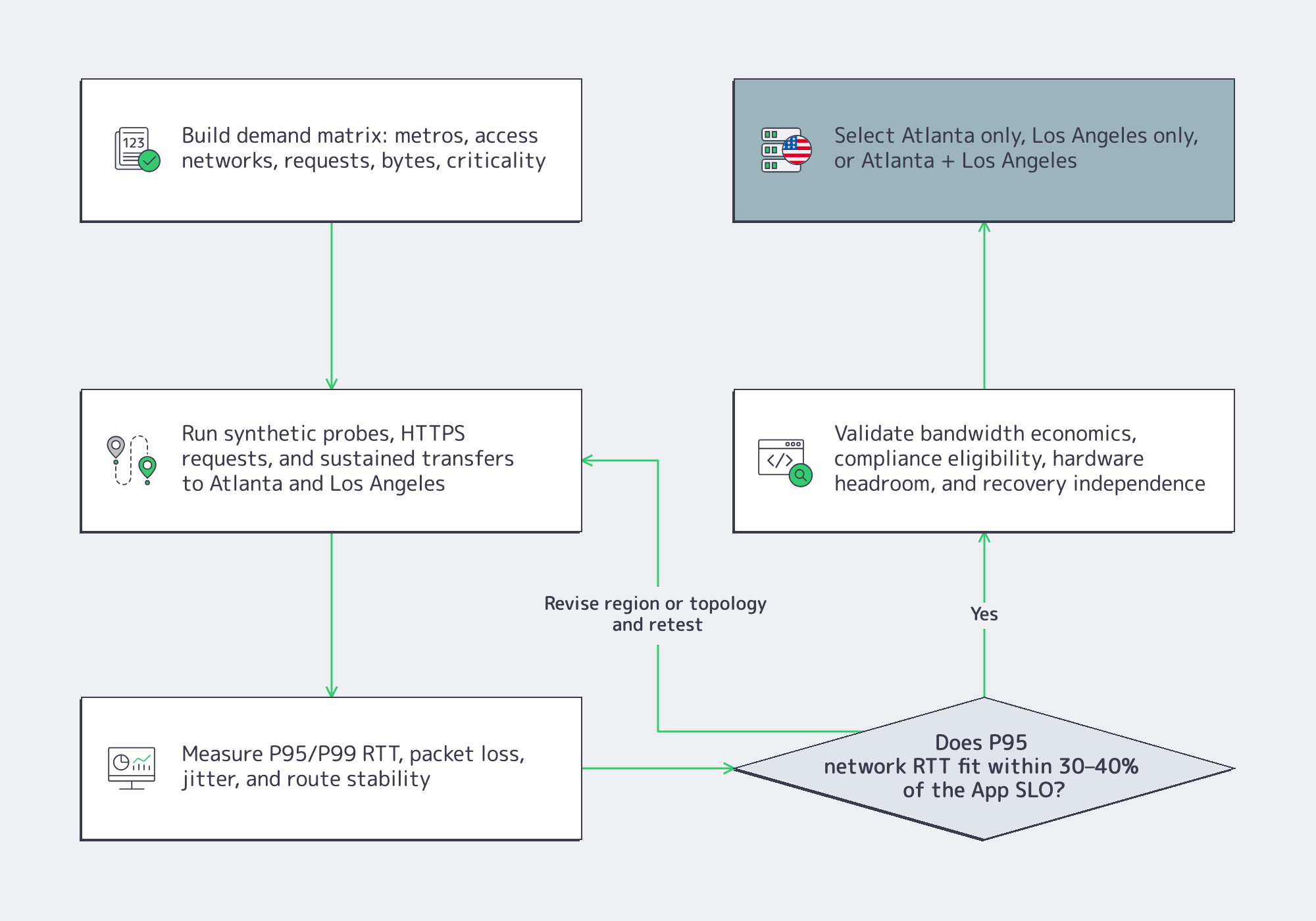
Combine synthetic probes with application timing. ICMP misses DNS, TLS, queueing, backend calls, and last-mile behavior, so test HTTPS requests and sustained transfers.
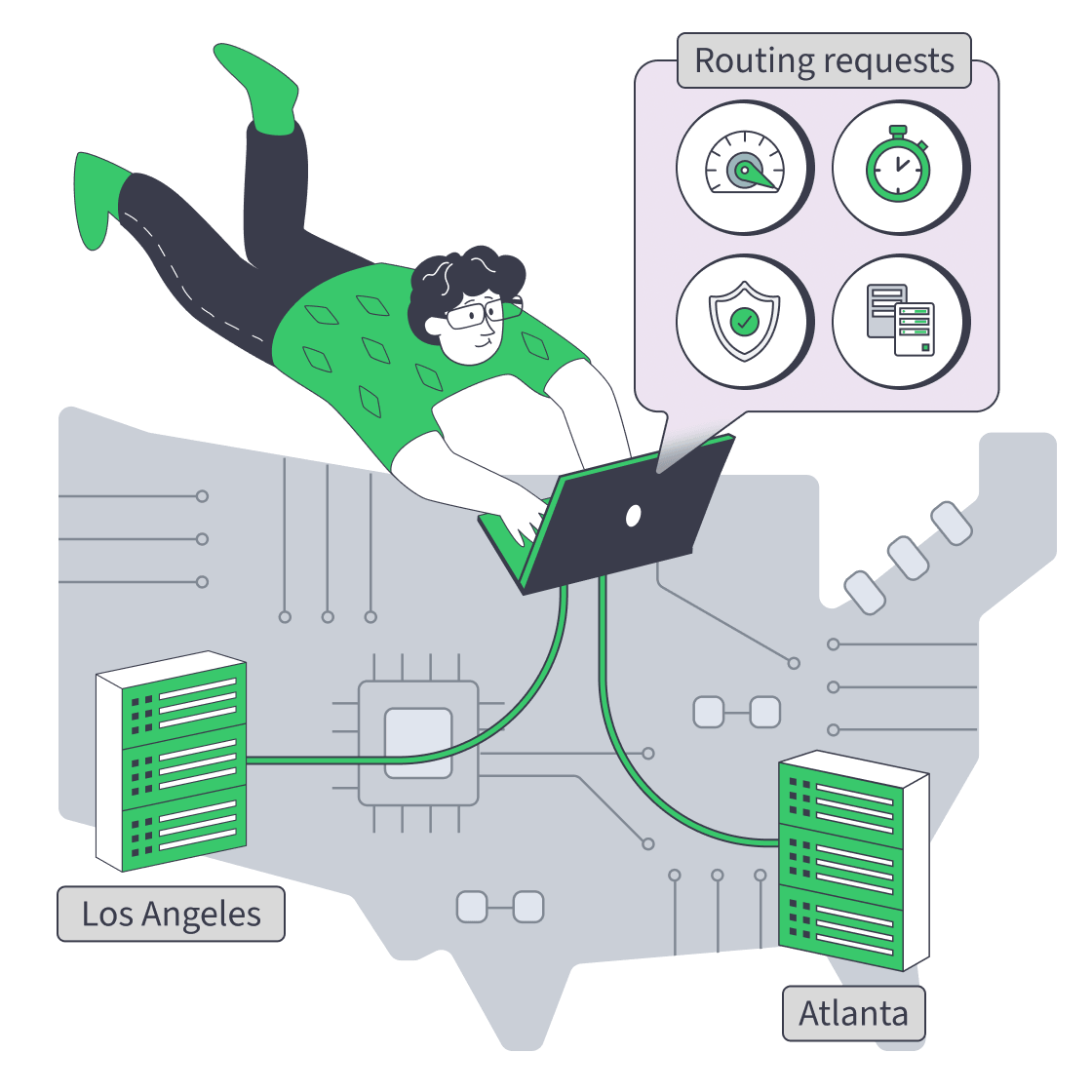
Melbicom’s U.S. footprint consists of Atlanta and Los Angeles. Both are Tier III locations, with per-server network capacity up to 200 Gbps in Atlanta and 200 Gbps in Los Angeles. Benchmark both before choosing one region or an east-west pair.
U.S. East, Central, or West Hosting
East or Southeast is the first candidate for east-heavy and transatlantic traffic; West fits western and Pacific-facing demand; Central is a compromise for balanced, moderately latency-sensitive workloads. For national interactive services, two regions often outperform one midpoint when traffic can be routed locally and state can be replicated without synchronous cross-country writes.
| Regional footprint | Best-fit workload pattern | Main tradeoff to validate |
|---|---|---|
| East or Southeast, such as Atlanta | Eastern and Southeastern users, transaction APIs, regional SaaS | West Coast latency plus storm, power, and carrier dependencies |
| Central U.S. | Balanced national demand, back-office systems, batch workloads | Average distance may still produce mediocre tail latency to both coasts |
| West, such as Los Angeles | Western users, media workflows, Pacific-facing delivery | East Coast latency plus seismic, wildfire, power, and telecom risks |
| Atlanta and Los Angeles | National interactive applications, regional steering, disaster recovery | Replication cost, consistency choices, duplicated capacity, and operational complexity |
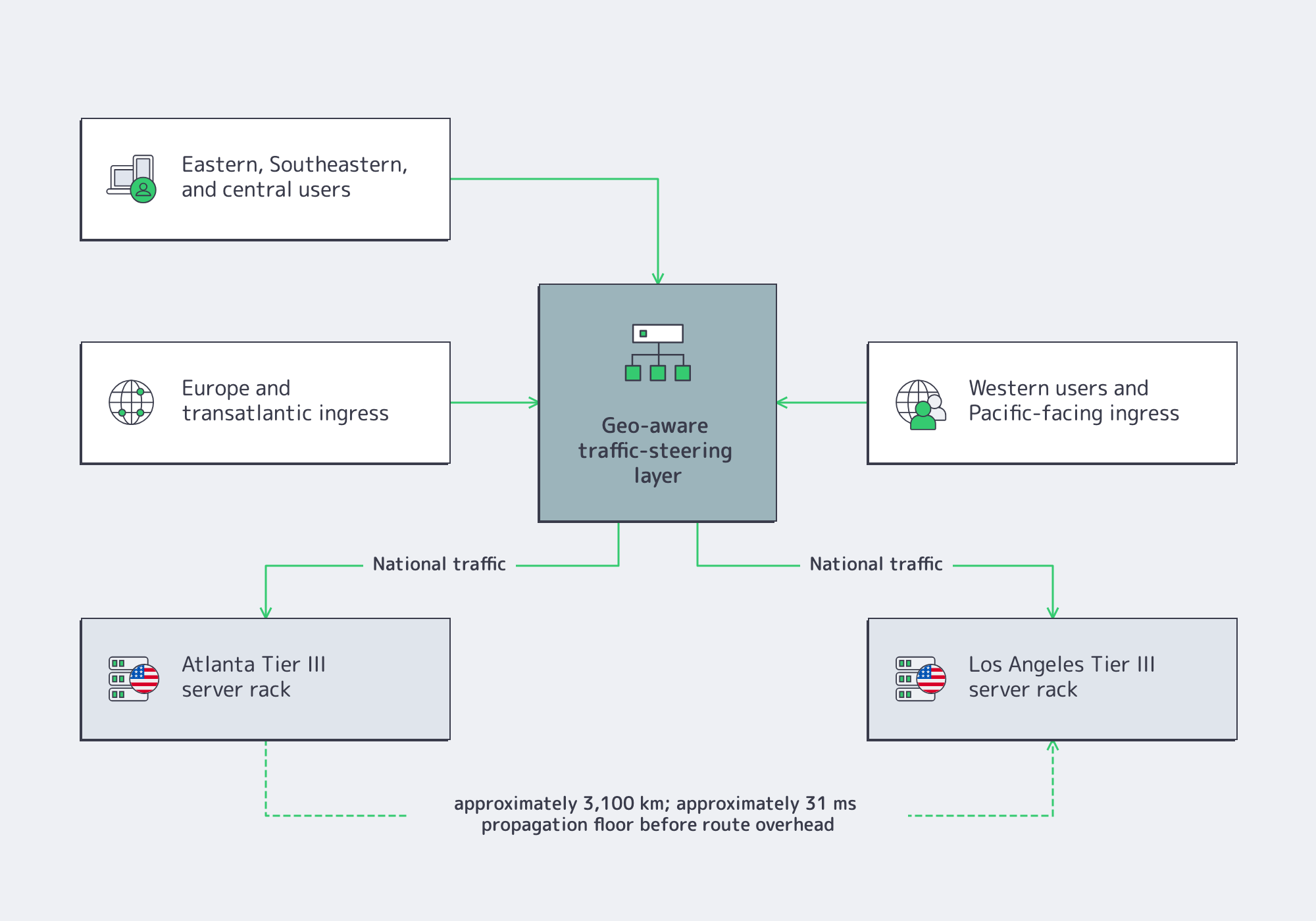
Test Atlanta for eastern and central networks and Los Angeles for western and Pacific-facing flows. Because Melbicom has no central U.S. location yet, compare a single-region deployment with an Atlanta–Los Angeles topology.
The cities are roughly 3,100 kilometers apart. RIPE’s estimate implies a floor near 31 milliseconds RTT; real routes add distance and queueing. Synchronous cross-region commits add WAN delay to every write, so low-latency systems usually need local commits, asynchronous replication, regional leaders, or partitioned ownership.
Build the Latency Budget First
Latency accumulates across connection setup, network RTTs, queueing, execution, storage, dependent services, serialization, and return transit: End-to-end latency = connection overhead + network RTTs + queueing + application time + data-service time + serialization.
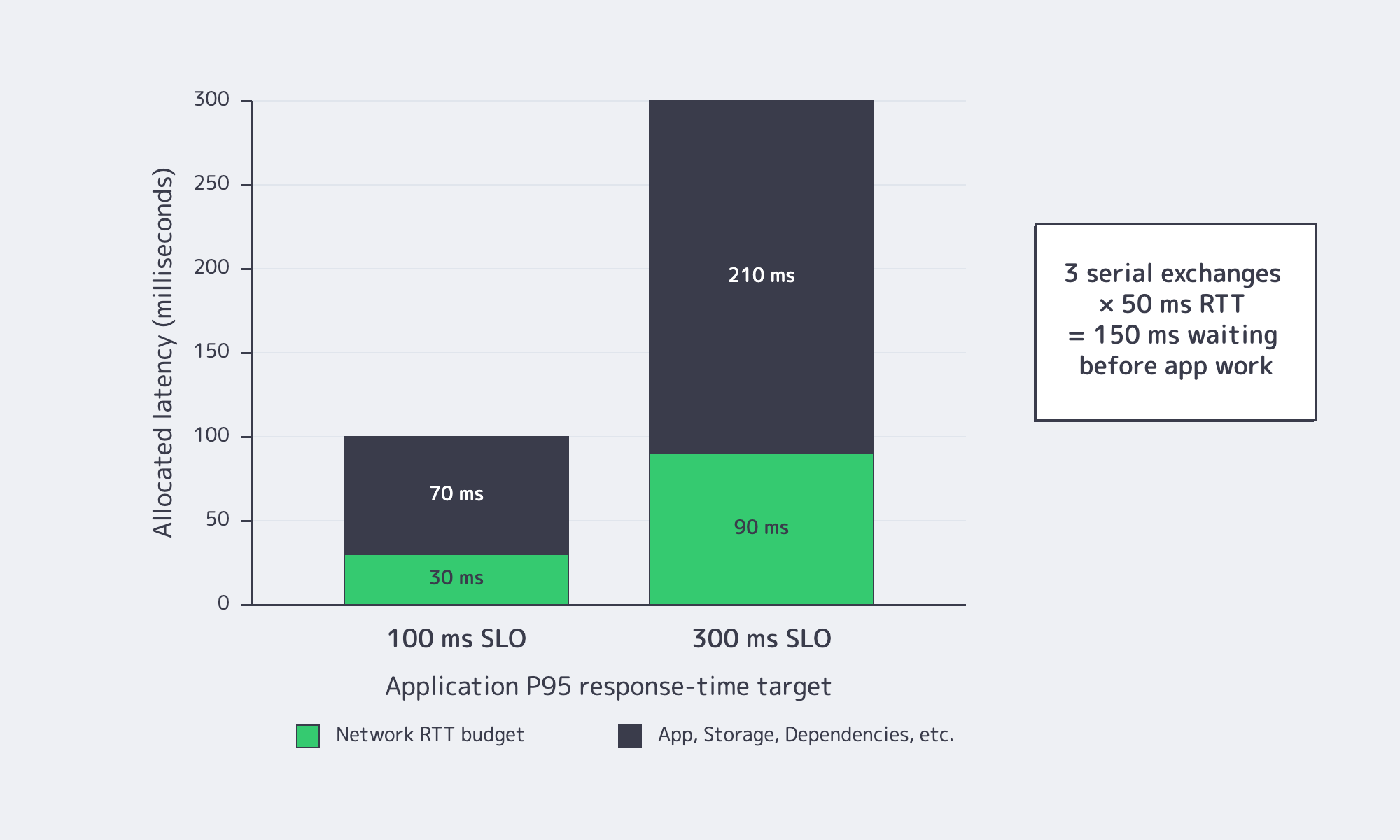
Three serial round trips over a 50-millisecond route consume about 150 milliseconds before useful work. Connection reuse, fewer chained calls, local caches, and co-located dependencies can outperform a processor upgrade.
Allocate the network a defined share of the SLO. A 100-millisecond P95 target might reserve 30 milliseconds for transit; a 300-millisecond application might reserve 90. Interactive APIs should optimize tail RTT, real-time services must include jitter and loss, and bulk transfer should prioritize sustained throughput.
Sizing U.S. Dedicated Server Hardware
Size a dedicated server in the U.S. around the resource that limits production: per-core speed for serial paths, core count for parallel workers, RAM for the active working set, SSD latency and endurance for write-heavy systems, and NIC capacity for sustained transfer. After representative load tests, retain 25–40 percent operating headroom.
CPU and Memory
High per-core performance matters for serial paths; more cores suit parallel workers. Track per-core utilization, run queues, throttling, and P99 latency because low average CPU can hide one saturated thread.
RAM must cover application state, database buffers, cache, guests, containers, and agents without sustained swapping. Include the load a surviving region must absorb.
Melbicom’s U.S. ready pool is asymmetric. Atlanta offers Intel Xeon E5 v4 and E5-2650 configurations with 64–128 GB RAM. Los Angeles adds first-generation Xeon Scalable systems and offers 128–256 GB RAM. Match the workload to the pool, or define a custom configuration—delivered in 3–5 business days—before committing.
Storage and Network
Choose storage by IOPS, write latency, throughput, endurance, and failure model—not capacity alone. SNIA explains TBW and DWPD and notes that write amplification changes real wear. Writing 3 TB daily to a 3.84 TB SSD is about 0.78 DWPD before amplification. Mirroring is not backup.
A fast NIC helps only when CPU, storage, buffers, and peers can fill it. RFC 6349’s bandwidth-delay product shows why: 10 Gbps at 60 milliseconds requires about 75 MB in flight; 40 Gbps requires about 300 MB. Window scaling, encryption, packet rate, and the remote endpoint can become bottlenecks.
Melbicom’s broader catalog contains 1100+ ready-to-go configurations, but U.S. options must be checked by region. Confirm CPU overhead, storage throughput, transfer policy, and failover demand before selecting a port rate.
Bandwidth, Compliance, and Failover Requirements to Validate
Document sustained throughput, transfer accounting, mitigation behavior, compliance responsibilities, backup locations, RTO, RPO, and traffic shifting. A port speed or “protected” label does not define the service boundary.
At continuous full utilization for 30 days, theoretical decimal transfer reaches 324 TB at 1 Gbps, 3.24 PB at 10 Gbps, 12.96 PB at 40 Gbps, and 64.8 PB at 200 Gbps. These are ceilings before protocol overhead and route limits. Include replication, backups, failover, retransmissions, and attack traffic.
For Melbicom’s U.S. locations, the upper per-server network option is up to 200 Gbps in Atlanta and 200 Gbps in Los Angeles (custom configurations). Ready-to-go configurations include 1–40 Gbps bandwidth choices with 50 TB or unmetered transfer plans. Compare unmetered servers with metered options using expected sustained utilization.
Melbicom provides DDoS protection, but requirements should specify attack classes, detection thresholds, mitigation time, protected scope, clean-traffic capacity, false-positive handling, telemetry, and escalation. ASD guidance updated in June 2026 recommends agreeing mitigation capacity, costs, monitoring and shutdown thresholds, and pre-approved actions with the provider. Reachability does not guarantee application recovery.
A U.S. server does not create compliance. For ePHI, HHS requires an appropriate business associate agreement and clear allocation of HIPAA responsibilities. PCI DSS v4.0.1 was published in June 2024; 51 of 64 new v4.x requirements became effective March 31, 2025 (PCI SSC). Replicas, backups, logs, and administrative paths can expand scope.
RTO defines recovery time; RPO defines tolerable data loss. Sub-15-minute RTO and sub-five-minute RPO generally require provisioned capacity, continuous replication, health-aware steering, and rehearsed procedures. A second server satisfies neither without current data, configuration, secrets, routing, monitoring, dependencies, and tested operators.
Multi-Region Failover for Real Failures
Choose cold, warm, hot active-passive, or active-active operation from RTO, RPO, and consistency requirements. Stateless services are easiest to distribute. Stateful systems need one writer, regional leaders, partitioned data, asynchronous replicas, consensus, or application-level reconciliation.
Separate correlated hazards. NIST SP 800-34 recommends alternate sites far enough apart to avoid common hazards, with equivalent controls, tested recovery, and telecommunications that avoid shared failure points. FEMA’s National Risk Index compares communities across 18 natural hazards and can inform—not certify—regional risk analysis.
Check DNS, certificates, secrets, deployments, monitoring, identity, upstream data, and staff access for shared failure domains. Measure replication lag in time and bytes, and design failback before the secondary accepts writes.
Traffic steering needs a failure model. DNS switching depends on caching. BGP can preserve a service prefix, but convergence does not restore application state; endpoint changes in DNS-based designs can break existing connections (RFC 8678). Melbicom’s BGP Session service can be incorporated into customer-controlled routing designs, while health criteria and application recovery remain workload decisions.
Remove the primary region’s production path during exercises. Verify detection, capacity, data freshness, traffic movement, and failback under peak load, replication lag, stale state, management-path loss, and shared deployment failure. Melbicom’s CDN, with 40 CDN PoPs across 35 countries, can reduce cacheable origin traffic but cannot replace writable application recovery.
Choose Footprints by Failure Domain
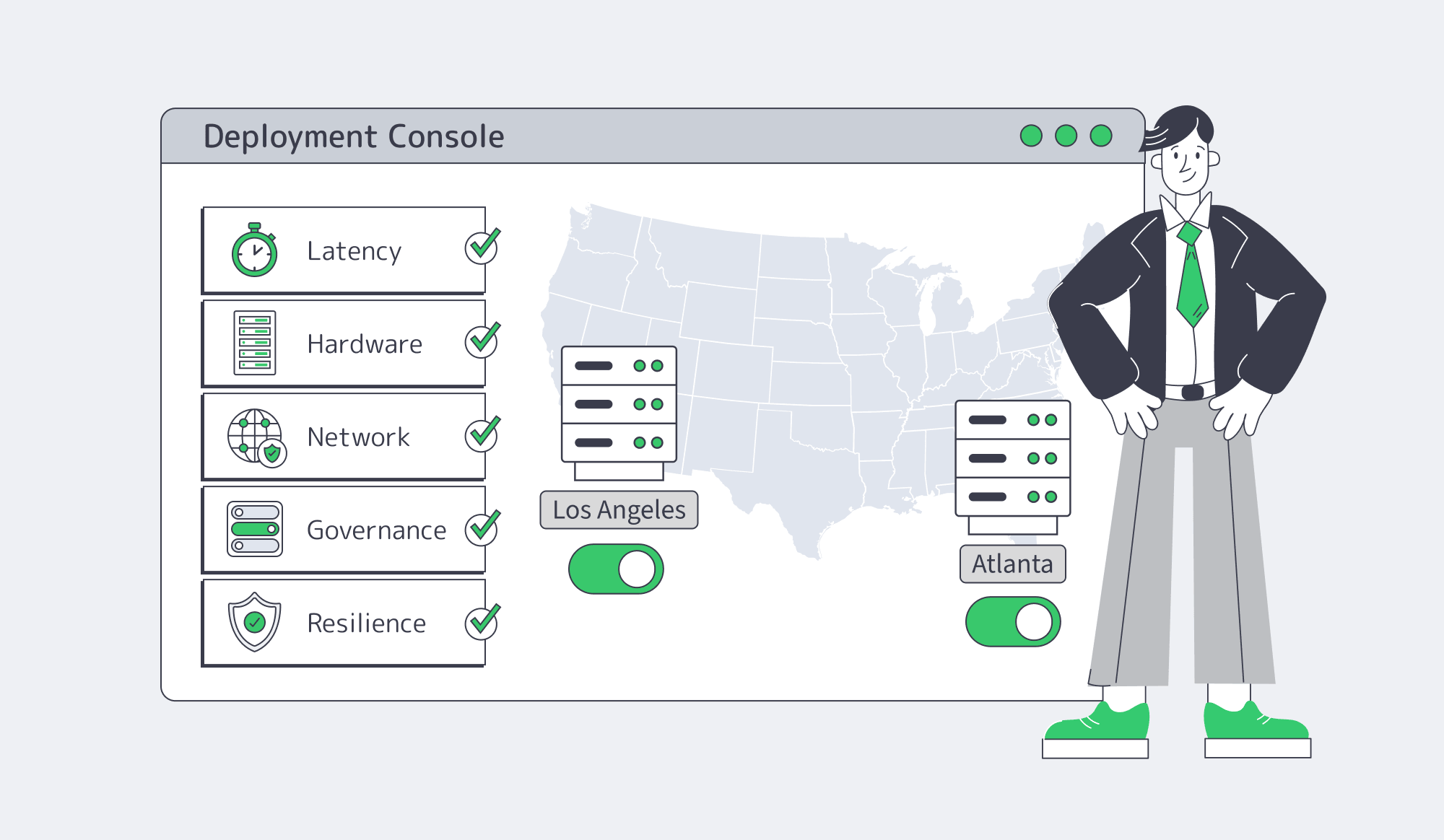
The right dedicated server in the U.S. satisfies a measured deployment model. Treat Atlanta and Los Angeles as separate operating regions, then confirm that latency, hardware headroom, usable throughput, compliance scope, RTO, RPO, traffic steering, and failback meet explicit objectives.
Apply these decision rules before comparing configurations:
- Use one U.S. region only when eastern and western tail latency fits the workload and recovery permits delayed promotion.
- Distribute stateless reads before writable state; avoid synchronous cross-country writes unless the added RTT is acceptable.
- Size the secondary for failover traffic, not its normal standby load.
- Treat the location’s published per-server maximum as a ceiling until storage, CPU, transport windows, and transfer policy prove usable throughput.
- Keep regulated data out until contracts, controls, and procedures cover it.
- Test failback and shared-dependency failures, not only one server’s loss.
Once those constraints are fixed, compare Atlanta and Los Angeles against the measured workload and recovery model.
Choose Your U.S. Server Footprint
Compare Atlanta and Los Angeles dedicated servers, bandwidth options, and ready-to-go configurations against your measured latency and failover targets.