
Blog

iGaming Server Compliance: Hosting Controls Operators Cannot Ignore
For regulated real-money operators, compliance is not a document that lives behind legal. It is the production topology: where critical systems run, which networks can reach them, how privileged access is controlled, and whether the platform can still prove what happened when traffic turns hostile.
That makes igaming server compliance a hosting problem as much as a governance problem. The UK Gambling Commission’s RTS security scope covers systems that handle sensitive customer data, RNG outcomes, game state, entry and exit points to critical systems, and communication networks carrying sensitive data. In Great Britain, major online operators processed 27.4 billion bets and spins in Q3 October-December 2025, with 12.7 million average monthly active accounts. At that event rate, logs, time sync, backups, payment boundaries, and failover paths become the evidence layer.
iGaming Hosting– Dedicated production systems – Regional data placement – DDoS and network controls |
 |
Where Does iGaming Server Compliance Create Hosting and Uptime Risk?
iGaming server compliance creates hosting and uptime risk anywhere infrastructure touches balances, authentication, RNG, game state, payment flows, support access, or the networks around them. If those layers are not isolated, logged, and recoverable, a routine platform issue can become an audit finding, a launch delay, or a player-trust incident.
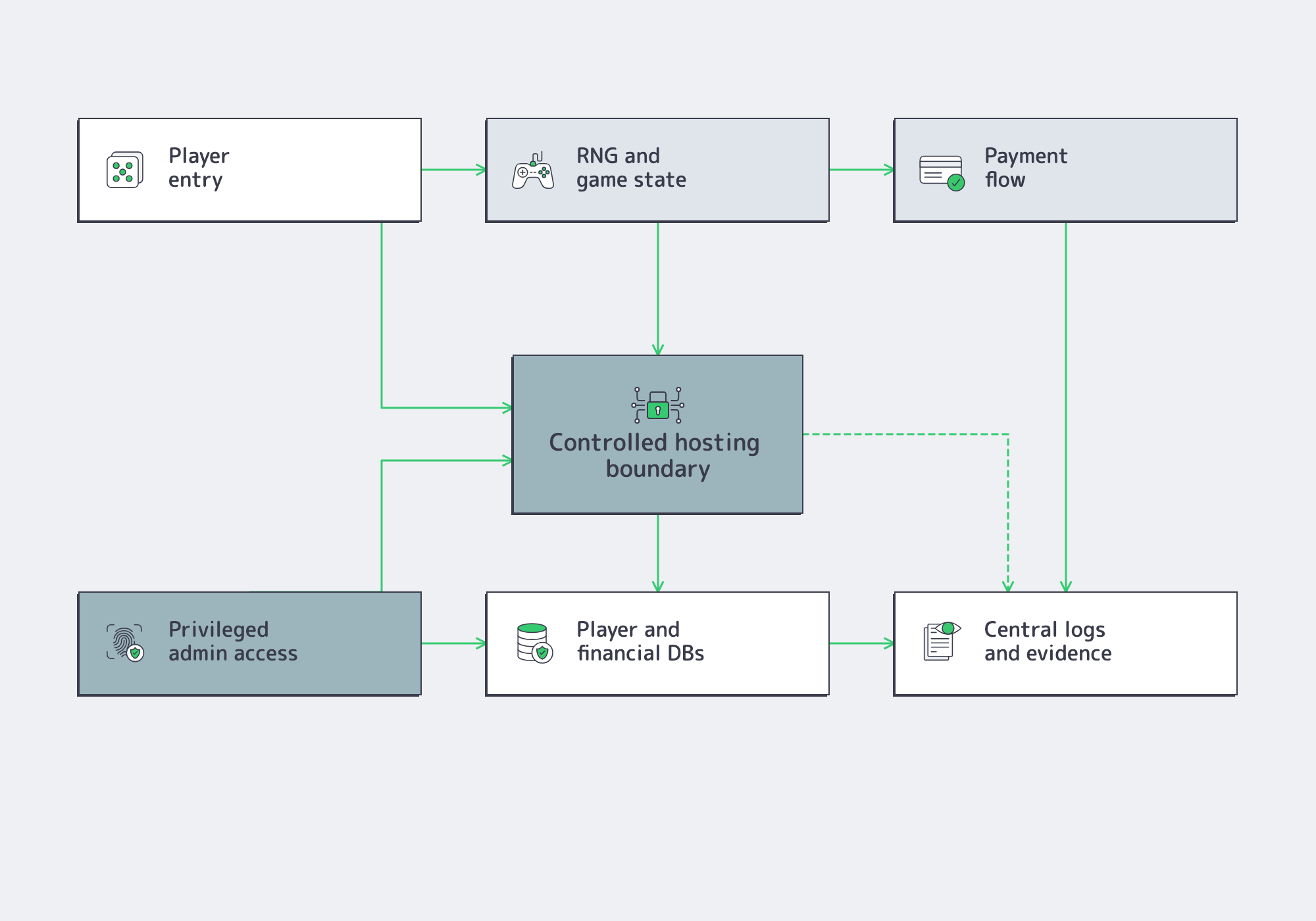
The first mistake is scoping compliance only around the game engine or cashier. UKGC requirements are broader. Malta’s regulator treats essential components as RNG hosts, jackpots, game hosts, gaming, player and financial databases, and the control system. Ontario requires certification for critical gaming systems and components before deployment. The hosting estate also includes public entry points, private databases, regulator-facing channels, admin paths, and connecting networks.
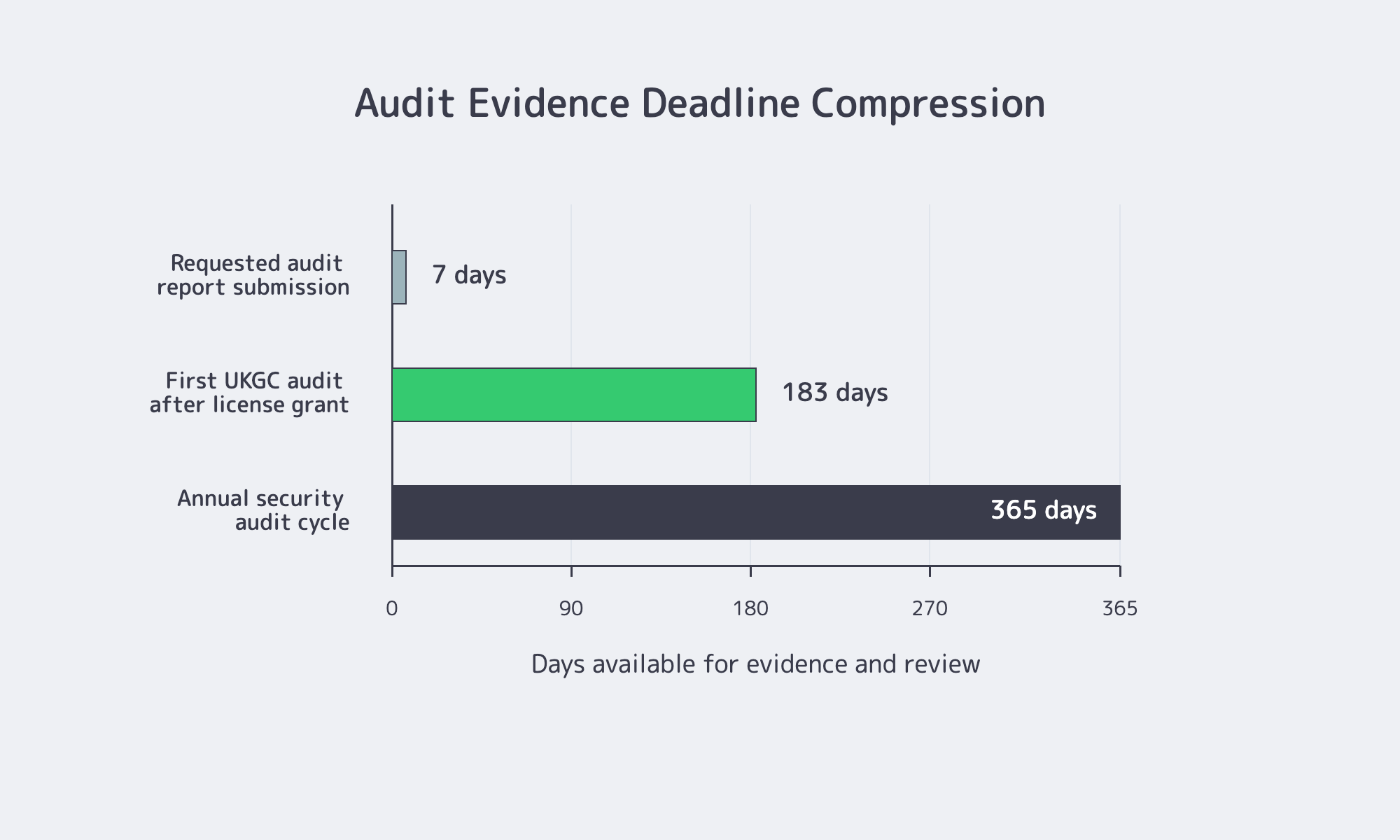
That is why infrastructure failures often read like regulatory exposure. A support bastion that can reach production databases, an unmanaged backup copy of player data, a payment-connected subnet with loose internal access, or a storage tier without clear retention controls all create questions auditors will ask. Newly licensed UK remote operators also face a first independent security audit within six months, then annual audits after that; major non-conformities must be reported without delay.
The hosting decision should make those questions boring. Critical workloads should run on named infrastructure, in known jurisdictions, with separate management paths and clear ownership. Shared convenience is expensive when it blurs access, scope, and recovery.
Which Data, Logging, Encryption, and Access Controls Matter?
Operators should validate data location, log integrity, encryption posture, and privileged access as one control system. A practical baseline is region-pinned production data, synchronized clocks, tamper-resistant centralized logs, MFA-gated admin access, current TLS profiles, and documented review cadence across critical components and suppliers.
Data location is about lawful operation, not just latency. Nevada publishes registered hosting centers. The UK’s ICO says a restricted transfer can include making personal information accessible to a separate organization outside the UK, including through remote access. So the hosting region and the support model have to be designed together. A platform can keep production data in the right facility and still create transfer risk if a loosely governed third party administers it from the wrong place.
Logging is the next pressure point. GLI-19 expects an internal clock that timestamps transactions, games, and significant events, plus synchronized time across components. It also expects user activity, exceptions, and security events to be centrally monitored, protected from tampering, retained for a suitable period, and reviewed with records of that review. PCI guidance frames logging as the record of who did what, where, when, and how. If the logs cannot reconstruct a deposit dispute, privilege change, failed geolocation check, or game-state incident, the operator is not audit-ready.
Encryption and access controls need the same specificity. NCSC recommends TLS 1.3 or hardened TLS 1.2 and disabling older protocol versions. GLI-19 requires least privilege, formal user registration and de-registration, regular access reviews, and secured remote access such as MFA where authorized. PCI DSS v4.0 extends MFA across access into the cardholder data environment and connected in-scope systems. For operators, the rule is simple: support access cannot become a permanent compliance exception.
| Control Surface | Evidence Operators Need | Hosting Decision That Helps |
|---|---|---|
| Data location | Named facilities for production, backups, logs, and remote support | Pin critical workloads by jurisdiction and keep admin access region-aware |
| Logging and time | Timestamped game, payment, admin, and security events | Centralize logs, sync clocks, and retain tamper-resistant copies |
| Encryption and access | TLS profile, key handling, MFA, least privilege, supplier controls | Isolate management networks and disable idle support access |
Melbicom’s iGaming infrastructure is built for this kind of mapping: 21 Tier III/IV locations, a 14+ Tbps backbone, private and inter-DC networking, BGP at every data center, and per-server connectivity up to 200 Gbps. Those details matter because compliance teams eventually ask the same concrete questions platform teams ask: where is it, how is it reached, what is isolated, and what happens under pressure?
DDoS Resilience and Compliance
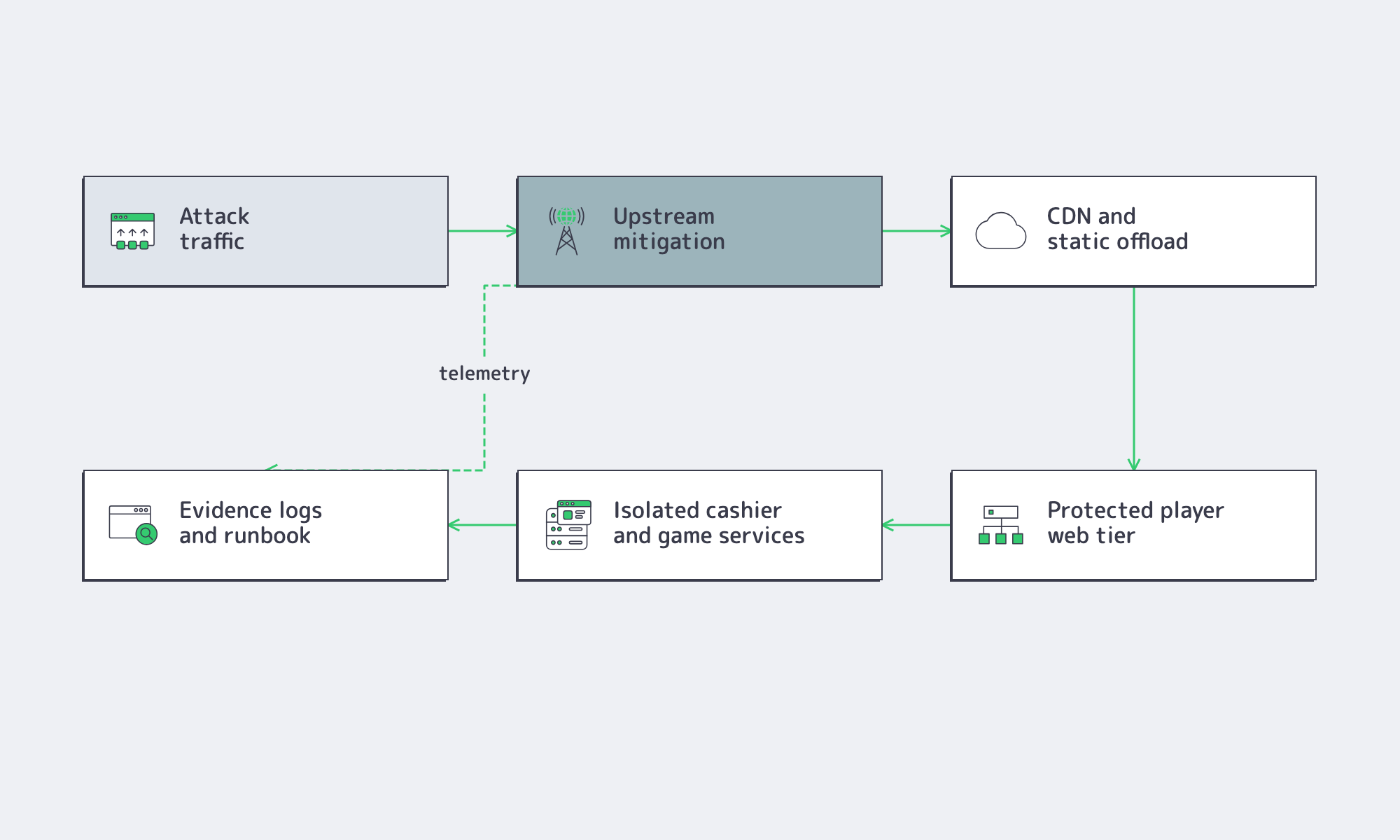
DDoS resilience changes the compliance math because availability failures can interrupt account access, wagers, settlement, and payment flows even without a breach. Operators need upstream mitigation, multiple network paths, cache or CDN offload for static traffic, and response plans that preserve evidence while the attack is still active.
The threat is ordinary enough to plan for directly. ENISA’s 2024 threat landscape put availability threats at the top of its chart, and NCSC treats denial-of-service as a credible, prevalent risk. For a real-money platform, the impact is not limited to an unavailable website. A cashier outage, delayed balance display, broken session flow, or unreachable regulator reporting channel can become a player-facing trust event.
The right architecture separates failure domains. The player web tier should not fail the same way the cashier does, and the cashier should not depend on the same recovery path as the audit pipeline. Static assets can move away from critical origins where practical. Critical data paths need redundant routes, and backups need isolation from the live environment they recover.
This is where capacity claims need engineering detail. DDoS resilience depends on upstream diversity, route control, private recovery paths, and management-plane isolation. Melbicom combines DDoS protection, CDN, private networking, 23 transit providers, and 29 IXPs across its global network, giving operators more than a server SKU to evaluate. The useful question is not “how much bandwidth is available?” It is “which parts of the platform remain reachable, observable, and recoverable during the event?”
Controls for Regulated Expansion

Regulated expansion requires more than launching servers in new places. Operators need acceptable hosting locations, certified critical systems, secure regulator reporting channels, geolocation controls, payment segmentation, and a repeatable evidence model that can adapt to each jurisdiction without rebuilding the platform from scratch.
Every market adds proof requirements. Ontario requires operators to configure secure AGCO data and information communication channels and to certify critical gaming-system technology before deployment. UK operators face recurring independent security audits. Nevada formalizes the location question with registered hosting centers. GLI-19 also treats geolocation as an operational control: location checks should happen before the first game on a device and again after an IP change or after thirty minutes since the last check.
That turns expansion into runtime design. DNS, session state, APIs, logging, and network policy all have to support the rule that a player outside the permitted boundary should be blocked before a wager becomes a settlement or dispute problem. Generic multi-region deployment is not enough if it cannot express jurisdictional policy.
The reusable pattern is a regional blueprint. Standardize privileged access, logging, time source, key handling, backup pattern, and evidence export. Then localize the pieces regulators actually vary: acceptable facility, reporting channel, retention overlay, geolocation policy, and payment or supplier boundary. Dedicated servers, vMesh private networking, CDN, storage, and jurisdiction-specific placement become building blocks rather than one-off exceptions.
Building an Audit-Ready Hosting Stack
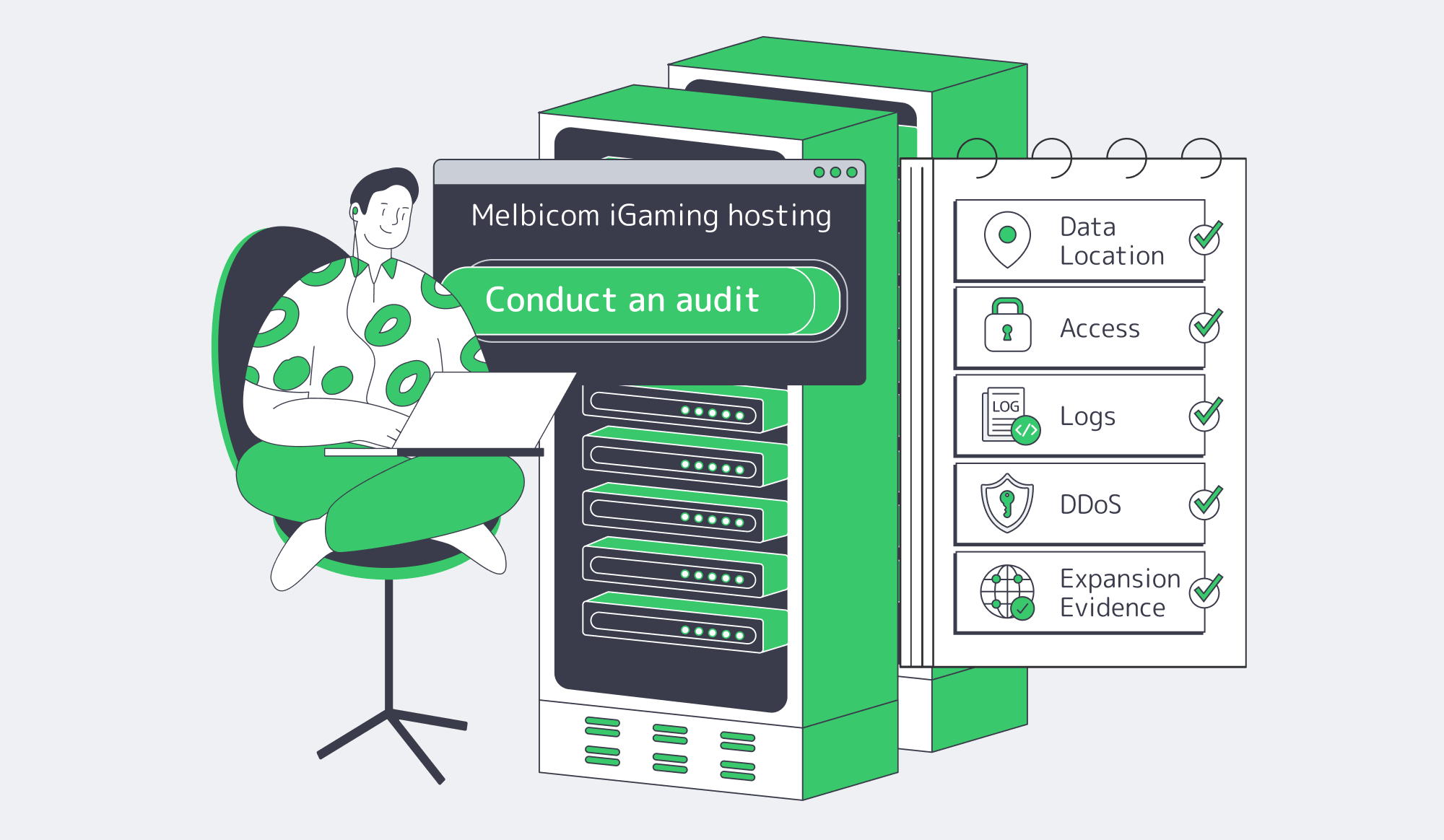
An audit-ready stack is easy to inspect and hard to misuse. Critical systems should run on dedicated or single-tenant production, logs should be centralized and tamper-resistant, clocks should be synchronized, privileged paths should require MFA, backups should be tested, and evidence should map cleanly to each regulator and payment requirement.
The goal is not to over-engineer every market. It is to make the control model repeatable. Before launch, operators should be able to answer five questions without a discovery project: where does regulated data live, who can reach it, what was logged, which systems stay available under attack, and how the same pattern will survive the next jurisdiction.
For teams planning that architecture, the provider conversation should focus on evidence, isolation, and recovery rather than generic uptime language. Closer alignment reduces audit-season work.
Build an Audit-Ready iGaming Stack
Map dedicated infrastructure, private networking, DDoS controls, and regional placement to each compliance requirement.