
Blog
Dedicated Server Ethereum: Paying with ETH for Production Bare Metal
Paying a hosting invoice with ETH can fit an Ethereum-native treasury. But production infrastructure is a recurring dependency involving invoice clocks, gas, confirmations, reconciliation, renewals, and capacity planning—not a single wallet action.
Uptime Intelligence’s 2026 outage analysis found that 57% of respondents’ most recent major outages cost more than $100,000, while one in five exceeded $1 million. A healthy server can still be threatened by payment failure.
Ethereum Hosting– ETH and crypto billing – Up to 200 Gbps per server – 24/7 infrastructure support |
 |
How Do Dedicated Server Ethereum Payments Work for Bare-Metal Hosting?
Dedicated server Ethereum payments convert a provider invoice into time-bound on-chain settlement. Verify the network, recipient, exact ETH amount, and quote expiry; send the invoice amount without subtracting gas; record the transaction hash; and wait for the provider’s crediting threshold. Reject any flow that leaves confirmation or underpayment rules undefined.
The invoice is the source of truth. Record its ID, quoted amount, expiry, recipient, network, and completion rule. “ETH” alone does not identify the rail: Mainnet uses chain ID 1, while other EVM networks use different IDs. A valid address on the wrong chain can still produce an unusable payment. Hyperledger Besu explains the distinction.
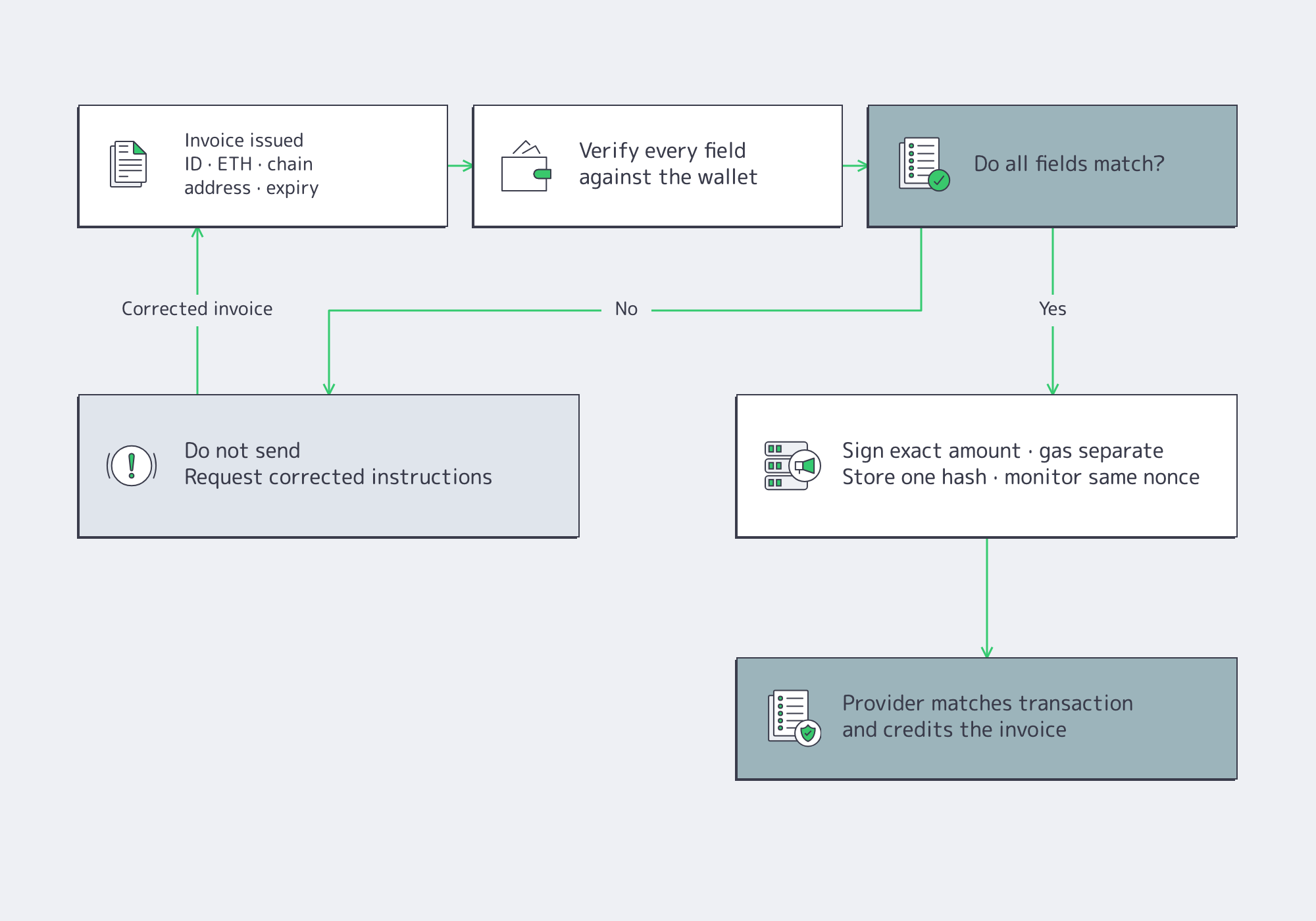
Fund the invoiced transfer value and gas separately. Ethereum.org states that a native transfer normally consumes 21,000 gas; contract checkout can require more.
Required Wallet Balance = Invoice Amount + Maximum Expected Transaction Fee
Maximum Expected Fee ≈ 21,000 × maxFeePerGas
The transaction hash is technical, not commercial, proof. The Ethereum JSON-RPC receipt shows inclusion, addresses, gas, and execution status; it does not prove provider credit. Store both. Once an invoice has a hash, monitor that transaction or replace it with the same nonce instead of sending a duplicate.
What Should Buyers Compare Across ETH Gas, Confirmations, Invoices, and Renewals?
Gas, confirmations, invoices, and renewals form one operating system. Production procurement requires exact invoice matching, an explicit chain ID, a documented crediting rule, monitored pending transactions, and settlement at least 24 hours before cutoff—or 72 hours when multisig approvals, exchange withdrawals, or weekend staffing can delay broadcast.
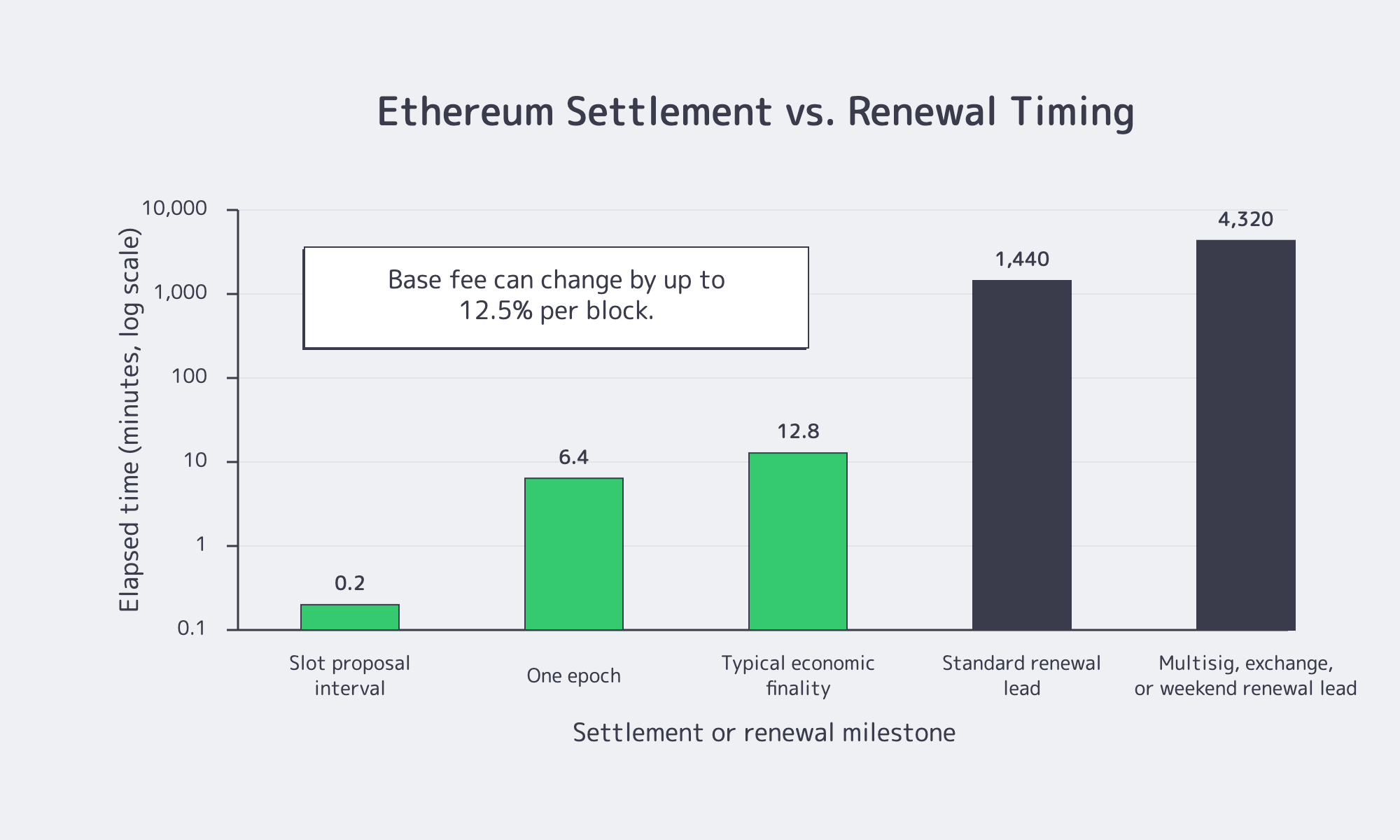
EIP-1559 separates the base fee, priority fee, and maximum fee cap. The base fee can move by up to 12.5% per block, so minimizing a small fee can expose a larger order to timing risk. Use a current estimate and increase urgency near the deadline. Contract checkout may consume more than 21,000 gas and can revert while spending gas.
Inclusion, confirmation, and finality differ. Ethereum proposes slots every 12 seconds; 32 slots form an epoch; economic finality normally arrives after roughly two epochs, or about 12.8 minutes, under normal participation. The procurement question is not “How many confirmations?” but “At what chain state does the provider credit the invoice?”
- Operational threshold: when the order, balance, or renewal is credited.
- Accounting threshold: when finance treats the transfer as economically final.
Renewal lead time should exceed protocol finality because approvals, withdrawals, quote regeneration, matching, and provider posting add delay. Reconciliation should bind the asset, invoice, Ethereum transaction, and provider credit. Preserve the quote, expiry, chain ID, addresses, hash, amount, gas cost, on-chain status, and credit time. Define handling for expired quotes, underpayments, and overpayments.
Ethereum Payment for Web3 Infrastructure
Ethereum payment fits when treasury already holds liquid ETH, finance can reconcile on-chain receipts to fiat-denominated invoices, and operations can settle before renewal deadlines. It can remove conversion and banking steps, but gas variability, quote expiry, potentially unrecoverable wrong-network transfers, and custody approvals require tighter controls than a casual wallet payment.
The strongest fit has three characteristics:
- Treasury holds ETH liquidity beyond staking, payroll, tax, and runway reserves.
- The organization can approve, broadcast, monitor, and replace transactions without an external withdrawal queue.
- Finance and operations share one view of issuance, approvals, broadcast, and credit.
ETH is weaker when budgets are entirely fiat, invoices exceed liquid ETH, immediate fiat certainty is mandatory, or staff use personal wallets. The quoted amount changes with exchange rates; gas changes with blockspace demand. Multisig and hardware signing must be reflected in renewal lead time.
Ethereum Workload Requirements
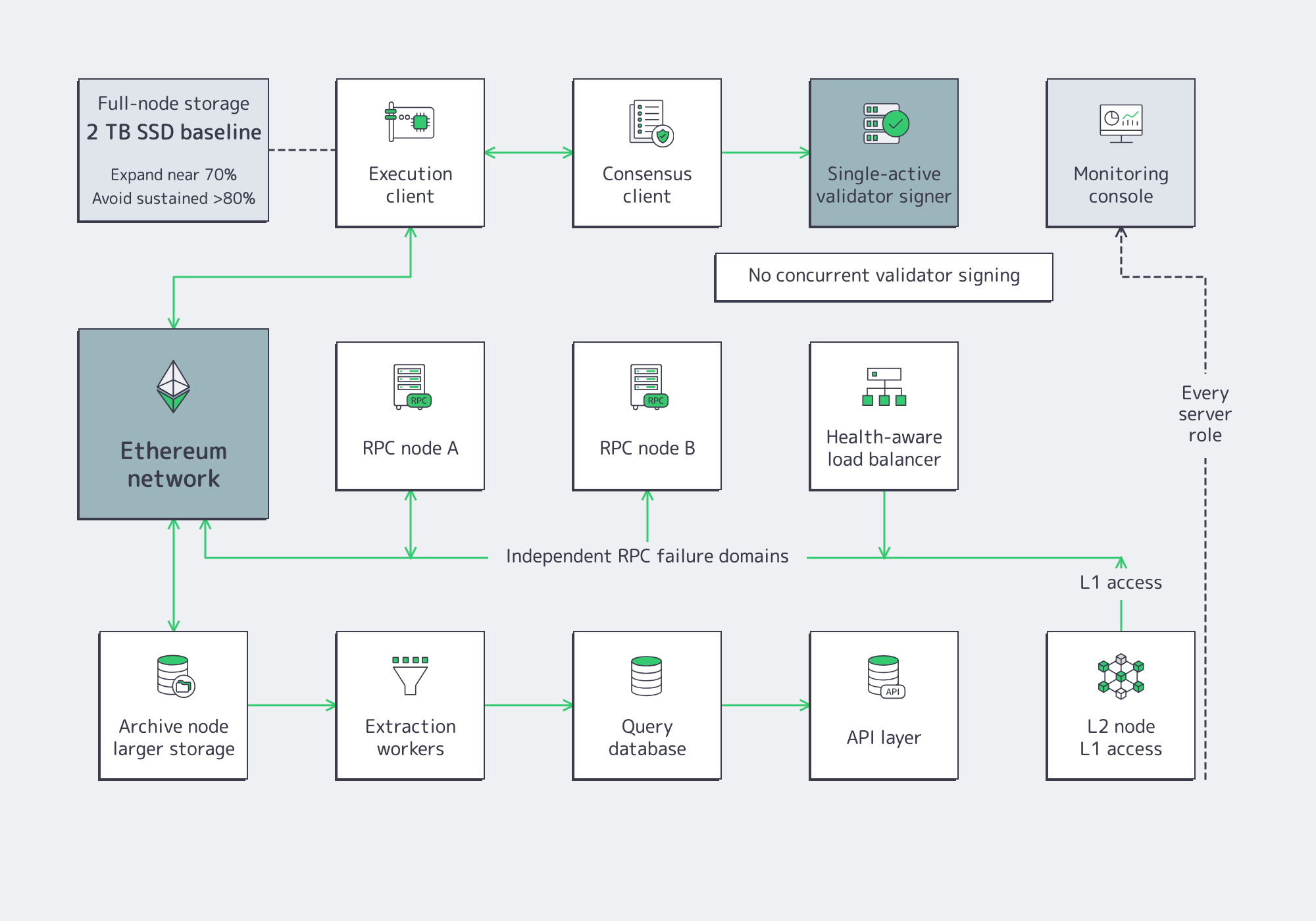
Payment method should not distract from workload fit. A production Ethereum node combines execution and consensus clients; validator deployments add signing duties. Production fleets should separate roles by blast radius, storage behavior, query load, and security sensitivity.
- Validators: isolate signing from public RPC spikes, archive queries, indexer backfills, and compaction. Measure how many validators one host failure affects. Keep failover single-active and synchronize slashing-protection data; copying keys to an uncontrolled hot standby can create double-signing risk.
- RPC nodes: need latency consistency, headroom, health-aware routing, and at least two maintained backends without one shared failure domain. Calls, traces, simulations, and WebSockets create uneven demand.
- Full and archive nodes: are not interchangeable. Geth’s guidance starts a full node plus consensus client at a 2 TB SSD; archive state needs far more. Plan for growth, migrations, snapshots, and recovery. As an operating policy, begin expansion near 70% sustained storage utilization and avoid remaining above 80%.
- Indexers and L2 systems: may depend more on NVMe IOPS, database memory, workers, and upstream L1 access than minimum node specifications. Separate node, extraction, database, and API layers. Nethermind documents L2 dependencies.
Client diversity is another control. Ethereum.org recommends minority clients because one defect can affect a large network share. The Ethereum Foundation’s July 2026 analysis described more than five production client implementations and roughly $76 billion in ETH securing the protocol. Diversity requires tested alternatives and upgrade runbooks.
Scaling Dedicated Server Ethereum Infrastructure Beyond the First Node
The first node proves synchronization. Production scale must survive maintenance, workload growth, client defects, renewal, and regional failure. A larger single host postpones saturation but does not remove single-client, single-region, single-endpoint, or single-payment dependencies.
Start with role separation and recovery. A standby matters only when it has current data, compatible versions, validated configuration, monitored health, and a tested cutover. Validator recovery also requires single-active signing and synchronized slashing-protection data. Initial synchronization can take days, so replacement capacity should be pre-staged. Snapshots help only when restoration is tested.
Multi-region design should follow user and protocol paths. RPC may prioritize latency; validators need stable peer connectivity; archive and indexing may prioritize storage economics. Uptime Intelligence also found external fiber and connectivity incidents becoming more prominent, so redundancy must cover the route to the server.
Scale against chain-head lag, disk latency, storage growth, RPC queues, p95 and p99 latency, errors, memory, throughput, and restart time. Payment operations must scale too: consolidate due dates, keep an asset register, and make invoice access, signing, and credit verification redundant. Hold the quoted amount plus at least twice the estimated maximum fee; the buffer supports replacement, not overpayment.
A Production Procurement Scorecard
| Decision Area | Production-Ready Criterion | Failure Mode to Prevent |
|---|---|---|
| ETH payment | Invoice defines chain, address, amount, expiry, and credit rule | Wrong-chain or unmatched payment |
| Gas | Amount and gas are separate; pending transfers are replaceable | Underpayment or duplication |
| Confirmation | Inclusion, credit, and accounting finality are distinct | Treating broadcast as payment |
| Reconciliation | Invoice, receipt, service period, and credit are linked | Conflicting finance and operations records |
| Renewal | Settlement starts 24 or 72 hours early | Administrative lapse |
| Sizing | CPU, RAM, NVMe, network, growth, sync, and role are modeled | Minimum hardware in production |
| Fleet resilience | Roles, clients, regions, endpoints, signing paths, and payment owners are distributed | One failure or concurrent signing event disabling the fleet |
Practical recommendations:
- Complete renewal only after provider credit; monitor both on-chain and billing states.
- Use a 24-hour lead time, or 72 hours for multisig, exchange, or weekend approvals.
- Reserve the exact invoice amount plus replacement-fee headroom; never reduce the transfer to fund gas.
- Keep validator failover single-active and preserve slashing-protection state.
- Scale on chain-head lag, disk growth, latency percentiles, and tested recovery time—not average CPU alone.
ETH Payment in the Availability Design
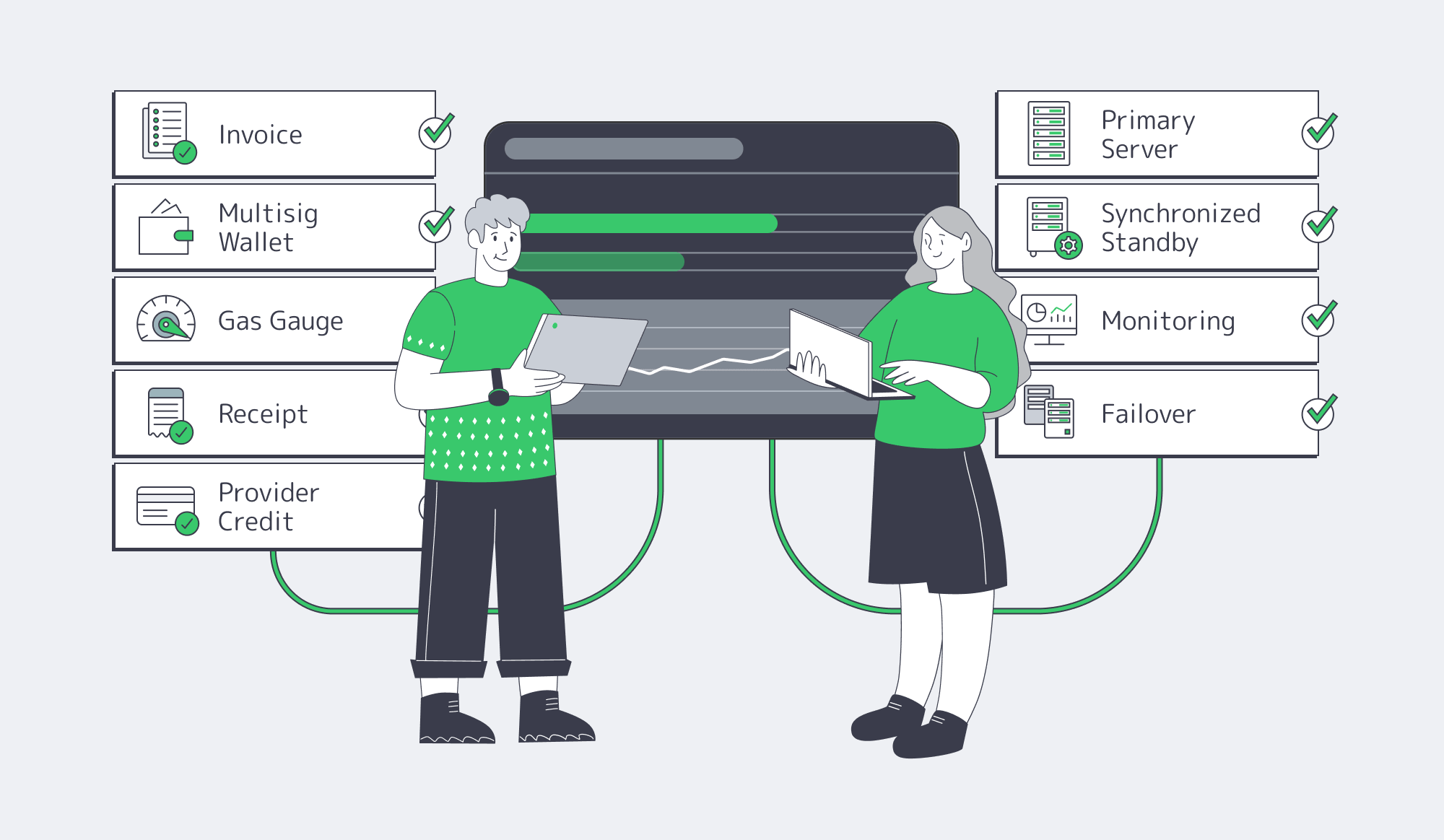
Paying for a dedicated server with ETH works when the payment rail shares the same operating model as monitoring, failover, capacity management, and incident response. The transfer may settle in minutes; the surrounding system must reliably issue invoices, approve funds, handle congestion, reconcile records, and renew infrastructure for years.
The same discipline should guide server selection. Separate validator, RPC, archive, indexing, and application roles; measure saturation; and design technical and treasury failover before the first node becomes critical. Verify payment instructions and infrastructure together.
Pay for Production Hosting with ETH
Review cryptocurrency billing options for new servers and renewals before your next infrastructure deadline.