
Blog
Tokyo Dedicated Server: Build the APAC Hot Path Without Overpaying
Map distance alone does not determine APAC latency; peering, transit, congestion, and BGP policy do. Tokyo belongs on the hot path—a game update, API call, media feed, RPC request, or blocking write—only when measurements show an advantage.
JPNAP reports more than 8 Tbps of peak traffic, 290+ connected networks, and 29 interconnection locations: deep domestic interconnection, not guaranteed routing. JPNAP Melbicom’s Tokyo dedicated server location provides a test IP and 1,000 MB object. The Tokyo network supports up to 100 Gbps per server, while orderable server bandwidth currently spans 1–40 Gbps with 50 TB or unlimited traffic.
Tokyo Hosting– Tokyo up to 100 Gbps – 1-40 Gbps orderable bandwidth – 24/7 infrastructure support |
 |
When Tokyo Should Be the APAC Hot Path
A Tokyo dedicated server should be the APAC hot path when Japan and nearby Northeast Asian users generate most latency-sensitive demand and production-shaped tests show a durable 15–20 ms p95 round-trip advantage over the fallback region. Promote Tokyo only when it survives peaks and outweighs replication, operational, and recovery costs.
A five-millisecond average gain can disappear inside mobile scheduling, TLS, queues, or database work. A persistent 15–20 ms p95 gain matters when serialized calls pay regional delay repeatedly. Weight by revenue, abandonment risk, and write sensitivity—not volume.
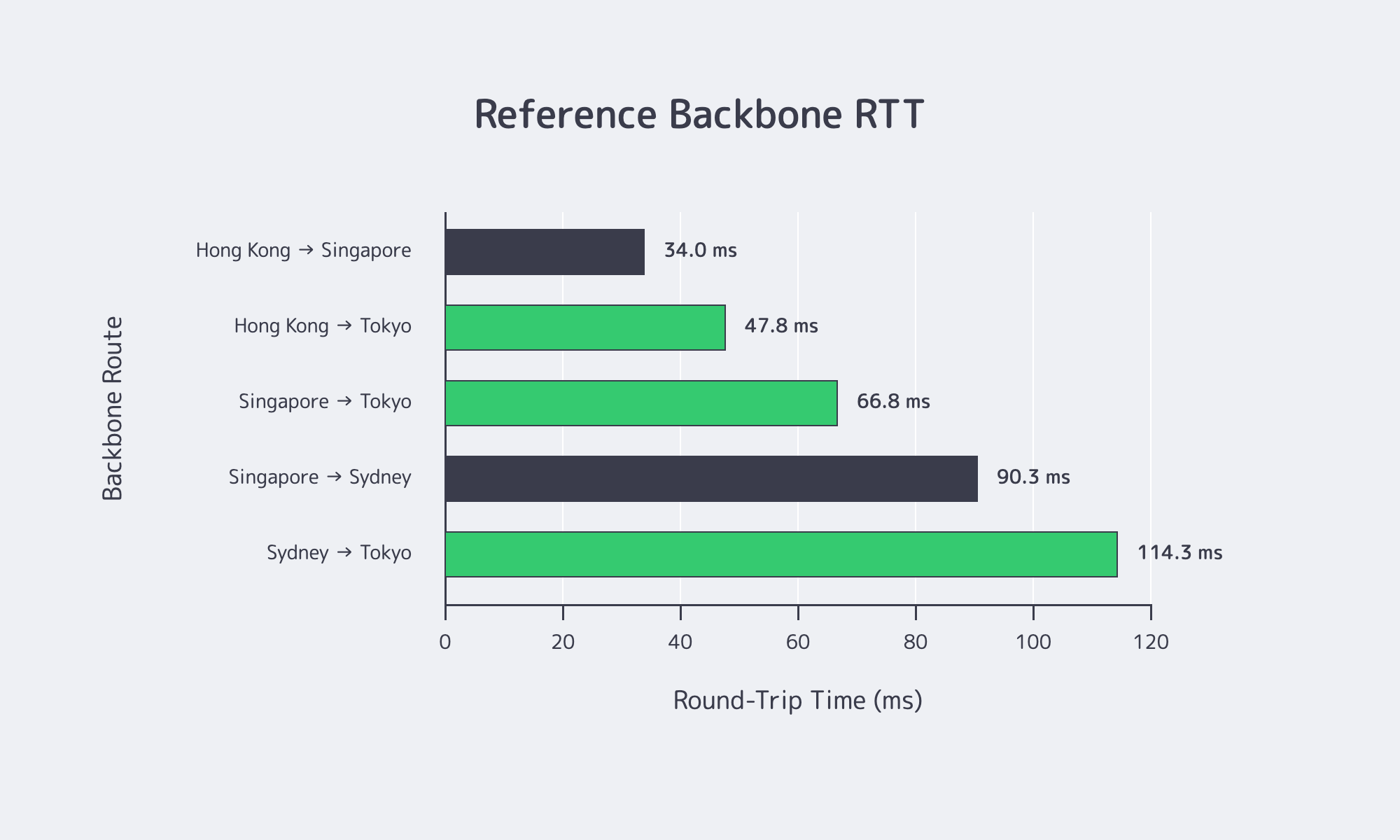
June 2026 backbone measurements show why “APAC latency” is not one number. Verizon
Tokyo need not win every market. It works when Japanese demand dominates, writes remain local, and farther-south users use caching or stateless tiers. Place ingress, execution, and authoritative state separately.
Tokyo vs. Singapore Workload Placement
Tokyo should lead for Japan-centered and Northeast Asia-heavy traffic; Singapore should lead for Southeast Asia-heavy demand. Use seven days of p50, p95, and p99 application measurements from target networks. A persistent 15 ms p95 advantage can change placement economics; a five-millisecond edge rarely justifies another region.
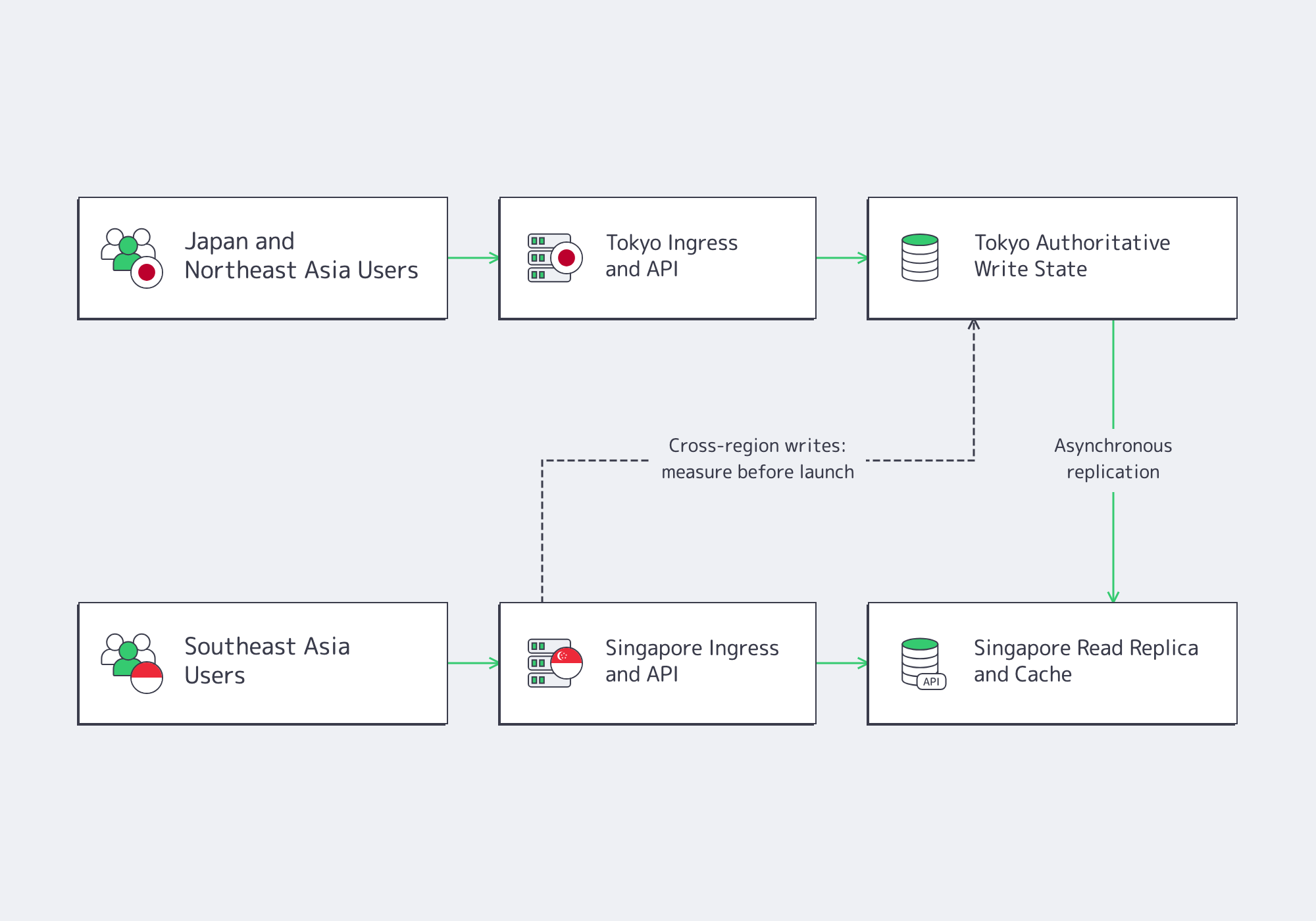
Compare which city removes more delay from the valuable dependency chain. Serial cross-region authentication, risk checks, inventory, and commits make users pay repeatedly. Put authoritative state where writes originate; replicate read models, public content, and analytics asynchronously.
| Workload | Tokyo-primary signal | Working launch gate |
|---|---|---|
| Interactive APIs | Valuable writes or sessions originate in Japan | Durable p95 application advantage from target networks |
| Trading-adjacent systems | Japanese data, counterparties, or users dominate | Data rights confirmed; internet latency excluded from execution assumptions |
| Multiplayer gaming | Dense Japanese or Northeast Asian cohort shares state | RTT, jitter, loss, and tick-budget targets pass at peak |
| Live and on-demand media | Contribution or origin processing is in Japan | Ingest, transcode, storage, and origin egress survive bursts |
| Web3 nodes and RPC | Clients or useful peers cluster in Northeast Asia | CPU, memory, storage, sync, and network tests pass under catch-up load |
| Regional failover | Japan is revenue-critical | Recovery objectives pass without synchronous WAN dependencies |
Measure DNS, setup, TLS, authentication, queues, storage, and downstream calls. Test by autonomous system across mobile, broadband, offices, VPN exits, and gateways. Because BGP paths can be asymmetric, track round-trip loss; the IETF counts failure in either direction. RFC 6673
When neither city wins, run stateless APIs in both and partition state by tenant, session, or geography. In mobile gaming, place apps by combined player latency; ingest media in Tokyo and distribute through caches.
Workload Fit: Trading-Adjacent Apps, Gaming, Media, and Web3
A Tokyo dedicated server is not a generic “Asia server.” Its value depends on each workload’s latency budget, traffic shape, state model, and failure mode. Dedicated hardware reduces contention, but routes, storage, queues, protocols, and application architecture still determine Tokyo production performance.
Trading-Adjacent Apps. Tokyo fits market-data normalization, analytics, APIs, risk, and reporting near Japanese infrastructure. It is not exchange co-location. JPX reports approximately 60 microseconds one-way through an access point and three microseconds in its co-location area—another class from an internet server.
Market-data rights are prerequisites: JPX says real-time data generally requires contracts and redistribution requires permission.
Gaming. At 60 Hz, one tick lasts about 16.7 ms; tens of milliseconds can span several ticks. Test real UDP traffic, bursts, matchmaking, voice, and evening routes—not ICMP alone. The IETF identifies low, stable latency as critical. RFC 9318
Run authoritative matches near Tokyo players while identity, commerce, and telemetry use suitable paths. Evaluate Melbicom’s game development hosting with match-level evidence.
Media. Tokyo is strongest when the first mile is in Japan: contribution, ingest, encoding, packaging, or origin storage. At a 12 Mbps reference bitrate for high-frame-rate 1080p SDR, 10,000 viewers imply 120 Gbps of video egress before audio, overhead, retransmissions, or margin. YouTube guidance
Use Tokyo streaming servers as origins and Melbicom’s CDN for fan-out across 40 PoPs in 35 countries, including Tokyo. HLS adaptive delivery follows RFC 9317.
Web3. Storage and I/O govern sync, pruning, state access, and recovery; CPU and memory affect execution; upload stability affects propagation. EIP-7870’s proposal-level reference configurations recommend 4 TB NVMe, 32–64 GB RAM, and 50/15 to 100/50 Mbps for selected Ethereum roles. EIP-7870
Validate sync, catch-up, state-heavy RPC, peer churn, restore, and sustained upload. Melbicom’s Web3 server hosting supplies the dedicated infrastructure layer; protocol documentation determines the final configuration.
Route Testing, Bandwidth, and Data Governance Checks before Launch
Before launch, test from the access networks, protocols, packet sizes, and peak-hour windows the application will use; size bandwidth from p95 throughput plus burst margin; and map every personal-data flow. A practical gate is seven days of testing, under 0.1% sustained loss, and at least 30% port headroom under representative load.
Start with 203.190.0.130 and the 1,000 MB object, then repeat from the provisioned server. Probe customer networks. Collect p50, p95, and p99 RTT, loss, jitter, DNS, TCP or QUIC setup, TLS, time to first byte, request duration, and throughput.
Use traceroute as a time series. RIPE Atlas TraceMON correlates latency and loss with route, BGP, IXP, and AS changes; LatencyMON compares ping, DNS, TLS, and HTTP.
Test single-flow and parallel throughput. RFC 6349 warns that access-port provisioning cannot guarantee end-to-end TCP performance and emphasizes bandwidth-delay product.
10 Gbps × 70 ms RTT ≈ 87.5 MB in flight
Required port capacity ≈ peak useful application throughput ÷ target utilization
A 6 Gbps workload at 70% utilization implies 8.6 Gbps, making 10 Gbps rational. For sustained replication or media, Tokyo unmetered servers replace a transfer allowance with the selected port as the primary capacity boundary.
Melbicom’s network uses 29 IXP peering hubs and 23 transit partners. That diversity helps shortlist Tokyo; route tests validate the client path.
Governance follows data beyond the server: access, support exports, logs, backups, CDN processing, analytics, snapshots, developer copies, and failover replicas. Japan’s PPC identifies APPI as the core framework; only the Japanese legal text has legal effect. PPC
The 2026 APPI amendment passed on July 10 and was promulgated on July 17; most provisions will take effect on a date set by Cabinet Order within two years of promulgation, with secondary rules pending. Record the current compliance basis and assign ownership for reviewing them.
Regional Failover without Two Hot Paths
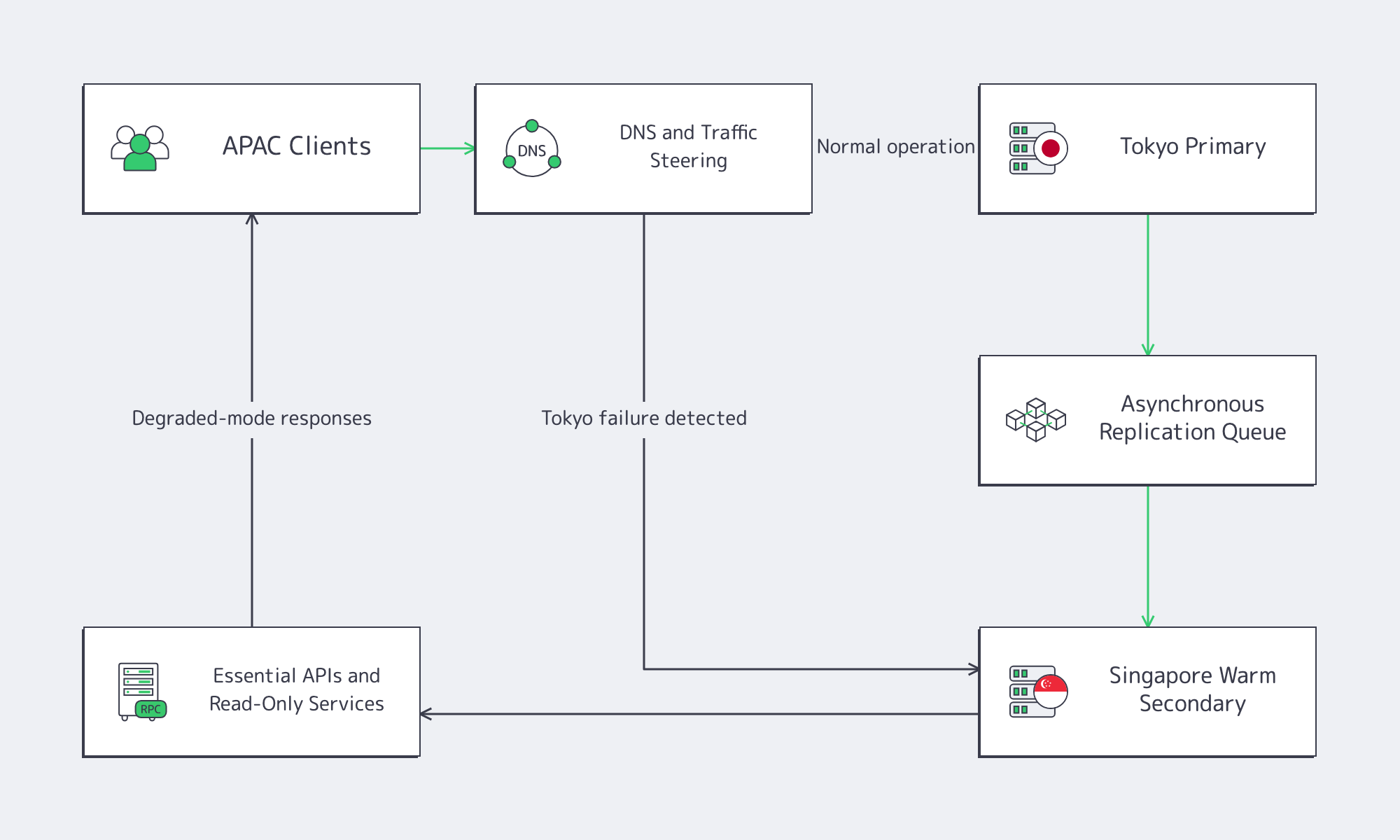
A Tokyo-primary service does not need a second region mirroring every feature at full scale. Size the secondary around the recovery point objective, recovery time objective, degraded-mode plan, and critical transaction set. A warm secondary protects the business while analytics and lower-value functions pause, queue, or become read-only.
Define RPO and RTO first. Asynchronous replication usually fits latency-sensitive systems because synchronous cross-region commits add WAN delay to every write. Rebuild artifacts, copy public data, and invalidate sessions; apply stricter durability to balances, entitlements, and user content.
Test detection, traffic steering, capacity, consistency, retries, and failback at production load. Standbys can fail under connection storms, cache misses, recovery, or queued jobs.
Melbicom operates 21 Tier III and Tier IV data centers, including Tier III locations in Tokyo and Singapore. vMesh can be evaluated for private server-to-server connectivity. Choose recovery through route tests, governance, and drills, and keep Tokyo authoritative only for data that benefits from Tokyo.
The Tokyo Dedicated Server Buying Decision
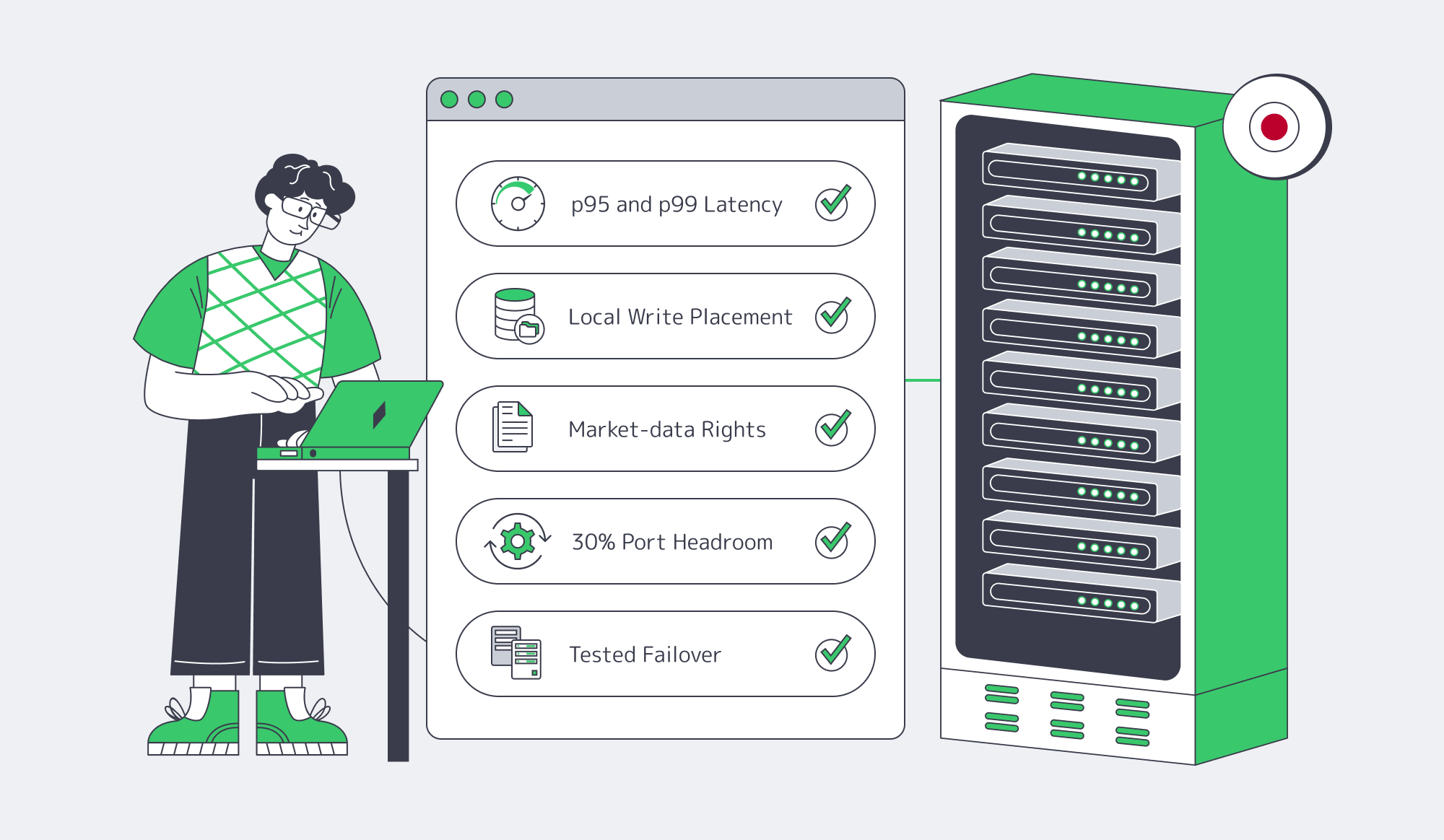
Tokyo should be primary when named access networks reach it consistently, high-value requests improve at the tail, critical state can remain local, and regional failure can be survived without putting every normal request across a wide-area link. It should not be selected as a generic APAC badge or justified by headline port speed alone.
Use these operating gates before committing budget:
- Weight p95 and p99 by revenue-bearing request class so cacheable traffic does not dominate the location decision.
- Keep write-heavy dependencies on the Tokyo hot path; use asynchronous replication unless the recovery point objective requires otherwise.
- Separate exchange-connected execution from internet-delivered analytics and APIs, and confirm market-data rights before ingest.
- Reserve at least 30% port headroom and test single-flow and aggregate throughput during Japanese peak hours.
- Define degraded mode, failover authority, and failback steps before sizing secondary capacity.
Build Your Tokyo Hot Path
Compare Tokyo dedicated servers, bandwidth options, and ready-to-go configurations against your measured APAC latency targets.