
Blog
Crypto Hosting Buyer’s Guide: Dedicated Servers for Nodes & Trading
Crypto hosting is no longer shorthand for “rent a box and keep it online.” Modern crypto workloads concentrate risk in three places: private keys, network reachability, and stateful data that is slow to rebuild. The latest NETSCOUT DDoS report says global attack counts topped 8 million and peak demonstrations reached 30 Tbps, which is why resilience has to start upstream rather than at the server edge alone.
The dependency story changed, too. Stripe cites research showing that 35.5% of global security breaches were linked to third parties. In crypto, that matters because externally managed nodes, shared infrastructure, and opaque platform layers expand the trust boundary. In proof-of-stake Ethereum, validators must stake 32 ETH—roughly $68,000 at recent ETH/USD prices—and operate on a fixed 12-second slot and 32-slot epoch cadence, so uptime is directly tied to economic outcomes.
Best Crypto Hosting— 1,300+ ready-to-go servers — Custom configs in 3–5 days — 21 global Tier IV & III data centers |
 |
What Crypto Hosting Means for Node Ops, Trading Workloads, and Secure Infra
Crypto hosting usually means one of three things: running nodes and validators, placing trading systems close to market data and liquidity, or hosting ASIC mining hardware. The first two are secure compute-and-network problems with very different failure modes. The third is mostly a power-and-cooling business, so this guide only mentions it in passing.
For node operations, crypto server hosting means validators, full nodes, RPC endpoints, indexers, and archival systems. Those are stateful workloads. On Ethereum, a production validator means an execution client, a consensus client, and a validator client. On Solana, the infrastructure profile is more explicit: Agave calls for high-clock CPUs, 12 cores / 24 threads or more for validators, 16 cores / 32 threads or more for additional RPC capacity, 256 GB or more of RAM, 512 GB for full account indexes, multiple NVMe devices, and at least 1 Gbit/s symmetric Internet, with 10 Gbit/s preferred.
For trading, crypto server hosting is less about chain state and more about deterministic networks. Trading systems fail when paths lengthen, packets queue, clocks drift, or endpoints move. That is a different problem from “keep the node in sync.” The buying process gets cleaner once those workloads are separated. ASIC mining hosting sits in the same search bucket, but it is fundamentally about facility power, thermals, and rack operations, not the secure infrastructure decisions covered here.
How to Evaluate Crypto Hosting for Security, Compliance, and Uptime
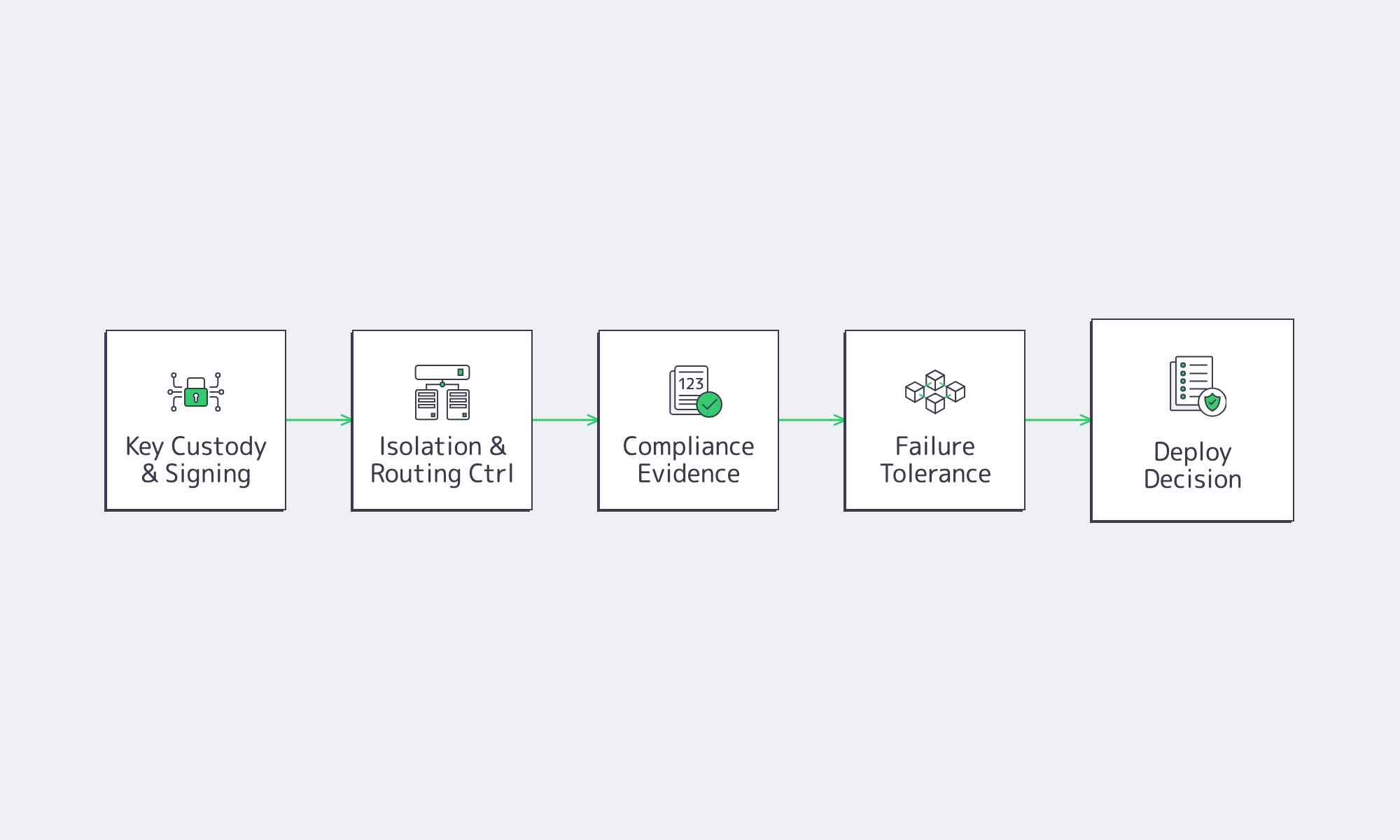
Evaluate crypto hosting in this order: key custody and signing, isolation and routing control, compliance evidence, and failure tolerance. CPU and RAM still matter, but they rarely decide outcomes alone. In production, the real question is whether the environment lets you sign safely, contain blast radius, and stay correct when components fail or networks get noisy.
Start with key management. If the workload can sign anything of value—validator duties, treasury actions, withdrawals, or custody operations—its risk profile starts there. Where the compliance footprint is higher, buyers should map HSM and KMS choices against FIPS 140-3 and NIST SP 800-57, not as future enhancements but as day-one design constraints.
Then look at isolation. Single-tenant infrastructure narrows the blast radius and reduces noisy-neighbor risk. Network isolation matters just as much: the management plane should be separate from production traffic, and private links should be available where state replication or multi-site failover matters. Melbicom enables private networking between data centers and an isolated management network reached through VPN. On the routing side, Melbicom offers BGP at every data center, enforces RPKI validation, and accepts only prefixes with valid IRR entries. In a world where DDoS demonstrations now reach 30 Tbps, those upstream controls matter more than checkbox language.
Compliance should be evidence-led, not promise-led. Ask for audit artifacts such as PCI DSS, ISO 27001, or SOC 2 Type II reports, plus incident-response and disaster-recovery procedures. Crypto-specific rules push that further: FATF’s virtual-asset guidance applies Recommendation 16—the travel rule—to VASP transfers and requires originator and beneficiary data handling. Uptime works the same way. Tier III means concurrently maintainable; Tier IV means fault tolerant. For validators and critical RPC, that distinction is operational, not cosmetic.
When Dedicated Servers Make More Sense Than Generic Hosting for Crypto Workloads
Dedicated servers make more sense when the bottleneck is predictability rather than burst capacity: fast local storage for sync-heavy nodes, stable routing for public endpoints, known tenant boundaries for sensitive operations, and deterministic paths for trading. When failure cost is measured in missed duties, stale data, or unstable ingress, generic hosting stops being cheap.
That is especially obvious in node operations. Ethereum’s node guidance centers storage and bandwidth: recommended specs are a fast CPU with 4+ cores, 16 GB or more of RAM, fast SSD storage with 2+ TB, and 25+ MBit/s bandwidth, while full-history footprints can climb from roughly 2.2 TB to 12 TB or more depending on client. Solana’s Agave guidance is blunter still: cloud deployment requires materially more operational expertise to achieve comparable stability and performance. Dedicated infrastructure wins when you need known disk behavior, cleaner tenant boundaries, and better control over public exposure.
Crypto Server Hosting for Validators and RPC
The table below condenses the latest published hardware guidance from Ethereum and Agave into a buying view.
| Workload | Baseline Hardware Profile | Storage / Network Posture |
|---|---|---|
| Ethereum node | Fast CPU, 4+ cores; 16 GB+ RAM | Fast SSD with 2+ TB; 25+ MBit/s bandwidth |
| Ethereum full-history / archive node | Client-dependent CPU and memory footprint | Roughly 2.2–12 TB+ depending on client, plus ~200 GB for beacon data; bandwidth caps still matter during sync |
| Solana Agave validator | 12 cores / 24 threads+; 256 GB+ RAM; ECC suggested | NVMe for accounts, ledger, and snapshots; at least 1 Gbit/s symmetric, 10 Gbit/s preferred |
| Solana Agave RPC | 16 cores / 32 threads+; 512 GB for full account indexes | Separate high-IOPS NVMe layout; dedicated public IP preferred |
The next design question is how the system fails. Signing should be isolated where possible, and distributed-validator patterns are worth evaluating because they reduce single points of failure. SSV argues that splitting validator operations across multiple independent nodes improves resilience and supports active-active redundancy. Recovery matters, too. Fast local storage should be paired with object storage for snapshots, rollback bundles, and long-retention logs; Melbicom’s S3-compatible storage is relevant here because it is designed as a drop-in S3 service that scales from 1 TB to 500 TB.
Crypto Server Hosting for Low-Latency Trading
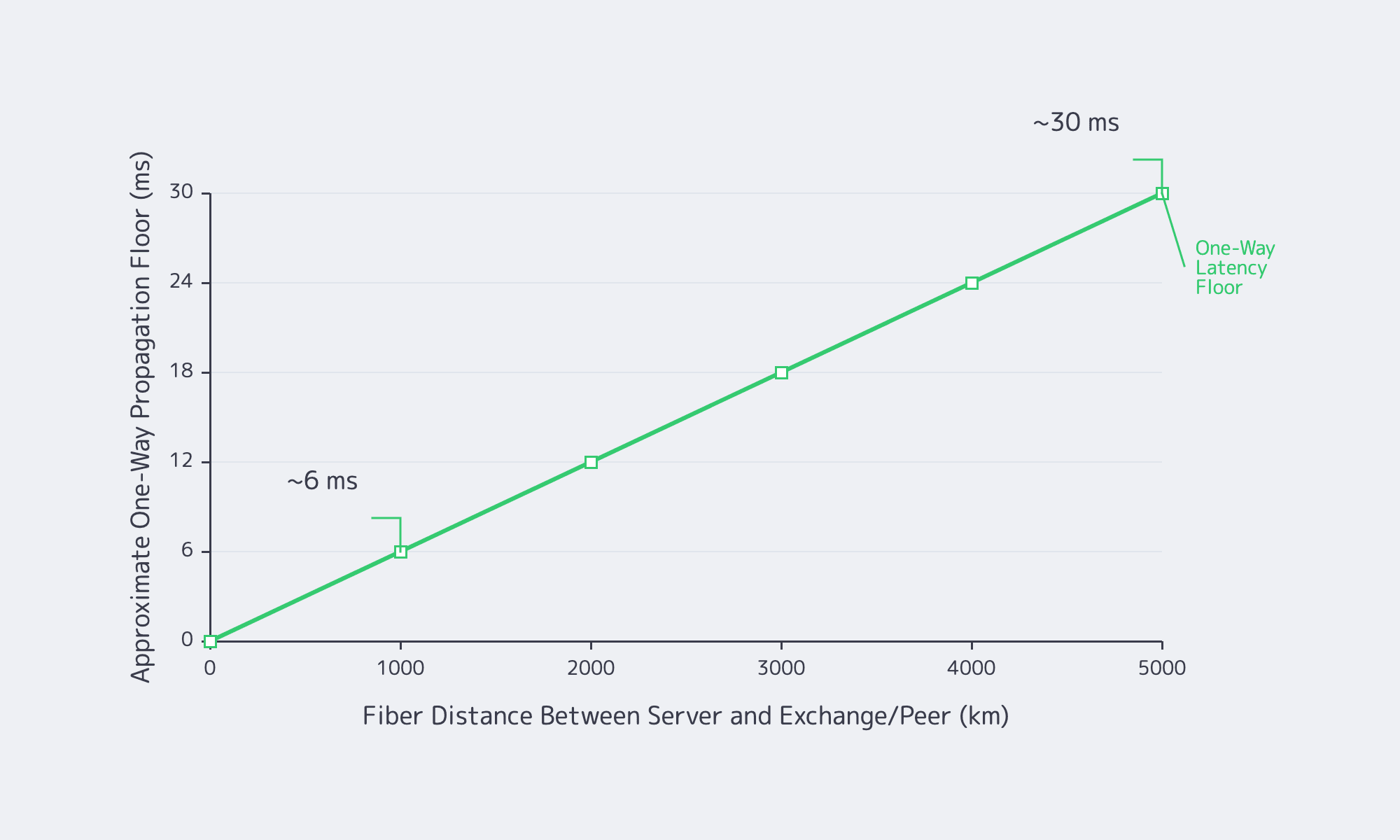
Trading infrastructure is a network-placement problem first. Physics sets the floor, then routing and congestion determine how close you stay to it. In optical fiber, a useful planning model is roughly 6 microseconds per kilometer one way. That is why routing control, path quality, and endpoint stability often matter more than another benchmark win on CPU.
This is where Melbicom’s footprint becomes practical rather than decorative. Melbicom offers single-tenant servers across 21 global data centers, a 14+ Tbps backbone, 20+ transit providers, 25+ IXPs, and per-server bandwidth tiers up to 200 Gbps depending on location. BGP is available in every data center.
Key Takeaways
- Classify the workload before pricing servers. A validator, an RPC estate, and a latency-sensitive trading stack should not be bought against the same checklist.
- Put signing architecture ahead of server architecture. If key handling is weak, better CPUs and faster ports do not reduce the real risk.
- Buy bandwidth against failure budgets, not average throughput. Sync bursts, market volatility, and public-endpoint abuse all show up at the worst possible moment.
- Design the recovery path before production cutover. Snapshots, rollback artifacts, and retained logs are part of the platform, not afterthoughts.
- Use real location and routing data when evaluating providers. Ask for concrete stock examples, actual port tiers by site, and the timeline for custom builds.
Buy for Failure, Not Just for Throughput
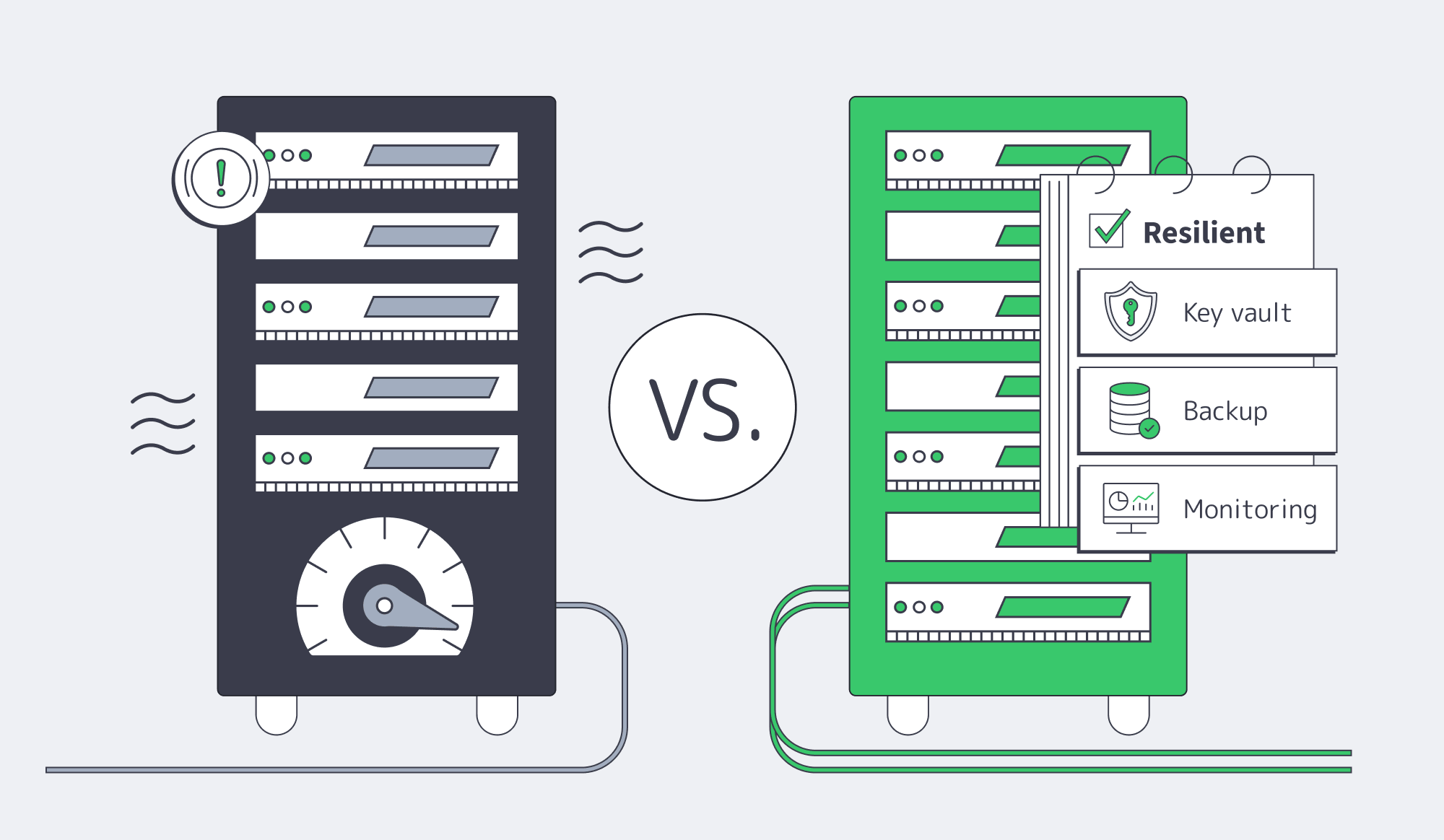
The best crypto hosting decision is rarely the one with the lowest monthly line item or the highest advertised core count. It is the one that matches the workload’s actual failure modes. For nodes and validators, that usually means safe signing, storage behavior, sync and recovery paths, and bandwidth headroom. For trading, it means distance, routing control, endpoint stability, and the ability to keep latency variance under control.
That is why “crypto hosting” should never be treated as one category. A validator cluster, an RPC layer, and a latency-sensitive trading stack may all run on servers, but they do not fail the same way. Buy around that reality, and the infra conversation gets more honest.
Dedicated servers for crypto workloads
Browse ready-to-order and custom dedicated servers for validators, RPC workloads, and low-latency trading across Melbicom’s global data centers.