
Month: February 2026
Blog
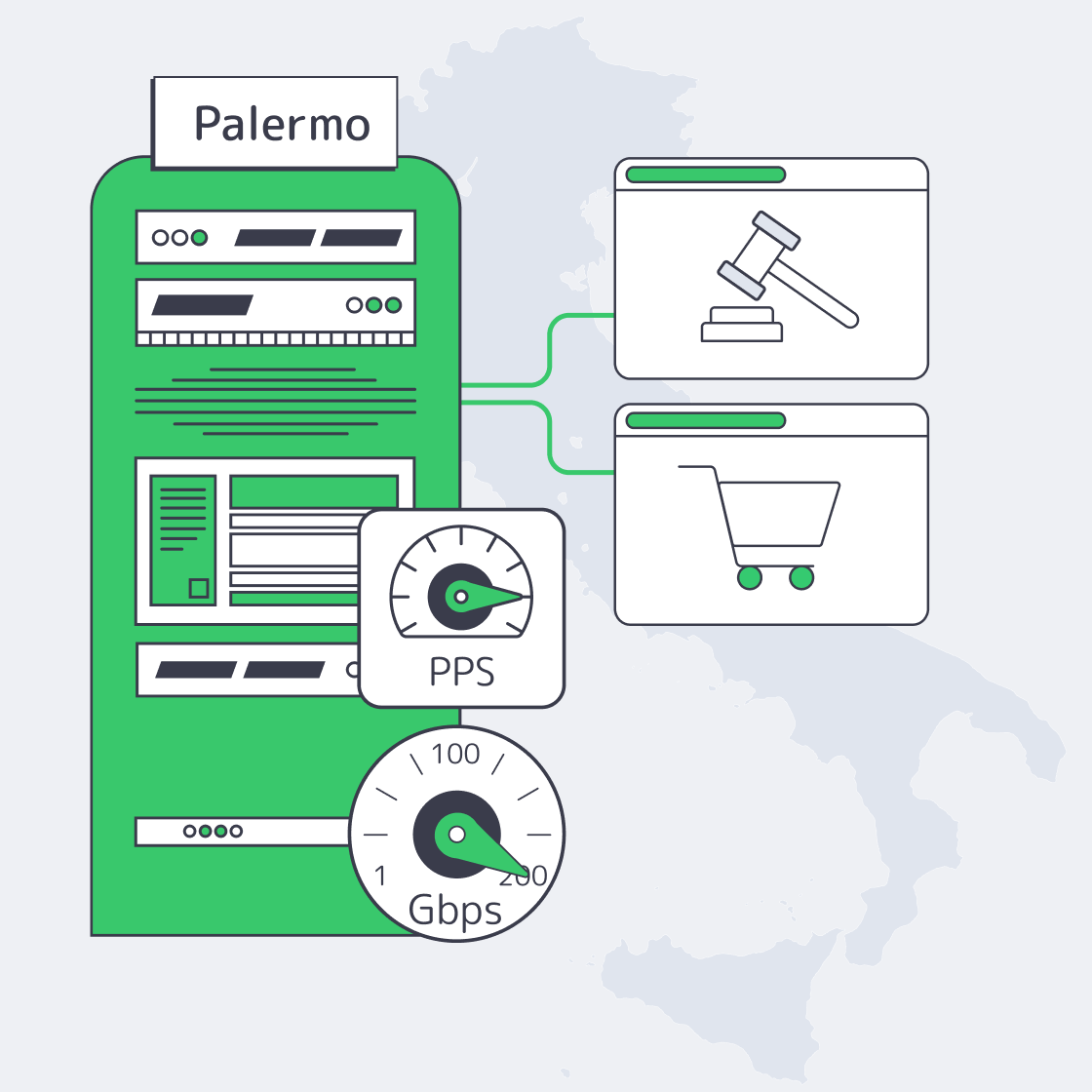
Designing Predictable Egress for Italy Servers
Ultra‑HD streaming and programmatic advertising share a constraint: egress you can actually deliver. Video represents 80%+ of global internet traffic, while AdTech stacks drive bursts of small requests where packet handling—not raw bandwidth—sets the ceiling. Italia is increasingly viable for both when you treat the server, kernel, NIC, and upstream connectivity as one system.
Here’s the practical playbook: metered vs. unmetered egress, how to measure real throughput (`iperf3` and HTTP), how to reason about PPS limits, and how the results map to NIC choice, kernel tuning, peering/IX strategy, and origin‑to‑CDN design.
Choose Melbicom— Tier III-certified Palermo DC — Dozens of ready-to-go servers — 55+ PoP CDN across 36 countries |
 |
Sizing a Server in Italia for Predictable Egress
Plan for two bottlenecks: throughput (Gbps) for origin fill and video delivery, and packet rate (PPS) for auctions, beacons, and fan‑out control traffic. A port can look huge on paper but underperform if the cost model is metered, the kernel is untuned, the NIC can’t parallelize queues, or upstream paths are congested.
Which Italy Servers Offer Best Unmetered Egress Rates

Unmetered egress is usually the most defensible answer when outbound traffic is high and spiky: you pay for a fixed-capacity port instead of per‑GB fees, so costs stay stable while performance becomes an engineering problem you can measure, tune, and forecast—rather than a billing surprise that explodes during peaks.
Cloud egress metering turns traffic volatility into budget volatility. The same workload can be cheap one month and painful the next—and finance doesn’t care that the spike was “a good problem.” The simplest way to de-risk is to buy capacity as capacity.
Metered vs. Unmetered: The Part Your Budget Actually Feels
(For the metered examples below, we’re using an Oracle public egress-cost reference point to illustrate how quickly per‑GB pricing turns spikes into line items.)
| Traffic scenario | Metered cloud cost (est.) | Unmetered capacity needed |
|---|---|---|
| Steady 10 TB outbound / month | ≈ $880 (Oracle) | ~0.3 Gbps port |
| Surging 100 TB outbound in one month | ≈ $7,000 (at ~$0.07/GB) | ~3 Gbps port |
| Massive 300 TB peak traffic event | ≈ $20,000+ (at ~$0.06/GB) | ~10 Gbps port |
On the unmetered side, the key question is: does the provider deliver the port rate to real networks, consistently? Melbicom’s Palermo facility is listed at 1–40 Gbps per server and frames bandwidth as guaranteed (no ratios). That matters for streaming origins and ad delivery systems that can’t “pause” egress when a bill looks scary.
Why an Italy Dedicated Server Can Be a Cost-Control Lever
- Mediterranean geography: Palermo sits on major subsea routes and can cut 15–35 ms versus mainland Europe for parts of Africa and the Middle East. Less tail latency means fewer retries and more stable delivery.
- Operational burst capacity: Melbicom offers dozens of servers ready for activation within 2 hours, which helps when a “temporary” spike becomes the new normal. Custom configurations are deployed in 3–5 business days.
Traffic Spikes: Capacity + Cost Worksheet
Use this worksheet to translate a spike into required port headroom and metered egress exposure. Keep inputs honest: peak origin rate, duration, and your cache hit ratio (because cache misses are what light up origins).
Sanity checks: 1 Gbps sustained is ~10 TB/day; 10 Gbps is ~324 TB/month at full tilt.
| Peak outbound (Gbps) | Duration (hours) | Data moved (TB) | Metered egress cost ($) | Recommended port (Gbps) |
|---|---|---|---|---|
| 10 | 6 | 27.0 | TB×1024×$/GB | 10–20 |
| 20 | 3 | 27.0 | TB×1024×$/GB | 20+ |
Formulas:
- Data(TB) ≈ Gbps × 0.45 × hours
- Metered cost($) ≈ Data(TB) × 1024 × ($/GB)
How to use it: If you rely on a CDN, plug in the origin rate during cache-miss storms (deploys, cold edges, token rotation, regional outages). That number is usually higher than your “average day” dashboards suggest.
What Kernel Tuning Optimizes Streaming Throughput And Latency
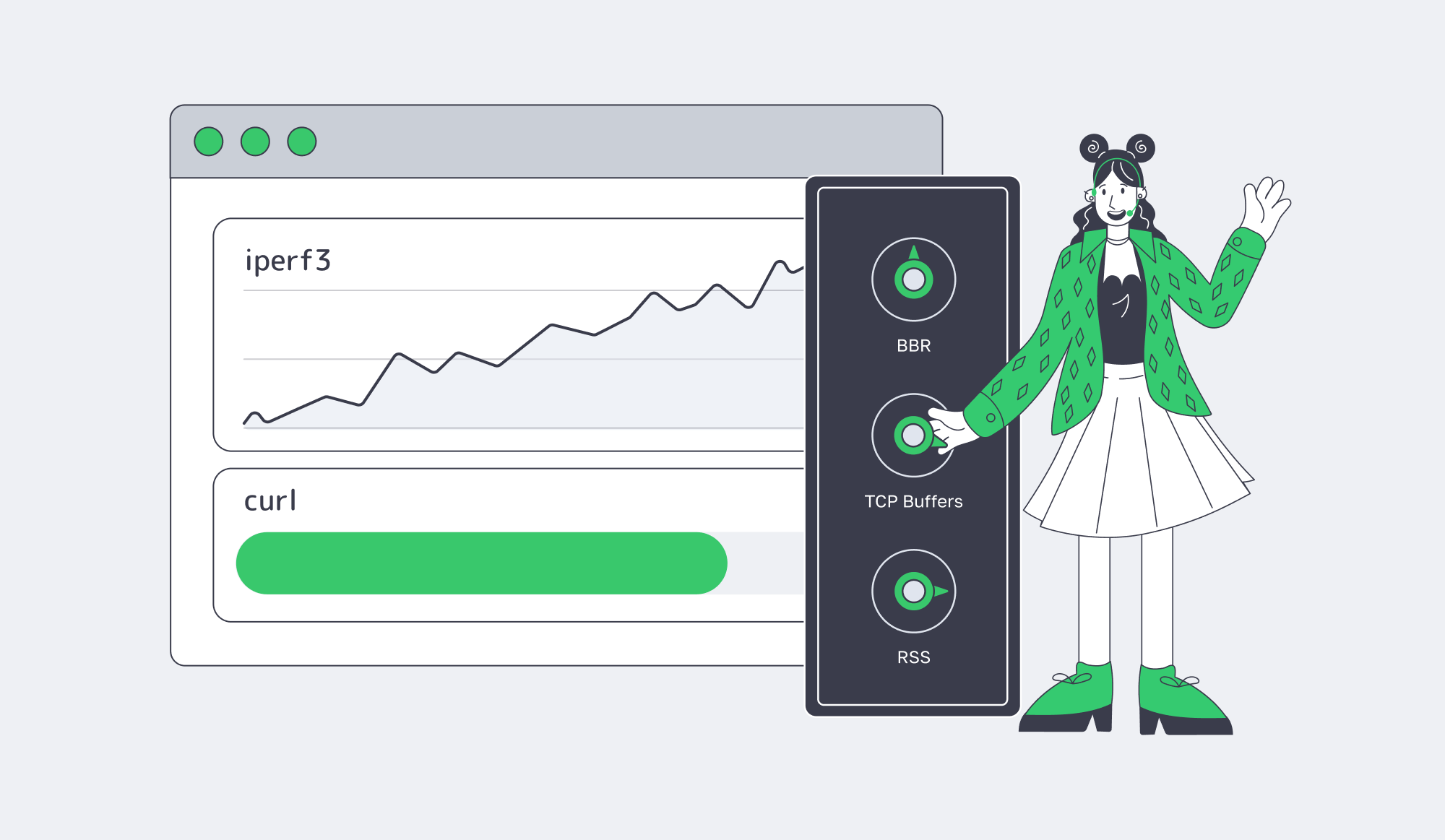
Kernel tuning that matters removes invisible ceilings: pick a modern congestion control (often BBR), increase TCP buffers/window scaling, and spread NIC work across CPU cores so a single interrupt queue doesn’t cap throughput or inflate latency under load—especially under high concurrency and real-world RTT variance.
Start by proving you have a ceiling. Untuned 10 Gbps tests often stall around 6–7 Gbps with iperf3, including a reported plateau at 6.67 Gbps until ring buffers and CPU affinity were adjusted. That’s why you benchmark with both synthetic tests and application-layer pulls, and only trust results you can reproduce under realistic concurrency.
Benchmark an Italy Server: iperf3 + HTTP
| # On the server (receiver) iperf3 -s # On the client (sender): parallel streams to fill the pipe iperf3 -c <server_ip> -P 8 -t 30 # HTTP throughput: parallel pulls to simulate segment delivery curl -o /dev/null -L –parallel –parallel-max 16 https://<host>/bigfile.bin |
Then tune what actually moves the needle:
- Congestion control: In results published by Google Cloud, BBR delivered 4% higher throughput and 33% lower latency versus CUBIC, and the same work was credited with 11% fewer video rebuffers.
- Buffers and windowing: Use Red Hat’s high-throughput checklist for
tcp_rmem,tcp_wmem, and socket limits. - CPU/IRQ hygiene: Enable RSS and multi-queue; isolate IRQ handling from hot app cores; raise NIC rings when microbursts drop packets (the “4096 ring” theme shows up in the same tuning thread).
Which NIC Hardware Handles High PPS AdTech Workloads
High-PPS workloads live or die on queues, offloads, and CPU scheduling: choose server-grade NICs with multiple hardware queues and stable drivers, enable RSS and multi-queue early, and validate packet-rate ceilings with synthetic tests so you don’t discover a 1 Mpps wall during a bid flood or beacon storm.
A 10 GbE link can theoretically push 14.88 million packets/sec at minimum-sized frames. Real systems hit software walls: Cloudflare engineers have pointed out vanilla Linux can top out around ~1 Mpps, while modern 10 GbE NICs can do “at least 10 Mpps”. With kernel bypass, the ceiling moves again—MoonGen/DPDK can saturate 10 GbE with 64‑byte packets on a single CPU core.
PPS Reality Check (10 GbE, small packets)

For an Italy server handling AdTech traffic, the practical playbook is: parallelize queues first (RSS + multi-queue), treat offloads as knobs (validate latency impact), and tune rings + interrupt moderation so microbursts don’t turn into drops.
When global routing matters, BGP becomes an architecture tool. Melbicom offers BGP sessions with BYOIP, BGP communities, and full/default/partial route options, which enables routing patterns where path control is part of performance—not a last-min rescue.
Peering, IX Strategy, and Origin-to-CDN Infrastructure Design
Latency budgets are shrinking. Google’s ad exchange requires bid responses within 100 ms, and the same analysis notes many flows aim to keep network transit well under 50 ms to stay safe. That’s why peering and IX presence are performance features: they reduce hop count, avoid congested transit, and make latency variance less random.
Melbicom positions upstream diversity and exchange reach as first-order network inputs: a 14+ Tbps backbone with 20+ transit providers and 25+ IXPs. For streaming, that improves origin-to-CDN fills by reducing “weird paths” and congested transit. For AdTech, it reduces the chance auction traffic detours through oversubscribed routes right when determinism matters most.
CDN design is where the bytes get disciplined. Melbicom runs a CDN delivered through 55+ PoPs in 36 countries. The durable pattern is simple: keep stateful logic on dedicated origins, push cacheable payloads to the CDN, and size origins for the days the CDN isn’t warm—deploys, outages, or sudden audience migration.
Key Takeaways for Predictable High Egress
- Treat egress like a capacity product: pick port tiers that match your peak profile, then measure and tune until you can reproduce the target rate on real paths.
- Benchmark both failure modes early—Gbps (fills/segments) and PPS (auctions/beacons)—because they collapse for different reasons and require different fixes.
- Use `iperf3` to find ceilings, then remove them systematically: congestion control, buffers, IRQ/RSS/affinity, and ring sizing—validated under realistic concurrency.
- Turn PPS into a budget: define “safe” Mpps targets per service, map them to NIC queues/cores, and decide when you need kernel bypass versus “just better tuning.”
- Design origin-to-CDN for the ugly days: cache-miss storms, deploy waves, and sudden traffic migration—then run the worksheet so spikes are planned engineering events, not billing incidents.
Conclusion: Building a Predictable Server in Italia Stack
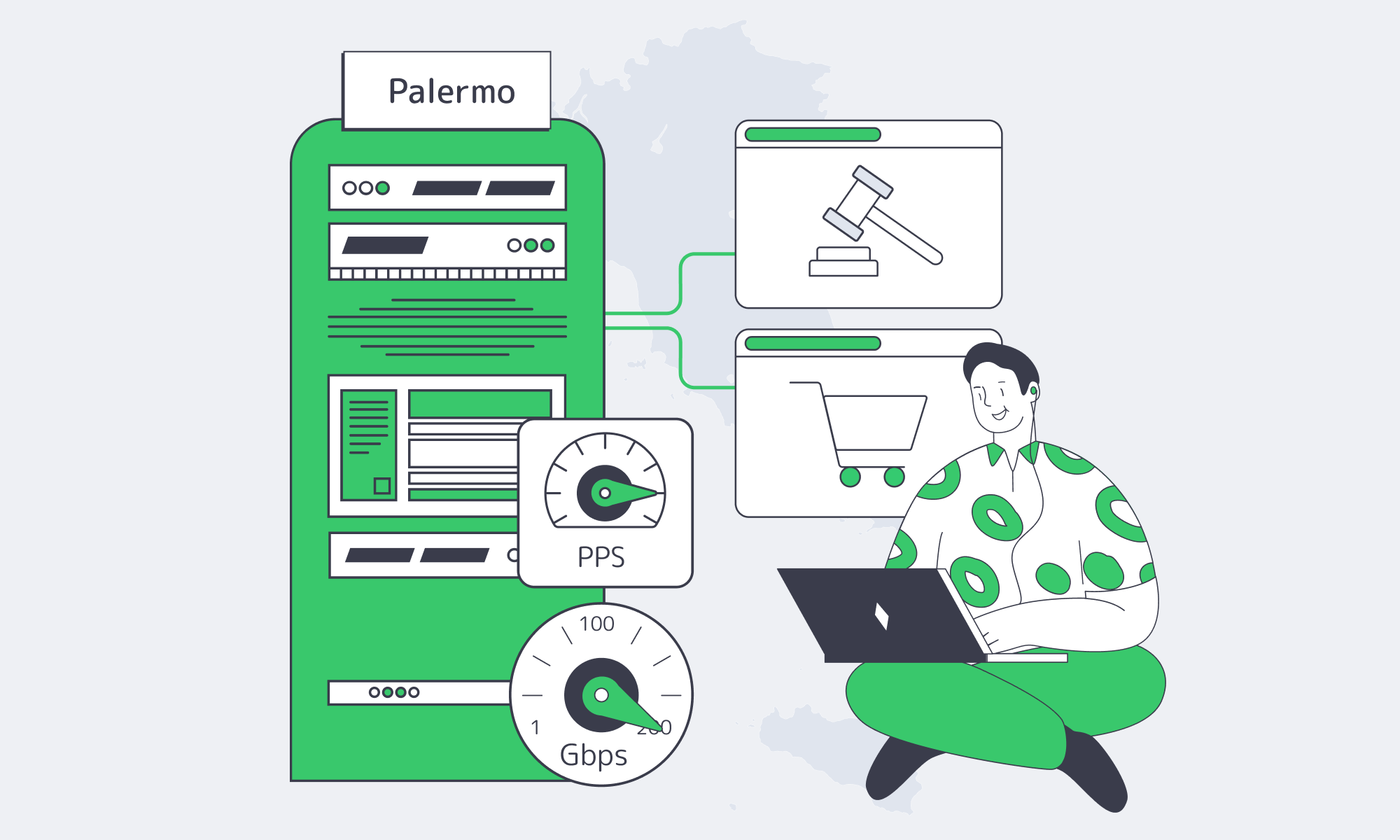
High-bandwidth delivery isn’t a single purchase decision; it’s a chain. Metered egress can punish success, untuned kernels can quietly cap throughput, and PPS-heavy services can collapse on the wrong NIC or queue setup. The fix is to engineer for predictability: measure, tune, and design for the ugly days—spikes, cache misses, and latency pressure.
That’s where Italia fits: strong geographic positioning for EMEA traffic, viable high-capacity ports, and an ecosystem where the right provider can make egress predictable and performance measurable.
Deploy high‑egress servers in Italy
Ready-to-go dedicated servers in Palermo with 1–40 Gbps unmetered ports, rapid activation, and 24/7 support. Ideal for streaming origins and AdTech workloads that demand predictable egress and low latency across EMEA.
Get expert support with your services
Blog

Hybrid Storage With Dedicated Servers In São Paulo
São Paulo isn’t “regional” anymore—it’s a gravity well. In 2023, over 84% of Brazil’s population was online, and the city’s interconnection role keeps expanding. If your users, partners, or data producers are in Brazil, the fastest path is straightforward: keep compute and the hot working set in São Paulo, then scale out with cloud storage in São Paulo patterns for durability and retention.
The latency math supports the move. The Seabras‑1 route sits at roughly 105 ms RTT between New York and São Paulo, so hosting in Brazil can shave close to ~100 ms versus routing workloads north. Hybrid is also the default posture: 80% of organizations using multiple platforms prefer a mix of public cloud and private/on‑prem environments.
Choose Melbicom— Reserve dedicated servers in Brazil — CDN PoPs across 6 LATAM countries — 20 DCs beyond South America |
 |
How to Architect Hybrid Object Storage in São Paulo
Start with a São Paulo dedicated server as the performance anchor, then attach object storage as the elastic capacity layer. Keep hot reads/writes local; move cold data and long retention to objects via lifecycle rules. Standardize on S3‑compatible interfaces so apps can swap storage backends without rewrites as requirements evolve.
Dedicated Server São Paulo as the Storage Gateway
Treat the dedicated server São Paulo footprint as the edge of your data plane: it terminates user traffic, runs ingestion/ETL, and hosts the tier your pipelines touch constantly. Local disk bandwidth is the difference between “fast enough” and “architectural regret”—NVMe can sustain 7–8 GB/s, compared with ~550 MB/s for SATA SSDs.
Local Object Storage for Backups, Media Libraries, and Data Lakes
In São Paulo, hybrid storage usually converges on three workloads: backups (fast restores plus off-site copies), media libraries (hot caches plus long-tail archives), and data lakes (cheap objects plus local transforms). Keep the active working set on the server, and push the rest into object storage on a schedule.
One constraint to design around: Melbicom doesn’t yet provide managed cloud storage in Brazil today. Melbicom’s S3 service is currently hosted in a Tier IV datacenter in Amsterdam. Teams either build S3‑compatible storage on dedicated infrastructure (software-defined object storage on local disks) or integrate São Paulo compute with an external object store—without hard-wiring the system to any single vendor.
Brazil Deploy Guide— Avoid costly mistakes — Real RTT & backbone insights — Architecture playbook for LATAM |
 |
Policy-Driven Tiering That Doesn’t Trap You
Policies should decide placement, not ad‑hoc scripts. Use lifecycle rules to keep fresh objects on São Paulo NVMe for a short window, then transition or replicate to cheaper tiers and long retention. This matters because budgets slip fast: 62% of businesses have exceeded cloud storage budgets, and 59% saw cloud costs rise in the last year.
Hybrid Storage Reality Checks for São Paulo
| Metric (used once) | Why architects care |
|---|---|
| IX.br peak throughput > 22 Tb/s | A proxy for how much traffic and interconnect density lives in-region |
| 95% of IT leaders report surprise cloud storage charges | Evidence that cost variance is systemic, not an edge case |
| Brazil cloud market grows ~$24B (2025) → ~$78B (2032) | Data gravity will intensify; hybrid won’t stay optional |
Which Replication Policies Secure Data Across South America
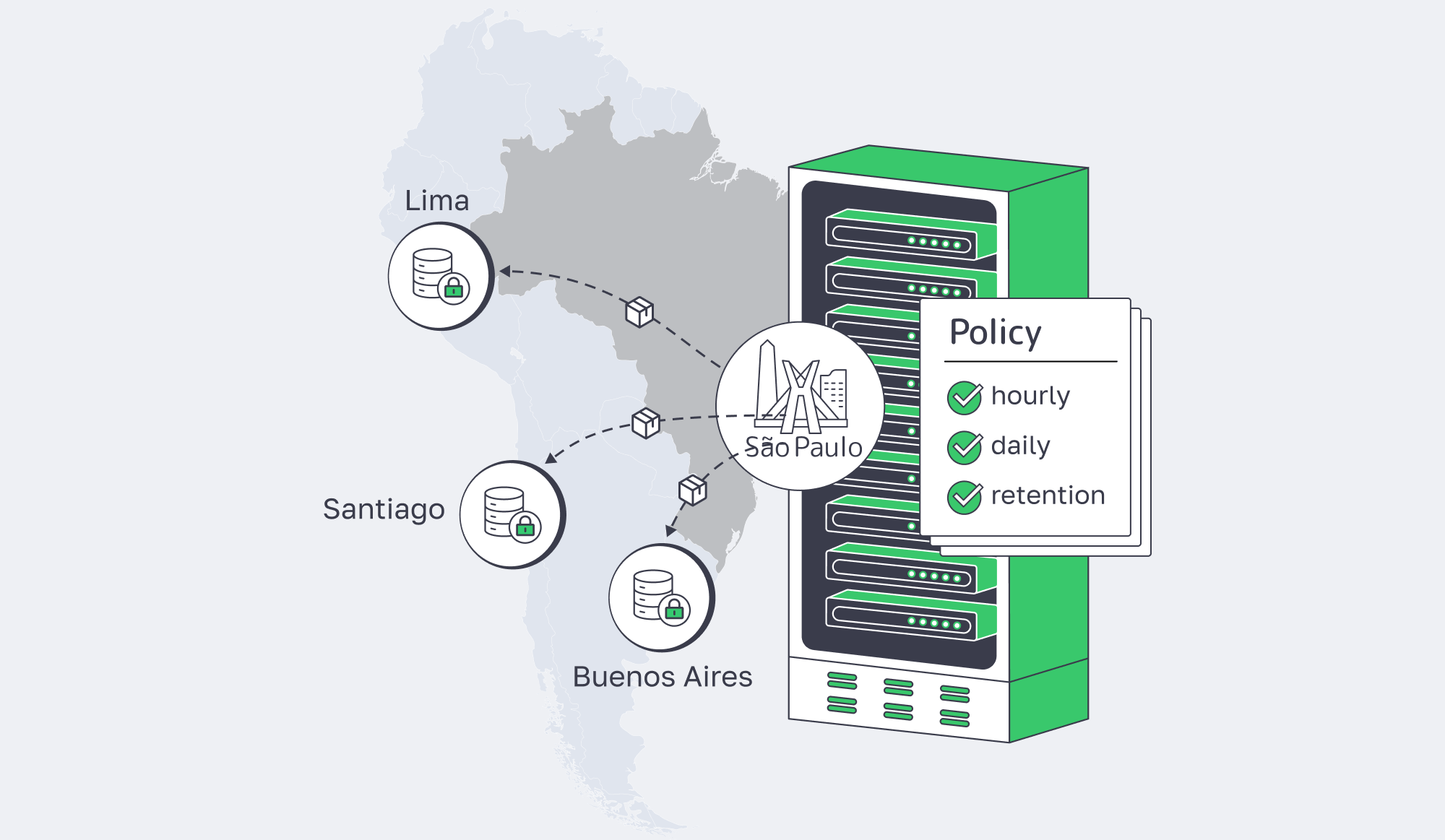
Replication policy is the bridge between local performance and regional resilience. Use São Paulo as the primary origin, then replicate critical objects to at least one other South American site for recovery and locality. Keep asynchronous replication for bulk data, and apply tighter consistency only where the write-path truly requires it.
Replication Rules: Scope, Timing, Placement
Replication shouldn’t be a DR checkbox—it’s a control plane with explicit knobs. Define scope (tier‑1 datasets and regulated objects first), timing (batch large objects; keep near-real-time replication for small, high-value writes), and placement (at least one geographically distinct South American location to reduce correlated failures). Many teams codify rules like “replicate incremental deltas hourly” to balance consistency against bandwidth and cost.
Cross-Border Replication Without Overbuilding
Brazil’s LGPD doesn’t universally mandate residency, but international transfers require a defensible framework, and guidance on cross‑border transfers continues to evolve. The practical implication: keep at least one replica in Brazil for recovery and audit, replicate outward only to approved jurisdictions, and encrypt replication traffic end-to-end.
Networking: Why Routes Matter
Replication succeeds or fails on network behavior—loss, jitter, and routing stability. Melbicom’s network services support routing control and private connectivity patterns. That matters when replication traffic shares pipes with latency-sensitive users: throttle replication during peaks, open it off‑peak, and keep failure modes legible.
What Egress-Aware Designs Minimize Enterprise Cloud Costs
Egress-aware design assumes your bill is shaped by data movement, not just storage size. Keep the busiest reads in São Paulo, cache aggressively on dedicated infrastructure, and offload repeat delivery to a CDN. Model cross-region traffic explicitly, because South America egress pricing can turn “cheap storage” into expensive operations.
Line-Rate Transfer Capacity (Theoretical maxima, 30-Day Month)
| Port Speed (Gbps) | Max Transfer / Month (TB) | Time to Move 10 TB (hours) |
|---|---|---|
| 1 | 324 | 22.2 |
| 10 | 3,240 | 2.2 |
| 40 | 12,960 | 0.6 |
| 100 | 32,400 | 0.2 |
The Egress Math in South America
Published examples put South America egress around $0.12–$0.18 per GB. That means pulling 10 TB can land in the $1,200–$1,800 range, and one example puts 8 TB egress from a South Brazil region at roughly $1,430. With a 10 Gbps port, that’s not a throughput problem—it’s a billing model problem.
Dedicated Server in São Paulo as an Egress Firewall
The simplest egress reducer is locality. Put hot content behind a dedicated server in São Paulo and treat object storage as the durability layer, not the serving layer: fetch once, cache locally, serve many times without repeated egress events. On metered bandwidth, repeats compound—Melbicom’s Brazil guidance warns that overages can become “a nasty surprise”. Portability is part of the prize, too: 55% of IT leaders said egress costs were the biggest barrier to switching cloud providers.
CDN in São Paulo, Brazil and Beyond as the Read-Traffic Absorber
A CDN turns your origin into a write-optimized system, not a read bottleneck. Melbicom’s CDN is delivered through 55+ strategic PoPs in 36 countries and supports pay-as-you-go or volume tiers with large-commit pricing as low as €0.002–€0.015 per GB depending on tier/zone. In practice, that means a São Paulo origin can stay focused on ingestion, auth, and writes, while the CDN absorbs repeat reads and smooths traffic spikes.
Cloud Storage São Paulo: The Hybrid Architecture That Holds Up Under Scale
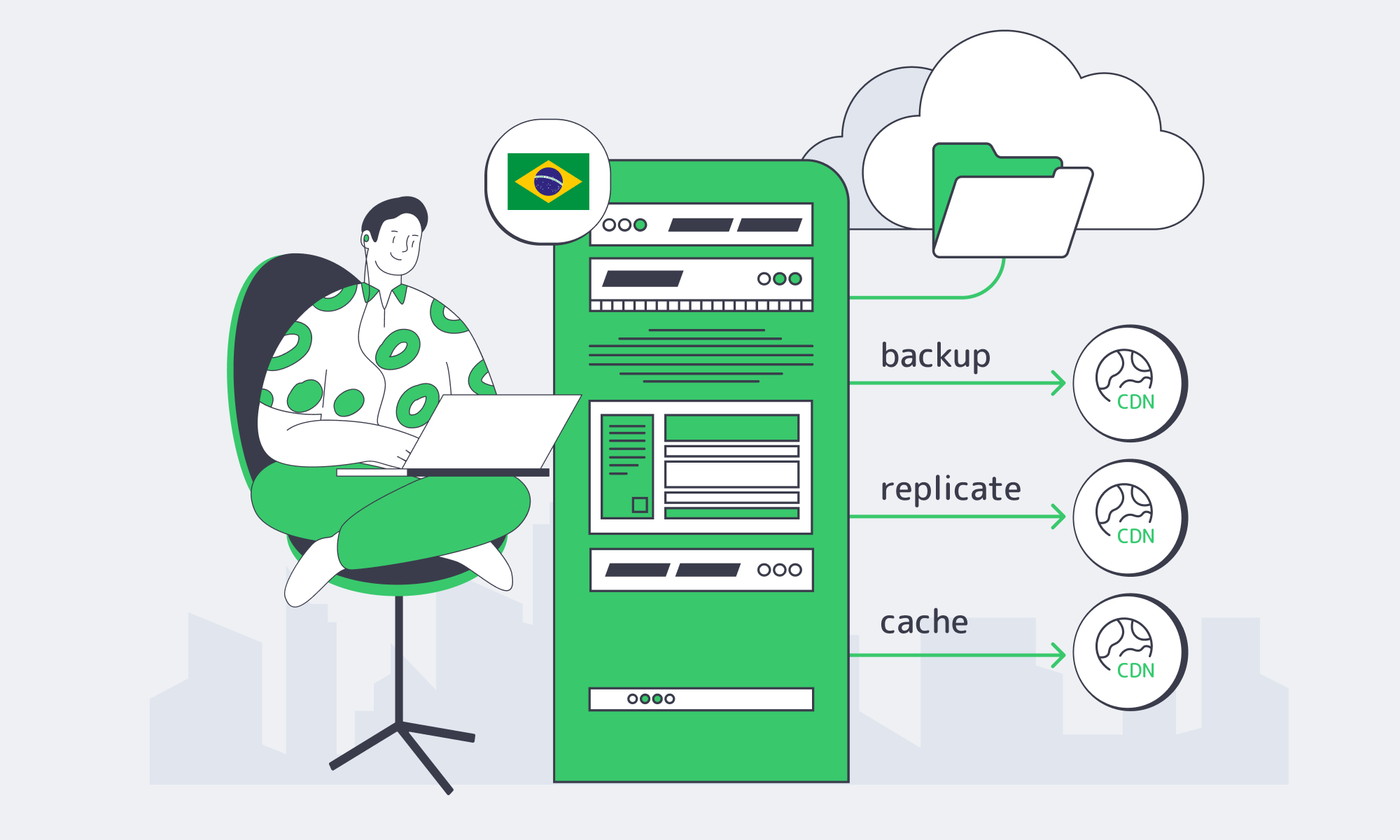
Hybrid in São Paulo works when the design treats dedicated compute as the control point and object storage as the elastic reservoir. Keep hot reads/writes local, replicate by policy to other South American sites, and use CDN distribution so cloud storage stops billing you for popularity. With cost management emerging as a top cloud challenge, egress-aware architecture is now part of platform engineering—not an afterthought.
Architecturally, the “boring” recommendations are the ones that prevent the expensive incidents later:
- Define an explicit egress budget (per workload) and make “unexpected egress” a regression—track it like latency.
- Cache with intent: pin hot objects to São Paulo NVMe, and use TTLs/lifecycle rules so cache doesn’t quietly become primary storage.
- Separate replication goals: one policy set for compliance/residency, another for RTO/RPO, and another for performance locality.
- Treat object storage as a durability layer first: move compute to data when possible; ship results, not raw datasets.
Plan Your São Paulo Hybrid Build
Share your target CPU/GPU, RAM, NVMe, and port speeds. We’ll help design a hybrid setup with dedicated servers in São Paulo, S3-compatible storage integration, and CDN coverage.
Get expert support with your services
Blog

Multi-Node High Availability on Italy Dedicated Servers
Downtime isn’t a blip on a status page; it’s a revenue event. Peak-season retail e-commerce outages have been estimated at $1–2 million per hour, while finance/trading downtime can run $5 million+ per hour. That’s why “high availability” becomes a product requirement when checkout or execution is the core flow.
Dedicated infrastructure matters because predictability is a reliability feature: “noisy neighbor” contention can turn p99 latency into a moving target. With server hosting in Italia, geography also matters. Tier III facilities are typically designed for 99.982% availability (~1.6 hours/year), and Palermo’s position on Mediterranean routes can reduce latency to North Africa, the Middle East, and Southern Europe by ~15–35 ms.
Choose Melbicom— Tier III-certified Palermo DC — Dozens of ready-to-go servers — 55+ PoP CDN across 36 countries |
|
Which Multi-Node Patterns Ensure Italy Dedicated Server Availability
High availability on an Italy dedicated server fleet means designing for inevitable node and network failures—and still hitting SLOs. Use redundant load balancers, an active-active stateless tier, and a data layer that continues after a node loss. Add N+1 capacity headroom, then prove the design with repeatable failover drills and chaos tests.
Load Balancing: Active-Active by Default, With a Redundant Edge
Treat the load balancer as a failure domain, not “just a router.” Run at least two LBs (failover pair or anycast/DNS design), and use health checks that eject sick nodes before they become brownouts. Keep app nodes stateless where possible so a backend can die mid-request without customer-visible downtime.
Dedicated Server Italy: Capacity Headroom as a Hard Requirement
Redundancy without headroom is theater. Design for N+1 so N-1 can still meet peak, and keep steady-state utilization around 60–70% on critical tiers to cover failures plus bursts. Load test the real constraints: DB connection pools, cache miss storms, and downstream rate limits.
Active-Passive Where State Makes It Safer
Some systems should not be multi-writer. Use active-passive for components like certain databases or tightly coupled stateful services—but demand automation: fencing to prevent split brain, automated promotion, and a measured RTO/RPO. If failover requires a human to remember the right commands, uptime depends on pager latency.
Geographic Redundancy: When the Math Forces It
Four nines is where a single building becomes a liability. Multi-location design is a recurring recommendation in reliability guidance. On dedicated servers, that often means an Italy primary plus a second site for disaster recovery, with DNS failover or BGP traffic steering.
Melbicom supports these designs with a backbone above 14 Tbps, connectivity across 20+ transit providers and 25+ internet exchange points, and optional BGP sessions for engineered routing and failover. In Italy, Palermo supports 1–40 Gbps per server, which matters when replication and catch-up traffic spike during incidents.
Chaos Engineering and Failover Testing: Stop Trusting Diagrams
Reliability is empirical. The chaos engineering tooling market had been pegged around $2–3B in 2024 and growing because teams learned the hard way: untested failover is imaginary failover.
Run experiments: kill an app node at peak, force a DB primary switch, sever a replication link, and roll an LB config forward and back. Track detect/route-around/recover times and SLO impact—then automate until drills feel boring.
What Database Quorum Configs Support Zero-Downtime E-commerce Deploys
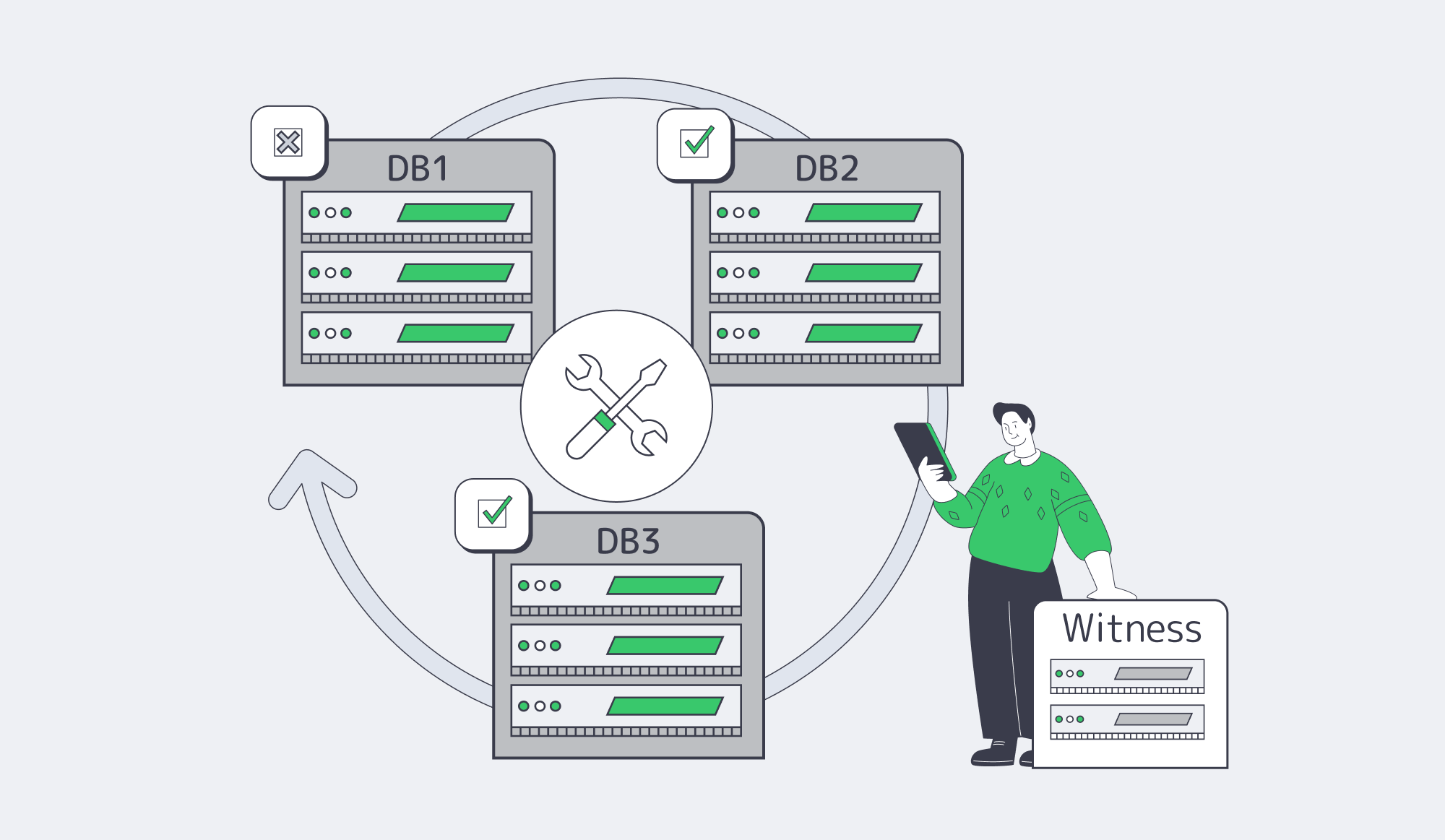
Zero downtime depends on quorum: a database topology where writes commit on a majority so the system keeps serving after a node failure and can be upgraded one node at a time. A three-node (or five-node) cluster avoids split-brain, and a lightweight “witness” can break ties when spanning two sites. Pair quorum with online schema changes and blue-green/canary deployments.
Odd Nodes, Majority Writes, Fewer Surprises
The practical rule is 2f+1 nodes: three nodes tolerate one failure; five tolerate two. Majority (quorum) commits trade a bit of write latency for survivability. If you stretch a cluster across exactly two sites, partitions get ambiguous—hence the witness pattern to prevent 1–1 deadlocks (Yugabyte).
Replication Models: Choose Your Truth About “The Last Write”
For trading and payments, synchronous or semi-synchronous replication is common because losing the last accepted transaction is worse than adding a little latency. Asynchronous replicas still matter for read scaling and distant DR, but they aren’t a substitute for quorum if your effective RPO is near zero.
Zero-Downtime Deploys: Overlap Versions, Shift Traffic, Keep Rollback Hot
Zero downtime is choreography: old and new code must coexist while traffic moves. The standard playbook—blue-green, canary, rolling updates—works because it keeps capacity online while changing software.
A compact pipeline teams can automate:
- Bring up the new version (green) on separate nodes; warm caches and connections.
- Run backward-compatible DB migrations (expand-first; avoid breaking reads/writes).
- Send a small slice of traffic (canary) and watch SLO metrics (error rate, p95/p99, business KPIs).
- Ramp traffic to green; keep the old version ready for immediate rollback.
- Drain and retire old nodes once stability holds.
- Perform “contract” migrations later (dropping old columns, removing flags) once safe.
CDN and Asset Versioning: Prevent “New Backend, Old Frontend” Outages
Many “availability incidents” are cache coherence failures. Version static assets (content-hash filenames) so deploys are atomic by URL, and purge only when required. Melbicom’s CDN footprint—55+ PoPs across 36 countries—reduces origin load so the core fleet has more headroom when something breaks.
From SLO to Redundancy, Alerting, and Runbooks
An SLO is a budget for failure. Convert it into requirements: how many failures you must survive, how fast you must detect them, and how quickly you must fail over.
The math is blunt: small changes in “nines” radically shrink the downtime budget (see the table below; source:Couchbase)). Tier IV targets are often cited around 99.995%, but software still fails—multi-node architecture carries the rest.
| Availability SLO | Max downtime/year (approx) | Typical architecture to meet it |
|---|---|---|
| 99.9% | ~8.8 hours | N+1 in one DC; automated node failover; tested restores |
| 99.99% | ~52.6 minutes | Multi-DC/site design; quorum/replication; automated site failover |
| 99.999% | ~5.3 minutes | Multi-region active-active for critical paths; aggressive automation; constant testing |
Redundancy Requirements: Start From the Worst Credible Failure Mode
List the failures that can violate the SLO: “DB primary dies,” “LB misconfig,” “cache stampede melts DB,” “Italy site loses upstream.” For each, define maximum tolerated user impact and the mechanism that keeps you inside the error budget. If restore-from-backup takes hours, four nines is already gone—replication and fast promotion are non-negotiable.
Alerting System: Page on Error-Budget Burn, Not on CPU Graphs
Burn-rate alerting pages only when users are being hurt fast enough to matter. A commonly cited approach uses 2% of the budget consumed in an hour for paging, and 5% in a day for escalation. Tie these to real user journeys (login/browse/checkout), not just host metrics.
Runbooks: Automate the Repeatable, Document the Dangerous
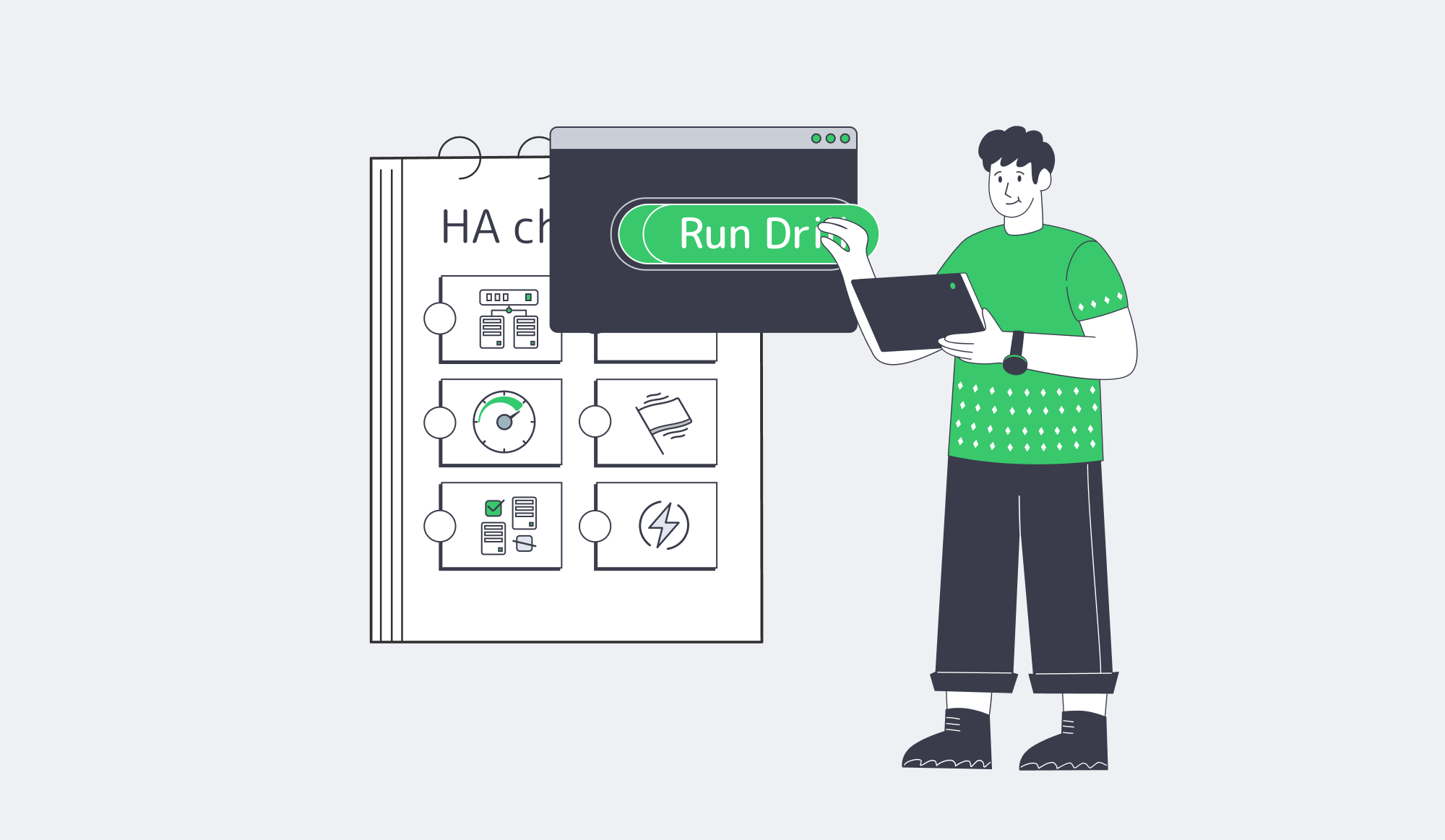
Every page should link to a runbook that answers: what’s broken, how to confirm, how to mitigate, and how to roll back safely. Test runbooks in game days, and convert repeated manual steps into automation (drain node, promote replica, reroute traffic, disable a feature flag).
Key Takeaways for Multi-Node Italy Deployments
- Write down your top three “revenue killers” (LB failure, DB quorum loss, deploy regression), then map each to a tested mitigation path with owners + RTO/RPO targets.
- Treat capacity as a resilience primitive: run N+1 with enough headroom that a single-node failure plus peak traffic doesn’t trigger rate limiting or queue collapse.
- Standardize a “quorum bundle”: odd-number clusters, explicit fencing, and a witness plan for two-site topologies—then rehearse promotion under load.
- Make deploy safety measurable: canaries gated on SLO burn-rate and business KPIs, with rollback that’s automated and practiced, not “documented.”
- Schedule failure on purpose: monthly game days that include a live failover, plus quarterly chaos experiments that validate assumptions about timeouts, retries, and backpressure.
Conclusion

High availability on dedicated servers is a discipline: assume failure, engineer redundancy, and measure whether failover stays inside the SLO. Load balance what can be stateless, fence and replicate what can’t, and keep enough headroom that “one node down” doesn’t become “everyone down.”
When the architecture is paired with SLO-based alerting and practiced runbooks, incidents stop being existential and start being measurable. That’s the difference between a platform that survives peak traffic and one that headlines it—for the wrong reasons.
Deploy HA Infrastructure in Italy
Build active-active apps and quorum databases on Palermo servers with tested failover, BGP routing, and 1–40 Gbps bandwidth options.
Get expert support with your services
Blog
Designing São Paulo Edge for Commerce and OTT
Brazil is already a high-scale digital market: more than 84% of Brazilians were online in 2024, and São Paulo’s IX.br exchange has recorded peak traffic above 31 Tbit/s. That density is the opportunity—and the trap. At this scale, every cache miss becomes an infra event.
The urgency isn’t hypothetical. 53% of mobile visitors abandon if a page takes over 3 seconds to load, and speed research often cites conversion losses around 5–7% per additional second. Meanwhile, Latin America’s e-commerce market is rising 12.2% YoY and projected to top $215B by 2026, with 84% of online purchases happening on smartphones. If the storefront or stream feels slow in São Paulo, it’s slow everywhere that matters.
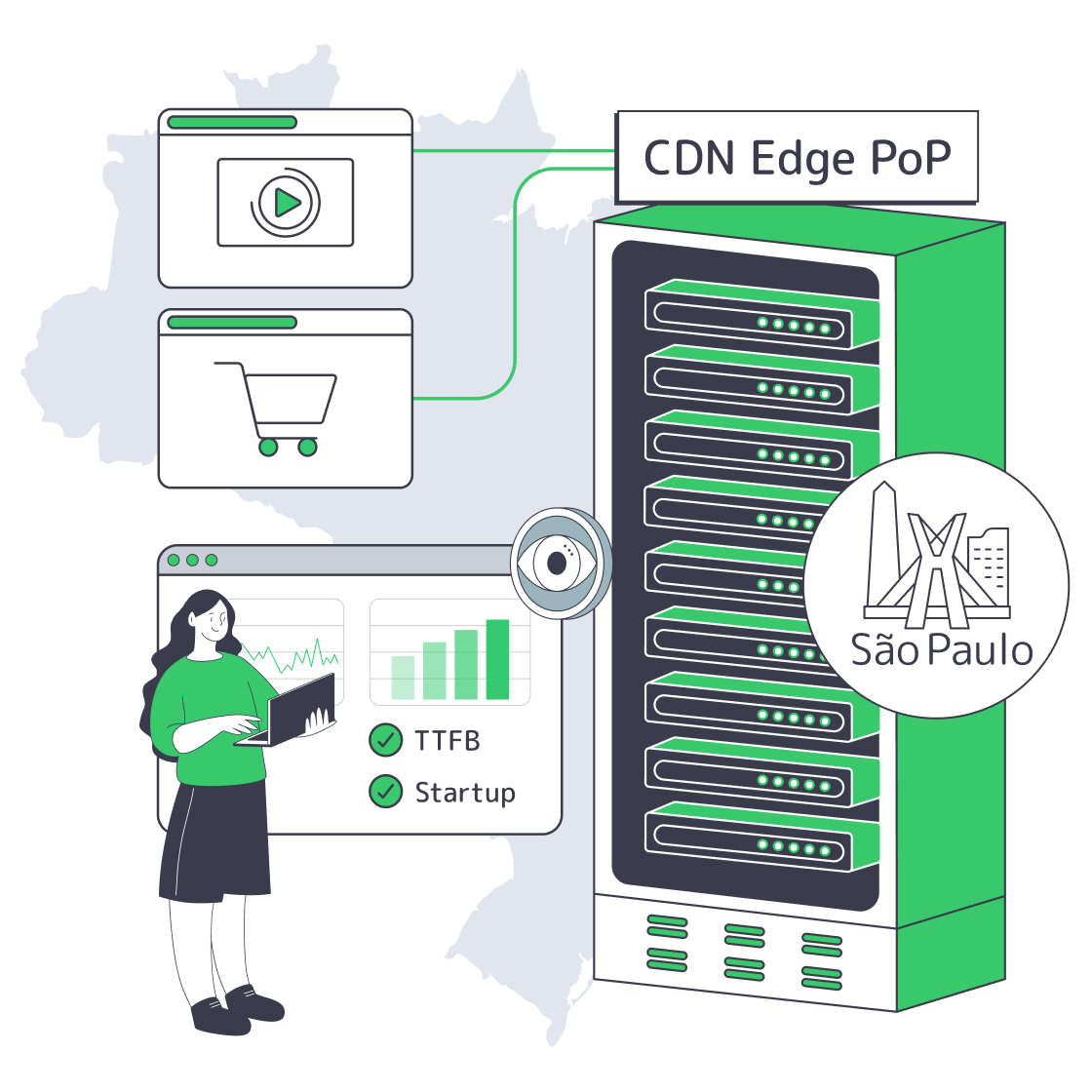
This is where CDN São Paulo PoP stops being a checkbox and becomes an operational design: cache rules tuned for commerce and OTT, an origin shield in São Paulo, and failover to secondary LATAM PoPs—measured with KPIs and A/B tests, not vibes.
Choose Melbicom— Reserve dedicated servers in Brazil — CDN PoPs across 6 LATAM countries — 20 DCs beyond South America |
|
How to Configure Cache Rules for São Paulo
Cache rules for a CDN in São Paulo should maximize edge hits without corrupting user state: cache static assets and VOD segments hard, micro-cache shared HTML where safe, keep carts/checkout uncacheable, and treat streaming manifests as near-real-time. The target is fewer long-haul origin trips, faster loads, and predictable behavior during spikes.
Cache what’s identical, never what’s personal
Start with the repeatable wins:
- Static assets (images/CSS/JS): Long TTL (days+). Use versioned filenames or cache-busting params so deploys invalidate naturally.
- Shared HTML: Product/category pages for anonymous users can take micro-caching (seconds to a few minutes) to absorb bursts without serving stale content for long.
- Personal flows: Cart, checkout, account, and strict price endpoints should be pass-through. Keep TLS termination at the edge so Brazilian users still get fast handshakes.
One rule: cache by content truth. If most users would see the same payload, edge-cache it. If it’s identity-, inventory-, or payment-sensitive, don’t.
Brazil Deploy Guide— Avoid costly mistakes — Real RTT & backbone insights — Architecture playbook for LATAM |
|
OTT: long-lived segments, short-lived manifests
- Segments (HLS/DASH): Cache aggressively. VOD segments can be long-lived; live segments can be cached briefly and will age out naturally.
- Manifests (.m3u8/MPD): Cache very short or require revalidation so viewers don’t drift behind during live events.
- Startup variance: Streaming research shows churn climbs once startup delay passes ~2 seconds, and each added second can lose ~5.8% more viewers—so treat manifest freshness as a reliability feature, not a tuning detail.
Melbicom’s CDN is built for this “segments are cache, manifests are control” split, and the São Paulo PoP is the right place to enforce it.
São Paulo Caching Patterns
| Content type | Examples | São Paulo caching strategy |
|---|---|---|
| Static assets | Product images, CSS/JS bundles | Long TTL; cache-bust via versioned URLs; enable modern delivery (HTTP/2, compression) where available. |
| Shared HTML | Home/product/category pages (anonymous) | Micro-cache; use stale-while-revalidate to hide origin latency while keeping content fresh. |
| Personal flows | Cart/checkout/account | No-cache / pass-through; still terminate TLS at edge for faster handshakes. |
| Video segments | HLS/DASH chunks | Cache hard (VOD) and cache briefly (live); fill São Paulo edge fast via pull or prefetch. |
| Manifests | .m3u8 / MPD | Very short TTL or revalidate; treat as “real-time index,” not a static file. |
Where to Integrate Origin Shields and Dedicated Servers

Put origin shields in São Paulo to collapse cache misses into a single upstream fetch, then pair that with a local dedicated server origin to eliminate cross-continent round trips for traffic you can’t cache. Design failover so Brazil can swing to secondary LATAM PoPs and backup origins automatically—without turning an edge hiccup into a full outage.
Dedicated origin shield in São Paulo: one miss, not a stampede
An origin shield is a mid-tier cache layer: edge PoPs check the shield first, and only the shield hits the origin on a miss. In a LATAM topology, São Paulo is the practical shield location because it’s the region’s aggregation point and Brazil’s main interconnect.
Two high-yield patterns:
- Origin outside Brazil → Shield in São Paulo: Regional PoPs pull through São Paulo, so the expensive international fetch happens once.
- Origin in São Paulo → Shield still helps: The shield reduces duplicate origin fetches during sudden spikes (product drops, breaking-news live streams).
Local dedicated server origin: when cache misses must be fast
Even the best CDN service in São Paulo won’t cache everything: pricing APIs, payment flows, entitlements, DRM, session state. That traffic should not be crossing continents.
Melbicom’s CDN is already operating across LATAM PoPs, and dedicated servers in São Paulo are coming soon—with capacity reservations open now. Melbicom also supports 1,400+ ready configurations across 21 Tier III/IV data center locations, with custom builds in 3–5 days.
The integration path is straightforward:
- Run origin services (web app, API gateway, streaming packager/auth) on a São Paulo dedicated server.
- Front it with the São Paulo CDN PoP for caching and TLS termination.
- Use São Paulo as the shield for other LATAM edges, keeping cache fill close.
For teams that want tighter routing control, BGP sessions can fit the same design—useful when standardizing delivery across regions without giving up autonomy. Melbicom empowers teams to deploy, customize, and scale infrastructure where customers actually are, not where a provider’s template says you should operate.
Failover strategy: secondary LATAM PoPs and backup origins
A single-PoP strategy is a fragile one. Build failover at two layers:
- Origin failover: Configure a secondary origin and health checks so the CDN switches automatically when the São Paulo origin is degraded.
- Edge failover: Ensure users can be routed to the next-closest LATAM PoP when São Paulo has issues, so Brazil stays online even if performance temporarily degrades. Melbicom’s CDN PoPs across Brazil, Chile, Colombia, Argentina, Peru, and Mexico make that secondary-path planning practical today.
Keep the failover path warm: replicate critical assets, keep config parity, and run failure drills during low-risk windows.
Which Metrics Measure E-Commerce and OTT Success
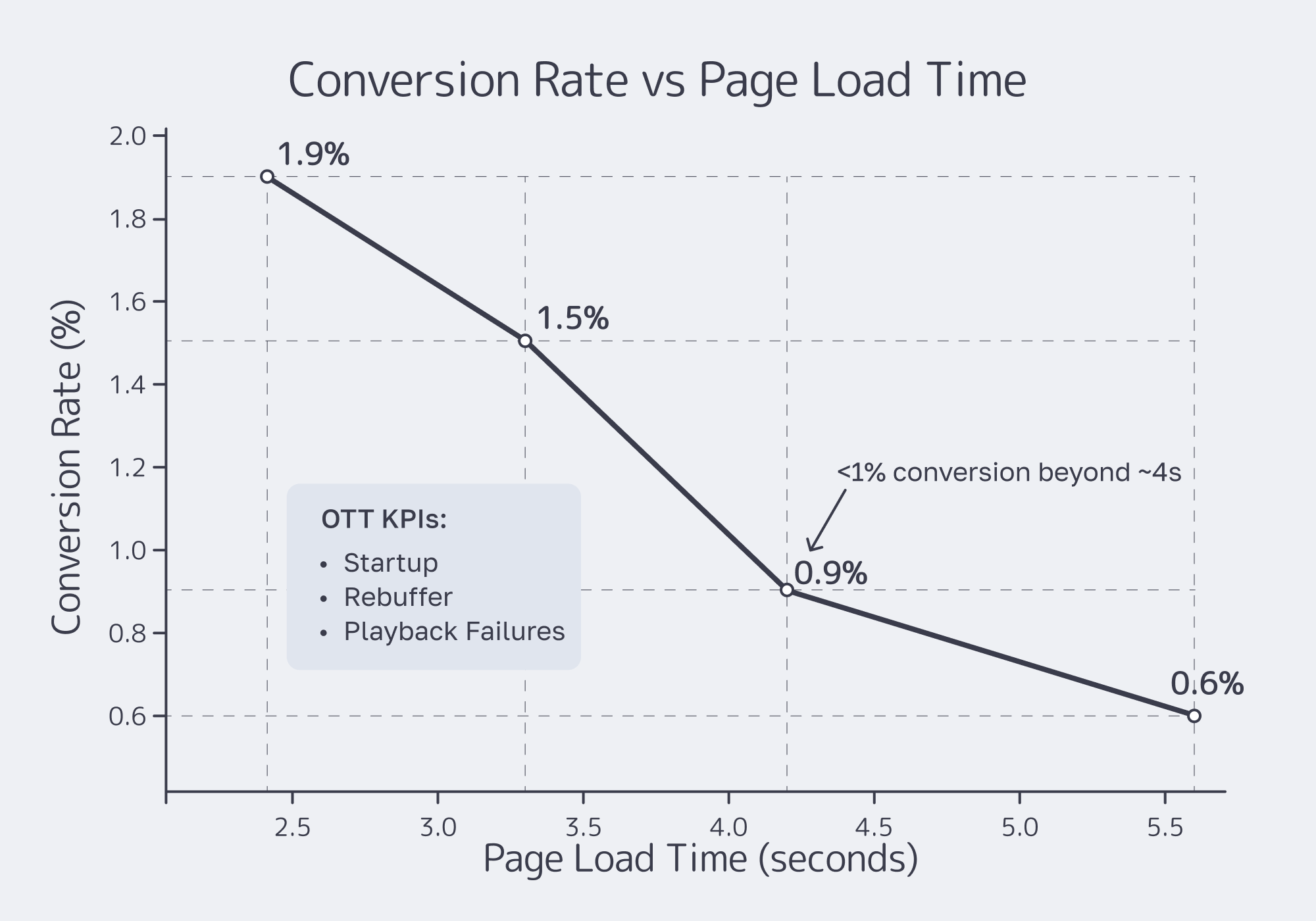
Success in a CDN São Paulo rollout is measurable: for commerce, track Brazilian-user TTFB/LCP plus conversion and bounce; for OTT, track startup time, rebuffering, and playback failure rates. Run an A/B plan that splits Brazil traffic between old and new delivery paths, uses real-user telemetry, and ties edge changes to business outcomes.
E-Commerce KPIs: speed is the input, conversion is the output
Measure from Brazil, not from your HQ:
- TTFB + LCP: Validate that São Paulo caching and edge TLS termination are working.
- Conversion and bounce: A retail benchmark reports a 1-second speedup can lift conversion.
- Checkout completion: Track cart abandonment and payment-step drop-offs; Brazil’s PIX usage makes “fast checkout” table stakes.
OTT KPIs: time-to-first-frame and “did it break?”
For streaming, track quality-of-experience, not just origin bandwidth:
- Video startup time: Measure p50/p95 time-to-first-frame and correlate to abandonment.
- Rebuffering ratio and stall events: The “buffer circle” is the product.
- Playback failures: Timeouts and errors during spikes are where delivery architecture shows its seams.
A/B testing plan: isolate the edge variable
Keep it simple enough to trust:
- Split Brazil traffic: 50/50 between the existing path and the new São Paulo edge configuration.
- Hold everything else constant: same release, same ABR ladder, same origin logic.
- Run long enough to cover peaks: promotional days for commerce and live-event windows for OTT.
- Evaluate by percentile: p50/p95 load and startup time and map changes to conversion and playback success.
Minimum dashboard:
- p50/p95 LCP and TTFB (Brazil)
- Cache hit ratio by content class (assets vs HTML vs video)
- p50/p95 startup time and rebuffering ratio
- Conversion rate and playback success rate
Conclusion: CDN São Paulo Rollout Checklist
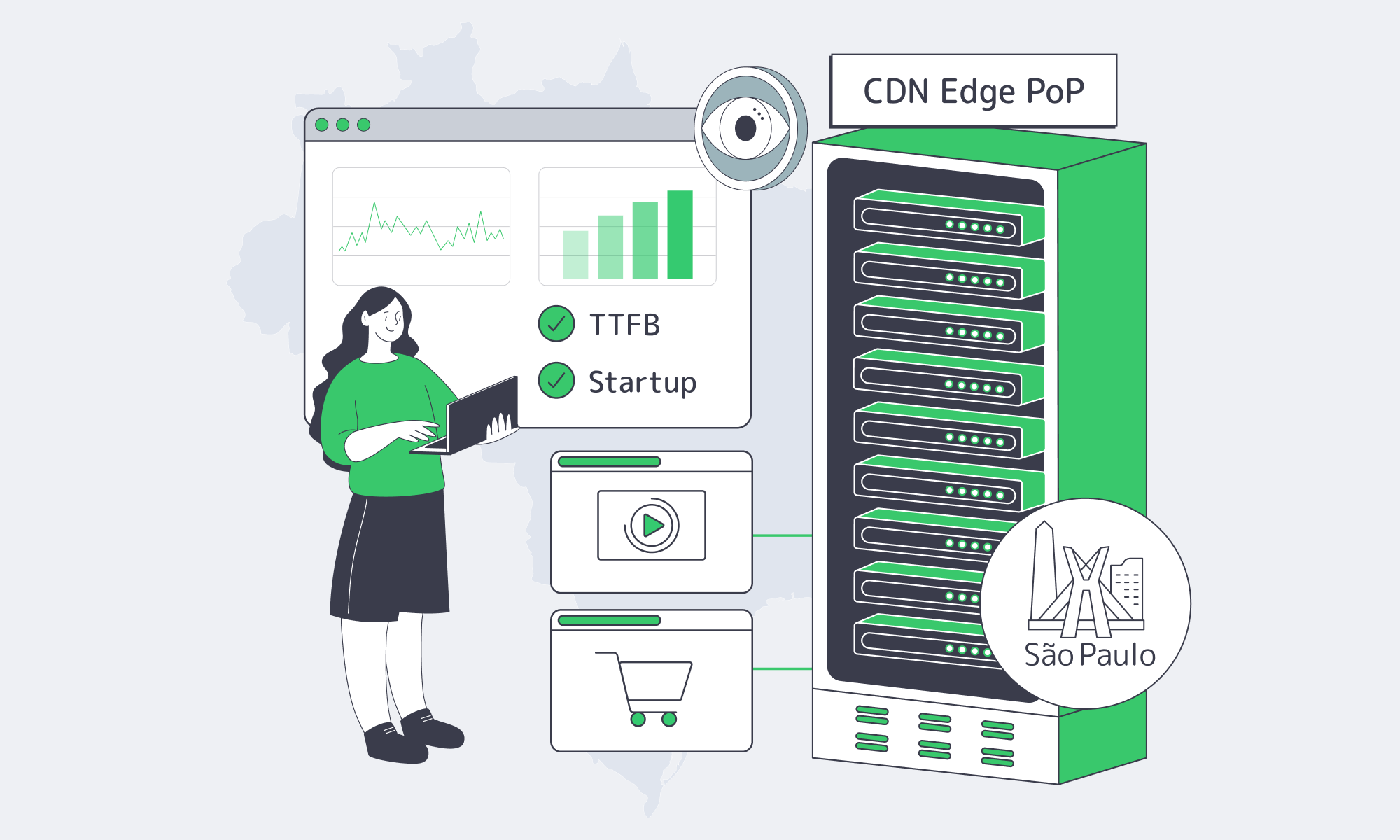
A São Paulo edge only pays off when it’s treated as a system:
- Define a cache taxonomy first: treat assets, shared HTML, private flows, segments, and manifests as different products—with explicit TTL/revalidation targets and separate hit-ratio goals.
- Make São Paulo a tier, not a point: place the origin shield there early so other LATAM edges pull through it and a miss becomes one upstream fetch, not a stampede.
- Localize the “uncacheable” path: move checkout/auth/DRM/session APIs to a São Paulo origin so personalized calls and cache misses don’t cross oceans.
- Make failover boring on purpose: use health-checked origin pools plus edge fallback to secondary LATAM PoPs, then rehearse the switch before campaigns and live events.
- Gate rollout on A/B evidence: require percentile improvements (p95 LCP/startup) and stable error rates before pushing the new São Paulo config to 100% of Brazil traffic.
Traffic density keeps rising, so “we’ll fix performance later” gets more expensive. Ship the edge, validate with A/B results, then scale the design across LATAM.
Reserve São Paulo Dedicated Servers
Capacity reservations for Brazil are open. Pair local origins with our São Paulo CDN PoP to cut latency for e-commerce and OTT traffic across LATAM.
Get expert support with your services
Blog

GPU-First Nodes by IX.br for Brazil Workloads
São Paulo is becoming the landing zone for GPU-heavy workloads that need predictable performance inside Brazil. Brazil has nearly 188M internet users, so latency-sensitive apps, AI inference, and streaming workloads pay a penalty when requests have to cross an ocean.
Choose Melbicom— Reserve dedicated servers in Brazil — CDN PoPs across 6 LATAM countries — 20 DCs beyond South America |
|
The network side is decisive. IX.br, anchored in São Paulo, connects 2,400+ networks and has pushed past 22 Tbps peaks at the São Paulo exchange. Put GPU compute next to that IX and you’re operating inside the routing decision point where Brazilian networks meet.
| Availability Snapshot | Melbicom: What’s in Place | Why It Matters for São Paulo GPU Workloads |
|---|---|---|
| São Paulo dedicated servers | Capacity is being staged near IX.br to your requested CPU/GPU/RAM/NVMe and port speeds | You can design the node shape first, then scale the pattern. |
| Global capacity + delivery | 21 global Tier III/IV data centers, 55+ CDN PoPs across 36 countries, and 1–200 Gbps per-server ports (by site) | Stage overflow and distribution without breaking Brazil latency paths. |
| Custom builds | Custom server configurations can be deployed in 3–5 business days | Specify exact GPU, storage, and port targets instead of settling. |
Which São Paulo GPU Servers Let You Make the Most of Proximity to IX.br?
The São Paulo GPU servers that best support IX.br are purpose-built compute nodes (EPYC/Ryzen plus NVIDIA GPUs) paired with high-throughput network interfaces and routing control. Prioritize 10+ GbE uplinks, redundant paths, and BGP sessions so traffic stays on local peering routes—turning São Paulo into a low-latency “home region” for Brazil-first workloads.
If your goal is IX.br adjacency, you want a server profile that’s equal parts GPU box and network edge: interface speeds that match real ingestion/egress, plus routing control.
Latency sketch (round-trip time, RTT)
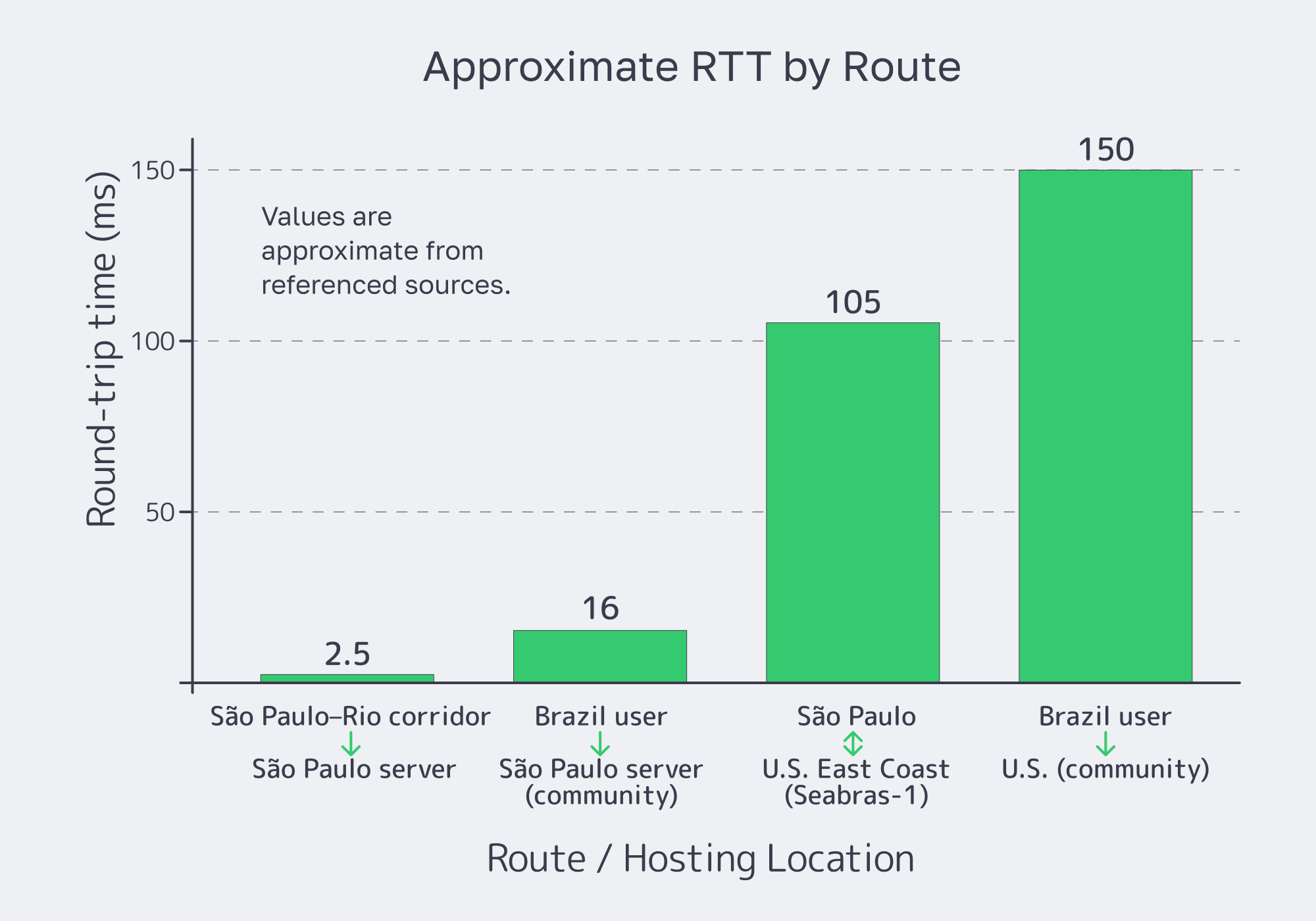
Melbicom frames the macro effect as up to ~70% latency reduction versus hosting the same workload overseas—especially when traffic can stay on domestic peering paths. The engineering win is that “fast” becomes repeatable: with local peering and BGP policy, you can keep critical APIs domestic, route around congestion, and still maintain global reach.
For GPU workloads, the pattern is “compute close, distribute wide.” Run training, feature generation, or transcoding on the São Paulo dedicated server; then push cacheable outputs outward. Regional CDN PoPs absorb delivery spikes for media segments, model artifacts, and dashboard assets, so the GPU node spends cycles on compute—not on re-sending the same bytes.
Brazil Deploy Guide— Avoid costly mistakes — Real RTT & backbone insights — Architecture playbook for LATAM |
|
What GPU Configurations Optimize Local AI Model Training
Optimized São Paulo training configurations balance GPU memory and throughput with a CPU platform that won’t starve accelerators. EPYC fits multi-GPU and high-I/O nodes (PCIe lanes and memory bandwidth); Ryzen fits single-GPU media and lighter training. Pair either with fast NVMe scratch, enough RAM to keep batches hot, and network headroom for dataset ingress and artifact egress.
Most “slow training” incidents are feed-and-flow failures: CPU → GPU, disk → GPU, network → disk. That’s why the São Paulo build is explicitly oriented around EPYC/Ryzen-class nodes, NVMe-first storage tiers, and port sizing (not “best-effort networking”).
Below are configuration patterns teams commonly request for a dedicated server in São Paulo that can handle model training, accelerated analytics, and media pipelines.
| Pattern (EPYC/Ryzen + GPU) | Best-fit workload | Why it works in São Paulo |
|---|---|---|
| Ryzen + 1 NVIDIA RTX-class GPU + NVMe | Media encoding, near-real-time vision, dev/test training | High clocks plus one large GPU keep latency work close while keeping thermals manageable. |
| EPYC + 2 NVIDIA data-center GPUs + high RAM + NVMe | Training plus accelerated analytics | A throughput “sweet spot” without extreme rack density; enough CPU/memory/I/O to keep loops fed. |
| EPYC + 4–8 NVIDIA data-center GPUs + density plan | High-density training / shared platform cluster | Maximum throughput per rack unit—if the facility can feed and cool it. Treat as a cluster building block. |
Which High Density Dedicated Clusters Improve Analytics Throughput
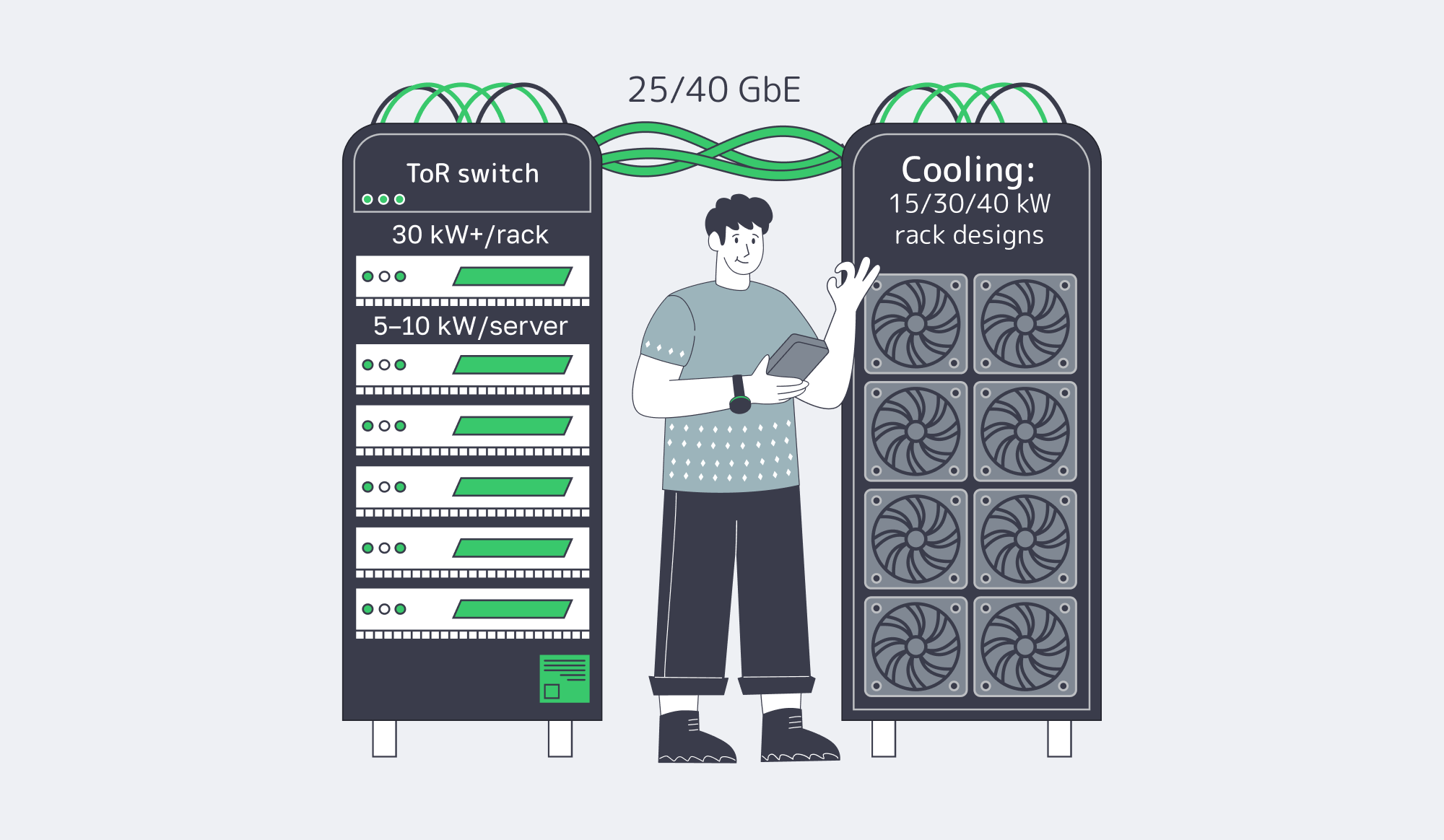
High-density clusters that improve analytics throughput are GPU-forward, network-first designs: multiple EPYC-based GPU nodes connected by 25/40 GbE, with local NVMe tiers and a private east-west fabric. The hard constraints are power, cooling, and acoustics—plan rack density so GPUs don’t throttle, and push distribution work to regional PoPs to keep São Paulo compute focused.
A cluster blueprint that scales cleanly in São Paulo:
- 8–12 identical GPU nodes (EPYC for multi-GPU; Ryzen where single-GPU latency work makes sense).
- 25/40 GbE top-of-rack fabric dedicated to east-west traffic (shuffles, joins, distributed training sync).
- Local NVMe scratch on every node + a shared dataset/checkpoint tier.
- Isolated control plane (deterministic provisioning, pinned driver stacks).
Now the constraints. Standard racks were built around 3–5 kW, while AI/GPU deployments routinely target 10–30+ kW per rack, with individual GPU servers consuming 5–10 kW; as density rises, cooling designs push toward 40 kW and beyond.
This is where “cluster + PoPs” becomes a performance strategy. Keep São Paulo GPUs reserved for computation, and use regional CDN PoPs to absorb repetitive delivery. On the network side, the difference between “local latency” and “local reliability” is upstream diversity: a backbone measured in 14+ Tbps, connected via 20+ transit providers and 25+ IXPs, is what keeps path quality stable when the internet gets weird.
The market tailwind is real. Grand View Research projects the Brazil AI data center market to grow at a 29.5% CAGR (2025–2030), reaching $2.3 billion by 2030.
Key Takeaways for GPU-First São Paulo Deployments

São Paulo plus IX.br is what makes Brazil feel like a first-class region for GPU workloads: low-latency access to local networks, plus the ability to build EPYC/Ryzen GPU nodes that run stable, repeatable pipelines. The forward-looking strategy is to start with a cluster blueprint you can grow, and a distribution layer that keeps GPUs busy.
- Standardize on two node shapes (Ryzen single-GPU and EPYC multi-GPU) so scheduling, spares, and imaging stay boring.
- Treat power and cooling as first-class capacity metrics (kW per server/rack and thermal headroom), not “facility trivia.”
- Use BGP only if you can instrument routes (RTT/jitter baselines, traceroutes, alerting); otherwise it’s just complexity.
- Offload cacheable outputs to the CDN so SP stays compute-bound, not egress-bound.
- Keep a “burst lane” to nearby regions using the global catalog, so São Paulo isn’t your only scaling lever.
Deploy São Paulo GPU servers
Get help selecting GPUs, ports, and IX.br adjacency. We’ll align power, cooling, BGP, and CDN so your São Paulo cluster scales predictably.
Get expert support with your services
Blog

Audit-Ready Dedicated Servers in São Paulo for Compliance
Brazil is now an always‑on market: over 84% of the population is online, and IX.br has hit traffic peaks above 31 Tb/s (with São Paulo alone exceeding 22 Tb/s). For regulated teams expanding into Brazil, that scale collides with a harder requirement: proving—continuously—that sensitive data stays in‑country, access is attributable, and retention is enforceable.
São Paulo’s role as Brazil’s digital core—home to IX.br and a dense fintech/telecom ecosystem—makes it the practical anchor for compliance‑first infrastructure. Keeping compute, logs, and backups local reduces cross‑border legal friction and makes audit evidence simpler to produce.
Choose Melbicom— Reserve dedicated servers in Brazil — CDN PoPs across 6 LATAM countries — 20 DCs beyond South America |
|
Dedicated Server in São Paulo: The Compliance Roadmap
A dedicated server in São Paulo only becomes a compliance asset when “local” is true across the full lifecycle: ingest, storage, processing, logging, backups, and deletion.
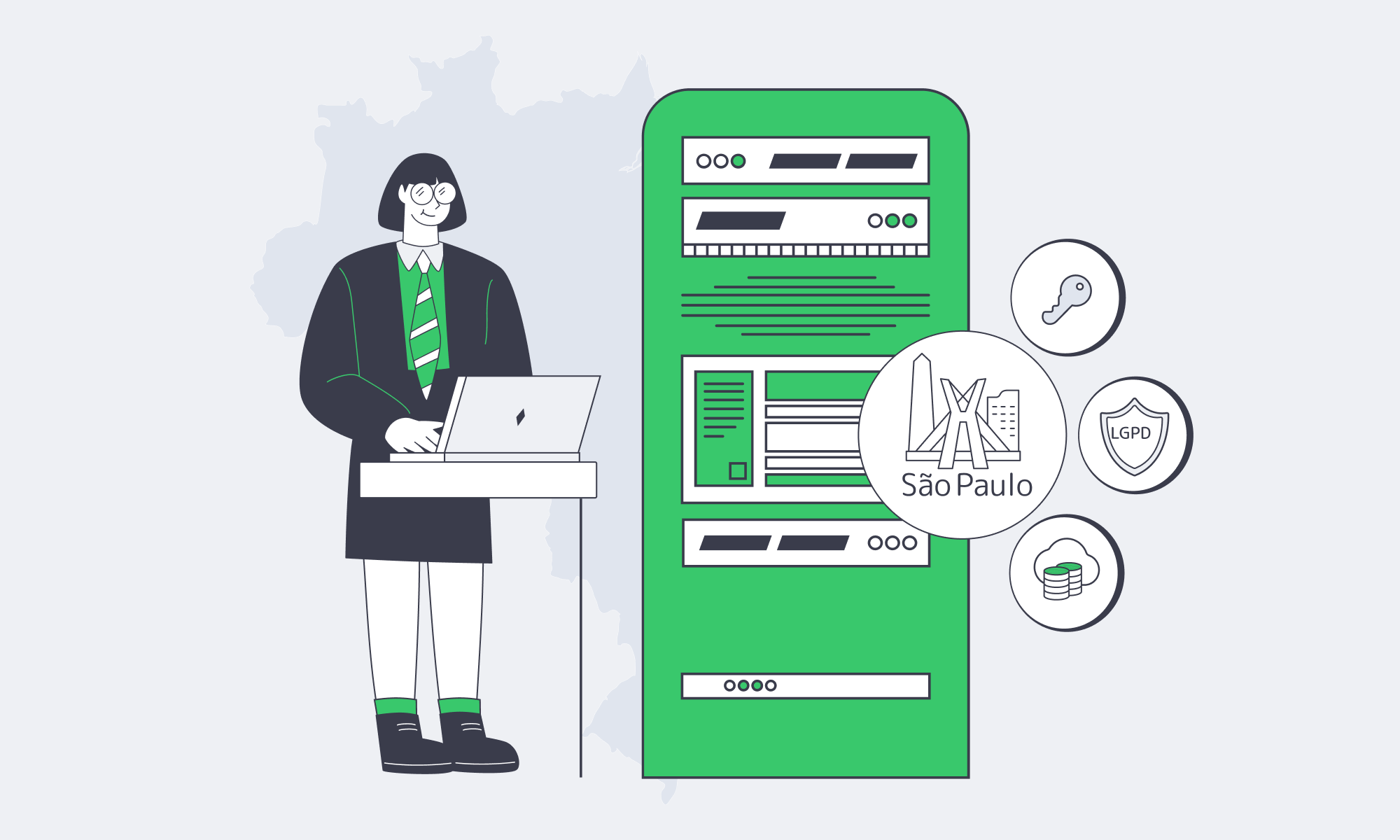
Residency is the first constraint. LGPD doesn’t impose blanket localization, but it restricts cross‑border transfers unless safeguards apply. Treat residency as an engineering requirement: map every outbound path (monitoring, analytics exports, default cloud regions, support tooling), then eliminate or formally justify each one.
Retention is the second constraint. Brazil’s Marco Civil sets statutory minimums for connection logs (providers) and application access logs (online applications). Longer windows (for fraud, AML, incident response, dispute handling) should be explicit and automated—because audits punish ambiguity, not just incidents.
Marco Civil Log‑Retention Minimums (Baseline)

Key custody is the multiplier. Encrypting data is table stakes; controlling keys makes sovereignty durable. “Region‑locked” key approaches—where key material and key operations stay inside the jurisdiction—are becoming the default recommendation for multinational risk programs.
Backups must obey the same borders. Cross‑border geo‑redundancy can silently violate residency and complicate deletion guarantees. Prefer Brazil‑only redundancy, disciplined rotation, and (when required) cryptographic deletion via key destruction.
Which Dedicated Servers Ensure São Paulo Data Residency
A dedicated server in São Paulo ensures residency only if compute, primary storage, logs, and backups are physically in Brazil—and if contracts and architecture prevent silent replication elsewhere. When location is enforced end‑to‑end, LGPD transfer risk drops, regulator access becomes clearer, and “where does the data live?” is answered with evidence, not assumptions.
Residency is easier to defend when performance and compliance point to the same place. São Paulo plugs directly into IX.br’s dense peering fabric (2,400+ networks) and can deliver 2–3 ms round‑trip latency within the São Paulo–Rio corridor—useful for auth flows, payment steps, fraud signals, and incident response.
Regulatory posture matters too. For institutions using external providers, Brazilian regulators have required guarantees of regulator access if customer data is stored overseas—via approvals, arrangements, or other controls.
Penalties can be material: LGPD allows fines up to 2% of Brazilian revenue, capped at R$50 million per infraction (≈ $9.6M / €8.0M at recent rates) (source).
Brazil Deploy Guide— Avoid costly mistakes — Real RTT & backbone insights — Architecture playbook for LATAM |
|
São Paulo vs. Overseas Hosting: Why the Workaround Fails
| Factor | São Paulo Dedicated Server | Overseas Hosting (US/EU) |
|---|---|---|
| Data residency | Data stored and processed in Brazil (residency by design). | Data leaves Brazil; transfers require legal basis under LGPD. |
| Latency | In‑region routing and peering in São Paulo’s ecosystem. | ≈100+ ms typical from the US/EU to São Paulo (often ~105 ms from the US East Coast). |
| Backup & recovery | Local backups remain feasible without violating residency. | Geo‑redundant backups often land outside Brazil, risking residency violations. |
Melbicom’s São Paulo dedicated servers are still in the launch phase, with early capacity reservations available ahead of general availability. For teams standardizing globally, Melbicom offers 1,400+ servers in stock across the ready‑to‑deploy catalog. Custom configurations are delivered in 3–5 days.
What Configurations Enable Audit Ready Logging Controls

Audit‑ready logging is a system: immutable event trails with defined retention, plus access controls that prove only authorized identities touched production. On a São Paulo dedicated server, that means OS auditing, application event logs, centralized Brazil‑resident log storage, and privileged access that’s role‑based, MFA‑enforced, and attributable—so audits become evidence retrieval, not archaeology.
Start with logs that survive scrutiny: authentication events, privilege changes, configuration changes, and access to sensitive datasets. OS audit frameworks provide the baseline; applications must log high‑risk actions such as approvals, exports, and admin overrides.
Retention is the trap door. Treat Marco Civil as the baseline, then encode longer windows as control objectives—automated, consistent, and reviewable. (Source: Privacy International)
Tamper‑resistance matters because privileged users are part of the threat model. Centralize logs to a dedicated log host or SIEM pipeline located in Brazil and use immutable/append‑only storage where possible. If you archive to cloud storage in São Paulo, treat archives as regulated data: encrypt them, and keep key custody local.
Access control should be designed for attribution. Avoid shared admin accounts. Enforce MFA for any path that can modify production. Funnel privileged access through a chokepoint (bastion/jump host) so sessions are attributable and reviewable.
KMS: Keep the Keys as Local as the Data
Auditability gets sharper when encryption is paired with local key control. A Brazil‑bound KMS means keys are generated and stored in São Paulo, with rotation and revocation governed by your change controls. “Region‑locked keys” are increasingly used to prevent encrypted artifacts from becoming accessible under foreign jurisdiction.
Which Vendor MSAs Guarantee Local Data Retention
Vendor MSAs guarantee local retention when they commit—in writing—to Brazil‑based handling, define retention and deletion responsibilities (including backups and support artifacts), and support audits through certifications and transparency. The strongest MSAs lock service location to São Paulo unless you approve changes, preserve your right to export data, and require secure deletion on defined timelines.
Vendor review should connect three layers: the questionnaire (what the vendor claims), the architecture (what the platform does), and the MSA (what’s enforceable). Focus on (1) data‑location commitments that prevent unilateral relocation, (2) retention/deletion language that covers backups and support artifacts, (3) audit evidence and incident/legal‑request handling, and (4) flexibility to adapt when your posture changes.
Here’s a compact due‑diligence checklist to keep MSAs aligned with reality:
- Data center & network: São Paulo facility standards, physical security, and local connectivity via Brazil’s peering ecosystem.
- Data sovereignty: Brazil‑only storage and processing for dedicated hosting in Brazil, including backups and operational telemetry.
- Retention & deletion: policy, automation, and evidence (including backup media).
- Audit evidence: what reports/logs you can access, and the practical path to retrieve them fast.
- Contract controls: location lock, change approvals, and clear data ownership and export rights.
Melbicom’s model is built around operational freedom: Melbicom enables customers to deploy, customize, and scale infrastructure wherever they operate. While São Paulo dedicated servers are still rolling out, Melbicom’s CDN spans 55+ PoPs in 36 countries. In LATAM, CDN PoPs are already live in Brazil, Chile, Colombia, Argentina, Peru, and Mexico—so regulated teams can keep São Paulo as the compliance boundary while delivering regionally.
Conclusion: Make São Paulo Residency Audit‑Proof
A São Paulo dedicated server isn’t compliant by default; it’s compliant when the whole lifecycle stays local: Brazil‑bound data flows, retention that matches legal and control objectives, keys that never leave São Paulo, and backups that don’t export regulated data. The goal is evidence‑driven ops—prove location, access, logging, and deletion on demand.
Practical close‑out checks for regulated teams:
- Treat “Brazil‑only” as an architecture property: block non‑Brazil endpoints for telemetry, exports, and admin tooling unless there’s a documented exception.
- Make retention measurable: define minimums, automate deletion, and run recurring evidence pulls (log samples, deletion proofs, restore tests).
- Put key custody under change control: separate key admins from system admins, rotate on schedule, and rehearse revocation.
- Design for privileged‑user accountability: no shared admin identities, MFA everywhere, session recording on chokepoints, and immutable logs.
- Align legal and technical truth: vendor questionnaires, MSAs, and your data‑flow diagram should describe the same system.
If these checks feel heavy, that’s the point: compliance in Brazil is less about a single control and more about operating a system that can produce proof on demand—without heroic manual work.
Reserve São Paulo Dedicated Capacity
Secure early access to São Paulo dedicated servers built for data-residency-first workloads. Reserve capacity now and pair it with our live LATAM CDN for compliant, low-latency delivery.
Get expert support with your services
Blog

Dedicated Servers for Layer 2 and Rollup Networks
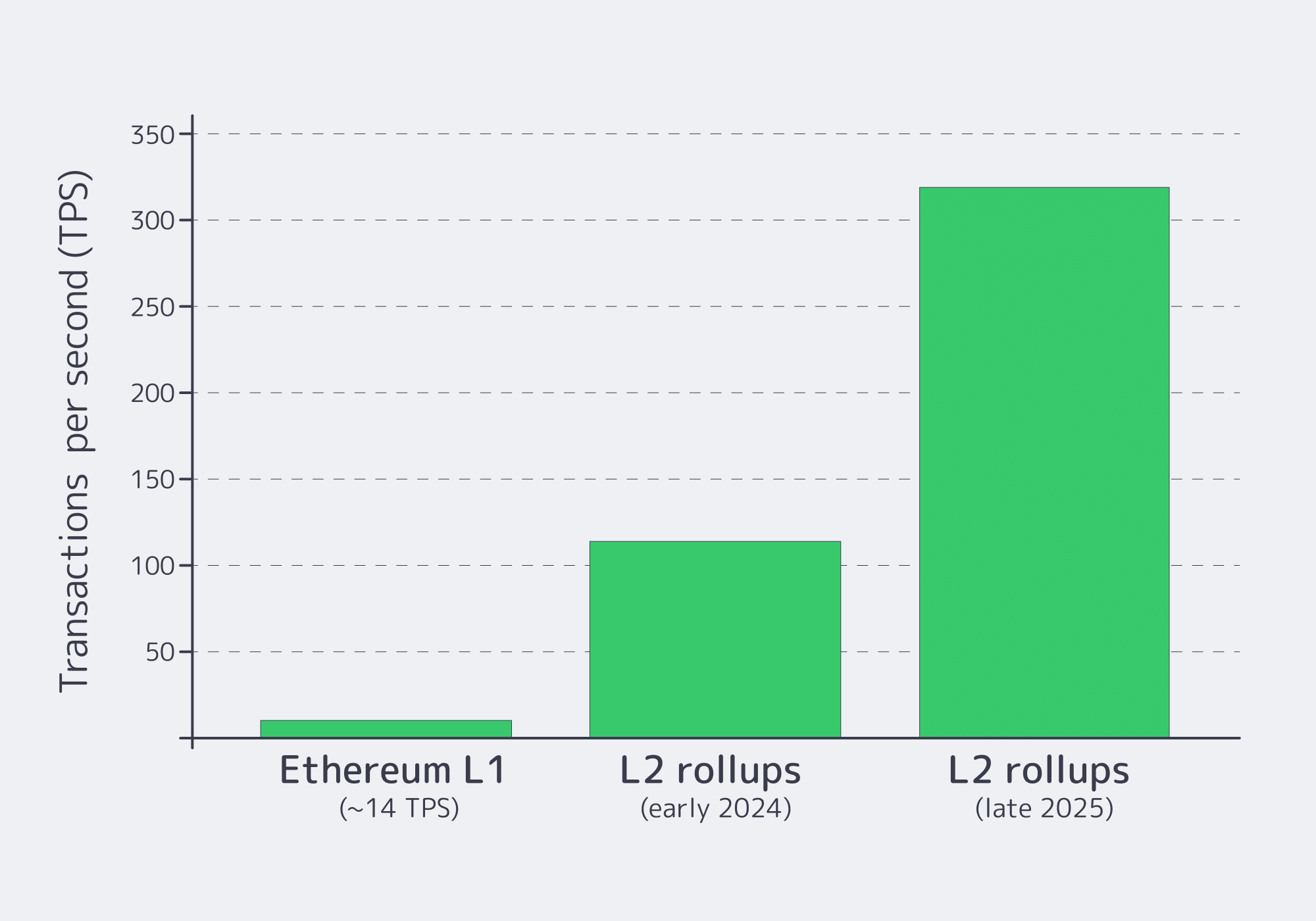
Ethereum’s Layer-2 rollup networks are no longer a side quest—they’re where volume is landing. By early 2024, major L2s were already doing roughly 100–125 transactions per second combined, while Ethereum mainnet sat around ~14 TPS. By the end of 2025, Layer-2 throughput reached roughly 300–330 TPS, about 20× the base layer’s capacity.
That growth doesn’t just stress-test protocol assumptions. It stress-tests infrastructure. A mature rollup network design has two compute cliffs: (1) the sequencer, which must turn a constant mempool into batches on schedule, and (2) the prover, which must turn those batches into zk-proofs fast enough that “finality” doesn’t feel like buffering. Latency to L1 and failure handling decide whether your L2 feels like a product—or a demo.
Rollup Network Design: The Production Pipeline, Not the Whitepaper
A Layer-2 rollup network is a pipeline. Users submit transactions; a sequencer orders them into L2 blocks/batches; the system posts data and state commitments to L1; and correctness is enforced via a fraud-proof window (optimistic) or validity proofs (zk). The sequencer is the piece that orders and produces batches, so its performance directly hits throughput and UX.
The point isn’t to relitigate early “single sequencer” setups—just to acknowledge the lesson: if one box coughs, the chain shouldn’t stop. The infrastructure choices that work at tens of TPS start failing at hundreds, because bottlenecks show up in CPU scheduling, storage latency, network jitter, and operational recovery. That’s why dedicated bare metal—where you control CPU, storage, and the network path end-to-end—shows up in most serious L2 runbooks.
Choose Melbicom— 1,400+ ready-to-go servers — 21 global Tier IV & III data centers — 55+ PoP CDN across 6 continents |
 |
Which Dedicated Servers Maximize Sequencer Node Throughput
Pick a single-tenant box that can execute transactions, compress batches, and submit to L1 without jitter: high-clock, many-core CPU, 128–256+ GB RAM, NVMe state storage, and guaranteed bandwidth (1–200 Gbps per server). The goal is predictable block production and fast L1 submissions under peak load.
Sequencers aren’t “just networking.” They execute state transitions, build batches, and often do CPU-heavy preprocessing like compression. Arbitrum’s docs note the sequencer compresses transaction data with Brotli, and that higher compression levels demand more CPU—enough that the system can adjust behavior when under load. That’s the hardware reality: if the CPU is marginal, throughput becomes a negotiation.
Storage is the other silent limiter. State databases punish slow disks; NVMe reduces I/O stalls and makes restarts less terrifying. Then comes the network. High-activity rollups need to serve user traffic and submit frequent L1 updates, so the sequencer benefits from guaranteed bandwidth and low jitter. Melbicom’s dedicated platform is built around deterministic throughput: Melbicom offers per server ports up to 200 Gbps and 1,400+ ready configurations with ~2-hour activation when a sequencer needs more headroom.
Finally, L1 proximity matters. “Fast sequencing” looks slow if L1 submission is delayed by routing. Melbicom’s backbone runs at 14+ Tbps across 20+ transit providers and 25+ IXPs, which helps reduce propagation delays when your rollup is posting commitments and syncing cross-layer messages.
| Layer-2 node role | Key performance demands | Dedicated server baseline |
|---|---|---|
| Sequencer node (optimistic or zk) | Fast tx execution + batching; low-latency state DB; high-bandwidth, low-jitter path to L1 | 32–64 high-clock cores; 128–256+ GB ECC RAM; NVMe; 10–200 Gbps port (location-dependent); Tier III/IV placement near IXPs |
| Prover node (zk proof generation) | Parallel ZK math; accelerator-friendly; large memory; fast scratch; tight link to sequencer | GPU-ready server where available or 64+ core CPU; 256–512 GB RAM; NVMe scratch; private interconnect; scale-out cluster |
What Hardware Accelerates Zero Knowledge Prover Performance
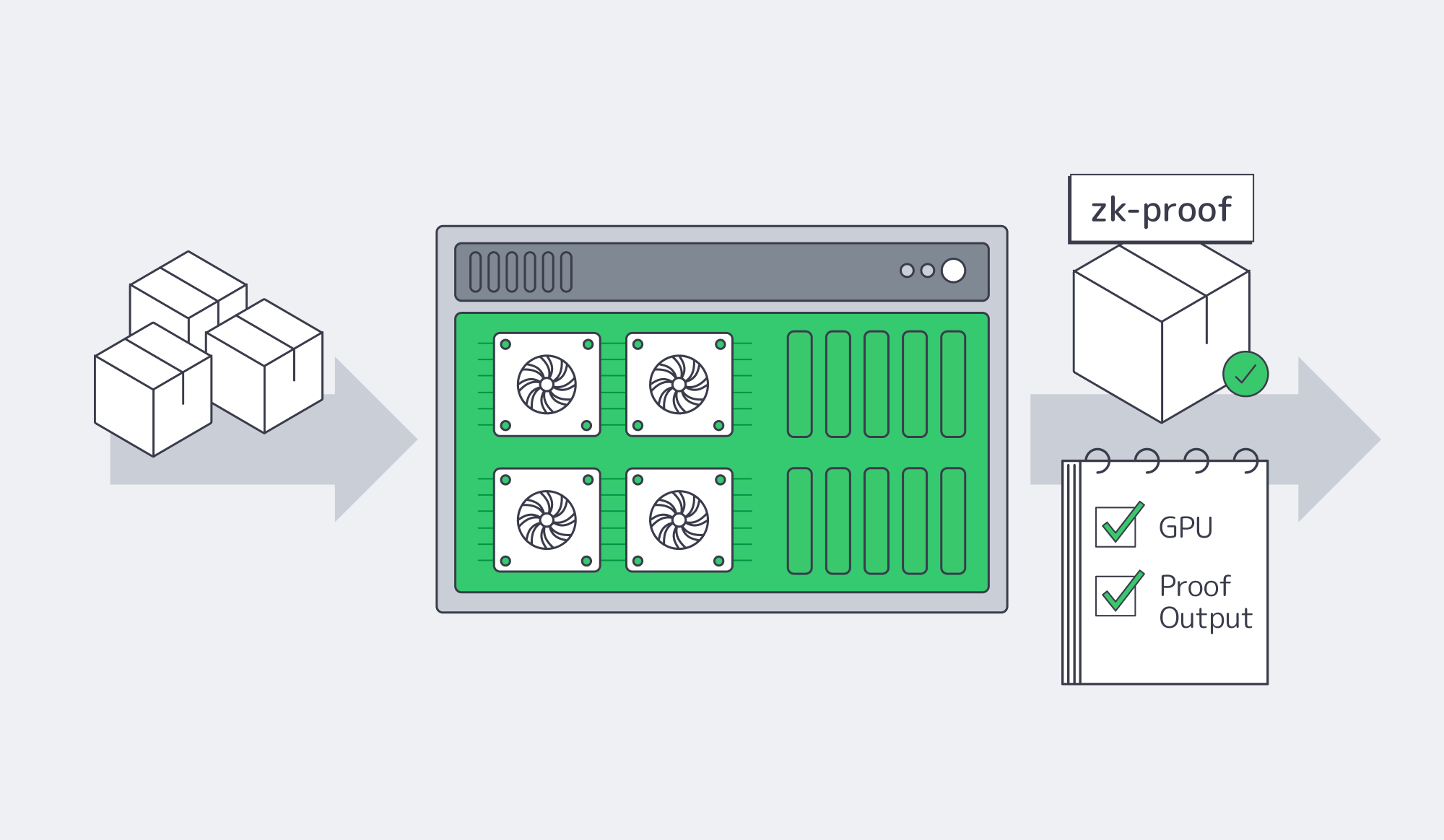
ZK proving is math-heavy and parallel; speed comes from GPUs, memory, and bandwidth. Use GPU servers (often multi-GPU) with large ECC RAM and fast NVMe scratch space, then connect them to the sequencer over low-latency private links so proofs return quickly enough to keep the rollup moving.
ZK proving is where rollups spend real compute. The operations (FFT, MSM, hashing, field arithmetic) reward parallelism, which is why GPU acceleration is now the default. One performance study reports GPU-accelerated ZK proving can be up to ~200× faster than CPU-only approaches. Paradigm’s survey of ZK hardware points to GPUs as the practical accelerator today and highlights production examples like Filecoin’s proof workloads running on GPUs.
Even with GPUs, proof “time-to-submit” often demands serious CPU and memory for orchestration and witness generation. Ethereum Research captures the scale with a concrete datapoint: one rollup (Linea) reportedly uses a 96-core machine with 384 GB RAM to generate a validity proof for a batch in about ~5 minutes. That’s the budget you’re working with when users expect near-instant confirmations.
When one machine can’t keep up, provers scale out. Ethereum Research also discusses parallelization approaches where 100+ modest nodes could prove a large program in minutes—conceptually promising, operationally brutal without the right interconnect. This is where dedicated infrastructure earns its keep: low-latency, high-bandwidth private links between sequencer and prover (and among prover nodes) keep proof pipelines from collapsing under their own data movement.
Melbicom can deliver GPU-ready single-tenant servers, plus private networking patterns that make prover clusters less theoretical to operate day to day. We at Melbicom can also pair hot-path servers with S3-compatible object storage for colder artifacts—proof outputs, witness archives, and snapshots—so NVMe stays focused on throughput.
Which Infrastructure Ensures Resilient Layer 2 Network Failover
Design for failure, not heroics: run redundant sequencers and critical services in multiple regions, sync state continuously, and route users with network-level failover. Combine Tier III/IV facilities, private interconnects, and BGP-based IP continuity so maintenance or hardware faults don’t pause the chain—or strand users during bridges and withdrawals.
Early rollups left an uncomfortable paper trail. A hardware failure in Arbitrum’s lone sequencer node once caused a 10-hour outage. The lesson is straightforward: sequencers are infrastructure and operations. You need redundancy + fast, automated switching.
Modern failover usually looks like this: a primary sequencer in one region, a hot standby in another, continuous state synchronization, and traffic steering that doesn’t require users to chase new endpoints. BGP-based approaches help because they solve the hardest part—IP continuity—at the network edge. Melbicom supports customer BGP sessions (including BYOIP), so teams can keep endpoints stable through failovers and maintenance windows.
The datacenter layer matters, too. Tier III/IV facilities are built for maintenance and redundancy; your rollup shouldn’t be the first time a site discovers what happens when a component dies. In availability terms, Tier III is commonly associated with >99.98% uptime (≈1.6 hours downtime/year) and Tier IV with >99.995% (≈26 minutes/year)—numbers that stop feeling abstract once a sequencer outage freezes withdrawals. Melbicom operates across 21 Tier III/IV data center locations, and Melbicom’s on-site teams handle hardware swaps within 4 hours when failures happen in the real world.
Before you finalize architecture, here’s the ops checklist that tends to separate stable rollup network deployments from fragile ones:
- Size for worst-case, not average: benchmark your sequencer under peak mempool pressure and max compression settings; plan around p95/p99 latency and queue growth, not a quiet day.
- Treat proving as a queueing system: model proof generation as a backlog you must continuously drain; reserve headroom for witness generation and retries so “proof time” doesn’t drift upward during spikes.
- Engineer the L1/L2 link as a first-class dependency: measure L1 submission round trips and jitter; ensure enough bandwidth and routing stability that state commitments don’t stall behind packet loss or congestion.
- Fail over at the edge: build hot standbys, continuous state replication, and IP continuity so endpoints don’t change during incidents; run game days until failover is boring.
- Isolate blast radius: separate sequencer, prover, and public RPC workloads so a traffic surge or proof backlog can’t starve block production.
Conclusion: Building a Rollup Network That Feels Boring—in the Best Way
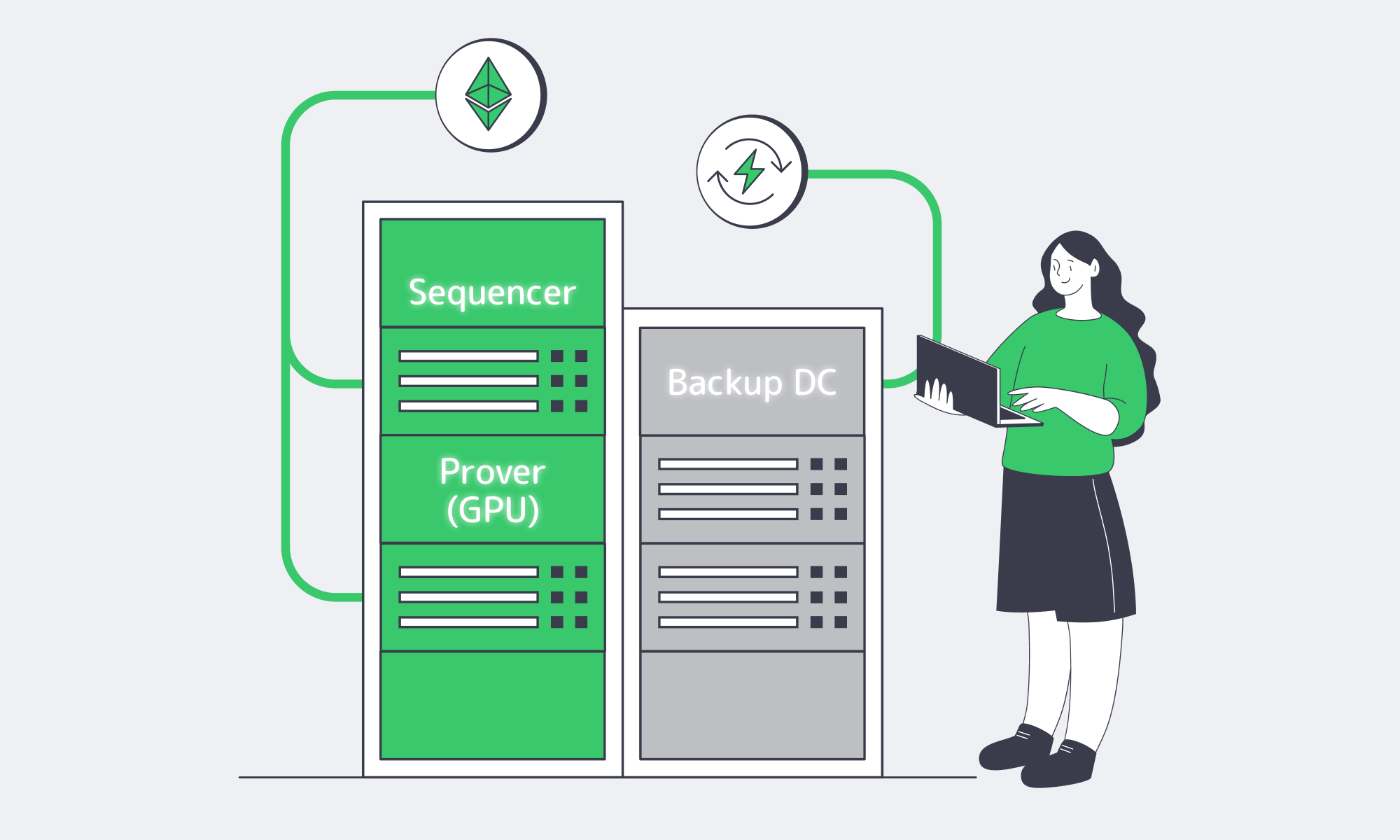
At scale, “performance” is a hardware profile and a network path. Sequencing wants predictable CPU, RAM, NVMe, and bandwidth. ZK proving wants GPUs, memory, and a tight handoff between sequencer and prover. Reliability wants redundancy, routing-level failover, and facilities that treat failure as routine rather than catastrophic.
Dedicated servers turn those requirements into something you can actually control: the CPU scheduler doesn’t change under you, the NIC isn’t shared, and your recovery plan isn’t blocked by multi-tenant constraints. That’s the difference between surviving growth and being surprised by it.
Deploy high-throughput L2 infrastructure
Provision dedicated servers and private networking for sequencers and zk provers across Tier III/IV sites. Activate in ~2 hours from 1,400+ configs, or request custom server builds (any vendor / product line).
Get expert support with your services
Blog

Emerging Web3 Infrastructure Trends & Future-Proof Solutions
Web3 is entering its infrastructure era. The biggest risk now isn’t token volatility—it’s operational fragility: where critical nodes live, how fast they can talk to each other, and what happens when a single region or upstream network goes dark. As more value and real usage shifts on-chain, web3 infrastructure stops being “just hosting” and starts behaving like protocol design.
Three forces are shaping the next wave: (1) decentralized multi-region deployments that reduce dependence on any single provider, (2) rapid expansion of oracle and cross-chain nodes as apps go multi-chain by default, and (3) new performance, reliability, and scaling demands from liquid staking and Layer-2 growth.
Choose Melbicom— 1,400+ ready-to-go servers — 21 global Tier IV & III data centers — 55+ PoP CDN across 6 continents |
|
Which Decentralized Hosting Solutions Ensure Multi-Region Redundancy
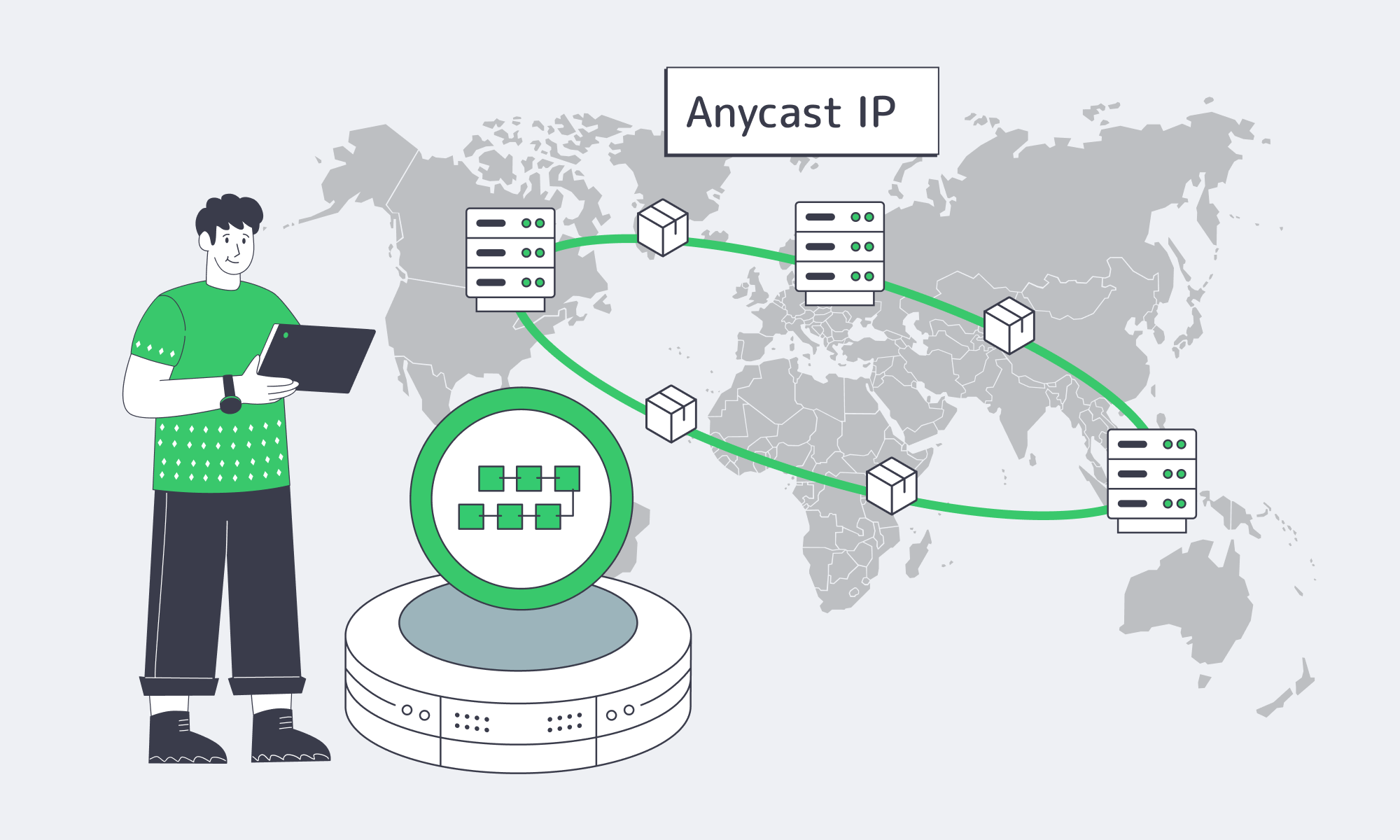
Decentralized multi-region hosting is the fastest path to real resilience: place critical nodes in independent Tier III/IV facilities across continents, connect them with private inter-DC links, and use BGP-based anycast patterns or BYOIP so endpoints stay stable during failover. The result: fewer single-provider outages, lower global latency, and cleaner regulatory segmentation.
The case for multi-region architecture is less theoretical than it sounds. A late-2025 hyperscaler region incident rippled into crypto operations because too many “decentralized” services still depend on centralized infrastructure (see this incident study). Hosting concentration adds another structural risk: when a large share of nodes sits with a small set of centralized operators, decentralization weakens exactly where it matters most—at the infrastructure layer (see Messari’s discussion).
Melbicom supports this pattern with BGP sessions and multi-region placement across 21 Tier III/IV data centers. For teams building active-active RPC gateways, oracle endpoints, or cross-chain relays, that stability is the difference between graceful degradation and a broken application.
What Infrastructure Optimizes Cross-Chain Oracle Node Deployment
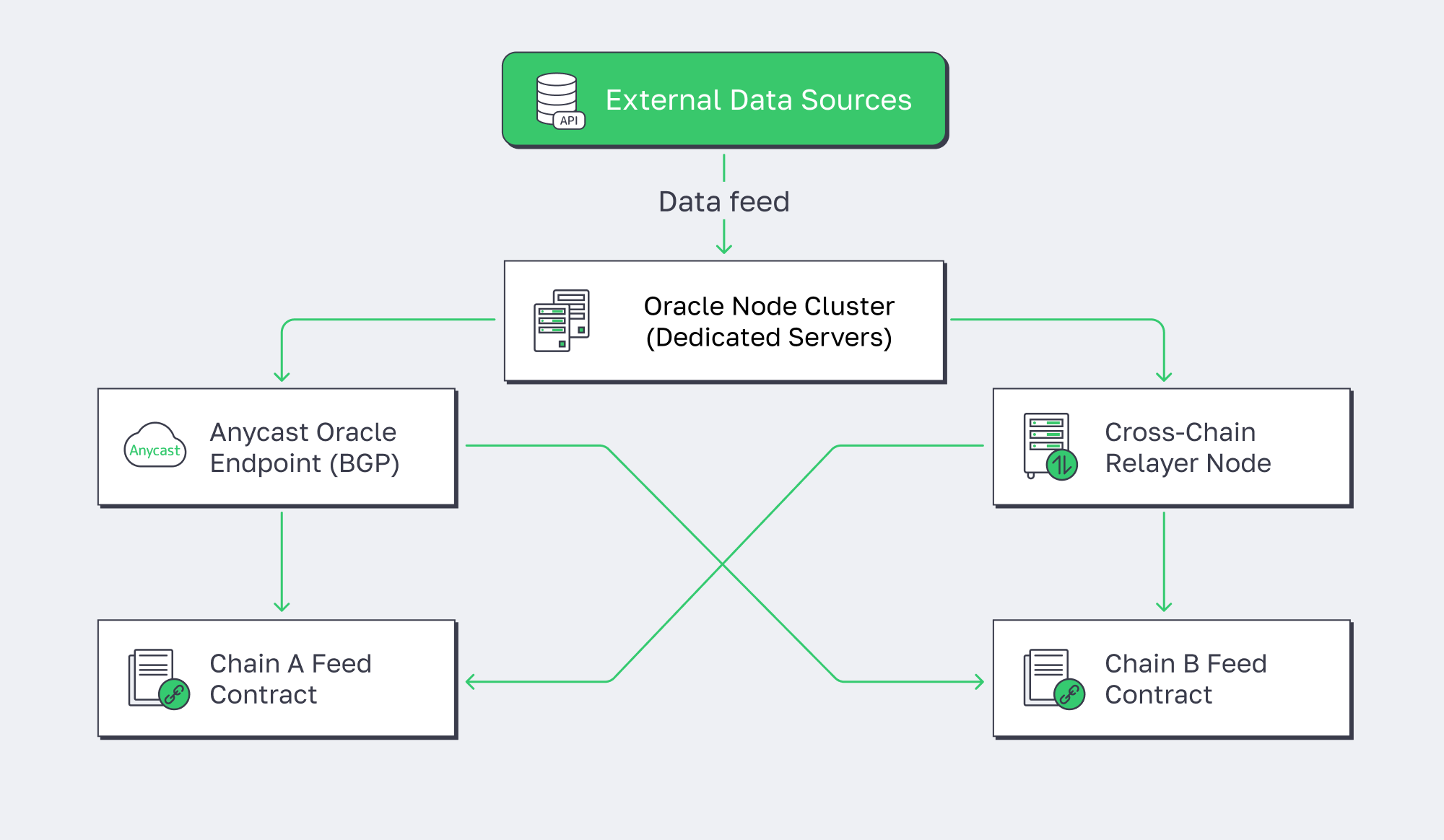
Cross-chain and oracle nodes scale best on infrastructure that treats network consistency as a first-class feature: low-latency peering to multiple chains, predictable bandwidth for state sync and proof relays, and redundant endpoints that don’t change during maintenance. Dedicated bare metal helps keep signing, indexing, and mempool monitoring deterministic under load.
Oracles and bridges aren’t optional middleware anymore—they’re core production dependencies. As adoption rises, so do the consequences of missed updates, stalled relays, and overloaded endpoints. The scale of this shift shows up in hard numbers (see the metrics table at the end, sourced to public reporting), but the operational takeaway is simpler: cross-chain services are “multi-network” by definition, so their web3 infra must be multi-network in practice.
The winning pattern is predictable networking plus deterministic compute. Dedicated servers reduce noisy-neighbor variance for steady workloads (signing, indexing, state sync), while a well-peered backbone reduces tail latency and timeouts across ecosystems. Melbicom’s network and CDN map cleanly to the reality that cross-chain services are API-heavy and globally distributed: 55+ PoPs across 36 countries help pull API surfaces closer to users.
Which Providers Scale Best for Liquid Staking Protocols
Liquid staking and validator fleets demand “boring” infrastructure at extreme scale: rapid provisioning for new validators, multi-region redundancy to reduce slashing risk, and operational tooling that recovers quickly from failures. Providers that pair large ready-to-deploy inventory with fast custom builds and 24/7 support can keep protocols ahead of deposit surges and upgrades.
Liquid staking has turned staking into a high-availability service business. By early 2026, over 36 million ETH was staked—around 30% of supply, according to CoinMarketCal study. As staking concentrates into large pools and liquid staking derivatives, infrastructure mistakes stop being local problems—they become ecosystem-level risks. Downtime isn’t just lost uptime; it’s missed attestations, degraded trust, and real economic penalties.
Infrastructure strategy here is straightforward but demanding: scale out quickly while tightening operational control. Teams increasingly prefer dedicated web3 server environments for consistent I/O across validator clients, execution clients, and monitoring stacks. Multi-region deployment reduces the blast radius of outages; stable endpoint design reduces the operational pain of failover and maintenance.
The other constraint is speed. Melbicom offers 1,400+ ready-to-go server configurations, so protocols can add capacity without long procurement cycles. When requirements are specialized, custom configurations are delivered in 3–5 business days—useful for scaling ahead of network upgrades or sudden deposit inflows.
Layer-2 Growth Is Forcing a New Class of Web3 Hosting
Layer-2 networks are quickly becoming the default execution layer for many user-facing apps. One late-2025 analysis noted combined L2 activity materially outpacing Ethereum mainnet (see the exact figures in the chart below, sourced to Investing.com). That flips the operational center of gravity: L2 components—sequencers, provers, indexers, batch submitters—become as mission-critical as L1 validators for end-user reliability.
Chart 1: Daily Transaction Throughput (Late 2025)

The horizon trend is decentralization-by-design: more operators, more regions, more independent infrastructure. ZK rollups add another pressure point because proving is compute-heavy and sensitive to jitter; teams are pushing critical workloads onto dedicated machines where performance stays predictable. This is also where web hosting starts to resemble a global systems problem: you’re not just running nodes, you’re managing latency budgets, failover behavior, and cross-region data movement as first-class product requirements.
Future-Proof Web3 Infrastructure Patterns That Will Matter in 2026+
Most “next-gen” outcomes come from disciplined engineering applied to crypto-shaped constraints: global users, adversarial environments, and always-on economics. Here’s the condensed checklist that’s emerging as table stakes for resilient web3 infrastructure:
- Treat provider concentration as a design flaw, not a cost optimization. Set minimum region diversity for validator/RPC/oracle footprints, and rehearse failovers on a schedule—not just during incidents.
- Make endpoints effectively immutable. Architect around stable ingress (BGP policies + health-based routing) so maintenance doesn’t become an emergency DNS migration.
- Separate deterministic workloads from bursty ones. Keep signing, sequencing, and proving isolated from indexing/analytics to prevent “background load” from becoming consensus-impacting jitter.
- Make recovery a first-class workflow. Use snapshot-driven rebuilds so resyncs, rollbacks, and region moves are measured in hours—not days.
- Operate cross-chain like an SRE problem. Define per-chain SLOs (latency, update cadence, error budgets), monitor relayer queues, and capacity-plan around bridge and L2 batch spikes.
Conclusion: Future-Proofing Web3 Infrastructure Before the Next Wave
The Web3 conversation is getting less speculative and more infrastructural—and that’s where the real moat forms. Multi-region redundancy is a direct response to systemic concentration and outage risk. Oracles and cross-chain nodes are scaling into high-throughput, low-latency workloads. Liquid staking and Layer-2 growth are raising the bar for deterministic performance, rapid expansion, and operations that survive bad days without drama.
Teams that treat infrastructure as part of protocol design—choosing dedicated compute when determinism matters, distributing across regions, and investing in stable network primitives—will ship faster and break less as usage patterns evolve.
Deploy resilient Web3 infrastructure
Launch on dedicated, multi-region hardware with stable BGP ingress, 55+ PoPs, and S3-compatible storage. Get rapid provisioning and 24/7 support for validators, RPC, oracles, and L2 workloads.
Key Web3 Infrastructure Metrics
| Metric or Trend | Recent Figures (Year) | Source |
|---|---|---|
| Ethereum node hosting concentration | ~65% of nodes in a small set of centralized data centers | Messari |
| Oracle network adoption (Chainlink) | $27.3T+ “total value enabled” | The Motley Fool |
| Cross-chain bridge volume | $56.1B monthly volume | MEXC News |
| Liquid staking scale signal (stETH) | ~8.5M ETH (~25% of ETH staked) | ETF Express |
| Layer-2 vs. Layer-1 activity | ~2M L2 tx/day vs ~1M L1 tx/day | Investing.com |