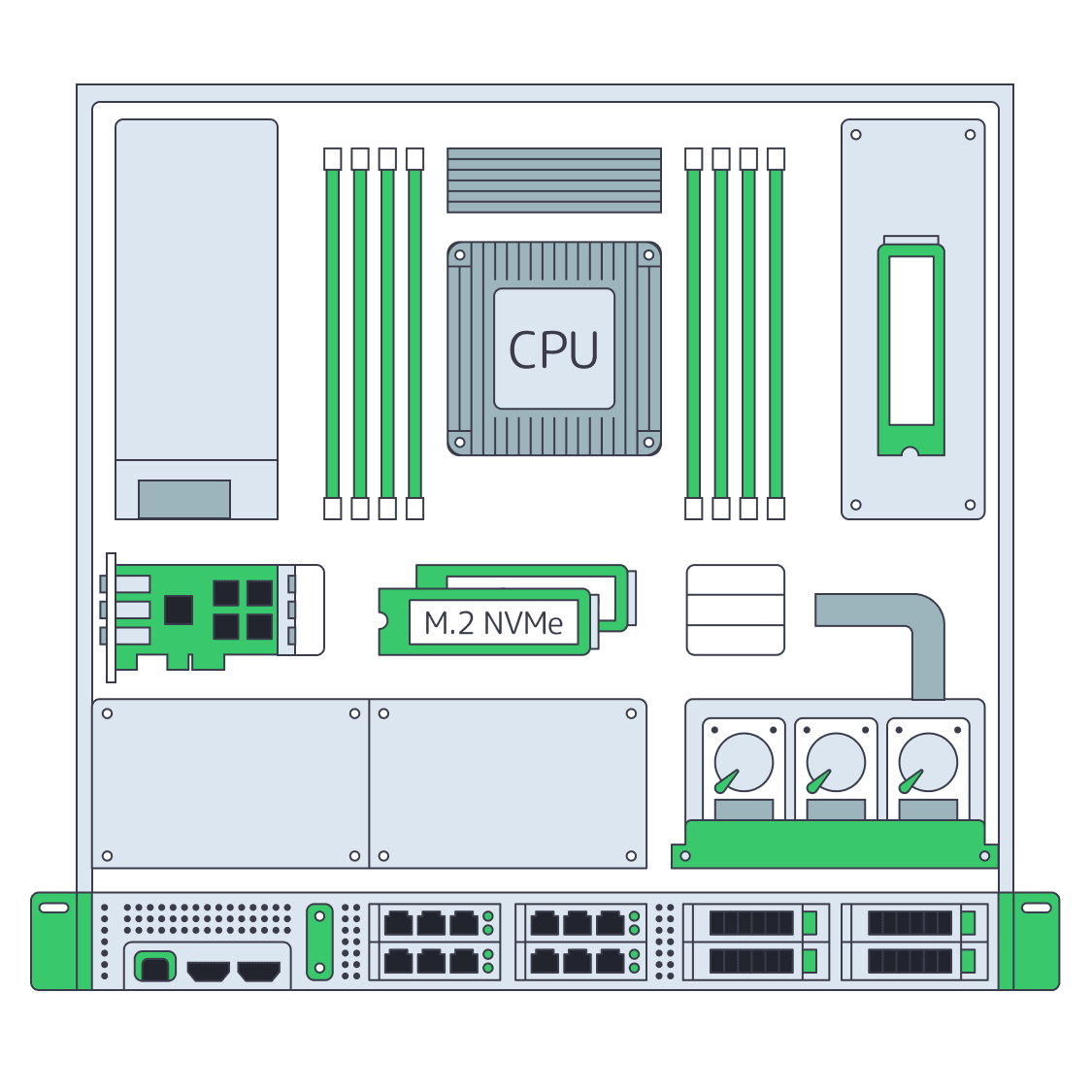
Size dedicated servers for VPN providers by measured traffic

Run customer-facing gateways and exit nodes on isolated hardware, then match CPU, memory, bandwidth, transfer, and region to measured tunnel demand, egress economics, and recovery plans.

Protected VPN infrastructure across global regions

Dedicated server hosting built around VPN traffic

CPU capacity sizing
Size for tunnel load

Match CPU and memory to representative encryption load, connection counts, and observed packet-processing pressure.

VPN gateway operations
Plan egress before rollout

Select transfer and bandwidth against sustained egress, peak traffic, and the economics of each target region.

Regional node placement
Place exits on user paths

Map regional capacity to subscriber demand, route quality, address needs, and a documented recovery boundary.

VPN server stack
Keep the VPN stack yours

Your team owns software, encryption, logging, health checks, updates, abuse handling, and incident response.

Available configurations
Need a Custom Build?
Filters
Clear all
Data center
Data center
CPU
CPU
CPU Brand
CPU Brand
RAM
RAM
Storage
Storage
from
up to
GPU
GPU
    Bandwidth
    Bandwidth
    Data Transfer
    Data Transfer
    Available configurations –
    CPU
    Memory
    Storage
    Network
    GPU
    Data center
    Price
    Show more

    Size VPN nodes from workload evidence

    A commercial VPN node is a compute, network, and egress decision, not a reusable hardware template. Tunnel demand, packet-processing pressure, concurrent connections, user paths, and recovery objectives define the node profile. Copying one configuration across every exit can hide regional cost, capacity, and failure-boundary differences during expansion.

    Melbicom lets operators choose isolated hardware by CPU, memory, storage, network, transfer model, and region. IPMI/KVM and the management API preserve infrastructure access for investigation and recovery, while configuration and bandwidth choices remain tied to the demand and operating conditions of each target location during rollout.

    The operating line stays explicit. Your team installs and maintains the VPN stack, sets encryption and logging policy, monitors node health, allocates traffic, tests failover, handles abuse, and owns incident response. Add BGP sessions only when authorized customer-owned prefixes require direct route exchange and customer-controlled routing policy.

    Operator launching regional VPN gateway

    Keep VPN operations measurable and owned

    Six operating effects to track across regional gateway and exit-node fleets.
    Packet-processing headroom
    Visible egress economics
    Out-of-band recovery access
    Repeatable node profiles
    Explicit incident ownership
    Controlled route policy

    Control every VPN server boundary

    Choose hardware, network, regional placement, and access while your team owns the complete VPN service.
    Isolated hardware for exit nodes
    Configurable CPU and memory capacity
    Regional deployment options
    Location-specific bandwidth choices
    IPMI/KVM access for recovery
    Management API for server control
    Unmetered transfer where available
    Current network options by location
    Authorized BYOIP through BGP
    Customer-controlled route policy
    Shape the right node
    Review tunnel demand, regional egress, and recovery needs before configuration.
    Talk to an expert

    Workloads that shape VPN node design

    Application traffic capacity sizing
    High-traffic exit nodes

    Size CPU, memory, and bandwidth from encryption load, session counts, transfer needs, and sustained egress.

    Regional node map placement
    Regional gateway fleets

    Repeat a documented node profile by region, then verify capacity against user paths and recovery requirements.

    VPN gateway operations
    Subscriber-facing gateways

    Keep VPN software, encryption, logging, health, and abuse handling customer-owned on each deployed regional node.

    Corporate business customer
    Enterprise VPN platforms

    Run customer gateways with root control, keeping infrastructure access and component recovery clearly separated.

    New server location
    New-region launches

    Validate demand, routing, address needs, and egress economics before moving subscribers into a new region.

    Successful recovery test
    Node recovery drills

    Use IPMI/KVM to investigate server issues while your team tests recovery, rollback, and VPN traffic movement.

    BGP peering sessions
    Authorized BYOIP routing

    Use BGP for authorized customer-owned prefixes while routing software controls sessions, communities, and policy.

    User-controlled routing policy
    Route-policy changes

    Apply customer-defined BGP route policy, then test reachability and rollback before shifting live VPN traffic.

    Infrastructure playbooks for VPN operators

    Amsterdam server hub with EU, UK, and US network routes
    Buy Amsterdam for Bandwidth and Control
    Dedicated server BOM with CPU, RAM, NVMe, and NIC modules sized from workloads
    Spec Dedicated Servers From Workload, Not the Catalog
    Servers protected by green shield guiding internet traffic safely
    BGP Guardrails for Secure, Stable, and Reliable Networks
    Servers under AI magnifier displaying live metrics
    Building a Predictive Monitoring Stack for Servers
    More articles
    FAQ
    Who operates the VPN software and policies?
    How should we size each exit node?
    Are bandwidth options identical in every region?
    When does an unmetered dedicated server fit a VPN node?
    Can we use customer-owned IP space?
    Who controls BGP announcements and route policy?
    What access is available for server recovery?
    Does Melbicom monitor VPN node health?
    Can configurations differ between regions?
    What should we test before moving subscribers?
    Open a Melbicom account
    Create an account, review current server options, and define the first regional node profile.
    Create an account
    Plan the node rollout
    Share demand, regions, egress, address needs, and recovery requirements for an infrastructure review.
    Talk to an expert