
Blog

BGP Guardrails for Secure, Stable, and Reliable Networks
The Border Gateway Protocol (BGP) is the Internet’s traffic controller and still one of its trust-based weak points. Its simplicity and scalability have let tens of thousands of autonomous systems (ASNs) share reachability information for 30-plus years, but BGP still trusts those claims.
In recent years, that blind faith has still led to both profitable hijacks and accidental leaks: KLAYswap users lost about $1.9 million after attackers hijacked routes tied to the service (The Record), and Cloudflare disclosed a January 2026 route leak caused by an automated routing-policy error in Miami (Cloudflare). The reason such incidents do not cause even broader damage is that many operators already deploy a practical guardrail stack—strict IRR/RPKI validation, per-session max-prefix limits, conservative use of flap damping, graceful-shutdown signaling during maintenance, and real-time route monitoring.
Choose Melbicom— 1,100+ ready-to-go servers — 21 Tier IV & III data centers — BGP sessions with BYOIP |
 |
This article focuses on guardrails that still work in contemporary production networks and distills them into a practical audit checklist without getting lost in historical detours or vendor-specific CLI detail.
First Line of Defense: IRR & RPKI Validation
Why it Matters
BGP updates propagate at Internet speed. Risk reduction is simplest when you accept only routes that can be shown to be legitimate. That is possible because operators use two complementary sources of data:
- Internet Routing Registry (IRR) – Route and AS-SET objects that are human-curated.
- Resource Public Key Infrastructure (RPKI) – Cryptographic Route Origin Authorizations (ROAs) which attach a prefix to an origin AS.
Together, they form an allowlist that stops many leaks before they propagate.
How Modern Operators Deploy It
- IRR filters remain relevant. IRR filters are usually built during provisioning and updated through change control when customers add or remove prefixes.
- RPKI Route Origin Validation (ROV) on ingress. Enforce ROV so invalid origin announcements do not propagate inward. RIPE Labs reported in early 2025 that about 54% of global IPv4/IPv6 routes were ROA-covered; Kentik estimated that covered destinations already drew about 74% of IP traffic.
- Defense-in-depth. IRR captures prefixes that have yet to get ROAs; RPKI rejects malicious origins that may be missed when using stale IRR data. Melbicom‘s BGP Session service rejects RPKI-invalid announcements and accepts only prefixes with valid IRR entries, so both controls are part of the service baseline.
Automation Spotlight
For Melbicom BGP sessions, the baseline is straightforward: verify the customer ASN and authorized prefixes, enforce IRR and RPKI checks, and then activate the requested route view (full, default, or partial).
Safety Valves: Max-Prefix Limits & Flap Damping
Max-prefix limits
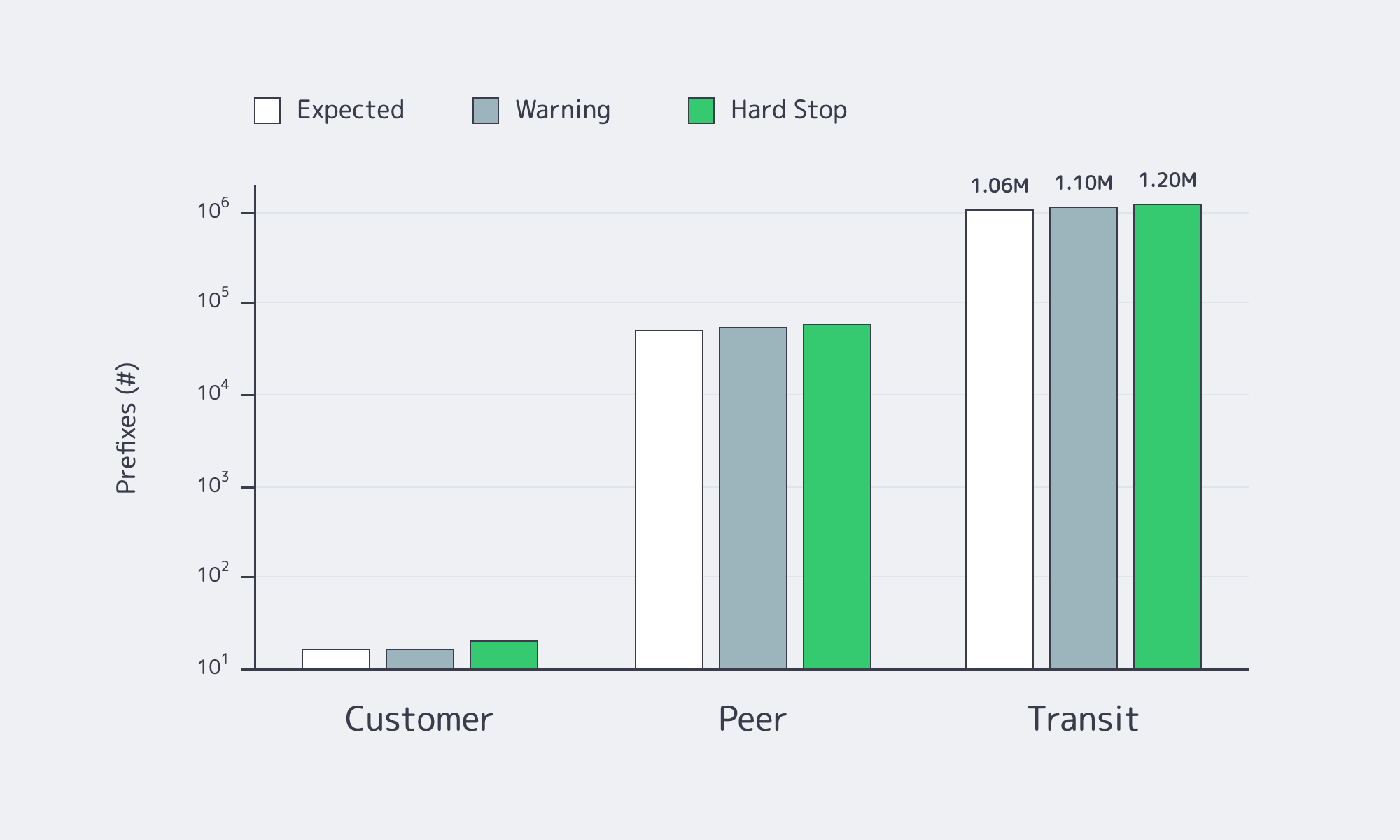
A single typo can turn a router into a flood of unintended routes. Prefix-count limits are circuit breakers, and transit thresholds should be reviewed against current table size instead of left at older one-million defaults. By early July 2026, the IPv4 table alone was already above 1.06 million prefixes at CIDR Report.
| Session type | Expected routes | Warning | Hard stop |
| Transit | 1.06 M | 1.10 M | 1.20 M |
| Peer | 50 k | 55 k | 60 k |
| Customer | ≤16 | 16 | 20 |
Exact full-feed counts vary by vantage point, so treat these transit numbers as a current example rather than a set-and-forget default.
As Cloudflare’s account of the 2019 incident shows, a low per-session customer max-prefix limit—set close to the customer’s expected prefix count—would have tripped and isolated the leak; a loose full-table cap would not.
Route-Flap Damping
Flapping prefixes consume CPU and churn forwarding tables. Early damping defaults were too aggressive, and RFC 7196 and RIPE-580 remain the references operators use when they choose to enable it. In practice, many networks leave damping off for transit and peer routes and, if they use it at all, apply conservative settings only to customer-learned routes.
Automation Spotlight
Per-session limits should combine warning and automatic shutdown thresholds, with telemetry alerts before any session reset.
Graceful Shutdown: Zero-Drama Maintenance
During planned maintenance, operators tag advertised prefixes with the well-known 65535:0 graceful-shutdown community so neighbors lower local preference and drain traffic to alternate paths before the session is taken down, minimizing packet loss.
In networks that honor the 65535:0 graceful-shutdown community, operators can coordinate region-wide drains and customers can use the same signal before planned maintenance or workload moves. Where neighbors do not honor the community, document the alternative drain procedure and test it anyway.
Continuous Eyes: Real-Time Route Monitoring

Guardrails work only if you know when they come into play—or fall short. Live tracking of BGP closes that feedback loop:
- External vantage points (RIPE RIS, Qrator Radar, RouteViews) identify a rogue origin or an abnormal AS-path several seconds after it is created.
- Internal BMP streams send all BGP updates from edge routers to a central collector for analysis, flagging bursts of churn and invalids in real time.
- Automated mitigations—route de-preference, FlowSpec filters, or prefix-limit adjustment—can be applied automatically, without waiting for manual commands.
The operational goal is correlation: combine external alerts with router logs such as “invalid ROA drop” or “max-prefix exceeded” so you can isolate a bad peer, roll back a change, or de-preference a path before users notice.
Quick-Scan Audit Checklist
| Control | What to Verify | Status |
| IRR filters | Per-neighbor prefix lists are created during provisioning and updated via change requests; review the update frequency. | ☐ |
| RPKI ROV | All edge routers drop RPKI-invalids; validator health monitored. | ☐ |
| Max-prefix limits | Settings provide warning and hard-stop thresholds per session and are tested against current route counts. | ☐ |
| Flap damping | If used, settings are conservative and limited to routes where damping is justified; otherwise document alternative controls (monitoring/BMP alerts). | ☐ |
| Graceful shutdown | If implemented in your environment, document and test 65535:0; otherwise, document the in-use maintenance drain procedure. | ☐ |
| External monitors | RIS/BGPStream alerts wired to NOC channels. | ☐ |
| Internal BMP/telemetry | Invalid counts, route-change-rate graphs, and session-state history are visible. | ☐ |
| Log retention | BGP events retained for at least 12 months. | ☐ |
Pulling It All Together
Human effort alone will not keep hundreds of routers synchronized; automation has to do the heavy lifting.
- Configuration as code — policy templates, device roles, and CI tests are version-controlled to catch fat-finger errors before deployment.
- Policy generation — validated IRR changes, live ROA feeds, and current route-count data inform prefix lists and max-prefix limits.
- Event-driven mitigation — if telemetry shows unusual churn, scripts can de-preference a path, isolate a flapping customer, or pause a rollout automatically.
- Staged rollout — push controlled batches and keep a tested rollback path.
At Melbicom, customers may only see an ASN field, a prefix list, and a route-view choice (default, full, or partial), but stable service depends on the validation, limits, and monitoring wrapped around those inputs.
Developing a Resilient BGP Future

Combining route validation, prefix-count circuit breakers, carefully scoped damping, operator signaling, and continuous monitoring helps operators contain real BGP risk without giving up flexibility. These guardrails do not make routing mistakes impossible, but they do shrink the blast radius when leaks and hijacks occur.
Execution still matters. A bad filter update or a missing prefix limit can undo months of careful design. That is why mature operators treat BGP policy as living code, backed by telemetry, staged rollouts, and automated feedback loops. Get the mix right and you get the outcome that matters most: stability at scale.