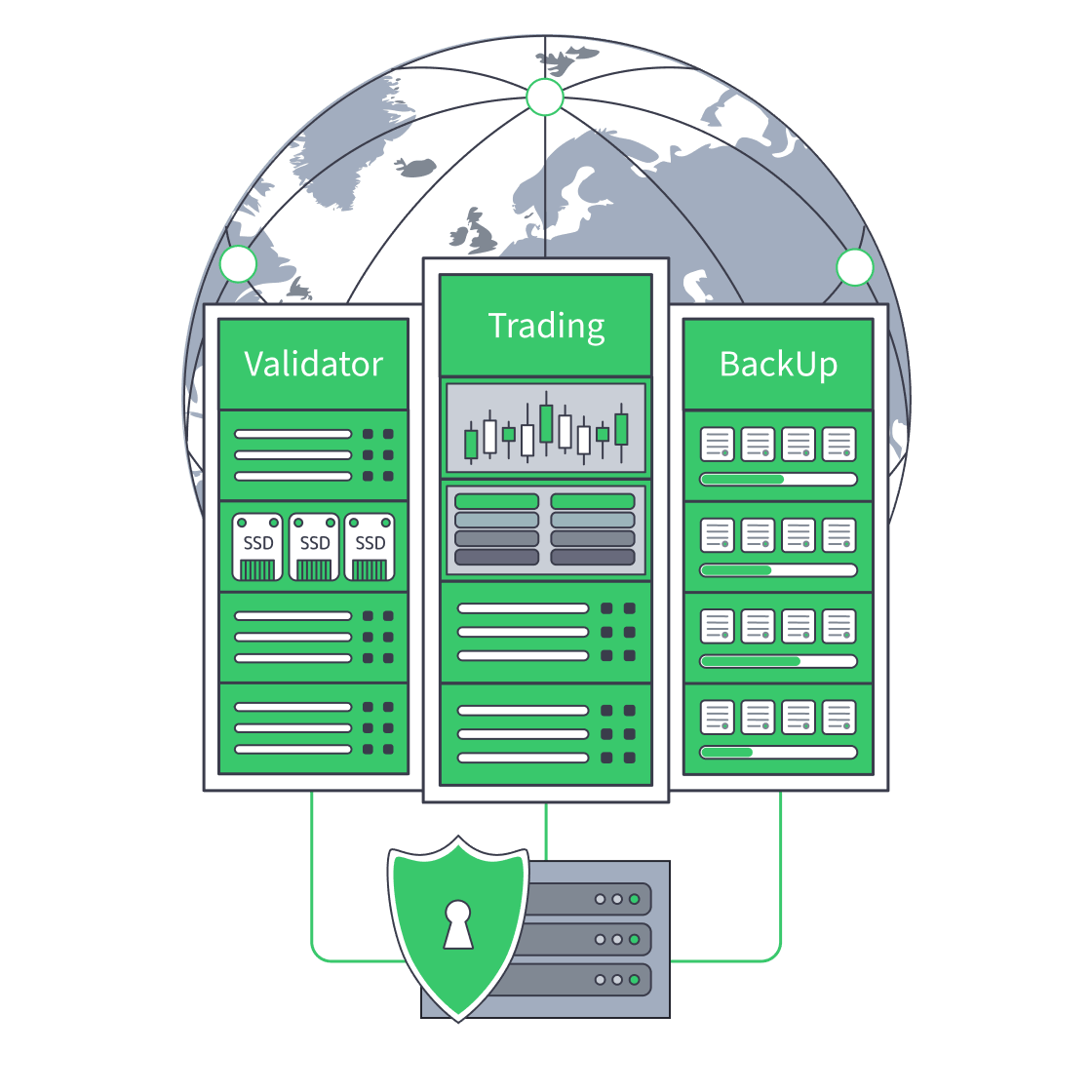
Crypto exchange hosting built around measurable order execution

Run matching, market data, APIs, risk, and telemetry on dedicated servers configured for each role, with CPU, RAM, storage, bandwidth, and location choices for clearer latency attribution and recovery planning.

Secure crypto exchange infrastructure monitoring markets

Map exchange capacity to workload pressure

Isolated trading engine
Isolate matching engines

Assign matching engines to dedicated capacity so CPU pressure and queue behavior remain easier to trace under load.

Exchange market data feeds
Measure market-data load

Place feeds, normalization, and distribution on distinct server roles so throughput and lag stay visible during bursts.

API server configuration
Size APIs for concurrency

Choose CPU, RAM, storage, bandwidth, and location from measured request volume, payloads, and regional paths.

Verified regional server protection
Protect exposed endpoints

Use separate DDoS protection for public APIs and trading endpoints while your team manages core server allocation.

Available configurations
Need a Custom Build?
Filters
Clear all
Data center
Data center
CPU
CPU
CPU Brand
CPU Brand
RAM
RAM
Storage
Storage
from
up to
GPU
GPU
    Bandwidth
    Bandwidth
    Data Transfer
    Data Transfer
    Available configurations –
    CPU
    Memory
    Storage
    Network
    GPU
    Data center
    Price
    Show more

    Choosing dedicated crypto exchange infrastructure: compare fit

    An exchange does not fail as one workload. Matching, market data, APIs, risk checks, and telemetry compete as order flow rises, so the core decision is where to draw boundaries that keep latency, jitter, queue depth, and recovery demand attributable to a single role under sustained load for operators.

    At Melbicom, we offer dedicated servers with configurable CPU, RAM, storage, bandwidth, and location choices. Teams map each role to the resources it uses, place capacity around measured paths, and reserve headroom for replay, synchronization, and recovery testing under peak load.

    Keep matching and order-entry paths on their own roles, move market data and analytics to separate capacity, and use DDoS protection as a bounded service for exposed endpoints. This model gives operators clearer evidence for capacity decisions without forcing one cost profile in production.

    Operator managing multi-currency crypto exchange infrastructure

    Turn exchange capacity into measurable operational signals

    Track signals that expose contention and recovery demand across execution, data, and API paths.
    Clearer latency attribution
    Visible matching queue depth
    Measured market-data lag
    Planned recovery headroom
    Capacity cost by workload
    DDoS protection for APIs

    Configure capacity by exchange role

    Map CPU, memory, storage, bandwidth, and 24/7 technical support to execution, data, API, and recovery roles.
    CPU choices for matching roles
    RAM choices for active state
    Storage sized for replay demand
    Bandwidth up to 200 Gbps per server
    20 data centers across 17 countries
    Locations chosen from measured paths
    Headroom for peak trading sessions
    Recovery capacity for rebuild windows
    24/7 technical support for infrastructure
    DDoS protection for public endpoints
    Size exchange servers
    Choose a ready configuration or discuss a custom server mapped to your workload roles.
    Talk to an expert

    Separate exchange roles for clearer capacity control

    Approved payment traffic
    Order-entry gateways

    Assign gateway processes to dedicated capacity and measure request rate, queue depth, CPU pressure, and tail latency.

    Trading engine operations
    Matching engine roles

    Keep matching execution on defined server roles so saturation, wait time, and processing variance remain attributable.

    Exchange market data feeds
    Market-data pipelines

    Separate feed handling, normalization, and distribution so throughput, packet volume, and downstream lag can be measured.

    Trading engine operations
    Risk and limits services

    Use transaction volume, state access, concurrency, and accepted response windows to size risk and limits services.

    Application traffic operations
    Public trading APIs

    Map API servers to measured concurrency, payload size, authentication work, and regional paths before production routing.

    Server telemetry statistics
    Telemetry and reporting

    Run telemetry and reporting on separate roles so analytical demand stays visible without masking execution pressure.

    Checked server recovery
    Recovery and replay

    Reserve storage, bandwidth, and compute for replay, synchronization, and recovery within your team's accepted window.

    Verified regional server protection
    Protected public endpoints

    Use separate DDoS protection for exposed APIs and trading endpoints while your team allocates server roles separately.

    Infrastructure insights for exchange teams

    Crypto servers for nodes, trading, and backup storage with secure network links
    Crypto Hosting Buyer’s Guide: Dedicated Servers for Nodes & Trading
    Italy dedicated server HA cluster for e-commerce and trading
    Multi-Node High Availability on Italy Dedicated Servers
    Shielded globe and servers connected by green latency pulses
    High-Performance Servers for Crypto Exchanges and Trading Platforms
    Servers under AI magnifier displaying live metrics
    Building a Predictive Monitoring Stack for Servers
    More articles
    FAQ
    How to isolate matching, market-data, API and telemetry workloads?
    How do teams validate latency, jitter, headroom at peak trade volume?
    What should exchanges compare in a server configuration?
    How should regions be chosen for exchange workloads?
    How much bandwidth should market-data services reserve?
    How should recovery capacity be planned?
    Where does DDoS protection fit in the architecture?
    What 24/7 technical support do you provide for exchange infrastructure?
    How does crypto server hosting stay exchange-specific?
    Start with a configuration
    Choose CPU, RAM, storage, bandwidth, and location options for the exchange role you are deploying.
    Create an account
    Map the production roles
    Share workload boundaries, peak demand, regional paths, and recovery targets with our server experts.
    Talk to an expert