
Blog

High-Performance Servers for Crypto Exchanges and Trading Platforms
Milliseconds and credibility determine the life or death of cryptocurrency exchanges. Matching engines need to respond to events almost in real time, APIs must broadcast massive quantities of market data, and the system must withstand demand peaks while staying online. It is not just a best‑effort web workload; it is an ever‑running financial system. High‑performance servers can support low‑latency execution, sustained high throughput, and resilience while giving teams operational control over security and compliance measures.
The size of the market is the reason why the bar continues to go up. CoinGecko’s 2025 annual report puts perpetual trading volume across the top 10 centralized perpetual exchanges at $86.2 trillion for the year. This measures trading value, not order-processing throughput; each exchange must benchmark its own order flow and latency.
Crypto Servers— 1,000+ ready configurations — 21 sites incl. upcoming — 39 CDN PoPs · 6 continents |
 |
Low Latency in Crypto Trading
Low latency in crypto trading means controlling delay and variability across network round trips, gateway acknowledgments, order matching, and market-data delivery. Measure p50, p95, and p99 separately for each stage under peak load. An acknowledged order is not necessarily filled; fill timing also depends on order conditions and available liquidity.
Geographical distance and clean routing. Geography and routing affect network round-trip times. Placing exchange gateways near users can shorten the user-to-gateway path, while caching public assets at the edge shortens the asset-delivery path. Neither removes the propagation delay involved in reaching a fixed matching engine.
Compute and network stacks with low jitter. Garbage collection, CPU scheduling, interrupt handling, and network queues can add latency variation. Dedicated hardware removes contention from other tenants on the host, but application pauses and congestion still need measurement and tuning; hardware isolation alone does not guarantee deterministic execution.
Low‑latency trading servers. Fast CPU cores, local NVMe, and tunable NIC interrupts on dedicated servers give teams control over execution latency. Melbicom’s regional placement and BGP sessions support customer-managed ingress routing. Anycast selection follows routing policy rather than geographic distance alone; test failover timing.
Real‑time market data feeds. Low latency also requires efficient fan-out of order‑book deltas to subscribers. Melbicom offers 1–200 Gbps per-server connectivity and multi-provider transit; usable headroom still depends on message sizes, subscription counts, and processing limits. The CDN PoPs can carry cacheable public UI assets, snapshots, and historical files to offload origins, not accelerate authenticated order execution or live WebSocket feeds through caching.
How Do Servers Handle Trading Spikes?
Token listings, liquidations, or macro headlines can bring abrupt traffic bursts. On June 1, 2020, Coinbase recorded a fivefold traffic increase in four minutes that outpaced autoscaling and disrupted its website and mobile apps; API trading remained functional. The design response is multi-layered:
Provision for the peak, rather than the average. Size capacity against measured order submissions, cancellations, and market-data bursts. With dedicated servers, teams can tune cores, frequency, RAM, and NVMe layout for the hot path without contention from other tenants; achievable throughput depends on the engine and workload.
Scale horizontally under load. Stateless gateways and replicated market-data publishers distribute load across nodes. Partition matching workloads by market while preserving an authoritative order sequence for each book. Orchestration can use prepared spare nodes; physical server provisioning is not instantaneous.
Keep bandwidth slack. Both compute and egress can become bottlenecks. Melbicom provides up to 200 Gbps per server; load tests must confirm that applications, NICs, and downstream paths can handle message bursts without unacceptable queue buildup.
Exchange matching engine hosting. The engine benefits from high clocks and cache‑resident data structures, low‑latency NICs, and predictable storage‑flush paths. Specialized tuning—interrupt coalescing, user‑space networking stacks, and CPU pinning—is possible on dedicated servers; validate each change against the engine’s measured throughput and tail latency.
Designing for 24/7 Trading Uptime

Crypto doesn’t close. Outages interrupt trading, reduce fee revenue, and damage trust; their cost depends on the venue, duration, and market conditions. There are three pillars of uptime discipline:
- Facility resilience. Resilient power, cooling, and carrier diversity reduce infrastructure risks, but facility Tier status does not guarantee application uptime. Melbicom combines Tier III/IV facilities in Amsterdam and Tier III facilities in Los Angeles, Singapore, and Tokyo with on-site engineers for hardware maintenance.
- Redundant services and tested failover. Active‑active load balancers, clustered gateways, hot‑standby matching engines, and geo‑redundant databases reduce single points of failure. Test promotion, order-state consistency, and client reconnection rather than assuming a server failure will be invisible to users.
- Operational control. Dedicated servers and 24/7 support help teams coordinate maintenance. Rolling upgrades require healthy replicas, spare capacity, and tested failover; kernel patches and hardware work may still require individual servers to restart.
Security & Compliance: What Defines a Secure Crypto Exchange Infrastructure?
Compliance is inseparable from performance and security posture. Single-tenant servers provide hardware isolation, control over the OS/kernel, and controlled change, which can simplify auditing and hardening:
Secure crypto exchange infrastructure. Dedicated servers enable customer-managed host‑level controls: hardened baselines, a minimized attack surface, key storage, separately provisioned HSMs where required, and detailed logging. BGP sessions with BYOIP support stable service addressing and customer-defined routing policy; anycast and failover require appropriate configuration and testing.
Melbicom is certified to ISO/IEC 27001:2022, the information security management system (ISMS) standard. This supports the provider-control evidence available to an exchange, but does not establish the exchange’s regulatory compliance. Teams remain responsible for application controls, data residency decisions, and evidence of compliance.
Architecture Patterns That Matter the Most
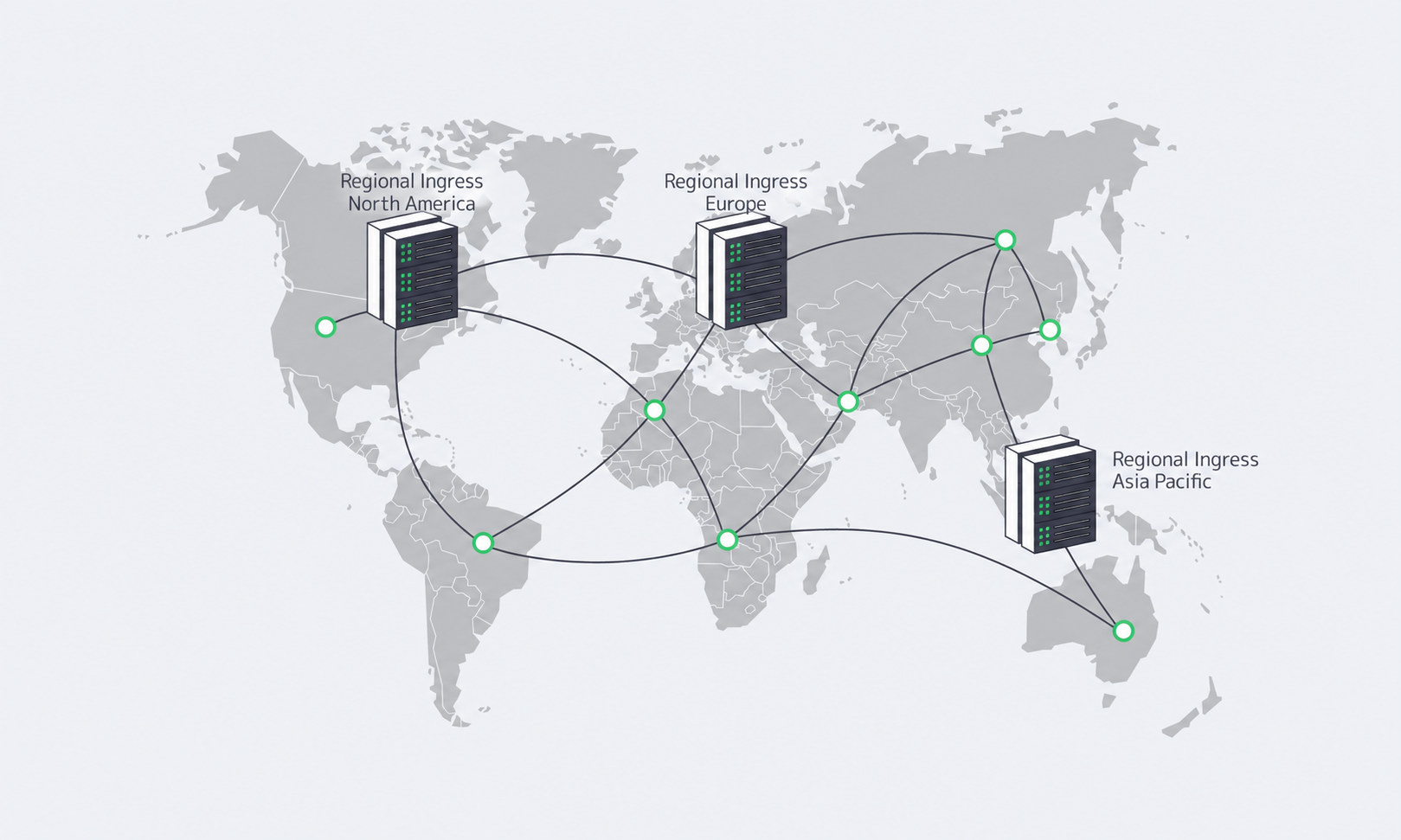
Modern architectures center on a plan that prioritizes predictable behavior and control.
Regional ingress + local bursts. Place gateways and read-heavy services near users while maintaining one authoritative order sequence per book, with coordinated replication and failover. Use active locations within Melbicom’s 21-data-center footprint; São Paulo and Marseille are coming soon. Its 39 CDN PoPs across 35 countries deliver cacheable public content, while order handling and matching stay on tuned servers.
Data‑path separation. Isolate market‑data publishers and internal risk engines to reduce the chance that a burst in one plane starves another service of resources.
Network‑level control. Use BGP‑based anycast and regional failover to retain service addresses across sites. Test failure detection, route withdrawal and convergence, and client reconnection; a route change alone does not preserve application sessions or order state.
Challenges and how high‑performance dedicated servers answer them
| Exchange challenge | Impact if under‑engineered | Dedicated‑server answer |
|---|---|---|
| Uptime & maintenance | Lost fees and reputation; high-risk upgrade | Tier III/IV facilities, hot standby, and rolling upgrades support resilience; application failover must be tested. |
| Low‑latency execution | Unfair dispersion, slippage, dissatisfied market makers | Regional placement, fast CPUs, and single-tenant tuning; test tail latency under load. |
| Security & compliance | High breach/audit risk | Single-tenant isolation, OS control, and the provider’s ISO/IEC 27001:2022-certified ISMS support the exchange’s own controls. |
| Volume spikes & fan‑out | Queue surge, timeouts, interrupted data feeds | Clusters, up to 200 Gbps per server, tested headroom, and prepared spare nodes. |
What Capacity and Throughput Targets Should an Exchange Set?
Capacity targets for a crypto exchange should come from load tests of its own order flow, including submissions, cancellations, concurrent sessions, and market-data subscriptions. Set sustainable throughput at acceptable p95/p99 latency and verify recovery after bursts and node failure. Another venue’s engine capacity is not a dedicated-server benchmark.
In October 2025, Binance reported capacity of 1.4 million orders per second for its own matching engine. A pragmatic planning model:
- Size order intake for peak concurrent sessions and message rates, with headroom validated against bursts and node failure.
- Size matching so peak bursts clear without exceeding the defined tail-latency budget.
- Size market‑data egress for worst‑case deltas, not averages.
- Use local NVMe for write spikes and object storage for snapshots; test restores.
Melbicom offers 1,000+ ready-to-go configurations with activation in around two hours. Provision spare capacity before expected peaks rather than relying on hardware activation during a sudden burst.
A Practical Deployment Checklist
- Pin your latency budget. Set separate p50/p95/p99 targets for network RTT, gateway acknowledgments, matching, and market-data delivery. Use regional ingress to shorten the gateway path; measure fills separately.
- Right‑size the engine. Benchmark high-clock CPUs, cache-resident order books, and local NVMe for logs and snapshots on single-tenant nodes.
- Design for the surge. Pre‑warm extra gateways and publishers for storm conditions, and size egress for those peaks. Target capacity above the mean.
- Separate planes. Isolate order entry, matching, market‑data, and administrative traffic so bulk delivery and maintenance do not contend with the hot path.
- Engineer for failure. Use active‑active load balancers, hot‑standby engines, rack‑ and region‑level replication, and tested cutovers.
- Control your routes. Configure the BGP session and BYOIP where appropriate for stable service addresses; test route selection, withdrawal, and client reconnection.
- Prove compliance. Map host, application, and operational controls to the exchange’s ISMS and applicable obligations. Keep evidence current; Melbicom’s ISO/IEC 27001:2022 certification covers the provider’s ISMS, not the exchange’s compliance.
Conclusion: Dedicated Servers Are the Backbone of Trustworthy Crypto Trading
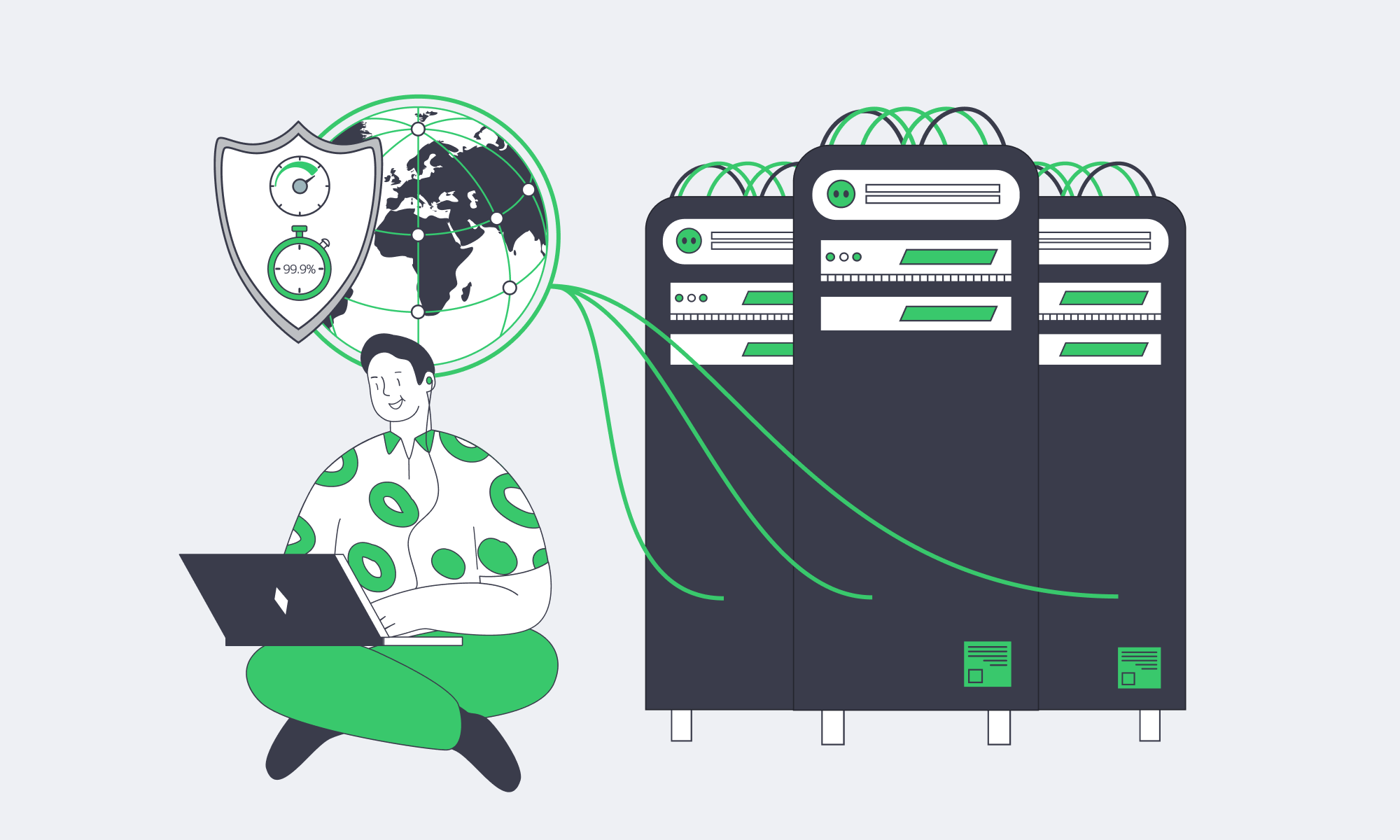
Exchanges compete on speed, reliability, and stability. This demands infrastructure with low‑jitter latency, high sustained throughput, and measured resilience—not just in normal periods but in the exact minutes when markets are most volatile. Trading volumes provide market context; investment decisions should rest on the exchange’s own load tests, latency budgets, and recovery requirements.
Dedicated servers on a professionally operated global platform give teams architectural freedom: choose regions, match hardware to workloads, move cacheable content to the edge, and control routing policy. Combined with tested application design and operations, these capabilities help trading venues keep UIs responsive and services resilient.
Build a low‑latency crypto exchange
Provision tuned, single‑tenant hardware in key regions to cut jitter, handle volume spikes, and meet uptime targets for your trading platform.