Cassandra hosting with resource headroom for sustained writes

Rent dedicated servers for your Apache Cassandra cluster. Match CPU and RAM to application traffic, local SSD/NVMe to retained data, and bandwidth to replication and node transfers.

Cassandra servers with access protection

Whole-host resources for Cassandra workloads

CPU capacity sizing
Compute and memory for concurrent work

Allocate CPU and RAM to client requests, with headroom for compaction, repair and other background work.

Storage retention capacity sizing
Storage capacity for retained replicas

Choose SSD/NVMe capacity and I/O for retained replicas, with working space for compaction and streamed data.

Multiple LAN bandwidth paths
Bandwidth choices for cluster traffic

Select bandwidth for client traffic and replication, with capacity for repair and data streamed between nodes.

Database capacity sizing
Hardware matched to your node workload

Rent a ready configuration or specify a custom build around your node's compute, memory and storage requirements.

Available configurations
Need a Custom Build?
Filters
Clear all
Data center
Data center
CPU
CPU
CPU Brand
CPU Brand
RAM
RAM
Storage
Storage
from
up to
GPU
GPU
    Bandwidth
    Bandwidth
    Data Transfer
    Data Transfer
    Available configurations –
    CPU
    Memory
    Storage
    Network
    GPU
    Data center
    Price
    Show more

    Size each node for its full workload

    Your cluster serves application reads and writes while compaction rewrites stored files and repair synchronizes replicas. Size each node for that overlap, retained data and transfers as hosts join or leave. Read latency, ingestion targets and repair windows guide hardware spending.

    Melbicom rents physical hosts with CPU, RAM, local SSD/NVMe and bandwidth choices. Order a ready server or a custom build for each node’s read, write and repair workload. Choose locations across 21 data centers worldwide to suit application access and your replication plan.

    Run Cassandra nodes on separate rented hosts, with your team in control of replication, retention and maintenance. Plan capacity for the load on remaining nodes when one is offline. Rent more hosts as demand grows and reserve disk space and bandwidth for data streamed to new nodes.

    Cassandra operator managing database workloads

    Capacity for traffic growth and maintenance

    Align node budgets with application demand, data retention and maintenance schedules.
    Capacity for sustained ingestion
    Read capacity under mixed load
    Retention within storage budgets
    Resources for repair windows
    Headroom for node outages
    Additional hosts for expansion

    Hardware choices for each node

    Select CPU, RAM, local disks and bandwidth for the Cassandra deployment your team operates.
    Exclusive use of a physical server
    Processor choices for node workloads
    RAM options for heap and cache
    Local SSD and NVMe disk options
    Storage capacity for retained data
    Bandwidth plans for cluster traffic
    Server locations for your topology
    Ready-to-go hardware configurations
    Custom builds to your specification
    Support for servers and networking
    Plan your next node
    We deliver custom hardware to your node specification in 3–5 business days.
    Request a build

    Application patterns shape node requirements

    Server telemetry statistics
    Industrial telemetry

    Match CPU to device event ingestion and local disks to retained histories queried by device and time window.

    System log document
    Logistics timelines

    Assign storage to shipment histories and memory to active lookups as tracking events arrive from your fleet.

    Isolated tenant workloads
    Tenant activity logs

    Account for uneven tenant activity when sizing CPU and RAM, with local disks for retained application histories.

    Database read processing
    Catalog lookups

    Allocate memory for active product lookups and local disk capacity for catalog data as your assortment expands.

    Three-person user group
    Customer profiles

    Account lookups and profile updates share CPU and RAM, with local disks sized for retained customer data.

    Event pipeline operations
    Operational events

    Plan local disk capacity for retained events and compaction while files containing expired records remain.

    Parallel event processing
    Delivery records

    Message status updates use CPU and local disks, with bandwidth for account queries and traffic between replicas.

    Server analytics processing
    Usage metering

    Size local disks for retained usage events and CPU for account queries across your chosen reporting periods.

    Cluster planning from hardware to recovery

    Engineer monitoring a 10Gbps dedicated server and network status
    10Gbps Dedicated Server Providers: Compare Ports, Terms and Network
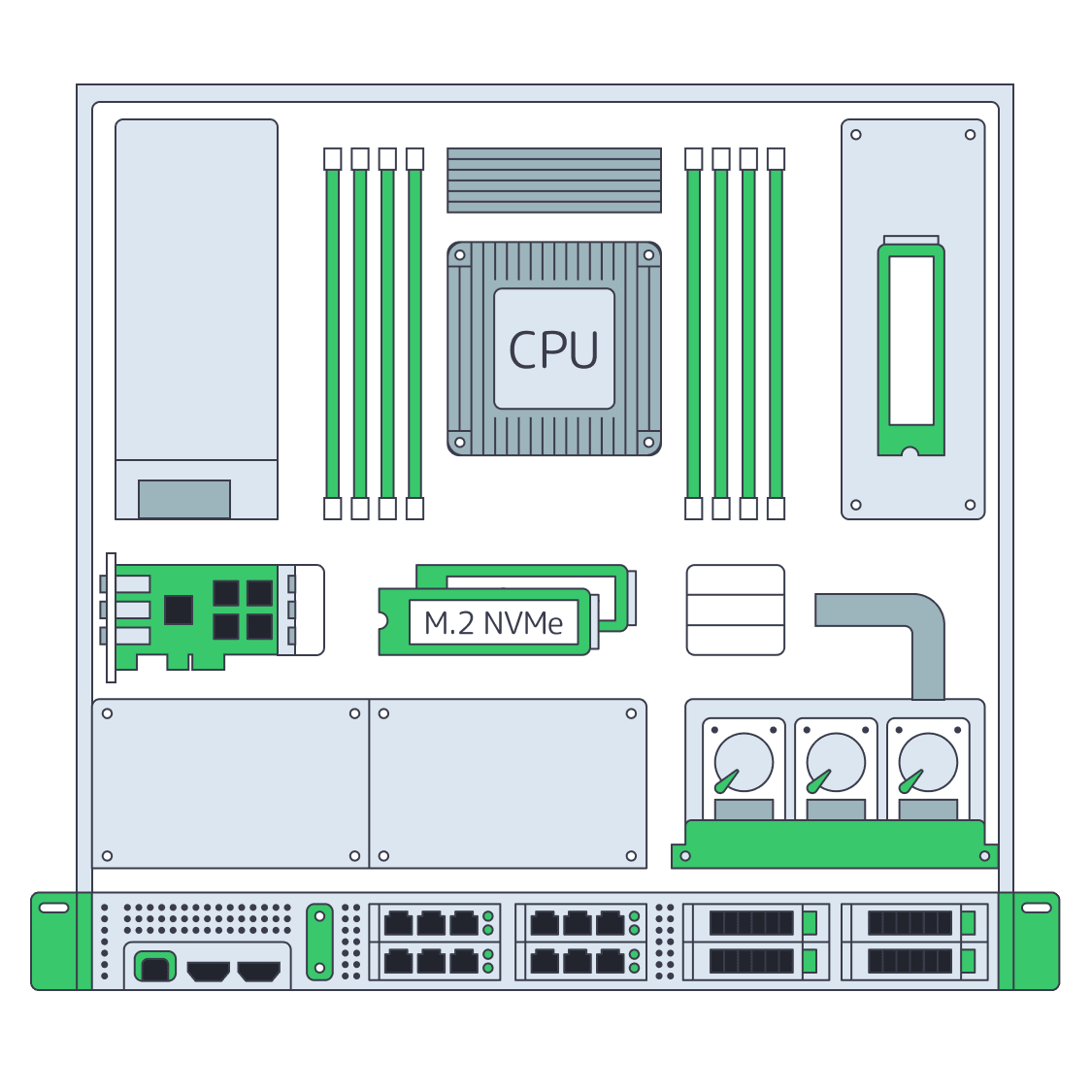
    Dedicated server BOM with CPU, RAM, NVMe, and NIC modules sized from workloads
    Spec Dedicated Servers From Workload, Not the Catalog
    Balanced scale comparing owned servers to rented subscription contract
    Database Server Acquisition: Should You Buy or Rent?
    Illustration of servers linked to cloud object storage by green high‑speed cables
    Blueprint for High-Performance Backup Server Solutions
    More articles
    FAQ
    Who operates the Cassandra cluster?
    When does a workload suit physical nodes?
    How many physical nodes should we rent?
    How should we budget CPU and memory?
    What matters when choosing SSD or NVMe storage?
    How much free disk space does a node need?
    How do partition choices affect hardware sizing?
    What traffic belongs in the bandwidth budget?
    How should we choose locations for cluster nodes?
    How do we add capacity as the dataset grows?
    How should we plan backups and restore capacity?
    How do ready configurations and custom builds differ?
    Start your server order
    Rent physical hosts with CPU, RAM and local storage sized for your cluster's reads and writes.
    Create an account
    Specify custom hardware
    Tell us your CPU, RAM, local storage and bandwidth requirements for a custom node build.
    Discuss hardware