
Blog
10Gbps Dedicated Server Providers: Compare Ports, Terms and Network
A 10Gbps dedicated server can have a 10Gbps Ethernet interface without delivering 10Gbps of committed bandwidth. That distinction matters when streaming traffic, replication jobs, or bulk transfers depend on sustained throughput.
According to TeleGeography’s 2026 research, international internet bandwidth reached 2,259 Tbps, growing 23% year over year. Average and peak international traffic grew at approximately 24% annually between 2022 and 2026.
Selecting a 10Gbps unmetered dedicated server therefore requires examining six separate factors: port speed, committed capacity, transfer accounting, acceptable use, network routes, and operational terms.
Melbicom 10Gbps– 10Gbps unmetered transfer – 21 Tier III & IV DCs – 24/7 engineering support |
 |
Which 10Gbps Providers Define Bandwidth and Transfer Terms?
10Gbps dedicated server providers should document the physical port rate, committed bandwidth, transfer accounting, acceptable-use restrictions, and contractual conditions. A 10Gbps interface alone does not establish guaranteed throughput. Buyers should require written confirmation of the committed rate, measurement conditions, and service boundary before treating advertised connectivity as production capacity.
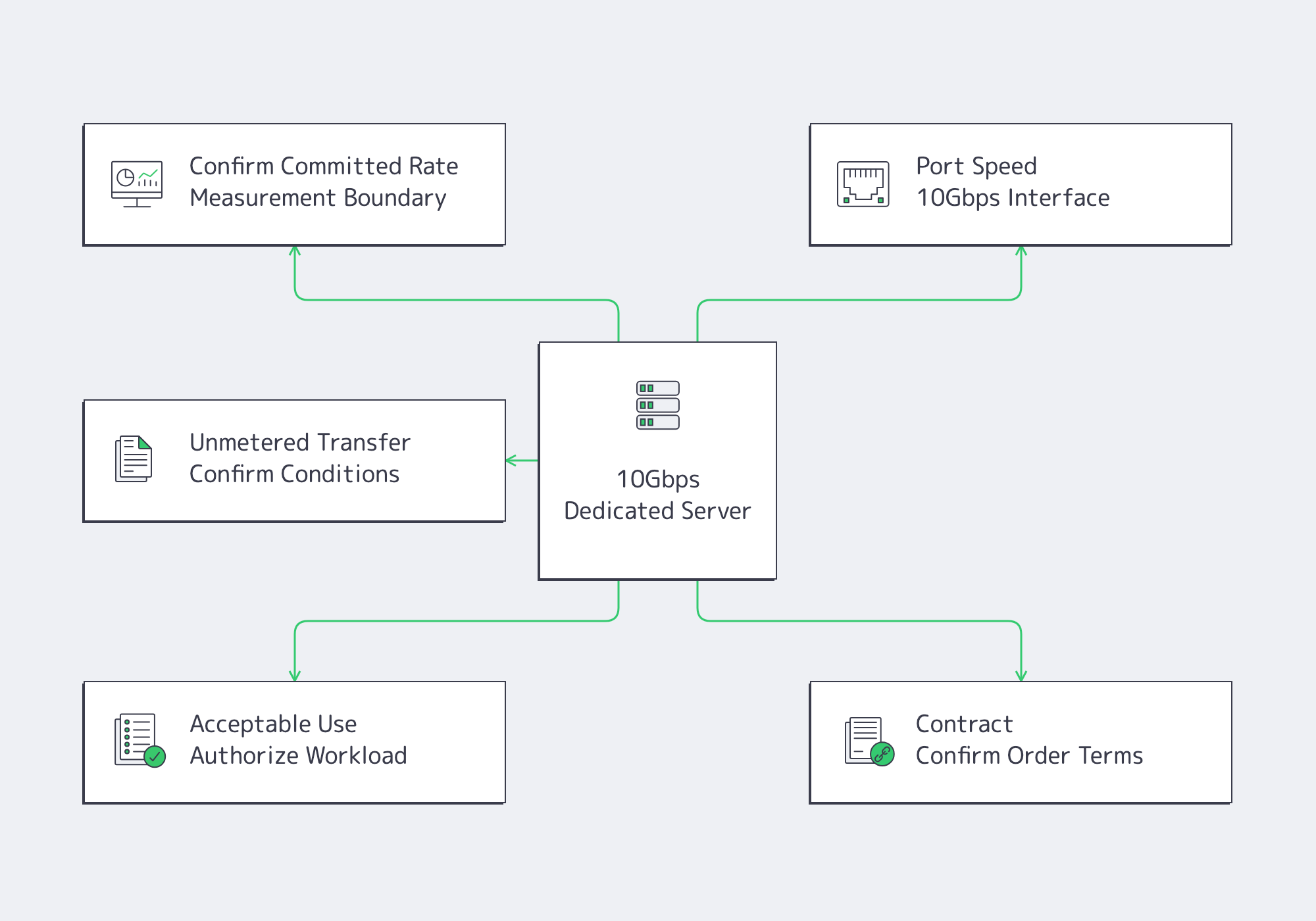
Melbicom’s 10Gbps unmetered offering combines a 10Gbps port with consistent and guaranteed bandwidth. We provide monthly billing, a one-month minimum payment period, and no required long-term commitment for dedicated servers.
Compare documented service characteristics with actual workload requirements—not marketing labels.
Port Speed Versus Committed Bandwidth
A 10Gbps port specifies interface capability, not necessarily available upstream capacity.
The IEEE 802.3 Ethernet standard defines link operation at specified speeds. Meanwhile, MEF’s bandwidth-profile framework, Section 15.1, defines CIR as the average rate of traffic treated as committed under its bandwidth-profile model.
MEF terminology provides a useful distinction between physical link capacity and a committed service rate.
For 10Gbps port guarantees, distinguish three quantities:
Port speed describes the server-facing interface. Committed bandwidth describes capacity promised at a defined service boundary. Application throughput reflects software transfers after protocol overhead, congestion control, CPU, storage, and remote-network conditions.
However, a server-side commitment cannot guarantee identical throughput to every internet destination. RFC 6349, an Informational RFC published in August 2011, provides a framework for evaluating sustained TCP throughput and identifying bottlenecks across managed IP networks.
For committed bandwidth hosting, ask where the commitment applies, whether ingress and egress receive equivalent treatment, what measurement interval is used, and how throughput can be validated.
Melbicom’s infrastructure supports up to 200 Gbps per server globally.
Metered Versus Unmetered Transfer Terms
Transfer accounting determines how traffic volume affects billing. Port capacity determines how quickly traffic can move.
Metered services associate consumption with an allowance or usage-based accounting. Unmetered services remove volume-based metering as the central billing constraint, but physical port limits and applicable use restrictions remain.
At continuous full line rate in one direction over 30 days, a 1Gbps port could theoretically transfer 324 TB, a 2Gbps port 648 TB, and a 10Gbps port 3,240 TB (3.24 PB). These decimal figures exclude protocol overhead and interruptions. They represent engineering ceilings, not guaranteed transfer volumes, customer allowances, or promised sustained throughput.
A hypothetical 100TB monthly allowance, by comparison, represents approximately 309Mbps averaged across 30 days.
Melbicom distinguishes bandwidth and data transfer in our dedicated-server configurations, while our 10Gbps product offers unmetered transfer.
For streaming distribution and high-volume data platforms, dedicated server transfer terms should establish whether sustained traffic creates additional charges, restrictions, shaping conditions, or approval requirements. These conditions matter independently of whether a service is described as unmetered.
Matching 1Gbps, 2Gbps, and 10Gbps Offers to Production Workload Profiles
Match 1Gbps, 2Gbps, and 10Gbps dedicated-server offers to measured p95 and peak demand, burst duration, transfer deadlines, and projected growth. As illustrative planning thresholds—not guaranteed performance—1Gbps suits p95 egress below roughly 600Mbps, 2Gbps suits approximately 600Mbps–1.3Gbps, and 10Gbps suits sustained multi-gigabit workloads or transfers requiring substantially shorter completion windows.
Melbicom offers 1Gbps, 2Gbps, and 10Gbps unmetered dedicated servers.
Ericsson’s Q2 2026 Mobility Report recorded more than 220 EB of monthly mobile-network traffic, including fixed wireless access, up 23% year over year. Video accounted for approximately three-quarters of mobile data traffic at the end of 2025.
These industry figures provide context, not a forecast for an individual deployment. Port selection must still follow measured workload demand.
Workload Worksheet: Choosing a Port
The following thresholds are illustrative planning guidelines. They assume the measurements represent actual server-interface traffic over relevant production periods.
| Observed Production Workload | Recommended Port | Upgrade Trigger |
|---|---|---|
| p95 egress ≤600Mbps; short peaks below 800Mbps; flexible transfer windows | 1Gbps | Sustained congestion, insufficient headroom, or missed transfer deadlines |
| p95 egress 600Mbps–1.3Gbps; peaks below approximately 1.6Gbps; regular replication | 2Gbps | Sustained traffic above 1.3–1.5Gbps or multi-gigabit transfer requirements |
| Sustained multi-gigabit egress; bursts exceeding 2Gbps; large distribution or replication jobs | 10Gbps | Validate storage, CPU, and remote-network throughput before deployment |
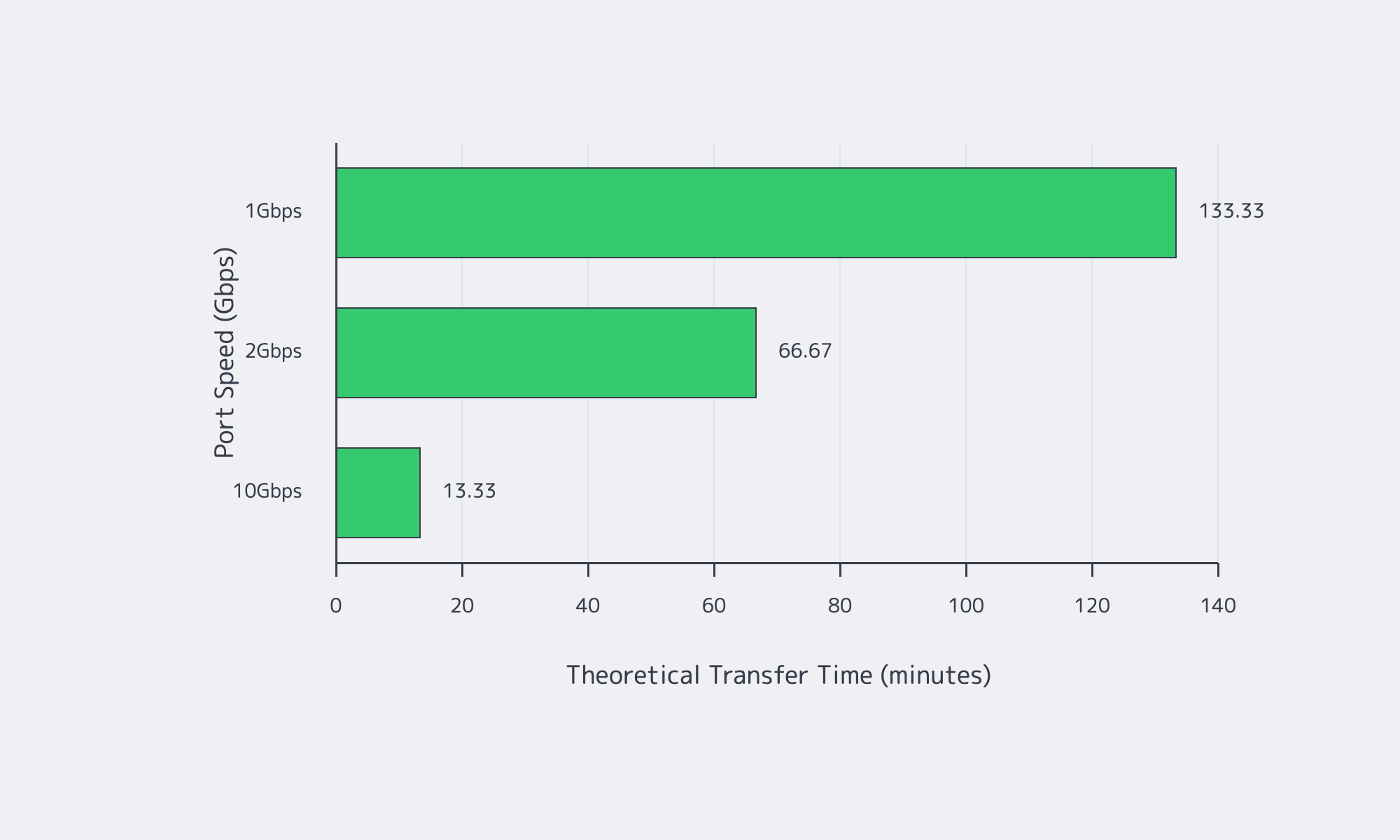
At theoretical line rate, transferring 1TB requires approximately 133 minutes at 1Gbps, 67 minutes at 2Gbps, or 13.3 minutes at 10Gbps. Actual transfers take longer because useful application throughput depends on protocol overhead, connection behavior, storage performance, and the available network path.
For data platforms, the decisive question is often the maximum acceptable replication, restore, or replay window.
For streaming, estimate outbound traffic using delivered bitrate multiplied by concurrent streams, then validate against measured interface utilization. A streaming origin may require substantially less bandwidth than a server distributing content directly to viewers.
Burst duration also matters: five seconds at 1.8Gbps differs operationally from 45 minutes at the same rate.
Growth must be modeled explicitly. A workload with 1.2Gbps p95 egress growing 10% quarterly may exhaust comfortable 2Gbps headroom over the deployment period.
Melbicom operates infrastructure across 21 data centers in 19 server cities and 17 countries. Our data-center directory provides location-specific network capabilities.
For example, our infrastructure in Amsterdam, Frankfurt, Paris, Singapore, and Warsaw supports server networking up to 200 Gbps, while Madrid and Mumbai have network ceilings of 40 Gbps per server. These are location-level capabilities, distinct from the bandwidth assigned to an individual ready-to-go configuration.
Verify Route Evidence, Support Obligations, and Acceptable Use Before Ordering
A bandwidth commitment establishes capacity at a defined network boundary, not performance across every internet route. Before ordering, verify paths from representative destination networks, confirm the support team’s responsibilities, and obtain written approval for high-load workloads where required. These checks reduce uncertainty that port specifications alone cannot resolve.
Network Evidence Must Match Destination Traffic
Melbicom’s network architecture includes a 14+ Tbps aggregate network, 23 transit providers, and 29 Internet Exchange Points.
Our data-center directory provides test IPs and downloadable objects for locations including Amsterdam, Frankfurt, Los Angeles, Madrid, Mumbai, Paris, Singapore, and Tokyo.
Route measurements provide the additional information needed to evaluate connectivity to a particular destination network.
RIPE Atlas enables distributed ping and traceroute measurements. Its Path Analysis tool supports comparisons of traceroutes over time, helping identify routing changes, ASN/IXP transitions, and latency shifts.
PeeringDB provides complementary interconnection information, although its user-maintained records should not substitute for measurements.
A useful acceptance test captures latency distributions, packet loss, route stability, and sustained TCP throughput from representative networks during relevant traffic periods.
For throughput testing, RFC 6349 provides a framework for examining TCP behavior, including round-trip time, bandwidth-delay product, and single versus multiple connections. Measurements should distinguish application goodput from link capacity and avoid treating results from one destination as universally representative.
Support Scope and Acceptable Use
Melbicom provides 24/7 engineering support. Our services agreement defines the included dedicated-server technical support scope as server hardware and network connectivity within the data center. Customer software configuration and operation remain outside that scope unless expressly agreed.
Acceptable use requires particular attention for streaming and data-distribution workloads.
Melbicom’s acceptable-use provisions require prior consent or authorization for certain high-load activities, including streaming, file-sharing, storage distribution, or P2P services where applicable. Provide expected ingress, egress, traffic volume, and application characteristics before purchasing so our team can confirm any required approval.
A Decision Framework for Selecting 10Gbps Dedicated Server Providers
A practical selection process starts with workload evidence and ends with documented acceptance criteria.
First, establish p50, p95, and peak utilization, distinguishing inbound and outbound traffic. Record burst duration, transfer deadlines, destination networks, and projected growth.
Next, verify the port commitment, transfer model, route evidence, acceptable-use conditions, and support boundaries against those requirements.
Questions to Resolve Before Purchasing
- Port guarantees: Does 10Gbps describe the interface, configured limit, and committed capacity? Where is the commitment measured, over what interval, and does it cover both directions?
- Transfer terms: Does unmetered traffic cover ingress and egress? Are there overages, sustained-use restrictions, percentile billing, or shaping conditions?
- Acceptable use: Does the intended streaming, replication, or distribution workload require prior written consent under the applicable agreement provisions?
- Network routes: Which test endpoints represent the selected location? What do repeated latency, loss, traceroute, and throughput measurements show?
- Support: Who owns hardware and network incidents versus OS, TCP, storage, and application tuning?
- Contract: When does billing begin? What are the minimum payment period, cancellation conditions, and applicable order terms?
- Acceptance: Which measurable throughput and route results must be achieved before production deployment, and which measurement methods will be used?
Melbicom’s 10Gbps offer, network documentation, and location-specific test endpoints help evaluate bandwidth, interconnection, and deployment location. Our team can help align a configuration with the workload profile and target networks.
The critical distinction remains: network scale demonstrates infrastructure capability, while server-specific commitments and route measurements establish whether a particular deployment meets its requirements.
Choose Bandwidth for Your Workload
The right dedicated-server port is the smallest capacity tier that reliably accommodates measured production traffic, transfer deadlines, and planned growth.
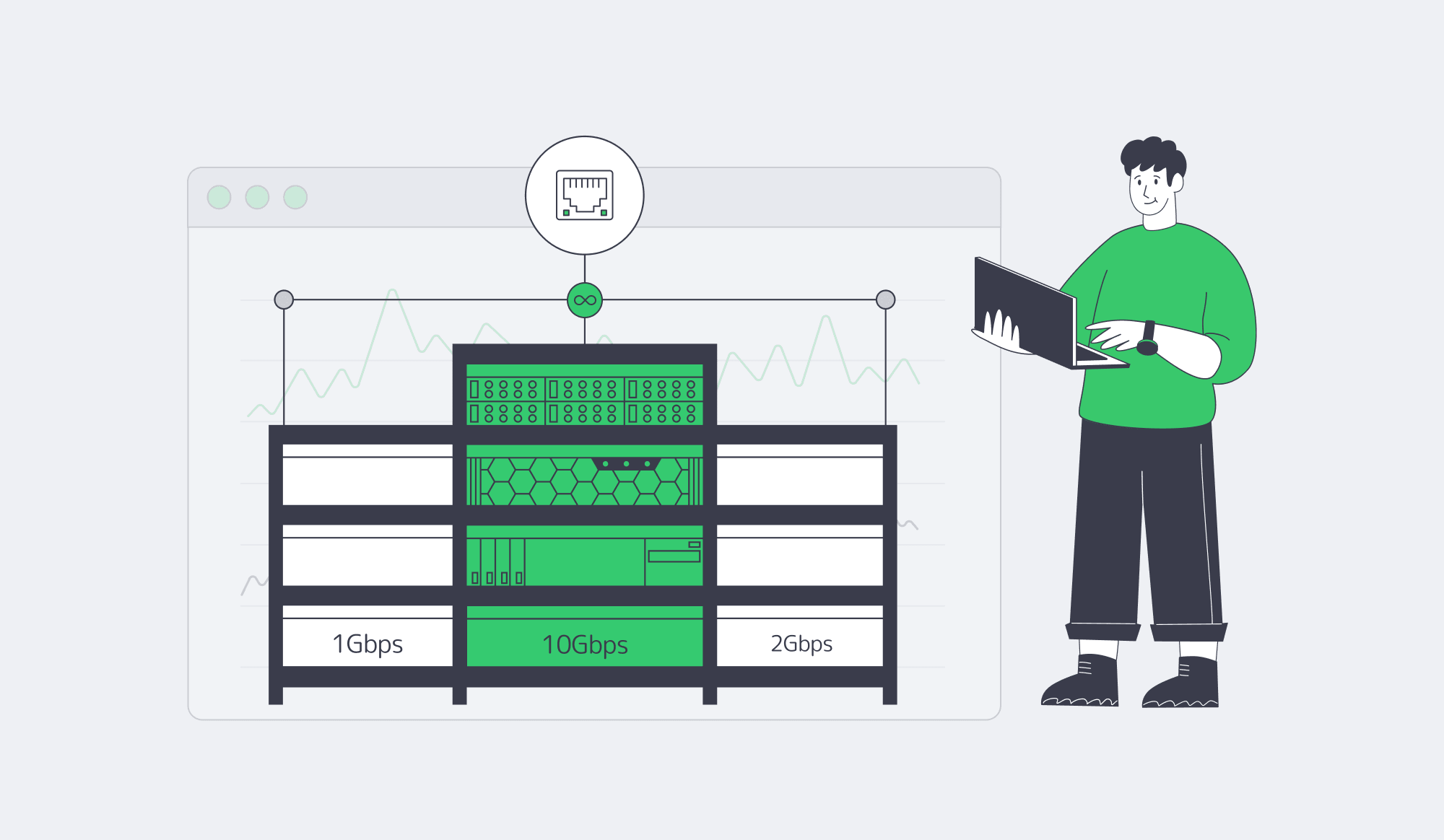
A 1Gbps service may comfortably support moderate egress. A 2Gbps service provides additional room for sustained traffic and replication. A 10Gbps service becomes compelling when multi-gigabit throughput or demanding transfer windows justify it.
But port speed alone is insufficient. Committed capacity, unmetered transfer conditions, acceptable-use authorization, route measurements, and operational responsibilities must align before deployment.
The purchasing decision should produce a documented workload profile, a confirmed service specification, and measurable acceptance criteria—not simply an order for the fastest available port.
Explore Melbicom’s 10Gbps Dedicated Servers
Melbicom offers 10Gbps unmetered dedicated servers backed by a 14+ Tbps network and 24/7 engineering support. Our team can help select a configuration for your workload.