Size bare metal Kubernetes from real microservice demand
Run internal microservices on isolated dedicated servers sized to CPU, memory, storage I/O, and failure tolerance while your team owns orchestration, observability, upgrades, and recovery.
Run internal microservices on isolated dedicated servers sized to CPU, memory, storage I/O, and failure tolerance while your team owns orchestration, observability, upgrades, and recovery.


Map CPU, memory, storage I/O, replicas, and headroom to measured demand before locking the cluster topology.

Separate control-plane, worker, ingress, stateful, and observability roles so saturation stays attributable under load.

Own Kubernetes, Docker, or Podman, networking, secrets, and deployment automation on isolated hosts we supply.

Select regions and bandwidth from service locality, data paths, and the systems each internal microservice calls.
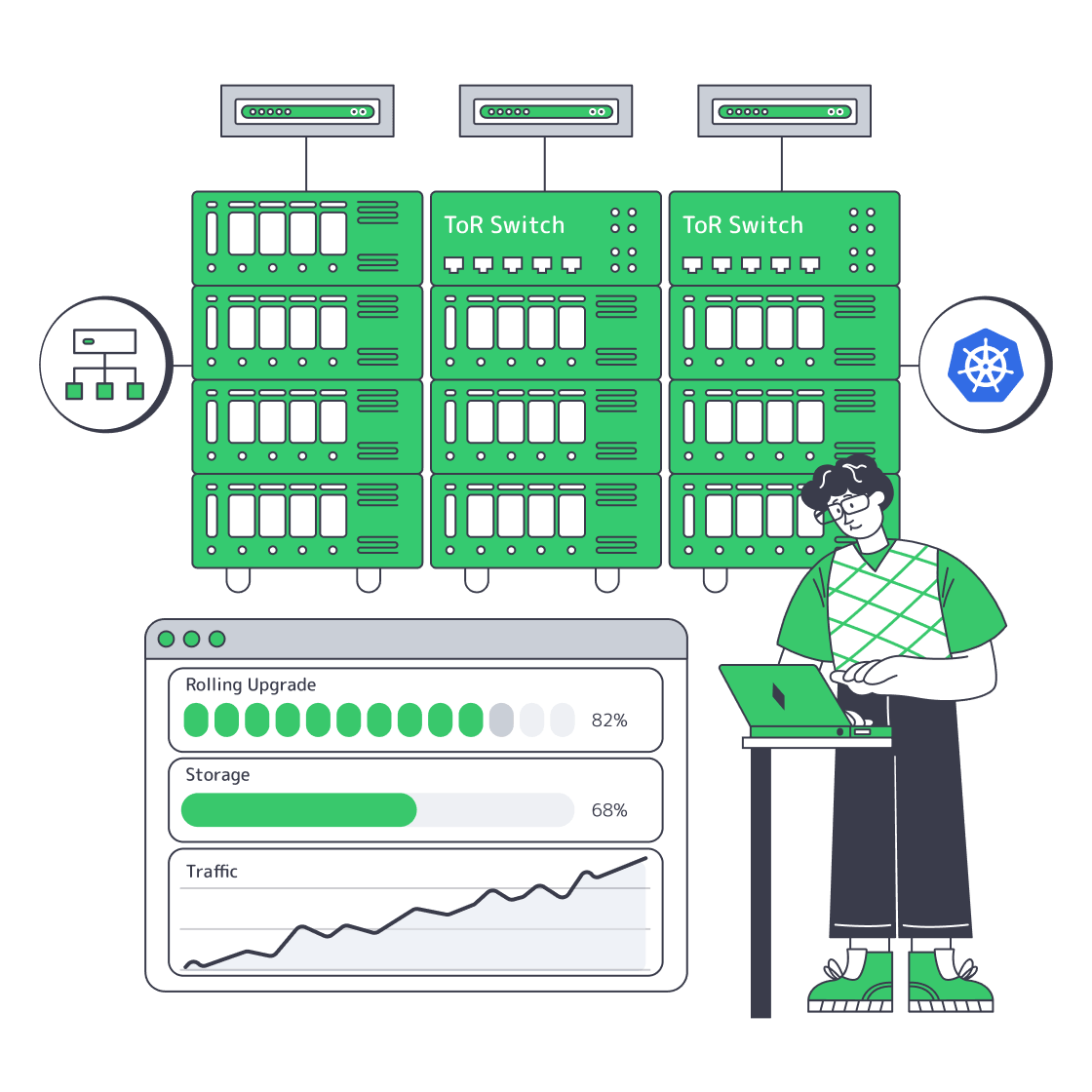
Internal microservices do not become operationally clear just because they run in containers. Replica growth, east-west traffic, stateful I/O, and observability load can saturate a host before the cluster tells a useful story. Start with measured demand and failure tolerance, then assign control-plane, worker, ingress, and stateful roles deliberately before production rollout.
At Melbicom, we provide bare metal server hosting on isolated, configurable hosts, including Intel and AMD processor options, location-specific memory and storage, regional deployment, and selectable bandwidth. The host boundary makes CPU pressure, eviction risk, queue depth, and storage contention easier to attribute without implying a managed Kubernetes layer.
Your team owns the runtime, orchestration, CNI, secrets, registry, deployment automation, observability, backups, upgrades, and recovery. We provide the underlying infrastructure and 24/7 technical support for infrastructure issues. Validate nodes, migrate services in phases, keep rollback gates, and review capacity as demand changes; the boundary stays explicit at every step.



Reserve CPU, memory, and failure tolerance for schedulers, controllers, and cluster-state work under sustained load.
Set worker capacity from replica counts, request pressure, queue depth, and measured headroom for service growth.

Separate ingress and internal APIs when concurrency, routing, or authentication load requires distinct capacity.

Allocate storage and memory to databases, queues, and persistent services with explicit backup and recovery plans.

Isolate metrics, logs, and traces when ingestion or retention demand can hide application-node saturation.

Place batch work on dedicated capacity so bursts do not distort latency, eviction pressure, or service SLOs.

Deploy clusters near dependent systems when data locality and service paths materially change request behavior.
Validate nodes, move services in phases, check health, and keep rollback gates before expanding production.