
Blog
Choosing the Right Web Application Hosting Strategy
Modern web deployments demand strategic infrastructure choices. The growth of web traffic and rising user demands have led to numerous web application hosting options: dedicated servers in global data centers, multi‑cloud structures, edge computing, and hybrid clusters. Choosing the right approach depends on workload characteristics as well as elasticity requirements, compliance rules, and geographic latency limitations. This article provides a useful selection framework to evaluate the appropriate hosting model.
What Criteria Should Guide a Web Application Hosting Strategy?
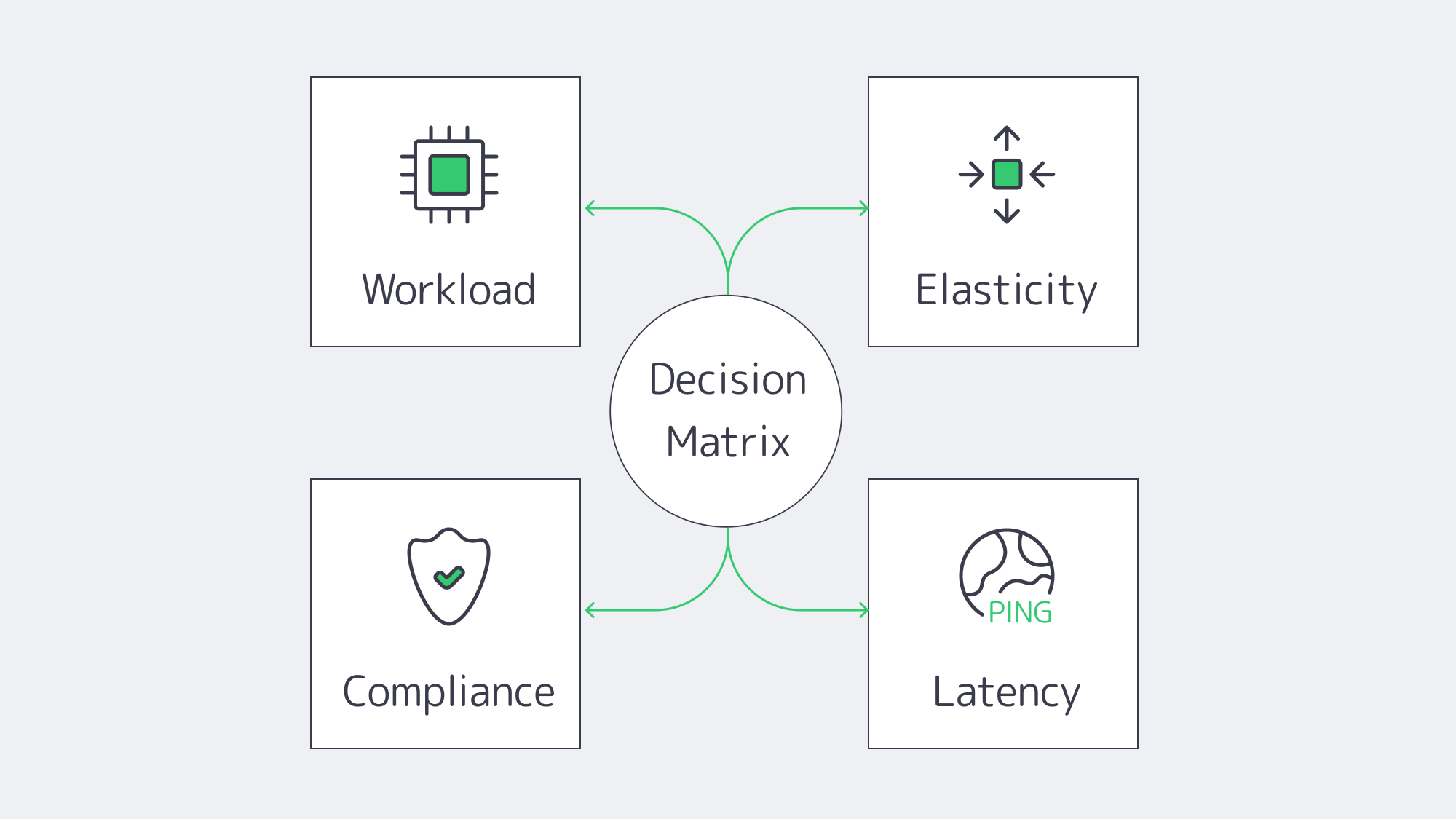
A web application hosting strategy should start with workload profile, elasticity, compliance, and geographic latency. Stateful or performance‑sensitive workloads often favor dedicated hardware, while spiky demand may need cloud elasticity. Regulated data can require controlled hosting environments, and latency‑sensitive applications need infrastructure placed near user clusters or supported by CDN/edge delivery.
Workload Profile
Stateful vs. stateless: Stateless services (e.g., microservices) scale horizontally more easily because they do not store state information. The handling of memory and session data becomes crucial when implementing stateful applications such as Java sessions and real‑time data services.
CPU, memory, or I/O bound: A media streaming platform with huge I/O needs might prioritize high‑bandwidth servers. An analytics tool that depends on raw computational power needs different server specifications than a streaming platform that prioritizes high bandwidth. A dedicated server with predictable resources can deliver more predictable performance than multi‑tenant virtualization for Java web applications under sustained concurrency loads.
Elasticity
Predictable vs. spiky demand: Dedicated servers excel when loads are consistent, as you can plan capacity. Cloud or container environments enable auto‑scaling to prevent bottlenecks during sudden traffic surges (e.g., product launches). A common strategy involves keeping dedicated servers operational for base capacity while activating cloud resources during times of peak demand.
Compliance and Security
Regulated workloads often require single‑tenant or verified data center hosting to process sensitive information. Dedicated servers give customers more direct control over the operating system, network rules, and isolation model, while facility access remains governed by the data center. Public clouds offer compliance programs for frameworks such as HIPAA and PCI‑DSS, yet multi‑tenant environments need users to place their trust in provider‑level isolation. Many enterprises maintain regulated data within single‑tenant or private hosting environments.
Geographic Latency
Physical distance influences response times. Across fiber, each 1,000 km can add roughly 10 ms of round‑trip propagation delay before routing, queuing, and application overhead. A long‑cited Amazon latency benchmark reported that a 100 ms delay was associated with a 1 % decline in sales, illustrating why low‑latency architecture matters. Server placement near user clusters is essential for high performance. Some organizations use edge computing along with content delivery networks (CDNs) to distribute content near user locations. Melbicom operates 21 global data centers, plus a CDN in 39 locations across 35 countries for low‑latency access.
Comparing Dedicated Servers, Multi-Cloud, Edge, and Hybrid Hosting
| Paradigm | Strengths | Trade‑offs |
|---|---|---|
| Dedicated Servers | Single‑tenant control, consistent performance, potentially cost‑efficient at scale. Melbicom dedicated servers run in Tier III and Tier IV data centers, with per‑server bandwidth options up to 200 Gbps. | Manual capacity planning, slower to scale than auto‑provisioned cloud. Requires sysadmin expertise. |
| Multi‑Cloud | Redundancy across providers, avoids lock‑in, can cherry‑pick specialized services. | Complexity in management, varying APIs, potential high data egress fees, multiple skill sets needed. |
| Edge Computing | Reduces latency by localizing compute and caching. Real‑time applications as well as IoT devices and content benefit most from this approach. | Complex orchestration across multiple mini‑nodes, data consistency challenges, limited resources at each edge. |
Dedicated Servers
Each server operates independently on dedicated hardware, which reduces the performance variability caused by neighboring applications. CPU‑ and memory‑intensive applications benefit from dedicated computing capacity. Melbicom offers 1100+ ready‑to‑go dedicated servers and bandwidth options reaching up to 200 Gbps per server. Fixed monthly or annual pricing makes baseline infrastructure costs predictable. Tier III/IV facility design targets support high availability, while application uptime still depends on architecture and operations.
The advantages of dedicated infrastructure come with the requirement for more direct hands‑on administration. The process of scaling up requires physical machine additions or upgrades instead of cloud instance creation. Workloads such as large databases and specialized Java web application stacks benefit from this feature because they require precise OS‑level tuning.
Multi‑Cloud
The use of multiple cloud providers decreases your dependence on any single cloud platform. Redundancy across providers can reduce the risk of one provider outage causing a full service interruption, although shared dependencies and cross‑cloud networking still need careful design. Flexera’s 2026 State of the Cloud survey reports that hybrid cloud remains the dominant model at 73 % of organizations, and multi‑cloud adoption continues to rise, but the complexity level is high. Juggling different APIs makes it harder to handle monitoring, networking, and cost optimization tasks. The costs of moving data outside of clouds can become quite expensive. A unifying tool such as Kubernetes or Terraform helps maintain consistent deployments.
Edge Computing
The processing of requests by edge nodes located near users leads to minimized latency. A typical example is a CDN that caches static assets. The deployment of serverless functions and container instances on distributed endpoints within advanced edge platforms enables real‑time service operations. Real‑time systems together with IoT analytics and location‑based apps often target sub‑50‑millisecond responses, making local processing useful. The distribution of micro‑nodes across various geographic locations creates challenges when trying to synchronize them. The network must redirect traffic to other edge nodes when a city‑level outage occurs.
Hybrid Models
Hybrid cloud integrates on‑premises (or dedicated servers) with public cloud. The deployment of sensitive data on dedicated servers combines with web front‑ends running on cloud instances. Kubernetes functions as a container orchestration platform to provide infrastructure independence which enables the deployment of identical container images across any environment. This method unites the cost efficiency of dedicated infrastructure with the scalability benefits of the cloud. The main difficulty lies in managing the complexity because synchronizing networks with security policies and monitoring across multiple infrastructures becomes extremely challenging.
Why Hybrid? Many teams find that a single environment does not fulfill all their requirements. A cost‑conscious organization may need steady monthly fees for core capacity while also using cloud flexibility for peak situations. Containerization helps unify it all. Each microservice can be deployed more consistently across dedicated servers and public cloud infrastructure through containerization. Robust DevOps practices together with observability represent the essential components for success.
Mapping Requirements to Infrastructure
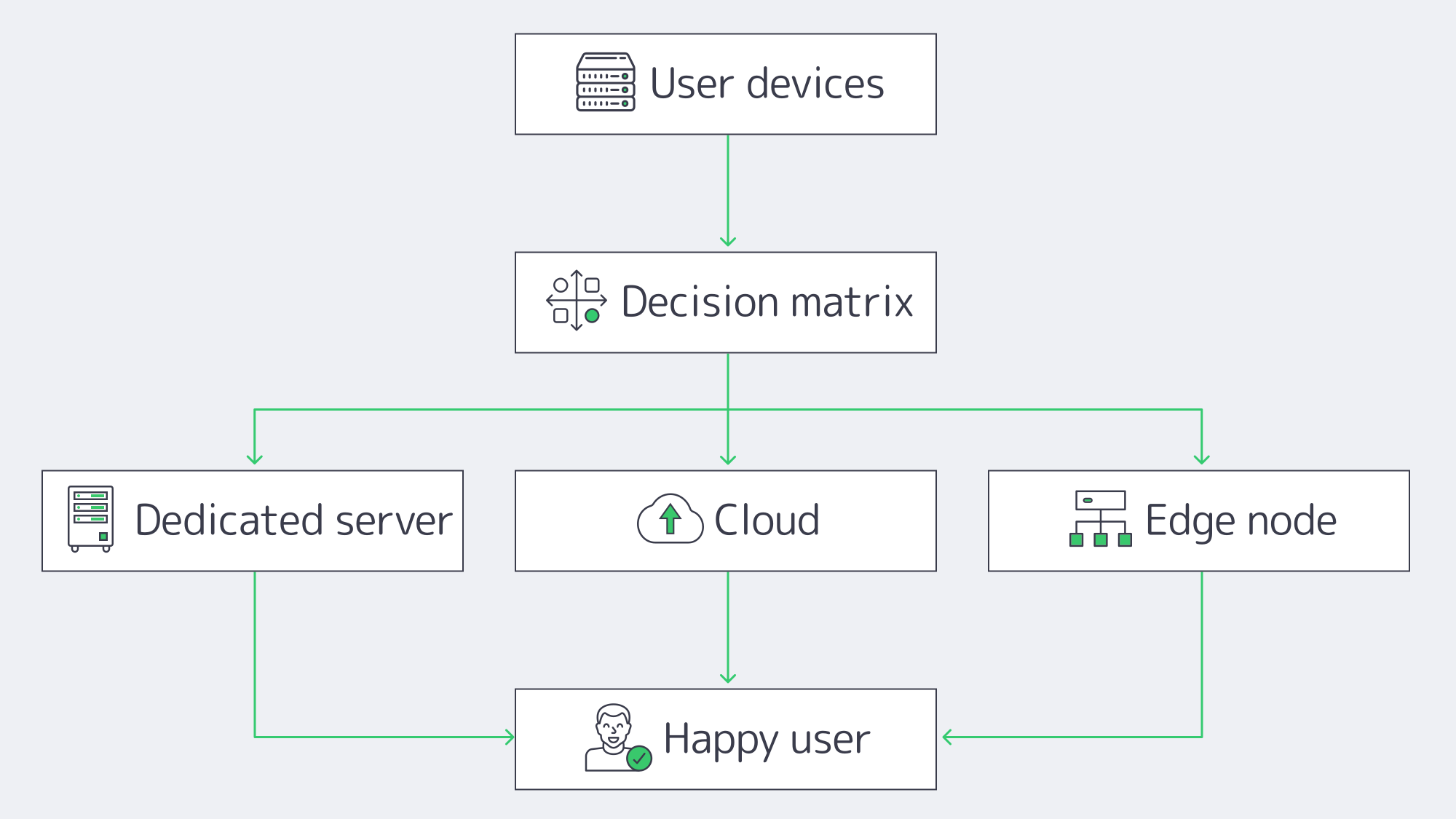
A combination of strategic environments usually leads to the best results. Evaluate the requirements of statefulness and compliance as well as latency and growth patterns when choosing a hosting model.
- Stateful and performance‑sensitive apps often fit dedicated servers for direct hardware access and predictable resource control.
- The use of auto‑scaling and container platforms in the cloud works best for unpredictable workload needs.
- The placement of compliance‑driven data may require single‑tenant or private systems within specific regions.
- Deploying in data centers near users combined with a CDN or edge computing can reduce response times for latency‑critical applications.
Each piece in your architecture needs to match the requirements of your application to achieve resilience and high performance. The combination of dedicated servers in one region with cloud instances in another and edge nodes for caching allows you to achieve low latency, strong compliance, and cost optimization.
Melbicom’s Advantage

Melbicom’s Tier III and Tier IV data centers offer dedicated servers with up to 200 Gbps bandwidth per server to support applications requiring constant high throughput. Integrating dedicated servers with cloud container orchestration and Melbicom’s CDN in 39 locations across 35 countries can improve latency reduction for distributed users. Melbicom’s adaptable infrastructure enables you to develop a solution that addresses the specific requirements of your application.
Launch Dedicated Servers Fast
Deploy high‑bandwidth dedicated servers in 21 global Tier III and Tier IV data centers and scale confidently.