Size AI inference server capacity from measured model demand signals
Run customer-operated LLM, vision, speech, and recommendation services on isolated GPU-capable compute sized for model footprint, concurrency, queue depth, and latency targets.
Run customer-operated LLM, vision, speech, and recommendation services on isolated GPU-capable compute sized for model footprint, concurrency, queue depth, and latency targets.
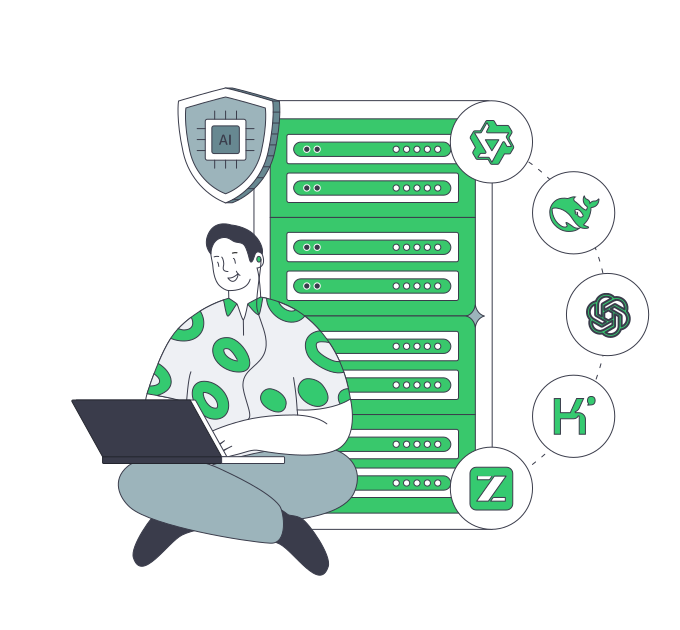

Match GPU, CPU, RAM, storage, and network capacity to model footprint, concurrency, and measured request demand.

Your team owns the runtime, containers, model artifacts, API layer, scaling policy, observability, release process, and SLOs.

Use IPMI/KVM and the management API for recovery access while keeping incident responsibility clearly assigned.

Use component monitoring for supported hardware signals; your team tracks model, runtime, API, and application telemetry.
A trained model is not a production service until the team defines request schemas, authentication, routing, batching, streaming, deadlines, health checks, versioning, and failure behavior. Capacity planning then ties model footprint and KV cache demand to concurrency, queue depth, time to first token, and throughput under representative production load.
Melbicom supplies isolated GPU-capable compute with configurable CPU, RAM, storage, and network capacity, plus IPMI/KVM and management API access. Component monitoring covers supported hardware signals; server configuration, operating-system installation, and specialist administration can be scoped under an agreed task boundary before deployment.
Your team owns the model, GPU software stack, inference runtime, serving layer, REST/gRPC contract, scaling logic, observability, rollouts, and SLOs. This boundary keeps interfaces portable across configurations, makes capacity cost easier to attribute, and assigns each production incident from hardware signal to client response paths with clear ownership.



Size GPU-capable compute for model weights, KV cache, batch policy, concurrency, and time-to-first-token targets.

Match image and video preprocessing, model memory, batch size, request rate, and response payloads to available capacity.

Plan streaming, audio preprocessing, model loading, concurrency, and timeout behavior before exposing the team-operated API.

Map embedding tables, feature inputs, ranking latency, batch policy, and request volume to hardware capacity.
Define REST schemas, authentication, timeouts, errors, health checks, and version rules in your serving stack.

Implement gRPC streaming, message contracts, deadlines, status handling, and client compatibility in your serving stack.

Separate model loading, routing, memory demand, and rollout ownership across models sharing one serving fleet.
Plan warm capacity, rebuilds, model reloads, traffic recovery, and hardware-failure ownership for production replicas.