OpenSearch hosting sized for concurrent search and indexing

Rent dedicated servers with CPU for concurrent requests, RAM beyond JVM heap, and local SSD/NVMe storage for retained indexes. Set bandwidth for replication and recovery.

OpenSearch developer with search and indexing server

Whole-host resources for OpenSearch workloads

CPU capacity sizing
Processor choices for search and indexing

Match CPU capacity to queries, indexing, and background merges that run alongside your application traffic.

RAM memory module
Memory for heap and filesystem cache

Budget RAM for JVM heap, filesystem cache, and native allocations across the node processes you run.

NVMe storage drive
Storage capacity for indexes and replicas

Local SSD/NVMe drives provide index I/O and space for shard copies, background merges, and retained data.

Multiple LAN bandwidth paths
Bandwidth sized for replication and recovery

Set bandwidth for incoming data, shard replication, and recovery transfers alongside your ongoing query traffic.

Available configurations
Need a Custom Build?
Filters
Clear all
Data center
Data center
CPU
CPU
CPU Brand
CPU Brand
RAM
RAM
Storage
Storage
from
up to
GPU
GPU
    Bandwidth
    Bandwidth
    Data Transfer
    Data Transfer
    Available configurations –
    CPU
    Memory
    Storage
    Network
    GPU
    Data center
    Price
    Show more

    Plan search capacity as indexes grow

    Live queries share resources with indexing, segment merges, and recovery. Budget CPU, memory, and disks for that overlap and the indexes you retain. Measured query demand and ingest targets guide hardware spending, with headroom for the data growth you expect.

    Melbicom rents physical servers with CPU, RAM, local SSD/NVMe drives, and bandwidth choices for each host. Order a ready configuration or a custom build delivered in 3–5 business days. The specification follows your query demand, ingestion rate, and retained index size, including RAM for heap, filesystem cache, and native allocations.

    Assign node roles to the hosts you rent and separate ingest or coordinating work where needed. Your team controls the software and shard allocation rules across physical hosts. Budget CPU, disk space, and bandwidth for application traffic, maintenance, and recovery.

    Administrator managing an OpenSearch data server

    Capacity choices tied to search targets

    Match host resources to query latency, ingestion rates, and index retention.
    CPU for query latency targets
    Capacity for indexing throughput
    Space for retention and growth
    Control over shard placement
    Hardware for node additions
    Optional S3 snapshot repository

    Hardware choices for your node roles

    Choose CPU, memory, disks, bandwidth, and a location near your applications or data producers.
    Dedicate CPU to queries and indexing.
    Budget RAM for heap and cache.
    Store indexes on local SSD/NVMe drives.
    Specify your drive count and layout.
    Set bandwidth for cluster traffic.
    Assign workloads to separate hosts.
    Control your node software and OS.
    Order ready hardware for your nodes.
    Customize CPU, RAM, and local storage.
    Choose from 21 data centers worldwide.
    Specify your nodes
    Discuss CPU, memory, and storage for concurrent queries and sustained indexing.
    Discuss hardware

    Search workloads with distinct capacity needs

    E-commerce shopping cart
    Retail catalog search

    Allocate CPU, cache, and disk I/O for faceted product searches alongside price changes and catalog updates.

    Isolated tenant workloads
    SaaS tenant search

    Each host provides CPU and memory for concurrent tenant queries, plus disk capacity for their retained indexes.

    System log document
    Document discovery

    Local disks hold a growing document corpus, with compute for searches that run alongside reindexing.

    Observability data ingestion
    Log observability

    Log ingestion and dashboard queries share CPU capacity, while local disks hold the event history you retain.

    SIEM capacity sizing
    Security operations

    Event ingestion shares CPU and disk I/O with analysts searching retained data during security investigations.

    Parallel event processing
    Event analytics

    Ongoing indexing and event aggregations draw on CPU capacity as transactions arrive from your business systems.

    Browser application window
    Publisher search

    CPU and cache serve reader searches while editorial updates and new articles keep changing the search index.

    Database performance optimization
    Vector retrieval

    Vector count, dimensions, recall targets, and retrieval engine guide your choice of CPU, RAM, and local disks.

    Planning search infrastructure from hardware to recovery

    Engineer monitoring a 10Gbps dedicated server and network status
    10Gbps Dedicated Server Providers: Compare Ports, Terms and Network
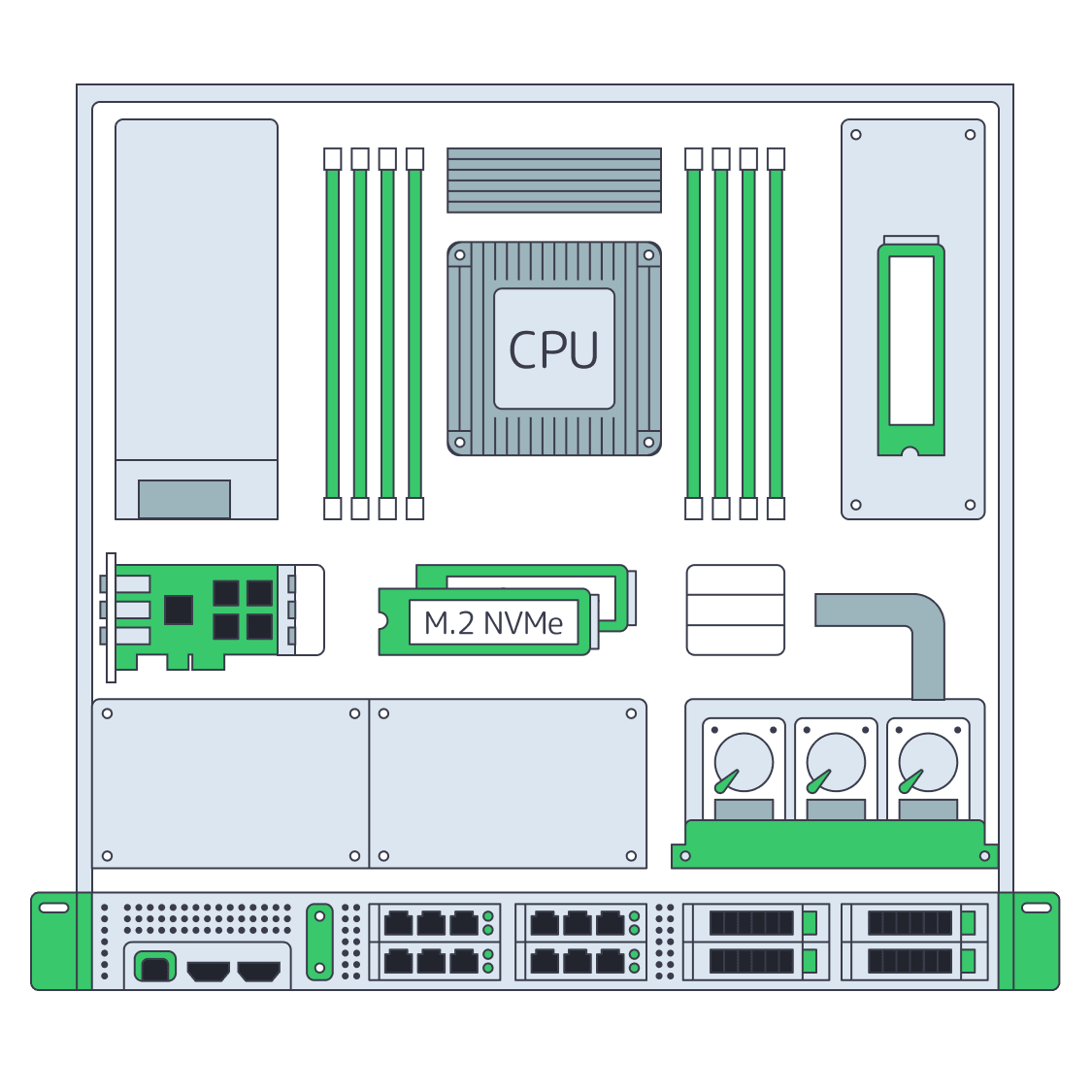
    Dedicated server BOM with CPU, RAM, NVMe, and NIC modules sized from workloads
    Spec Dedicated Servers From Workload, Not the Catalog
    Block vs object storage bridge linking a fast server and a scalable storage cluster
    Choosing Between Object and Block Storage for Your Workloads
    Illustration of servers linked to cloud object storage by green high‑speed cables
    Blueprint for High-Performance Backup Server Solutions
    More articles
    FAQ
    Who runs the OpenSearch cluster?
    When does a workload need whole-host capacity?
    How should I choose CPU capacity?
    How much RAM should I reserve beyond JVM heap?
    How do I size storage for retained indexes?
    How should primary and replica shards be placed?
    When should I separate node roles?
    What bandwidth should I choose for cluster traffic?
    How should I test recovery capacity?
    Can I add storage for OpenSearch snapshots?
    How do I plan version and plugin compatibility?
    How do ready and custom configurations differ?
    Start your server order
    Create an account to select CPU, RAM, and local disks for the search nodes you operate.
    Create an account
    Specify a custom build
    Tell us your query demand, ingest rate, and index size to discuss a custom server build.
    Discuss a build