Ollama hosting sized for model residency and concurrent requests

Rent GPU-equipped dedicated servers for customer-operated local inference, with usable VRAM, host RAM, and NVMe matched to resident models, concurrent contexts, and response targets.

Dedicated servers for Ollama hosting

Open WebUI hosting needs separate resource budgets

GPU server appliance
Keep models resident

Match usable VRAM to quantized weights, runtime overhead, and active models so requests avoid repeated reloads.

RAM memory module
Reserve context headroom

Budget KV cache and overlapping requests so live sessions stay inside the memory capacity you planned.

Protected server infrastructure
Control sensitive inputs

Process confidential company documents and source code with local models in an environment your team controls.

NVMe storage drive
Retain models on NVMe

Store model files, application state, and retained assets on persistent NVMe sized for updates and working headroom.

Available configurations
Need a Custom Build?
Filters
Clear all
Data center
Data center
CPU
CPU
CPU Brand
CPU Brand
RAM
RAM
Storage
Storage
from
up to
GPU
GPU
    Bandwidth
    Bandwidth
    Data Transfer
    Data Transfer
    Available configurations –
    CPU
    Memory
    Storage
    Network
    GPU
    Data center
    Price
    Show more

    Size the host from the live workload

    A business local-model service carries more than a checkpoint. Resident weights share memory with active contexts, KV cache, parallel requests, and runtime overhead. Open WebUI adds users, chats, files, settings, and provider connections, so the host must preserve both inference capacity and application state through routine model changes.

    Melbicom matches GPU-equipped dedicated hardware to the model set you plan to keep live, combining usable VRAM with CPU, host RAM, and NVMe for the surrounding services. Custom builds can follow your preferred compatible GPU and VRAM target, ready in 3–5 business days for a defined deployment window and production rollout schedule.

    Your team installs and operates Ollama, Open WebUI, databases, identity, network access, updates, monitoring, and backups for the server you control. Start with one host when the complete live workload fits, then add GPUs or hosts from measured residency, concurrency, and response targets so hardware spending follows sustained demand across production cycles.
    Persistent infrastructure for local models

    Turn model fit into operating control

    Size each layer around the demand your team can measure.
    Fewer model reload delays
    Less queuing under concurrency
    Clear RAM and VRAM budgets
    Persistent model and chat state
    Controlled runtime update timing
    Measured capacity decisions

    Build the complete local model host

    Match every resource to model residency, active contexts, persistent state, and controls your team keeps.
    Usable VRAM for resident weights
    Host RAM for shared services
    KV cache and context headroom
    Concurrency sized from live demand
    NVMe for models and app state
    CPU capacity for host processes
    Preferred compatible GPU selection
    Customer-controlled runtime policies
    Customer-owned network access policy
    Separate app and inference budgets
    Plan your GPU build
    Share model residency, context, concurrency, and usable VRAM for a matched configuration.
    Discuss your build

    Ollama workloads built to persist

    AI assistant operations
    Employee AI assistants

    Keep selected models and shared context available as employees handle recurring support, drafting, and knowledge tasks.

    Three-person user group
    Team research sessions

    Retain chats, files, model choices, and provider connections so teams can resume shared investigations over time.

    API server configuration
    Business inference APIs

    Serve controlled endpoints for business applications, matching resident capacity to concurrent requests and context.

    Overlapping storage folders
    Document review flows

    Combine local inference, retained files, user access, and saved settings for recurring document review and extraction work.

    Software development screen
    AI coding agent workflows

    Connect tool-executing coding agents to a locally served model backend for edits, tests, and repository tasks.

    Validated AI model processing
    Multi-model evaluation

    Compare quantizations, model families, and context settings while measuring memory use under repeatable evaluation demand.

    Application user controls
    Customer support teams

    Give AI agents one interface while model choices, user state, and access policies remain under customer control.

    Browser application window
    Remote model interface

    Connect Open WebUI to remote providers when model compute runs elsewhere, retaining interface access and user state.


    Hardware and operations for local model teams

    Dedicated server pricing drivers arranged around a server rack and invoice
    Beyond Hardware: Total Cost Of Dedicated Servers
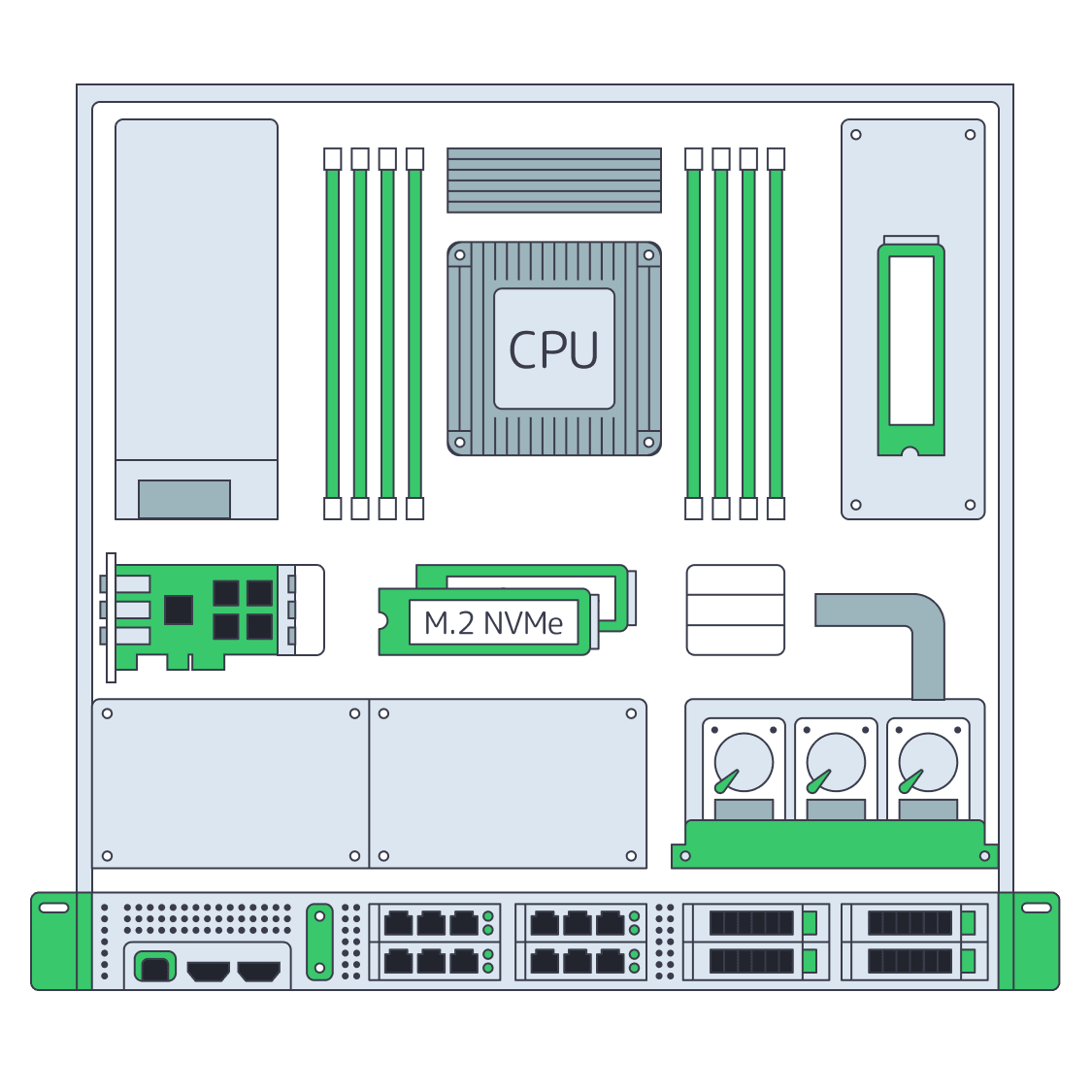
    Dedicated server BOM with CPU, RAM, NVMe, and NIC modules sized from workloads
    Spec Dedicated Servers From Workload, Not the Catalog
    Illustration of server rack topped by HDD, SSD, and NVMe icons showing speed hierarchy
    Choosing Dedicated Server Storage: HDD, SSD, or NVMe?
    Servers under AI magnifier displaying live metrics
    Building a Predictive Monitoring Stack for Servers
    More articles
    FAQ
    Does every Ollama deployment need a GPU?
    What does Open WebUI run on the host?
    How should I size usable VRAM?
    Is host RAM interchangeable with GPU VRAM?
    Can Open WebUI use remote model providers?
    How much NVMe storage should I plan?
    Can one server keep several models loaded?
    Can I request a preferred GPU configuration?
    Who installs and operates Ollama and Open WebUI?
    How should network access be planned?
    Opening your account
    Create an account, add funds, and choose a server for your customer-operated model stack.
    Create an account
    Plan the right model host
    Share models, quantization, context, concurrency, preferred GPUs, and usable VRAM for sizing.
    Talk to an expert