Mistral hosting built for your model class and endpoint load

Rent GPU-equipped dedicated servers for compact Ministral, larger dense, and MoE models, with preferred GPUs and VRAM matched to the endpoint load you expect in production.

Mistral hosting on dedicated GPU servers

Mistral hardware requirements reflect architecture

RAM memory module
Compact models leave VRAM headroom

Compact Ministral models use less memory for weights, preserving GPU capacity for replicas under live load.

GPU server appliance
Dense models keep every weight active

Dense models keep every weight active, making precision and VRAM the main model-placement constraint.

AI inference processing
MoE activates fewer weights per token

MoE models activate fewer weights per token, but the complete set of weights still occupies memory.

Private network shield
Keep confidential data under control

Run Mistral models on confidential documents or source code within the environment your team controls.

Available configurations
Need a Custom Build?
Filters
Clear all
Data center
Data center
CPU
CPU
CPU Brand
CPU Brand
RAM
RAM
Storage
Storage
from
up to
GPU
GPU
    Bandwidth
    Bandwidth
    Data Transfer
    Data Transfer
    Available configurations –
    CPU
    Memory
    Storage
    Network
    GPU
    Data center
    Price
    Show more

    Model architecture and endpoint demand determine the host

    Compact Ministral models, larger dense variants, and granular MoE architectures place different demands on weight residency, per-token compute, and GPU memory. Start with the model class, then account for precision, KV cache, request mix, and the latency or throughput target that defines usable production capacity under sustained endpoint load.

    Melbicom rents GPU-equipped dedicated hardware matched to your preferred accelerator and VRAM, with host RAM and local NVMe sized for model loading, runtime services, and model artifacts. Custom configurations are prepared in 3–5 business days, turning the deployment profile into hardware your team can operate without forcing the workload into a generic preset.

    Run the model, serving stack, and API layer you choose, then measure queue depth, tail latency, and sustained throughput under the real request mix. Increase the residency budget for larger models, add GPUs for parallel placement, or add replicas when traffic—not model fit—becomes the production constraint, tying each expansion to a measured bottleneck.

    Mistral deployment with dedicated infrastructure

    Turn model fit into production capacity

    Translate model architecture and request load into capacity your team can measure.
    Context capacity after weight fit
    GPU cost tied to endpoint load
    Replica growth tied to demand
    VRAM headroom beyond weights
    Queue-aware batch throughput
    Latency measured under real load

    Fit the host to inference demand

    Choose the GPU, memory, storage, and network resources required by the model and endpoint load.
    Preferred GPU and VRAM profile
    Model class and precision target
    GPU count per inference host
    Host count for replica growth
    System RAM for runtime services
    Local NVMe for model artifacts
    KV cache budget by request mix
    Batching policy for endpoint load
    Root access for serving software
    Custom builds for preferred GPUs
    Order your GPU build
    Choose the GPU, VRAM, host memory, and NVMe for your custom configuration.
    Order your build

    Where Mistral model fit changes the host

    AI assistant operations
    AI business assistants

    Use compact Ministral, larger dense, or MoE models for assistants, matching GPU capacity to active user sessions.

    Database read processing
    Document retrieval

    Pair document retrieval pipelines with cache headroom for source-heavy prompts and overlapping user queries.

    Software development screen
    Code review workflows

    Run supported coding models beside local repositories, matching GPU capacity to parallel code analysis jobs.

    Landscape image content
    Multimodal documents

    Process supported text and image inputs, reserving memory for vision components within document workflows.

    Automated service workflow
    Tool-using AI agents

    Run tool-using agents with capacity for reasoning steps, repeated calls, and sessions that stay active.

    RAM memory module
    Long-context services

    Budget cache for long prompts and generated output before extending context across active user sessions.

    Parallel queue worker processing
    Extraction pipelines

    Match recurring extraction queues to batch windows, queue depth, and the model's complete memory footprint.

    API server configuration
    Private API endpoints

    Expose your OpenAI-compatible endpoint, then scale replicas from measured request volume and tail latency.

    Hardware decisions for private inference

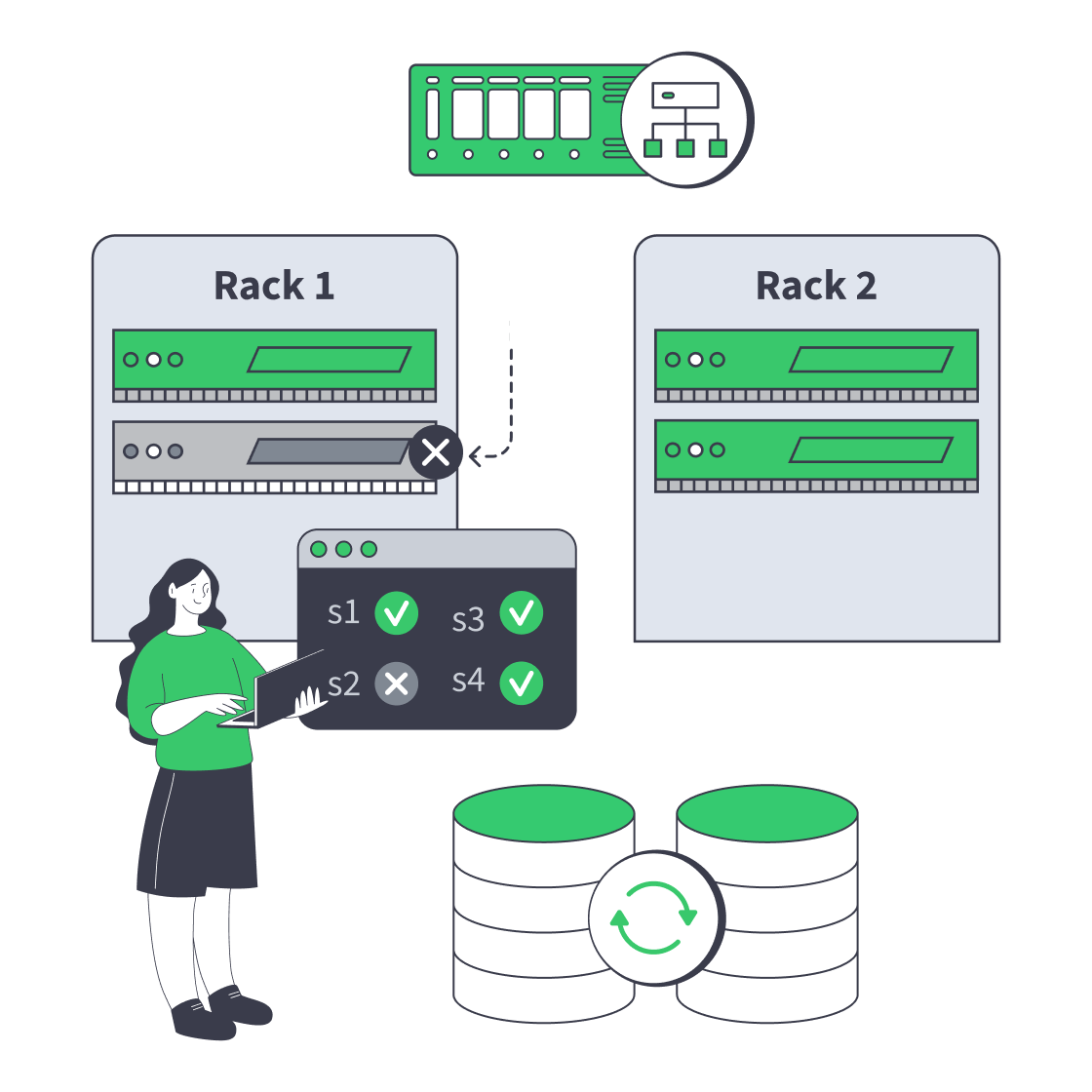
    Dedicated server cluster rerouting traffic after a node failure
    Designing High-Availability Clusters That Fail Safely
    Dedicated server pricing drivers arranged around a server rack and invoice
    Beyond Hardware: Total Cost Of Dedicated Servers
    Dedicated server BOM with CPU, RAM, NVMe, and NIC modules sized from workloads
    Spec Dedicated Servers From Workload, Not the Catalog
    Illustration of server rack topped by HDD, SSD, and NVMe icons showing speed hierarchy
    Choosing Dedicated Server Storage: HDD, SSD, or NVMe?
    More articles
    FAQ
    Which Mistral models can I self-host?
    How do dense and MoE models change hardware sizing?
    Can one GPU run a Mistral model?
    What determines VRAM beyond the model weights?
    Which serving runtimes can I install?
    What host resources matter beyond the GPUs?
    Can Melbicom build around a preferred GPU?
    How should I scale higher request volume?
    Start with a ready server
    Compare available configurations, select a host for the model, and prepare your runtime.
    Create an account
    Order a custom GPU build
    Set GPU, VRAM, RAM, NVMe, and endpoint load for a tailored AI inference configuration.
    Order GPU build