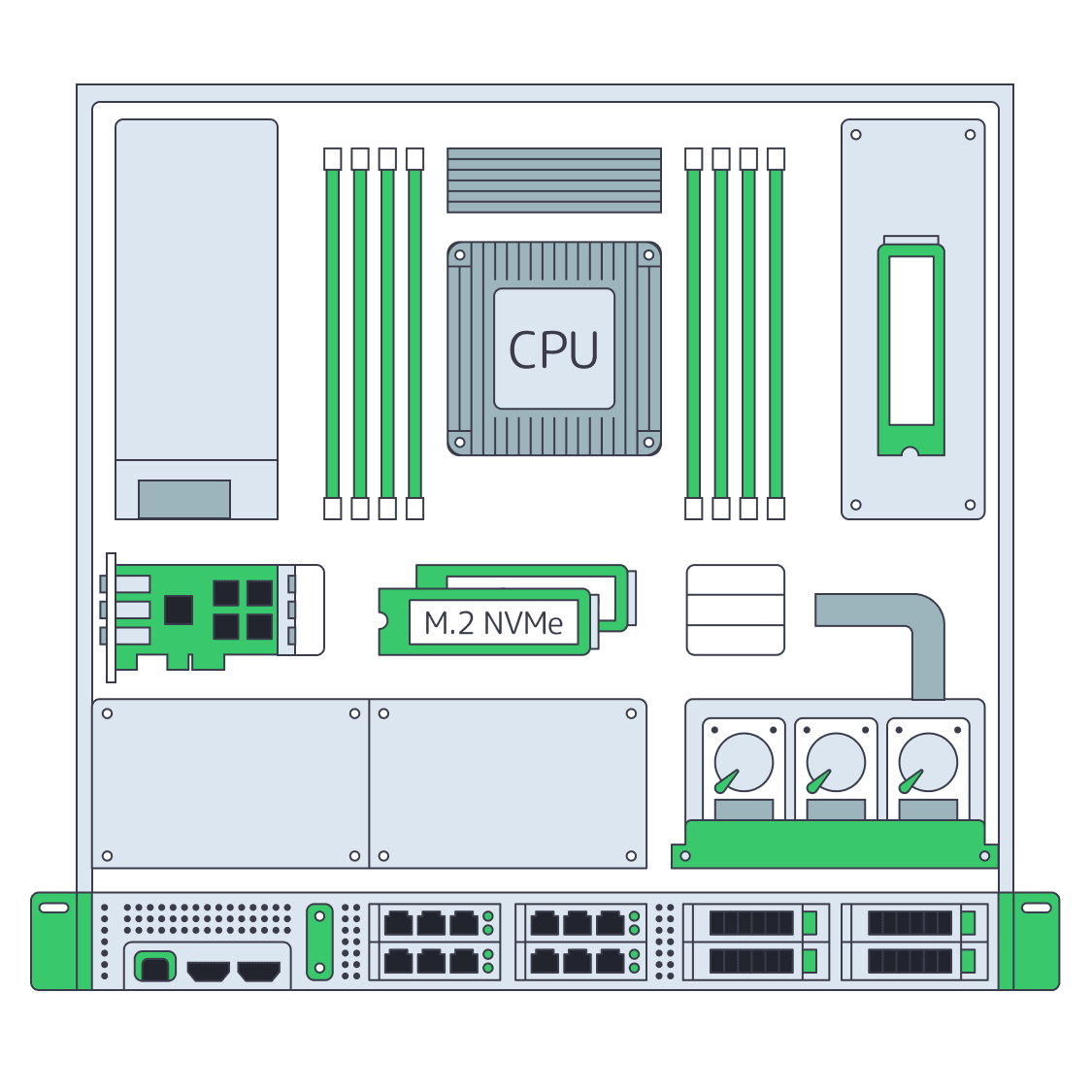
Dedicated storage server sized for real workloads

Plan storage server hosting around usable capacity, access patterns, and growth. Align CPU, RAM, storage, and bandwidth on dedicated infrastructure for predictable performance and controlled expansion.

Secure storage for diverse workloads

Storage sized by workload behavior

Database capacity sizing
Usable capacity matched to dataset needs

Define usable capacity, working sets, and growth headroom before selecting storage totals for production workloads.

Verified storage I/O
I/O patterns matched to application demand

Match sequential throughput, random I/O, metadata load, and concurrency to application read and write patterns.

Storage retention capacity sizing
Growth planned before limits appear

Align compute, memory, storage, and bandwidth so expansion remains predictable as workload demand grows.

Infrastructure operations control
Storage behavior under operator control

Control filesystem, cache behavior, and data layout directly so storage consistently matches workload requirements.

Available configurations
Need a Custom Build?
Filters
Clear all
Data center
Data center
CPU
CPU
CPU Brand
CPU Brand
RAM
RAM
Storage
Storage
from
up to
GPU
GPU
    Bandwidth
    Bandwidth
    Data Transfer
    Data Transfer
    Available configurations –
    CPU
    Memory
    Storage
    Network
    GPU
    Data center
    Price
    Show more

    Dedicated storage server sizing for capacity, access, and growth

    Storage teams rarely struggle with raw capacity alone. The real challenge is aligning usable capacity, working set size, and access patterns with how applications read, write, and move data across systems, while keeping growth predictable, latency stable, and consistently avoiding performance bottlenecks under heavy sustained production load conditions.

    At Melbicom, we provide dedicated infrastructure where compute, memory, storage, bandwidth, and location are selected together. Operators define filesystem behavior, data layout, and I/O handling while choosing between SSD and high-capacity configurations that match workload patterns and expected growth across evolving datasets in production environments.

    This creates an operating model where capacity, throughput, and growth remain aligned with application behavior. Teams expand infrastructure, manage maintenance windows, and adapt configurations without disruptive migrations, keeping performance predictable and ensuring storage decisions stay controlled as datasets scale reliably under sustained demand.

    Operator uploading files to remote storage

    Storage outcomes tied to workload behavior

    Operational results teams see when storage matches real access patterns
    Predictable I/O behavior
    Fewer storage bottlenecks
    Controlled growth planning
    Stable latency under load
    Clear data movement paths
    Operator-level control

    Storage server hosting with I/O fit

    Dedicated infrastructure aligned to storage workloads from sizing decisions to operational control
    Dedicated hardware for storage I/O
    CPU, RAM, storage, bandwidth options
    Configurable deployment locations
    Configurations ready for deployment
    Custom builds for storage profiles
    Operator control over filesystem stack
    Predictable maintenance planning
    Aligned compute and storage resources
    Flexible transfer and bandwidth options
    SSD storage server options available
    Storage server builder
    Select configurations or request builds aligned to storage workload growth.
    Talk to an expert

    Storage workloads mapped to infrastructure design

    Searchable video storage
    Media repositories

    Serve large media libraries with stable throughput, controlled caching, and delivery aligned to real user access patterns.

    Protected backup copies
    Backup repositories

    Store backup datasets with write cycles, retention planning, and recovery workflows aligned to steady capacity growth.

    System log document
    Log retention systems

    Capture logs with steady ingestion, defined indexing patterns, and storage aligned to retention windows and query performance.

    Multi-location data centers
    Dataset distribution

    Distribute datasets across regions with controlled bandwidth and transfer paths for predictable downstream access.

    Storage retention capacity sizing
    Archive storage pools

    Manage long-term archives with growth headroom, defined access frequency, and storage layouts aligned to real usage.

    Server analytics processing
    Analytics datasets

    Support analytics pipelines with balanced read/write patterns, concurrency control, and predictable dataset expansion behavior.

    Overlapping storage folders
    Content libraries

    Operate content platforms with metadata workloads, caching strategies, and access policies tuned to consistent user interaction.

    Verified storage I/O
    File serving platforms

    Deliver files at scale with stable throughput, predictable latency, and high capacity storage server planning for peak demand.

    Storage engineering guides for infrastructure teams

    Dedicated server BOM with CPU, RAM, NVMe, and NIC modules sized from workloads
    Spec Dedicated Servers From Workload, Not the Catalog
    Server rack adding NVMe and nodes, with an 80% capacity gauge and p99 latency dial
    When and How to Scale Storage on Dedicated Servers
    Block vs object storage bridge linking a fast server and a scalable storage cluster
    Choosing Between Object and Block Storage for Your Workloads
    Illustration of server rack topped by HDD, SSD, and NVMe icons showing speed hierarchy
    Choosing Dedicated Server Storage: HDD, SSD, or NVMe?
    More articles
    FAQ
    Which storage workloads benefit from a dedicated server?
    What should teams validate before choosing storage server hosting?
    When should storage workloads use metered or unmetered bandwidth?
    What is an SSD storage server used for?
    When is a high capacity storage server required?
    Opening an account
    Access the control panel, fund your account, and deploy a dedicated storage server for your workload.
    Create an account
    Plan your storage setup
    Share workload patterns, capacity targets, and growth plans so we can size your dedicated server.
    Talk to an expert