
Blog
MongoDB vs. SQL: Choosing the Right Database Hosting
A decade ago, NoSQL-versus-relational debates often treated the choice as winner-takes-all. In practice, many systems combine document and relational databases. The useful question is how each model handles data shape, consistency, query patterns, and scale—then how to host the selected engine on reliable infrastructure that matches the workload.
This guide compares the two models around four pillars—data model, scaling topology, schema philosophy, and feature convergence—and closes with hosting patterns that use Melbicom’s global dedicated-server footprint.
Choose Melbicom— 1,100+ ready-to-go configurations — 20 Tier III and Tier IV data centers — Up to 200 Gbps per server |
 |
What’s the Difference Between Document and Tabular Models?
Relational databases organize data in tables with defined columns, keys, and constraints. SQL engines are well suited to joins and aggregations across related data, but schema changes still require planned migrations and compatibility checks.
Document stores such as MongoDB treat each BSON document as a self-contained record. Documents in one collection can contain different fields, nested arrays can reduce joins, and applications can add fields without an immediate table-wide migration.
| Model | Strengths | Trade-offs |
|---|---|---|
| Tabular (SQL) | ACID transactions, mature join and aggregate engines, defined schemas | Schema evolution requires coordination; multi-node write scaling depends on the engine |
| Document (MongoDB) | Flexible documents, hierarchical reads, built-in replication and sharding options | Cross-document relationships and integrity rules require deliberate modeling |
Many production architectures use both models: finance ledgers may remain in PostgreSQL while content metadata lives in MongoDB. This polyglot approach is useful when each dataset has distinct consistency, query, and change requirements.
How Do MongoDB and SQL Scale?
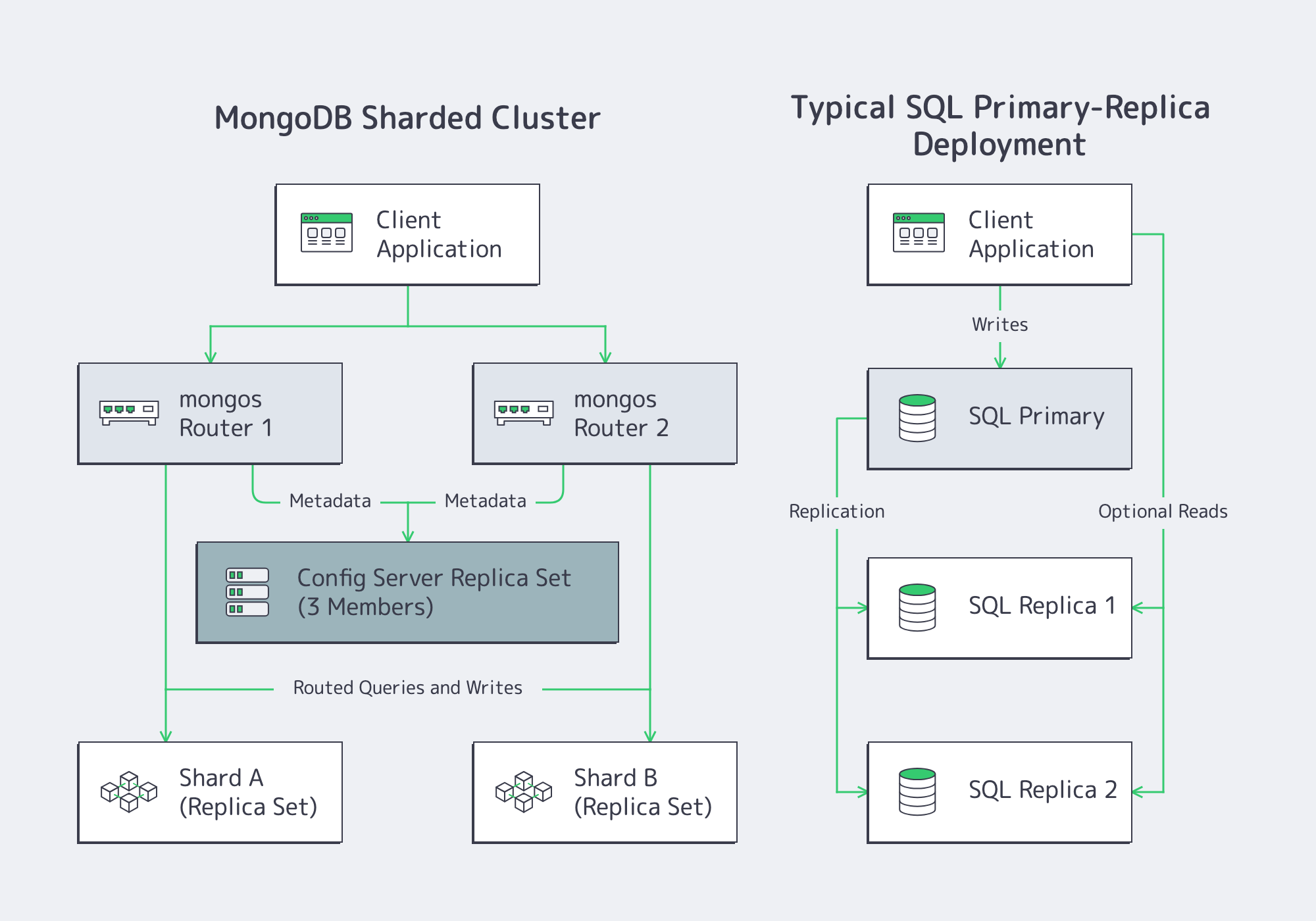
- MongoDB sharding distributes collection data across shards according to a shard key. The shard key and query routing determine whether the cluster can spread writes effectively across servers; production shards and config servers use replica sets, while
mongosprocesses route application requests. - Relational engines can scale vertically, distribute reads through replicas, and partition large tables. Multi-node write scaling depends on the selected engine and architecture; distributed SQL is a separate design choice rather than a default property of SQL.
Topology drives hosting: a production MongoDB sharded cluster includes mongos routers, a config-server replica set, and replica-set-backed shards, while a relational deployment may use a primary with read replicas or standby servers. Compare node count, storage, network traffic, failover targets, and database licensing before sizing either pattern.
Flexible Schemas vs. ACID: Which Fits?
MongoDB’s flexible document model lets applications add fields without an ALTER TABLE operation, but schema flexibility still requires validation, versioning, and migration planning. A MongoDB customer case study reports that OTTO cut product-catalog refresh times from 12 hours to 15 minutes after adopting MongoDB for that workload.
Relational databases can enforce types, keys, and constraints, and transactions can make multi-step changes atomic. The guarantees depend on the engine, schema, and transaction settings, so application-level validation and operational discipline still matter.
MongoDB supports multi-document transactions on replica sets and sharded clusters. Relational platforms such as PostgreSQL, MySQL, and SQL Server also support JSON storage, querying, and indexing, although their data model and operational trade-offs remain relational. Architects can mix strict tables, flexible documents, and application validation according to each workload.
How MongoDB and SQL Converge
- Analytics in MongoDB –
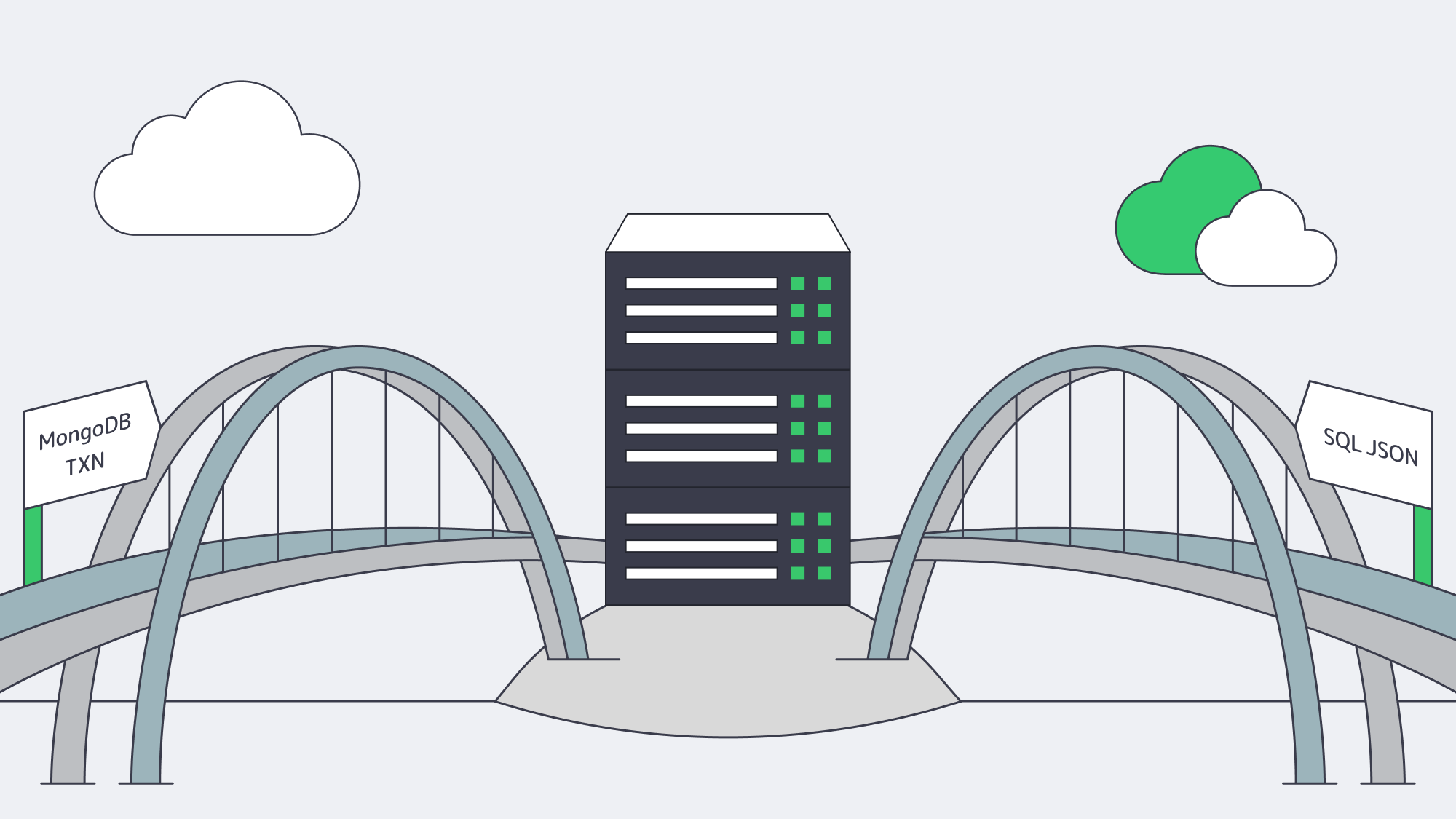
$lookup, aggregation pipelines, window functions, and time-series collections support more analytical work inside the document database. - JSON in SQL – PostgreSQL, MySQL, and SQL Server can store, query, and index JSON data, although syntax and index behavior differ by engine and version.
- Vector search – PostgreSQL can add vector similarity search through extensions such as pgvector, while MongoDB offers separate search and vector-search components for supported deployments.
- Replication and failover – Both ecosystems offer replication, but election, consistency, and failover behavior depend on the selected engine and configuration.
Selection is therefore less about whether a feature exists and more about how it behaves under the application’s query mix, consistency requirements, and operational constraints.
How Should You Choose MongoDB or SQL?
Choose MongoDB when data is naturally document-shaped, schemas change often, and access patterns avoid complex joins. Choose SQL when relationships, constraints, and multi-row transactions dominate. Before either choice, test representative queries, failure recovery, growth, and licensing.
| Criterion | Lean Document | Lean Relational |
|---|---|---|
| Data shape | Polymorphic, nested | Highly normalized or relationship-heavy |
| Query profile | Document lookups and bounded aggregations | Multi-table joins and ad hoc analysis |
| Consistency model | Per-document atomicity, multi-document transactions, and tunable concerns | Multi-row constraints and transactions |
| Growth | Shardable access and write patterns | Vertical scale, replicas, partitioning, or distributed SQL |
| Licensing | SSPL or commercial subscription | Open-source or commercial licensing |
| Operations | Document modeling, replica-set, and shard-key skills | Schema, query, transaction, and replication tuning |
MongoDB Database Hosting: Why Do Dedicated Servers Matter?
Dedicated servers matter for MongoDB database hosting when workload isolation, root-level tuning, predictable resources, or local storage control outweigh shared-cloud elasticity. They remove cross-tenant CPU and memory contention, but teams must still benchmark storage, design replication, test restores, and plan growth capacity.

- Local NVMe can provide high-throughput, low-latency storage without a shared network-volume layer; benchmark the actual drive, filesystem, and RAID layout.
- Dedicated CPU resources reduce contention from unrelated tenants, but query stability still depends on workload shape, NUMA layout, and database tuning.
- Root access enables kernel, filesystem, huge-page, and I/O-scheduler tuning when the database and operating system support it.
Melbicom offers 1,100+ ready-to-go dedicated server configurations across 20 data centers, with up to 200 Gbps per server. Teams can place MongoDB shards or SQL replicas in supported locations and choose CPU, RAM, storage, and bandwidth around measured database requirements. Melbicom provides 24/7 support; database teams should still plan configuration, replication, backups, and failover separately from hardware support.
Dedicated vs. Cloud Database Costs
Storage capacity, IOPS, snapshots, data transfer, and software licensing all affect database cost. Cloud services often meter these line items separately. A dedicated-server configuration makes the selected CPU, RAM, and local storage explicit, while bandwidth and optional services still depend on the plan. Compare the full bill at the same redundancy and retention targets.
For teams asking how much Microsoft SQL Server costs, the answer depends on edition, licensing model, core count, and support terms. Before choosing hardware, verify the supported SQL Server release and licensing rules for the planned operating system and core layout; do not size an out-of-support edition only because an old license is available.
Separately from database traffic, Melbicom’s CDN has 39 disclosed PoPs across 35 countries and can cache eligible application assets at the edge. It does not reduce database replication, backup, or query traffic, so size those flows against the selected server bandwidth plan and the actual placement of replicas.
Operational Playbooks and Tooling
Dedicated-server operations can be automated, but the available control plane matters. Configuration-management tools such as Ansible can standardize database packages and operating-system settings; infrastructure-as-code support depends on the provider API and the team’s tooling. Before committing, confirm how provisioning, remote console access, power control, reinstallations, IP management, monitoring, and data-center hardware replacement are handled. Database teams should separately automate backups, restore tests, certificate renewal, metrics, alerts, and failover procedures.
Hosting Patterns at a Glance
| Pattern | Typical Nodes | Best For |
|---|---|---|
| Relational Primary and Replicas | Primary plus standby or read replicas | Relational transactions, joins, and read scaling |
| MongoDB Sharded Cluster | mongos, config-server replica set, replica-set-backed shards |
Horizontal partitioning across shards |
| Polyglot Deployment | Separate SQL and document clusters | Applications with distinct data-model needs |
Conclusion: Choose the Model, Then Size It
Modern database engineering is about trade-offs. MongoDB can simplify development for evolving, document-shaped data, while relational engines provide mature constraints, transactions, and joins. Feature convergence softens the extremes, but the engines remain operationally different. Choose with representative queries and failure tests, then size infrastructure for the measured CPU, memory, storage, and network profile.
Deploy dedicated servers today
Choose from 1,100+ ready-to-go configurations or request a custom server delivered in 3–5 business days.