
Blog

Dedicated Servers for Blockchain Node Hosting and Staking
Blockchain has long outgrown the playground of hobbyists. Tens of billions of dollars in digital assets ride on the success of not only validators, but of nodes. The margin for error is slim. High-stakes applications demand that networks like Ethereum and Polkadot maintain high availability, achieve low-latency data propagation, and deliver predictable I/O throughput. In that context, blockchain node hosting on dedicated servers moves from “nice to have” to a professional baseline.
Choose Melbicom— 1,100+ ready-to-go servers — 21 Tier III & IV data centers — 55+ CDN locations worldwide |
 |
4 Elements of Success for Blockchain Node Hosting on Dedicated Servers
Dedicated servers, as single-tenant machines hosted in professionally managed data centers, can provide four key wins that translate directly into validator success: exclusive resources, continuous uptime, stronger security and management control, and scalable capacity for blockchain workloads.
Exclusive resources and predictable performance
Consensus participation is a time-critical activity: The processes of proposing, attesting, and voting need to occur on strictly scheduled time intervals. Predictable compute performance requires hardware that is unaffected by other users’ workloads, or by the resource allocation decisions made by hypervisors. A dedicated server grants your node an exclusive CPU, RAM and NVMe I/O path. The resulting stability shows in faster block ingestion, fewer missed attestations, and more predictable catch-up performance after restarts. When execution clients and indexers work on RPC endpoints, they need constant IOPS and memory bandwidth to achieve lower tail latencies in their API responses and prevent backlog issues as mempools grow.
24/7 blockchain uptime
Uptime is not a vanity metric; on proof-of-stake networks it’s revenue preservation. Miss enough duties and rewards erode. Prolonged gaps can even trigger penalties on some chains. Purpose-built facilities reduce those risks with redundant power and cooling, multi-homed transit, and on-site technicians. That’s why many operators host validators in Tier III and Tier IV data centers: the engineering goal is 24/7/365 operation with maintenance performed without downtime. Melbicom’s data center portfolio includes Tier IV and Tier III facilities in Amsterdam; other data centers around the world are also Tier III-rated, all engineered with multiple paths for power, cooling, and networking.
Bandwidth ceilings also play a bigger role than you might think. Initial sync and snapshot restores contribute to sustained throughput, but bursty blocks and heavy state transitions drive traffic spikes. With per-server connectivity from 1 Gbps all the way up to 200 Gbps where it’s needed, the extra headroom from Melbicom means you’re far less likely to fall behind your peers when surges happen, which means faster time-to-sync and smoother propagation under load.

Security and control for validator server hosting
Validator keys and signing paths should be strictly isolated. On a dedicated server, you get to control the OS hardening, the kernel, the firewalling, the key storage mechanism, and the monitoring stack without any co-tenants to introduce additional risk. Beyond node-level security, there is systemic flexibility: a significant portion of public nodes are on only a few cloud providers, creating large correlated failure surfaces. Distributing your validators between providers and across geographies not only bolsters decentralization but also dilutes shared-fate risks. With 21 global locations, choosing where to place nodes with Melbicom is easy, making it both resilient and performant.
Scalability without surprises
Networks grow, client footprints expand, and new features such as MEV or PBS tooling introduce background services. Dedicated servers scale in two useful dimensions: vertically (RAM, higher-frequency CPUs, more NVMe) and horizontally (additional servers dedicated to relays, RPC, sentries, indexing, etc.). With 1,100+ ready-to-go configurations in Melbicom’s portfolio, operators commonly boot a clone node for rolling upgrades or failover, then power down the older server once cutovers are finished. That process preserves continuity without frantic late-night cutovers.
Modern Blockchain Hardware Requirements
The traditional approach of “renting a small VM” or “running a full node on your spare PC” fails to meet modern client requirements or the scale of ledger data. Throughput-optimized newer networks are defined less by a light footprint and more by a shift toward sustained performance. Fast CPUs, generous memory, NVMe SSDs, and reliable bandwidth are the through line across all our target ecosystems, and network interfaces must be fit for purpose to accept and serve sustained ingress/egress without intermittent packet loss.
| Network | Example Operational Footprint |
|---|---|
| Ethereum (PoS, consensus + execution) | 4+ fast CPU cores; 16–64 GB RAM depending on client mix and validator/RPC load; 2+ TB fast SSD/NVMe for full or pruned nodes, with 4–8 TB+ for larger local history or RPC roles; unmetered bandwidth, preferably 1 Gbps for fast syncs and serving peers. |
| Solana (PoS) | 12 cores / 24 threads or more at 2.8 GHz+ with higher clock speed preferred; 256 GB RAM, or 512 GB for all account indexes; separate high-TBW NVMe SSDs for accounts, ledger, and snapshots; 2 Gbps required for staked validators, 10 Gbps recommended. |
| Polkadot (NPoS) | 8 physical cores at ~3.4 GHz; 32 GB DDR4 ECC RAM; ≥2 TB NVMe; ≥500 Mbps symmetric. |
| Cardano (PoS) | Block producer + at least 2 relays; 2+ cores at 2.0 GHz+; 8–24 GB RAM depending on backend; 250 GB storage, with 350 GB recommended for future growth; about 1 GB/hour broadband on a public IPv4 connection. |
Table 1: Sample full/validator node footprints. Fast CPUs, adequate memory, SSD/NVMe storage, and low-loss bandwidth remain common across ecosystems, but exact sizing depends on client mix, pruning/archive policy, RPC load, and whether the node participates in consensus.
A few patterns worth underlining
CPU frequency and single-thread performance matter. Validation, consensus, and block production are latency-sensitive operations; higher per-core clocks keep the critical path short.
RAM cushions instability. As clients, caches, and state grow, memory headroom helps absorb sync work and post-upgrade reorgs.
NVMe is a must-have. Random I/O has a high share for many clients; SATA SSDs and network-attached storage introduce preventable stalls.
Network bandwidth is not just a number. Operators should consider packet loss, micro-bursts, and route quality among the first-class properties of their network connection, rather than focusing solely on nominal bandwidth.
High-throughput chains such as Solana still have the steepest footprint in this comparison: validator guidance emphasizes high-clock CPUs, ECC memory, separate high-TBW NVMe devices for accounts, ledger, and snapshots, and 2–10 Gbps symmetric networking for staked validators. Polkadot’s validator guidance is more moderate but still specific: eight physical cores, ECC memory, local 2 TB NVMe, and 500 Mbps symmetric networking. Ethereum’s baseline full-node requirements are lighter, but professional validators and RPC operators often provision larger NVMe and memory footprints to keep local state responsive and avoid slow remote calls during spikes.
Reliable Crypto Node Infrastructure Design
Place nodes where latency and resilience intersect
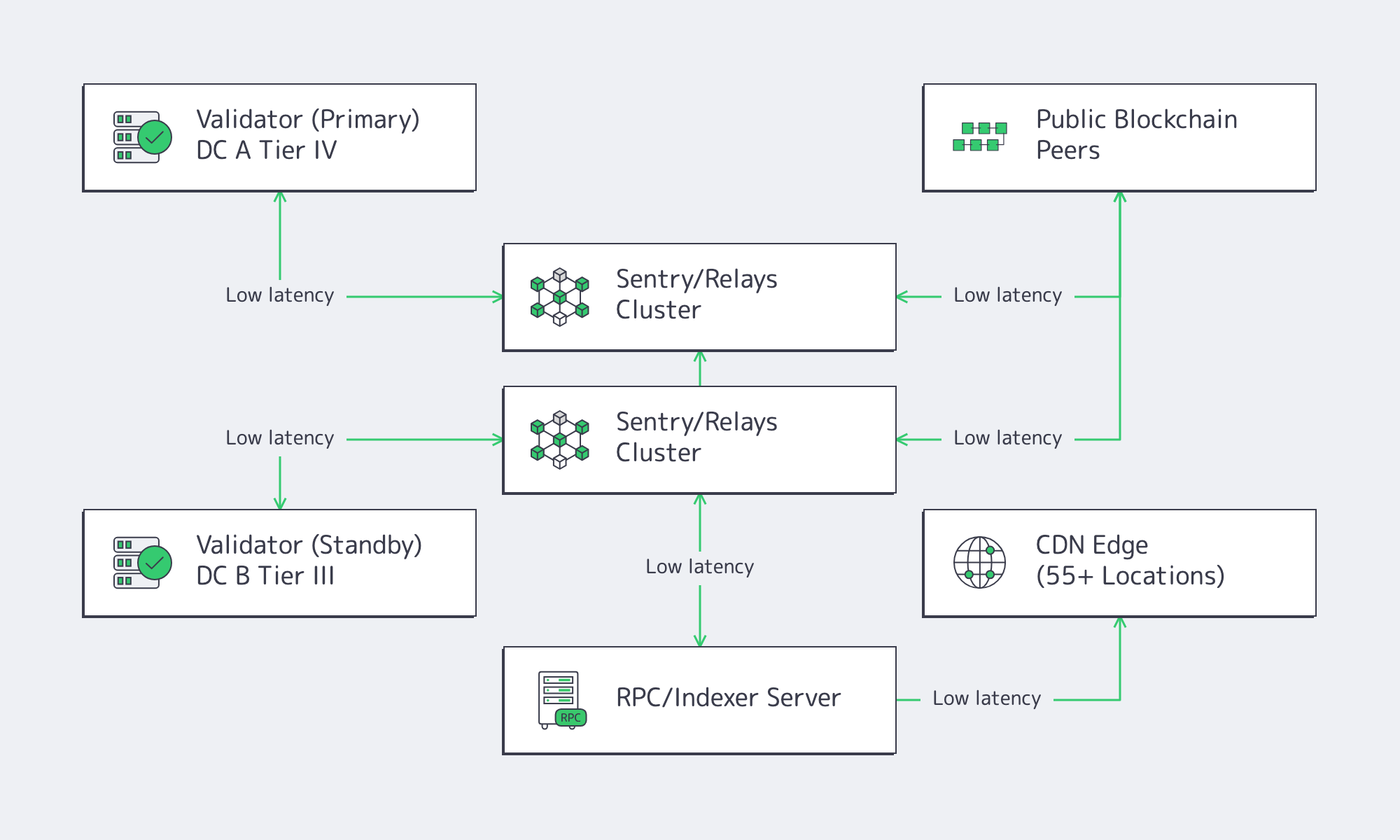
The geographic location of your nodes still matters. Validators located close to major Internet exchange points have been observed to exhibit better peer connectivity and lower path variance, on average. Melbicom operates 21 Tier III and Tier IV data centers worldwide to enable operators to strike a balance: place your consensus and relay nodes strategically, near your peers but spread far enough to reduce correlated disruptions.
Prioritize propagation over throughput alone
A 1 Gbps port that never drops packets is superior to a 10 Gbps port with intermittent micro loss. We’ve found that dedicated ports with quality upstreams, ample burst capacity, and fast restoration paths (across diverse providers with shorter downstream routes) are best. We provision per-server bandwidth up to 200 Gbps for special use cases that require it, and a CDN across 55+ locations in 39 countries can take public RPC or static requests off your validator network path, where your architecture requires such isolation.
Standardize on modern CPUs, ECC RAM, and NVMe
Validator workloads are jitter-sensitive. Platforms with modern AMD EPYC and Intel Xeon CPUs, ECC memory, and NVMe RAID provide the deterministic behavior the node software demands. For Ethereum-class professional footprints, many operators standardize on 64–128 GB RAM and 4–8 TB NVMe to leave room for client growth, local history, and RPC tasks. For Solana-class footprints, 256–512 GB RAM and separate high-TBW NVMe drives for accounts, ledger, and snapshots are the practical baseline to keep hot state responsive.
Build for continuous operations
Rolling upgrades and fast recovery are part of the plan. The simplest pattern is two like-for-like servers per critical role (validator + hot standby, block-producer + sibling relay). With 1,100+ ready-to-go configurations, we at Melbicom can mirror your primary build in the same metro or second region, then help you cut over during client upgrades or hardware refreshes. Free 24/7 technical support shortens mean-time-to-repair if a component fails.
Keep RPC and validator roles separate
Mixing public API traffic with consensus work is convenient until it isn’t. A split architecture (validator on one host, RPC/indexing on another) helps isolate unpredictable workloads. On dedicated servers, that separation is cost-effective without sacrificing performance.
Why Outdated Setups Struggle
Consumer gear and oversubscribed VMs underperform for predictable reasons: shared I/O, noisy neighbors, single-ISP exposure, and limited hands-on recovery if hardware fails. Occasional home-lab nodes still have a role in testing and education. But for networks where missed duties lower income, or where your reputation with delegators is on the line, professional, single-tenant servers in Tier III/IV facilities are the cost-effective answer. The calculus is simple: more signed duties, fewer reorg headaches, lower operational risk.
Conclusion

Melbicom’s footprint and network were architected for this moment. With 21 Tier IV and Tier III data centers, per-server connectivity up to 200 Gbps, a 55+ location CDN across 39 countries, 1,100+ configurations ready to deploy, and 24/7 support, Melbicom makes professional-grade validator hosting accessible and scalable. If you’re architecting for the next cycle of network growth, the right move is to put your keys on infrastructure engineered for nonstop duty.
Launch Your Dedicated Validator Server
Deploy a Melbicom dedicated server built for blockchain nodes—fast CPUs, NVMe storage, and bandwidth up to 200 Gbps.