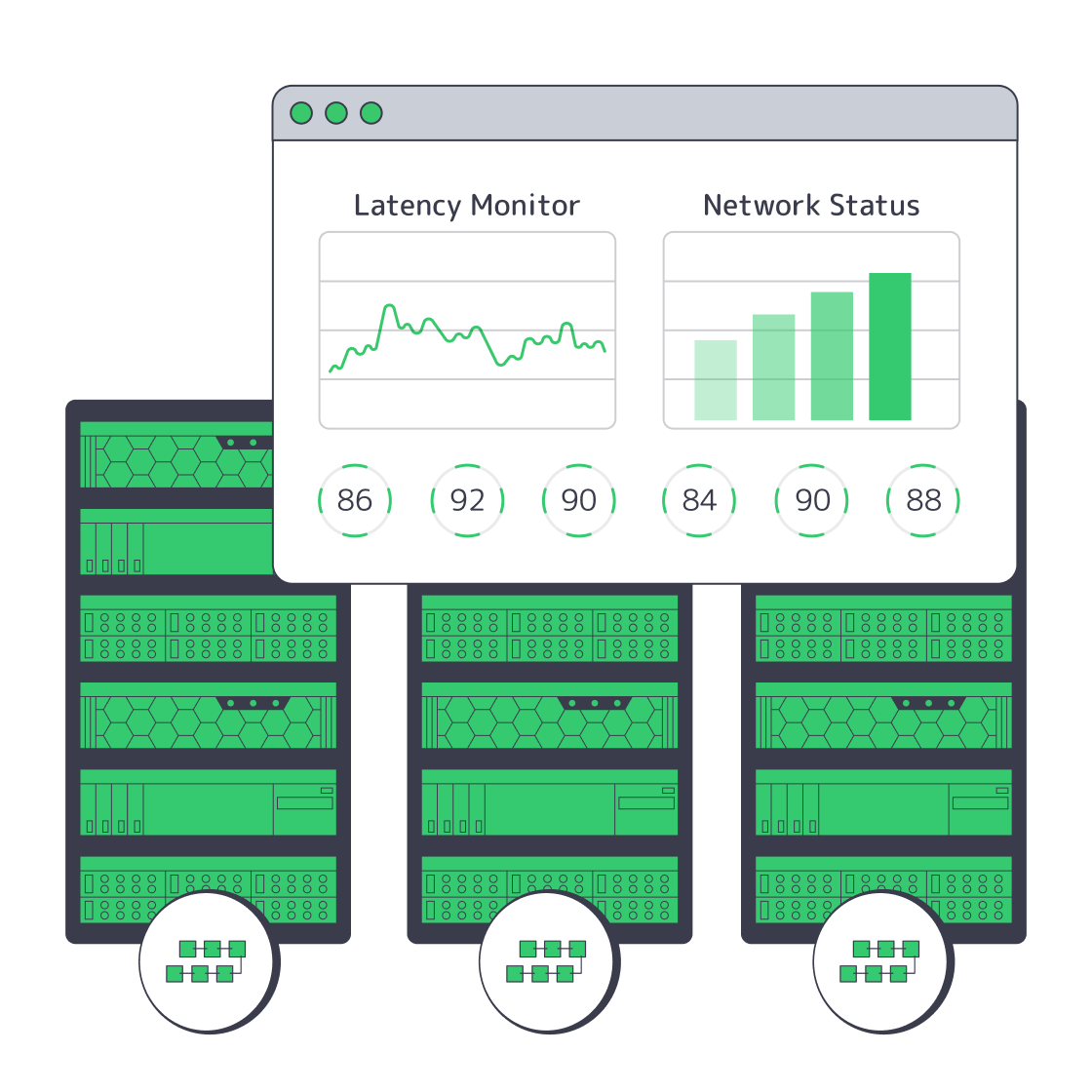
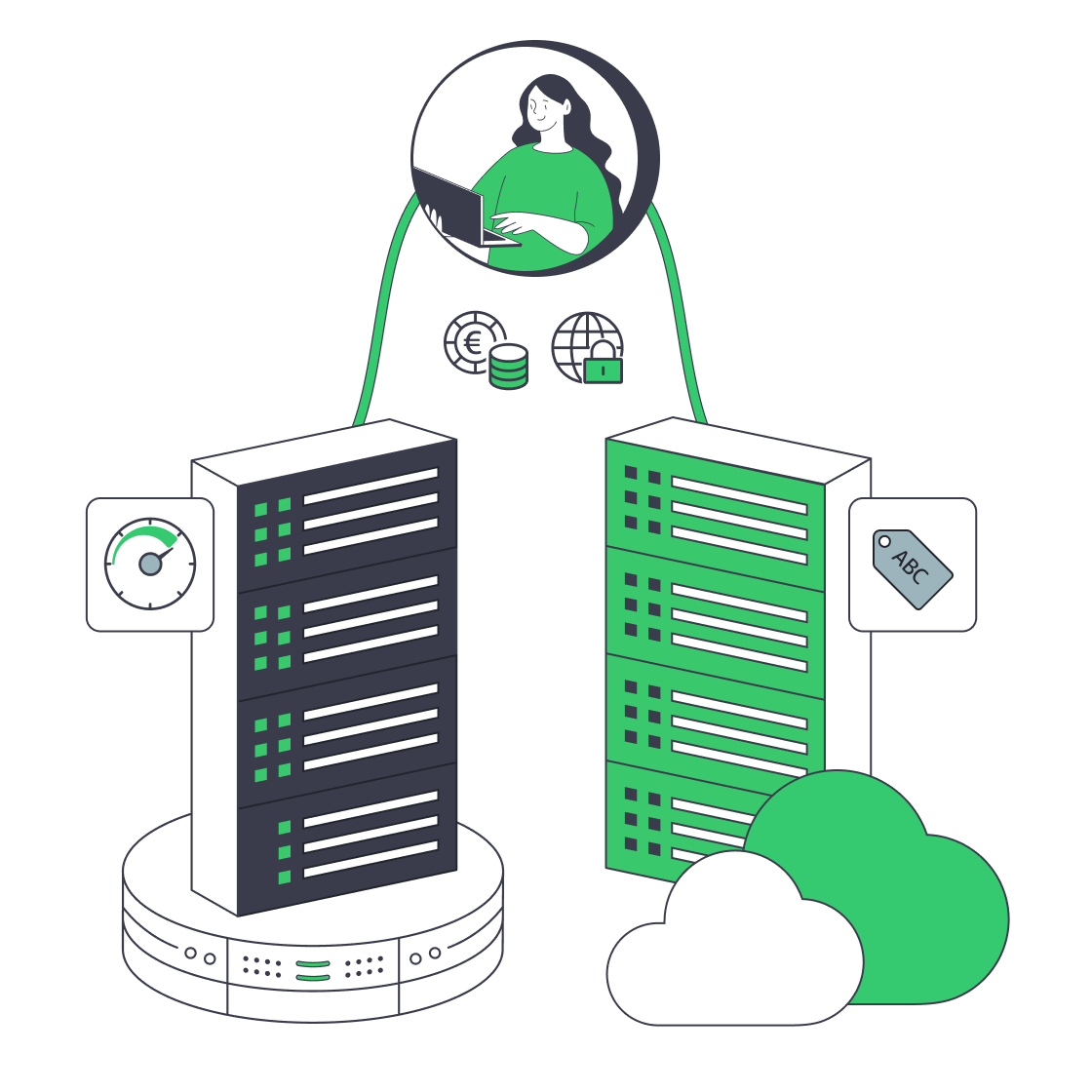
NFT hosting for marketplaces with isolated mint workloads

Run NFT marketplaces, mint services, and indexers on dedicated infrastructure that separates live API traffic from indexing jobs, keeps latency stable during drops, and preserves control over metadata origins.

Secure NFT marketplace hosting infrastructure

Compare NFT infrastructure by workload and control

Isolated application traffic
Isolate mint spike traffic

Isolate mint coordination, APIs, and ownership queries from indexing jobs to keep latency stable during spikes.

Stylized NFT monkey avatar
Size for NFT demand

Select CPU, memory, NVMe storage, and bandwidth from concurrency, catalog size, and event volume to avoid limits.

Cache policy operations
Control origin and lifecycle

Keep NFT metadata and media on a controlled origin with defined cache policy, ownership rules, and consistent access.

Multi-location CDN network
CDN cache NFT media

Serve public NFT media via CDN caching when requests justify offloading, while applications and storage remain controlled.

Available configurations
Need a Custom Build?
Filters
Clear all
Data center
Data center
CPU
CPU
CPU Brand
CPU Brand
RAM
RAM
Storage
Storage
from
up to
GPU
GPU
    Bandwidth
    Bandwidth
    Data Transfer
    Data Transfer
    Available configurations –
    CPU
    Memory
    Storage
    Network
    GPU
    Data center
    Price
    Show more

    Factors NFT teams compare when choosing infrastructure hosting

    NFT platforms combine storefront APIs, mint coordination, ownership queries, metadata services, databases, and event indexers that compete for compute when capacity is shared. During drops, live requests collide with replay, enrichment, analytics, and recovery jobs, slowing browsing, ownership checks, and transaction paths. This creates unpredictable latency under load.

    At Melbicom, we provide isolated dedicated servers with defined CPU, memory, storage, and bandwidth boundaries. Marketplace traffic and mint services run separately from indexing, replay, analytics, and recovery jobs, while metadata and media stay on a controlled origin with explicit cache policy and lifecycle control. Isolation preserves consistent API latency during spikes.

    Teams assign workloads to separate nodes, choose regional placement around users and blockchain endpoints, and use CDN only for repeated public media delivery. You retain full ownership of applications, smart contracts, wallets, keys, metadata, monitoring, backups, and incident response across the stack. This model keeps capacity planning tied to demand.

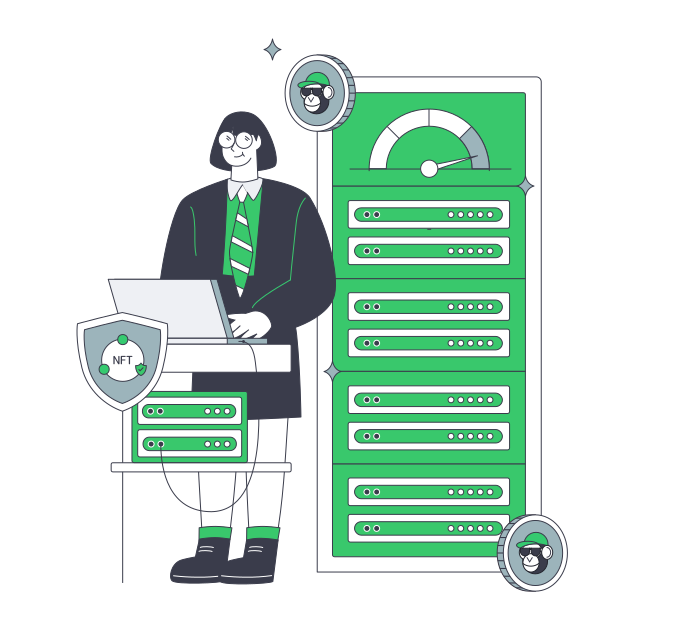
    Operator managing NFT marketplace infrastructure

    NFT platform performance outcomes under isolated workloads

    Operational results tied to marketplace traffic, indexing, and recovery behavior.
    Stable API latency
    Fewer drop slowdowns
    Predictable indexing throughput
    Controlled storage growth
    Faster rebuild cycles
    Efficient media delivery

    Dedicated servers for NFT platforms

    Both metered and unmetered bandwidth options are available for NFT workloads, depending on server location.
    Isolated compute for NFT workloads
    Separate live and replay jobs
    CPU and RAM sized by demand
    NVMe storage for indexers
    Metered and unmetered bandwidth
    Server coverage across 5 continents
    Supported crypto or fiat payments
    CDN for media caching layer
    Global delivery when needed
    Origin cache policy control
    NFT server builder
    Configure NFT infrastructure with dedicated capacity, storage, and regional zones.
    Talk to an expert

    NFT marketplace and infrastructure use cases

    Stylized NFT monkey avatar
    NFT marketplaces

    Run storefront APIs, search, bids, and ownership queries on isolated infrastructure so indexing jobs never affect latency.

    Application traffic capacity sizing
    Mint and drop services

    Dedicated capacity runs mint coordination and submission during spikes so browsing and metadata access stay responsive.

    Distributed indexing statistics
    Event indexing pipelines

    Process blockchain events and replay history on separate nodes so indexing throughput scales without slowing live APIs.

    Searchable video storage
    Metadata and media origins

    Host NFT metadata and media on controlled origins where cache rules, ownership, and availability remain consistent.

    Blockchain state topology
    Multi-chain NFT platforms

    Support multi-chain collections with dedicated capacity for indexers, databases, and APIs, reducing schema conflicts.

    Checked server recovery
    Recovery and rebuild

    Plan recovery using separate compute for backups, restores, and reindexing so production APIs stay responsive.

    Multi-location CDN network
    CDN media distribution

    Cache frequently requested NFT media through CDN layers to reduce origin load while keeping ownership controlled.

    Media origin delivery network
    Public NFT content delivery

    Deliver images and metadata globally through CDN layers when demand justifies caching without replacing origin storage.

    Infrastructure guidance for NFT platforms

    Dedicated servers linking RPC, indexers, storage, CDN, and observability
    Why Production dApps Fail in the RPC Layer, Not the Chain
    Blockchain chain linked to dedicated servers with performance dashboards
    Dedicated Servers for dApp Backends and Off-Chain APIs
    Load balancer routing NFT drop traffic to dedicated server cluster with global CDN
    How Dedicated Servers Turbocharge NFT Drops
    Block vs object storage bridge linking a fast server and a scalable storage cluster
    Choosing Between Object and Block Storage for Your Workloads
    More articles
    FAQ
    Which NFT workloads should be isolated during mint spikes?
    Who manages NFT smart contracts wallets keys metadata backups?
    What is NFT marketplace hosting in practice?
    How do teams size NFT infrastructure correctly?
    How do metered and unmetered bandwidth options differ?
    How do cryptocurrency payments work with mandatory KYC?
    Opening an account
    1000+ ready-to-go server configurations power NFT APIs, mint services, databases, and caches.
    Create an account
    Plan your NFT architecture
    Custom builds in 3–5 business days include 24/7 technical support for NFT infrastructure.
    Talk to an expert