
Blog
Japan Server: Choosing the Right Infra for Low-Latency Local Workloads
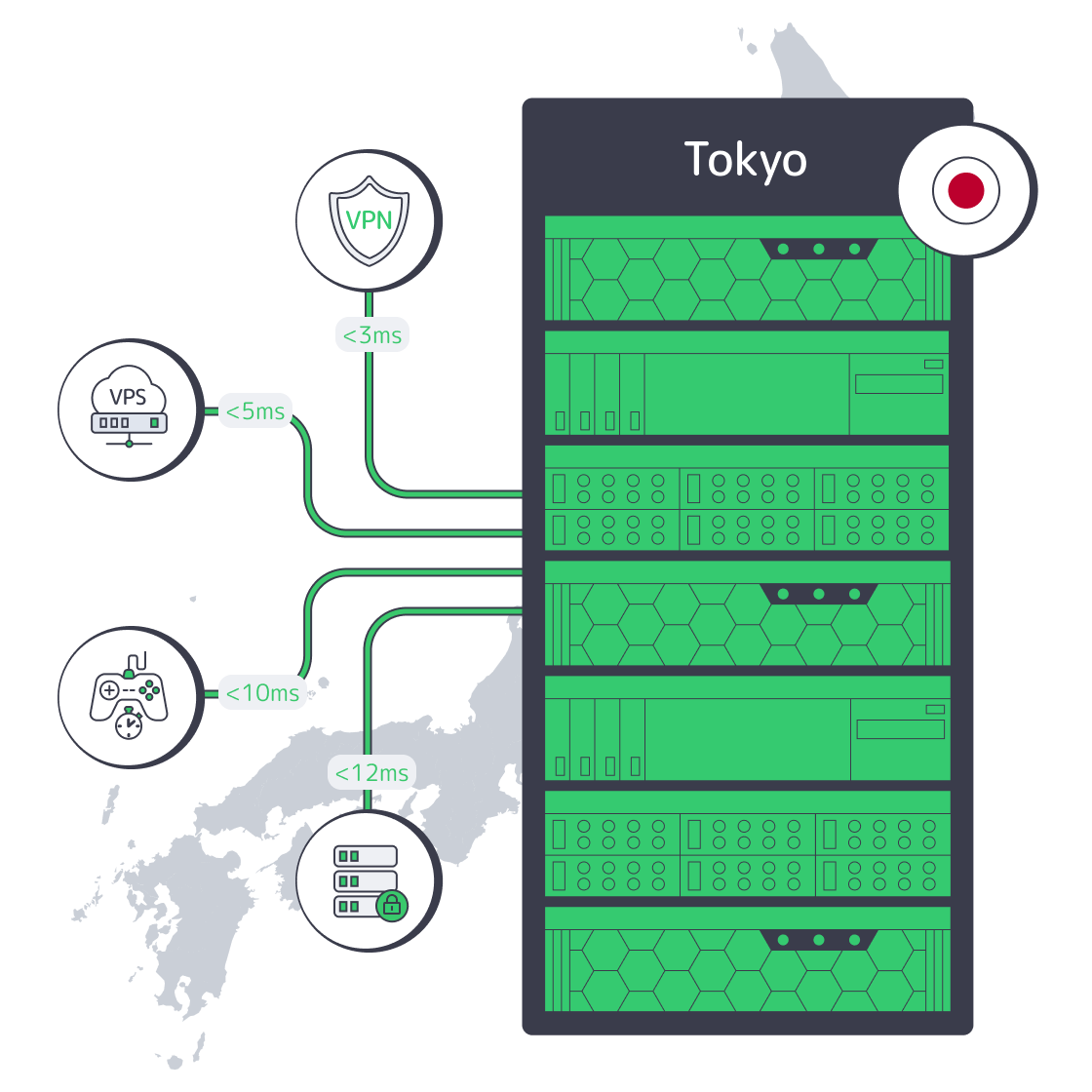
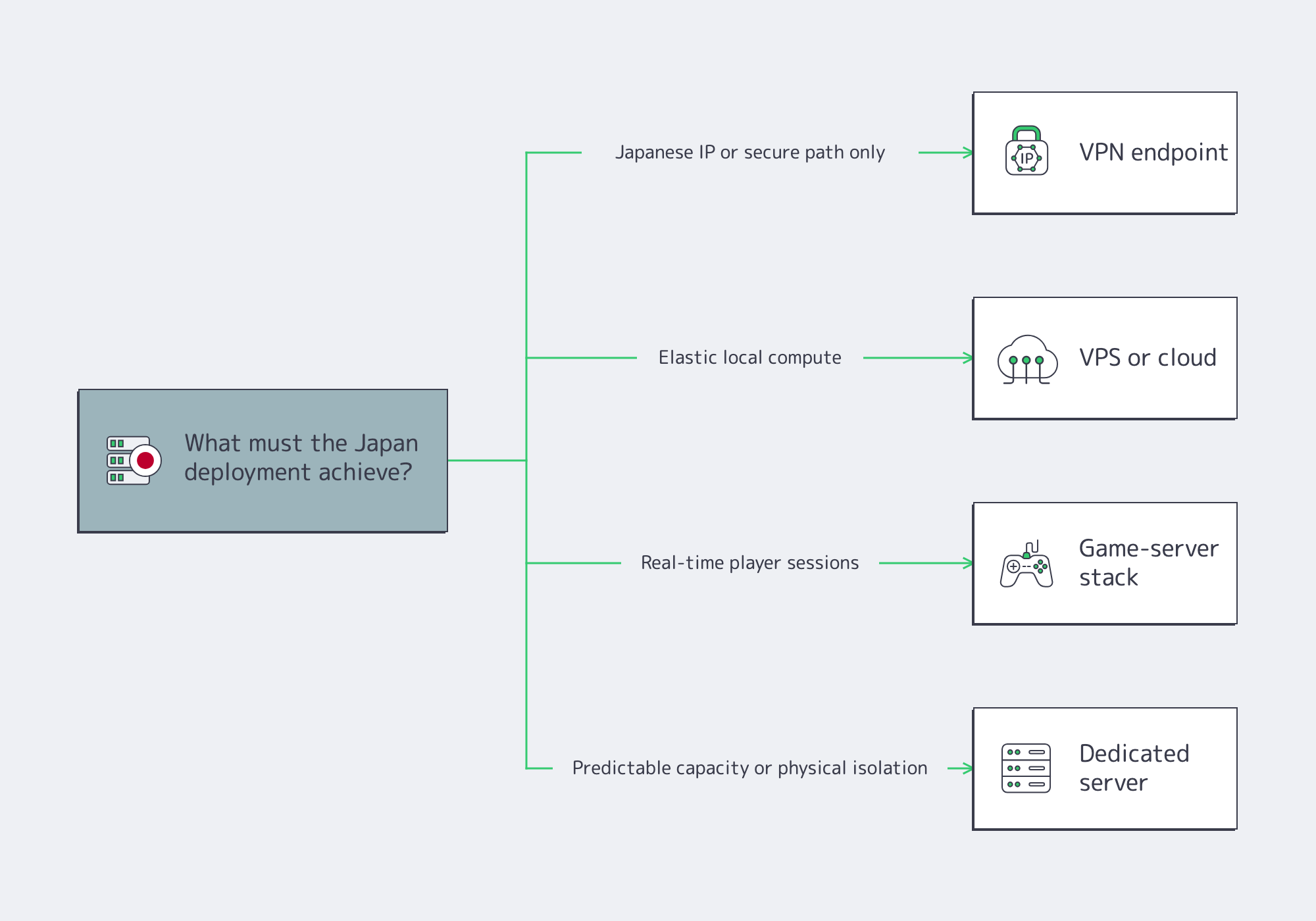
“Japan server” query usually describes four different infrastructure goals. One buyer needs a Japanese IP address. Another wants game sessions closer to players. A third needs virtual compute in Tokyo. A fourth requires a dedicated physical server with predictable resources and a clear isolation boundary.
Treating those needs as interchangeable leads to poor architecture decisions. A VPN changes network identity without moving the workload. A VPS relocates compute but still uses virtualized infrastructure. A game server describes an application role rather than a hardware category. A dedicated server provides exclusive physical resources but requires more deliberate capacity planning.
Japan’s internet usage makes local performance relevant for many services. The Japan Statistical Handbook reports that 85.6% of people aged six and older had used the internet during the preceding year, with usage above 90% across every age group from 13 through 69. The practical question is not whether Japan has substantial digital demand. It is which parts of a system must run close to Japanese users.
Japan Servers– 14 Tokyo configurations – Tier III Tokyo facility – Up to 100 Gbps per server |
 |
Japan Server Meaning for Buyers
A Japan server search usually hides one of four requirements: obtaining a Japanese egress IP, hosting real-time sessions near players, deploying virtual compute, or reserving a physically isolated machine. Choose by outcome: VPN for network identity, VPS or cloud for virtual capacity, game hosting for session latency, and dedicated infrastructure for predictable resources and isolation.
A Japan VPN is primarily a network-path and egress-identity tool. It creates an encrypted tunnel with a Japanese source address when terminated in Japan. It does not relocate application, database, game, or file-processing workloads.
That makes a VPN appropriate for secure administration, regional behavior testing, private connectivity, or access through a Japanese IP. It does not lower application latency if the workload remains on another continent.
A Japan VPS places virtual compute inside a Japanese data center. It can be a practical starting point for APIs, development environments, proxies, control-plane services, smaller databases, and regional application components. It provides a persistent operating-system environment without requiring a physical machine.
A VPS should not automatically be equated with a full cloud platform. The NIST cloud definition includes on-demand self-service, pooled resources, rapid elasticity, broad network access, and measured service. A conventional VPS may provide virtual compute without all of those operational characteristics.
A Japan game server is an application role, not a server class. Matchmaking, authoritative simulation, persistence, telemetry, voice, and content delivery can run on separate systems. The underlying capacity may be virtual, cloud-based, or dedicated.
Latency requirements vary by game, but they can be unforgiving. An ACM latency survey found that delays below 100 milliseconds can already affect tasks such as target selection and steering. Genre, input model, tick rate, and compensation design determine how much delay is acceptable.
A Japan dedicated server is a single-customer physical machine located in Japan. It is the relevant interpretation when sustained CPU performance, exclusive memory and storage resources, predictable capacity, deeper operating-system control, or a physical workload-isolation boundary matter.
Dedicated hardware is not automatically faster than every virtual instance. Poor routing, insufficient capacity, or a badly configured application can still produce weak performance. Its central distinction is that unrelated virtual tenants do not share the machine’s physical compute allocation.
Comparing Japan Server Options
The right Japan server class follows the workload’s bottleneck rather than the product label. Use a VPN when the application stays elsewhere, VPS or cloud when provisioning speed and elasticity matter, game-server architecture when packet timing drives experience, and dedicated hardware when sustained load, broader control, or physical single-customer isolation outweigh elasticity.
| Buyer Intent | Best-Fit Option | Deciding Tradeoff |
|---|---|---|
| Obtain a Japanese IP or secure a network path | Japan VPN endpoint | Changes routing and source address without necessarily relocating the workload |
| Launch local compute quickly or absorb irregular demand | Japan VPS or cloud instance | Faster provisioning, with virtualized and potentially pooled physical resources |
| Keep real-time sessions close to Japanese players | Japan game-server architecture | The workload still requires a VPS, cloud, or dedicated capacity decision |
| Run steady, sensitive, or performance-variable workloads | Japan dedicated server | Physical resource isolation and control, with more capacity planning |
The most important distinction is between what the system does and what it runs on. VPN describes a secure network overlay. Game server describes an application role. VPS, cloud, and dedicated server describe ways to supply compute.
Virtual infrastructure is often the rational starting point for a regional API, test environment, monitoring node, low-volume backend, or service with uncertain demand. It allows local deployment without committing to an entire physical system.
That advantage becomes less significant when the workload is consistently busy. If a service consumes stable CPU, memory, storage I/O, and network capacity around the clock, predictable physical resources may matter more than the ability to create and delete instances rapidly.
The difference is especially important for authoritative game simulation. Average CPU utilization can hide scheduling delays that create missed ticks or unstable processing times. Teams should benchmark session density, p95 processing time, and p99 processing time instead of comparing only total vCPU counts.
Dedicated infrastructure also provides a clearer fit when licensing, audit scope, security policy, or internal risk classification requires a physical single-customer boundary. Virtualization can deliver strong logical isolation, but dedicated hardware removes cross-customer hypervisor sharing from the compute layer. Neither model automatically secures the operating system or application.
Latency, Control, Compliance, and Isolation Checks for Japan Hosting
Evaluate Japan hosting against four written acceptance tests: latency from representative Japanese access networks, the administrative controls the team requires, the data-handling obligations that apply, and the isolation boundary defined by the threat model. A location should fail procurement if it misses any mandatory threshold, regardless of its headline port speed.
Latency must be measured rather than inferred from a map. Physical proximity reduces theoretical propagation delay, but real traffic follows routing policies, peering relationships, transit availability, congestion, and failure conditions.
Japan has a substantial local interconnection ecosystem. JPNAP reports hundreds of connected autonomous systems, more than 8 Tbps of peak traffic, and interconnection facilities across several areas. Those figures establish the scale of the market; they do not guarantee that every Tokyo provider has equally effective routes to every access network.
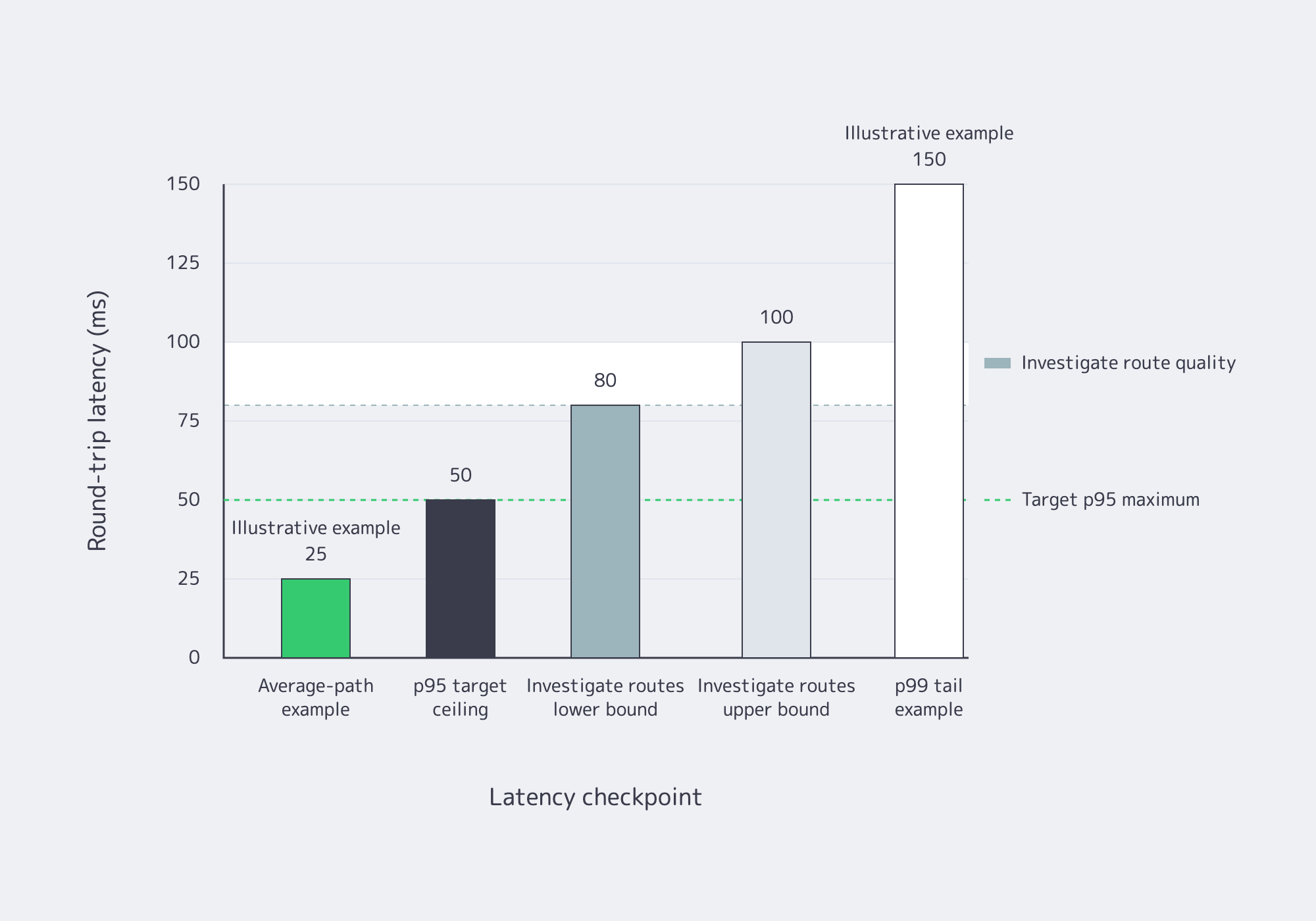
Average ping is not enough. The IETF performance-metrics registry distinguishes round-trip delay, one-way delay, packet loss, and packet-delay variation because each reveals different failure modes. A 25-millisecond average can still fail when p99 reaches 150 milliseconds or brief loss triggers retransmissions.
For action-heavy multiplayer workloads, a reasonable procurement screen is to target p95 player-to-server round-trip time below roughly 50 milliseconds for the primary Japanese cohort and investigate routes approaching 80–100 milliseconds. This is an operating target, not a universal gaming standard. Competitive systems may need less, while slower-paced applications may tolerate more.
Transactional applications require a different calculation. A 30-millisecond round trip may be negligible for one request but material when a user action creates several sequential authentication, database, and API exchanges. Measure end-to-end task time with network delay, server processing, cache behavior, and database latency.
Control requirements must also be explicit. Root access to a virtual machine does not provide control over the host, hypervisor, physical storage topology, or network interface. A dedicated server exposes a broader system boundary, but the buyer must still confirm operating-system installation procedures, recovery access, reinstall options, firewall ownership, and division of operational responsibilities.
Compliance is not created by a Tokyo address. Japan’s Act on the Protection of Personal Information governs how covered organizations handle personal information. The Personal Information Protection Commission emphasizes access controls, protection against unauthorized access, appropriate third-party handling, purpose limitation, and organizational, human, physical, and technical safeguards.
A Japan-based server can support a data-residency requirement by keeping selected processing and storage in Japan. It does not prove that backups remain in scope, support access is controlled, retention is appropriate, subprocessors are governed, or cross-border transfers use the required legal mechanisms.
Isolation must follow the threat model. A virtual machine provides logical separation through virtualization controls. A dedicated server assigns the physical machine to one customer. Neither protects an unpatched OS, exposed credential, insecure pipeline, or unsafe application tenant boundary.
Benchmarking a Japan Server
Benchmark from representative Japanese networks with realistic application traffic over several days. Measure median, p95, and p99 performance while separating network delay from DNS, TLS, application processing, database access, storage queues, and resource contention. The result should be a repeatable acceptance report, not a favorable screenshot from one short ping test.
Testing solely from Europe or North America says little about performance for users in Japan. Test from the fixed and mobile access networks that matter commercially.
Run measurements for at least seven days so the sample includes Japanese business hours, evening consumer peaks, weekends, temporary route changes, and maintenance periods. A short test during an uncongested interval can hide packet loss, queue buildup, and tail-latency spikes.
Use more than ICMP. Add TCP connection tests on the production port, TLS-handshake measurements for encrypted services, UDP tests for real-time applications, and complete application transactions.
Measure DNS lookup, TCP establishment, TLS negotiation, time to first byte, server processing, total response time, upload and download throughput, retransmissions, packet loss, and delay variation separately. Low ping with a slow first byte usually points toward compute, application, database, or storage delay rather than distance.
For game workloads, correlate network round-trip time with simulation duration, missed ticks, session concurrency, garbage-collection pauses, database calls, and outbound packet queues. This distinguishes routing problems from CPU scheduling or application problems.
Test under expected production load and then exceed the forecast by a controlled margin. Record how tail latency changes as CPU, memory, storage, and network resources approach saturation. Performance at 10% utilization does not predict stability at 70%.
Use traceroute or MTR-style observations from several access networks, but do not treat hop count as a quality score. The objective is to identify persistent routing detours, route changes, packet loss, and differences between access providers.
We at Melbicom provide a test endpoint and downloadable file through our data-center page. The Tokyo facility is Tier III, with network options ranging from 1 to 100 Gbps per server. Still, we recommend buyers to measure the achievable path and application performance from their own target networks before deployment.
Bandwidth must be sized from the workload model rather than the largest available port. Estimate peak concurrent users, per-session bitrate, protocol overhead, replication, backups, software distribution, and growth headroom. Then identify whether port speed, transfer allowance, storage reads, packet processing, or CPU is the constraint.
Japan Workload Placement Paths
Begin with the narrowest component that genuinely requires Japanese proximity. Keep network identity, static delivery, application execution, databases, and real-time state as separate decisions. Move additional systems into Tokyo only when measurements show that remote dependencies, resource contention, or isolation requirements prevent the workload from meeting its latency and operational targets.
When the requirement ends at a Japanese source IP, private administrative path, or regional behavior test, use a VPN. Do not relocate the production stack unless application measurements justify local compute.
When Japanese users interact directly with an API, authentication service, websocket endpoint, website backend, or real-time application, move the latency-sensitive execution path into Tokyo. Static assets can be cached separately, but a CDN does not relocate game state, database transactions, or dynamic logic.
For deployments with uncertain demand, begin with VPS or cloud infrastructure and define migration triggers in advance. Useful triggers include sustained CPU pressure, rising p99 processing time, memory exhaustion, storage-I/O contention, rapid cost growth, or a new requirement for physical isolation.
For game workloads, place the authoritative simulation near the player population and separate it from noncritical work. Analytics, backups, build pipelines, and batch processing do not necessarily require the same latency tier. If simulation-time variation increases under virtualized contention, or stable demand can fill a physical system, dedicated capacity becomes easier to justify.
For databases, identify where writes originate and which consistency model the application requires. Moving an application server to Tokyo while leaving every synchronous database call overseas can add long-haul delay to each transaction. Local performance depends on the full critical path, not the frontend.
For regulated workloads, map primary storage, replicas, backups, logs, monitoring, crash dumps, support access, analytics exports, and subprocessors before choosing the machine. Decide which data must remain in Japan, which data may cross borders, and which controls govern every transfer.
Melbicom’s Japan dedicated-server configurations are deployed in the Tier III Tokyo location. Current Tokyo inventory has 14 configurations, including Intel Xeon options.
The facility supports network options from 1 to 100 Gbps per server.
When the ready configurations do not fit the workload, custom server configurations are delivered in 3–5 business days. Melbicom provides 24/7 support; customers still own OS, application, capacity, security, and incident-response planning.
The Japan Server Buying Checklist
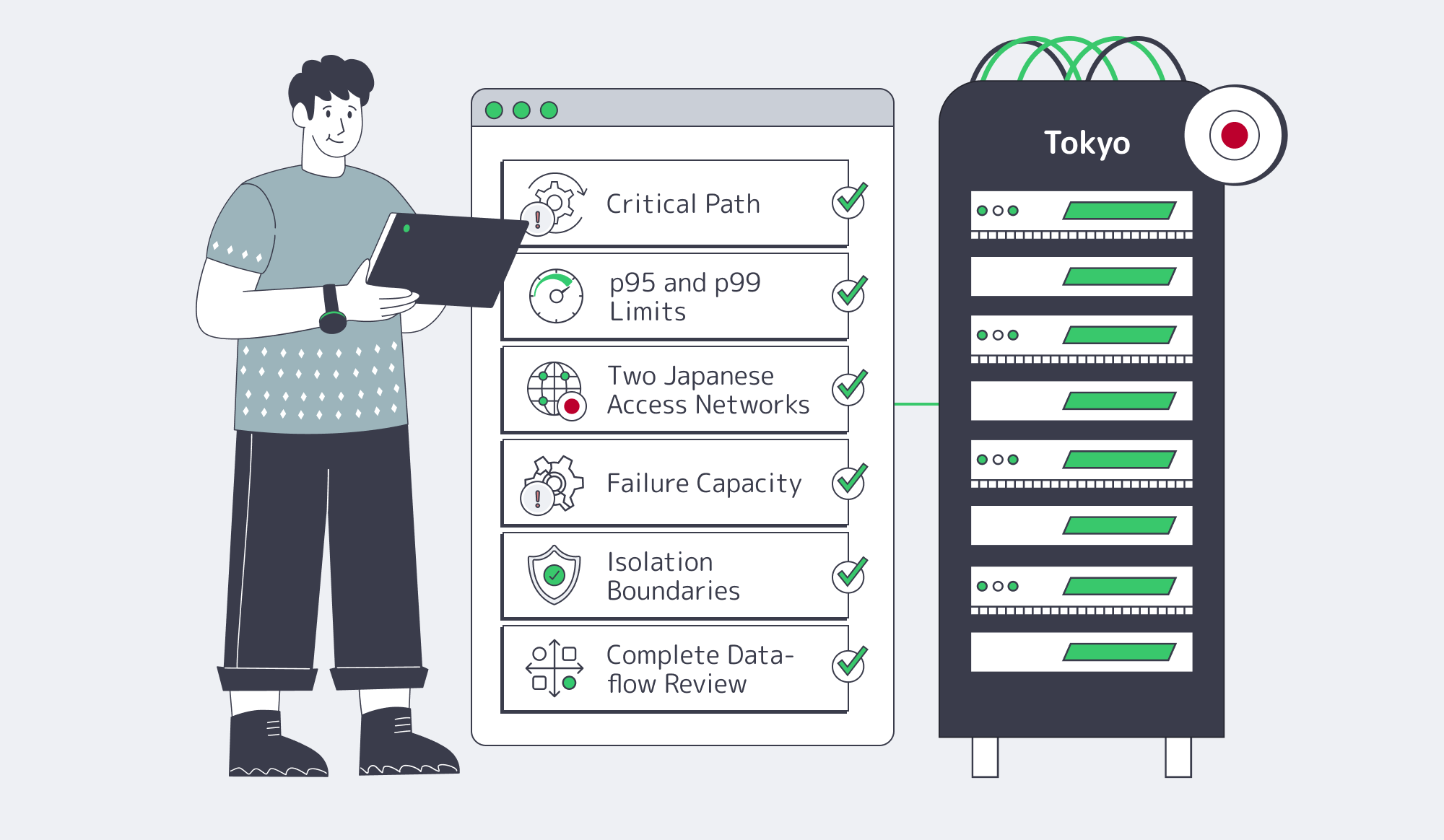
The correct conclusion is not that one infrastructure class wins. It is that “Japan server” intent can be reduced to measurable decisions about network identity, workload location, elasticity, real-time performance, administrative control, and physical isolation. Procurement should begin with acceptance thresholds and architecture boundaries rather than a location filter alone.
Turn those measurements into a deployment decision:
- Keep the first Tokyo deployment limited to the latency-sensitive path; move supporting systems only when dependency tracing proves material delay.
- Create migration triggers before launch, including maximum p95 and p99 processing time, resource saturation thresholds, storage-queue limits, and acceptable packet loss.
- Test at least two Japanese access-network paths so a favorable route from one provider does not hide poor connectivity from another.
- Reserve failure capacity and benchmark what remains with one application node, database replica, or network path offline.
- Treat physical isolation as one control within a broader security model that also covers identities, patching, secrets, backups, logging, and deployment access.
- Review the full data flow after every architecture change because a new analytics export, backup target, or support workflow can alter the original residency and compliance assessment.
A VPN is the right answer when the requirement ends at the network edge. VPS or cloud infrastructure fits services that benefit from fast provisioning, elasticity, and a smaller starting footprint. A game server must be sized around packet timing and simulation behavior. A dedicated server fits workloads that need sustained local capacity, broader control, predictable physical resources, and a single-customer compute boundary.
The word “Japan” narrows the geography. Benchmarking and workload design determine the infrastructure.
Test Japan Server Routes
Use Melbicom’s Tokyo test endpoint to compare routes, ready configurations, and custom builds delivered in 3–5 business days.