
Blog
Milliseconds Matter: Build a Fast German Dedicated Server
Modern European web users measure patience in milliseconds. If your traffic surges from Helsinki at breakfast, Madrid at lunch, and LA before dawn, every extra hop or slow disk seek shows up in conversion and churn metrics. Below is a comprehensive guide on putting a dedicated server in Germany to work at peak efficiency. It zeroes in on network routing, edge caching, high-throughput hardware, K8 node tuning, and IaC-driven scale-outs.
Choose Melbicom— 250+ ready-to-go server configs — Tier III-certified DC in Frankfurt — 39 CDN PoPs across 6 continents |
 |
How Does Frankfurt’s DE-CIX Cut Latency for Dedicated Servers in Germany?
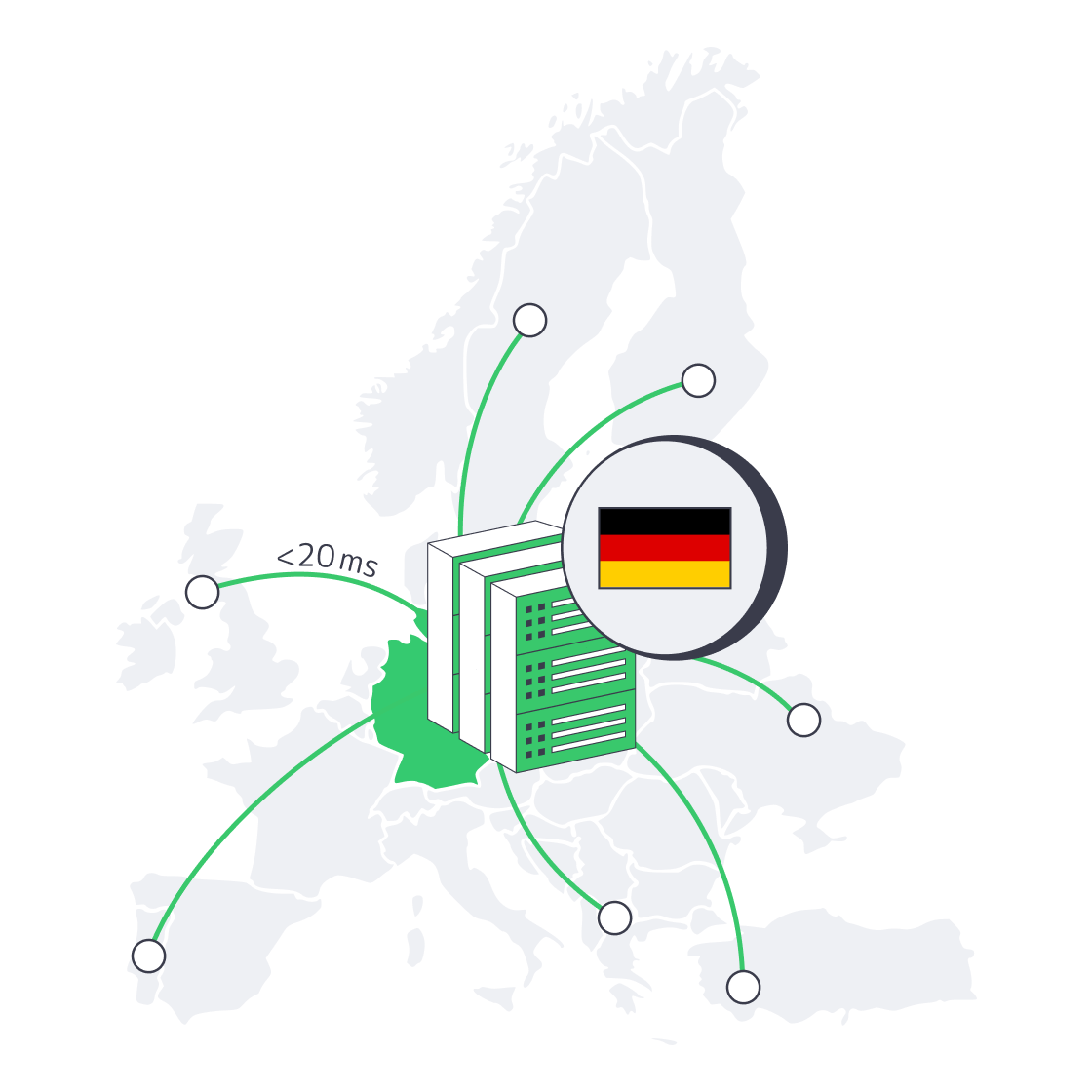
Frankfurt’s DE-CIX cuts latency for a dedicated server in Germany by putting the origin near the world’s leading Internet exchange, where more than 1,000 networks exchange traffic and peak load exceeds 18 Tbit/s. The practical gain is fewer long transit paths, lower hop counts, and cleaner routes to European users.
For Melbicom deployments, the Frankfurt facility provides Tier III certification and 1–200 Gbps per-server network capacity. Melbicom also maintains direct peering relationships with major Internet exchanges and global carriers, so teams can validate real paths with traceroute and synthetic probes before putting latency-sensitive traffic into production.
Carrier Diversity and Smart BGP
A single peering fabric is not enough. Melbicom combines 20+ transit partners and 25+ IXP peering hubs with multi-path BGP policies, so route choices are not locked to one upstream. If a path congests or a carrier has maintenance, traffic can reconverge through an alternate route. Validate failover targets and convergence time for critical workloads.
Edge Caching for Line-Speed Delivery
Routing is half the latency story; geography still matters for static payloads. That’s where Melbicom’s 39-PoP CDN enters. Heavy objects—imagery, video snippets, JS bundles—cache at the edge, often a metro hop away from the end user. Instead of assuming a fixed page-load gain, track cache-hit ratio, TTFB, and LCP before and after moving static payloads off the Frankfurt origin.
Which Hardware Choices Make a Dedicated Server in Germany Fast?
Packet paths are useless if the server stalls internally. In Melbicom’s German configurations today, the choice starts with workload fit: Frankfurt inventory includes 250+ ready-to-go configurations with Intel and AMD CPU options, 16–768 GB RAM, and 1–200 Gbps per-server network capacity. For hot databases, search indexes, and media pipelines, choose NVMe rather than HDD where low I/O latency matters most.
PCIe 4.0 NVMe: The Disk That Isn’t
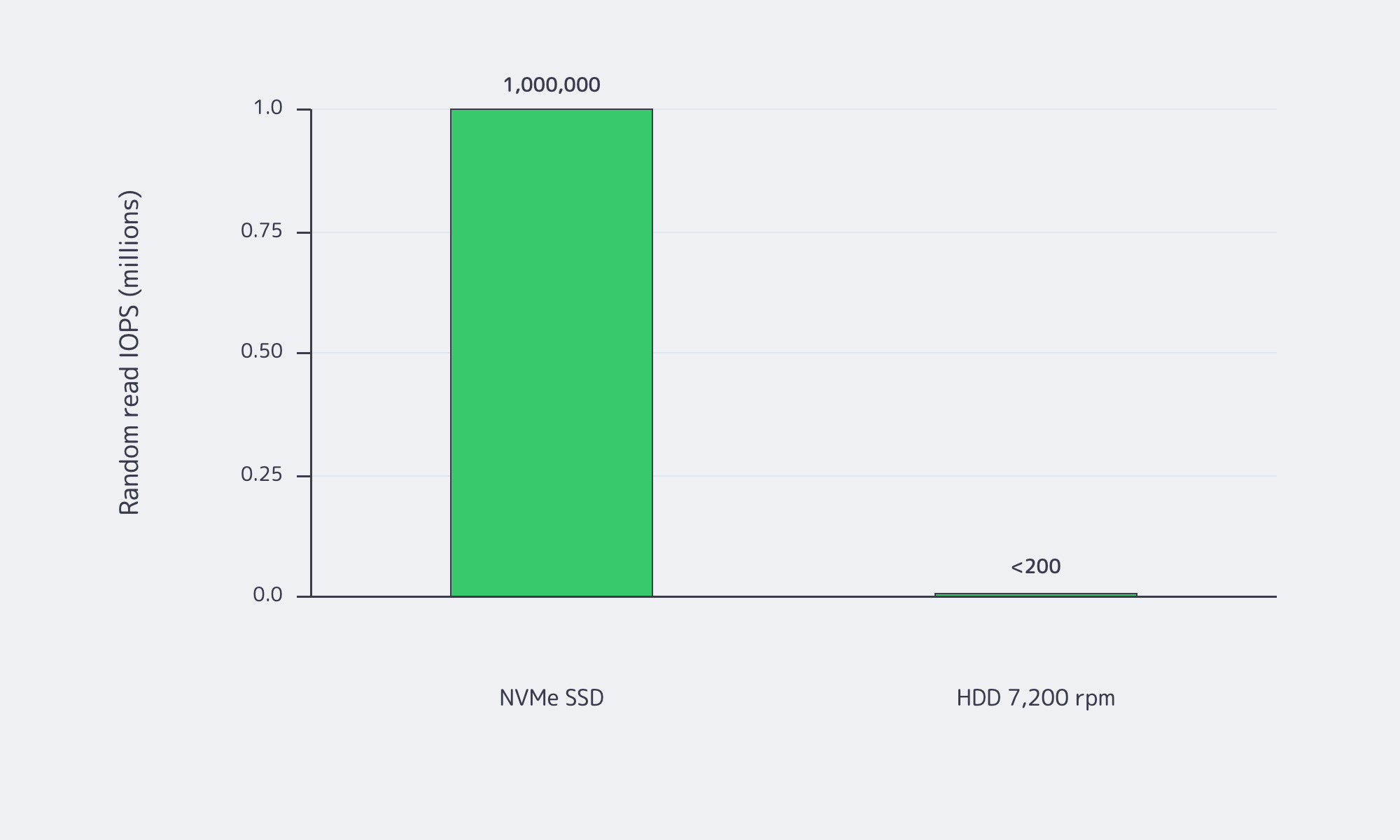
Spinning disks top out near ~200 MB/s and < 200 random IOPS. High-end PCIe 4.0 x4 NVMe drives can sustain ~7 GB/s sequential reads and scale to ~1 M random-read IOPS with tens of microseconds access latency. Database checkpoints, search-index builds, and media exports finish before an HDD hits stride, while NVMe removes tail-latency spikes from checkout APIs and chat messages.
| Metric | NVMe (PCIe 4.0) | HDD 7,200 rpm |
|---|---|---|
| Peak sequential throughput | ~7 GB/s | ~0.2 GB/s |
| Random read IOPS | ~1,000,000 | < 200 |
| Typical read latency | ≈ 80–100 µs | ≈ 5–10 ms |
Table. PCIe 4.0 NVMe vs HDD.
DDR4: Memory Bandwidth that Still Delivers
DDR4-3200 provides 25.6 GB/s per channel (8 bytes × 3,200 MT/s | DDR4 overview). On 6–8 channel Xeon servers, that translates to ~150–200+ GB/s of aggregate bandwidth—ample headroom for in-memory caches, compiled templates, and real-time analytics common to high-traffic web stacks.
CPU Compute: Core Count, Cache, and Turbo Headroom
For Germany builds, match the CPU to the workload instead of assuming one processor family is always best. Melbicom’s Frankfurt inventory includes Intel and AMD options; Intel Xeon Scalable CPUs can provide strong per-core turbo, large caches, and built-in accelerators such as AVX-512 where the selected SKU supports them (Intel Xeon Scalable family). For WebSocket fan-out, Node.js services, and analytics workers, validate both single-thread latency and total core count before ordering.
Kubernetes Node Tuning for Low Latency
Running containers on a dedicated server beats cloud VMs for raw speed, but only if the node is tuned like a racecar. Three adjustments yield the biggest gains:
- CPU pinning via the CPU Manager — Use the static policy for Guaranteed pods with integer CPU requests so latency-critical containers get exclusive CPU affinity. Keep system daemons on reserved CPUs to avoid noisy-neighbor interruptions.
- NUMA-aware placement — Use the Topology Manager and, where needed, Memory Manager to align CPU and memory allocations on as few NUMA nodes as possible. This reduces cross-socket memory trips, but capacity fragmentation can cause pod admission failures, so test requests against real node topology.
- HugePages for mega-buffers — Kubernetes supports pre-allocated HugePages, including 2 MiB pages on common x86 systems. Use them only for applications that explicitly benefit from huge pages, then measure query latency and throughput before making the setting a platform default.
Spinning-disk bottlenecks vanish automatically if the node boots off NVMe; keep an HDD RAID only for cold backups. Likewise, allocate scarce IPv4 addresses only to public-facing services; internal pods can run dual-stack and lean on plentiful IPv6 space.
How to Use IaC for Just-in-Time Scale-Out

Traffic spikes rarely send invitations. With Infrastructure as Code (IaC) you script the whole server lifecycle, from bare-metal provisioning through OS hardening to Kubernetes join. Need a second dedicated server Germany node before tonight’s marketing blast? Model one of the 250+ ready-to-go Frankfurt configurations in Terraform, inject SSH keys through the provisioning workflow, and hand the node to Ansible for post-boot tweaks. Ready-to-go delivery is listed at two hours, and templates make each node reproducible, reducing the “snowflake-server” drift that haunts manual builds.
IaC also simplifies multi-region redundancy. Because a Frankfurt root module differs from an Amsterdam one only by a few variables, expanding across Melbicom’s global footprint becomes a pull request, not a heroic night shift. The same codebase can version-control IPv6 enablement, swap in newer CPUs, or roll back a bad driver package in minutes.
Avoid Spinning Disks and IPv4 Scarcity
Spinning disks still excel at cheap terabytes but belong on backup tiers, not in hot paths. IPv4 addresses cost real money and are rationed; architect dual-stack services now so scale-outs aren’t gated by address scarcity later. That’s it—legacy mentioned.
Why Frankfurt Is a Smart Choice for Dedicated Server Hosting in Germany

Germany’s position at the crossroads of Europe’s Internet, coupled with the sheer gravitational pull of DE-CIX, makes Frankfurt an obvious home for latency-sensitive applications. Add in carrier diversity, edge caching, NVMe storage, memory bandwidth, and Intel or AMD compute options, then wrap the stack with Kubernetes node tuning and IaC automation, and you have an infrastructure that meets modern traffic head-on. Milliseconds fall away where the routing and hardware choices match the workload, throughput rises, and scale-outs become code commits instead of capital projects. For teams that live and die by user-experience metrics, that difference shows up in retention curves and revenue lines.
Order a German Dedicated Server Now
Deploy in Frankfurt today: 250+ configs, up to 200 Gbps, 24/7 support.