
Blog
Choosing ERP Servers for Performance, Uptime, and Scale
Enterprise resource planning (ERP) systems coordinate orders, inventory, finance, HR, analytics, and audits, making them always on. These workflows need consistent performance, resilient architecture, and strong security because ERP platforms hold sensitive, business-critical data. IBM’s 2026 breach report puts the global average breach cost at $4.99 million, showing why resilient ERP infrastructure matters.
Use this framework to evaluate ERP server hosting for performance headroom, high availability, predictable costs, scalable design, and compliance.
Choose Melbicom— 1,200+ ready-to-go server configurations — 21 global Tier IV & III data centers — 39 CDN PoPs across 35 countries |
 |
What Hardware Profile Runs ERP Efficiently?
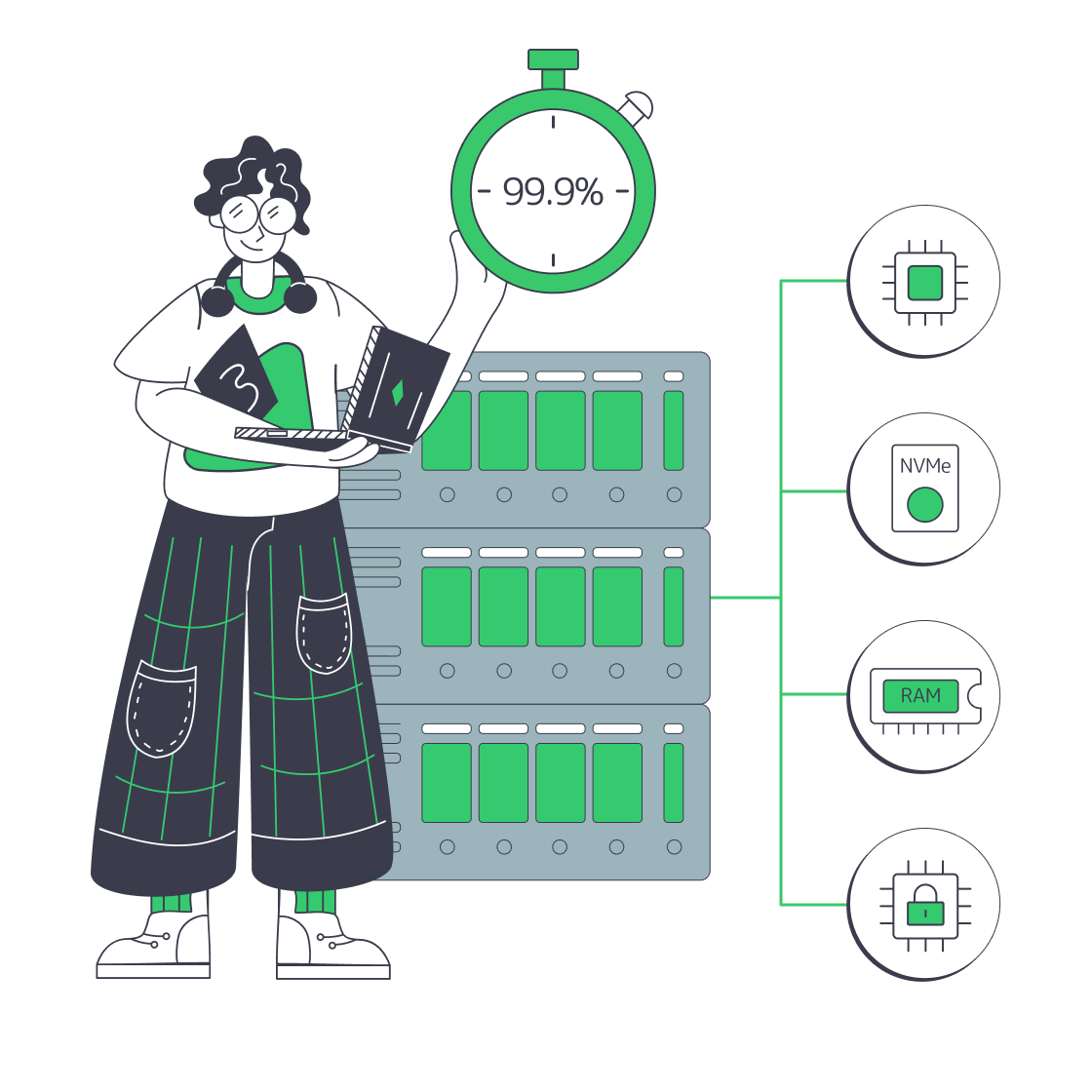
Prioritize CPU and RAM: ERP stacks concentrate OLTP traffic, reporting, background jobs, and integrations, so size both core count and clock speed from measured concurrency and query behavior. Provide enough RAM for database and application caches so application servers do not swap under normal peaks. Odoo uses Python and PostgreSQL, and its worker model makes concurrency a key sizing input.
Balance storage latency and capacity: For active ERP data, latency and IOPS often matter more than raw capacity alone. NVMe SSDs can reduce batch and query runtimes, while write-heavy ledgers and MRP benefit from sustained IOPS. Size databases, logs, snapshots, and backups separately.
Size network throughput from real flows: ERP environments move EDI files, BI extracts, backups, and API payloads, so measure peak traffic, ensure high bandwidth where the workload requires it, and avoid oversubscribed ports. Melbicom offers up to 200 Gbps per server, depending on location, for integration and backup spikes.
Think headroom by design: Size your server so typical peaks do not exhaust CPU or RAM, then validate the margin with month-end, seasonal, and failover load tests.
How Close to “Always On” Should ERP Be?
For business-critical ERP, a 99.99% service-availability objective allows about 53 minutes of annual downtime. Whether that target is appropriate depends on business impact, recovery objectives, maintenance windows, and budget. Treat it as an end-to-end application objective, not a guarantee created by one server or facility tier.
Tier III/IV DCs can reduce facility risk, but tier is one design layer. The Uptime Institute defines Tier III as concurrently maintainable and Tier IV as fault tolerant; these classifications describe site topology, not guaranteed application availability.
The network architecture must also match. Melbicom connects each top-of-rack switch to two aggregation switches and uses vPC and 802.3ad for link redundancy. Dual core routers and VRRP protect Layer 3 connectivity, reducing single-device failure exposure.

Best ERP Server Hosting: Plan for Scale
Vertical scaling adds CPU, RAM, storage, or NIC capacity to the existing node and can postpone architectural complexity. Horizontal scaling separates database, application, print/reporting, and integration roles so contention in one service does not consume the entire ERP stack. Choose a dedicated server with free memory slots and storage bays for scale-up, and a provider that can add nodes quickly as demand changes.
Melbicom has 1,200+ ready-to-go server configurations across 21 Tier III/IV data centers, so capacity can be added closer to users and data.
Price Clarity: Predictable ERP Economics
Unexpected ERP hosting costs often come from outbound data transfer, support tiers, and migration work. The UK CMA’s 2025 final decision summary identifies egress fees as a key commercial barrier to switching or multi-cloud use. In the EU, the Data Act has applied since September 12, 2025; switching charges, including egress charges tied to switching, must be removed from January 12, 2027. Model normal traffic and migration traffic separately, and verify exactly what the provider meters.
Choose a dedicated server provider with clear bandwidth limits and broad CDN access for cacheable content and eligible API responses.
Melbicom’s CDN spans 39 CDN PoPs across 35 countries.
Integration and Compatibility
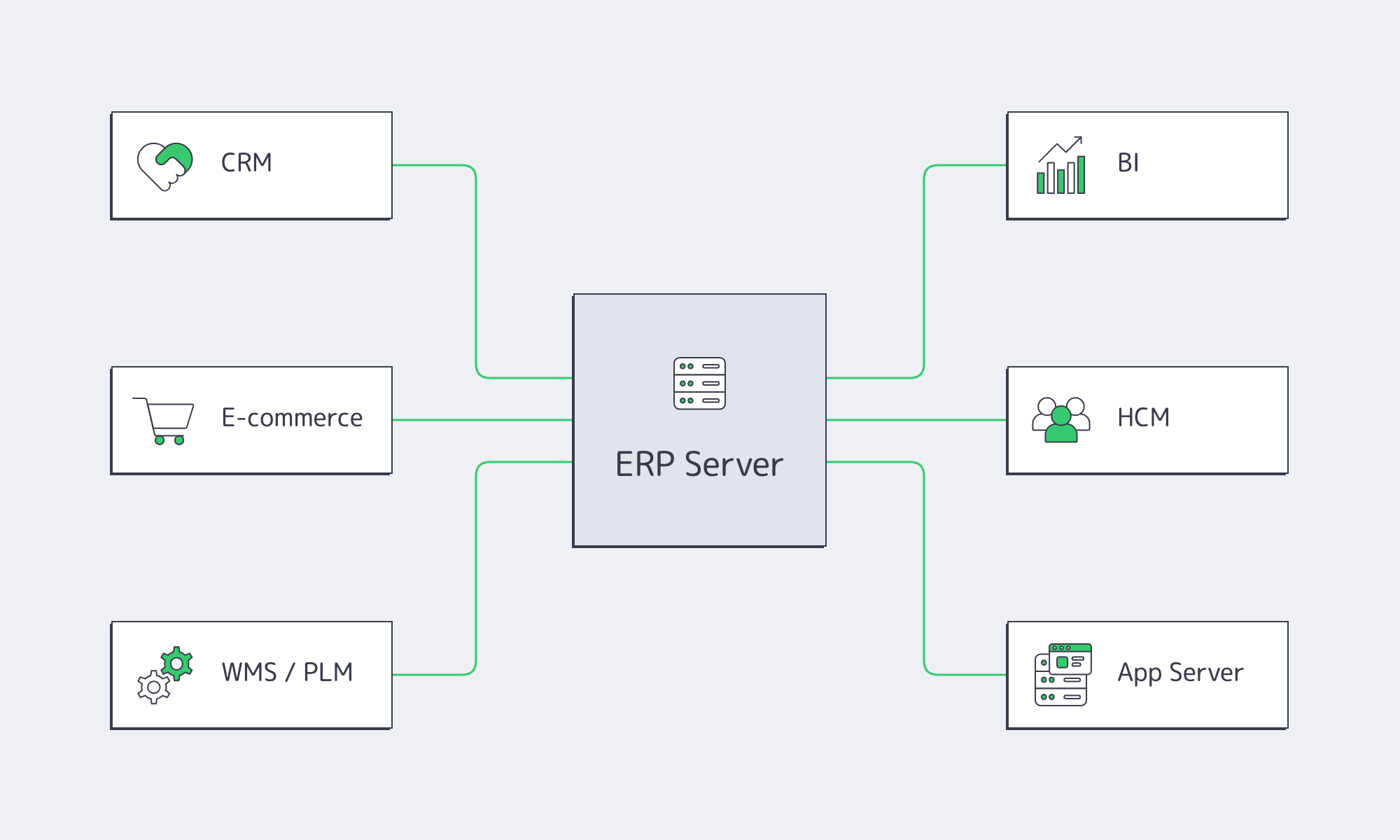
An ERP server must support payroll, PLM, WMS, e-commerce, BI, identity, and other simultaneous workflows without letting one integration overwhelm core transactions. Choose the operating system, database, drivers, and connectors from the exact ERP version and deployment model.
- Odoo stack alignment. For self-hosted Odoo, full server access simplifies dependency, module, and database administration. Odoo uses Python and PostgreSQL, and production sizing should account for worker processes, scheduled jobs, and peak concurrent use rather than user count alone.
- Windows stack alignment. For Epicor, Infor, or IFS deployments, validate the exact product, version, and deployment model before choosing Windows or Linux, SQL Server or another database, ODBC, and reporting components. Cloud and on-premises options vary by product and lifecycle, so do not infer infrastructure requirements from the vendor name alone.
- Print/report offload. If Sage X3 printing or reporting is deployed as a separate service, isolate its capacity so document jobs do not consume OLTP resources.
- SaaS peers. Workday is delivered as SaaS rather than a self-hosted ERP server, so the infrastructure decision applies to integration middleware, data pipelines, and network paths to Workday—not to hosting Workday itself.
Platforms at a glance
| ERP/system | Typical hosting | Hosting notes |
|---|---|---|
| Odoo | Self-hosted Linux or vendor cloud | Python + PostgreSQL; size workers, scheduled jobs, and concurrency. |
| Epicor / Infor / IFS | Cloud or supported on-premises deployment, depending on product and version | Validate the OS, database, ODBC, reporting, and lifecycle requirements for the exact release. |
| Sage X3 | Self-managed or provider-hosted, depending on deployment | Validate application, database, print, and Windows service roles for the exact architecture. |
| Workday | SaaS (multi-tenant) | No self-hosted Workday application tier; size integration middleware and network paths. |
A Support Model to Reduce Risk
ERP incidents often occur outside business hours, so 24/7 technical support should be a priority. Engineers who can help diagnose database stalls, NIC saturation, or filesystem errors can make a material difference when minutes matter. Melbicom provides around-the-clock technical support.
Beyond response coverage, ask which disks, DIMMs, and NICs are kept onsite, how hardware replacement and escalation work, and whether architectural guidance is available for database replicas or application-server splits.
AI, Real‑Time Data, and Regulation
ERP platforms increasingly use AI for forecasting, recommendations, and anomaly detection, but these workloads can raise compute and memory demand. Isolate models and vector indexes on adjacent nodes when they would contend with OLTP, use high-throughput networking where measurements justify it, and consider GPU‑capable servers. Melbicom offers per-server bandwidth up to 200 Gbps, depending on location.
Real-time IoT feeds and event streams need backpressure control and predictable ingestion capacity. Isolating message brokers such as Kafka or MQTT on separate cores or nodes prevents them from starving OLTP workloads.
Because the EU Data Act now applies, ERP teams using in-scope data processing services should document export formats, dependencies, migration procedures, and residency requirements before deployment. Regional hosting matters, but base portability plans on architecture and contracts—not geography.
Best ERP Server Hosting Checklist
- Size CPU, RAM, and NVMe for OLTP peaks and batch windows.
- Set an availability objective from business impact, then combine Tier III/IV facilities with end-to-end application, data, and network redundancy.
- Engineer for compliance with encryption, segmentation, auditable access, and tested recovery controls.
- Separate database, application, reporting, printing, and integration roles as needed; reserve hardware capacity for scale-up.
- Don’t underestimate support: verify 24/7 response coverage, hardware replacement procedures, escalation paths, and architecture assistance.
- Model egress and switching costs: favor clear bandwidth terms and broad CDNs, and check how the Data Act’s switching rules apply to the service.
- Use GPU capacity, high-throughput NICs, and regional nodes only where measured workloads and latency requirements justify them.
Make Your ERP Server a Strength

ERP needs consistent performance, so provision enough CPU, RAM, and NVMe for measured peaks and let databases operate without memory or storage contention. Choose a suitable facility, but use redundant application, data, and network layers to meet the availability objective. Add auditable security controls, clear scale-up and scale-out paths, and transparent bandwidth and support terms. Confirm the environment fits each integration, from Odoo modules and Epicor add-ins to SaaS platforms such as Workday.
Melbicom provides ERP server options across 21 Tier III/IV data centers, with per-server bandwidth up to 200 Gbps, 39 locations across 35 countries, and 24/7 support. That footprint gives ERP teams options for integration traffic, backup windows, regional capacity, and predictable bandwidth planning.
Provision ERP on dedicated servers
Get reliable performance, up to 200 Gbps of per-server bandwidth, and 24/7 support for ERP workloads across Tier III/IV sites. Choose from 1,200+ ready-to-go configurations close to users and data.