
Blog

Brazil CDN and Dedicated Origins: Faster South American Streaming
Update
September 2026: Melbicom’s current Brazil CDN PoPs are in Fortaleza and Rio de Janeiro. São Paulo is a coming-soon dedicated-server location, not a current CDN PoP. The São Paulo origin-shield design below is a deployment plan; confirm server availability, final ports, and the required cache hierarchy before ordering.
South American audiences are impatient with slow‑loading content, and distant origins can increase time‑to‑first‑byte (TTFB) and rebuffering risk, while routing, available throughput, and player behavior also affect results. Deploying CDN edge PoPs close to viewers and pairing them with a Brazil‑based origin or a configured caching layer on a local dedicated server can shorten delivery paths. Validate the improvement under real traffic rather than assuming a fixed latency reduction or the elimination of rebuffering.
Host in LATAM— Reserve servers in São Paulo — 6 CDN PoPs in 5 LATAM countries — 21 Tier III & IV DCs, including Brazil |
 |
Why Distance Still Matters for Streaming Quality in South America
When an origin is on the U.S. East Coast, South American cache misses can incur a long network trip. As one route-specific example, CloudPing’s AWS inter-region matrix showed approximately 115 ms between São Paulo (sa-east-1) and Northern Virginia (us-east-1) on September 16, 2026. This is not a regional average, a viewer TTFB measurement, or a Melbicom benchmark. São Paulo↔Buenos Aires pings likewise concern particular measurement hosts; test the actual edge-to-origin route before using a city-pair result in a deployment plan.
Mobile access varies: a countrywide mobile-latency average is not a CDN-to-origin RTT or an application TTFB target. Compare startup time and rebuffering by operator and connection type rather than treating one country’s average as a universal benchmark.
Higher network latency can delay startup, and modern viewers expect seamless streams. A 2012 study of on-demand video, based predominantly on North American views, found that abandonment rose as startup waits increased beyond roughly two seconds. That historical result is not a current Brazil-specific or live-streaming forecast. Keeping content closer to viewers is one way to reduce startup delay, alongside player and delivery optimization.
How Can a Brazil CDN Help Streaming?
A CDN in Brazil can shorten delivery paths by serving cached video segments near viewers. Pairing those edges with a regional origin can also reduce cache-miss delays when routing is favorable. Choose locations using measured viewer-to-edge and edge-to-origin performance, then validate startup time, cache-hit ratio, and rebuffering under peak load.
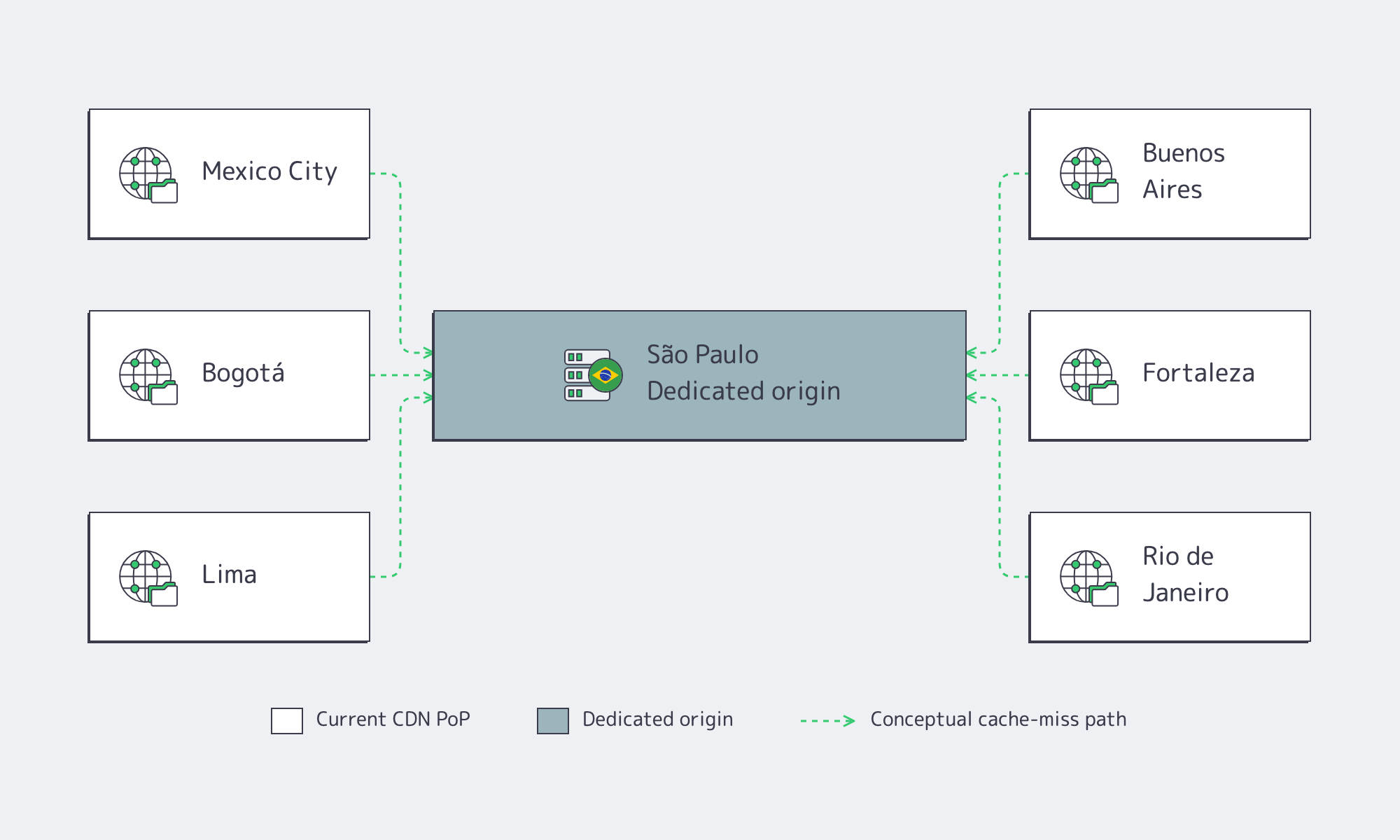
A Latin American edge paired with a distant origin can still serve cache hits locally, but misses and live segment fills depend on the origin path. Multi‑PoP coverage across population centers should therefore be evaluated alongside origin placement. Melbicom’s CDN spans 40 PoPs across 35 countries, including Buenos Aires, Fortaleza, Rio de Janeiro, Bogotá, Mexico City, and Lima. These six LATAM PoPs cover 5 countries; a listed PoP does not guarantee the geographically nearest route or a fixed TTFB.
Latency scenarios and what to measure
| Delivery scenario | Latency evidence or measurement | Performance impact |
|---|---|---|
| North America ↔ Brazil: AWS route example | ~115 ms for São Paulo ↔ Northern Virginia; September 16, 2026 snapshot. | Illustrates a long origin-fetch path, not a universal viewer-latency benchmark. |
| Regional origin in Brazil (e.g., São Paulo) | Measure the selected edge-to-origin route. | Can reduce miss and fill delays when the measured route is shorter. |
| Local in‑country edge cache (e.g., Buenos Aires PoP) | Measure viewer-to-edge RTT and cache-hit TTFB by ISP. | Cache hits avoid an origin fetch; access-network conditions still affect playback. |
Edge Caching Paired with a São Paulo Origin Shield on a Local Dedicated Server
While hits can be handled with edge caching, a fast origin is still needed for misses and cache fills. A self-managed caching proxy on a local dedicated server in São Paulo can act as a regional origin shield once that capacity is available. Configure the cache hierarchy and test routes; geography alone does not ensure that fill traffic stays in South America. This combination can provide the following benefits:
- Lower miss penalty. A regional origin can shorten an edge’s fetch path compared with a distant origin, but the gain depends on the actual route and whether the shield itself has the requested content.
- Thundering herd shielding. Configure request coalescing for cacheable objects so concurrent misses for the same cache key can share a fill rather than all reaching the content backend.
- Spike Headroom. Size storage, CPU, and network capacity for measured fill traffic and peak cache-miss load. Confirm final São Paulo hardware and ports in the quote rather than treating the global bandwidth range as a local delivery guarantee.
This architecture does not require a public cloud region, but a dedicated server does not automatically provide managed caching or failover. Melbicom’s optional Origin Shield setting is a separate CDN feature that routes misses through a shared edge node after it is enabled. Do not assume that this node is in São Paulo or that a particular parent hierarchy is selectable.
Which Protocol and Media Optimizations Actually Make a Difference?
TLS and HTTP versions
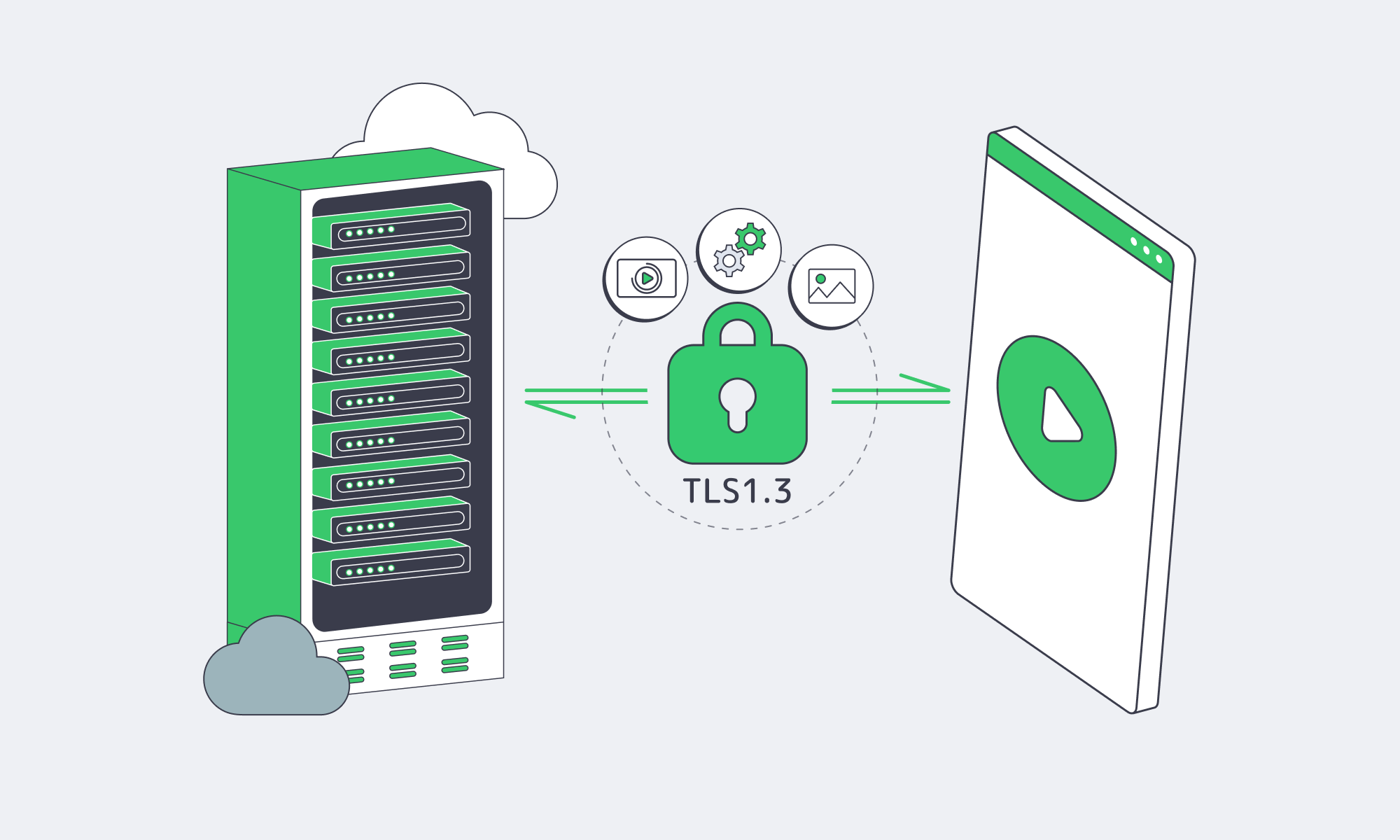
New encrypted connections incur handshake delay; an established connection can carry many segment requests. A normal TLS 1.3 handshake takes one RTT, with TCP setup additional when TLS runs over TCP. Optional 0‑RTT early data requires compatible resumption support and replay-safe application use; it is not a general promise for repeat connections. Terminating TLS closer to users can reduce setup time, but not to zero.
HTTP/2 remains a staple. HTTP/3/QUIC avoids transport-level head-of-line blocking between independent streams, not all packet-loss delays. For a CDN in Brazil, verify TLS 1.3, HTTP/2, and HTTP/3 support for the resource and client base, and retain HTTP/2 fallback where QUIC is unavailable. Do not assume every LATAM PoP supports all protocols.
Image and video: Optimizing at the edge
Images: To make the most of the latency wins that are associated with using a Brazilian CDN network, convert images to WebP/AVIF wherever supported, resize for specific devices, and apply Brotli for text and manifests. Perform image conversion and resizing in your media pipeline or a confirmed optimization service; CDN caching alone does not create those variants.
Video: keep popular renditions warm by caching HLS/DASH segments at edges and regionalize packaging/transcoding by creating and holding bitrate ladders near São Paulo if feasible. Melbicom’s CDN delivers pre-transcoded HLS/DASH streams; packaging and transcoding require a separate workflow. Placing that workflow near ingestion and the origin can reduce repeated long-haul transfers, but measure startup time and rebuffering.
Route packets regionally
Sparse regional peering can create unnecessary long-haul paths, so evaluate a CDN provider in Brazil against these requirements:
- Favor local interconnection. Review peering at IX.br (São Paulo) and relevant local IXPs in Buenos Aires, Santiago, Bogotá, Lima, and Mexico City. Verify the actual routes rather than inferring them from IXP membership.
- Evaluate regional parents for cache misses: a Bogotá edge → São Paulo caching-origin path is a design option to test, not a confirmed managed-shield configuration.
- Steer using telemetry: RTT, loss, and 95th‑percentile TTFB. Test failover to eligible healthy edges; a warm Buenos Aires cache alone does not establish an automatic failover policy.
The bottom line is to keep delivery short by using predictable paths that keep TTFB and loss‑triggered bitrate downshifts low.
Brazil Deploy Guide— Avoid costly mistakes — Real RTT & backbone insights — Architecture playbook for LATAM |
 |
An Ideal Rollout Plan
- Map your audience density: Evaluate viewers and growth in hubs such as São Paulo, Mexico City, Buenos Aires, Bogotá, Santiago, and Lima.
- Start with a regional origin shield in Brazil: Plan a dedicated origin in/near São Paulo, with storage and ports confirmed in the quote. Configure caching and miss coalescing rather than assuming that server provisioning supplies them.
- Place edges local to users: Evaluate Melbicom’s current LATAM PoPs in Buenos Aires, Fortaleza, Rio de Janeiro, Bogotá, Mexico City, and Lima against actual viewer routes.
- Use TLS 1.3 + H2/H3 where supported: Verify the serving edge and client protocol support, test session resumption, and keep an HTTP/2 fallback.
- Optimize media for the edge: Format images by converting and resizing, cache eligible ABR segments with suitable TTLs, and keep hot titles pre‑warmed without serving stale live playlists.
- Validate regional routes: Test peering and backhaul before relying on a cache‑parent hierarchy with a São Paulo origin; a regional address alone does not guarantee a regional path.
- Instrument and iterate: Analyze country‑level TTFB and rebuffer ratio by ISP and cache status. Investigate deviations from your own performance baseline before changing capacity, routing, or edge coverage.
- Forecast capacity: To make sure live events don’t stress your shields, size them adequately. Load-test concurrent fills and peak miss traffic against confirmed origin and edge capacity.
CDN and Brazil Origin Shields
Combining a CDN and a properly configured dedicated server origin shield can address network-related contributors to end‑to‑end stalling in the following ways:
- First byte times: Terminating TLS at well-connected in‑country PoPs can shorten connection setup; it does not remove DNS, application, or player startup work.
- Segment fetches: Serving cache hits from nearby edges can shorten segment fetches, while sustained throughput and player buffering still affect playback.
- Miss penalty: A São Paulo cache can reduce remote-origin fills when it holds the requested content. Measure the full path for upstream cache misses.
These changes can improve delivery, but proximity alone does not determine rebuffering or retention. Validate startup time, sustainable bitrate, and rebuffer ratio under representative load rather than assuming longer sessions or higher customer lifetime value.
Where Should a CDN and São Paulo Origin Fit in LATAM Roadmaps?
Grand View Research forecasts a 21.7% compound annual growth rate for Latin America’s video streaming market revenue from 2025 to 2030. For capacity planning, combine that market outlook with your own audience and bitrate forecasts:
- Plan regional delivery first, pairing suitable edges with a configured São Paulo origin when available.
- Expand edge coverage to secondary metros as country‑level TTFB and rebuffer telemetry dictate.
- Use in‑region packagers/transcoders to reduce cold‑start penalties on hot titles.
Moving from a single edge to broader coverage can improve delivery, but it does not guarantee fewer cold starts. Measure cache warm-up, hit ratio, and performance under load rather than assuming that each additional PoP automatically produces steadier ABR.
Edge and Origin for South America
Edge nodes near viewers—and a regional origin with a correctly configured cache layer—can reduce first‑byte delay and cache-miss penalties when the measured paths are shorter. This can reduce long-haul fills, but reliability also depends on origin capacity, cacheability, and routing. Test health checks and traffic steering before expecting another LATAM PoP to take over, and use real-user telemetry to measure bitrate, rebuffering, and retention.
Melbicom’s CDN places PoPs in Buenos Aires, Fortaleza, Rio de Janeiro, Bogotá, Mexico City, and Lima. Dedicated servers in São Paulo are coming soon, so you can reserve planned origin capacity to pair with the existing CDN footprint.
We offer infrastructure freedom—a footprint of 21 Tier III/IV data centers, including São Paulo and Marseille coming soon, dedicated servers with high-bandwidth options up to 200 Gbps per server globally, and fully custom hardware configurations. You get deployment freedom (spin up what you want, where you need it), configuration freedom (tailor hardware and network scale), operational freedom (single-tenant, no lock-in), and experience freedom (direct control, simple onboarding, 24/7 support).
Be first to host in Brazil with Melbicom
Explore our dedicated-server plans for Brazil (servers) and global footprint (data centers and CDN), then share your traffic volumes and exact technical specs. We’ll shape a tailored origin-plus-edge offer as our Brazil capacity comes online—so you can be among the first to host in Brazil on special terms. Final server ports and availability will be confirmed in your quote.