
Blog

Adult VR Hosting Solutions with Dedicated Servers
Immersive adult experiences—high-resolution 180°/360° VR scenes, live multi-camera shoots, and interactive adult gaming—are now mainstream engineering problems. What used to be a single HLS ladder is becoming a GPU-accelerated, edge-anchored, multi-protocol pipeline that must hold quality under extreme concurrency while keeping motion-to-photon latency within the experience’s comfort limits. Below, we zero in on the infrastructure demands behind these formats and how dedicated servers, paired with an edge CDN and modern codecs, provide the determinism, bandwidth, and compute density needed to deliver them at scale.
Choose Melbicom— 1,100+ ready-to-go server configs — 21 global Tier IV & III data centers — 39 CDN PoPs across 35 countries |
 |
Why Adult VR Hosting Is Hard
Throughput per viewer is much higher than for conventional video. Current Meta Quest media guidance expects high-quality 360° video to use more than 50 Mbps and identifies 8K as a typical codec decode ceiling for clear 360° content. Plan origin and CDN capacity from the tested top rendition bitrate, expected concurrency, cache-hit ratio, protocol overhead, and failover headroom instead of assuming one fixed bitrate per viewer.
Latency budgets tighten dramatically. Current Cloud VR measurements separate network latency from end-to-end latency: around 20 ms RTT is cited for optimal VR network performance, while the user-visible path also includes rendering, encoding, decoding, and display. Regional ingest and edge-proximate delivery reduce the transport share, so validate the complete end-to-end path rather than treating network RTT as the entire motion-to-photon budget.
Protocols must match the experience. At one end, WebRTC reliably delivers sub-500 ms glass-to-glass latency for interactivity and live VR cam shows; at the other, Low-Latency HLS (LL-HLS) can reduce delivery latency to around 2 seconds while preserving HTTP scalability and CDN friendliness. A production pipeline for adult VR rarely picks one protocol—it mixes them by workload.
Compute shifts from “nice to have” to “hard requirement.” Real-time HEVC/AV1 encoding for stereoscopic 4K and 8K ladders, AI-assisted upscaling/denoising, multi-angle compositing, and interactive state synchronization all compete for cycles.
Hardware encoders (NVIDIA NVENC) support HEVC and AV1 on compatible GPU generations. Multi-NVENC split-frame encoding can accelerate one high-resolution HEVC or AV1 session, but NVIDIA documents a possible quality tradeoff, so benchmark the codec, GPU, preset, and throughput together. Use NVMe storage for large VR segmenting work.
Global proximity matters. Keeping session logic and media delivery close to viewers helps control RTT and jitter. That means multi-origin deployment across regions and a CDN footprint dense enough to shorten last-mile paths during peaks. Melbicom’s footprint—21 Tier III and Tier IV data centers, per-server bandwidth up to 200 Gbps, and a CDN with 39 PoPs across 35 countries—supports this pattern: place origins near target audiences, fan out cached segments globally, and deploy low-latency nodes where interactivity requires WebRTC.
Brief context: why the old stack fails
Classic OTT stacks assumed seconds of buffer, a handful of renditions, and region-limited audiences. They struggle when 8K stereoscopic assets must be transcoded in real time, and when control channels (camera switching, avatar state, haptic triggers) need sub-second round-trip. The modern answer is not “one giant cloud region,” but single-tenant dedicated servers tuned for throughput, paired with an edge CDN and regionally distributed real-time nodes. (Think: origins in Amsterdam/Atlanta/Singapore, WebRTC SFUs in additional metros, CDN caching everywhere your users are.)
Adult VR Hosting Setups That Scale

1) GPU-optimized dedicated origins for encode, packaging, and authorization
VR ladders drive extreme parallel encodes. Dedicated servers with GPUs can offload AV1/HEVC encoding from the CPU and increase parallel encoding capacity. Actual bitrate, latency, and quality depend on the GPU generation, codec, preset, content, resolution, and device support, so benchmark the complete ladder before capacity planning. On GPU-heavy workflows such as preprocessing, denoising, or stabilization, keeping compatible stages on the same GPU can reduce avoidable data movement. Melbicom can provision GPU dedicated servers with high-bandwidth network options so ingest and encode nodes can be sized together.
2) Edge CDN for scale; edge compute for interactivity
On-demand VR scenes cache efficiently. Use LL-HLS over 39 CDN PoPs across 35 countries to distribute cacheable media while origins focus on cache fill and authorization. For live VR cams and interactive adult gaming hosting, place WebRTC SFUs or microservices (state sync, avatar presence, telemetry) on dedicated regional nodes. Operators often target under 500 ms for two-way interactions and around 2 seconds for broadcast-style LL-HLS delivery; choosing protocols by workload—and placing servers appropriately—is the difference between an interactive path and a scalable broadcast path. Melbicom’s CDN and regional data centers let you anchor compute in the required metros and fan out assets globally.
3) High-bandwidth NICs and capacity planning
VR peaks require explicit egress planning. Size each origin from the top rendition bitrate multiplied by expected concurrent sessions, then add headroom for cache misses, failover, and protocol overhead. Melbicom offers per-server bandwidth up to 200 Gbps, depending on location and configuration. Monitor throughput, packet loss, queueing, and jitter across ingest, origin, and CDN paths; timestamp alignment and player drift are primarily controlled by encoder, packager, clock, and buffer management.
4) NVMe for asset prep; S3-compatible object storage for libraries
VR masters are enormous. NVMe SSDs keep packaging/transmux and thumbnail/extract steps from blocking on I/O, while S3-compatible storage holds the long tail economically. Melbicom’s S3-compatible storage offers plans from 1 TB to 500 TB in Amsterdam with free ingress, making it practical to stage new scenes from encode nodes to durable storage and let the CDN fetch on demand.
5) Multi-origin layouts (don’t centralize your failure domain)
Spread origins across at least two failure domains for critical markets. That helps keep origin paths short for the CDN, supports failover, and avoids one encoder pool becoming the global bottleneck during a release spike. Melbicom operates 21 Tier III and Tier IV data centers; choose origin metros from the current data-center footprint and verify latency to ingest sources, CDN fill paths, and target audiences before deployment.
Example workload mapping (adult VR focus)
| Workload | What it demands | What to deploy |
|---|---|---|
| 8K/4K stereoscopic VR VOD | More than 50 Mbps for high-quality 360° video; exact rate varies by codec, frame rate, stereoscopy, and device | GPU-equipped dedicated origins for AV1/HEVC; LL-HLS packaging; CDN with 39 PoPs across 35 countries; NVMe scratch + S3 library. |
| Live VR cam & Q&A | Sub-500 ms interaction; regional ingest; rapid scale-up | WebRTC ingest/SFU on regional dedicated servers; bandwidth sized to measured session load; multi-origin failover. |
| Interactive adult gaming hosting (VR worlds/minigames) | Application-specific RTT budget; state sync; bursty peaks | Regional game/logic servers; proximity-aware routing; CDN for static assets; telemetry backhaul to origins. |
Production architecture building blocks
- Encode where you ingest. Use regionally distributed GPU-optimized dedicated servers to transcode ladders near cameras and contributors; ship packaged outputs to nearby origins/CDN to minimize first-mile.
- Pick protocols by interaction level. WebRTC for two-way/live control; LL-HLS for scale when chat latency is tolerable. Keep the player’s buffer discipline separate from the control channel.
- Keep the network fat and simple. Select per-server bandwidth up to 200 Gbps based on measured peak egress and location availability. Track throughput, packet loss, queueing, and jitter together.
- Use NVMe for hot paths; S3 for the library. Stage transcodes on NVMe, publish to S3-compatible storage, and let the CDN fill. This keeps origin disks focused on hot paths.
- Exploit AV1 where devices support it. Benchmark content-specific gains against HEVC/H.264 before rollout.
Why dedicated servers instead of cloud VMs?
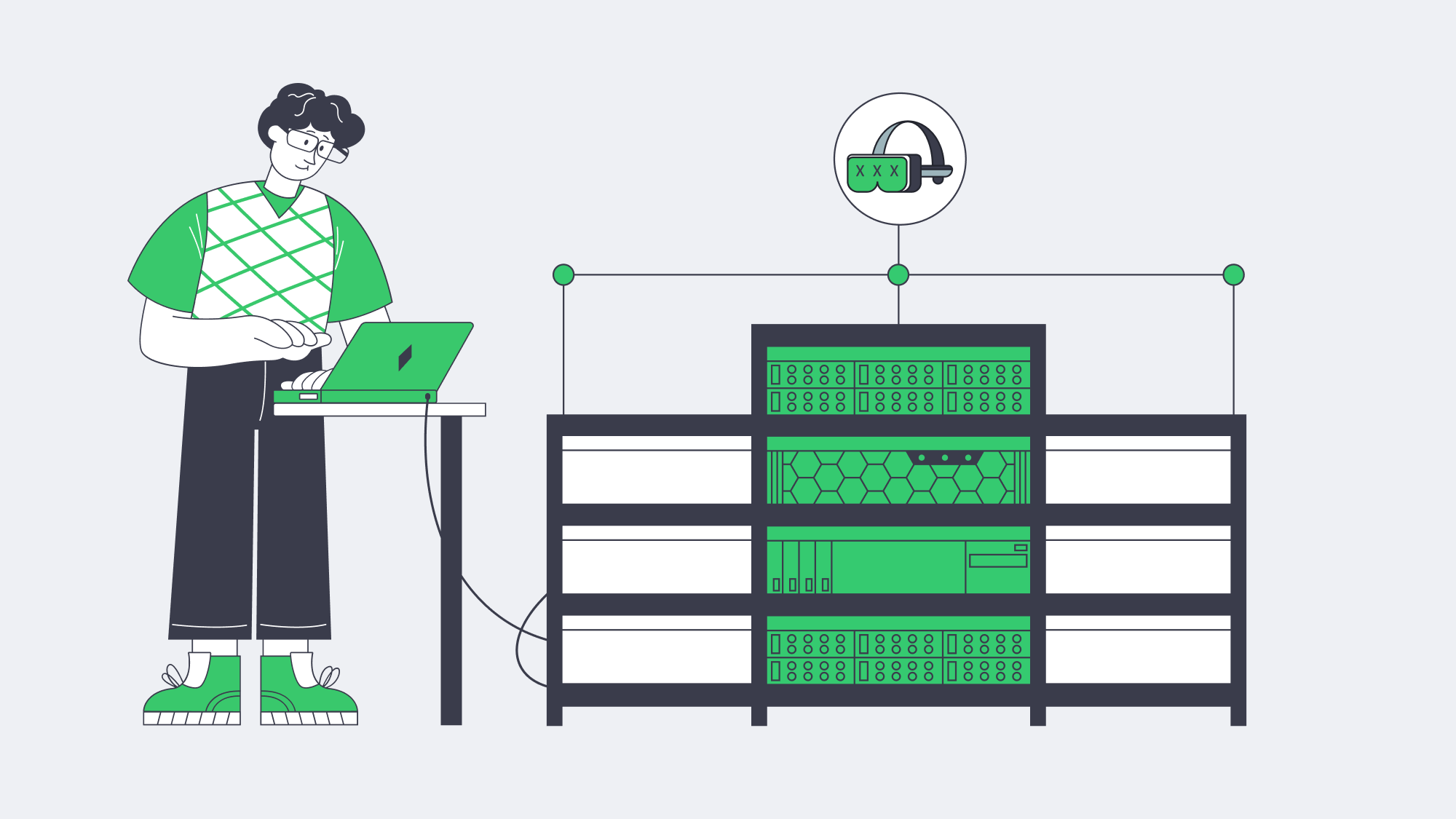
VR delivery is sensitive to resource contention. Dedicated servers provide exclusive CPU, memory, and storage resources plus root-level control to tune queues, congestion control, and driver stacks around real-time behavior. Melbicom’s dedicated platform offers 1,100+ ready-to-go server configurations, per-server bandwidth up to 200 Gbps, and 24/7 support, so you can size machines to the role—encode, origin, or regional compute—without compute noisy-neighbor contention. Pair those servers with 39 CDN PoPs across 35 countries so viewers can reach a nearby edge by default.
Reference pipeline
- Ingest/Encode (GPU) → Packager (per-workload: LL-HLS segments + WebRTC tracks) → Regional Origins (Atlanta, Amsterdam, Singapore, etc.) → CDN (39 PoPs across 35 countries) for VOD/live cache → Edge WebRTC SFUs for sub-second interactions → Players & headsets.
- Storage: NVMe scratch on encode nodes; S3-compatible object storage for masters and long-tail renditions.
Implementation notes you can apply tomorrow
- Viewport-aware or tiled streaming for 8K 360° keeps device decode and network budgets sane. Use AV1 when the device supports it; HEVC otherwise.
- Hybrid live: LL-HLS for the “watch” cohort, parallel WebRTC for a smaller “interact” cohort (tip, vote, switch camera) sharing the same production feed.
- Edge selection: Direct interactive users to the nearest WebRTC SFU; leave VOD to CDN affinity. Melbicom’s multi-region footprint supports this hybrid routing model.
How Should You Move from Pilot to Production without Re-Architecting Twice?
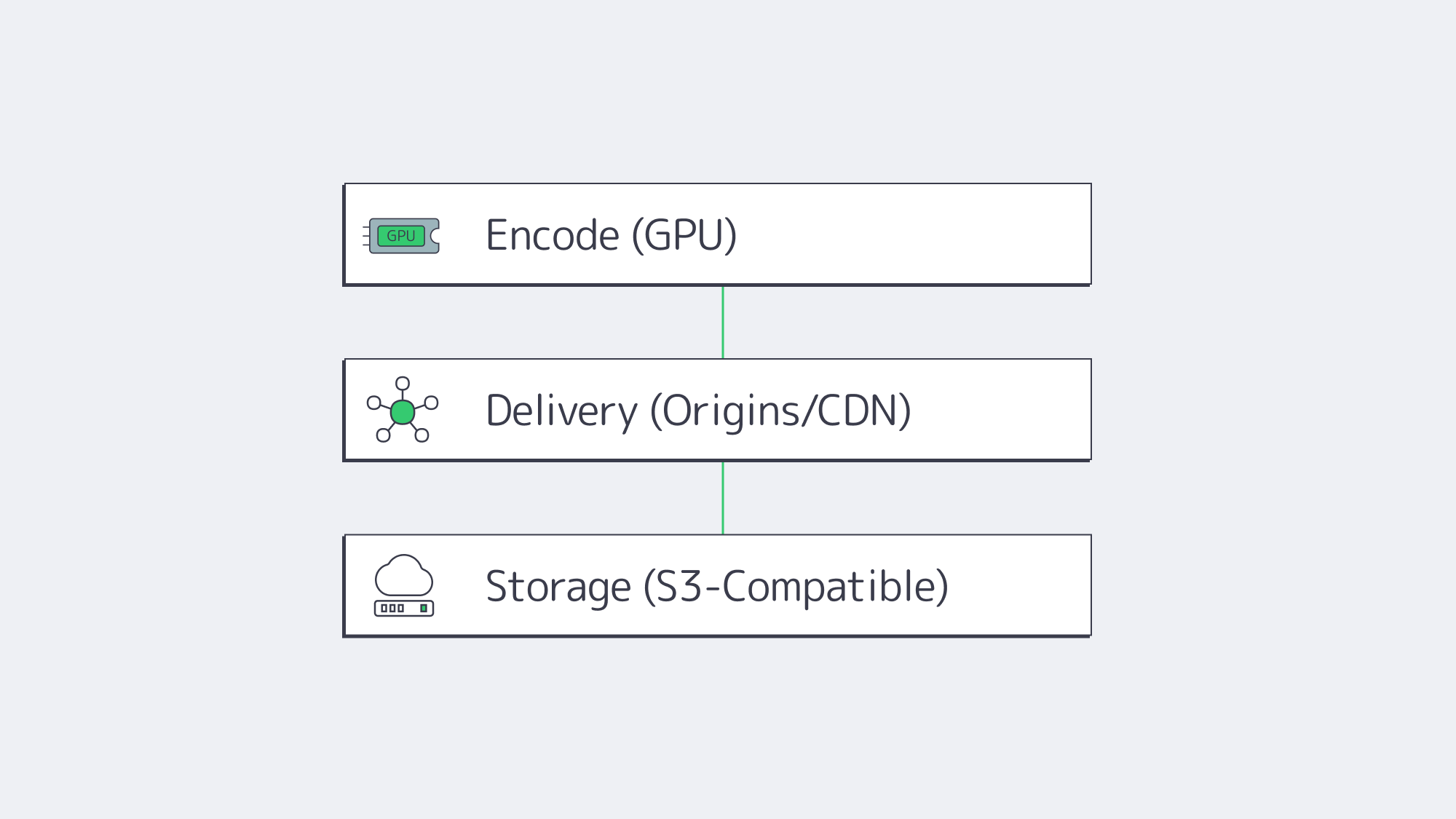
Start by right-sizing the three planes of your system:
- Encode plane: Place GPU encoders in the same metros where you gather content or where creators connect. Prefer AV1 when headsets/browsers decode it; keep HEVC ladders for fallback. Use NVMe for segmenting and thumbnails to maintain deterministic encode-to-publish timing.
- Delivery plane: Publish LL-HLS ladders to origins in at least two failure domains for critical markets, then cache via a CDN for scale; route interactive cohorts to regional WebRTC nodes. This separates the scalable broadcast path from the sub-500 ms interaction path.
- Storage plane: Keep your library on S3-compatible storage (Melbicom offers 1 TB to 500 TB plans in Amsterdam), with lifecycle rules where supported; serve “first frames” from NVMe caches on origins to minimize startup delay.
The outcome is a pipeline that de-risks growth: you can add origins by region, add encoders by ladder, and drop in new edge compute nodes as interactive formats evolve—without replacing your core.
Launch Your VR Platform
Deploy ready-to-go servers, storage, and a global CDN for bandwidth-intensive 180°/360° adult VR streaming.