
Blog

How Dedicated Server Hosting Supports Infrastructure Reliability
Digital presence and revenue go hand in hand in the modern world, and uptime is no longer simply a technical metric; it is a business KPI. For workloads that need a clear hardware boundary, dedicated server hosting can improve reliability by isolating resources and giving operators direct control over capacity and recovery design. Availability still depends on redundancy, monitoring, backups, failover, and tested recovery procedures.
Choose Melbicom— 1,100+ ready-to-go configs — 21 Tier III/IV data centers — CDN across 39 countries |
 |
Multi-tenant environments can introduce performance variability when host resources are oversubscribed or isolation controls are insufficient. Dedicated hardware removes cross-tenant contention at the physical host and can make bottlenecks easier to attribute, but it does not make a service immune to hardware failure, software defects, network problems, or operational error. The reliability advantage comes from combining isolation with deliberate redundancy, monitoring, failover, backup, and recovery design.
How Dedicated Servers Reduce Contention
Dedicated servers assign the physical host’s CPU, memory, and storage controllers to one customer, removing cross-tenant contention on that machine. Application processes can still compete with one another, and network paths may remain shared, so consistent performance still depends on capacity planning, workload controls, and measurement under representative load.
In shared or virtualized environments, resource limits, scheduling, and overcommit policies determine how strongly one tenant can affect another. Bursty workloads can increase I/O wait or latency when the host is oversubscribed, which is a material risk for latency-sensitive databases and applications.
A dedicated server removes cross-tenant competition for the host’s CPU, RAM, and storage-controller capacity. It does not eliminate contention inside the customer’s own stack, but it gives the team a clearer capacity boundary and makes performance pressure easier to measure and attribute.
Predictability as a Foundation
Performance predictability supports reliability for real-time processing, financial systems, and critical SaaS backends because throughput and latency need to remain within operating targets. Dedicated hardware can reduce cross-tenant variability, but smooth operation still depends on workload sizing, software behavior, storage design, and network conditions.
Virtual machines (VMs) add a hypervisor and virtualized I/O path, but the practical overhead varies by platform, device model, and workload and can be small on modern systems. Dedicated servers remove that abstraction at the host boundary, which can simplify performance attribution; they do not automatically prevent application or storage bottlenecks.
Direct hardware access from dedicated servers can suit latency-sensitive trading, database, and analytics workloads when isolation and predictable capacity matter. The server alone does not determine latency; software design, storage behavior, traffic patterns, and the end-to-end network path remain part of the result.
Resilient Hardware: The Foundation of Uptime
Reliable infrastructure is engineered in layers. A dedicated server provides a controllable hardware boundary, while the selected server configuration and data center determine which storage, power, and network redundancy options are available. Each layer must be verified rather than assumed.
RAID for Drive Redundancy
A single-drive failure can cause downtime or data loss when no redundant copy is available. RAID combines drives to tolerate selected hardware failures or improve I/O characteristics, depending on the level, but RAID does not replace independent backups, restore testing, or application-level data protection.
When the server has the required drive count and controller or software support, two common options are:
- RAID 1 (Mirroring): Writes identical data to two or more drives. If one member fails, the array can continue operating in a degraded state while the failed drive is replaced and the mirror is rebuilt. RAID 1 provides drive redundancy, not backup.
- RAID 10 (Stripe of Mirrors): Stripes data across mirrored pairs, combining redundancy with the potential for higher parallel I/O than a single mirror. It suits write-intensive databases when its capacity overhead and rebuild profile fit.
The appropriate RAID level depends on drive count, usable capacity, read/write pattern, rebuild time, failure tolerance, and backup strategy.
Reducing Power and Network Single Points of Failure
Drive redundancy does not cover power or network failures. Where the chosen server and facility support it, operators can reduce those risks with independent power and network paths:
- Dual Power Paths: Two PSUs connected to independent power feeds or PDUs can keep a compatible server powered if one path fails. Both the chassis and facility design must support true path independence.
- Redundant Networking: Multiple NICs or ports help only when bonding or routing, switch diversity, and upstream paths are configured to fail over. A second interface on the same failure path is not full redundancy.
These features are architecture choices, not automatic properties of every dedicated server. Melbicom offers dedicated infrastructure across 21 global Tier III and Tier IV data centers; the exact power, network, and server options should be confirmed for the selected configuration and location.
Continuous High Availability Architecture
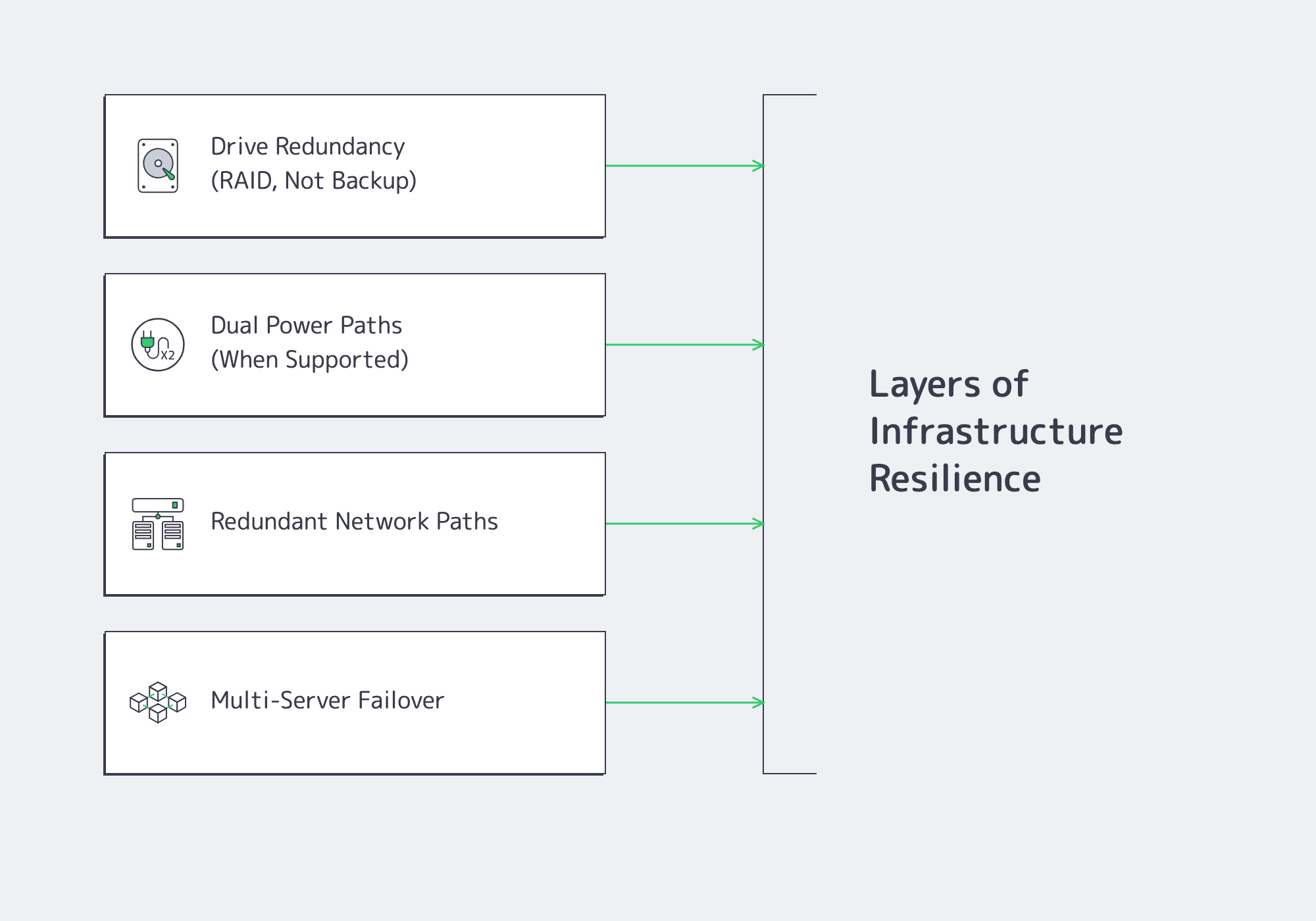
High availability starts by treating one server as a failure domain. Running a service across more than one dedicated server can preserve availability after a server failure only when health checks, failover orchestration, data replication, routing, and recovery procedures are configured and tested.
Common deployment models include active-passive and active-active:
Active-Passive: One node serves traffic while a standby receives the state or data it needs to take over. Failover requires health detection, orchestration, a safe way to isolate the failed node where applicable, and a tested method for moving traffic or service addresses.
Active-Active: Multiple nodes serve traffic at the same time, usually behind load balancing or routing logic. Availability depends on health checks, state and session handling, data consistency, and enough remaining capacity to absorb traffic when a node is removed.
These designs require direct hardware and network control, which dedicated server hosting can provide, but high availability is not exclusive to bare metal. Reliability comes from the complete topology, failure-domain separation, observability, and tested operating procedures.
Building Reliable Infrastructure with Melbicom

Dedicated server hosting can provide an isolated capacity boundary and clearer hardware-level control for workloads that need predictable resource ownership. That foundation becomes reliable only when teams size the workload, choose appropriate storage and network paths, separate failure domains, maintain backups, monitor the service, and test failover and recovery. A dedicated server reduces cross-tenant host contention; it does not eliminate every bottleneck or replace high-availability design.
Deploy Your Dedicated Server Today
Choose from 1,100+ ready-to-go configs across 21 Tier III & Tier IV data centers worldwide.