
Blog
Buy Dedicated Server with USDT: Stablecoin Payment Checklist
USDT can remove one of the most persistent delays in international infrastructure procurement: moving funds from a treasury wallet to a hosting provider without waiting for banking hours, correspondent banks, or international wire processing. According to Chainalysis, stablecoins processed $28 trillion in adjusted economic volume during 2025, while Visa’s on-chain analytics reports billions of dollars in average daily weekend activity.
That does not mean every successful blockchain transaction becomes a successfully paid server order. A valid USDT transfer can still fail operationally if it arrives on the wrong network, misses the invoice deadline, uses the wrong amount, exceeds processor limits, or cannot be matched to the correct invoice. For dedicated server procurement, payment succeeds only when blockchain settlement, invoice reconciliation, and provisioning all work together.
USDT Payments– Invoice-based crypto billing – 1100+ server configurations – 24/7 infrastructure support |
 |
How to Buy a Dedicated Server with USDT Across Stablecoin Networks?
To buy a dedicated server with USDT, begin with the provider’s invoice—not your wallet. Match the token, network, receiving address, exact amount, expiry time, and required confirmation state, then submit the payment with sufficient native gas. The order should proceed only after the provider marks the invoice as paid.
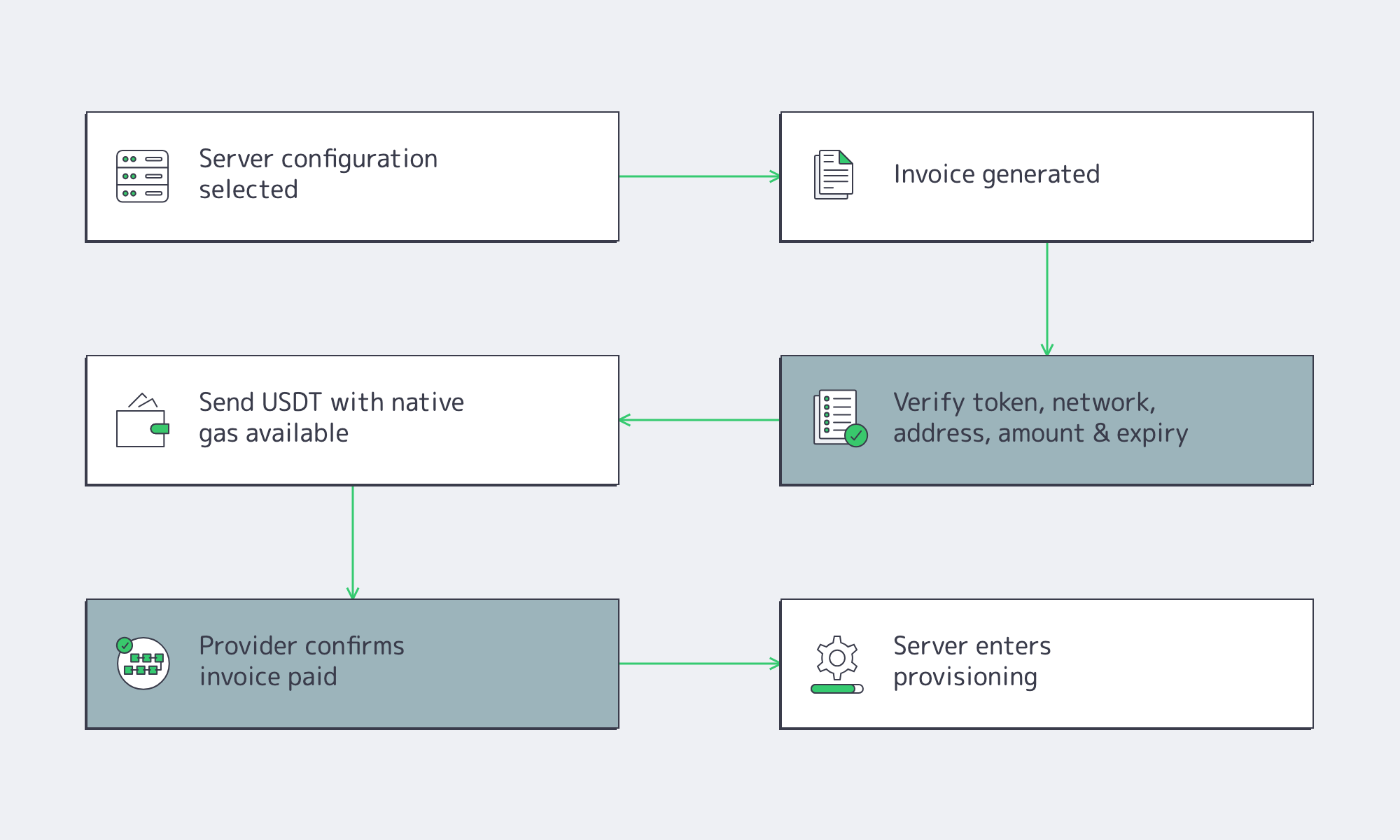
The invoice is the source of truth. It defines the customer account, server configuration, billing period, payment network, and destination address. Never rely on an address from a previous renewal or an older invoice because payment processors may rotate addresses or associate them with limited payment windows.
USDT exists on multiple blockchains. USDT-TRC20 and USDT-ERC20 represent the same stablecoin but operate on different networks with different addresses, fee models, and confirmation processes. A provider expecting TRC20 cannot automatically reconcile an ERC20 payment simply because both assets display the ticker “USDT.”
Before approving any transfer, verify five fields together:
- USDT token
- Network (TRC20 or ERC20)
- Destination address
- Exact invoice amount
- Invoice expiry
Also keep the native fee asset available. ERC20 transfers require ETH for gas, while TRC20 transfers consume TRON resources and may require TRX. Do not reduce the invoiced USDT amount to cover network fees.
Finally, save both the invoice ID and transaction hash. A blockchain transaction proves funds were transferred; it does not prove the invoice has been reconciled or the server order released.
TRC20, ERC20, Confirmations, and Invoice Matching: What Should You Compare?
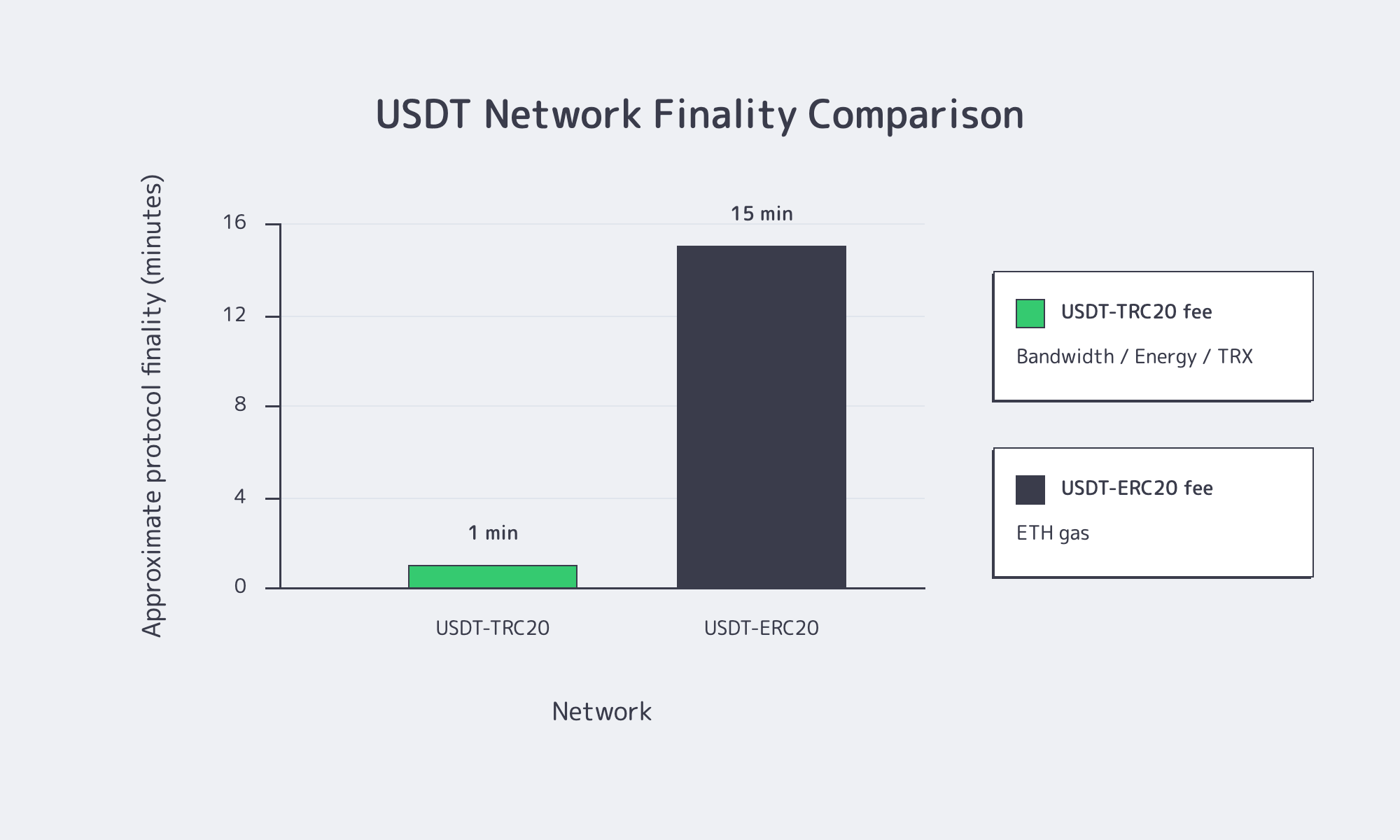
Compare TRC20 and ERC20 primarily by operational compatibility—not marketing claims about speed. The correct network is the one your provider explicitly accepts, your treasury wallet supports, and your invoice specifies. Confirmation policy, fee mechanics, and invoice expiry all matter more than block time alone.
| Criterion | USDT-TRC20 | USDT-ERC20 |
|---|---|---|
| Network | USDT on TRON | USDT on Ethereum |
| Finality | ~3-second blocks, solidification typically ~1 minute | 12-second slots, protocol finality roughly 15 minutes |
| Fees | TRON Bandwidth/Energy or TRX | ETH gas |
| Best fit | Invoice explicitly requests TRC20 | Invoice explicitly requests ERC20 |
Confirmation Speed Has Several Meanings
A wallet, blockchain explorer, payment processor, and hosting provider may all define “confirmed” differently. On TRON, broadcast, inclusion, successful execution, and solidification are separate events. Ethereum likewise distinguishes inclusion from protocol finality. Providers often credit payments before full finality under their own risk rules.
For procurement teams, the useful metric is time to provider acceptance, not blockchain block time. That includes transaction broadcasting, confirmations, invoice reconciliation, payment processing, and order release.
Invoice Matching Is an Off-Chain Control
Neither ERC20 nor TRC20 transfers include a built-in invoice reference. Providers therefore reconcile payments using combinations of receiving address, exact amount, invoice ID, transaction hash, payment window, and network.
This is why exact payment amounts matter. Public processor documentation shows underpayments, overpayments, and late payments often enter exception workflows instead of automatically marking invoices as paid. Use your wallet’s “send exact amount” function and keep network fees separate from the invoice amount.
Why USDT Can Simplify International Dedicated Server Procurement
USDT simplifies procurement because it reduces friction between treasury and infrastructure teams—not because it makes every payment instant.
Traditional cross-border payments depend on multiple commercial banks operating across different time zones and internal processes. The IMF notes that stablecoins can compress the transfer leg of international payments, while the BIS observes they can operate independently of banking hours, although compliance, liquidity, and operational controls still remain important.
For infrastructure procurement, that creates several practical advantages:
- Treasury can pay immediately when deployment is approved.
- Weekend or holiday purchasing becomes possible.
- Dollar-linked pricing simplifies budgeting compared with volatile cryptocurrencies.
- Every payment produces an independently verifiable transaction hash.
- The same treasury workflow can support deployments across multiple regions.
Those benefits depend on operational maturity. Publishing a wallet address alone is not enough. Mature providers connect cryptocurrency payments with customer accounts, invoices, renewals, payment status, and provisioning workflows.
At Melbicom, cryptocurrency billing is integrated into an account-managed process. To comply with KYC requirements, the first payment for your initial order must be processed via traditional methods (e.g., bank wire or credit card). Following this initial step, all subsequent renewals and new orders can be completed via crypto, tying payment directly to dedicated server deployments instead of treating it as an isolated checkout option.
Processor Limits Before Paying
Before sending USDT, verify invoice minimums, maximum transaction limits, supported networks, payment windows, confirmation requirements, and policies for underpayments or overpayments. Blockchain capability alone does not define payment acceptance; processors and providers may enforce additional operational limits that determine whether an invoice can be completed automatically.
Important checks include:
- Minimum invoice amount
- Maximum transaction or account limits
- Supported USDT networks
- Invoice expiry window
- Required confirmation threshold
- Underpayment policy
- Overpayment handling
- Unsupported-network recovery
Public payment processors illustrate why these checks matter. Some document minimum invoice sizes, while others publish minimum TRC20 payment amounts. Those examples are processor-specific rather than universal, reinforcing the need to follow the actual invoice rather than assumptions.
Do not split a dedicated server payment into multiple transfers unless the provider explicitly allows it. Likewise, avoid sending small test payments to production invoices. Exact matching remains the safest approach for high-value infrastructure purchases.
What Renewal and Refund Checks Matter for USDT Dedicated Server Payments?
Treat every renewal as a new invoice and every refund as a new blockchain transaction. Verify renewal payment instructions each billing cycle, and understand refund approval, destination requirements, fees, and network rules before paying. Successful initial checkout does not automatically guarantee predictable recurring billing.
Renewals Are Fresh Payment Objects
Renewals commonly generate new invoices, updated payment objects, or different receiving addresses. Even when the amount appears unchanged, invoice IDs, addresses, billing periods, or conversion quotes may differ.
Infrastructure teams should monitor service expiry while treasury confirms payment acceptance. The internal process is complete only after the provider records the renewal as paid—not simply after the wallet broadcasts a transaction.
A Refund Is a New Transaction, Not a Reversal
Blockchain payments cannot be reversed like card authorizations. Any refund requires the provider or processor to create a separate outbound transaction.
Before purchasing, clarify:
- Refund denomination
- Same-network return requirements
- Network fee treatment
- Approval process
- Expected timelines
This is especially important for custodial platforms, where the sending address may belong to a shared wallet rather than the customer.
How Does a Confirmed USDT Payment Become a Provisioned Server?
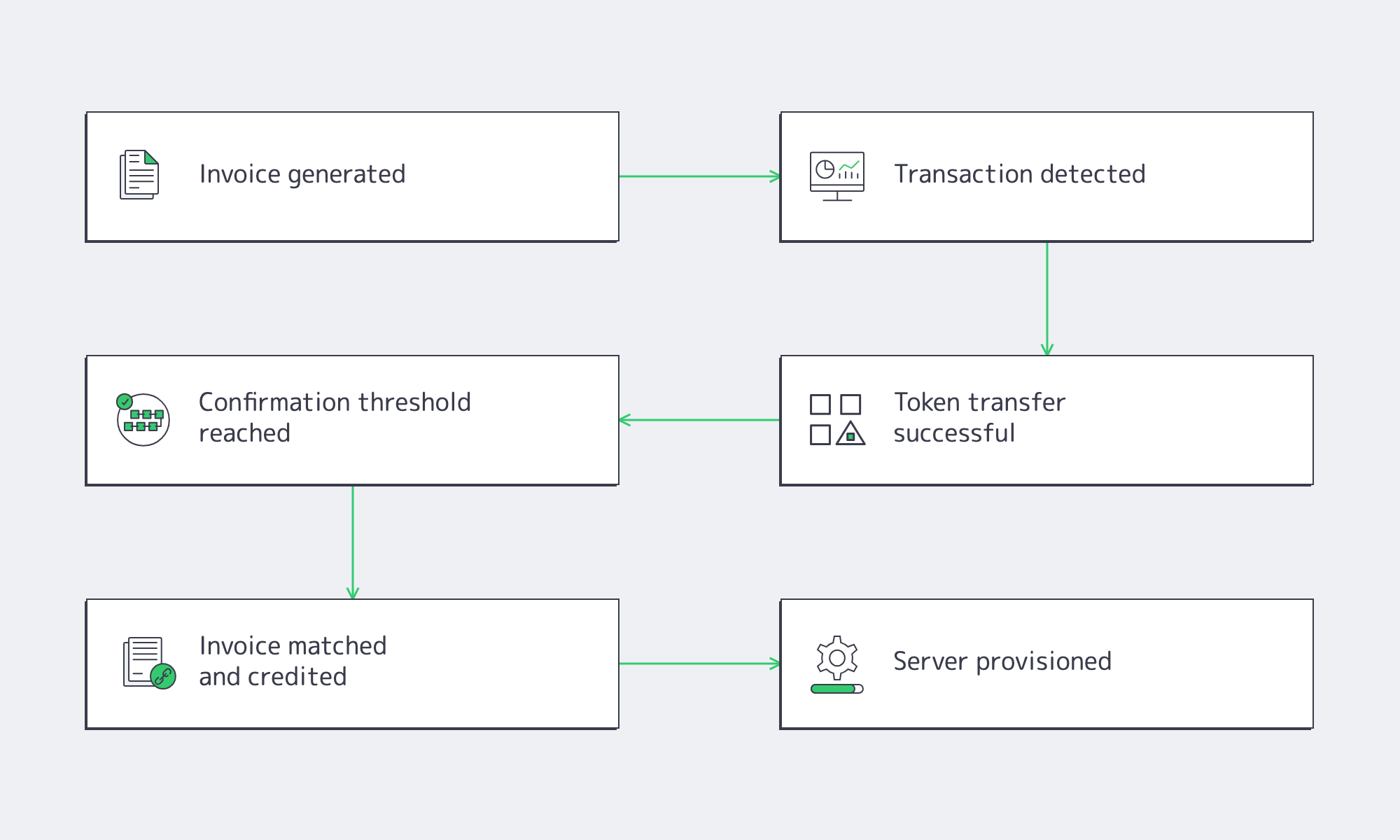
A confirmed blockchain payment is only one step toward deployment. Provisioning begins after the provider matches the invoice, verifies confirmations, credits the order, and releases the server into its deployment workflow. Payment speed reduces treasury delay but does not eliminate inventory, compliance, or provisioning processes.
Operationally, at least six separate events occur:
- Invoice generation
- Transaction detection
- Successful token transfer
- Required confirmation threshold reached
- Invoice matched and credited
- Server released for provisioning
Each step matters. A payment can appear on-chain yet remain underpaid, arrive after invoice expiry, or require manual reconciliation.
Provisioning then depends on inventory. Ready-to-go configurations can move directly into deployment, while custom builds remain a hardware workflow.
Melbicom provides 1100+ ready-to-go dedicated server configurations, custom configurations delivered in 3–5 business days, infrastructure across 21 Tier III and Tier IV data centers, and per-server bandwidth of up to 200 Gbps, allowing payment reconciliation to map directly to the ordered configuration and deployment location.
When exceptions occur, mature support processes become just as important as blockchain speed. Teams should be able to identify whether an order is waiting on confirmations, billing, compliance review, inventory allocation, or deployment rather than simply reporting that a payment was “received.”
Dedicated Server USDT Payment Checklist
Use this checklist before every new order and renewal:
- Confirm the server configuration, location, billing cycle, and customer account.
- Use the current invoice only.
- Verify both USDT and the exact network.
- Keep ETH or TRX separate for network fees.
- Check payment limits, expiry, and confirmation requirements.
- Send the exact displayed amount without rounding.
- Record the invoice ID, transaction hash, network, wallet, amount, and timestamp.
- Wait for provider acceptance rather than relying on wallet notifications.
- Define internal ownership for renewals, refund requests, and payment monitoring.
Operationally Mature USDT Procurement
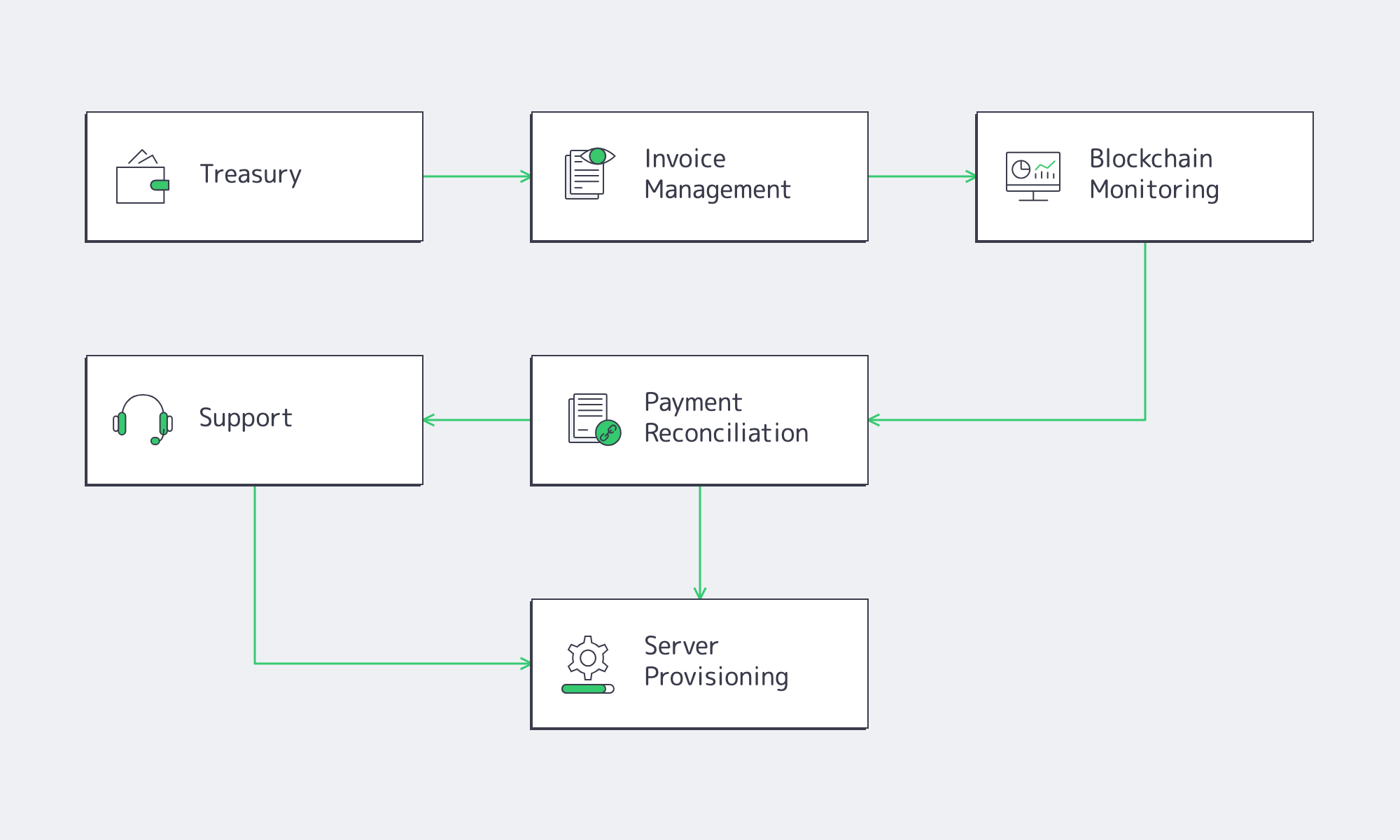
USDT’s real advantage is not that every payment becomes instant or free. Its value comes from shortening the path between treasury approval and dedicated server deployment while preserving transparent, independently verifiable payment records. That advantage only survives when invoices, confirmations, renewals, exception handling, and provisioning are connected into one operational workflow instead of isolated manual steps.
When evaluating a provider, focus on operational maturity beyond blockchain support:
- Confirm invoice matching, confirmation handling, and renewal workflows before the first purchase.
- Verify the supported USDT network for every order instead of assuming all Tether networks are accepted.
- Treat provider acceptance—not blockchain broadcast—as completion.
- Keep payment evidence, invoice IDs, and transaction hashes together to simplify reconciliation and support.
Buy Dedicated Servers with USDT
Use Melbicom’s account-managed crypto payment flow for dedicated server orders, renewals, and provisioning.