
Blog
Deploying Bare Metal in Brazil for AI/ML
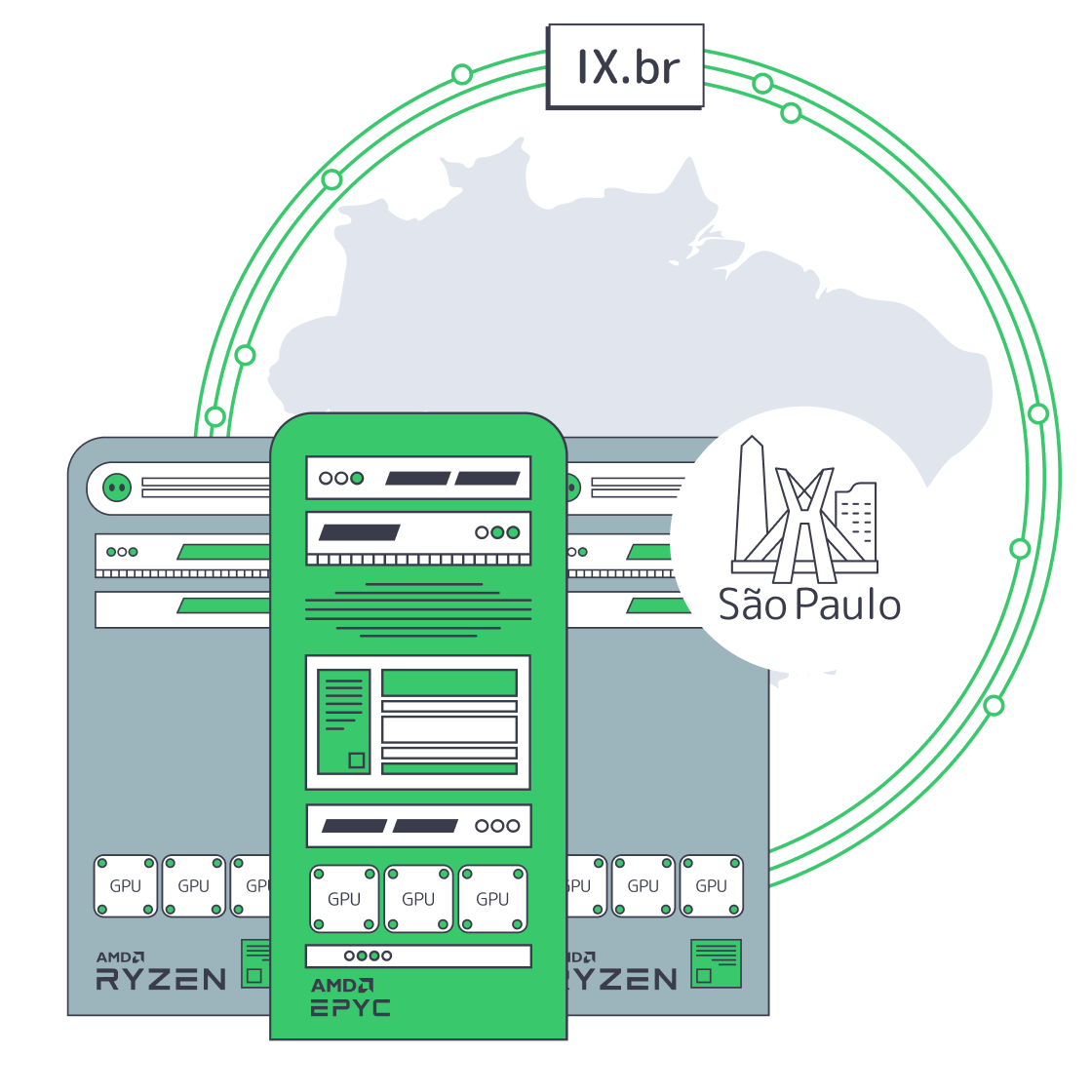
The IX.br exchange in São Paulo is a major interconnection hub for Brazilian networks. The dense networks and fiber concentrated in the area provide an advantage for AI/ML teams considering modern bare metal in Brazil. Shorter paths can reduce network delay, but response time also depends on routing, congestion, and model execution. Local hosting supports data-location control; it does not, by itself, establish LGPD compliance. Melbicom’s São Paulo server location remains available for preorder, so confirm the configuration and launch timing before planning production traffic.
Host in LATAM— Reserve servers in São Paulo — 6 CDN PoPs · 5 LATAM countries — 21 data centers globally |
 |
Why Deploy AI/ML on São Paulo Bare Metal?
Arizton’s April 2026 investment analysis estimates Brazil’s data center market at US$6.7 billion in 2025 and projects US$8.12 billion by 2031. These are market estimates and forecasts, not a sizing rule for an individual AI deployment.
The advantages of placing AI on bare metal in Brazil:
- Exclusive hardware for AI workloads: Bare metal provides sole access to CPU cores, RAM, and installed GPUs. Running the OS directly avoids a shared host hypervisor, but training and inference performance still depends on the model and configuration.
- Proximity to IX.br São Paulo: Direct interconnection can shorten paths to Brazilian ISPs. Measure round-trip latency, packet loss, and jitter from the networks your users actually use rather than assuming a fixed improvement.
- Data-residency control: Keeping selected processing and storage in Brazil can simplify residency records, but LGPD compliance requires lawful processing, security measures, data-subject rights, and appropriate handling of international transfers.
- Predictability and customization: With full control over the OS, compatible drivers, frameworks, and network layout, you can tune specific model stacks and data pipelines. Costs still depend on the selected hardware, traffic, and operations.
Brazil Deploy Guide— Avoid costly mistakes — Real RTT & backbone insights — Architecture playbook for LATAM |
 |
Which CPUs and GPUs Suit AI/ML?
For a dedicated server in São Paulo, choose CPUs and GPUs using benchmarks of the target model, batch size, and concurrency. Match CPU cores, RAM, and accelerator memory to the workload. Melbicom’s São Paulo capacity is preorder-based; confirm the exact hardware and launch timing before committing.
AMD EPYC, AMD Ryzen, and Intel Xeon are custom configuration options, with optional GPUs. CPU family alone does not establish model throughput or latency. Confirm the GPU model, VRAM, driver compatibility, power and cooling, and the allocated port speed in the quotation. Plan headroom from measured utilization and expected demand rather than an industry-wide training-compute doubling rate.
How Local Peering Can Reduce AI Latency
Long-distance paths can increase RTT for requests and real-time data feeds. Deploying in São Paulo and arranging appropriate peering through the IX.br exchange can place inference closer to participating ISPs and content networks. In a March 20, 2026 release, NIC.br reported 50 Tbps of aggregate IX.br traffic, including 32 Tbps at São Paulo. These are exchange traffic peaks, not RTT measurements or per-server capacity guarantees.
Public, cacheable assets such as front-end bundles and video tiles can be delivered through Melbicom’s CDN, which spans 39 PoPs across 35 countries, including Fortaleza and Rio de Janeiro in Brazil. Keep model execution on the origin and sensitive embeddings or personalized responses out of shared caches. Review cache rules and edge locations against the workload’s data-residency requirements; CDN delivery does not run the model.
Where a Brazilian Dedicated Server Helps
Hosting in Brazil can avoid unnecessary international paths when users and data sources are local. Benchmark routes and end-to-end latency for recommendation engines, fintech risk scoring, live-ops analytics, and speech systems; local placement alone does not guarantee stable bandwidth or deterministic RTT.
Bare Metal in Brazil: Privacy and Sovereignty
Keeping selected processing and storage in Brazil on dedicated hardware gives you control over that deployment’s location and tenancy. It does not establish where every backup, log, CDN copy, or external service stores data. LGPD does not impose a blanket requirement to host all personal data in Brazil, and local hosting does not by itself establish compliance. Document lawful processing, security measures, retention and deletion, access controls, and each data flow. Where personal data is transferred abroad, use an applicable mechanism under ANPD’s international-transfer rules, such as a relevant adequacy decision or ANPD standard contractual clauses.
For private-sector legal entities, LGPD fines can reach 2% of the revenue in Brazil of the entity, group, or conglomerate in the preceding fiscal year, excluding taxes, capped at BRL 50 million per infraction. Other sanctions can include suspending affected data processing.
Monitoring and Capacity Planning for Instrumentation and Scaling

A performant node must also be healthy and right-sized. The dashboard is illustrative; its displayed percentages are not scaling thresholds. Monitor the following:
- Instrumenting from day one: High‑frequency metrics for CPU, installed GPUs, memory, NVMe I/O, and NICs should be collected, and you need to ingest application traces and logs into a searchable store. That way, you can identify GPU throttling, data‑loader stalls, and queue build‑ups before they hit SLOs.
- Applying AIOps: Employ anomaly detection on latency, throughput, GPU memory, and temperature to surface subtle degradations such as sustained latency increases or a slow memory leak.
- Forecasting capacity on leading indicators: Track sustained utilization, p95/p99 latency, request queue depths, and feature-store I/O. Set resource-specific thresholds from load tests and leave headroom for bursts and failures. Plan scale-up or scale-out before demand exceeds tested capacity, accounting for hardware lead times. Add GPUs only where the chassis, power, cooling, and software stack support them; otherwise add appropriately sized nodes behind a model router.
- Operational discipline: Schedule kernel/driver updates, monitor SMART/NVMe health, and pre-stage replacements when error rates rise.
Sizing for Training, Inference, and Pipelines
- Training nodes advice: Size CPU cores, RAM, and NVMe scratch for data loading and preprocessing. Budget GPU memory for model weights, gradients, optimizer state, activations, and working buffers at the intended precision and batch size. For São Paulo, plan within the quoted 1–40 Gbps port options; verify checkpoint and multi-node synchronization performance instead of assuming a 100 Gbps training interconnect.
- Latency-critical inference: Benchmark the actual CPU and, where needed, GPU against target concurrency, batch size, and p95/p99 latency. Allow accelerator memory for model weights and runtime state. Adding a second GPU does not automatically reduce tail latency. Keep latency-critical dependencies close to the São Paulo inference node.
- Real-time data pipelines: Handle Kafka/Fluentd ingestion with NVMe and network capacity sized to measured ingress and replication traffic. Co-locate feature stores with inference when the data is sensitive or high-velocity.
- Hybrid edge caching operation: Keep model execution on the São Paulo node while public static assets and non-sensitive, cacheable artifacts are delivered through a CDN such as Melbicom’s, with PoPs in South America.
Scale with Melbicom’s Global Footprint
A locally based AI platform may later expand globally. Melbicom’s footprint comprises 21 global Tier III/IV DCs, including the coming-soon São Paulo location, and a CDN with 39 PoPs across 35 countries. You can replicate approved model artifacts to Europe or Asia while keeping selected training data in Brazil; assess personal data in artifacts and supporting services before cross-border transfers. Globally, we provide up to 200 Gbps per server. This is not the São Paulo port specification. We have large in-stock server pools at active locations and offer 24/7 support.
Bare Metal in Brazil for AI Workloads
| AI/ML challenge | How São Paulo’s bare metal helps |
|---|---|
| High compute demand, such as deep nets and large optimizers | A custom preorder can allocate exclusive CPU, RAM, and optional GPU resources; confirm the accelerator and benchmark the intended model. |
| Massive I/O, such as feature streams and checkpoints | NVMe and planned 1–40 Gbps port options in São Paulo can support local pipelines; size storage and networking against measured workloads. |
| Low latency/user proximity | Appropriate IX.br peering can shorten network paths; validate RTT, jitter, and end-to-end inference latency from target ISPs. |
| Data privacy/LGPD | In-country processing and storage on dedicated hardware support residency controls, but do not replace lawful processing, security, or transfer compliance. |
| Rapid demand growth | Workload-specific monitoring, load testing, and modular scale-up/out help identify bottlenecks; industry-wide training-compute growth is not a demand forecast. |
Deploying Bare Metal in Brazil: Next Steps
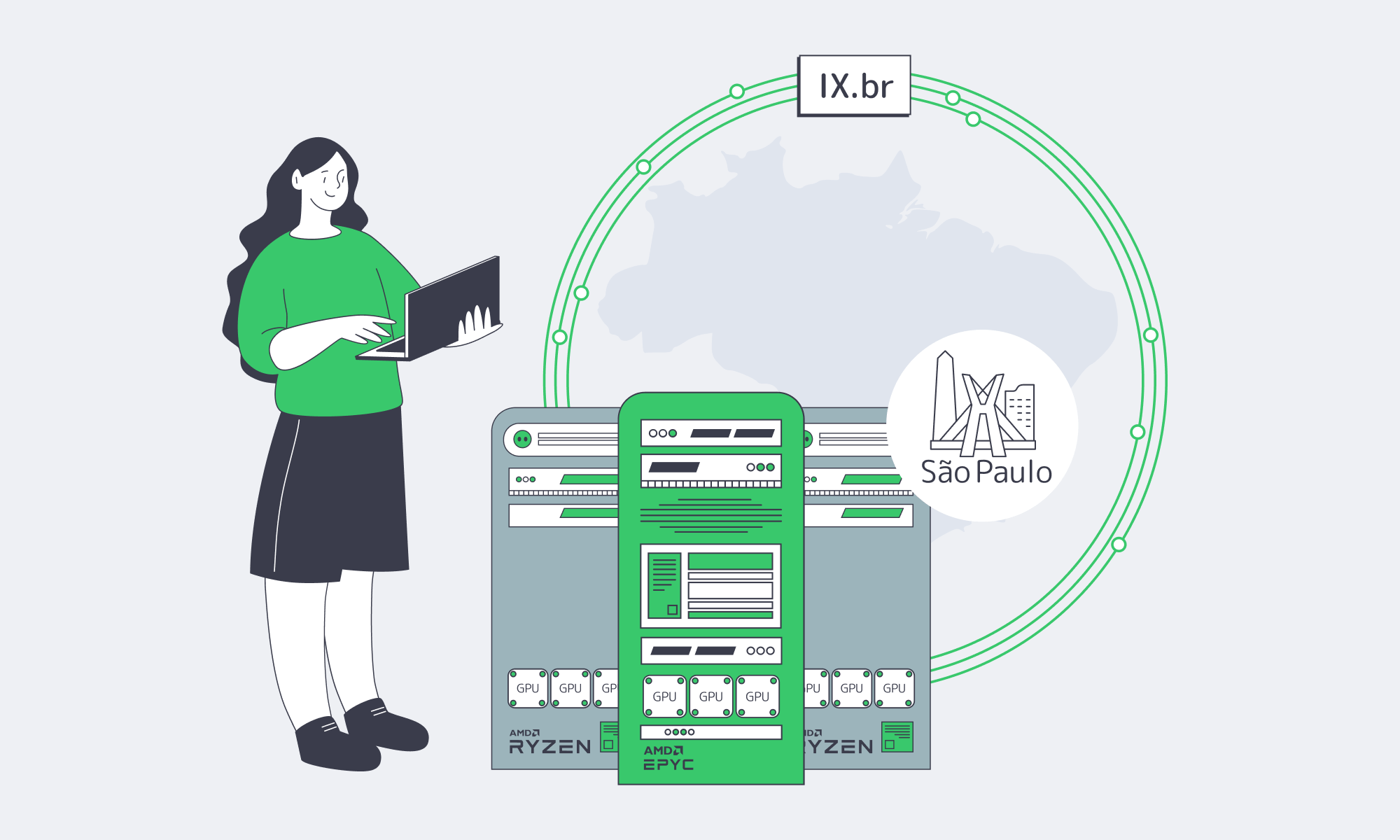
Melbicom is preparing its São Paulo server location and accepts preorders for custom hardware configurations. We operate our own network, provide high-bandwidth options globally, and tailor hardware and networking to the agreed deployment. Share your traffic volumes, latency SLOs, data-residency needs, GPU/CPU requirements, and peering preferences so we can confirm the configuration, network options, and launch timing in a reservation-backed plan.
Be the first to host in Brazil on special terms
We at Melbicom will help you plan a custom São Paulo deployment with AMD EPYC/Ryzen or Intel Xeon CPUs, optional GPUs, and 1–40 Gbps port options, subject to quotation and allocation. Our CDN already covers 39 PoPs across 35 countries, including 6 LATAM PoPs across 5 countries. Tell us your volumes, targets, and exact specs so we can shape a tailored early offer and reserve capacity for your launch.