
Blog
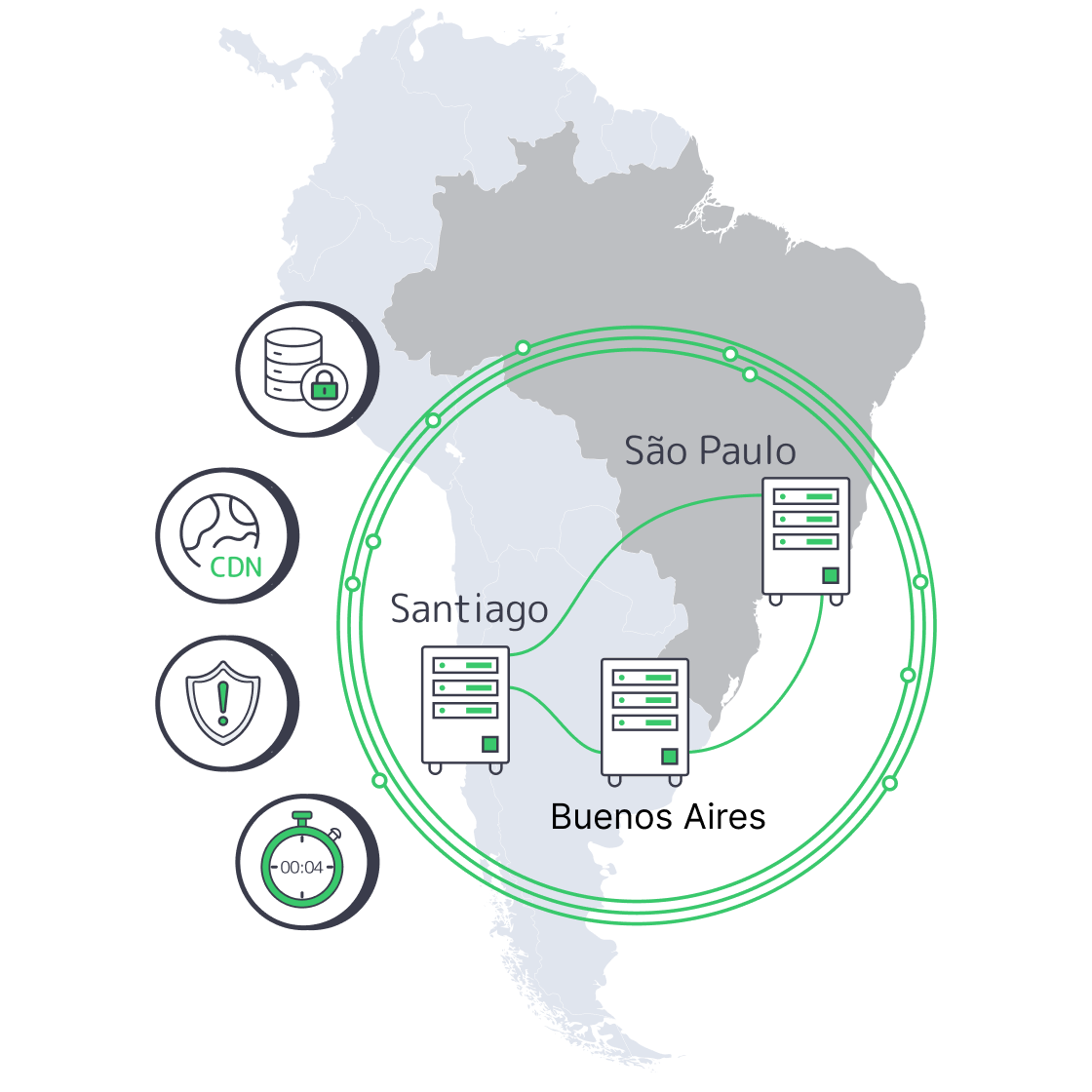
Active/Active Across São Paulo, Santiago, Buenos Aires
South America forces availability engineering to get honest—fast. When your workload is regulated (payments), adversarial (crypto), or real-time (iGaming cores), you don’t get to treat a region as “just another edge.” You have to prove uptime under partial failure: broken fiber segments, bad upstream routes, and the kind of cascading latency spikes that turn “highly available” into “highly unpredictable.”
This playbook uses an illustrative, operator-managed active/active design across São Paulo, Santiago, and Buenos Aires to explain dedicated hosting patterns for real incidents: transaction-safe replication, health-based traffic steering, and a CDN that can absorb volatility without masking it.
Choose Melbicom— Reserve planned Brazil capacity — CDN PoPs across 5 LATAM countries — 21 DCs, incl. planned São Paulo |
 |
South America Dedicated Server Requirements for “No-Excuses” Uptime
If you’re shopping for a South America dedicated server setup for 24/7 apps, don’t start with hardware checklists. Start with failure math:
- Use metro failure domains. São Paulo, Santiago and Buenos Aires are separate metros; check shared carriers, networks and control systems.
- Your data layer decides your uptime story. If the ledger can’t fail over safely, your active/active front end is theater.
- Routing must be health-based and reversible. Steer based on measured health (app + data), not on geography.
Diagram. The Three-Site Active/Active Shape
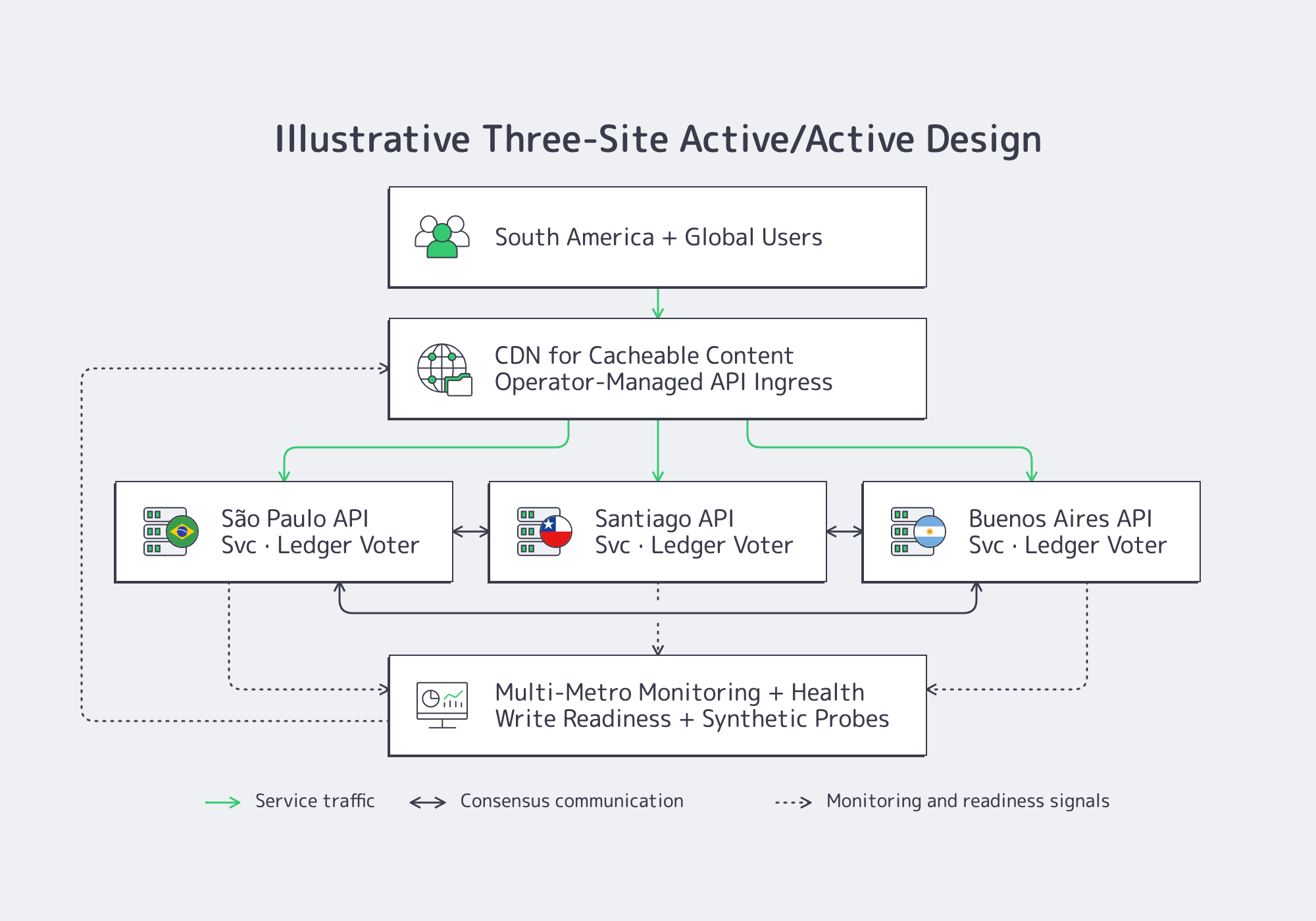
Melbicom provides BGP sessions with BYOIP and private networking at operating locations; inter-DC connections must be confirmed for the selected sites. Our S3-compatible object storage is in Amsterdam, Netherlands, for off-region snapshots where that placement fits your requirements. São Paulo dedicated-server capacity is coming soon; the illustrative Santiago and Buenos Aires sites require separate providers.
How Does Active/Active Dedicated Hosting Keep South America Apps Online 24/7?
An illustrative three-site active/active design runs active application services in São Paulo, Santiago, and Buenos Aires, backed by a transaction-safe data layer. São Paulo dedicated servers can anchor throughput, with peer capacity in the other metros. Services forward ledger writes to the authorized leader for each consensus group; surviving sites continue while the required quorum remains available.
Dedicated Hosting in South America: The Stack That Holds Under Stress
For crypto exchanges, Web3 wallets, payment gateways, and iGaming cores, break the platform into three layers:
- Edge layer (CDN): static assets, API caching where safe, WAF rules if you use them, and the ability to steer around failures quickly.
- Stateless service layer: auth, pricing, game logic, matchmaking, session services—everything horizontally scalable.
- State layer: balances, orders, settlements, wallet state, player economy—anything that can’t be “eventually fixed” after an incident.
Melbicom’s CDN supports origin pools for load balancing and failover, delivered through 40 CDN PoPs in 35 countries (including 5 LATAM countries). Our Brazil CDN PoPs are Fortaleza and Rio de Janeiro. Origin failover complements your application’s transaction-safety controls during regional brownouts; it does not replace them.
São Paulo as a Regional Anchor
São Paulo is a major regional interconnection hub: IX.br’s São Paulo exchange lists 2,400+ participating networks. Actual reachability and latency depend on your provider’s peering and traffic paths; regional interconnection can avoid detours through other continents. Measure inter-site RTT and loss under load before choosing synchronous replication.
Which Replication Strategy Between São Paulo, Santiago, and Buenos Aires Can Meet Strict RPO/RTO Targets?
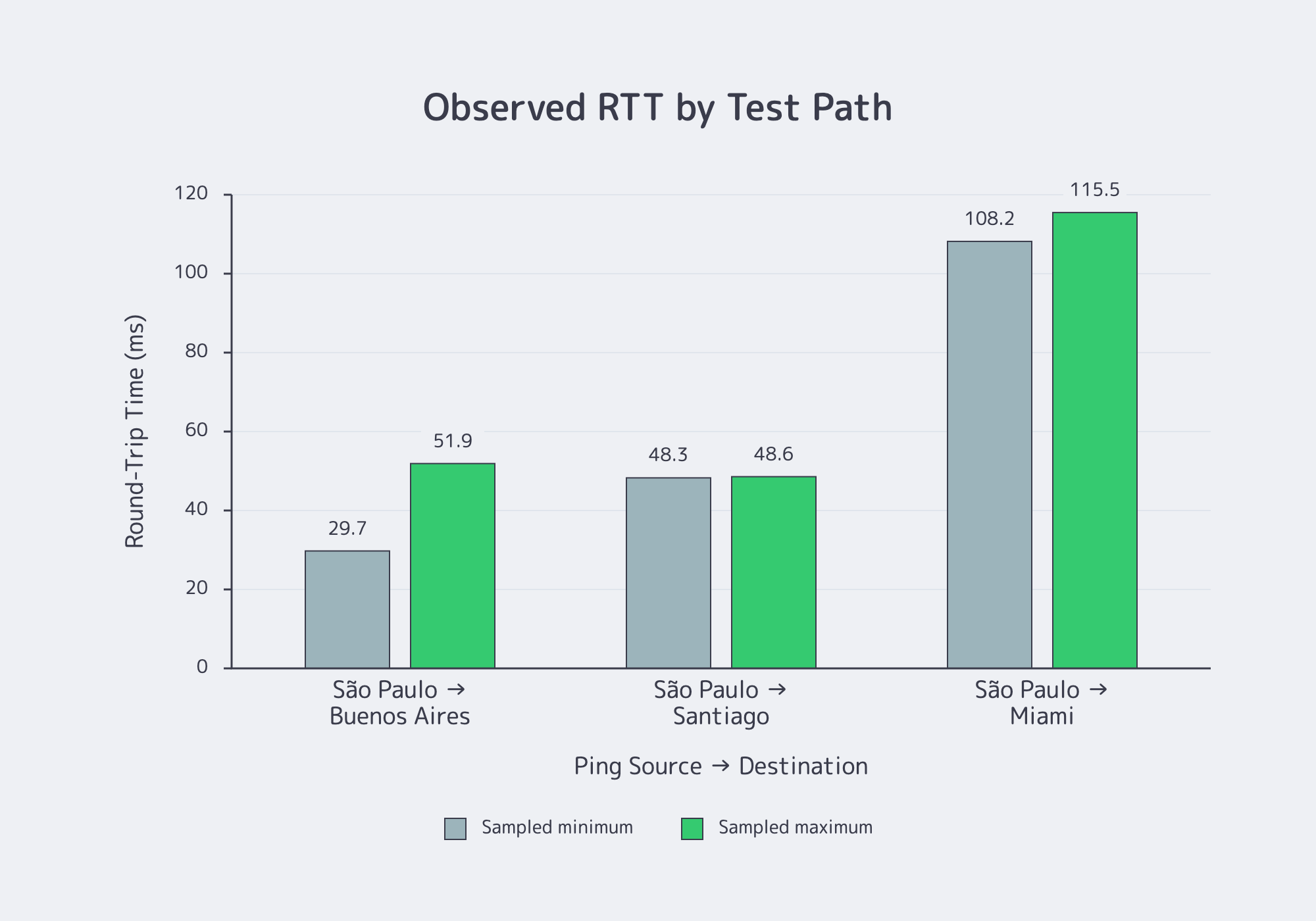
Use durable quorum commits for critical ledger state across São Paulo, Santiago, and Buenos Aires; use asynchronous replication where defined data loss is acceptable. Quorum commits can provide zero RPO for acknowledged transactions within the system’s failure model. RTO depends on detection, safe election, application recovery, and routing; validate both targets in failure drills.
Practical Replication: Ledger vs. Other State
A workable pattern in regulated systems:
- Tier 0 (Ledger / balances / settlement / financially binding orders): a transactional data store with durable quorum replication across three metros.
- Tier 1 (Derived order views, replaceable sessions, non-critical gameplay state): async replication + idempotency + replay from a durable source.
- Tier 2 (analytics, logs, non-critical caches): async batch replication or rebuild.
Table: Replication Choices and Recovery Constraints
| Replication Mode (Three-Site) | RPO Constraint | RTO Constraint |
|---|---|---|
| Quorum-based, synchronous commit for ledger | 0 for durably quorum-committed transactions within the tested failure model | Detection + safe election + application/routing recovery; writes pause without quorum |
| Async replication with monitored lag (services + read models) | Unreplicated writes at failover; lag alarms do not enforce a loss bound | Promotion + recovery + routing + warming caches; validate in drills |
| Snapshot/backup-driven recovery (last resort) | Since the latest recoverable snapshot or log record | Restore + rehydrate + verify; measure against dataset size and restore throughput |
With three voting replicas, one per metro, two form a majority; each consensus group has one current leader. A connected majority can continue after one metro fails, but an isolated minority cannot commit writes. Keep routing tied to current write readiness and test recovery under partitions as well as complete site loss.
Brazil Deploy Guide— Avoid costly mistakes — Real RTT & backbone insights — Architecture playbook for LATAM |
 |
How Do Routing and CDN Protect Uptime for Regulated South America Workloads?
For South American workloads, use CDN multi-origin routing for cacheable content and application-aware load balancing for write APIs. Where fixed IPs are required, operator-managed BGP/BYOIP can complement this design. Admit writes only through sites that can reach an authorized data leader and quorum. Test failover and connection recovery; routing alone does not transfer write authority.
Health-Based Routing That Isn’t Geo-DNS
Geographic selection alone is insufficient. Use:
Real health signals (not just “port open”):
- API p95 latency
- dependency health (current write authority, quorum availability, and replication lag for permitted stale reads)
- queue depth / saturation
A routing controller that can make the call:
- CDN origin selection for web + assets
- L7 load balancer decisions for APIs
- BGP failover/anycast when fixed IPs are required
Melbicom’s BGP service supports BYOIP, routing policies, and IRR integration at operating data centers. Your team must connect application and data readiness to announcements and withdrawals for its authorized prefixes. These customer-operated ingress routes are separate from Melbicom CDN PoP routing; configure CDN origin pools separately and test convergence and connection recovery.
The CDN Pattern: Shield + Multi-Origin + Fast Purge
For regulated workloads, CDN is not “just static assets.” It’s a resilience layer:
- Origin pooling: in this illustrative design, keep origins in São Paulo, Santiago, and Buenos Aires ready to serve and distribute requests among eligible active origins. Enforce application and data readiness in your ingress controls.
- Shielding: collapse cache misses through a supported shield before fetching from an origin, such as a planned origin in São Paulo. Verify the shield’s location and traffic path; an origin’s city does not establish the shield’s location.
- Fast purge + versioned assets: when you push a critical client fix (wallet UI, payment flow), purge globally without waiting on TTL drift.
Melbicom’s CDN supports cache purge across PoPs within seconds, active origin pools with round-robin or weighted distribution, and backup origins that take over when all active origins are down. Origin Shield routes cache misses through a shared edge node. Origin connection checks do not establish ledger quorum or write authority.
Code example: a concrete “Only Route If Data Is Safe” gate
This illustrative policy routes ledger writes only when the API is healthy and the site can reach the authorized leader with a commit quorum. The data layer must enforce stale-writer fencing independently of routing. Failed, stale, unknown, or timed-out checks mean not ready; low replication lag alone never authorizes writes.
|
# Illustrative policy; implement the checks in your stack. routing_policy: scope: ledger_writes sites: sao_paulo: http_health: https://sp.example.com/healthz write_ready: https://sp.example.com/write-ready santiago: http_health: https://scl.example.com/healthz write_ready: https://scl.example.com/write-ready buenos_aires: http_health: https://bue.example.com/healthz write_ready: https://bue.example.com/write-ready # write_ready requires: |
Routing readiness is advisory: the data layer must still reject writes without current authority and quorum. An isolated minority must stop ledger writes. Lag thresholds can qualify reads only when the application permits stale results; they cannot authorize writes.
FAQ
Does active/active mean “no downtime ever”?
No. It means you can survive site failure without a full outage. You still need maintenance windows, rollback plans, and a strict definition of “correctness” under partial failure.
Can we hit zero RPO and sub-minute RTO at the same time?
Potentially, for acknowledged ledger transactions within a defined failure model. Durable quorum commits protect those writes, but sub-minute RTO depends on measured detection, safe election, fencing, application recovery, and routing times. If quorum is unavailable, writes must stop; replication mode alone cannot establish the RTO.
Where does object storage fit?
Use S3-compatible object storage for snapshots, rollback artifacts, and forensic retention. Melbicom’s service is in Amsterdam, Netherlands; check data-placement requirements and restore paths for South American workloads. It’s not your hot-path database; it’s your “recover and prove” layer.
Closing the Loop: Proving Uptime

The South America active/active story that passes scrutiny is simple: three metros, a ledger that replicates safely, and routing that refuses to lie. If São Paulo is degraded, Santiago and Buenos Aires should keep serving—but only when the data layer says it’s safe. If the data layer isn’t safe, fail closed, preserve correctness and follow the tested recovery steps.
Before going live, document the failure model you’re willing to survive (loss of one metro, loss of one interconnect path, partial packet loss), then build the telemetry and routing gates to enforce it. That’s what regulators, partners, and enterprise customers ultimately care about: not the diagram, but the evidence trail.
- Treat the ledger as a separate system with its own RPO/RTO targets; don’t let it inherit the “stateless scaling” assumptions of the API tier.
- Gate routing on data health, not just HTTP health (current write authority, quorum availability, and stale-writer fencing).
- Keep a playbook for draining a site (read-only mode, write redirection, cache shielding) that can be executed automatically and verified externally.
- Use CDN for resilience: multi-origin routing, shielding and purge discipline.
- Store rollback artifacts and snapshots where they can be audited and restored—then test restores as a scheduled production exercise.
Plan your São Paulo active/active rollout
Talk to our engineers about planned São Paulo capacity, BGP/BYOIP requirements, current CDN options, and whether Amsterdam-based S3 storage fits your rollback plan.