
Blog

Dedicated Hosting Server: A Path to Greater Control
Modern jurisdictional boundaries continue to put increasing pressure on data transmission and storage. Many organizations were quick to jump on the “cloud-everything” bandwagon only to realize it simply doesn’t suffice for latency-critical workloads, resulting in a shift back to physically located infrastructure. Hence we are seeing dedicated hosting servers with their endless tweakability, ideal for the most rigorous of audits.
IDC’s 2024 cloud-repatriation research paints a more selective picture: close to half of cloud buyers spent more than expected in 2023, 59 % anticipated similar overruns in 2024, and only 8–9 % planned full workload repatriation. Most organizations are instead moving specific elements—such as production data, backup processes, and compute resources—into private or on-premises environments.
Choose Melbicom— 1,100+ ready-to-go server configs — 21 global Tier IV & III data centers — 39 CDN PoPs across 35 countries |
 |
Market spending is also following suit; Maximize Market Research estimates the dedicated server hosting market at USD 23.96 billion in 2025 and projects it to reach nearly USD 80.49 billion by 2032. That growth is pushing providers to integrate cloud-like automation with single-tenant hardware. At Melbicom, customers can choose from 1,100+ ready-to-go configurations in 21 Tier III and Tier IV data centers, with per-server bandwidth available up to 200 Gbps. Procurement is a painless online process that can be up and running in less than two hours, and is easily managed via API.
Melbicom infrastructure is founded on five fundamentals that address data sovereignty and control concerns: root access, bespoke software stacks, custom security, compliance tailoring, and hardware-level performance tuning.
Repatriation and Sovereignty Fuelling the Return to Dedicated Server Solutions
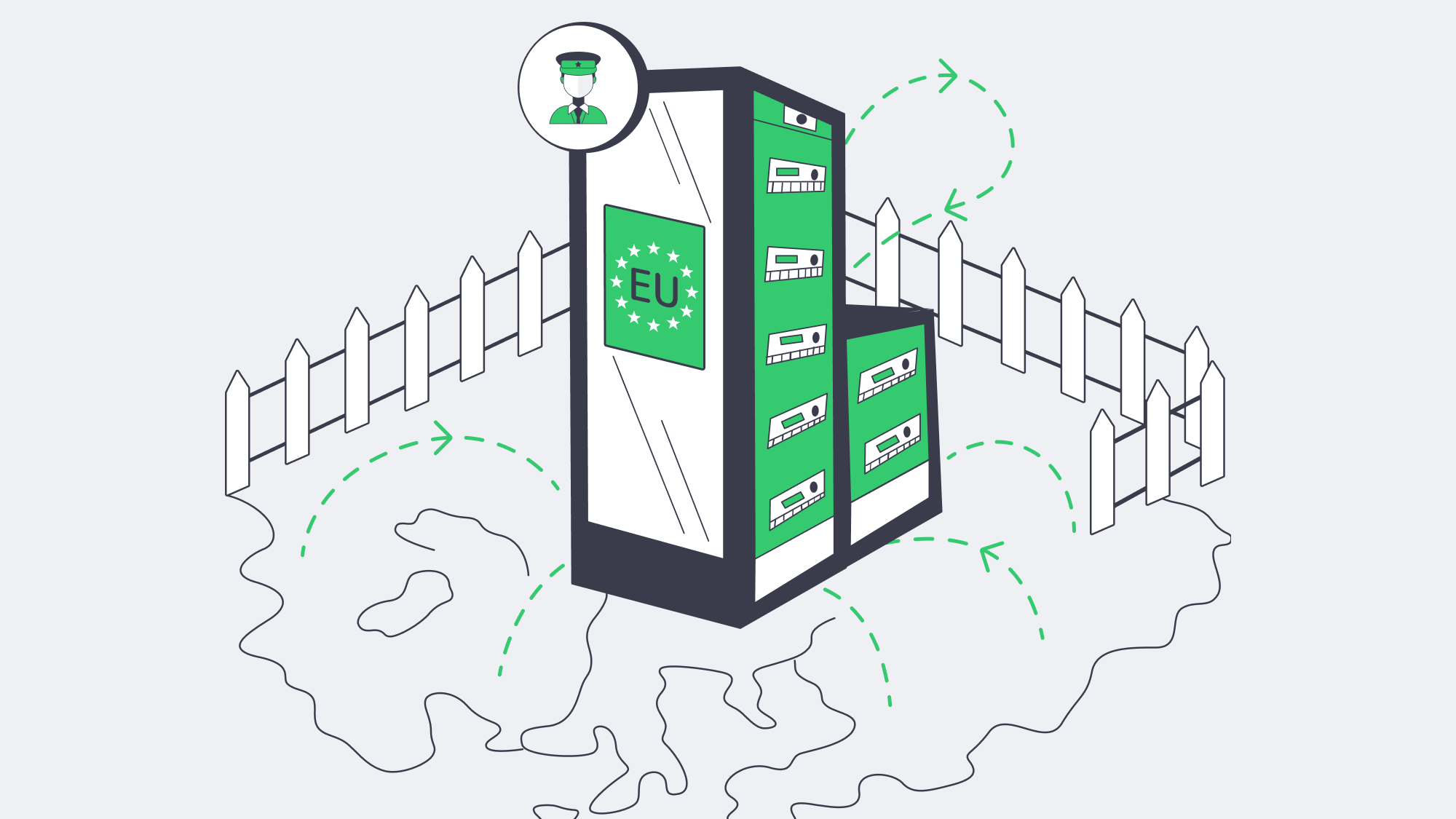
Across the board, data residency has become a genuine concern: state privacy statutes have tightened considerably, and Europe has Schrems II in place. Regionally pinned public-cloud VMs can help with proof of sovereignty to an extent, but a dedicated server gives auditors a cleaner tenancy story because the workload sits on hardware you alone occupy. With Melbicom, clients can document single-tenant hardware placement, whether they are positioning analytics nodes in Amsterdam’s Tier IV hall for GDPR-sensitive workloads or anchoring U.S. customer PII inside our Los Angeles facility.
A dedicated server also makes control boundaries clearer. With VMs, root access is exposed inside the guest, but firmware patching, hypervisor policy, and out-of-band management remain under provider control. With dedicated hosting, teams can govern the stack from BIOS settings to application runtime. Where the CPU and BIOS support it, hardware security features such as enclave encryption can be enabled, and management traffic can be locked to an on-prem VPN by binding the BMC to a private VLAN. Compliance language often demands “demonstrable physical isolation,” and single-tenant hosting makes that isolation easier to prove.
Full Root Access for Engineering Control
Arguably one of the biggest benefits of hosting with a dedicated server is full root access for engineers. Microsecond deterministic trading is possible by recompiling the kernel with PREEMPT_RT; teams can follow packets at nanosecond resolution by dropping in eBPF probes and rapidly deploy a hardened Gentoo build with ease. Kubernetes can run directly on the host, using physical CPU cores in place of virtual slices, which significantly reduces scheduling jitter for latency-sensitive microservices.
Workflows translate cleanly into infrastructure as code, and teams can PXE-boot, image, and enroll a physical host with Terraform or Ansible much like a cloud VM. With sole tenancy, the blast radius is contained if an experiment bricks the kernel: only your sandbox is affected, lowering systemic risk. There are also no hypervisor guardrails dictating rescue procedures, which gives teams more autonomy and accelerates iteration.
How Does Root Access Unlock Bespoke OS and Software Stacks?
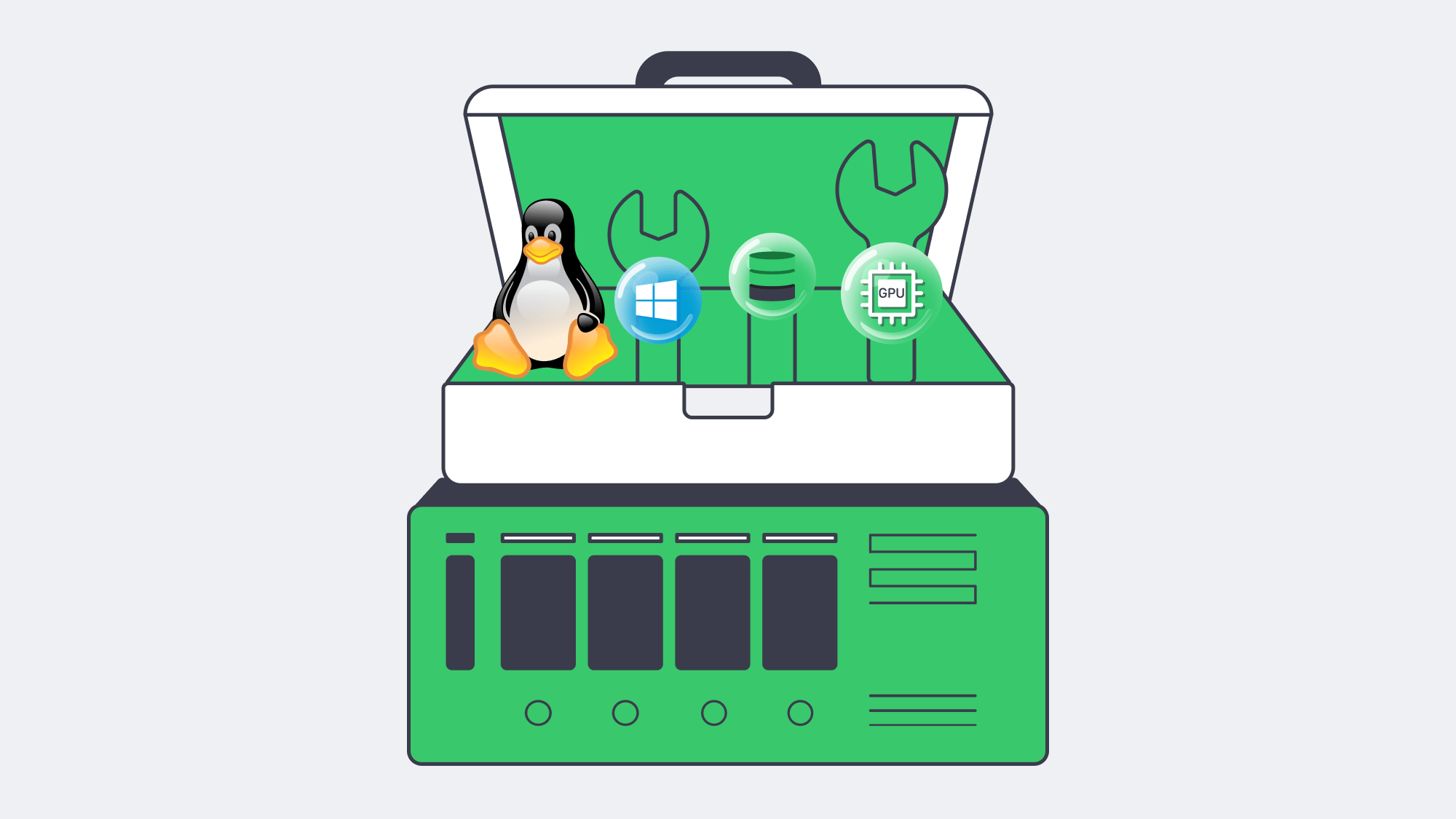
Public clouds often limit OS and software stacks, forcing organizations to find a workaround rather than load what they prefer to use. With sole tenancy and full root access, the operating system is customizable to your needs. Media teams can tune network stacks on FreeBSD, for example, while fintech teams that require stricter crypto-library control can load a distribution and package set aligned with their compliance program. AI labs can install current CUDA drivers on Rocky Linux and reuse a tested image.
You only have to look to open-source databases to understand the upside. Marketplace defaults are usually layered on virtualized disks and may deliver lower sustained write performance than a self-compiled PostgreSQL build tuned for huge pages and direct I/O. With a dedicated server, there is nothing forcing snapshots or stealing cache lines, so even a low-cost setup can outperform a pricey multi-tenant option for the right workload.
How Does a Dedicated Hosting Server Clarify Security and Compliance?
A dedicated hosting server clarifies security and compliance by making the control boundary physical: one tenant, one hardware stack, and fewer hidden provider layers. Teams can place encryption keys in an onboard TPM or external HSM, isolate management paths, route packet captures to SOC tooling, and enforce firewall policy in their own pfSense chain.
The clarity of separation provided by a dedicated hosting server helps address PCI DSS, HIPAA, and GDPR evidence requirements: the hardware is tagged, cables are traceable, and tenancy is not shared. Melbicom further strengthens that posture with optional private VLANs and hardware-component replacement when needed. Essentially, Melbicom takes care of the plumbing, freeing up your security teams to enforce policies.
Hardware‑Level Performance Engineering
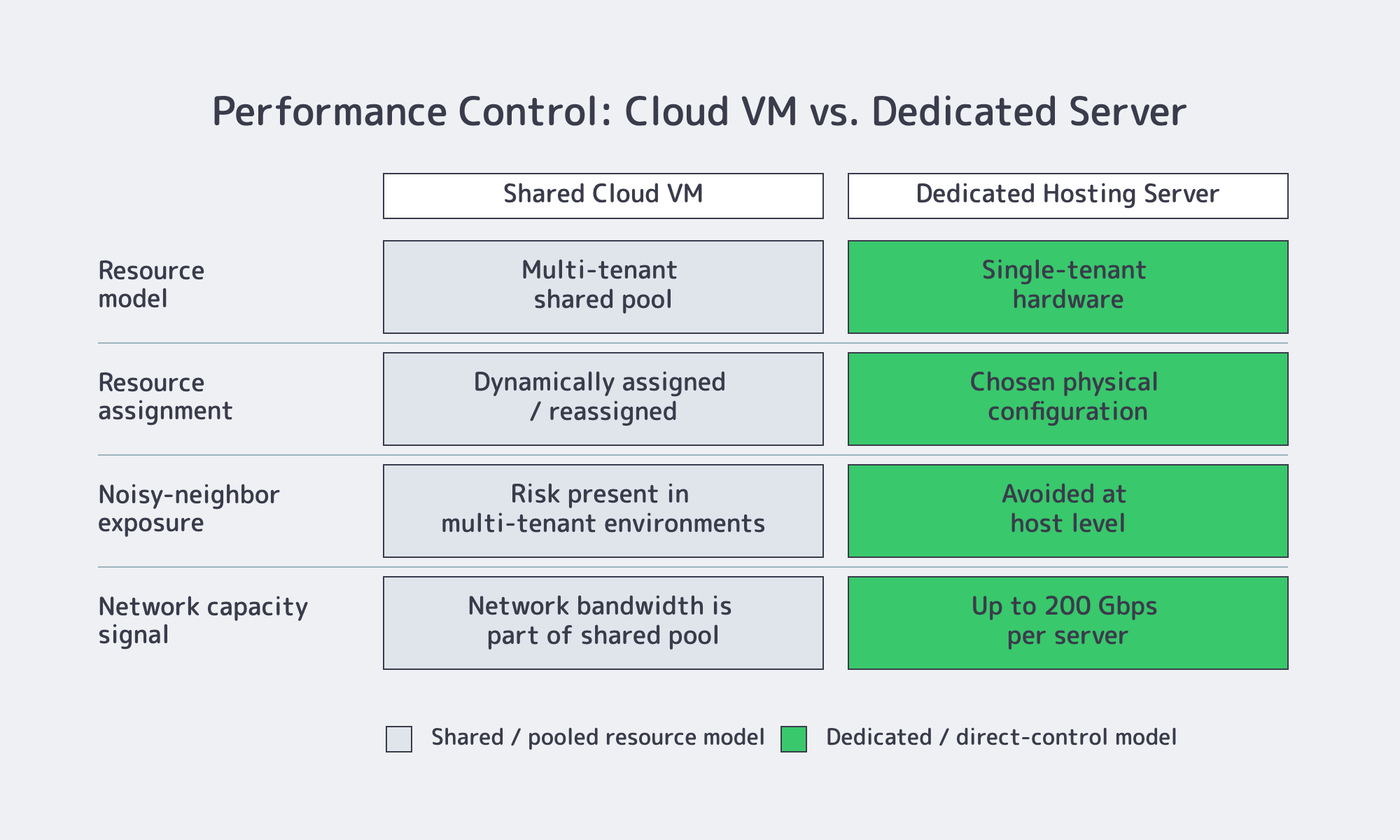
Performance goes beyond raw speed. With VMs, engineers have to architect with noisy neighbors in mind, but this statistical multiplexing is avoided through a dedicated server. With single tenancy, you have worst-case predictability because CPU cycles, cache lines, and NVMe interrupts are yours exclusively. This shrinks long-tail latency and improves performance consistency.
You also unlock performance preferences, be it 56-core Intel Xeon processors for parallel analytics or a front-end burst focus with fewer but higher-GHz cores. Melbicom offers a wide range of server choices. With per-server bandwidth available up to 200 Gbps, real-time video or massive model-training pipelines can be supported without the throttling often experienced with noisy neighbors. We also offer flexible storage tiers, from NVMe RAID-10 for OLTP to spinning disks or hybrid pools where appropriate.
These capabilities are available across even many economical SKUs. Our dedicated servers are transparent to operate, include hardware health monitoring, and provide full IPMI access. That way, if a disk trends toward failure, engineers can request a proactive swap.
Performance Levers on Dedicated vs. Shared Hosting at a Glance
| Layer | Shared Cloud VM | Dedicated Hosting Server |
|---|---|---|
| CPU | Noisy-neighbor risk | 100 % of cores, NUMA control |
| Disk | Virtual, snapshot overhead | Raw NVMe/SAS with custom RAID |
| NIC | Virtual function, capped bandwidth | Physical port, up to 200 Gbps |
How Dedicated Servers Reduce Vendor Lock-In
Historically, the industry is familiar with the promises of frictionless scalability touted by proprietary databases and serverless frameworks—promises that were later complicated by egress fees, licensing traps, and deprecations. Architects learned the hard way that anchoring critical data on hardware they can relocate creates a smoother exit path. PostgreSQL on a dedicated hosting server is portable, Kafka is upstream, and Kubernetes clusters can move without a wholesale rewrite. That makes dedicated infrastructure a practical middle ground if strategy shifts in the years to come. With a dedicated server, moving data from one center or provider to another is possible without rewriting fundamental services, something which will undoubtedly pique the interest of CFOs.
Infrastructure Autonomy as a Baseline

Without assurance that stacks can cope under pressure and clarity on where data lives, fast features are ultimately worthless. Leveraging a dedicated server for hosting addresses both issues. The hardware is transparent, making latency more predictable, and highly customizable security supports data sovereignty and compliance work. Unrestricted root access leaves space for innovation, bespoke software can perform better, and API-driven provisioning retains enough elasticity for experiments.
Ready to Order?
Get dedicated-server control without giving up convenience. Melbicom operates 21 Tier III/IV data centers and offers 1,100+ ready-to-go configurations with two-hour delivery.