
Blog

Dedicated Server Hosting Amsterdam: How to Choose an EU Connectivity Hub
Choosing an Amsterdam deployment should be less about putting “Netherlands” or “EU” on a quote and more about whether the metro behaves like a real connectivity hub under production traffic.
AMS-IX’s February 2026 facts-and-figures update says Amsterdam handled 35.66 exabytes of traffic in 2025, reached 902 connected parties, and grew active port capacity to 69.57 Tb/s. In April 2026, AMS-IX reported a new Amsterdam peak above 15 Tb/s.
That density is the reason Amsterdam works as an EU anchor: peering, transit, and European traffic already converge there. Cushman & Wakefield’s April 2026 EMEA update put Amsterdam at 852 MW of operational data-center capacity; Europe’s largest core markets still represent more than 45% of regional operational capacity.
Choose Melbicom– 1,400+ ready-to-go servers – 21 global Tier IV and III data centers – 24/7 infrastructure support |
 |
Why Dedicated Server Hosting in Amsterdam Works for EU Workloads
Dedicated server hosting in Amsterdam works for EU workloads when one node keeps most Western and Central European users inside roughly 10–25 ms RTT, connects through dense local peering, and supports clean 1–10+ Gbps delivery. The tradeoff is reach: Spain, Italy, and farther-eastern markets may still need a second region for low interactive latency.
Amsterdam’s advantage is path quality. DE-CIX’s FAQ explains that Internet Exchange access can reduce latency by shortening traffic paths and improve resilience by creating more redundant routes. That is the buying logic: a better chance of direct routes into the networks that matter.
Cushman & Wakefield says Amsterdam remains one of Europe’s largest hubs, but growth is shaped by power and permitting constraints. That makes operational evidence more important than expansion narratives: available inventory, test IPs, realistic port speeds, and a provider network that can support traffic after launch.
For Melbicom, the Amsterdam decision framework is intentionally location-specific. Our Amsterdam dedicated server capacity includes 250+ ready-to-go configurations across Tier III and Tier IV data-center environments, Intel and AMD CPU options, and 1–200 Gbps per-server network connectivity. That matters when Amsterdam is not just a server location, but the first node in a wider European delivery design spanning Melbicom’s network backbone, European dedicated servers, and CDN.
Amsterdam Latency, Interconnection, and Bandwidth Requirements to Compare
Dedicated server hosting in Amsterdam should be compared on measured RTT to target metros, peering and transit quality, and whether bandwidth pricing matches sustained throughput rather than burst headlines. A practical cut line is simple: if top markets sit below about 25 ms RTT and 95th-percentile traffic fits the commit, Amsterdam is doing real work instead of only looking central on a map.
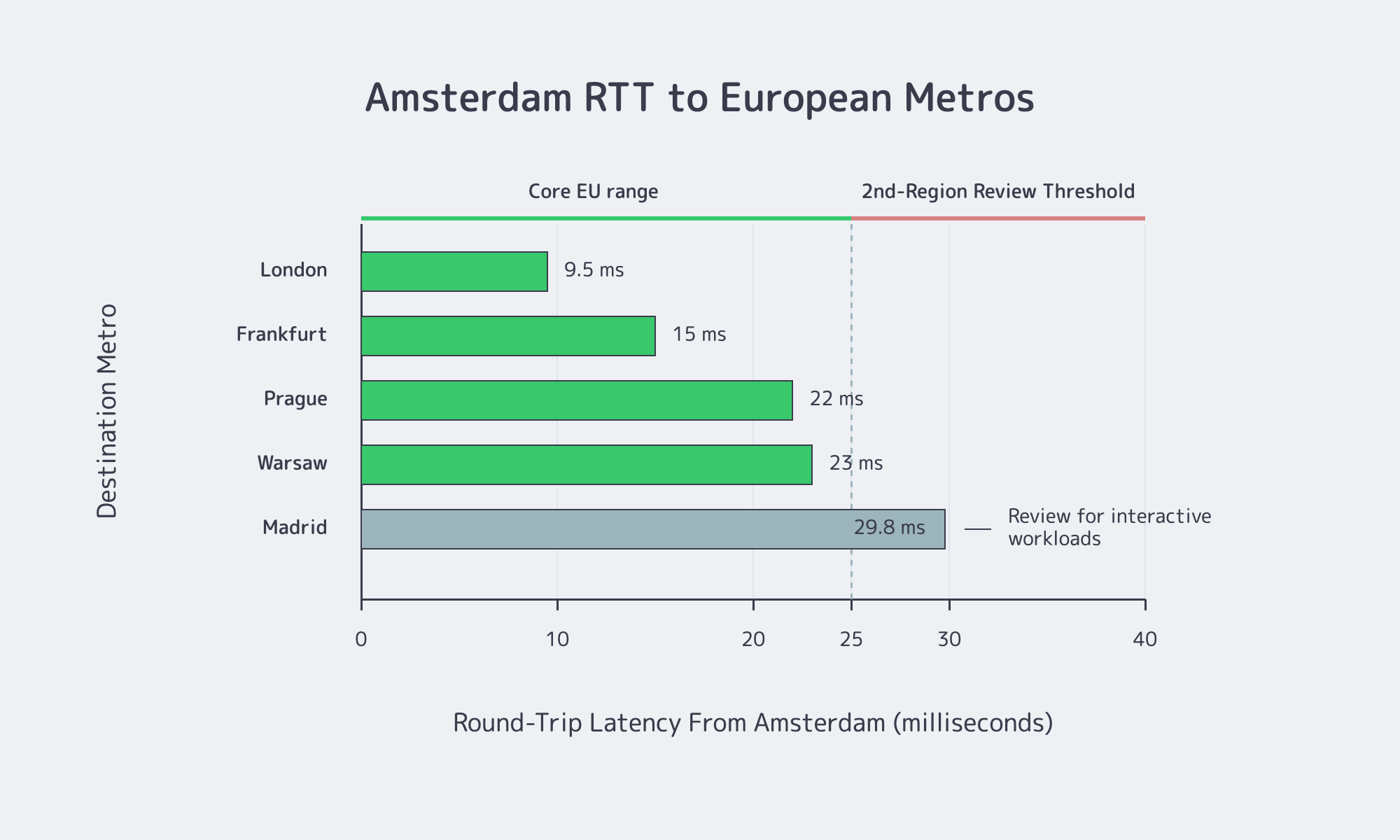
Start with latency. WonderNetwork’s Global Ping Statistics are generated by 30 pings per city pair and displayed as averages; they are not end-user guarantees, but they are useful directional planning data for an Amsterdam origin, API node, or control-plane service. The metros below are also markets where Melbicom has dedicated server capacity, CDN PoP capacity, or both.
| Destination From Amsterdam | Indicative RTT | Operational Takeaway |
|---|---|---|
| London | ~9.5 ms | Strong fit for interactive traffic |
| Frankfurt | ~14–16 ms | Very solid core-market coverage |
| Prague | ~21–23 ms | Strong Central Europe coverage |
| Warsaw | ~23 ms | Acceptable for many workloads; monitor p95 |
| Madrid | ~29.8 ms | Often where a second region starts to make sense |
The pattern matters more than any single sample. London and Frankfurt are excellent; Prague and Warsaw are still reasonable; Madrid is where Amsterdam starts acting like a strong regional core, not a universal edge. A Cloudflare Radar Europe quality view showed continental median RTT at 27 ms, with 18 ms at the 25th percentile and 42 ms at the 75th.
Interconnection is what decides whether those numbers hold under load. A poor route can overwhelm map distance; the fix is simple but often skipped. Ask for test IPs, run traceroutes from priority markets, compare IPv4 and IPv6, and watch whether traffic stays direct during busy windows.
Bandwidth deserves the same discipline. Cloudflare’s bandwidth documentation explains the standard 95th-percentile model: sample utilization every five minutes, discard the top 5%, and size around the highest remaining value. A 10 Gbps port is not automatically a 10 Gbps economic fit if the commit is wrong.
Media workflows expose the risk fastest. YouTube’s current upload guidance recommends about 8 Mbps for 1080p SDR and 35–45 Mbps for 4K SDR uploads. Ingest, cache fill, replication, and mirror traffic can consume real capacity before viewer delivery is counted. API-heavy SaaS may fit 1 Gbps; origins, mirrors, segment distribution, and heavier hosting nodes often start more honestly at 10 Gbps or above.
Amsterdam Resilience and DDoS Protection
Network density does not remove operating risk. Uptime Institute’s May 2025 outage analysis said IT and networking issues accounted for 23% of impactful outages in 2024, nearly 40% of organizations had suffered a major outage caused by human error over the previous three years, and 85% of those human-error incidents involved ignored or flawed procedures.
That makes redundancy a three-layer decision: facility, upstream path, and regional recovery. For low-stakes batch processing, one Amsterdam node may be enough. For customer-facing SaaS, media origins, and hosting platforms, Amsterdam plus route diversity plus a second European recovery point is safer than assuming a healthy server means a resilient service.
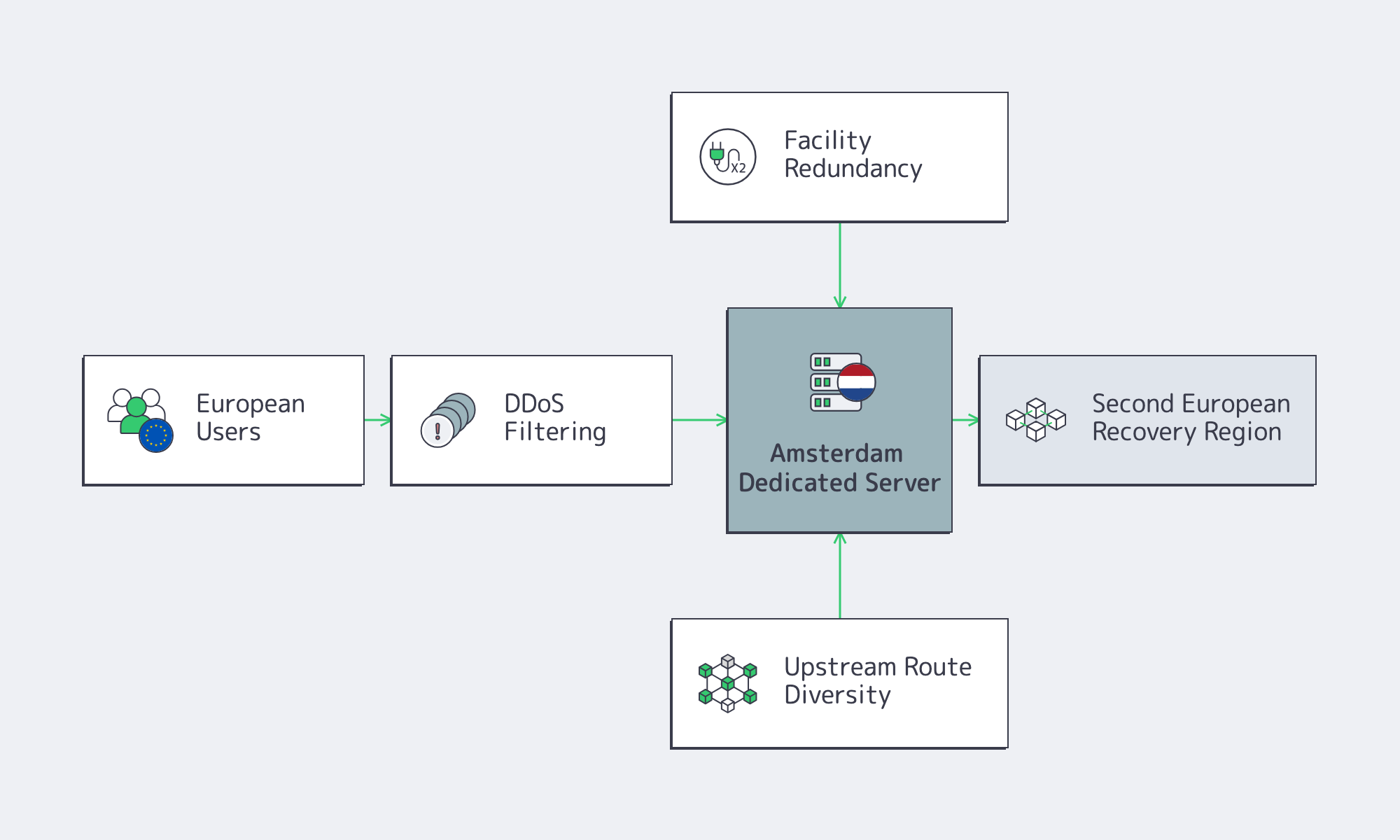
DDoS belongs in the baseline, not the appendix. Cloudflare’s Q1 2025 DDoS report recorded 20.5 million blocked DDoS attacks, up 358% year over year, including roughly 700 hyper-volumetric attacks above 1 Tbps or 1 Bpps. Its Q2 2025 report reported a 7.3 Tbps record attack and more than 6,500 hyper-volumetric attacks. For public Amsterdam nodes, ask where traffic is cleaned, how quickly legitimate traffic returns, how IPv6 is handled, and how user experience behaves during mitigation.
Workload Fit Decides the Amsterdam Choice
For SaaS platforms, Amsterdam is strongest as a control-plane, API, authentication, queue, or database-adjacent node when users cluster in Western and Central Europe. The latency pattern supports that profile, and the IXP density improves the odds of short paths. If a product is highly interactive and large cohorts sit in Southern Europe or farther east, Amsterdam should usually be the core node, not the only node.
For media teams, Amsterdam is especially useful for ingest, origin, packaging, storage-adjacent processing, and traffic-heavy control layers. Those jobs benefit from dense peering and higher port options, but they also punish under-bought bandwidth. Once replication, VOD movement, or cache fill becomes routine, the design usually looks better with larger ports and adjacent CDN logic. Melbicom’s CDN operates in 55+ locations across 39 countries, including Amsterdam, Frankfurt, London, Madrid, Paris, Prague, Palermo, and Warsaw, which makes the dedicated-server decision easier to connect to distribution strategy instead of treating origin and delivery as separate projects.
For hosting teams, Amsterdam fits mixed European demand where predictable route quality, peering, and high-throughput delivery matter more than physical proximity to one national audience. Shared hosting clusters, download nodes, mirrors, reverse proxies, and service platforms all fit that model. The actual test is whether Amsterdam matches the application’s latency budget, attack exposure, and sustained egress profile.
When Amsterdam Should Anchor Europe
Amsterdam should anchor a multi-region European deployment when Amsterdam keeps most users within the latency budget and can serve as the control-plane, origin, or ingest hub. Use Amsterdam first for Western and Central Europe, then add another region when large cohorts exceed roughly 25–30 ms RTT or failover must survive metro-level faults.
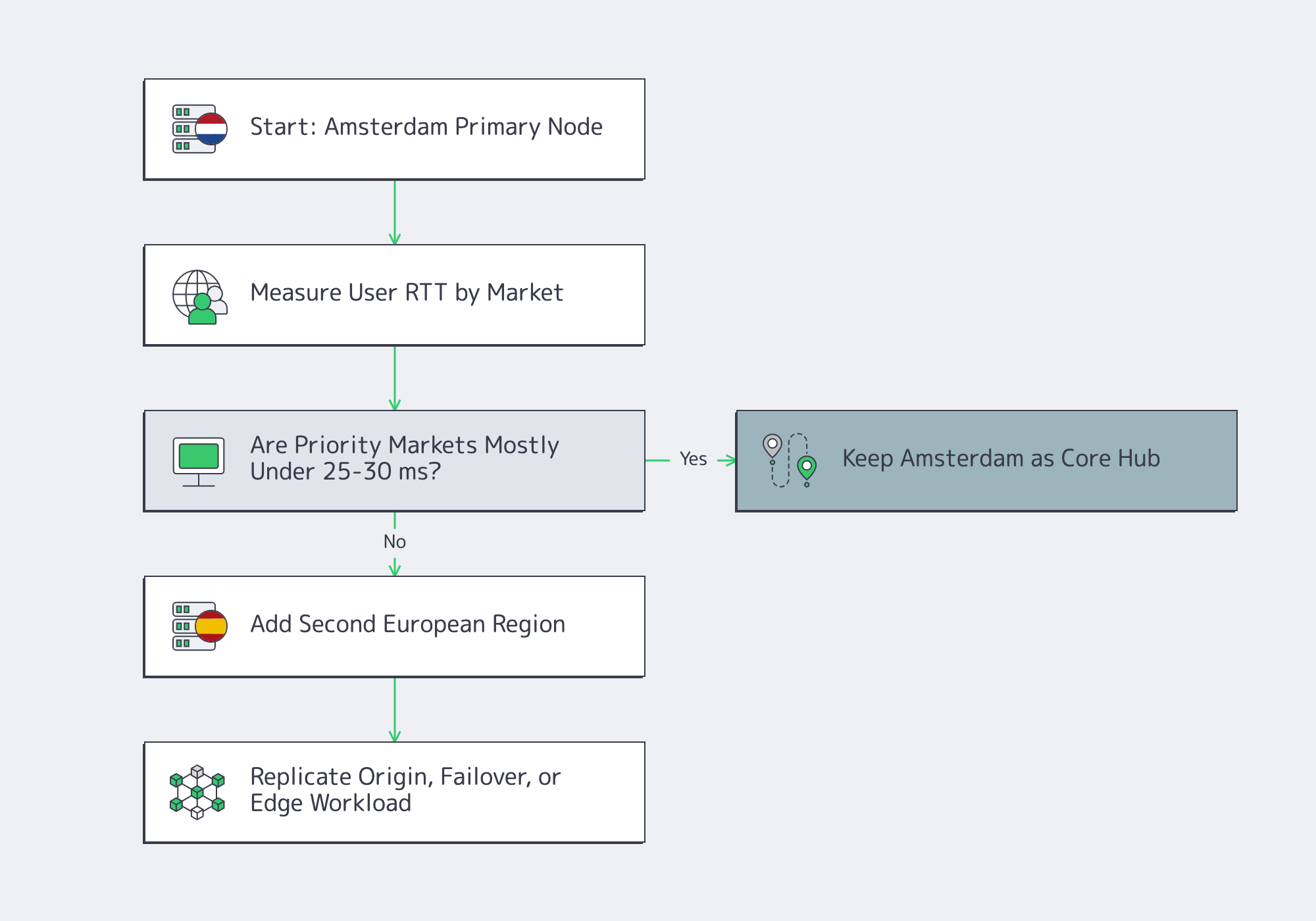
In practice, that means expanding from telemetry, not ideology. If Spain, Italy, or farther-edge cohorts miss the latency target, a second region stops being theoretical optimization and becomes product work. If outage tolerance is low, the second region is also non-negotiable because metro-level redundancy is not the same as European resilience.
This is where a broader footprint matters. Melbicom’s Amsterdam location can be combined with dedicated server locations such as Frankfurt, Madrid, Paris, Palermo, Warsaw, Riga, Vilnius, and Sofia, plus CDN PoPs in adjacent European markets. The cleanest pattern is usually Amsterdam first, then expand without rebuilding the network model.
The Practical Shortlist

The practical Amsterdam test is not “is this server in the Netherlands?” It is whether the Amsterdam node can hold the latency budget, route cleanly, absorb sustained traffic, survive failures, and fit the workload’s shape. Use five checks:
- Measure actual RTT from Amsterdam to real user markets; if large cohorts sit above roughly 25–30 ms, plan a second region early.
- Favor dense interconnection and route diversity over the cheapest nominal port.
- Buy bandwidth around sustained 95th-percentile traffic, not the biggest port headline.
- Treat redundancy as facility, upstream, and regional—not just server health.
- Assume DDoS pressure is part of the baseline design for public workloads.
For teams that want Amsterdam to behave like a practical EU hub instead of a symbolic location pin, the winning design is specific: measured latency, direct routing, correctly sized bandwidth, layered redundancy, and workload placement that respects geography. That is the natural point to evaluate Amsterdam capacity against real traffic plans rather than against a generic regional checkbox.
Explore Amsterdam Dedicated Servers
Melbicom’s Amsterdam dedicated servers give teams 250+ ready-to-go configurations, Tier III and Tier IV facility options, 1–200 Gbps per-server network connectivity, 1–100 Gbps bandwidth tiers with 50 TB or unmetered plans, and a path into Melbicom’s European infrastructure, network backbone, and CDN footprint. The value is highest when Amsterdam is treated as a measured EU anchor—not a shortcut around latency physics.
Deploy Dedicated Servers
Choose ready-to-go dedicated infrastructure and scale capacity without guessing.
Get expert support with your services
Blog

Dedicated Server BTC: How to Buy Bare Metal with Bitcoin w/o Payment Friction
The hard part of paying for a production dedicated server with BTC is usually not Bitcoin. The hard part is the seam between treasury, billing, and provisioning: invoice timers, confirmation policy, identity checks, renewal handling, refund math, and the moment the hosting account actually shows funds available.
That distinction matters because Bitcoin payment status is layered. Bitcoin.org’s confirmation explainer says each confirmation can take from seconds to 90 minutes, with 10 minutes as the average, and the first confirmation can take much longer when the fee is too low. Invoice systems then add quote windows, underpayment states, overpayment states, and manual exceptions.
BTC Payments– Clear invoice flow – Dedicated server capacity – 24/7 support |
|
How Dedicated Server BTC Payment Works
Dedicated server BTC payment works cleanly when invoice terms, confirmation thresholds, and account-credit timing are known before funds move. Treat “sent,” “confirmed,” and “posted to the hosting account” as separate states. For production orders, activation should begin only after the provider states which state unlocks provisioning.
In Web3 shorthand, “bare metal” often means a dedicated server: single-tenant hardware with predictable capacity. The payment workflow should be just as deterministic: choose stock versus custom hardware, confirm the invoice currency, BTC method, expiration window, confirmation policy, and provisioning trigger, then send funds.

Avoid BTC Invoice Drift
The lowest-friction way to buy dedicated server with BTC is to settle infrastructure details before payment details. Decide whether the order is stocked or custom, get the exact hardware scope priced, ask what confirmation threshold unlocks provisioning, ask who enables crypto billing, and only then request the invoice.
If the invoice expires, regenerate it. BTCPay’s invoice states include expired, paid late, paid partial, paid over, processing, invalid, and settled. For a server order, every exception can slow deployment.
Underpayment deserves special attention. Use a wallet flow that can send the exact invoice amount and choose a fee policy designed for timely confirmation.
Bitcoin Invoices, Confirmations, KYC, and Renewal Risks to Check
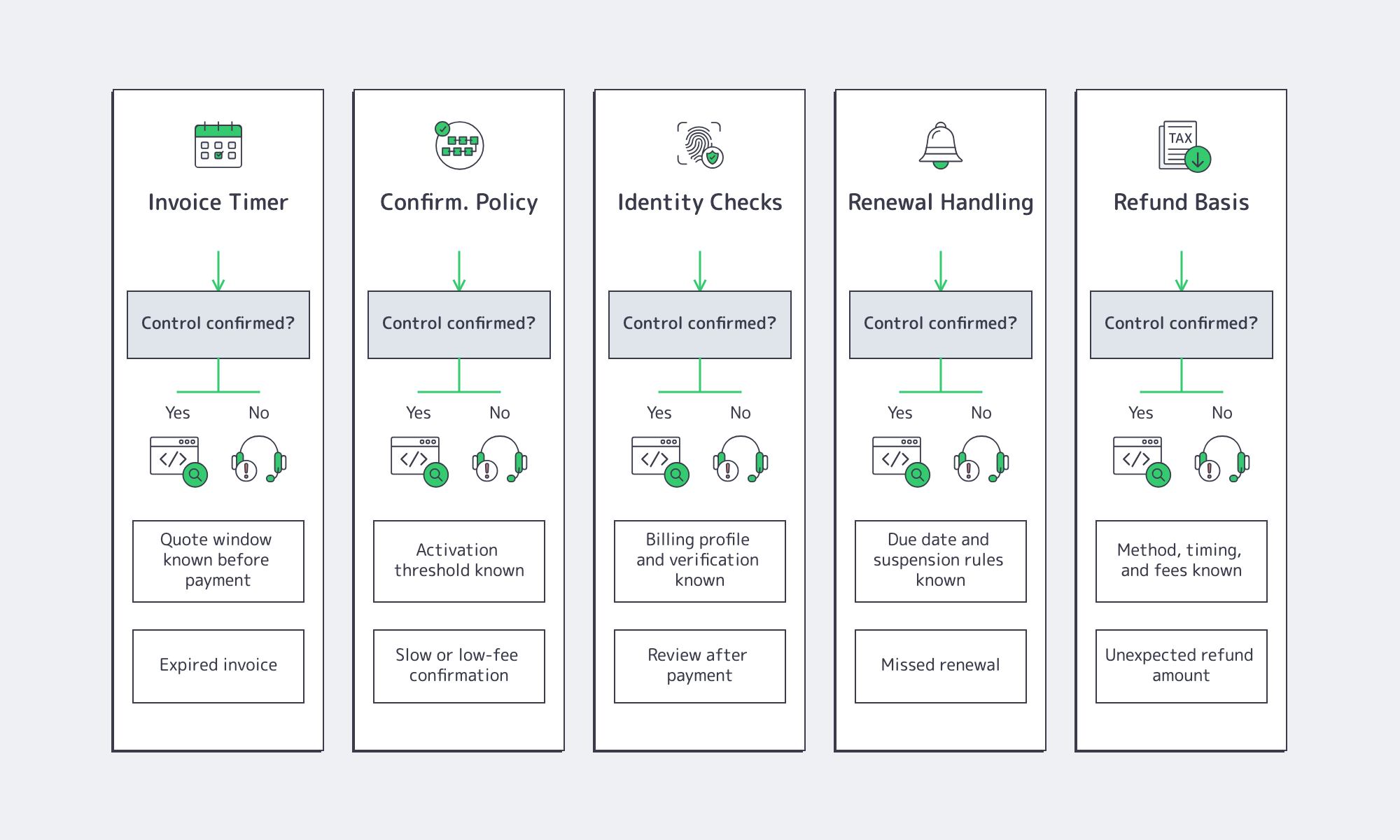
Bitcoin server invoices fail most often at five handoffs: quote expiry, slow confirmations, identity review, missed renewals, and refund handling. A buyer who verifies the invoice timer, required confirmations, renewal trigger, and refund basis before checkout removes most payment friction before hardware procurement starts.
| Procurement check | Good answer sounds like | Red flag sounds like |
|---|---|---|
| Invoice timer | “The quote is locked for this long; expired invoices must be reissued.” | “Send it if the address still works.” |
| Confirmation policy | “Activation starts at this status; account credit posts at this later status.” | “We’ll see it when it arrives.” |
| Identity requirements | “These billing details or documents are required before payment.” | “It depends after you pay.” |
| Renewal handling | “Invoices post here, due here, suspension starts here, restoration works like this.” | “Pay right at expiry and it should be fine.” |
| Refund basis | “Refunds follow this path, timing, method, and fee rule.” | “We’ll sort it out manually later.” |
Invoice risk is exchange-rate risk wearing a UX costume. Fixed-rate invoices preserve quoted fiat value for a limited window. That helps the seller, but it pressures teams using approvals, multisig coordination, or staged treasury workflows. Do not request a BTC invoice until the purchase order, signer availability, and fee policy are ready.
Confirmation risk is partly fee risk. Bitcoin.org’s 10-minute average is not a delivery guarantee; the first confirmation can run longer, especially at a low fee. Ask whether provisioning starts at transaction detection, one confirmation, six confirmations, or only after the balance is allocated to the hosting account.
Identity risk is policy-driven, not protocol-driven. FATF’s updated virtual asset guidance says virtual-asset service providers must apply preventive measures such as customer due diligence and transfer-data obligations where applicable. Melbicom’s services agreement also requires accurate customer information and allows suspension or blocking when requested verification documents are not provided.
Renewals and refunds are where dedicated server BTC becomes operations. Melbicom invoices in advance through the Personal Account, and payment is complete only after funds are received and allocated there. If the next period is unpaid, service may suspend when the paid period ends. Data on physical servers may be retained for up to two days after suspension, restoration may take up to 24 hours after full payment is received and allocated, and refunds are processed within 30 days using the agreed payment method, with payment-system fees borne by the customer.
When Buying a Dedicated Server with BTC Makes Operational Sense
Buying a dedicated server with BTC makes operational sense when the workload has a real hardware floor and the billing path is explicit. If a workload needs multi-terabyte SSDs, 1–10 Gbps connectivity, or same-day deployment, payment ambiguity becomes a reliability risk rather than a back-office inconvenience.

This is why the dedicated server BTC decision belongs in infrastructure planning, not at checkout. Ethereum.org’s node guide recommends a fast 4+ core CPU, 16 GB+ RAM, a fast 2+ TB SSD, and 25+ Mbit/s bandwidth; full archive footprints range from about 2.2 TB to 12 TB+ depending on client. Agave validator requirements are steeper: 12 cores / 24 threads or more, 256 GB RAM or more, separate NVMe volumes, 1 Gbit/s for an unstaked node, at least 2 Gbit/s for a staked node, and 10 Gbit/s recommended for stable operation.
The takeaway is blunt: if storage layout, port speed, and deterministic performance matter, a vague BTC payment flow can become an outage vector.
When BTC Payment Makes Sense
Buy dedicated server capacity with BTC when the provider can state the invoice timer, confirmation threshold, payment-posting event, renewal trigger, and refund basis before the first satoshi moves. If those rules remain vague, BTC stops being a convenience and becomes an avoidable uptime risk.
For Melbicom, the best fit is a buyer that already knows its target region, hardware floor, port speed, expected renewal cycle, and deployment timeline. Melbicom’s 1,400+ ready-to-go configs, custom server builder, payment, and support paths make those checks part of the buying process.
Dedicated Server BTC Buyer Checklist
The clean BTC order is the one whose moving parts are explicit before finance signs anything. Use this as the final check against Melbicom’s payment methods, server builder, account-management flow, and support process.
- Confirm whether the order is a stocked configuration targeting about 2-hour activation or a custom configuration typically delivered in 3–5 business days.
- Ask which event marks successful payment for the order: network detection, one confirmation, six confirmations, or actual allocation inside the Personal Account.
- Get the invoice timer in writing and confirm what happens if payment lands after expiry, arrives under the quote, or arrives over the quote.
- Verify whether billing profile fields, account login steps, or verification documents are required before invoice issuance, renewal, or refund handling.
- Know the renewal path: Melbicom invoices in advance, may suspend service when the paid period ends, and may take up to 24 hours to restore service after payment is received and allocated.
- Ask how refunds are calculated and routed, because refund amount, timing, payment method, and fees may not mirror the original BTC amount sent.
Make the BTC Payment Rail Boring Before the Server Goes Live

The point of paying for a dedicated server with BTC is not to turn procurement into a crypto experiment. The point is to give treasury a payment rail that matches how the team already operates while keeping infrastructure delivery predictable. That requires boring details: invoice windows, confirmation policy, identity requirements, renewal timing, refund math, and account-credit rules.
Melbicom’s role in that workflow is practical. We give buyers a way to evaluate production infrastructure first—server availability, region, bandwidth, support path, and deployment timing—then route the payment conversation through the account-management and billing process. That is how dedicated server BTC procurement should feel: explicit before payment, traceable after payment, and unremarkable once the server is live.
Buy Dedicated Servers with Bitcoin
Use BTC billing with ready-to-go configs, custom builds, and 24/7 support.
Get expert support with your services
Blog

Data Centers in California: Low-Latency Infra Without Capacity Risk
Choosing among data centers in California is a routing and capacity decision. Los Angeles is usually stronger for Southern California user traffic, Pacific-facing routes, and fast first-node deployment. Santa Clara is stronger for Bay Area adjacency and dense east-west interconnection. The risk is assuming low latency automatically means usable capacity.
The practical comparison is measured latency, energized power, interconnection reach, sustainability exposure, and deployment speed. The winning site proves the route, powers the rack, and ships capacity fast.
LA Servers– West Coast placement – Fast activation – Global Melbicom backbone |
|
How Data Centers in California Compare for Latency and Capacity
Data centers in California should be compared by measured user-to-server latency first, then by deliverable capacity. Los Angeles often wins for Southern California and Pacific-facing workloads; Santa Clara wins for Bay Area adjacency. A site with attractive latency but no energized power, carrier diversity, or expansion path is a capacity risk, not a platform.
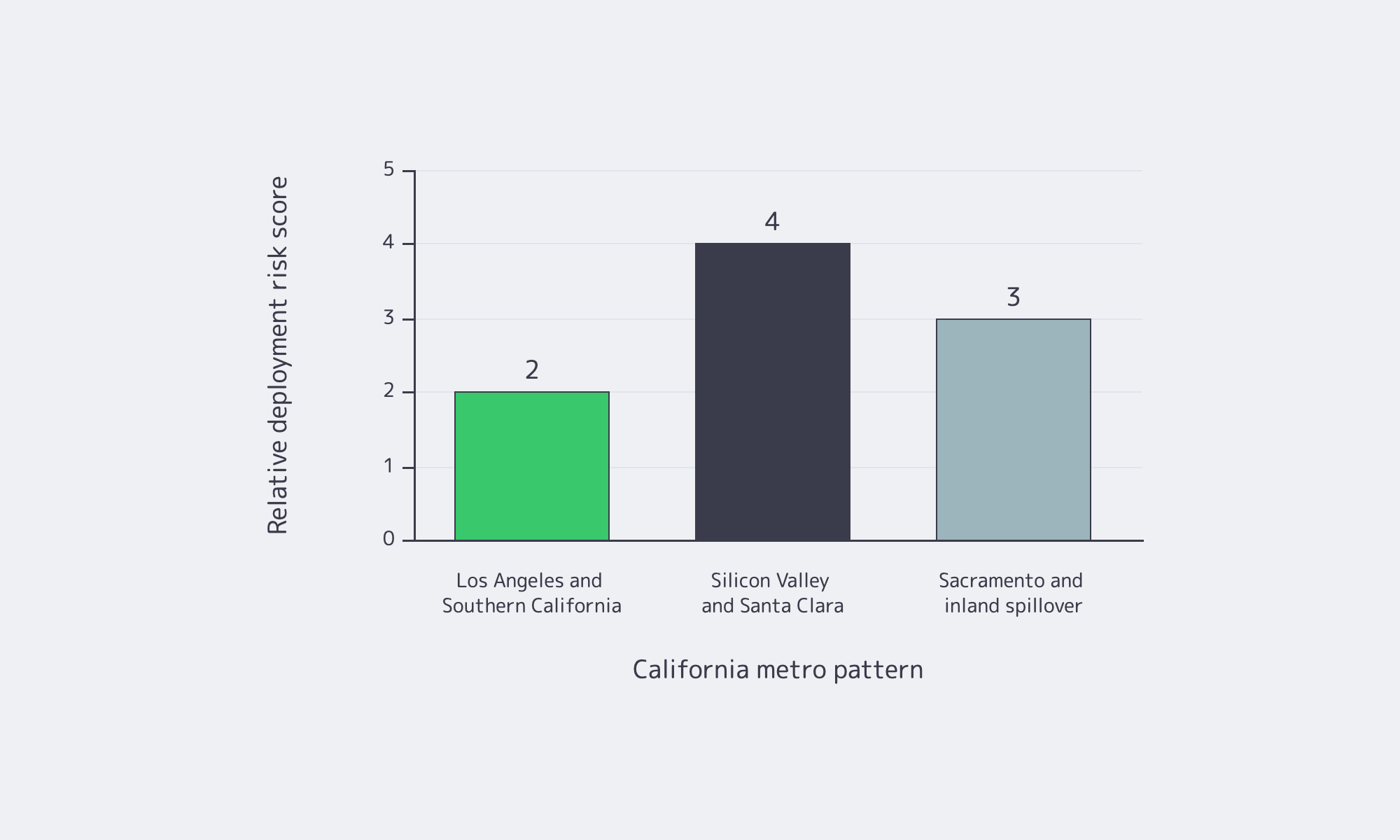
The California Energy Commission says California has more than 200 active data centers, using roughly 1,000 MW, about 2% of CAISO peak demand, in early 2026; by 2040, the forecast rises to 4,500 MW, or 9% of peak demand. CAISO separately says CEC forecasts data-center load on the ISO grid increasing by 1.8 GW by 2030 and 4.9 GW by 2040. Those numbers explain why “available California capacity” needs proof.
| California Metro Pattern | Best Fit | What to Validate First |
|---|---|---|
| Los Angeles and Southern California | Southern California users, Pacific-facing routes, fast first-node deployment | Energized power, carrier diversity, trace performance to major eyeball networks |
| Silicon Valley and Santa Clara | Bay Area users, cloud-adjacent traffic, interconnection-heavy tiers | Utility energization date, contiguous capacity, cross-connect plan, public PUE data |
| Sacramento and inland spillover | Overflow capacity and less latency-sensitive tiers | Added RTT, utility path, backhaul design, cooling and water model |
CBRE’s H1 2025 data-center reporting said Southern California had available retail and wholesale inventory. In Silicon Valley, power constraints limited new supply and pushed vacancy to a record-low 4.5%. Santa Clara city materials show more than 50 data centers; a 2025 city study session counted 56 active or under-construction standalone sites.
Latency still matters inside the state. Using standard light-in-fiber assumptions, the physical RTT floor is roughly 1.8 ms between Los Angeles and San Diego, about 4.8 ms between Los Angeles and San Jose, and about 6.6 ms between San Jose and San Diego before route stretch, switching, and congestion. For API-heavy, cache-sensitive, multiplayer, or real-time bidding systems, single-digit milliseconds are a budget. But routing can erase geography: a closer site that hairpins through poor transit can lose to a farther site with cleaner interconnection.
Interconnection Is What Separates Strong Data Centers in California
If latency is the headline, interconnection is the body text. TeleGeography’s 2025 State of the Network identified a downtown Los Angeles facility as the world’s most carrier-dense colocation site, and its submarine-cable research keeps California visible as a Pacific landing geography. PeeringDB exists for exactly this diligence: checking which networks, exchanges, and facilities are actually reachable.
The practical test is not “does this metro have carriers?” It is “which carriers, which exchanges, which cross-connect path, and what does the first packet to my top destination ASNs do?” Buyers should run traces and synthetic probes from the user networks that matter, then compare the results with facility-level interconnection data.
Dedicated Servers Versus Colocation for California Workload Deployment
Dedicated servers usually beat colocation for California workload deployment when the constraint is usable capacity speed, not hardware ownership. If a new node must go live in days rather than weeks, pre-racked dedicated inventory is the lower-risk path. Choose colocation when specialized owned hardware or custom physical topology is required.
In colocation, the customer owns the servers and leases the facility environment. The data center solves space, power, cooling, and physical security, but the customer still has to procure, ship, stage, install, cable, and manage hardware before production traffic moves. Dedicated servers remove that front-end hardware lifecycle from the critical path because the infrastructure is already inside the provider environment.
That matters because capacity is tight. JLL’s year-end 2025 data-center analysis said North American vacancy stayed at a record-low 1% for a second consecutive year, with 92% of under-construction capacity already precommitted. Uptime Institute’s 2025 survey found operators dealing with power constraints, supply-chain delays, and density-driven planning problems. In that market, deployment speed is risk control.
For California-facing capacity, dedicated servers in Los Angeles solve the first-node problem. Melbicom’s Los Angeles location includes 50+ server configurations in a Tier III data center. Across all dedicated server locations, Melbicom offers 1,400+ ready-to-go options, custom configurations in 3–5 business days, 20 other Tier III and Tier IV data centers, per-server connectivity up to 200 Gbps, 25+ IXP peering hubs, and 20+ transit partners worldwide.
Colocation still has a place. If a deployment depends on specialized appliances, long-lived owned assets, or a physical topology that a provider-led dedicated model cannot match, colocation is the cleaner fit. But when the blocker is “we need ten more West Coast nodes before the quarter ends,” dedicated servers are usually faster.
Power, Interconnection, and Sustainability Risks to Validate Before Deployment
Power, interconnection, and sustainability risks should be validated before any California deployment because one wrong assumption can neutralize every latency gain. Ask for three proofs up front: energized power delivery dates, exact carriers and exchanges reachable from the rack, and cooling and water data detailed enough to estimate carbon, cost, and local exposure.

Start with power. CAISO makes an important distinction: the ISO does not study retail load interconnections; those are governed by local utility tariff and process. A site with “planned megawatts” but no firm utility path is not deployable capacity. In May 2025, PG&E said it was seeing 8.7 GW of data-center-related electricity demand over the next decade, including 1.4 GW in final engineering and 4.1 GW of new requests through an additional cluster study.
Interconnection needs the same skepticism. PeeringDB and carrier lists are starting points, not proof. Buyers should validate the exact facility or campus, the cross-connect path, and measured latency to priority ASNs. A one-millisecond metro advantage disappears quickly if traffic exits through the wrong upstream.
Sustainability Exposure in Data Centers in California Is Local
Sustainability exposure in data centers in California is local, not generic. A 2026 Berkeley Law report said California still lacks a complete picture of data-center water use, current reporting is incomplete, and development speed warrants better disclosure. The report also framed the key tradeoff: water-saving cooling can consume more energy, while energy-efficient cooling can use more water.
That makes cooling method, water source, and reporting posture operational issues. Santa Clara recycled-water rules require recycled water for non-potable uses where available, suitable, and economically feasible, including industrial cooling systems with operational-plan requirements. The CEC benchmarking program requires annual energy-use disclosure for standalone data centers over 50,000 square feet and data centers inside buildings larger than 50,000 square feet. And the U.S. Department of Energy says data-center cooling can account for up to 40% of total data-center energy use, making cooling architecture a cost and sustainability variable.
Low-Risk California Deployment Pattern
A low-risk California deployment pattern puts latency-sensitive entry points closest to users and routes, then places less latency-sensitive scale where capacity is less fragile. Southern California can serve first-hop application tiers; broader U.S. capacity can absorb overflow, back-end processing, and non-interactive workloads when coastal power or lead time becomes the constraint.
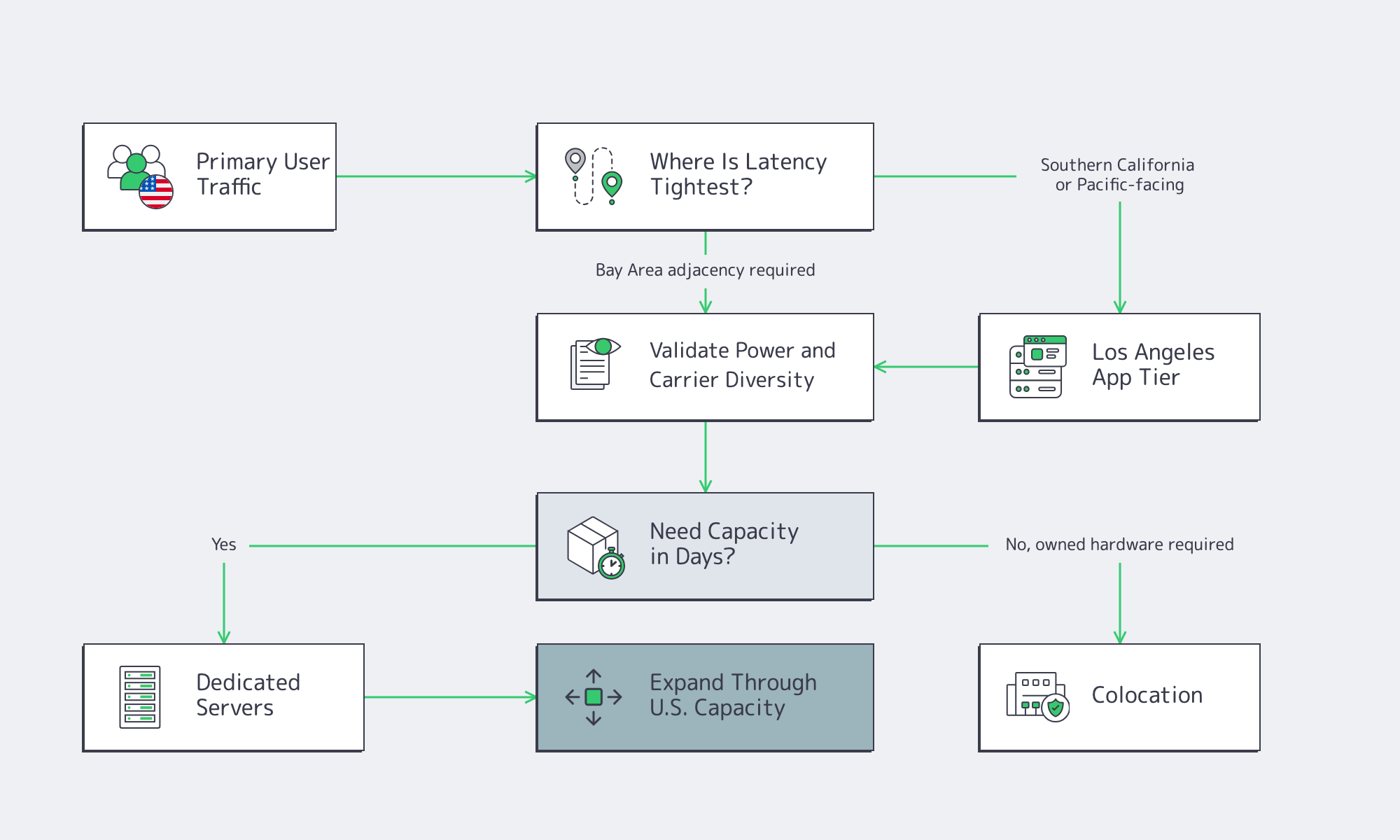
Before signing anything, ask for these proof points:
- A utility-backed energization timeline, not just total designed megawatts.
- Facility-level carrier and exchange reach, checked against PeeringDB and validated with live test traces.
- Measured latency from the ASNs that matter, not generic nearby-region ping tests.
- Cooling and water disclosures, including PUE, cooling architecture, recycled-water use where applicable, and public benchmarking data.
- A deployment-speed plan that identifies the pre-production steps still on your side before launch.
Two inputs should still be revalidated at deal time: facility-level cross-connect pricing and live utility energization dates for the specific building or campus. The latency floors above are illustrative physics estimates, not provider-specific production benchmarks; real routing policy, congestion, and carrier choice can move observed latency materially higher.
Build Low-Risk Latency Capacity
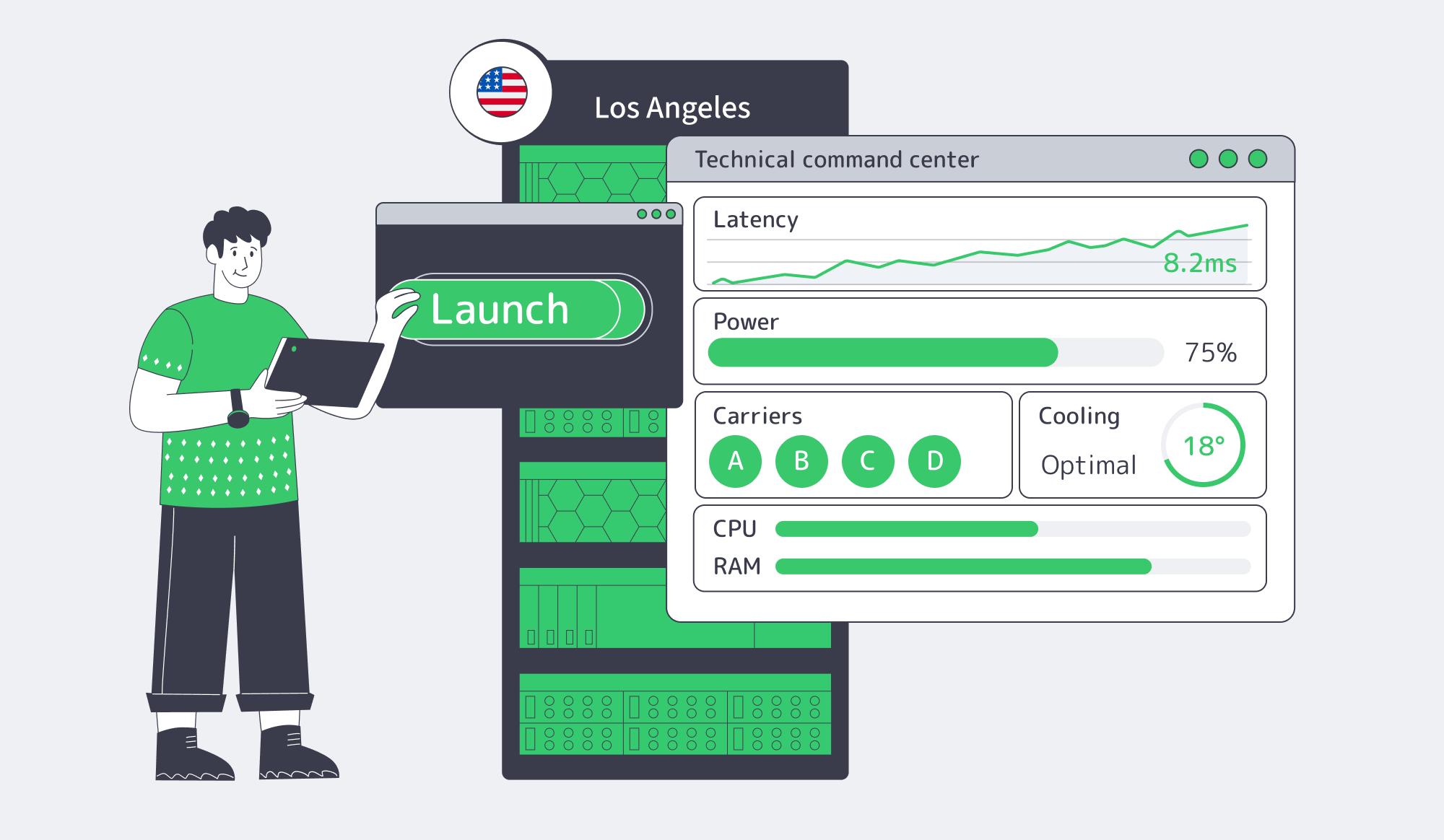
California data centers should not be selected by map distance alone. The practical route is to measure user latency, confirm energized power, verify facility-level interconnection, and test sustainability exposure before committing nodes. Dedicated servers are the faster choice when the deployment schedule is tighter than the hardware supply chain.
For teams building California and West Coast capacity, the question is not whether California is attractive. It is whether the first deployment can stay fast without trapping future growth in a power- or cross-connect-limited site. That is where Melbicom’s Los Angeles footprint becomes a practical starting point, not a generic regional claim.
Deploy in Los Angeles
Launch dedicated server capacity close to West Coast users without waiting on colocation timelines.
Get expert support with your services
Blog

Asia Dedicated Server Buying Guide for Low-Latency APAC Growth
Choosing an Asia dedicated server is not a map exercise. A workload that feels local from Singapore can feel distant from Tokyo, Mumbai, or Fujairah. Start with measured user paths: where sessions originate, which networks carry the traffic, what latency budget the product can tolerate, and where regulated data is allowed to live.
The practical question: should the first deployment land in Singapore, Tokyo, Mumbai, or a multi-site design using Asia dedicated servers?
Asia Servers– Singapore, Tokyo, Mumbai – High-bandwidth capacity – 24/7 support |
|
How Should You Choose an Asia Dedicated Server for APAC Workloads?
Choose an Asia dedicated server by setting a per-market latency target first, then testing routes from real user networks before buying. For interactive SaaS traffic, keep P95 round-trip latency under roughly 80 ms where possible. Above 150 ms, design the workload as regional, asynchronous, or read-heavy instead of pretending one site serves all APAC users equally across markets.
The practical sequence is user clustering, route testing, port sizing, compliance review, and failover design. That order matters. A 10 Gbps port in the wrong city still gives users the wrong path. A compliant data location with weak peering still creates tickets. A failover site that shares the same upstream risk is not meaningful resilience.
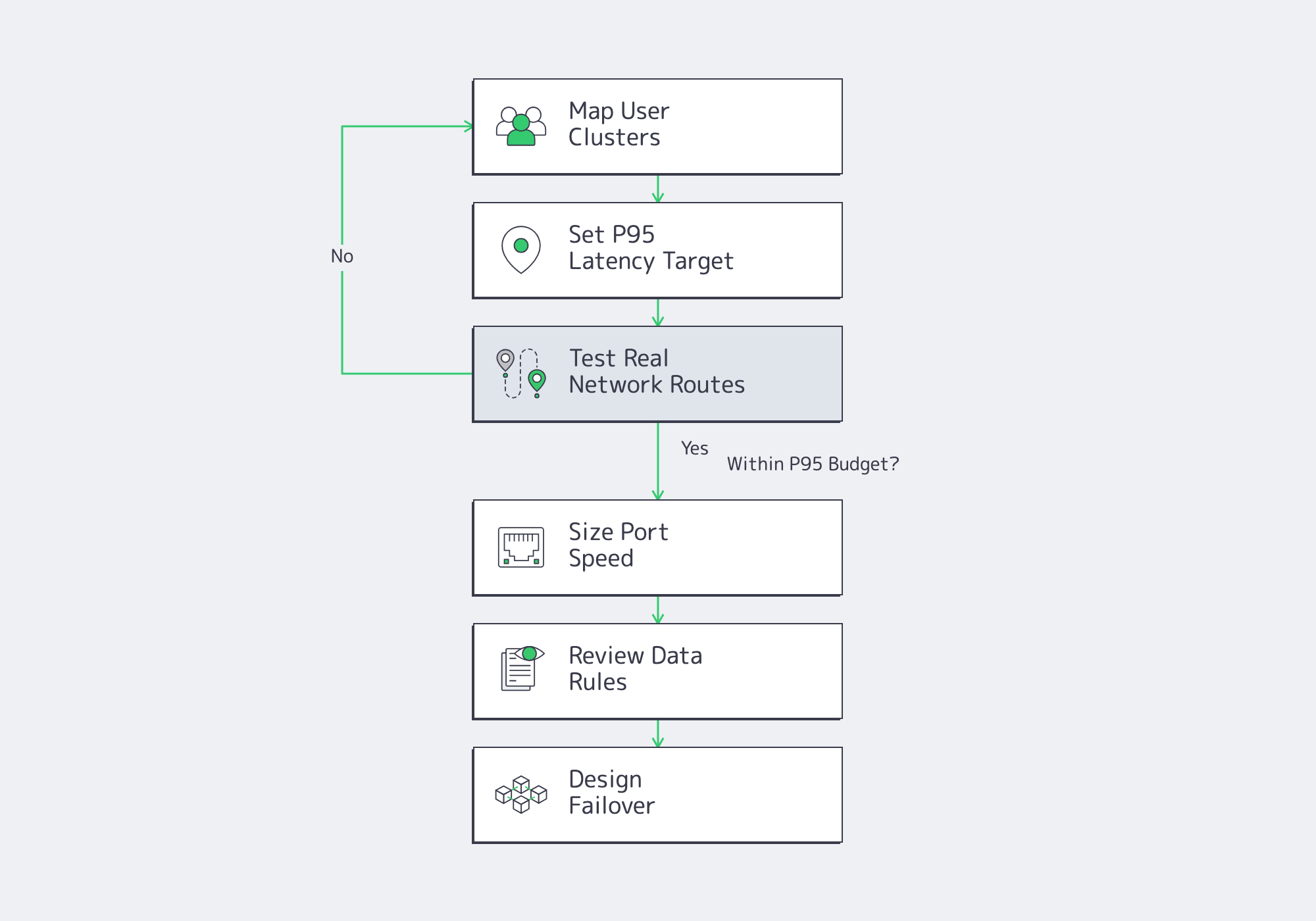
Melbicom’s Asia footprint, network backbone, 25+ IXP peering hubs, 20+ transit partners, and dedicated server bandwidth options up to 200 Gbps help match workloads to routes.
Where an Asia Dedicated Server Should Be Placed for APAC Users
An Asia dedicated server should be placed closest to the largest latency-sensitive user cluster, not necessarily at the geographic center of APAC. Put write-heavy application tiers within roughly 50–80 ms RTT of core users, then use secondary sites for failover or read replicas when cross-region paths exceed about 100 ms.
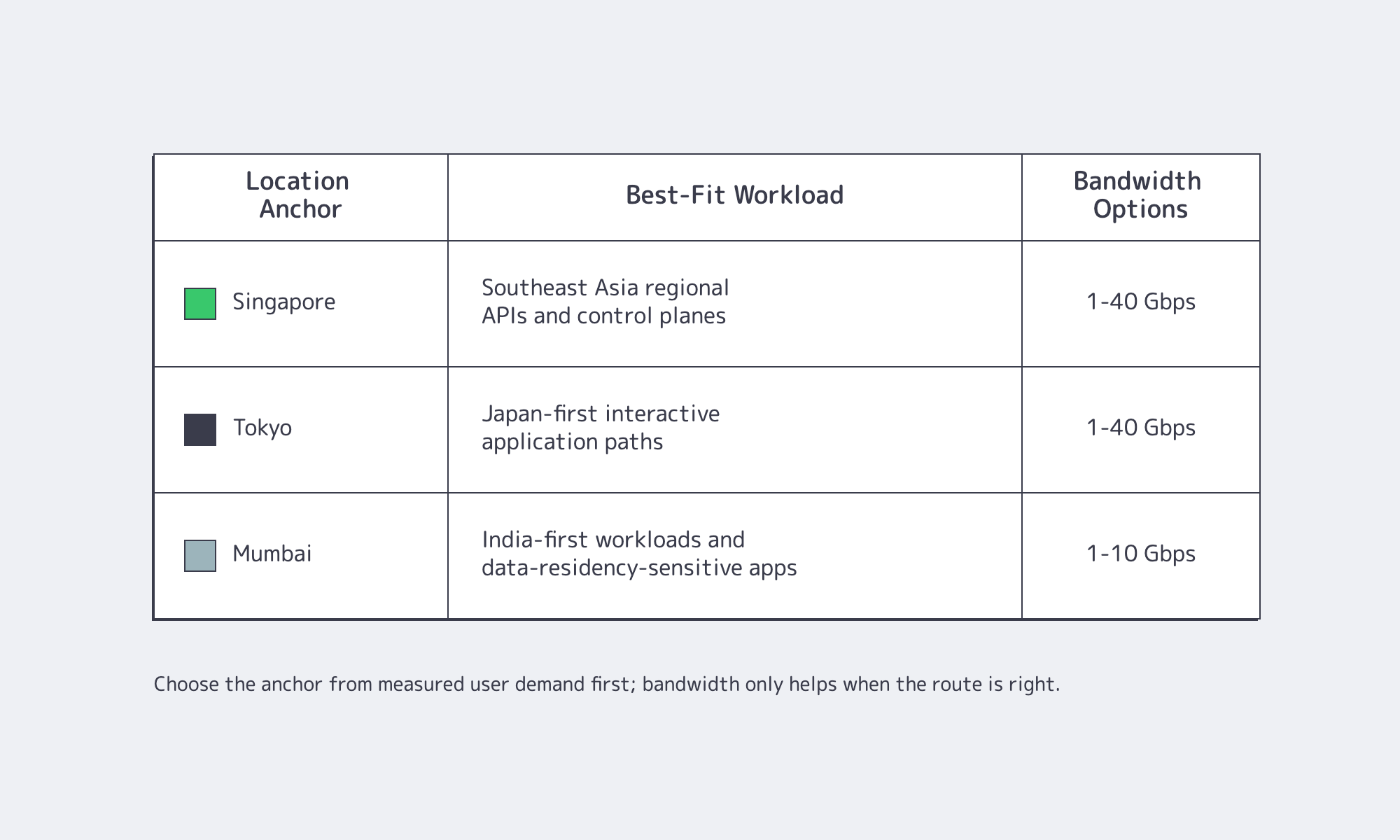
The first split is usually Southeast Asia, North Asia, and South Asia. Singapore works well for regional APIs, authentication, dashboards, analytics collection, and control planes. Tokyo is the right first choice when Japanese users need native-feeling latency. Mumbai is the better anchor when Indian users, payment flows, or Indian data expectations dominate. Fujairah can be relevant when APAC expansion overlaps with Middle East traffic or cross-region continuity requirements.
| Primary Anchor | Best-Fit User Geography | Buying Trigger |
|---|---|---|
| Singapore | Singapore and Southeast Asia-oriented workloads | Choose when Southeast Asia is the largest active base or peering diversity matters more than one-country proximity. |
| Tokyo | Japan-first workloads and North Asia-oriented read paths | Choose when Japanese users need low interactive latency and Japan-specific data handling is part of the roadmap. |
| Mumbai | India-first workloads and nearby South Asia-oriented traffic | Choose when India is a primary revenue market, data locality is expected, or Singapore tests above the product’s P95 budget. |
Use public measurement platforms such as RIPE Atlas and Globalping for preflight tests, then verify from the access networks that matter: mobile carriers, broadband ISPs, corporate VPN exits, and payment or identity provider endpoints.
Singapore, Tokyo, or Mumbai: Comparing APAC Server Locations
Singapore for Regional Server Placement
Singapore is the pragmatic default when a workload must serve many APAC markets before the demand curve is obvious. On Melbicom, teams can start with Singapore dedicated servers, where more than 120 ready-to-go configurations support 1–40 Gbps bandwidth options, 50 TB or unmetered plans, and Tier III data center placement. The tradeoff is distance: Singapore will not make Tokyo feel local, and it will not always satisfy India-first latency or policy expectations.
Tokyo for Japan-First Application Paths
Tokyo should be treated as a performance location, not an afterthought. If Japan contributes a meaningful share of interactive sessions, moving the application tier to Tokyo dedicated servers can reduce the gap between a usable product and a product that feels native. Melbicom’s Tokyo configurations run in Tier III facilities with 1–40 Gbps bandwidth options and unmetered plans available.
Japan’s Personal Information Protection Commission maintains APPI. That makes Tokyo placement a compliance design choice as much as a latency decision.
Mumbai for India-First Growth
Mumbai is the right first question when India is not merely “included in APAC” but central to the workload. Indian access networks can behave differently by carrier and region, so teams should test from the Indian networks their customers actually use before assuming Singapore is close enough. A Mumbai dedicated server can also simplify data-residency expectations for Indian customers. Melbicom’s Mumbai footprint includes dozens of configurations in Tier III data centers, with 1–10 Gbps bandwidth options and unmetered plans available.
India’s Digital Personal Data Protection Act received assent in 2023, and privacy rules putting the framework into practice were reported as implemented in 2025 by Reuters. Treat India as a jurisdiction with explicit personal-data controls, not only as a latency zone.
How Should Teams Test Latency Before Buying an Asia Dedicated Server?
Teams should test an Asia dedicated server with multi-network probes, not a single office ping. Run TCP, HTTPS, and traceroute tests from user-heavy markets, compare P50, P95, packet loss, and route changes for at least seven days, and reject locations where peak-hour P95 exceeds the application budget by 20% or more.

- Build a market list from product analytics, billing country, support tickets, and authentication logs.
- Test Singapore, Tokyo, Mumbai, and Fujairah when relevant from several last-mile networks per target market.
- Measure HTTPS time-to-first-byte, not only ICMP ping.
- Record P50, P95, packet loss, jitter, AS path, and peak-hour variance.
- Repeat after provisioning, then keep lightweight RUM or synthetic monitoring as production guardrails.
For buying, the threshold is not “lowest average latency.” It is predictable tail latency. A location with a 45 ms median and 220 ms evening P95 can be worse than a 65 ms median with a tight tail.
How Much Port Speed Does an Asia Dedicated Server Need?
An Asia dedicated server needs port speed sized to peak sustained egress, not monthly traffic averages. Use 1 Gbps only when P95 traffic stays comfortably below 500–700 Mbps; move to 10 Gbps or higher when replication, media, analytics export, or multi-tenant bursts can saturate the port for minutes at a time.

The math is unforgiving: 1 Gbps is about 125 MB/s before overhead; 10 Gbps is about 1.25 GB/s. That bandwidth disappears quickly during database snapshot shipping, log export, large customer imports, or video-heavy application paths. Melbicom’s dedicated server bandwidth range—up to 200 Gbps globally, with 1–40 Gbps options in Singapore and Tokyo and 1–10 Gbps options in Mumbai—matters most when the architecture has real burst demand or regional replication windows.
Network, Compliance, and Failover Requirements for Asia Dedicated Hosting
Peering quality is the hidden buying criterion. Ask where traffic exits, which IXPs and transit paths are in play, and whether the provider can show route diversity into the user networks you care about. Melbicom’s network backbone is relevant because peering hubs and transit diversity help reduce dependence on a single path across APAC.
Compliance should be designed as a placement constraint. Singapore’s PDPA includes a transfer-limitation concept documented by the Personal Data Protection Commission. Japan has APPI. India has DPDP. The infrastructure decision is deciding which data classes can replicate, which must stay regional, and which can be cached without creating a new regulatory problem.
Failover is the same discipline. Use Singapore–Tokyo for regional continuity when Southeast Asia and North Asia both matter. Use Singapore–Mumbai when India is business-critical but some regional services can remain outside India. Use Tokyo–Mumbai only when the product is already multi-region; the latency between North Asia and South Asia is usually too high for synchronous writes. Use Fujairah as a nearby regional option when Middle East reach or APAC-adjacent continuity is part of the architecture.
FAQ: Asia Dedicated Server Buying
Can One Asia Server Cover APAC?
One location is enough for a first regional control plane or read-heavy service, but not for latency-sensitive coverage across all APAC markets. If Japan and India both matter, plan for at least two anchors.
Compliance or Latency First?
Compliance wins when regulated personal data or customer contracts require locality. Otherwise, measured P95 latency should decide. Keep regulated data regional while serving static or low-risk assets from broader edge locations.
When Should Failover Become Active-Active?
Use active-active when the product cannot tolerate regional downtime or when failover latency would break the user experience. Use active-passive when the main need is recoverability and the secondary site can run degraded workloads.
Build the APAC Footprint Around Measured Latency, Not Map Distance
The best Asia dedicated server strategy is specific: place the first server where the most latency-sensitive users are, validate routes from the networks they actually use, size ports for peak egress, and keep compliance boundaries visible in the architecture. APAC is too fragmented for one-size-fits-all infrastructure.
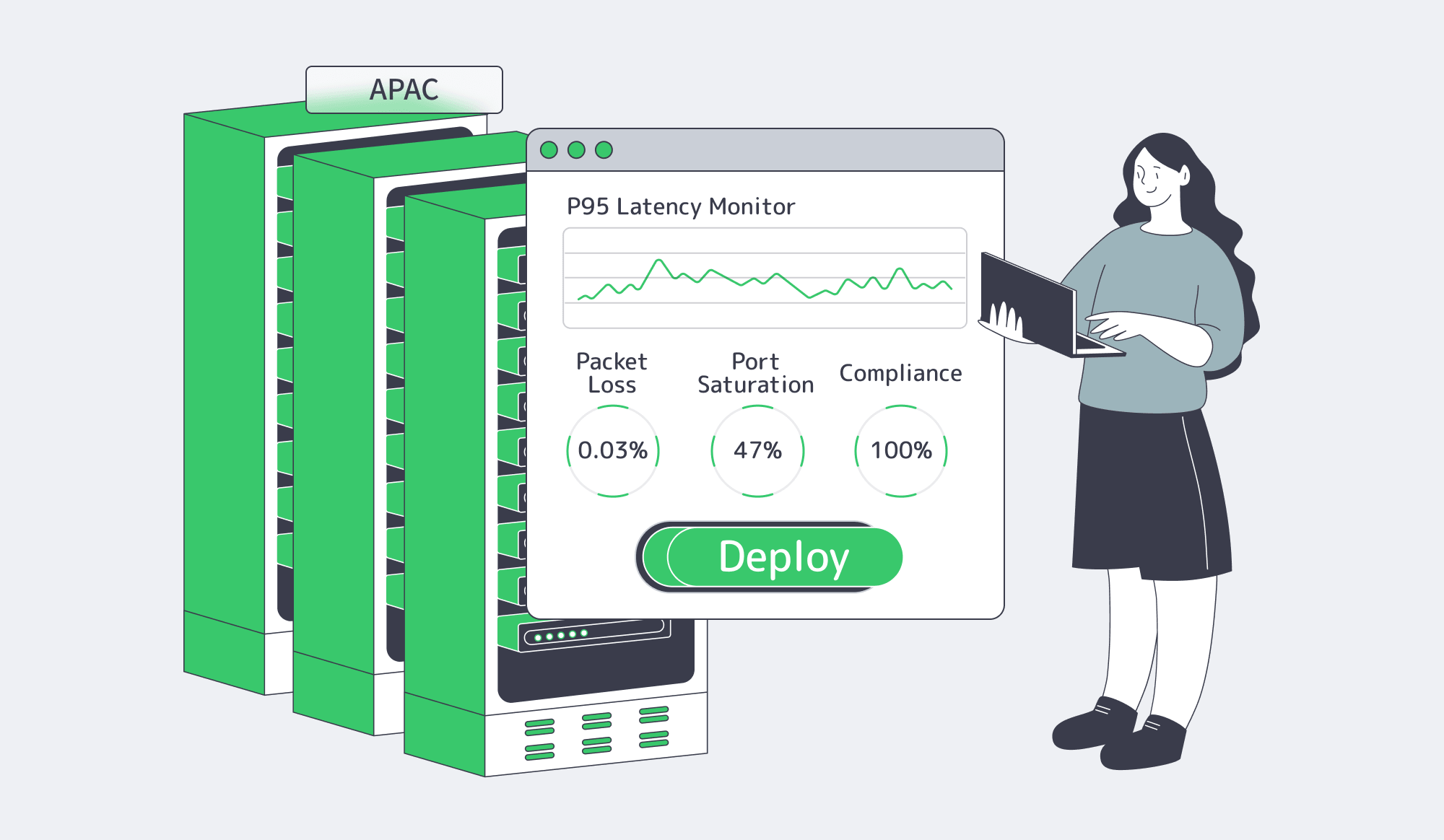
Key buying recommendations:
- Choose the first region from measured P95 latency, not headquarters location or generic APAC coverage.
- Keep synchronous writes inside a tight latency envelope; use replicas, queues, and regional reads once cross-region RTT becomes unpredictable.
- Test during local peak hours before committing; tail latency and packet loss are stronger buying signals than clean daytime averages.
- Separate data placement decisions from application placement decisions when privacy rules, customer contracts, or operational recovery requirements diverge.
- Treat failover as workload design: define normal, degraded, and later-recovery services under NIST SP 800-34 Rev. 1-style continuity planning rules.
That is where Melbicom fits into the decision: not as a generic Asia checkbox, but as infrastructure you can place, size, and expand around actual APAC traffic patterns using data center coverage, network reach, and dedicated server configurations.
Deploy Dedicated Servers in Asia
Place APAC workloads on dedicated infrastructure with measured latency and predictable expansion paths.
Get expert support with your services
Blog

GPU Dedicated Servers: How to Choose Hardware for AI, Rendering, and Web3
The GPU is the headline, but production failures usually start elsewhere: too little VRAM for concurrency, CPU offload that adds latency, NVMe behind the wrong PCIe path, or a deployment region that burns the latency budget before the model answers. Choosing GPU dedicated servers well means sizing GPU model, CPU, RAM, NVMe, bandwidth, and location as one production system.
GPU Servers– Production GPU hardware – Dedicated compute – Global locations |
|
How GPU Dedicated Servers Fit AI, Rendering, and Web3 Workloads
GPU dedicated servers fit AI, rendering, transcoding, and Web3 best when the workload has a stable bottleneck you can size in advance. AI inference usually runs into VRAM and latency limits, rendering into ray-tracing throughput and scene fit, transcoding into media-engine density, and Web3 proving into CUDA-capable VRAM, RAM, and fast local storage.
For AI inference, the question is not “What is the fastest GPU?” It is whether the server can hold the model, activations, and KV cache with enough headroom to keep latency predictable in production.
MLCommons’ MLPerf Inference v5.0 release is useful because it is open, peer-reviewed, and architecture-neutral. In that release, Llama 2 70B submissions increased 2.5x year over year, the median submitted score doubled, and the best score was 3.3x faster than the prior benchmark round.
Latency targets explain why memory discipline matters. MLPerf’s LLM inference benchmark page defines an Interactive Llama 2 70B benchmark with a 99th-percentile ceiling of 450 ms time to first token and 40 ms time per output token. For Llama 3.1 405B, it allows 6 seconds TTFT and 175 ms TPOT, which changes the serving budget.
GPU model selection follows. NVIDIA lists H200 with 141 GB of HBM3e and 4.8 TB/s of memory bandwidth; H100 SXM is listed with 80 GB and 3.35 TB/s. Those figures shape batching without spills. The PagedAttention paper reported 2–4x higher throughput at the same latency by reducing KV-cache waste. Current vLLM optimization docs warn that insufficient KV-cache space can trigger preemption and recomputation.
Rendering, transcoding, and Web3 proving have different signatures. NVIDIA’s L40S page lists 48 GB of ECC GDDR6, 864 GB/s of memory bandwidth, and 3x NVENC / 3x NVDEC with AV1 support for media workloads.
Blender Open Data describes its methodology as community-submitted benchmark runs scored by samples rendered per minute; the source report listed a median L40S score of 9083.53 from 57 submissions, versus 6259.42 from 11 submissions for H100 80GB HBM3.
For transcoding, encoder and decoder blocks matter as much as tensor throughput. NVIDIA’s Video Codec SDK page says Blackwell AV1 UHQ mode is comparable to software AV1 at roughly 3x throughput, and advertises up to 8K240 fps with 4 NVENCs on Blackwell.
Netflix’s technology blog reported on December 1, 2025 that AV1 powers about 30% of Netflix viewing. Media infrastructure should prioritize codec support, egress, and storage throughput together.
Web3 proving has its own shape. Succinct’s SP1 hardware requirements recommend GPUs with at least 24 GB of VRAM, CUDA compute capability 8.6+, and at least 4 CPU cores with 16 GB of RAM available to utilize the GPU. Its hardware acceleration docs note that provers may keep large matrices in memory.
The ZKProphet paper, published in 2025, says that after MSM acceleration, NTT can account for up to 90% of proof-generation latency on GPUs. In Web3 proving, dedicated servers—often called bare metal in that space—are GPU-plus-memory-plus-local-I/O systems.
GPU Model, CPU, RAM, and NVMe Requirements to Compare
Compare gpu dedicated servers by asking five production questions. Does the workload fit in VRAM with concurrency headroom? Can CPU and RAM feed the GPU without becoming a routine offload tier? Is NVMe on the right PCIe path? Do media engines match the codec plan? Is deployment location close enough to users or data?

Scatter chart comparing GPU memory capacity and memory bandwidth
The chart from the source report uses official NVIDIA specifications for H200, H100 SXM, L40S, and RTX PRO 6000 Blackwell Server Edition. Memory capacity and bandwidth scale differently across AI-first and universal GPU designs, so production fit matters more than spec-sheet ranking alone.
CPU and RAM are not secondary. vLLM’s offload documentation says CPU offloading uses zero-copy access from CPU-pinned memory and requires a fast CPU-GPU interconnect. Its example: adding 10 GiB of CPU offload to a 24 GB GPU can make it behave “virtually” like a 34 GB GPU, but the model is loaded from CPU memory to GPU memory during each forward pass. That is a fallback, not steady state.
NVMe and PCIe topology matter for the same reason. NVIDIA’s GPUDirect Storage docs say GDS creates a direct DMA path between GPU memory and storage, avoiding the CPU bounce buffer. It also notes that PCIe topology, root complex placement, and GPU, NIC, or NVMe path sharing can change storage latency and production throughput.
| Workload | First Constraint to Size For | Node Shape to Compare |
|---|---|---|
| AI inference | Interactive latency and KV-cache headroom | Favor VRAM and memory bandwidth before adding scaling complexity; keep host RAM as fallback, not normal operation |
| Rendering | Scene fit, RT throughput, and out-of-core avoidance | Favor graphics-capable GPUs with VRAM margin, substantial system RAM, and fast NVMe scratch |
| Transcoding | Media-engine density and sustained I/O | Favor GPUs with strong NVENC/NVDEC support, then size CPU, storage, and egress for packaging and delivery |
| Web3 proving | CUDA compatibility, VRAM floor, and artifact movement | Favor CUDA-capable GPUs with enough VRAM, plus host RAM and local NVMe for traces, checkpoints, and proofs |
When Dedicated GPU Hardware Beats Shared Cloud GPU Instances
Dedicated GPU hardware beats shared cloud GPU instances when latency budgets are tight, utilization is steady, or the I/O path is important enough that multi-tenant variance becomes operational risk. Once p95 and p99 behavior matter more than instant elasticity, dedicated hardware becomes the simpler and more controlled production choice.

The isolation argument is measurable. A 2026 noisy-neighbor study validated its methodology across 10 independent rounds in a Kubernetes testbed and found performance degradation up to 67.58% under combined stress, with a 75% increase in causal links when a noisy neighbor was active. Even with quotas and policies, hardware-level contention still caused severe degradation.
NVIDIA’s MIG doc adds the nuance: MIG exists because jobs sharing a GPU can compete for memory bandwidth and miss latency targets. On supported GPUs, MIG can partition one device into as many as seven isolated instances with dedicated compute, memory, cache, and guaranteed QoS. That is useful when you intentionally subdivide your own dedicated GPU server, not when you assume an upstream shared environment will stay deterministic.
The practical conclusion is narrow: once the workload shape is known, GPU dedicated servers remove a class of scheduling and tenancy uncertainty that affects live inference, render queues, dense transcoding fleets, and proving infrastructure. Burst testing can remain elastic; production should optimize for repeatable latency and utilization.
Location Is Part of the Hardware Spec
Location is a hardware decision because distance creates a latency floor. Light in fiber travels at roughly 200,000,000 meters per second, so even a perfect 100 km round trip costs about 1 ms. That sounds small until an inference service is already budgeting tens of milliseconds for queueing, token generation, retrieval, and network transit.
The placement rule changes by workload. Inference should sit near users and retrieval data. Rendering should sit near artists, asset storage, or review pipelines. Transcoding should sit near origin media and delivery edges. Proving should sit near the coordination and submission path. We at Melbicom support clients with this as we run 21 Tier III and Tier IV data centers, enable per-server bandwidth up to 200 Gbps, connect through 25+ IXP peering hubs and 20+ transit partners, and operate CDN infrastructure in 55+ locations across 39 countries.
From Spec Sheet to Production
The safest way to choose gpu dedicated servers is to start with the failure mode you cannot tolerate. Slow first-token latency points to memory headroom and locality. Scene spill points to VRAM margin and rendering throughput. Weak stream density points to media engines and bandwidth. Slow proof generation points to CUDA compatibility, RAM, and NVMe before peak compute.
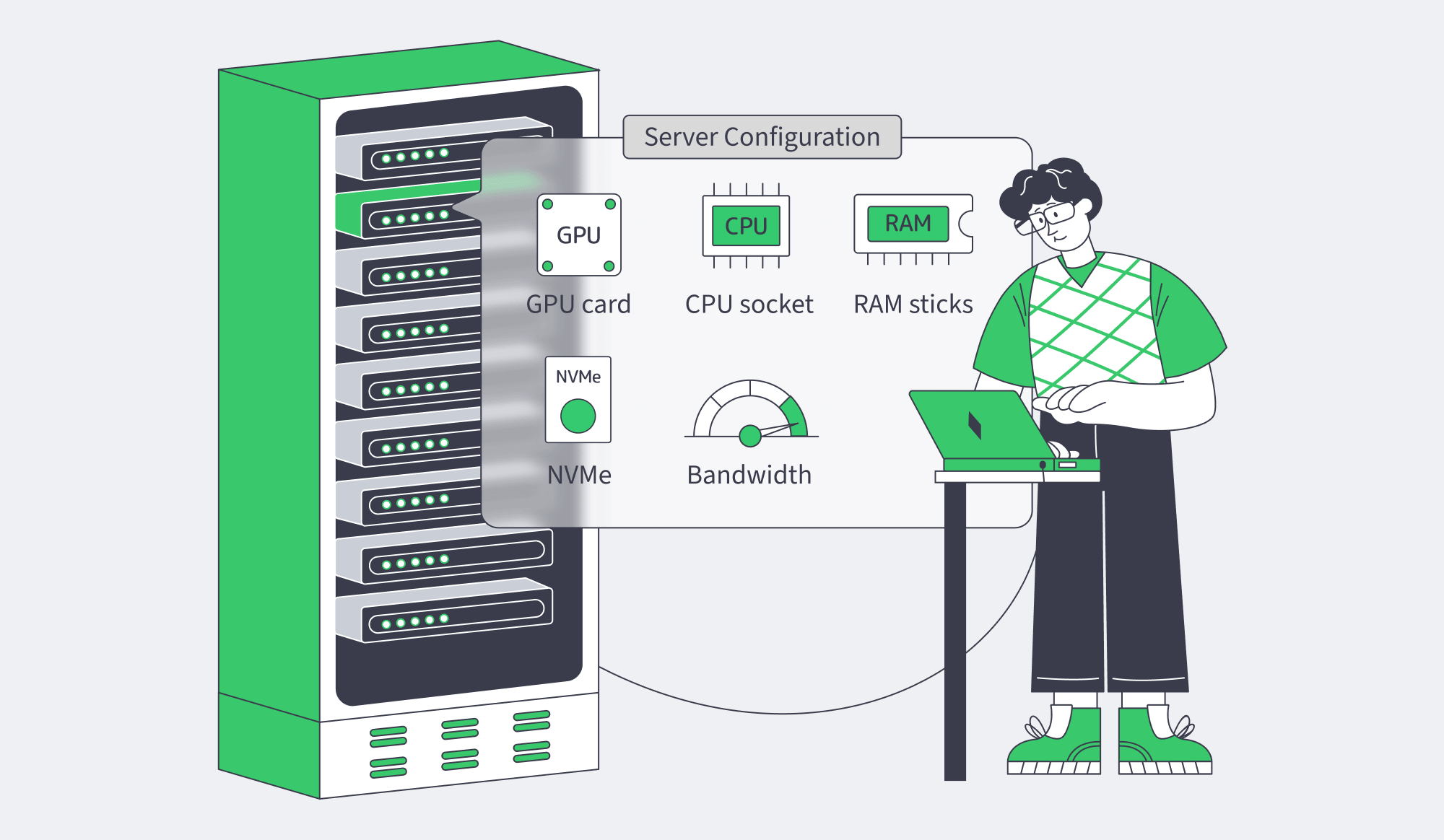
Before deployment, the production checklist should look like this:
- Verify that the model, scene, or proving workload fits in GPU memory with headroom, because vLLM preemption, Blender system-memory spill, and proving-memory pressure show up as performance penalties.
- Check PCIe and NUMA affinity, not just total core count, because crossing the wrong root complex or CPU socket changes throughput and latency.
- Treat host RAM as a working tier, not a magical extension of VRAM, because CPU offload depends on pinned memory and interconnect speed.
- Match media workloads to actual media hardware, because video fleets scale on encoder/decoder density and egress behavior more than tensor numbers.
- Decide the scaling path before deployment: larger single GPU, multiple GPUs with tensor or pipeline parallelism, or more single-GPU nodes.
Deploy GPU Dedicated Servers
Choose dedicated GPU hardware for AI, rendering, and production workloads with predictable capacity.
Get expert support with your services
Blog

Holland Dedicated Server: What Buyers Really Need in the Netherlands
Searchers typing “Holland dedicated server” usually do not need a geography lesson. They need a Netherlands buying framework: city, facility, network, data-handling terms, bandwidth model, support scope, and expansion path.
The value is not the label; it is Amsterdam interconnection, EU-located processing, throughput economics, support, and room to scale.
Choose Melbicom– 1,400+ ready-to-go servers – 21 global Tier IV and III data centers – 24/7 infrastructure support |
|
What a Holland Dedicated Server Search Means for Netherlands Hosting
A “Holland dedicated server” search should be treated as a Netherlands hosting search, with Amsterdam as the default shortlist unless real latency tests prove another Dutch city fits better. The practical criterion is specificity: buy only when the offer resolves to a Dutch city, facility, test endpoint, and network model.
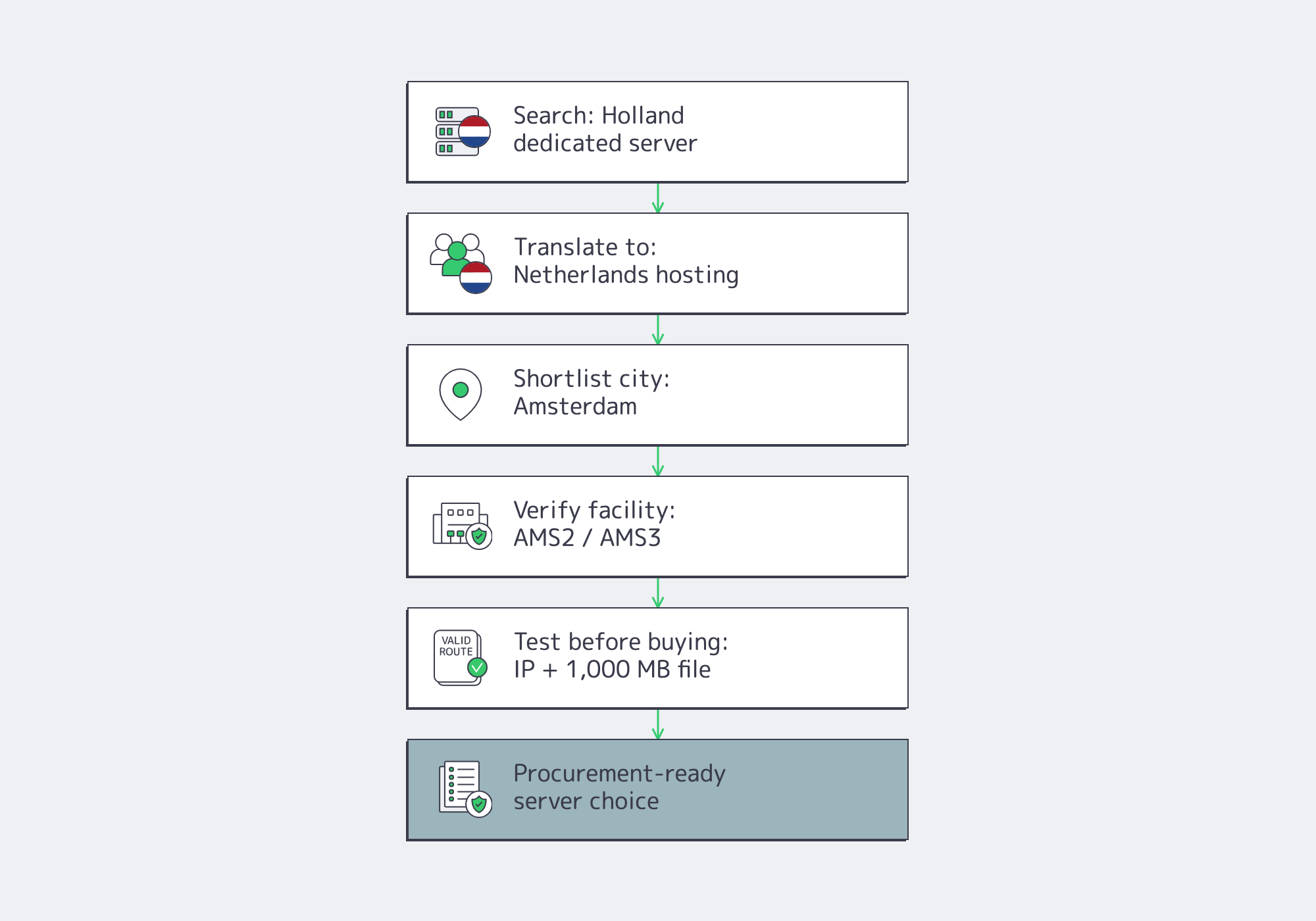
The brief clarification is enough: Holland refers to two provinces, while the country is the Netherlands. For hosting buyers, that makes “Holland dedicated server” an entry query, not a buying requirement. From there, procurement language should shift to Netherlands, Amsterdam, data center tier, port speed, transfer policy, support scope, and contract terms.
For buyers comparing Netherlands dedicated servers, the offer has to become operationally specific. For teams that already know Amsterdam is the latency target, Amsterdam dedicated servers should be evaluated directly. In our Netherlands configuration pool, deployment is centered on Amsterdam Tier III and Tier IV facilities, with a test IP and 1,000 MB test file so teams can validate routes before migration.
Amsterdam Connectivity, EU Data Handling, and Bandwidth Requirements
Netherlands dedicated hosting works when Amsterdam connectivity, EU data handling, and bandwidth policy line up in the same decision. The threshold is concrete: the provider should support measurable path testing, defensible processor and transfer terms, and a port model sized for sustained traffic rather than a one-off burst headline.
Amsterdam Interconnection Is Measurable
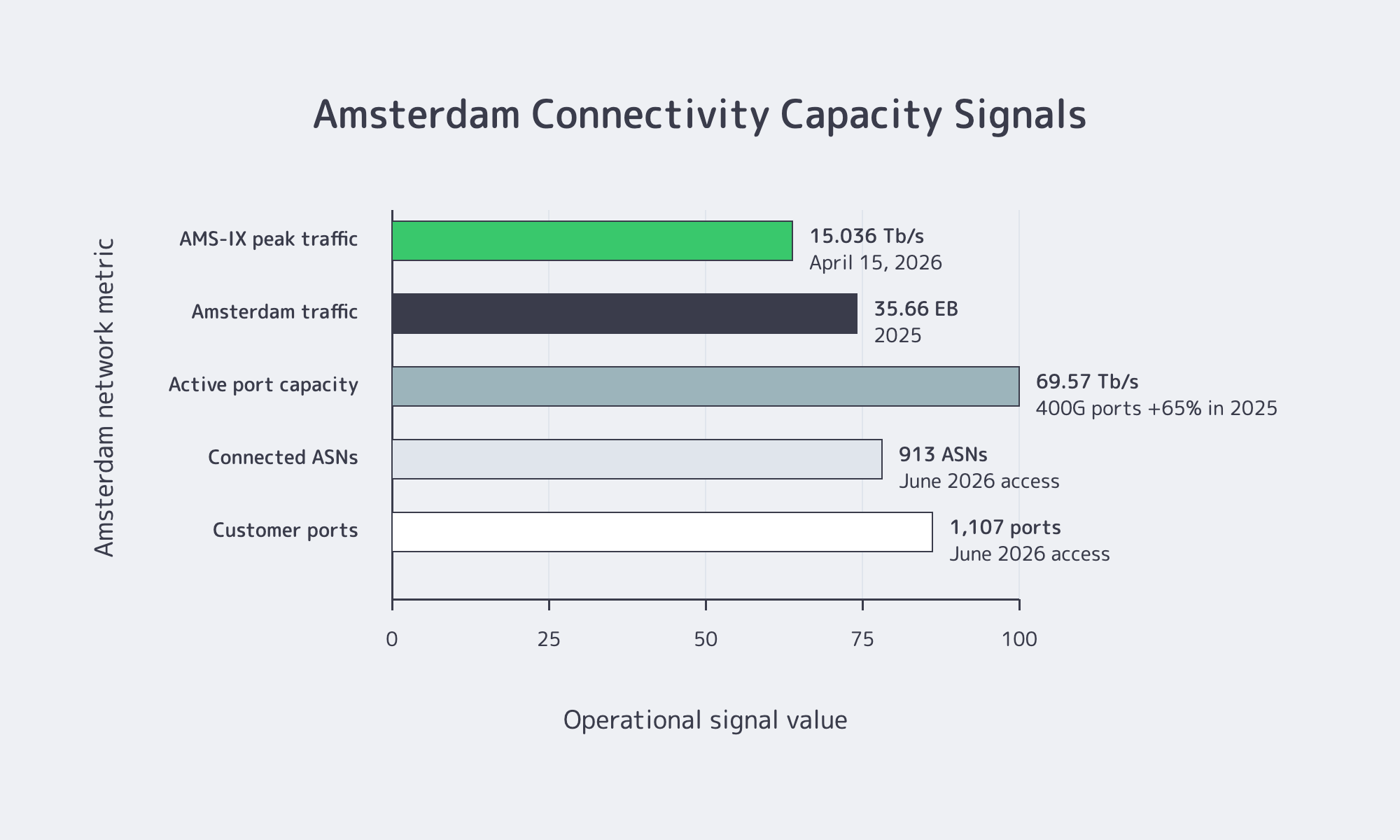
Amsterdam stays on serious European shortlists because its interconnection fabric is documented and operationally large. AMS-IX’s 2025 Facts & Figures update, published February 2, 2026, reported 35.66 exabytes of traffic in 2025, a 4% year-over-year increase, plus 69.57 Tb/s of active port capacity and a 65% annual increase in 400G ports. AMS-IX Amsterdam counters, accessed in June 2026, put the platform at more than 900 connected ASNs, more than 1,100 customer ports, and more than 900 IPv6 peers.
| Signal | Recent Data Point | Buyer Implication |
|---|---|---|
| AMS-IX peak traffic | 15.036 Tb/s on April 15, 2026 | Exchange-scale infrastructure |
| Amsterdam traffic volume | 35.66 EB handled in 2025 | Sustained demand, not speed-test theater |
| Active port capacity | 69.57 Tb/s; 400G ports up 65% in 2025 | Headroom for throughput-heavy workloads |
| Connected-network density | 900+ ASNs, 1,100+ customer ports, 900+ IPv6 peers | Lower risk of needlessly long paths |
| European capacity backdrop | CBRE projects 6.5% vacancy by end-2026 despite 750 MW of new capacity | Lead-time discipline matters |
Amsterdam does not automatically win every workload. It gives buyers a verifiable baseline. If users are spread across the EU, the United Kingdom, and nearby markets, Amsterdam deserves first-pass testing, followed by traceroutes, application probes, and test-file pulls from real user geographies.
EU Data Handling Is a Processing Chain
A Netherlands server helps with EU-located processing, but it does not complete the compliance work. The EDPB’s international-transfer guidance focuses on whether personal data becomes available outside the EEA, and the European Commission’s SCC page confirms that adequacy decisions or safeguards such as the modernized SCCs adopted on June 4, 2021, are the usual transfer routes.
That turns “EU hosting” into a processing-chain question: where production data is stored, where support staff can access it from, and where backups, monitoring records, and ticket attachments live. The EDPB’s Opinion 22/2024, adopted October 9, 2024, says controllers should have processor and subprocessor identities readily available and should verify sufficient guarantees. A Dutch data-center address is useful; a documented processor chain is defensible.
Buy Bandwidth for Sustained Traffic
Bandwidth is where Netherlands dedicated server decisions often get lazy. The right question is not “Which page says unmetered?” It is: what port speed, committed behavior, traffic profile, concurrency level, and upgrade path does the workload need at normal sustained load?
A serious Amsterdam offer should state the port range, whether bandwidth is guaranteed, how transfer is billed if metered, and whether heavier usage belongs on dedicated infrastructure rather than a fair-use cloud product. In our Amsterdam configuration pool, the network range goes up to 200 Gbps per server.
How to Evaluate Netherlands Dedicated Servers Beyond Search Terminology
Evaluating Netherlands dedicated servers beyond search terminology means converting each claim into an operational check. Before buying, verify a test IP and file, named data-center location, processor and subprocessor terms, 24/7 support scope, and an expansion path to higher bandwidth, private networking, BGP, or multi-region services.
The first operational test is support. “24/7 support” matters only when engineers handle recovery-blocking work. Our Support scope includes server reboots, OS reinstalls, BGP setup, network troubleshooting, and performance issues, with engineers on call 24/7. If the answer to “what happens during an outage?” is vague, the support story is still marketing.
The second test is data-handling visibility. Ask for the DPA, processor and subprocessor visibility, non-EEA transfer basis if relevant, and enough documentation to show how the processing chain works in practice. A Netherlands server location helps; the contract and operational evidence close the loop.
The third test is expansion. A Netherlands dedicated server should not become a dead end. Our Network can connect servers on a private network even between different data centers, while BGP Session is available in all locations for dedicated servers and supports BYOIP, IPv4, and IPv6. That matters when one Amsterdam deployment needs to become a multi-region or route-controlled platform.
When a Holland Dedicated Server Shortlist Should Include Melbicom
A Holland dedicated server shortlist should include Melbicom when Amsterdam deployment, high-bandwidth headroom, and expansion beyond one server matter. The operational fit is clear: Amsterdam facilities, up to 200 Gbps per-server networking, 24/7 technical support, test artifacts, and adjacent services that help a Netherlands server grow into a broader European platform.
For the Netherlands specifically, our Amsterdam location has 250+ ready-to-go Intel and AMD configurations, RAM options from 32 GB to 1,536 GB, Tier III and Tier IV facility options, and unmetered traffic models. Across the wider platform, Melbicom adds 1,100+ ready-to-go server configurations, 21 global Tier III and Tier IV data centers, 25+ IXP peering hubs, 20+ transit partners, and CDN coverage in 55+ locations across 39 countries.
That combination lines up with the actual Netherlands buying criteria: start country-first, go city-first, inspect Network for private inter-data-center connectivity, use BGP Session for route control or BYOIP, and keep Support in view.
If the workload later needs edge distribution or storage, Melbicom also has CDN, S3 Cloud Storage, and data storage services.
The working checklist is simple:
- Translate the term first. If the quote never gets more precise than “Holland,” procurement has not started; the decision should say Netherlands and usually Amsterdam, with named facilities and test artifacts.
- Treat Amsterdam connectivity as measurable, not mystical. AMS-IX publishes current counters and traffic records, so buyers can judge density from data.
- Keep EU data handling separate from geography branding. A Netherlands server helps with EU-located processing, but processors, subprocessors, and non-EEA access still need the right documents.
- Buy bandwidth for sustained load. Port range, transfer policy, and upgrade paths matter more than generic “unmetered” wording.
- Prefer an expansion path. Private networking between data centers, BGP availability, and adjacent CDN or storage services reduce the odds of a second migration later.
The Purchase-Ready Takeaway
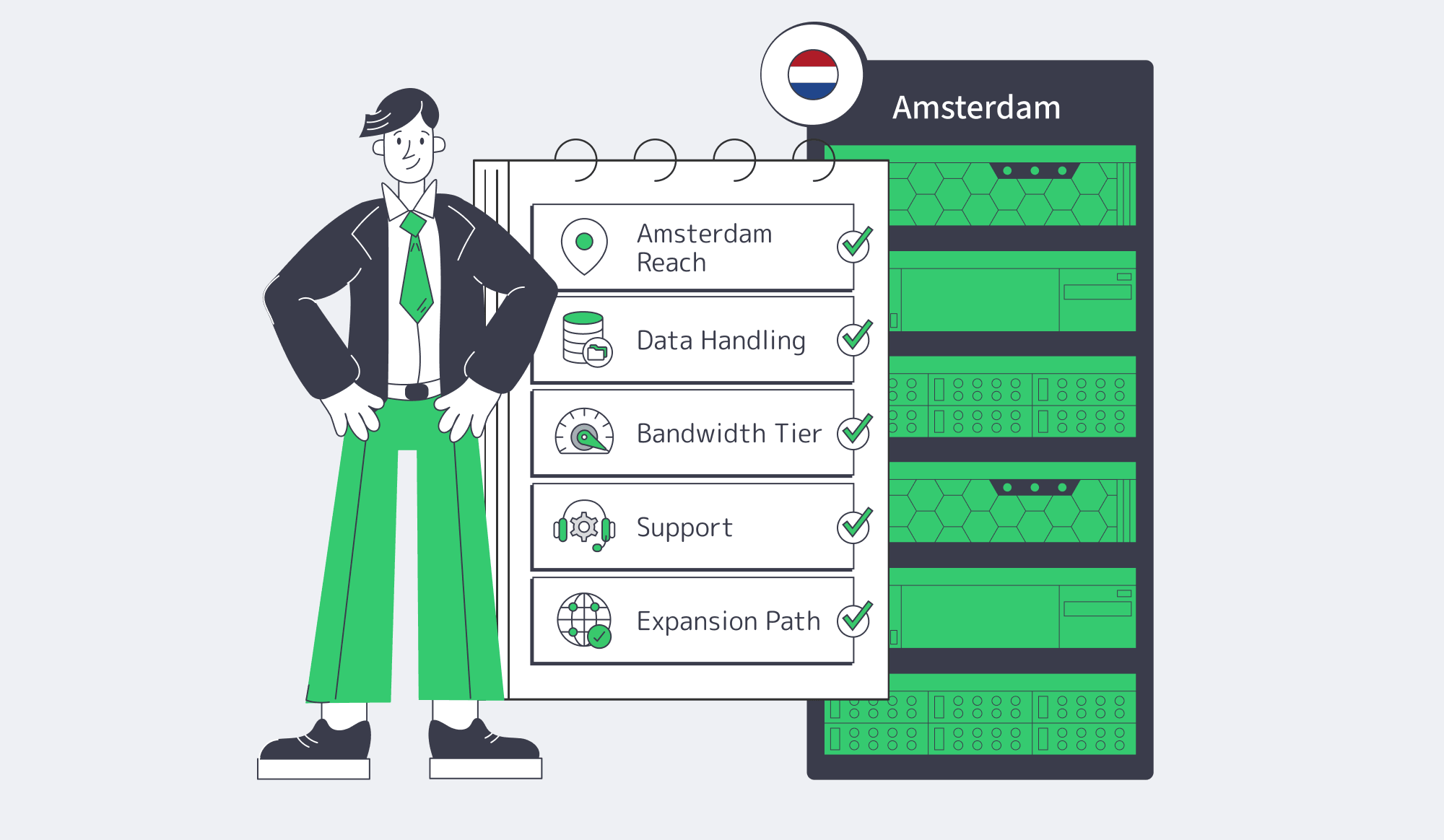
The best Netherlands server decision is the one that survives first contact with traffic, compliance, and growth. If a provider can prove Amsterdam reach, document data handling, offer the right bandwidth tier, answer operational questions at any hour, and extend into multi-region networking, the search term has done its job.
For buyers using “Holland dedicated server,” the move is simple: translate the phrase, then test the dedicated infrastructure. For teams that want Netherlands deployment with Amsterdam options, test endpoints, high-bandwidth tiers, 24/7 engineering coverage, and a route into broader network services, the next step should be infrastructure-specific, not terminology-specific.
Explore Netherlands Dedicated Servers
For a concrete Amsterdam starting point, Explore Netherlands dedicated servers: 250+ configurations in Amsterdam, Tier III and Tier IV facility options.
Get expert support with your services
Blog

Dedicated Server Hosting in UAE: Low-Latency GCC Playbook
The mistake is treating server placement as a box-ticking exercise. In the United Arab Emirates, the real decision is architectural: keep hot-path latency low across the Gulf Cooperation Council, keep live customer and payment data where governance teams want it, choose between interconnection density and cable-adjacent resilience, and fail over without wrecking the user experience. Mobile performance research found that as page-load time rises from one second to 10 seconds, bounce probability rises by 123%.
The Internet Society’s IXP Tracker lists two active IXPs in the UAE with 111 combined members, while DE-CIX says UAE-IX exceeds 1 Tbps peak traffic, connects more than 110 networks, and carries more than 6.6 Tbps of connected customer capacity. Dedicated server hosting in UAE is now a network decision, not just a facilities decision.
Host in the UAE— Ready-to-go UAE servers — Low-latency GCC routing — Europe and US failover options |
|
How to Choose Dedicated Server Hosting in UAE for GCC Latency and Residency
Choose dedicated server hosting in UAE by anchoring the full transactional path in-country, not just the cache. The application tier, session layer, queues, cache, and primary write database should sit close to users, while cross-border replicas are governed by explicit data-transfer, access-control, and recovery rules.
The fastest way to miss the latency target is keeping the origin abroad and hoping a CDN will hide it. CDN works for static assets, downloads, images, and media. It does not fix log-in, inventory checks, checkout, authenticated APIs, customer updates, or session refreshes. Those paths still need the application tier and primary database near users.
Placement now intersects with governance. The official UAE platform describes the Personal Data Protection Law as an integrated framework for confidentiality and privacy. DIFC rules require an adequate destination or safeguards for many personal-data transfers. The Central Bank’s retail payment services framework adds payment-flow obligations. The result: live records, logs, keys, and payment-sensitive logic increasingly belong in the UAE, while replication abroad must be designed rather than improvised.
| Traffic Pattern | Practical RTT Budget | Placement Rule |
|---|---|---|
| UAE-resident users | Single-digit to low-teens ms | Keep the full hot path in UAE. |
| Core GCC interactive journeys | Sub-50 ms design target | Keep app, session, cache, queue, and primary DB in UAE; use CDN for static and media-heavy reads. |
| European failover | Roughly 120 ms class RTT | Use for warm standby and asynchronous replication, not normal interactive primary traffic. |
| US tertiary recovery | Roughly 180 ms+ class RTT | Use for tertiary DR, support systems, analytics, reporting, and cold backup. |
Dubai vs Fujairah for Peering, Resilience, and Procurement Strategy
Dubai and Fujairah solve different infrastructure problems. Dubai is the UAE’s interconnection gravity well for peering density and carrier marketplace access. Fujairah is the safer lens for Melbicom examples and a major cable-adjacent hub where route diversity, submarine landings, and east-coast resilience become procurement variables.
Dubai matters because UAE-IX powered by DE-CIX is described as the largest carrier- and data-center-neutral Internet exchange in the Middle East, interconnecting global networks, carriers, and content providers across the GCC. For peering density and carrier choice, that gravity is real.
Fujairah matters for route diversity. Submarine Networks identifies it as the UAE’s major submarine-cable landing location, listing AAE-1, BBG, IMEWE, SMW3, SMW4, TEAMS, and others. Public capacity-hub documentation says a Fujairah-based Smart Hub connects through more than 20 terrestrial and submarine cable systems and can provide a terrestrial route to Europe that avoids the Egypt crossing.
Subsea resilience is no longer abstract. The ITU says submarine cables carry more than 99% of international data exchange and suffer roughly 150-200 faults globally each year. A single elegant path is not a resilience strategy. The market is moving toward mixed designs: SmartHub IX is geo-redundant across Fujairah and Dubai.
UAE Hosting Due Diligence: Security Baseline, Pricing Drivers, and Failover Design
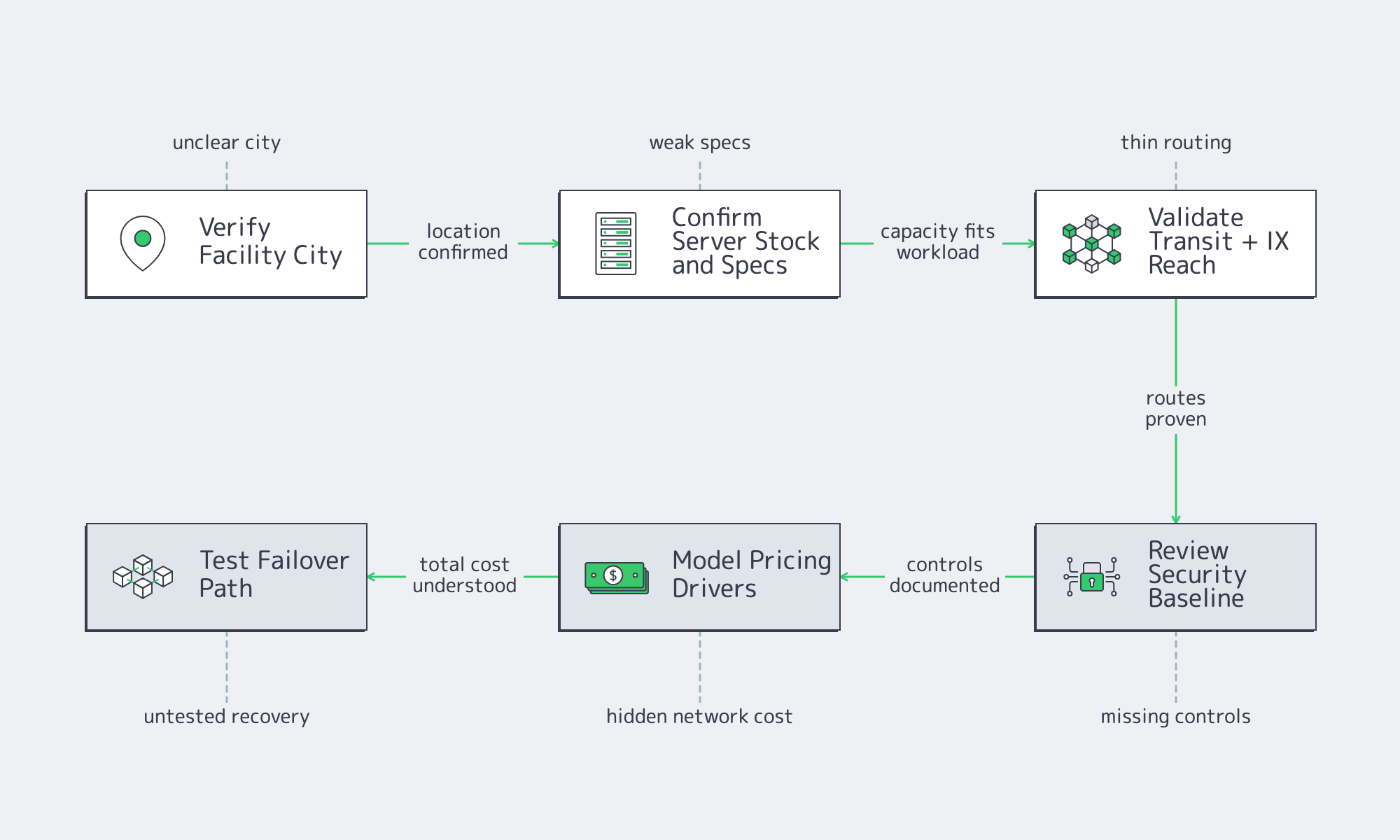
Due diligence should prove three things before signature: where data lives, how routes behave, and what the recovery path actually costs. A credible dedicated-server proposal must expose facility city, stock, CPU and memory class, per-server bandwidth, IX and transit reach, backup posture, and failover-region economics.
A dedicated server improves isolation only if the security model changes with it. NIST SP 800-207 defines zero trust as moving defense away from static network perimeters and toward users, assets, and resources. For payment handling, the PCI Security Standards Council spans PCI DSS, P2PE, Secure Software, and Secure Software Lifecycle controls; PCI DSS v4.0.1 is a limited revision, not a lighter regime.
The baseline is straightforward: tokenize early, keep cardholder data out of the general application estate, segment payment environments from customer-facing APIs, separate management and production planes, enforce MFA and least privilege, encrypt volumes and replication paths, keep logs immutable, and test restoration. For payments, that is the control floor.
Pricing is where low-end offers hide compromises. CPU matters, but so do route diversity, IX reach, port size, transfer model, storage performance, and the secondary region required for resilience. Melbicom publishes relevant signals: 20+ transit providers, 25+ IXPs, 14+ Tbps of network capacity, and a CDN footprint of 55+ PoPs across 39 countries. Used properly, CDN is an economic control for static assets, not a residency workaround for an overseas origin.
Routing hygiene also deserves attention. Internet Society data shows that 91 of 103 members at UAE-IX use RPKI. That does not guarantee perfect routing, but it shows route validation and prefix integrity are part of the local interconnection conversation. Ask how prefixes are handled before any BYOIP plan is signed.
Designing a UAE Plus Europe and United States Topology That Survives Failures
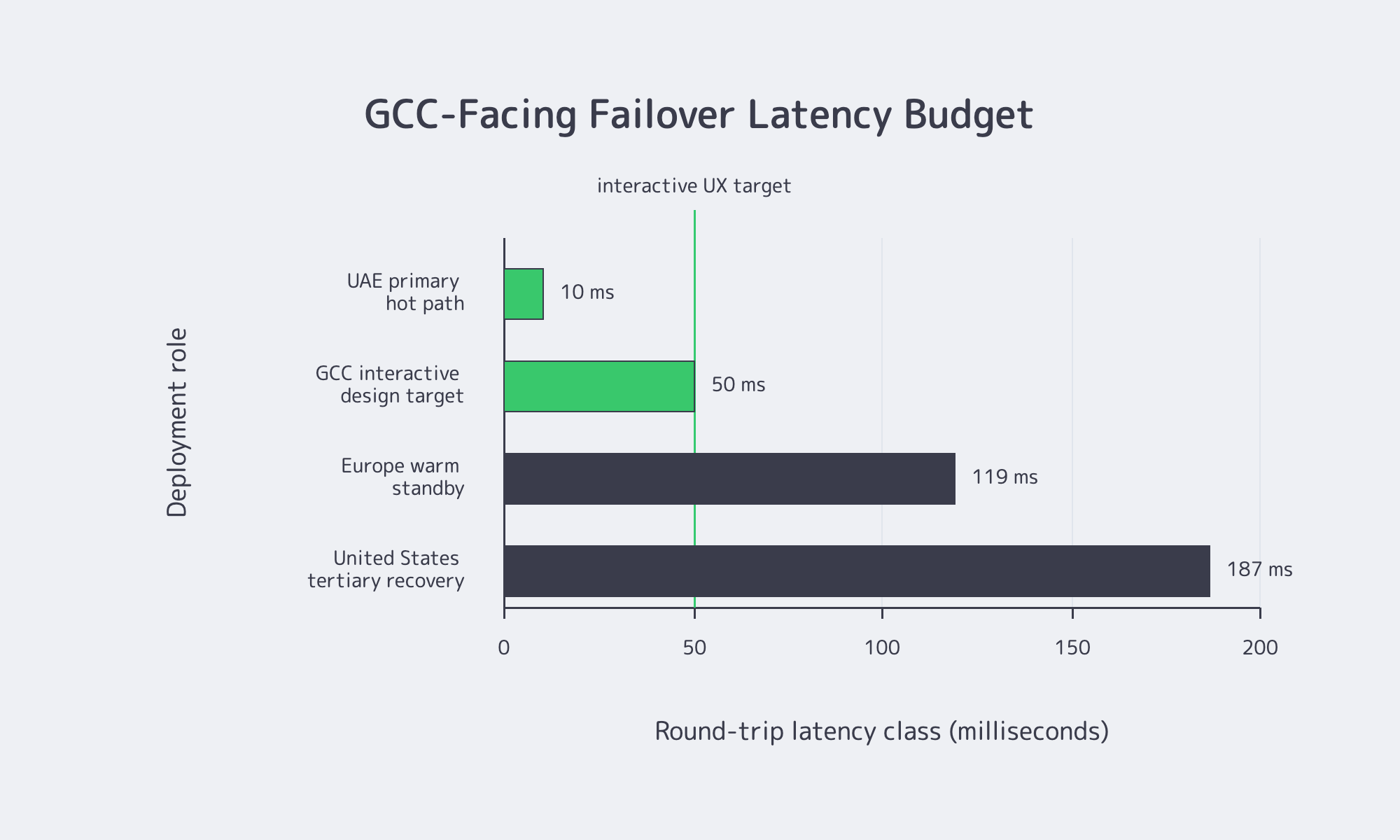
Most GCC-facing platforms should start with UAE-first active service, Europe as warm standby, and the United States as tertiary recovery. That keeps interactive writes close to users while preserving a documented recovery path for regional disruption, cable incidents, data corruption, and operational failure.
Published disaster-recovery guidance defines warm standby as a secondary region with some infrastructure already deployed and running at reduced capacity. That maps well to UAE-first deployments: keep live transactional services in the UAE, maintain a scaled-down but functional copy in Europe, and reserve the United States for tertiary recovery or non-latency-sensitive work.
Published backbone RTT data gives a reality check. Published latency tables put UAE-to-Germany-West-Central around 118-119 ms and UAE-to-East-US around 182-187 ms. Those are not public-Internet promises, but they show the failure shape: Europe can be a serious warm failover target; the United States is usually a resilience tier, not a live write tier.
A practical Melbicom topology uses Fujairah as the UAE primary, Amsterdam or Frankfurt as the European standby, and Atlanta or Los Angeles as tertiary recovery. The UAE primary handles auth, app, cache, queue, and primary writes. Europe receives asynchronous replication, backups, and enough pre-deployed capacity for a regional event. The United States holds reporting, support systems, or batch work that can tolerate higher RTT.
Procurement Checklist and the Low-End Traps to Avoid
The low-end trap is rarely just old hardware. It is usually a stack of hidden compromises: vague site naming, thin route diversity, weak storage for write-heavy workloads, decorative failover, and cheap pricing that excludes the network and recovery posture the workload actually needs.
- Confirm the exact UAE facility city in the order form; “UAE” is not precise enough when Dubai and Fujairah have different interconnection and cable-exposure profiles.
- Require measurable network proof: transit depth, IX reach, test files, route-control posture, stock visibility, and per-server bandwidth, not adjectives.
- Split data into residency tiers before comparing quotes: what must stay live in the UAE, what may replicate to Europe or the United States, and what can be tokenized, anonymized, or regenerated.
- Set latency and failure budgets before shopping configurations: keep GCC interactive paths under a sub-50 ms design target, treat Europe as warm failover territory, and treat the United States as tertiary recovery for most UAE-centered user journeys.
- Reject ambiguity: undefined city, unclear transit, vague “unmetered” networking without throughput proof, no documented failover sequence, or no RTO/RPO conversation.
- Run failover and failback drills before production. If the recovery sequence cannot be tested cleanly, the design is not ready.
Conclusion: Build for the Gulf’s Real Failure Modes, Not the Cheapest Quote
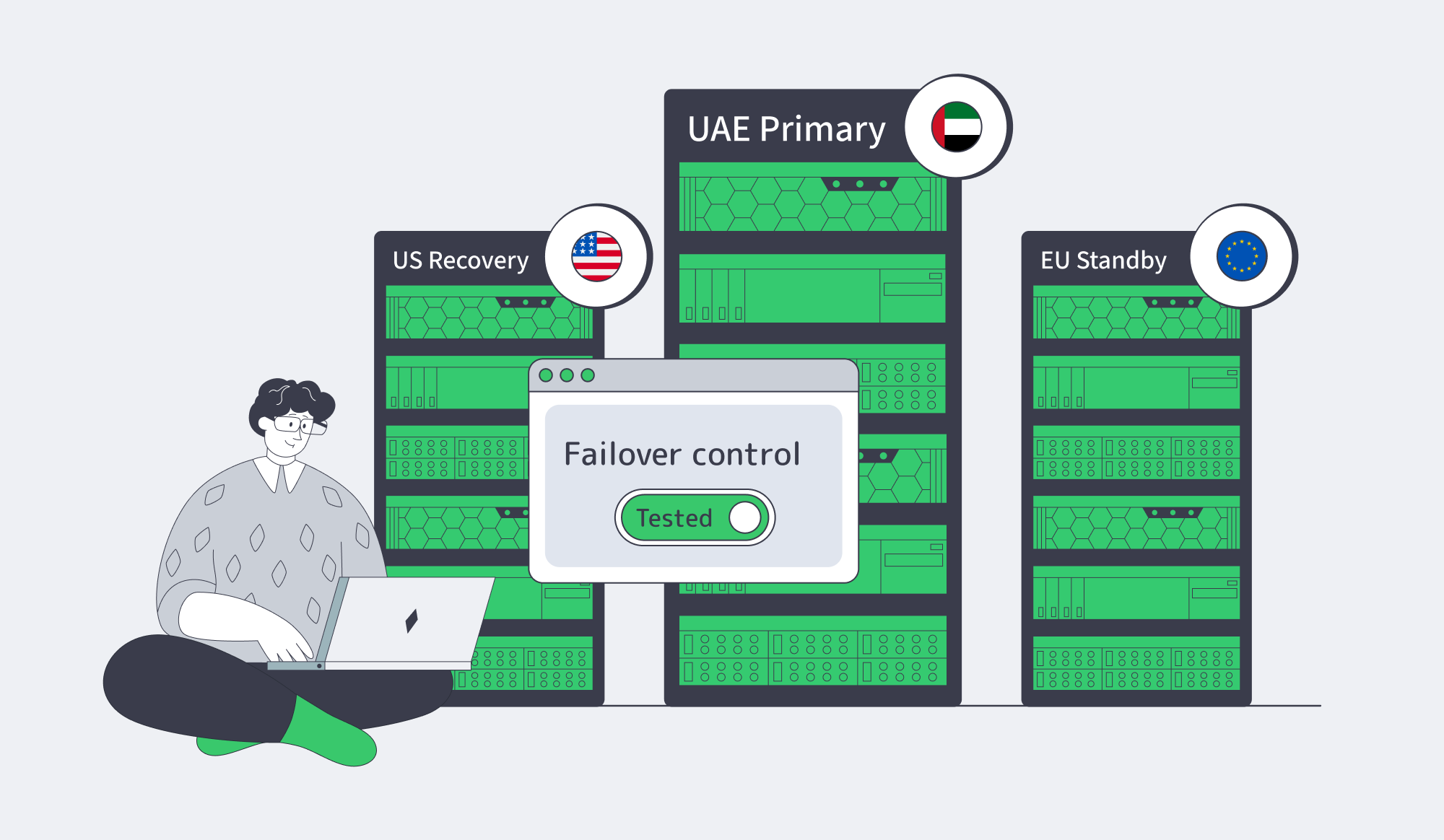
The strongest dedicated server hosting in UAE is not the cheapest monthly headline or the loudest latency promise. It is the design that keeps the write path local, treats Dubai and Fujairah as different infrastructure variables, secures payment and customer data by architecture, and fails cleanly when regional paths degrade.
That is the standard procurement teams should apply: verify the city, prove the network, size the server honestly, document the data boundary, and test the recovery path before production traffic depends on it.
Deploy in the UAE
Build a verified Fujairah/UAE deployment with ready-to-go dedicated servers, custom configurations in 3-5 business days, and Europe or United States locations for resilient multi-region design.
Get expert support with your services
Blog

Dedicated Server France: Paris-First Performance & Data Sovereignty Guide
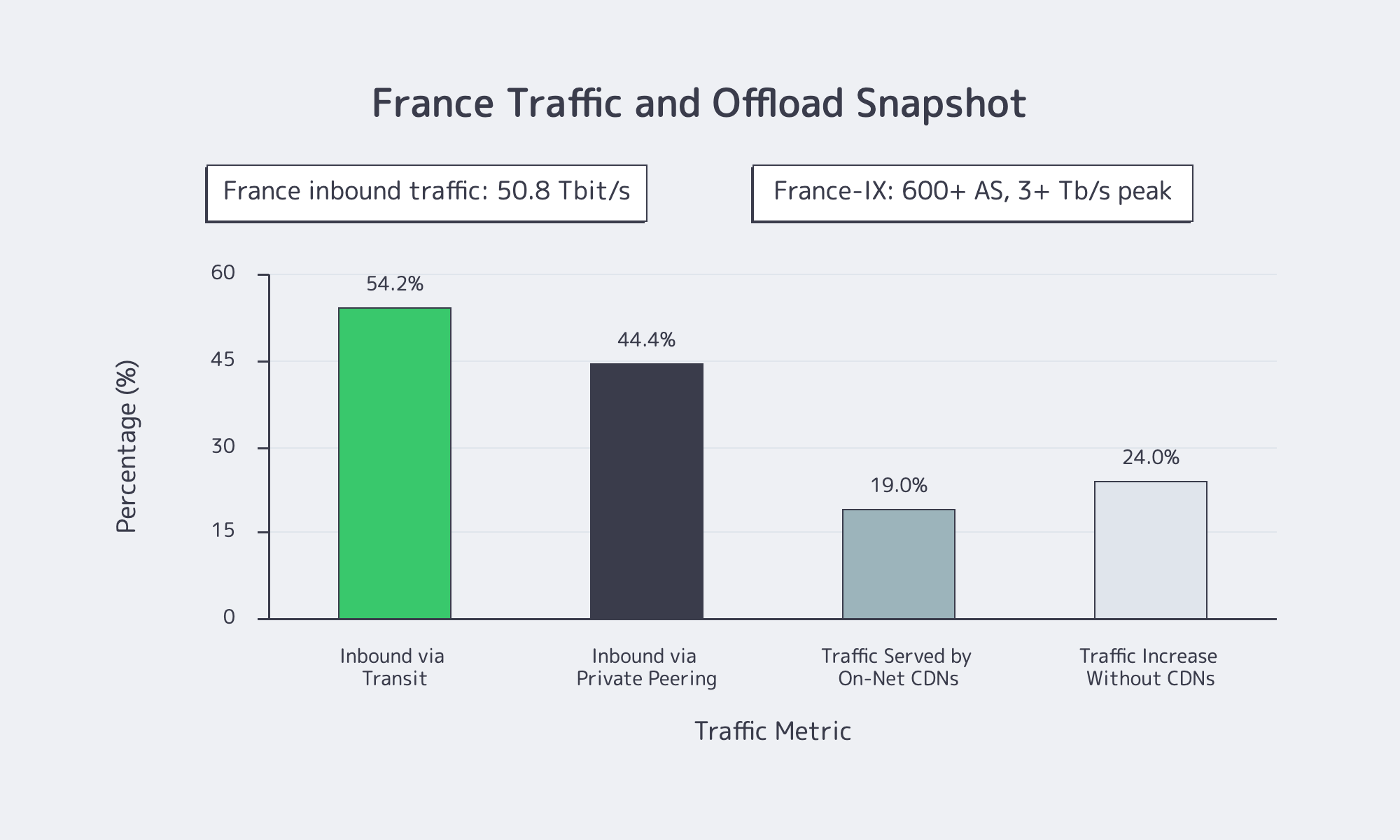
A strong France hosting decision is no longer “France versus Europe.” It is Paris as the performance anchor, sovereignty at the legal-and-operational layer, and redundancy in adjacent EU regions. ARCEP reports inbound traffic to France’s four largest ISPs reached 50.8 Tbit/s, up 9.2% year over year, with 54.2% over transit and 44.4% over private peering. That makes server specifications, origin placement, exchange reach, and cache strategy part of the same hosting decision.
Build in France— Paris dedicated servers — Adjacent-EU standby — CDN for France traffic |
|
Why Paris-First Still Matters for a Dedicated Server in France
Paris matters because France’s user experience is shaped by interconnection as much as compute. Dense domestic peering can shorten paths for shoppers, staff tools, APIs, and media services; a Paris origin also gives teams a clearer latency baseline before CDN, failover, and cloud-adjacent pieces are added.
France-IX says it connects 600+ AS networks and sees 3+ Tb/s peak traffic. ARCEP adds that on-net CDNs account for roughly 19% of traffic to ISP customers in France and that, at identical end-user consumption levels, inbound interconnection traffic would rise by 24% without them. The right model is therefore not “Paris origin or CDN.” It is Paris for the latency-sensitive origin path, CDN for repeatable static delivery, and surge absorption before traffic becomes expensive origin load.
The business case is measurable. A cross-site performance study found that improving mobile speed metrics by 0.1 seconds increased conversion progression; in retail, that included a 9.1% lift from product detail to add-to-basket and a 9.2% uplift in spend. Network latency is only one factor, but for checkout, search, session, and API flows concentrated in France, Paris placement remains a clean controllable variable.
How to Choose a Dedicated Server in France for Paris-First Latency and Sovereignty
Choose the server by mapping who needs the fastest and cleanest path to stateful systems: users, payment processors, support teams, auditors, and data subjects. When those paths converge in France, Paris should host the primary origin; sovereignty then becomes a legal-control question, not just rack geography.
Buyers often confuse residency with sovereignty. Residency answers where data sits. Sovereignty asks who can compel access, which laws follow the operator, where onward transfers occur, and what supplementary controls are needed. CNIL warns that a European location alone does not resolve exposure to foreign-authority access, and for the most sensitive processing it recommends providers exclusively subject to European law.
For regulated data, the filter tightens. French digital-health guidance says outsourced personal health data requires HDS-certified hosting and EEA storage. ENISA says availability threats top the EU threat landscape, while Uptime Institute research found that 54% of respondents said their latest significant outage cost more than US$100,000 and one in five put the cost above US$1 million. A serious DDoS and uptime baseline is therefore architectural: filtered edge capacity, independent backups, tested failover, documented incident handling, and enough secondary capacity for runbook-led recovery.
France Dedicated Server vs. VPS Hosting for Regulated and Commerce Workloads
Dedicated infrastructure and virtualized hosting are not rivals; they are different control points. Keep stateful, revenue-critical, and throughput-sensitive services on dedicated servers when predictable capacity matters. Use VPS or other virtualized nodes for elasticity, orchestration, previews, and secondary-region functions where deployment speed matters more than sustained isolation.
Eurostat reports that 52.74% of EU enterprises now use paid cloud services and that 40.89% are already highly dependent on them. The practical question is not whether virtualized infrastructure belongs in the stack; it does. The question is which parts of the stack need dedicated capacity because contention, governance complexity, or sustained egress can become a cost problem.
Melbicom makes split concrete. The France VPS offer is KVM-based and built for quick deployment, with most plans listing up to 1 Gbit/s and possible reduction to 100 Mbit/s after a 5 TB monthly quota. By contrast, France dedicated servers offer higher per-server capacity for workloads that should not share the revenue path with bursty neighbors. A good hybrid keeps the authoritative database, checkout, search, and core API path in Paris, while smaller virtualized nodes handle workers, jump hosts, observability, previews, and standby roles for recovery.
France Plus Adjacent-EU Redundancy Planning Without Overspending on Infra
Redundancy gets expensive when the second region becomes a full copy of the first. For most France-first services, a leaner pattern works: Paris for active state, an adjacent EU region for warm standby, CDN for repeatable assets, and backups or replication sized to recovery targets, not vanity symmetry.
Current Melbicom Europe entry points show why the economics work:
| Location | Architecture Use |
|---|---|
| Paris, France | Primary France origin for latency-sensitive state, checkout, API, search, and regulated data paths. |
| Amsterdam, Netherlands | Cost-efficient adjacent-EU standby, route diversity, and high-capacity cache/origin overflow. |
| Frankfurt, Germany | Warm standby for SaaS control planes, finance-adjacent services, and Central/Western Europe reach. |
| Madrid, Spain | Southern-EU route diversity when France traffic also reaches Spain or wider southern routes. |
Amsterdam is the low-cost way to buy dense interconnection and route optionality. Frankfurt is the clean adjacent-region fit for SaaS control planes and Central or Western European reach. Madrid adds route diversity when France is paired with southern-European traffic. None require full dual-active complexity to be useful.
The first redundancy euro often belongs to edge offload, not duplicate origin servers. ARCEP’s CDN data shows how much traffic can be absorbed before it reaches interconnection links; Melbicom’s CDN footprint gives us a way to pair a Paris dedicated origin with distributed cache capacity, including 55+ CDN PoPs across 39 countries and volume economics for bandwidth-heavy assets. For storefronts, portals, and media-heavy services, CDN plus warm standby usually beats keeping a fully mirrored second origin stack idle for rare failover.
Decision Trees for E-Commerce, SaaS, and Regulated Data
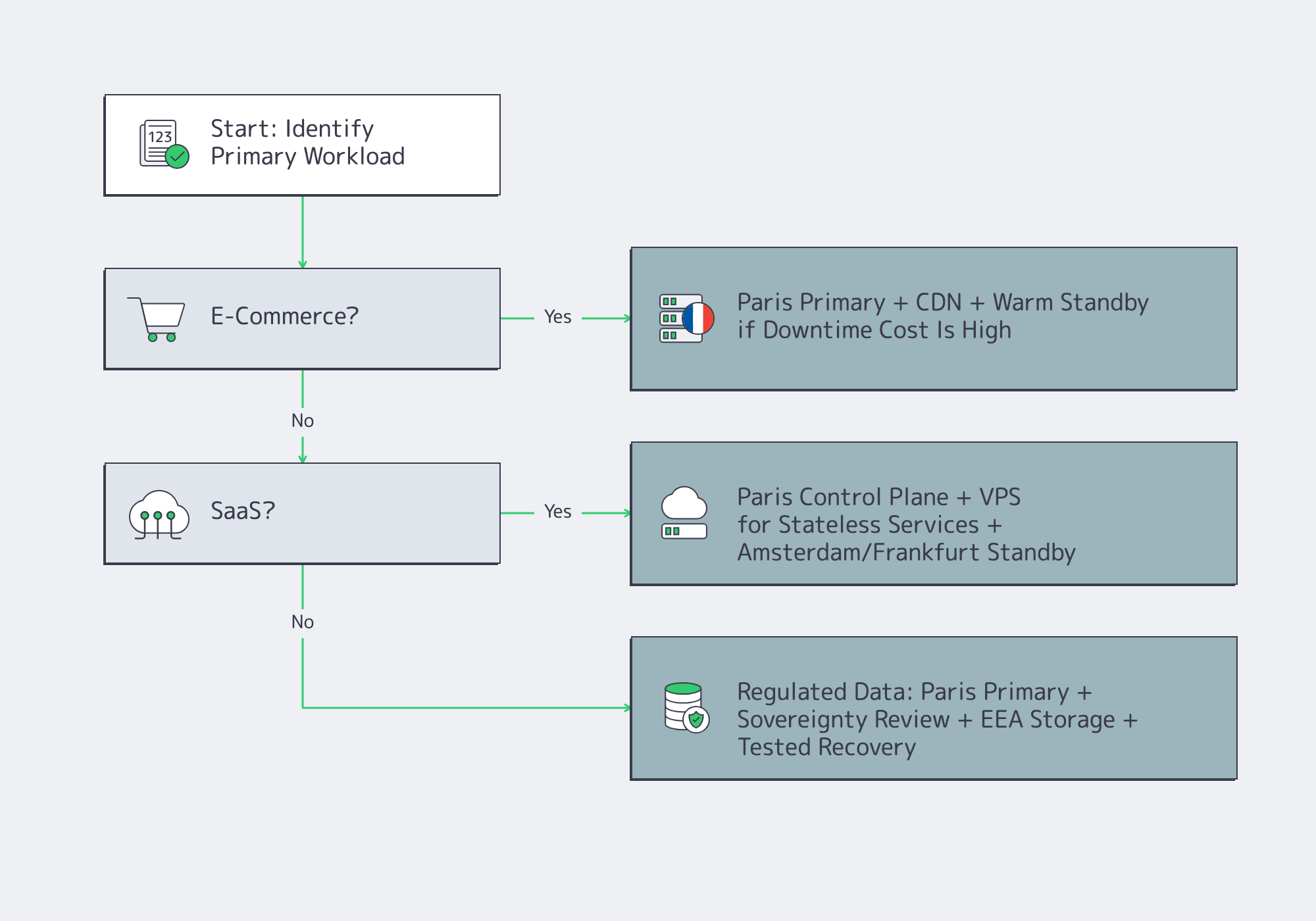
Use the decision trees below to decide what belongs in Paris, what can move to the edge, and what deserves adjacent-region standby. The point is not to buy more infrastructure; it is to separate revenue path, control plane, and regulated state so each receives the right level of locality.
E-commerce: if the conversion path, support workflow, and payment dependencies are concentrated in France, put origin, checkout, search, and sessions in Paris first. If the catalog is image- or video-heavy, add CDN before adding more origin servers. If one hour of downtime costs more than a secondary node, add adjacent-EU warm standby with asynchronous replication.
SaaS: if authentication, tenant metadata, billing, and support operations center on France, use a Paris dedicated primary for the control plane and stateful substrate. If the product is bursty, keep stateless services on virtualized nodes. If recovery targets matter more than always-on symmetry, add a warm app stack and replica DB in Amsterdam or Frankfurt.
Regulated data: start with classification, not infrastructure branding. If sensitive processing creates transfer-risk questions, map legal exposure and supplementary measures. If outsourced personal health data is involved, HDS-certified hosting and EEA storage become thresholds. If strict cyber or financial resilience rules apply, require tested recovery, third-party control evidence, and regional-event-resistant logging.
The Shortlist That Ages Well

The durable shortlist is simple: Paris for latency-sensitive origin services, sovereignty controls that withstand legal review, and adjacent EU redundancy that can actually be operated. Architectures that age well assume traffic gets noisier, audits get more specific, and resilience must be demonstrated rather than merely diagrammed.
That leaves a buyer checklist focused on architecture, not vendor theater:
- Put the latency-sensitive origin in Paris, and let CDN handle repeatable static traffic before it becomes origin load.
- Treat sovereignty as legal exposure, operating control, and transfer mapping, not just rack geography.
- Use dedicated servers for stateful, revenue-critical, and throughput-sensitive paths; use virtualized nodes where flexibility matters more.
- Prefer France plus adjacent-EU warm standby before paying for full dual-active duplication.
- For regulated workloads, design for evidence: required certifications, tested recovery, durable logs, and documented third-party controls.
Configure France Infrastructure
Build on Paris dedicated servers with adjacent-EU options, VPS, CDN, 1,400+ configurations across 21 data centers, 20+ transit providers, 25+ IXPs, and 55+ CDN PoPs in 39 countries.
Get expert support with your services
Blog

Netherlands Server: Bandwidth Checks and Deployment Guidance
Choosing a Netherlands server is no longer just a data-residency check. Eurostat says 52.7% of EU enterprises now use paid cloud services, up 7.4 percentage points from the prior survey, so the harder question is how to place predictable capacity when traffic, logs, backups, and partner integrations converge.
The practical decision is when a VPS is still enough, when dedicated capacity becomes safer, and how to validate the network, unmetered wording, data handling, and operating model before launch. For Netherlands-hosted workloads, Amsterdam connectivity can make central European deployments fast or expose weak routing choices.
Deploy in Amsterdam— 450+ Amsterdam server configs — 1-200 Gbps bandwidth plans — Private networking and BGP support |
|
Why Amsterdam Changes the Shape of a Netherlands Server Deployment
Amsterdam matters because it is an interconnection system, not just a rack market. Netherlands workloads on a server in Amsterdam can sit closer to dense peering, transit, and exchange paths; a server on a thin network can still feel distant. The difference shows up in latency, route stability, and incident blast radius.
The public numbers explain why buyers test Amsterdam differently. AMS-IX public statistics show 935 route-server peers, 912 connected ASNs, 1,122 customer ports, and 913 IPv6 peers, with current traffic above 10 Tb/s and a recent peak above 15 Tb/s. That is not a provider guarantee, but it is a hard baseline for route-quality diligence.
A second signal is inter-region latency. A public cloud round-trip latency dataset places West Europe in the Netherlands and publishes median round-trip figures from that region of about 13 ms to Germany West Central, 15 ms to France Central, 23 ms to Poland Central, 24 ms to Italy North, and 36 ms to Sweden Central. Use them only as sanity checks.
Chart: Median Netherlands-to-Europe Round-Trip Latency
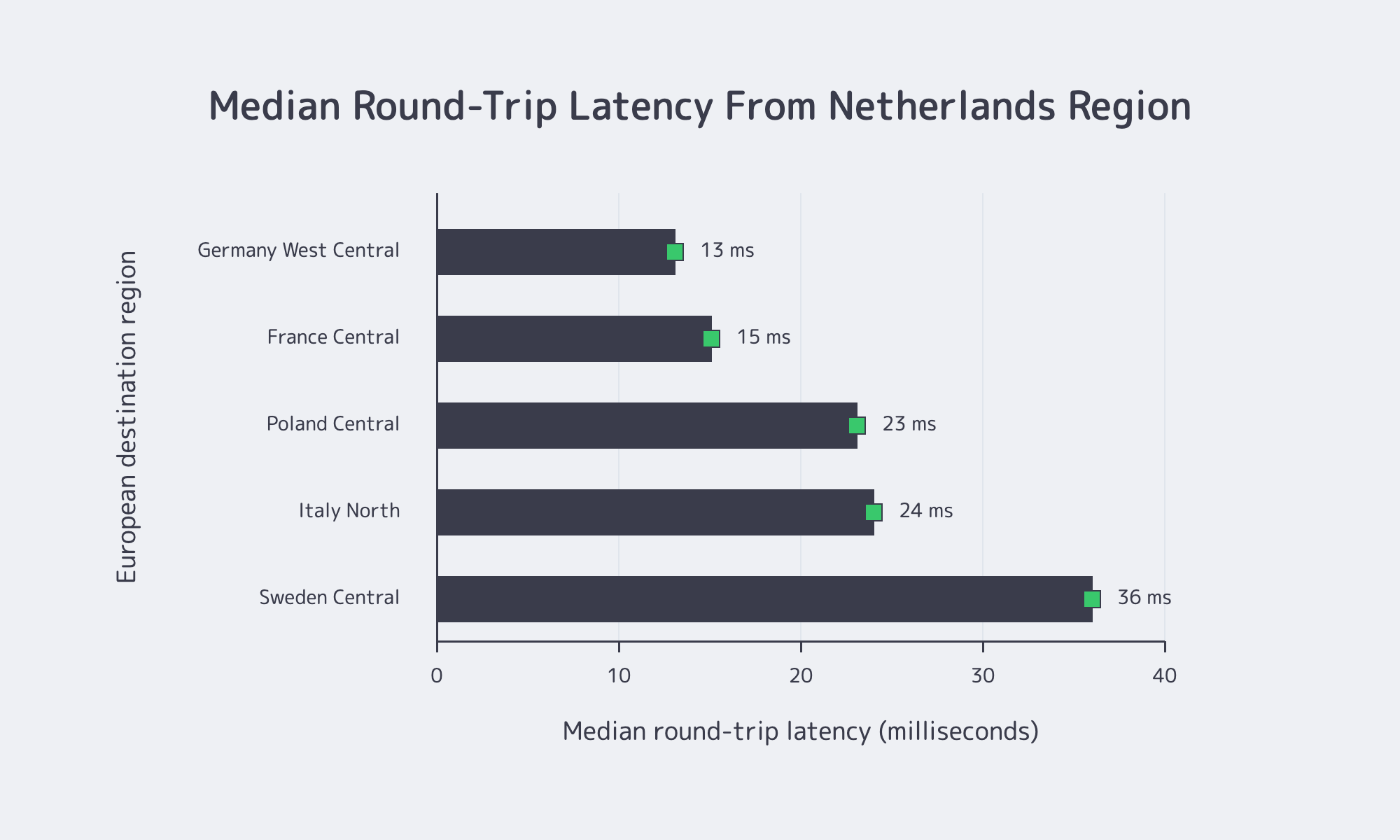
Source: source.
Netherlands Server: When VPS Makes Sense and When Dedicated Is Safer
A VPS makes sense when demand is uncertain, the workload tolerates noisy-neighbor effects, and operational simplicity matters more than strict isolation. A dedicated server is safer when sustained load, long-tail latency, fixed bandwidth economics, or audit scope make shared tenancy a business risk rather than a cost saver.
Use the matrix below as a practical decision frame rather than a rulebook.
| Decision Signal | VPS Usually Makes Sense | Dedicated Is Safer |
|---|---|---|
| Demand pattern | Early or irregular demand; bursty workloads with idle time | Sustained utilization; busy periods are routine |
| Performance tolerance | Small latency swings are acceptable | CPU contention, storage variance, or long-tail latency hurts operations |
| Compliance posture | Logical isolation is enough | Cleaner tenancy boundaries and narrower audit scope are required |
| Networking model | Mostly public internet traffic with simple addressing | Fixed-capacity ports, private networking, BYOIP, or routing policy matter |
| Cost shape | Elastic convenience matters most | Predictable compute and bandwidth economics matter most |
The common upgrade path is not dramatic. Teams start on VPS for prototypes, staging, low-duty background services, and modest internal tools. They move when graphs flatten into known load: backup windows collide with peak hours, cache rebuilds contend with user traffic, and scaling sideways becomes a workaround for variance.
That VPS-to-dedicated move should be triggered by evidence, not instinct. Track CPU contention symptoms, p95/p99 latency, disk wait, network saturation, packet loss, and deployment-window impact. Noisy-neighbor guidance frames shared-resource contention as an architectural risk, not just a hosting annoyance.
How to Validate Amsterdam Connectivity, Unmetered Wording, and Private Networking Options
Do not buy a Netherlands server on labels alone. “Low latency,” “unmetered,” and “private network” only matter when they are measurable in your metros and clear in the commercial terms. Validate path quality, throughput behavior, billing language, private east-west design, and BGP requirements before order approval.
A Netherlands Server Should Be Benchmarked From Your Real Metros
Start with public evidence, then test the exact path. Melbicom’s Amsterdam dedicated server page publishes a test download endpoint and describes Amsterdam facilities with Tier III and Tier IV data centers and 1–200 Gbps per-server networking. That is the kind of buyer-visible signal to pair with your own probes.
Melbicom’s current Amsterdam configuration set includes 450+ ready-to-go dedicated server configurations. At the top level, the Netherlands list spans Intel and AMD processors, Xeon Scalable and Ryzen 7000/9000 options, 32–1536 GB RAM, and bandwidth plans from 1–200 Gbps with 50 TB or unmetered transfer choices. Custom server configurations can be deployed in 3–5 business days for planned rollouts.
Run latency, packet-loss, traceroute, and sustained-download tests from the cities where users, offices, APIs, and upstreams actually sit. For European acceptance testing, Frankfurt, Paris, Warsaw, Madrid, Stockholm, Riga, Vilnius, and Palermo are more useful than arbitrary map points because they mirror real network presence. A credible record includes median RTT, jitter, p95/p99 latency, packet loss, sustained throughput, route changes, and method.
A Netherlands Server Private Fabric Is About East-West Traffic, While BGP Is About Control
Private networking and BGP solve different problems. Private VLAN or private-network options are for east-west flows: database replication, cache fills, internal APIs, backup sync, and management traffic that should not compete with public ingress or egress. BGP gives control over your own IP space, address portability, and routing policy.
The decision is architectural. If internal systems talk constantly, private networking reduces unnecessary exposure and public-port contention. If address ownership, failover policy, or multi-location routing matters, BGP earns its complexity through BYOIP, IPv4/IPv6 support, route-policy control, and BGP communities. Without those requirements, BGP can be unnecessary operational weight.
How to Validate Compliance and Data Handling Without Hand-Waving
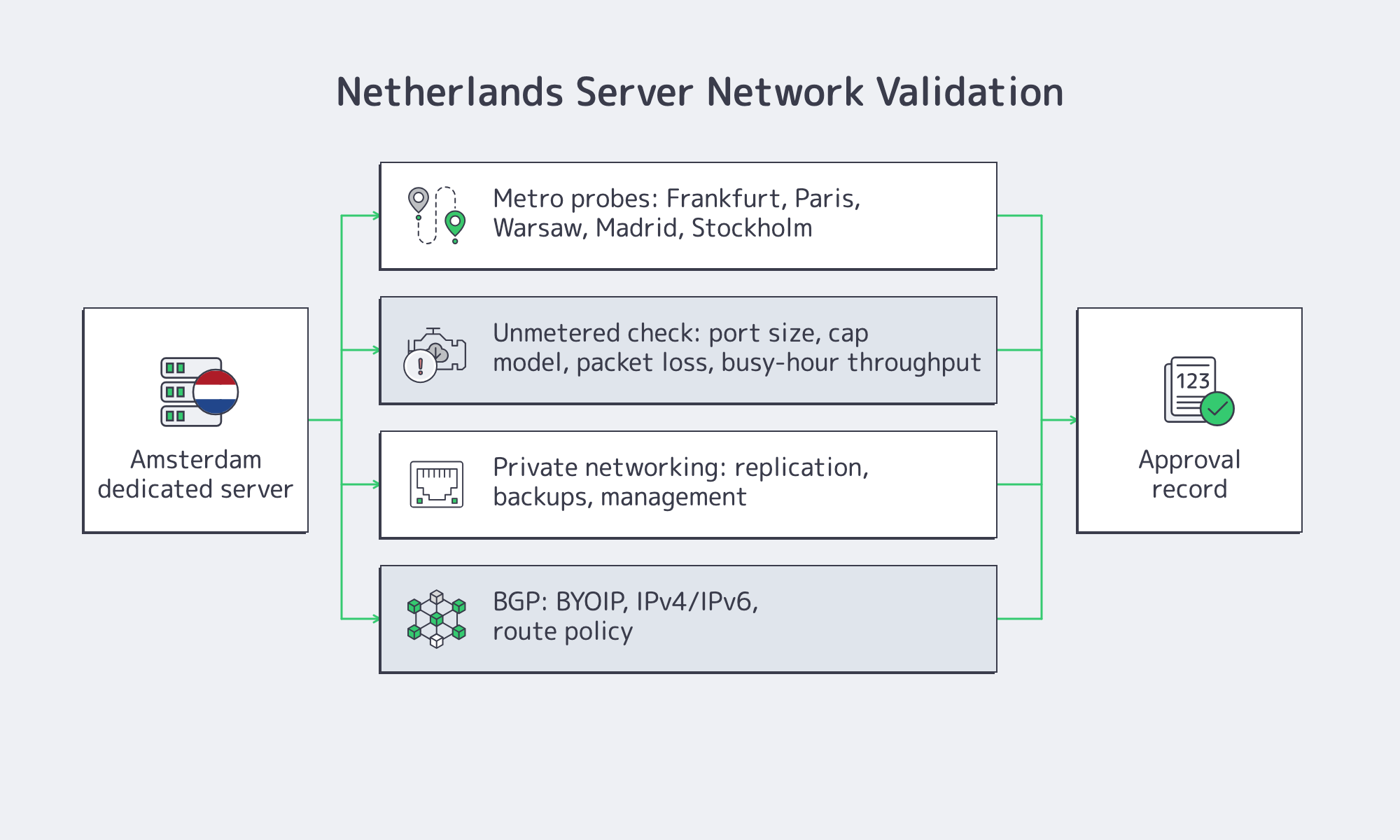
A Netherlands server is not compliant merely because it is in the EU. The useful test is whether you can document where data is stored, who can access it, which systems can move it elsewhere, and what evidence exists when access or processing changes.
For hosting, the processor relationship needs to be explicit. EDPB guidance treats a hosting provider that stores customer personal data on servers on the customer’s behalf as a processor. That makes processor terms, sub-processor visibility, deletion or return of data, audit support, and security evidence procurement questions, not legal boilerplate.
Keep the review operational. Draw production systems, backups, logs, metrics, privileged access, support access, and third parties on one diagram. If personal data leaves the EEA through support tooling, analytics, log processing, or backups, attach the transfer mechanism; the European Commission continues to position standard contractual clauses as a standard tool. Then map security evidence to controls operations can prove, including least privilege, limited-duration third-party access, incident logging, and security evidence reflected in current NIS2 and ENISA guidance.
Netherlands Server Deployment Checklist for Monitoring, Backups, and Access Controls
A reliable Netherlands server launch treats observability, recoverability, and access governance as release gates, not cleanup work. The useful checklist is short enough to run, specific enough to audit, and tied to measurable outcomes: external visibility, tested restores, least privilege, strong authentication, and controlled supplier access.
- Probe from outside the rack. Run synthetic checks from the European metros that matter, and centralize logs with protected transport, limited access, and timestamps that stay consistent across systems.
- Treat logs as sensitive data. Centralized logging guidance emphasizes useful, protected records; avoid secrets or personal data unless the reason is documented.
- Design backups for restores, not dashboards. Define recovery objectives, isolate backup credentials from production, and test restores; NIST ransomware-resilience guidance frames backups as something to conduct, maintain, and test.
- Lock down privileged accounts. Apply least privilege, separate admin identities from normal accounts, and protect system-admin accounts more strongly.
- Mandate strong authentication on admin and build paths. Build-environment guidance treats MFA as baseline; recovery flows must not bypass it.
- Time-box supplier and support access. Set scope and duration before approving third-party access, prefer temporary accounts, and keep an audit trail.
- Keep internal traffic internal when possible. Use private networking for replication, cache fill, backup sync, and management flows.
Where Dedicated Capacity Becomes a Melbicom Conversation
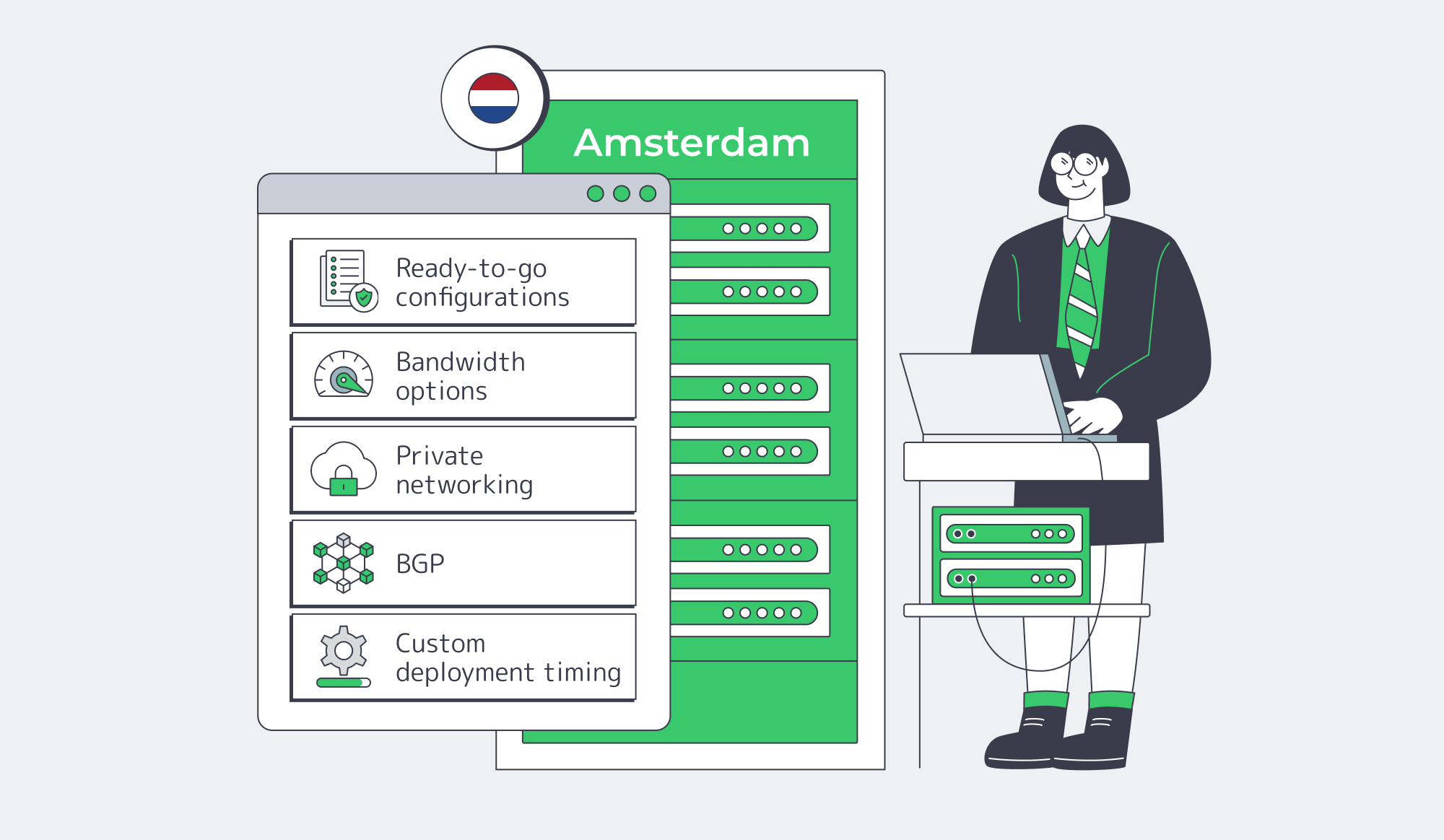
Dedicated capacity becomes the right conversation when the deployment has outgrown shared-tenancy assumptions and needs a testable operating model with predictable networking and clearer isolation. At that point, the decision is about proving the path, pipe, controls, and recovery plan before the move.
For that kind of deployment, Melbicom fits best as an Amsterdam dedicated server option rather than a generic European placeholder. We at Melbicom see the strongest cases when fixed-capacity networking, clean tenancy, private east-west traffic, and documented operating controls all matter at once. Melbicom’s wider footprint also gives Amsterdam deployments room to fit a broader architecture: 21 locations/data centers globally, 20+ transit providers, 25+ IXP peering hubs, and 55+ CDN PoPs across 39 countries.
Explore Netherlands Dedicated Servers
Review Amsterdam dedicated server options with published bandwidth plans, private networking discussions, BGP support, a large ready-to-go pool, and custom builds in 3–5 business days.
Get expert support with your services
Blog

Dedicated Server America: Region Selection and DDoS Resilience
Buying a dedicated server in America is now a latency-budget and risk-budget decision, not a generic geography choice. Round-trip time is driven by physical distance, intermediate hops, congestion, and server response time; even CDN offload only helps when the origin, cache layer, and request path are planned together. A practical fiber heuristic is that every extra 1,000 km can add roughly 10 ms of round-trip delay before queueing or application work is counted. That is enough to change p95 latency, bidder win rates, playback starts, and inference responsiveness.
The stakes are not theoretical. IAB puts full-year U.S. digital advertising revenue near $300 billion. Nielsen’s Gauge recently measured streaming at 47.5% of total U.S. TV viewing in a month. IDC says AI infrastructure spending has moved into the high hundreds of billions and is still rising sharply. Those markets do not fail gracefully when region selection, bandwidth math, or DDoS readiness is treated as an afterthought.
Deploy in America— Atlanta and Los Angeles capacity — DDoS-ready bandwidth planning — Stock servers live in 2 hours |
|
How to Choose a Dedicated Server in America for Coast-Level Latency and Scale
Choose the coast from real demand maps: user metros, revenue-critical API calls, playback starts, bidder traffic, and egress. Atlanta is the stronger anchor for eastern and central demand; Los Angeles fits Pacific and trans-Pacific demand. If traffic is bi-coastal, plan two regions instead of forcing one origin to carry both latency budgets.
The architecture pattern is simple: keep state, origin logic, inference endpoints, or session control near the largest user cluster; push repeated heavy objects outward. Cloudflare’s RTT guidance is clear that distance, hops, and congestion increase latency, while CDNs improve response time by moving cached assets closer to users. Melbicom’s Atlanta and Los Angeles DCs plus CDN footprint of 55+ CDN PoPs across 39 countries, including Ashburn, Atlanta, Dallas, Kansas City, and Los Angeles—fits that origin-plus-edge model.
Provider Due Diligence: Bandwidth, DDoS Posture, Delivery Time, and Remote Hands
Validate the provider like an incident is already underway. Ask how port speed maps to committed throughput, how transfer is counted, what happens during short DDoS spikes, how quickly stock or custom servers arrive, and which remote-hands tasks are routine. The objective is a runbook that survives launch pressure.
DDoS readiness needs first-minute clarity. NETSCOUT reports more than 8 million attacks across 203 countries and territories in half a year, with peaks up to 30 Tbps. If mitigation depends on a ticket, diversion delay, or unclear escalation path, availability is still undefined during active attack traffic.
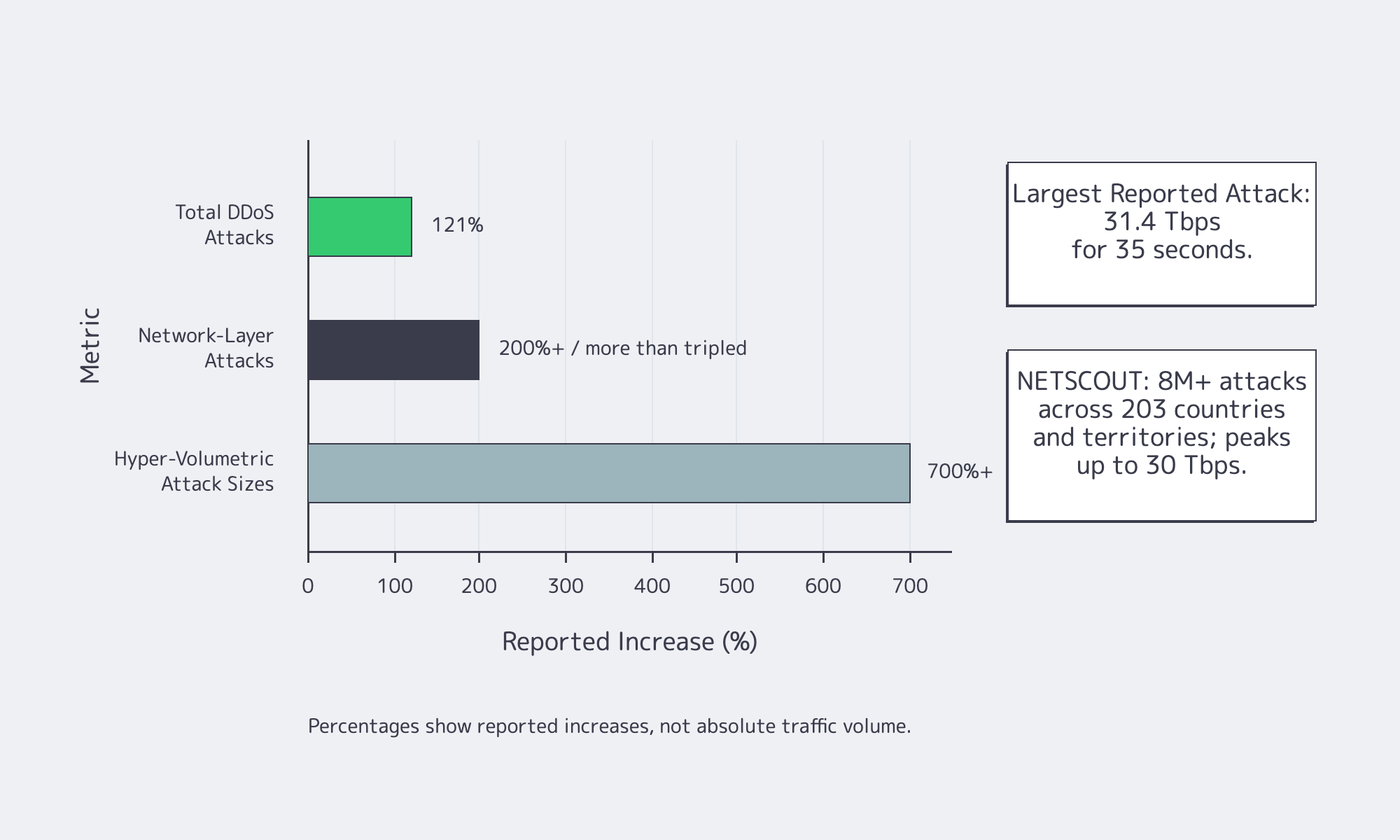
Bandwidth validation deserves the same rigor. Size ports from peak five-minute egress, not monthly averages. Confirm whether “unmetered” changes contention assumptions, whether burst traffic can queue, and how upgrades are handled before a launch, model release, sports window, or paid campaign. Melbicom offers 1,400+ ready-to-go server configurations activated in 2 hours; with 21 global data center locations, 24/7 support, 25+ IXPs, 20+ transit providers, and custom configurations delivered in 3–5 business days. Those facts matter because emergency growth and planned growth have different timelines for ordering and response.
Which Infrastructure Triggers Justify Upgrading for AI, Streaming, and Adtech
Upgrade when behavior changes, not when a refresh calendar says so. AI inference needs new capacity when latency slips before utilization looks catastrophic. Streaming needs headroom when event traffic jumps above baseline. Adtech needs more or better-placed servers when bidder paths, redirects, analytics, and creative delivery compete across the wrong coast for the largest user base.
AI workloads often expose memory, local-storage, and east-west-copying limits before CPU graphs look alarming. The next dedicated server should therefore be chosen for memory footprint, NVMe capacity, and network headroom as much as for cores. A common region-right-sizing pattern is to launch near the larger user cluster, measure p95 latency and egress, then add the second coast before the next product spike.
Streaming is more brutal because events bend the curve. AppLogic Networks says video is the largest application category by volume at 5.6 GB per user per day, and live-sport days accounted for all ten of its top traffic days, with peaks 30–40% above normal usage. In practice, a single origin that looks fine on ordinary days can become fragile during premieres, finals, or news-driven surges.
Adtech exposes the same problem through path design. AppLogic says ad analytics touches 93% of fixed-network subscribers, which makes it pervasive rather than peripheral. Melbicom offers regional placement, high-QPS routing, guaranteed bandwidth, BGP Session support for routing requirements, and CDN offload for creatives and landing assets. When bidder logic and conversion APIs drift across the wrong coast, the upgrade case has already arrived for infrastructure planning.
Compare Offers Worksheet for a Dedicated Server America Shortlist
Use this worksheet to compare any dedicated server America shortlist in operational terms. It focuses on decisions that affect production: coast fit, burst bandwidth, DDoS operating model, delivery windows, remote hands, and second-stage scale. Fill it with evidence from logs, monitoring, and incident assumptions—not sales adjectives.
| Buying question | What good looks like | Why it matters |
|---|---|---|
| Where is demand concentrated? | Logs point east, west, or clearly bi-coastal | Cuts avoidable RTT and hop count |
| How should bandwidth be sized? | Peak five-minute egress plus burst headroom | Prevents queueing during launches and live events |
| What is the DDoS model? | Immediate mitigation posture with explicit escalation | Short, large attacks leave little reaction time |
| How transparent are operations? | Known delivery windows, access methods, and remote-hands scope | Turns incidents and growth into planned work |
| What is the scale path? | Extra servers, second coast, CDN offload, stable routing | Avoids migration under pressure |
Used honestly, the worksheet exposes false economy. A lower-cost server in the wrong region can cost more through failed bids, late origin fetches, or incident response. Against that worksheet, Melbicom’s relevant facts are specific: Atlanta and Los Angeles options, 1,400+ ready-to-go configurations globally, 19 other global data center locations, 25+ IXPs, and 20+ transit providers. That gives the buying team concrete inventory and routing data to validate against its own traffic model.
Quick Path to Configure America Servers
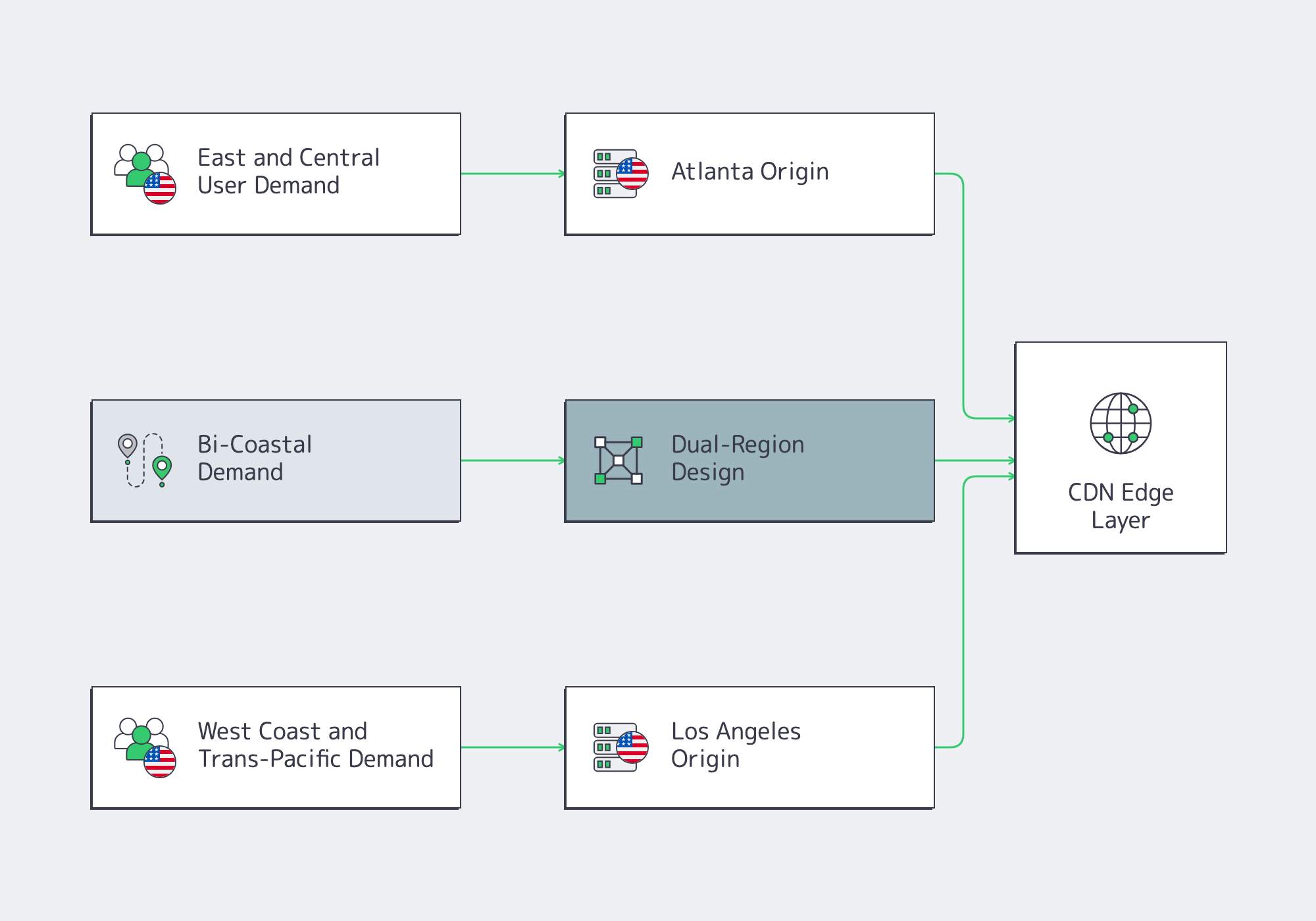
The fastest path is to convert traffic evidence into a server configuration before touching checkout. Start with recent logs, choose the coast, size the port from real peaks, decide whether stock or custom hardware is required, and define the CDN or routing dependencies that will shape the second phase.
- Build a city-weighted demand matrix from the last 30 days of request, playback, bidder, or API logs.
- Treat peak five-minute egress as the bandwidth baseline, then add burst headroom for launches, campaigns, live events, and model releases.
- Choose Atlanta, Los Angeles, or two regions based on p95/p99 tests rather than headquarters location.
- Reserve stock capacity early; when hardware needs are specific, plan custom configuration work 3–5 business days ahead.
- Use CDN offload for repeated heavy objects and confirm routing, DNS, access, and remote-hands requirements before migration.
Melbicom’s USA presence is the first stop for regional choices; the Atlanta and Los Angeles pages offer the city-level ready-to-go options; and the Dedicated Servers Configurator is the path when CPU, RAM, storage, and bandwidth requirements need a closer match to traffic.
Conclusion: Buy Dedicated Server America Capacity Around Traffic Truth
The best dedicated server America decision is not “which country?” but “which coast, port model, incident posture, and scale path match the traffic?” For modern platforms, the winning design combines a coast-correct origin, validated bandwidth headroom, DDoS-ready operations, and a second-stage plan before the spike arrives.
That planning discipline is especially important before streaming events, AI launches, and ad campaigns, where latency and availability problems show up in user behavior before they show up in monthly invoices. A provider should make the next capacity move easier to justify, faster to order, and clearer to operate.