
Blog

Decoding Unlimited Dedicated Server Offers: Ports & Policies
“Unlimited” bandwidth is one of hosting’s most abused phrases because it tries to sound like both a pricing model and a technical guarantee. One promise says your bill will not spike with every extra terabyte. The other says the network will carry sustained load without a quiet intervention later. Those are not the same thing.
Market Reality: Why Unlimited Dedicated Server Pricing Exists
Providers can offer flat-fee “unlimited” plans because bandwidth is bought upstream as capacity and because most customers do not run hot all month. A small minority account for a disproportionate share of traffic, a pattern visible in operator discussions and in the broader market. TeleGeography reports continued IP transit price erosion in major hubs, with 100 GigE now standard and 400 GigE appearing. At the same time, Sandvine extrapolates global internet traffic at roughly 33 exabytes per day across 6.4 billion mobile and 1.4 billion fixed subscriptions. “Unlimited” is real business math. It becomes risky when the contract assumes you will never behave like the port you bought.
What “Unlimited Dedicated Server” Really Means in Hosting Offers
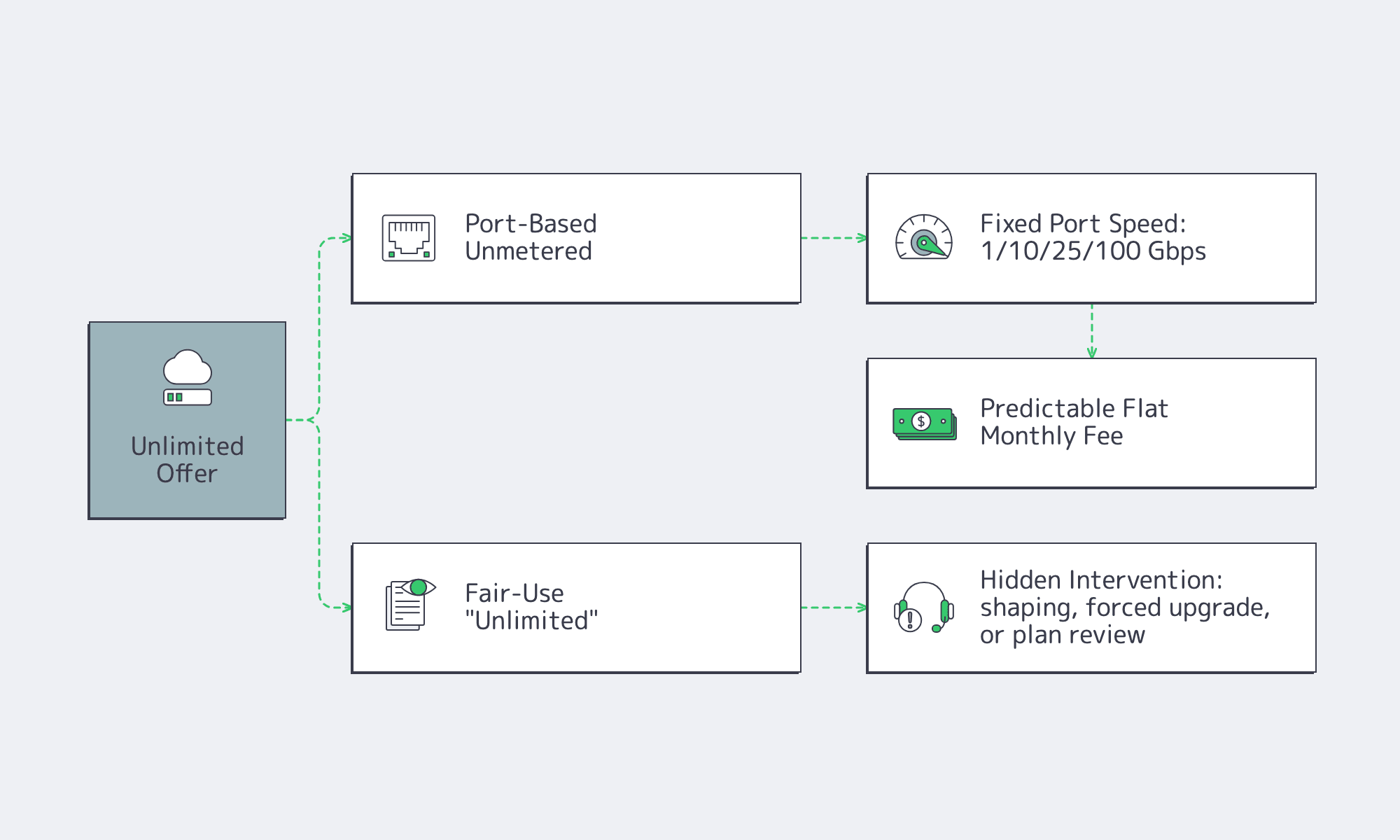
An unlimited dedicated server offer is almost never infinite bandwidth. In practice, it means either the provider stopped billing by TB and is selling access to a fixed port speed, or it is selling a flat monthly headline while keeping the right to intervene under fair-use language. The entire buying decision is figuring out which version you are actually being sold.
The physical ceiling is always the port: 1 Gbps, 10 Gbps, 25 Gbps, 100 Gbps, or higher. That is why “unmetered dedicated server” is usually the more useful phrase. It does not pretend data is infinite; it says volume is not billed separately, while throughput is limited by the port rate.
A simple reality check: a 1 Gbps port sustained for a 30-day month moves roughly 324 TB before overhead. A 10 Gbps port moves traffic on a multi-petabyte scale. So the core question is not whether a provider says “unlimited.” It is whether sustained use near line rate is treated as normal.
Choose Melbicom— Unmetered bandwidth plans — 1,300+ ready-to-go servers — 21 DC & 55+ CDN PoPs |
 |
Unmetered Dedicated Server: Port Speed Is the Real Ceiling
Port-based unmetered is the clean version. You buy a defined port speed, the monthly price is flat, and normal use does not trigger a punitive conversation just because you actually use the port.
The other version is “unlimited until fair use.” The ad says unlimited, but the terms reserve the right to shape traffic, force an upgrade, or redefine your workload as “non-standard” once it becomes expensive.
We at Melbicom offer guaranteed bandwidth and backbone capacity. That matters because the network behind the offer is the real product.
How Fair-Use Policies, Shaping, and Throttling Affect “Unlimited” Server Plans
Fair-use language is not automatically a problem; the risk appears when it replaces measurable bandwidth terms. In practice, throttling usually means shaping or policing that appears once your traffic changes the provider’s cost, congestion, or abuse profile. If the trigger is undefined, the headline stops being an operating guarantee.
The most common red flags are consistent across the market:
- sustained near-line-rate use that breaks the provider’s utilization assumptions;
- DDoS exposure or collateral filtering on busy networks;
- traffic profiles with high packets per second, many small packets, or heavy UDP;
- inbound-heavy patterns that look different from classic “mostly outbound” hosting;
- encrypted transport such as QUIC and HTTP/3, where RFC 9000 makes clear that packet payloads are protected, reducing classification and pushing enforcement toward blunter rate-based controls.
The abuse backdrop is real. ENISA’s threat landscape says DDoS accounted for about 76.7% of recorded incident types in its dataset. That does not mean your traffic is malicious. It means many providers now design first for survivability, and fuzzy terms can turn that posture into customer-visible throttling.
How to Compare Unlimited, Unmetered, and 95th-Percentile Bandwidth Models
Ignore the adjective and compare the meter. Unlimited, unmetered, and 95th percentile can all ride on the same physical port, but they create very different cost and throttling risks. The safe comparison is the rule that determines when more traffic changes your bill or triggers a network response.
Think of the options this way:
| Model | How It Works | Where Buyers Get Burned |
|---|---|---|
| Port-based unmetered | Flat monthly fee tied to a defined port speed. No per-TB billing; throughput is capped by the port. | Trouble starts when the provider quietly assumes you will not sustain heavy utilization. |
| “Unlimited” until fair use | Flat monthly headline plus discretionary thresholds such as “excessive” or “impacts others.” | You cannot model either performance or cost because the real limit is hidden. |
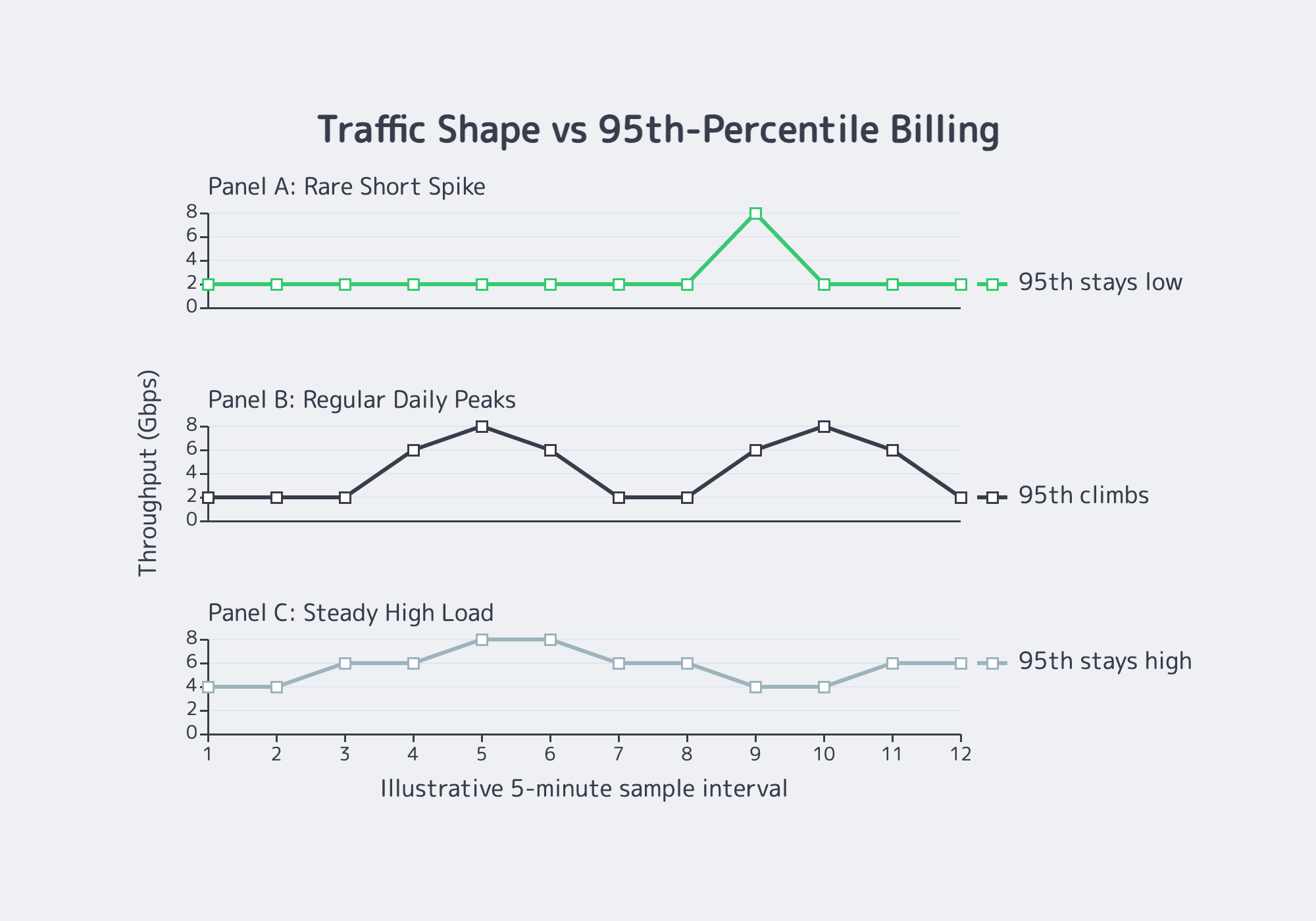
| 95th percentile | Traffic is sampled, the top 5% of samples are discarded, and the remaining peak becomes the bill. | Repeated “bursts” stop being bursts and become your normal bill. |
| Committed rate with policing | You buy X Mbps and the network enforces it. | Predictable, but inflexible; spikes require overprovisioning or upgrades. |
A quick way to sanity-check 95th percentile is to ask whether your peaks are rare events or daily behavior. Equinix’s enterprise billing documentation describes 95th percentile as a burst-billing model, not a flat rate.
If you spike for a short launch window, the model can work well. If you run hot every afternoon, the percentile climbs with you.
Contract and Technical Checklist for Predictable Bandwidth
This is where expensive surprises hide. Your contract should define sustained-use expectations, the billing method, intervention triggers, and renewal mechanics in plain language. Words like “excessive” or “non-standard” are not harmless if they are undefined.
Ask four things before you sign: is sustained port utilization allowed, and what counts as “sustained”; is billing flat-rate, 95th percentile, or a committed rate with overage; what happens first if traffic is flagged + what happens at renewal if your pattern stays the same?
Traffic mix belongs in that conversation too. Two customers can both use 2 Gbps and create very different network load. Sandvine notes the growing importance of upstream traffic from backups, file sharing, and user uploads. If your workload is upload-heavy, UDP-heavy, or event-driven, say so early and get the answer in writing.
Designing for Predictability: Modern Ways to Reduce Bandwidth Surprises
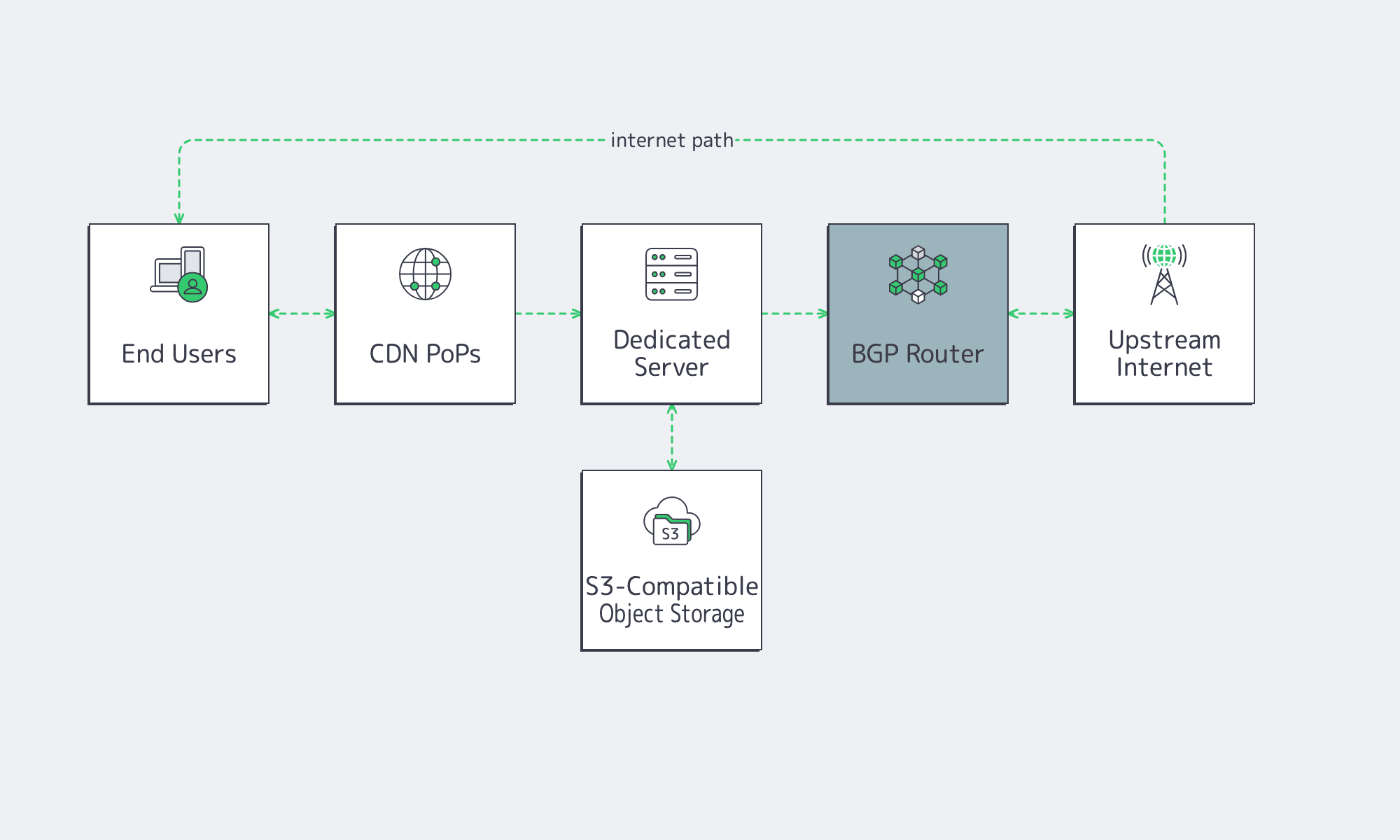
Bandwidth predictability is also an architecture question. TeleGeography says direct connections and caching have a localizing effect on traffic, which is one reason CDN and regional distribution still matter.
That is where Melbicom’s stack becomes relevant. Melbicom’s CDN spans 55+ PoPs in 36 countries and offers unlimited requests with bandwidth-based pricing options. Melbicom’s S3-compatible object storage can help separate origin compute from bulk object delivery. BGP sessions are available in every data center for predictable routing and BYOIP. On the network side, Melbicom has a 14+ Tbps backbone tied into 20+ transit providers and 25+ IXPs. Those are the kinds of facts that make “unlimited” testable.
The Right Way to Buy “Unlimited”

The safest way to evaluate an unlimited dedicated server offer is to treat “unlimited” as branding and ask what is actually being sold: a flat port, a burst-billed percentile, a committed rate, or a fair-use plan with discretionary enforcement. Once that is clear, the decision becomes operational instead of emotional.
Use this filter before you commit:
- treat “unlimited” as packaging until the port, meter, and intervention policy are explicit;
- match the billing model to your traffic shape, because steady high throughput and bursty peaks are not the same purchase;
- require written thresholds for shaping, policing, abuse review, and renewal;
- include upstream mix, packet profile, and protocol behavior in the pre-sales discussion;
- leave headroom in ports and architecture so the first sign of growth is not the first throttling event.
That checklist does not slow the buying process. It makes the result safer. When a provider can answer those questions directly, “unlimited” stops being a slogan and starts acting like infrastructure you can plan around.
Get predictable bandwidth now
Choose unmetered ports or committed rates across global locations. Pair with CDN, S3 storage, and BGP to reduce throttling risks and keep costs predictable.