
Blog
Why UAE Hosting Delivers Speed, Compliance, and Scale
Enterprises serving customers across the Gulf now face a simple infrastructure question with complicated consequences: where should the origin servers live? For years, many hosted in Europe or North America and absorbed the cost of distance—triple‑digit‑millisecond round trips and cross‑border data exposure. Between London and Dubai alone, typical latency hovers around ~130 ms. Today, a dedicated server in the UAE places compute inside the region’s network core, aligning with data‑residency rules and delivering ultra‑low latency for fintech, e‑commerce, AI inference, streaming, and collaborative apps. This is no incremental tweak; it’s the difference between “fast enough” and instant—and between “legally acceptable” and locally compliant.
Choose Melbicom— {{servers_in_stock_fujairah}} ready-to-go servers — Tier III-certified DC in Fujairah — 40 PoP CDN across 6 continents |
 |
Why Are Digital Demands in the Middle East Surging?
Two secular shifts define the region’s new reality. First, digital consumption and online commerce are exploding; Deloitte estimates Middle East e‑commerce will reach roughly US$50 billion in the near term, propelled by mobile adoption and pro‑digital policy. Second, data center capacity is ramping hard: PwC projects regional capacity to triple—from ~1 GW to ~3.3 GW—over five years, driven by cloud, AI, and sovereign data strategies. In other words, the demand side (users, transactions, streams) and the supply side (local compute, power, and interconnects) are meeting in the UAE and its neighbors, making a regional hosting footprint both practical and advantageous.
What Do Strict Data‑Residency Laws Mean for Your Hosting Strategy?
Compliance has moved infrastructure decisions from “best practice” to “must have.” In the UAE, sector rules make the stakes explicit:
- Payments: The Central Bank’s Retail Payment Services and Card Schemes Regulation requires payment service providers to store and maintain personal and payment data within the UAE, with secure backups retained locally.
- Healthcare: The Health Data Law (Federal Law No. 2 of 2019) limits the transfer or processing of UAE health data outside the country except under defined exceptions.
- IoT: The national IoT regulatory policy requires Secret/Sensitive/Confidential data—especially for government or critical infrastructure—to remain in the UAE.
Leading firms summarize the risk plainly: non‑compliance may trigger fines, service suspensions, or even criminal penalties—and cross‑border transfers face stricter scrutiny.
Creating Measurable Advantage via Ultra‑Low Latency

Latency is not an abstraction; users feel it. Human‑factors research shows three crucial thresholds: ~0.1 s feels instantaneous, ~1 s remains flow‑friendly, and >10 s breaks focus—guardrails that translate directly to web and app UX. For revenue‑producing funnels, the numbers are unforgiving: a 100‑ms delay can cut conversions by up to 7%, and 53% of mobile visitors abandon pages exceeding three seconds.
The geography of your origin matters more than any front‑end micro‑optimization. Hosting in Europe or the U.S. keeps round‑trips in the triple‑digit milliseconds for Gulf users (e.g., London–Dubai ~133 ms), whereas a UAE origin collapses that to tens of milliseconds. The regional UAE‑IX exchange (operated by DE‑CIX) keeps traffic local and has demonstrated latency reductions of up to 80% for gaming and interactive content—precisely the workloads most sensitive to jitter and lag.
For industries where milliseconds decide outcomes, the bar is even higher. As DataBank’s Gregory Ryman notes, “Whereas milliseconds were once acceptable, microsecond responses are now required” for trading, payments, and real‑time analytics. AI inference pipelines and personalization engines show similar sensitivity; moving model scoring closer to users reduces tail latency and bandwidth costs, enabling richer on‑page experiences without the penalty of long‑haul calls.
Local UAE Server vs. Overseas Hosting: What changes in practice?
| Factor | UAE Dedicated Server | Overseas Hosting (EU/US) |
|---|---|---|
| Data compliance | Meets UAE localization (payments, health, IoT), keeping sensitive records on UAE soil. | Cross‑border exposure; additional legal burden for transfers and higher penalty risk if localization applies. |
| Latency to Gulf users | Tens of milliseconds via in‑country peering and regional IXs (UAE‑IX). Up to 80% lower vs. out‑of‑region. | 100–200+ ms transcontinental RTT common; sluggish UX under load. |
| User experience | Faster pages and APIs → higher conversions and engagement. | Slower flows → bounce and cart abandonment. |
| Network resilience | Local exchanges + diverse subsea routes keep Gulf traffic in‑region. | Long‑haul dependency raises risk from cable events and congestion. |
| Operational control | Local time‑zone support and auditability under UAE standards. | Remote operations across time zones and jurisdictions. |
What Makes UAE Data Centers Genuinely World‑Class?
Three ingredients: tiered facilities, dense interconnects, and subsea diversity.
- Tiered reliability at scale. The UAE hosts multiple Tier III+ sites, including in Fujairah and Dubai, designed for concurrent maintainability and enterprise uptime.
- A heavyweight Internet core. UAE‑IX (DE‑CIX) now connects 110+ networks and pushes terabit‑scale peaks, keeping content, cloud, and eyeballs local—explicitly to reduce latency and improve experience.
- A cable‑landing powerhouse. Fujairah is the Middle East’s largest subsea landing hub, with systems like AAE‑1, EIG, GBI, SEA‑ME‑WE variants, and the 2Africa mega‑cable adding more diversity via the UAE’s east coast (Kalba). This translates to east‑west path optionality and fast failover when one route degrades.
On top of the physical network, capacity headroom is real. We at Melbicom operate dedicated servers in Fujairah with dedicated port options up to 20 Gbps locally, and per‑server bandwidth up to 200 Gbps in select global locations, with a CDN spanning 40 PoPs to accelerate static/video workloads outside the Gulf. Free 24/7 support remains standard for dedicated servers.
Why Choose a UAE Dedicated Server Strategy Over “Host Elsewhere and Hope”?
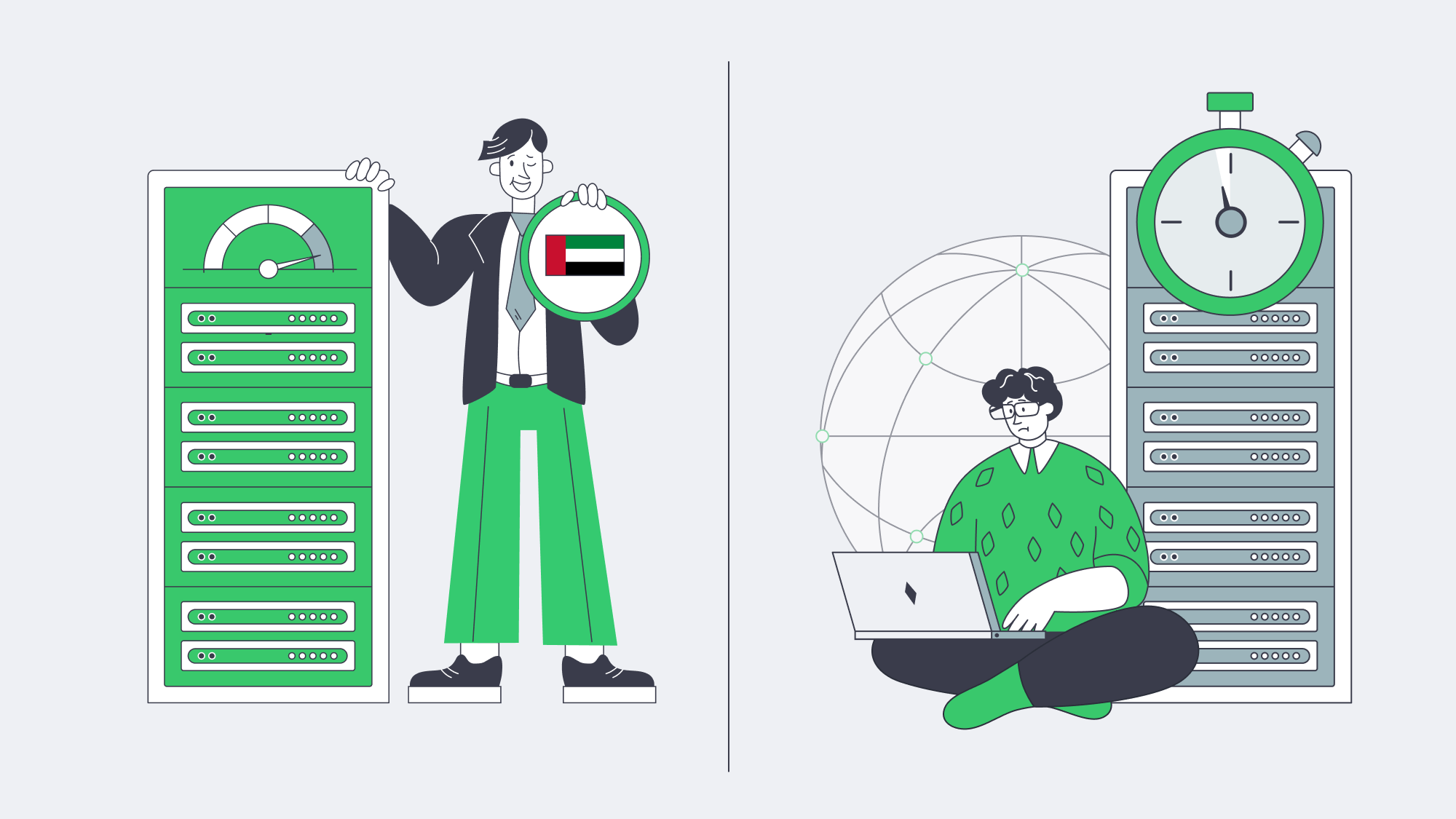
Because distance and jurisdiction now impose hard costs. The UAE offers a rare combination—lawful locality, tens‑of‑milliseconds proximity, and carrier‑dense interconnects—that few offshore options can match for Gulf user bases. The result is not just faster pages; it’s fewer abandoned checkouts, snappier banking flows, and smoother AI‑assisted experiences.
When is dedicated server hosting in UAE non‑negotiable:
- You process regulated data (payments, health, government/IoT), or must prove records stay in‑country.
- You sell or trade in real time (fintech, marketplaces, gaming) where milliseconds—or microseconds—matter.
- Your conversion engine depends on speed (retail, subscriptions, ads), and you can’t afford 100‑ms tax from offshore origins.
- You need scale and resilience with in‑region peering and subsea path diversity—not single‑continent bets.
Where Does the UAE Stand vs. Saudi Arabia and Qatar?
All three markets are modernizing fast and tightening oversight of personal data. Saudi Arabia’s PDPL and sector frameworks (e.g., SAMA) restrict cross‑border transfers and increasingly enforce localization—making in‑KSA hosting advisable for Saudi‑resident datasets. Qatar’s PDPPL also limits transfers and prescribes fines.
What makes the UAE uniquely useful is its function as the GCC interconnect fabric—home to UAE‑IX and Fujairah’s cable landings—so UAE servers serve the wider region with lower latency, even as organizations stand up country‑specific clusters where laws require. Many enterprises therefore adopt hybrid regional topologies: a UAE origin for GCC‑wide proximity and shared workloads, plus in‑country nodes where sectoral laws demand.
Local Infrastructure Has Become Table Stakes
Data sovereignty and user experience are now board‑level issues in the Gulf. The shortest, safest path to both is to run your origin in the UAE—within the jurisdiction that governs your customers and close enough to render the network invisible. With e‑commerce growth, AI‑heavy applications, and payments modernization all accelerating, the performance and compliance dividend from UAE hosting compounds year over year.
The strategic calculus is simple: if your revenue, risk, or reputation depends on speed and lawful processing in the GCC, a UAE dedicated server is no longer optional. It’s the foundation for the services your users already expect.
Deploy a UAE dedicated server
Place your workloads in Fujairah for low latency, local compliance, and carrier‑dense connectivity. Choose from ready configurations and ports up to 20 Gbps, backed by 24/7 support.