
Blog

Dedicated Server Hosting in UAE: Low-Latency GCC Playbook
The mistake is treating server placement as a box-ticking exercise. In the United Arab Emirates, the real decision is architectural: keep hot-path latency low across the Gulf Cooperation Council, keep live customer and payment data where governance teams want it, choose between interconnection density and cable-adjacent resilience, and fail over without wrecking the user experience. Mobile performance research found that as page-load time rises from one second to 10 seconds, bounce probability rises by 123%.
The Internet Society’s IXP Tracker lists two active IXPs in the UAE with 111 combined members, while DE-CIX says UAE-IX exceeds 1 Tbps peak traffic, connects more than 110 networks, and carries more than 6.6 Tbps of connected customer capacity. Dedicated server hosting in UAE is now a network decision, not just a facilities decision.
Host in the UAE— Ready-to-go UAE servers — Low-latency GCC routing — Europe and US failover options |
 |
How to Choose Dedicated Server Hosting in UAE for GCC Latency and Residency
Choose dedicated server hosting in UAE by anchoring the full transactional path in-country, not just the cache. The application tier, session layer, queues, cache, and primary write database should sit close to users, while cross-border replicas are governed by explicit data-transfer, access-control, and recovery rules.
The fastest way to miss the latency target is keeping the origin abroad and hoping a CDN will hide it. CDN works for static assets, downloads, images, and media. It does not fix log-in, inventory checks, checkout, authenticated APIs, customer updates, or session refreshes. Those paths still need the application tier and primary database near users.
Placement now intersects with governance. The official UAE platform describes the Personal Data Protection Law as an integrated framework for confidentiality and privacy. DIFC rules require an adequate destination or safeguards for many personal-data transfers. The Central Bank’s retail payment services framework adds payment-flow obligations. The result: live records, logs, keys, and payment-sensitive logic increasingly belong in the UAE, while replication abroad must be designed rather than improvised.
| Traffic Pattern | Practical RTT Budget | Placement Rule |
|---|---|---|
| UAE-resident users | Single-digit to low-teens ms | Keep the full hot path in UAE. |
| Core GCC interactive journeys | Sub-50 ms design target | Keep app, session, cache, queue, and primary DB in UAE; use CDN for static and media-heavy reads. |
| European failover | Roughly 120 ms class RTT | Use for warm standby and asynchronous replication, not normal interactive primary traffic. |
| US tertiary recovery | Roughly 180 ms+ class RTT | Use for tertiary DR, support systems, analytics, reporting, and cold backup. |
Dubai vs Fujairah for Peering, Resilience, and Procurement Strategy
Dubai and Fujairah solve different infrastructure problems. Dubai is the UAE’s interconnection gravity well for peering density and carrier marketplace access. Fujairah is the safer lens for Melbicom examples and a major cable-adjacent hub where route diversity, submarine landings, and east-coast resilience become procurement variables.
Dubai matters because UAE-IX powered by DE-CIX is described as the largest carrier- and data-center-neutral Internet exchange in the Middle East, interconnecting global networks, carriers, and content providers across the GCC. For peering density and carrier choice, that gravity is real.
Fujairah matters for route diversity. Submarine Networks identifies it as the UAE’s major submarine-cable landing location, listing AAE-1, BBG, IMEWE, SMW3, SMW4, TEAMS, and others. Public capacity-hub documentation says a Fujairah-based Smart Hub connects through more than 20 terrestrial and submarine cable systems and can provide a terrestrial route to Europe that avoids the Egypt crossing.
Subsea resilience is no longer abstract. The ITU says submarine cables carry more than 99% of international data exchange and suffer roughly 150-200 faults globally each year. A single elegant path is not a resilience strategy. The market is moving toward mixed designs: SmartHub IX is geo-redundant across Fujairah and Dubai.
UAE Hosting Due Diligence: Security Baseline, Pricing Drivers, and Failover Design
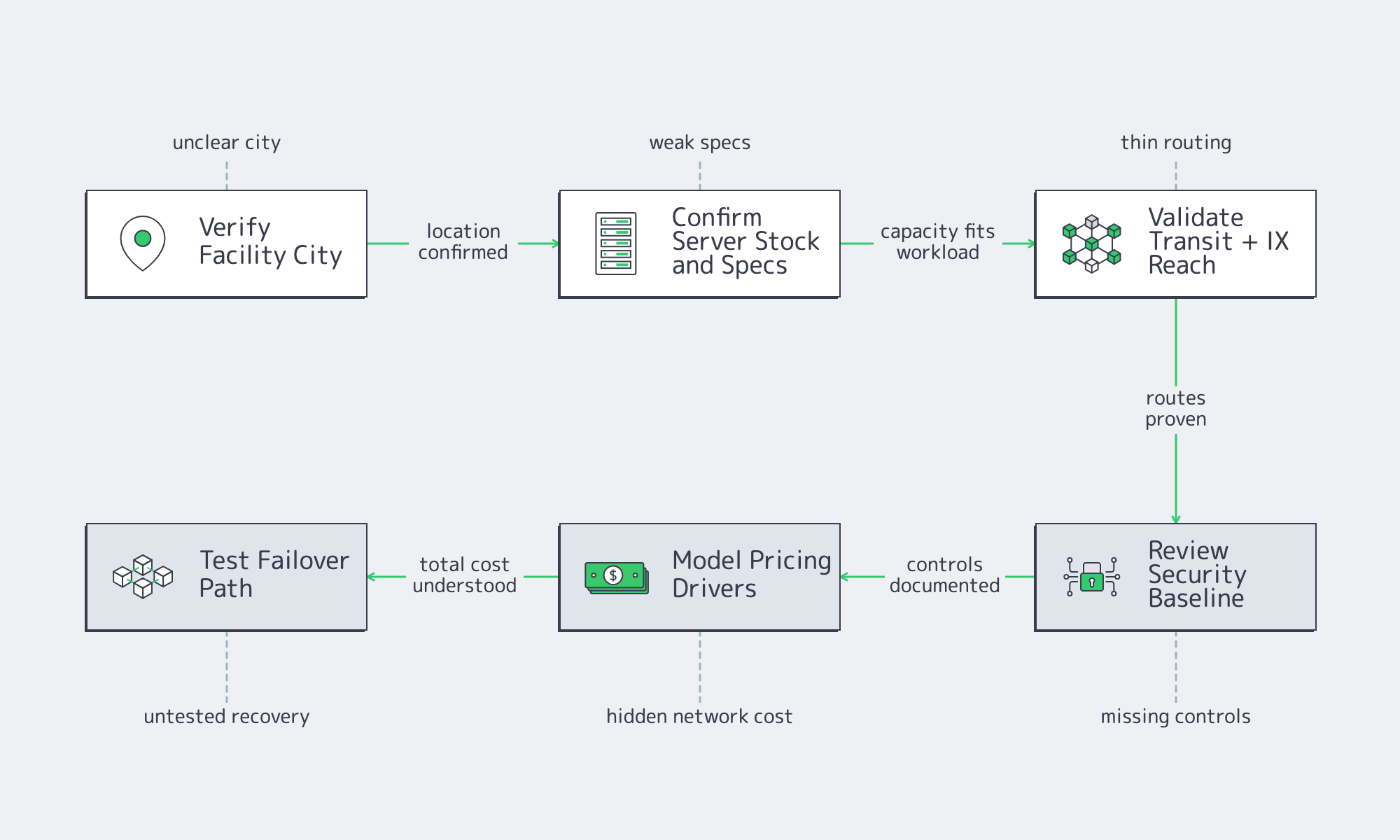
Due diligence should prove three things before signature: where data lives, how routes behave, and what the recovery path actually costs. A credible dedicated-server proposal must expose facility city, stock, CPU and memory class, per-server bandwidth, IX and transit reach, backup posture, and failover-region economics.
A dedicated server improves isolation only if the security model changes with it. NIST SP 800-207 defines zero trust as moving defense away from static network perimeters and toward users, assets, and resources. For payment handling, the PCI Security Standards Council spans PCI DSS, P2PE, Secure Software, and Secure Software Lifecycle controls; PCI DSS v4.0.1 is a limited revision, not a lighter regime.
The baseline is straightforward: tokenize early, keep cardholder data out of the general application estate, segment payment environments from customer-facing APIs, separate management and production planes, enforce MFA and least privilege, encrypt volumes and replication paths, keep logs immutable, and test restoration. For payments, that is the control floor.
Pricing is where low-end offers hide compromises. CPU matters, but so do route diversity, IX reach, port size, transfer model, storage performance, and the secondary region required for resilience. Melbicom publishes relevant signals: 20+ transit providers, 25+ IXPs, 14+ Tbps of network capacity, and a CDN footprint of 39 CDN PoPs across 35 countries. Used properly, CDN is an economic control for static assets, not a residency workaround for an overseas origin.
Routing hygiene also deserves attention. Internet Society data shows that 91 of 103 members at UAE-IX use RPKI. That does not guarantee perfect routing, but it shows route validation and prefix integrity are part of the local interconnection conversation. Ask how prefixes are handled before any BYOIP plan is signed.
Designing a UAE Plus Europe and United States Topology That Survives Failures
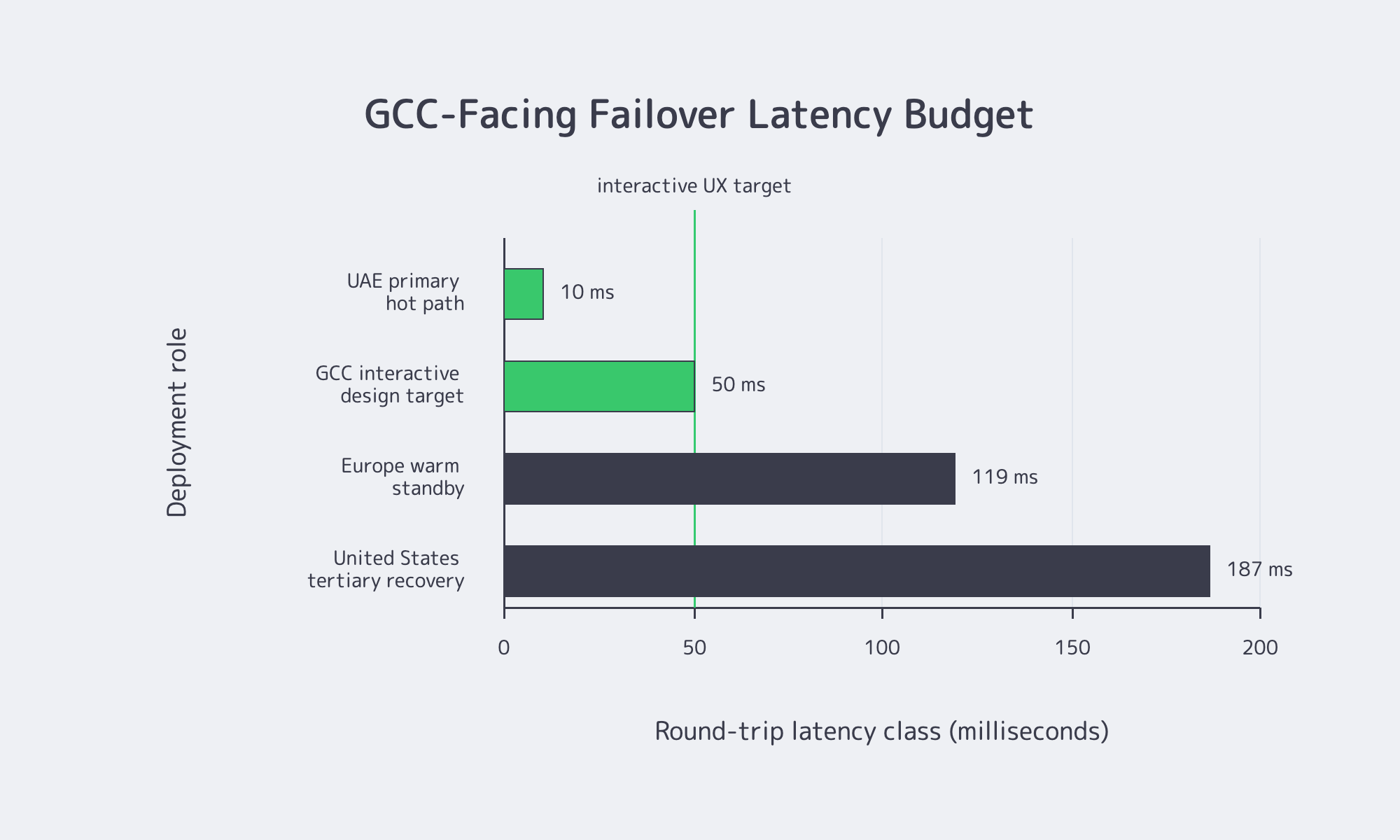
Most GCC-facing platforms should start with UAE-first active service, Europe as warm standby, and the United States as tertiary recovery. That keeps interactive writes close to users while preserving a documented recovery path for regional disruption, cable incidents, data corruption, and operational failure.
Published disaster-recovery guidance defines warm standby as a secondary region with some infrastructure already deployed and running at reduced capacity. That maps well to UAE-first deployments: keep live transactional services in the UAE, maintain a scaled-down but functional copy in Europe, and reserve the United States for tertiary recovery or non-latency-sensitive work.
Published backbone RTT data gives a reality check. Published latency tables put UAE-to-Germany-West-Central around 118-119 ms and UAE-to-East-US around 182-187 ms. Those are not public-Internet promises, but they show the failure shape: Europe can be a serious warm failover target; the United States is usually a resilience tier, not a live write tier.
A practical Melbicom topology uses Fujairah as the UAE primary, Amsterdam or Frankfurt as the European standby, and Atlanta or Los Angeles as tertiary recovery. The UAE primary handles auth, app, cache, queue, and primary writes. Europe receives asynchronous replication, backups, and enough pre-deployed capacity for a regional event. The United States holds reporting, support systems, or batch work that can tolerate higher RTT.
Procurement Checklist and the Low-End Traps to Avoid
The low-end trap is rarely just old hardware. It is usually a stack of hidden compromises: vague site naming, thin route diversity, weak storage for write-heavy workloads, decorative failover, and cheap pricing that excludes the network and recovery posture the workload actually needs.
- Confirm the exact UAE facility city in the order form; “UAE” is not precise enough when Dubai and Fujairah have different interconnection and cable-exposure profiles.
- Require measurable network proof: transit depth, IX reach, test files, route-control posture, stock visibility, and per-server bandwidth, not adjectives.
- Split data into residency tiers before comparing quotes: what must stay live in the UAE, what may replicate to Europe or the United States, and what can be tokenized, anonymized, or regenerated.
- Set latency and failure budgets before shopping configurations: keep GCC interactive paths under a sub-50 ms design target, treat Europe as warm failover territory, and treat the United States as tertiary recovery for most UAE-centered user journeys.
- Reject ambiguity: undefined city, unclear transit, vague “unmetered” networking without throughput proof, no documented failover sequence, or no RTO/RPO conversation.
- Run failover and failback drills before production. If the recovery sequence cannot be tested cleanly, the design is not ready.
Conclusion: Build for the Gulf’s Real Failure Modes, Not the Cheapest Quote
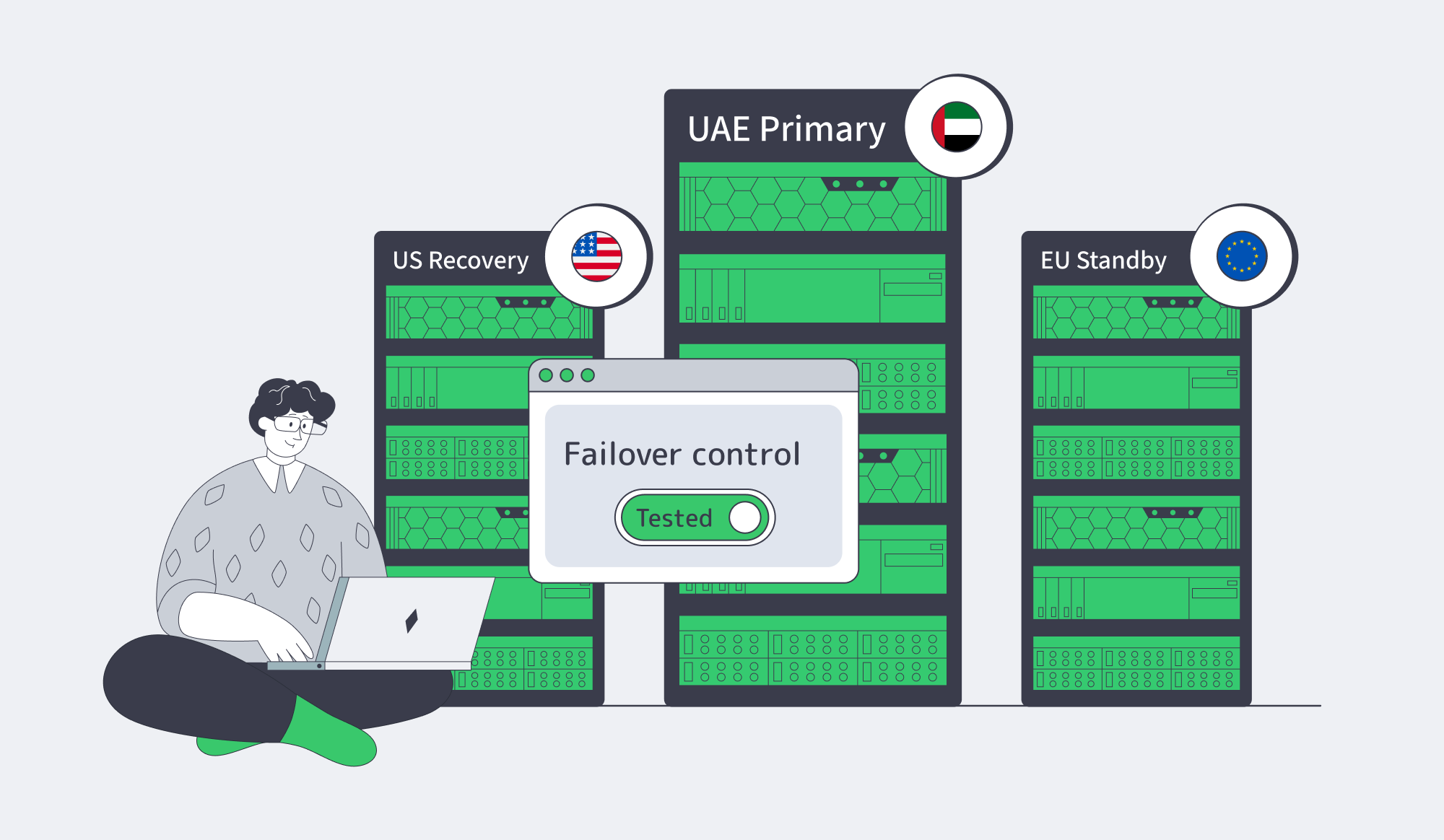
The strongest dedicated server hosting in UAE is not the cheapest monthly headline or the loudest latency promise. It is the design that keeps the write path local, treats Dubai and Fujairah as different infrastructure variables, secures payment and customer data by architecture, and fails cleanly when regional paths degrade.
That is the standard procurement teams should apply: verify the city, prove the network, size the server honestly, document the data boundary, and test the recovery path before production traffic depends on it.
Deploy in the UAE
Build a verified Fujairah/UAE deployment with ready-to-go dedicated servers, custom configurations in 3-5 business days, and Europe or United States locations for resilient multi-region design.