
Blog

Why Sweden Is Your Next Dedicated Server Hub
Choosing where to place your infrastructure is now as strategic as what hardware you buy. For many organizations, Sweden has quietly become one of the most compelling places in the world to deploy a dedicated server: legally safe, politically stable, and wired into Europe’s core internet exchange routes.
This piece walks through why Sweden punches above its weight as a dedicated server location, how Stockholm’s connectivity compares to other European hubs, and what all of that means for high‑demand, compliance‑sensitive workloads.
Choose Melbicom— Tier III-certified DC in Sweden — Dozens of ready-to-go servers — 55+ PoP CDN across 36 countries |
 |
What Are the Key Advantages of Dedicated Hosting in Sweden vs. the Rest of the EU?
Hosting dedicated servers in Sweden combines three levers you rarely get in one place: strong EU‑grade data protection with clear residency options, a pro‑infrastructure policy environment that supports long‑term cost control, and network infrastructure that rivals Europe’s biggest capitals while benefiting from a cooler climate and low‑carbon power.
Sweden’s privacy and data‑protection posture starts with GDPR but is reinforced by a strong local culture around data ethics and sovereignty. For organizations dealing with Schrems II fallout and cross‑border transfer headaches, keeping sensitive EU data on a dedicated server in Sweden is a clean way to stay under EU jurisdiction and reduce exposure to non‑EU surveillance laws.
On the cost side, Sweden has historically made decisive moves to keep large digital infrastructure affordable. A previous electricity‑tax incentive cut the rate for data centers by 97%, down to 0.005 SEK (≈ $0.00054) per kWh, signalling that compute belongs alongside heavy industry. Even as that specific scheme has changed, industrial power in Germany has averaged around €0.16 per kWh, and Nordic operators still report up to 80% lower TCO than comparable setups in central Europe, with power costs often 40–50% below the wider European average.
Sweden is also an innovation hub. Stockholm’s tech ecosystem—fintech, GamDev, SaaS, AI—demands modern, high‑density, and highly connected data centers. That pressure has created a market where Tier III+ facilities, strict physical security, and advanced connectivity options are table stakes, not nice‑to‑have extras.
Sweden vs. Typical EU Hosting at a Glance
| Factor | Sweden’s Advantage |
|---|---|
| Data Residency & Privacy | EU jurisdiction, strong enforcement culture, straightforward GDPR‑compliant hosting. |
| Power & Sustainability | Historically ~97% tax cut to 0.005 SEK/kWh; today Nordic sites still enjoy cheaper power and a cool climate for extensive free cooling. |
| Network Connectivity | Major European hub; rich peering; low‑latency reach across Europe and beyond. |
| Business Climate | Politically stable; pro‑tech policies; long‑term commitment to digital infrastructure. |
Which Swedish DC Features Matter for High-Demand, Compliance-Sensitive Workloads?
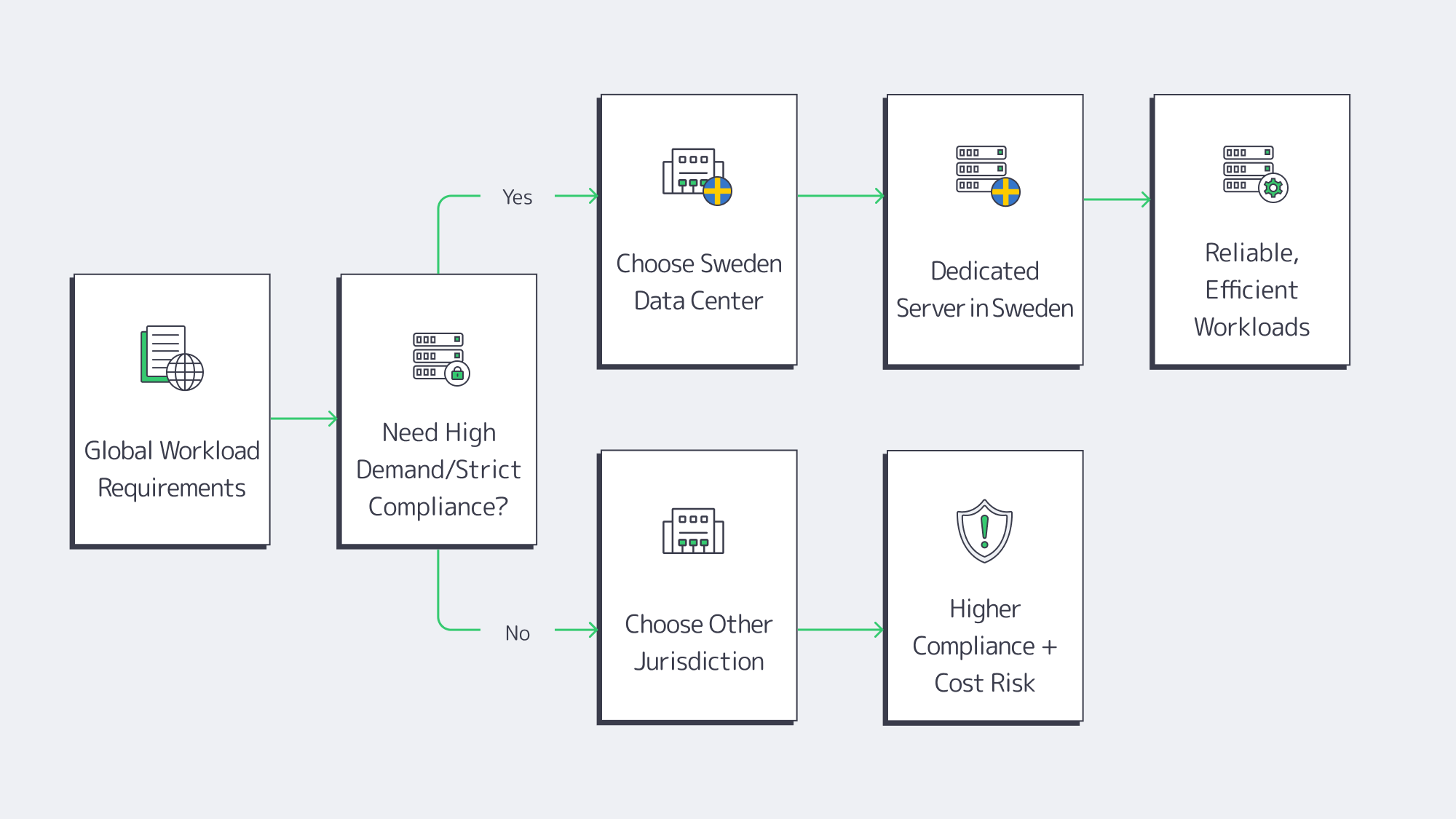
For high‑demand, compliance‑sensitive workloads, Swedish data centers offer a combination of Tier III+ redundancy, strong physical and logical security, and a legal framework that makes EU data residency straightforward, wrapped in an energy‑efficient environment that can economically support dense compute, AI, and data‑heavy applications over the long term.
From an engineering perspective, you’re typically looking at fully redundant power and cooling, with N+1 or better designs and expected uptime in the 99.99% bracket. Sweden’s grid is resilient and well‑connected, which reduces the risk of brownouts or extended outages. For mission‑critical workloads—trading systems, healthcare platforms, real‑time analytics—that reliability is non‑negotiable.
Compliance is where Sweden quietly shines. A dedicated server Sweden deployment keeps your data on EU soil, making GDPR alignment and Schrems II risk assessments more straightforward. Many Swedish facilities are certified against standards like ISO 27001 and PCI‑DSS and follow SOC‑style security practices, giving you a strong base for audits in finance, healthcare, and public‑sector use cases.
Sweden is also pushing operators to stay efficient. A new law requires data centers to disclose energy‑performance information and report their energy usage into a European DB, in line with the updated EU Energy Efficiency Directive. That effectively bakes continuous efficiency improvements into the market—good for optics and for long‑term hosting costs.
On the hardware side, Swedish facilities are comfortable with high‑density racks, GPU nodes, and custom configurations. In Stockholm, we at Melbicom keep dozens of ready‑to‑deploy servers, and can assemble custom builds within 3–5. That kind of agility matters when a new workload or region needs to be spun up fast without compromising on locality or compliance.
Which Connectivity Benefits Do Stockholm-Based Servers Offer for Global Apps?
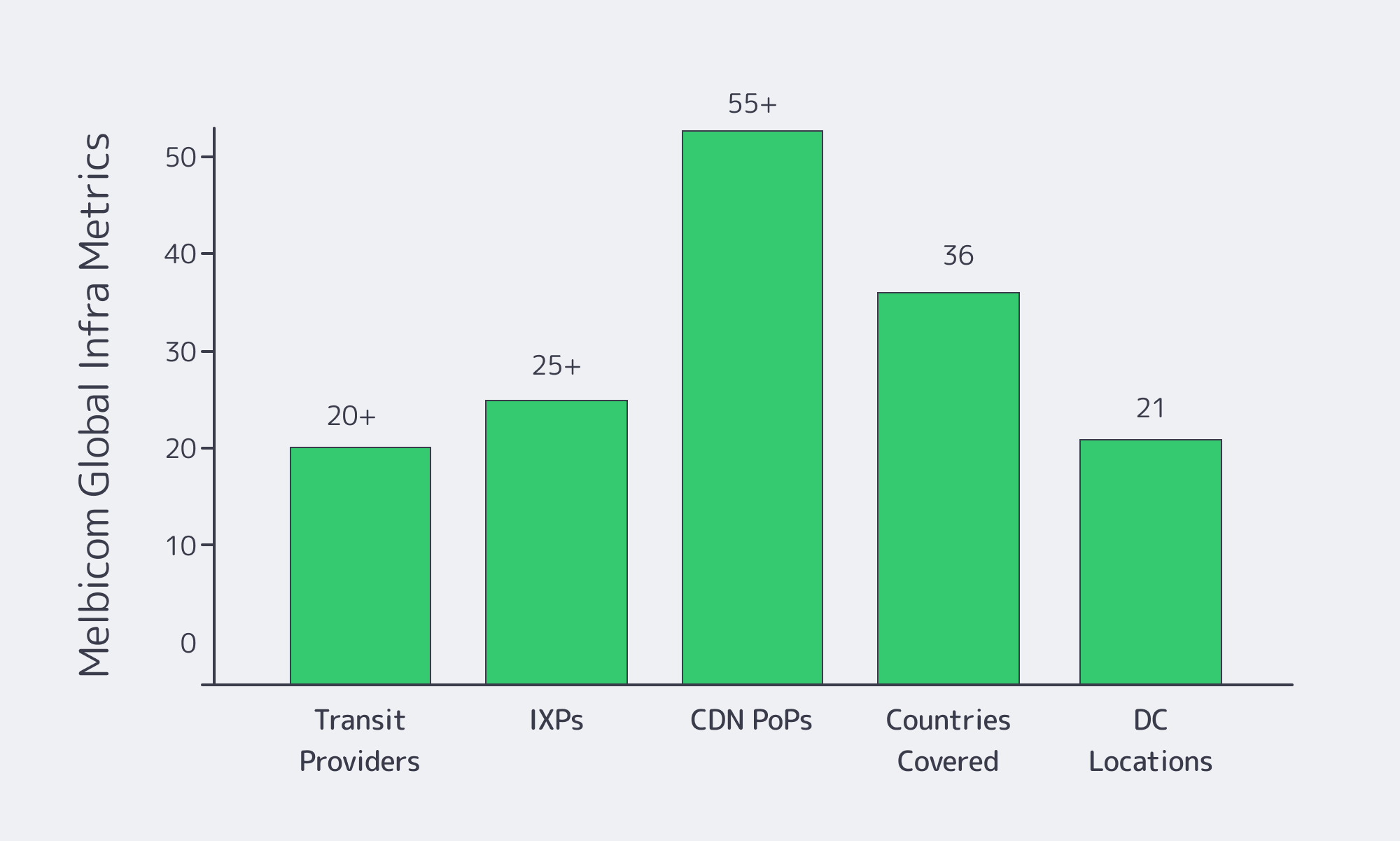
Stockholm’s position as a Nordic network hub means a dedicated server there can serve hundreds of millions of users with low latency, plug into multiple tier‑1 carriers and internet exchanges, and integrate cleanly with global clouds, CDNs, and private backbones—all from a jurisdiction that still gives you full EU data residency.
Geographically, Stockholm sits at a sweet spot—350 million users are reachable within 30 ms round‑trip latency from the city. That captures most of Scandinavia, large parts of Western and Central Europe, and the Baltics. Even to the U.S. east coast, latency is typically in the ~80–90 ms range—usable for many web and API workloads.
On the peering side, Stockholm is home to major internet exchanges. Netnod’s IX platform in Sweden has hit all‑time traffic peaks around 2.35 Tbps, and maintains > 2 Tbps peak traffic with 200+ connected networks, underscoring how much regional traffic is exchanged locally rather than backhauled through distant hubs. For a Sweden dedicated server deployment, that translates into fewer hops, more direct paths, and better performance.
Major carriers operate dense fiber backbones through Sweden, making Stockholm an anchor point on routes to Amsterdam, Frankfurt, Paris, and Warsaw with sub‑20 ms latencies, as well as to Helsinki and the Baltics. There are multiple subsea and terrestrial paths in and out of the country, so fiber cuts or route failures have less chance of isolating your workloads.
For content and latency‑sensitive applications, origin placement in Sweden pairs well with global edge delivery. Melbicom’s CDN runs over 55+ Points of Presence in 36 countries, so you can keep authoritative data and sensitive logic on your Sweden dedicated servers while caching content closer to users worldwide.
Why a Sweden Dedicated Server Belongs in Your Roadmap
Sweden has quietly become one of the most rational places to pin your European infrastructure strategy. You get EU‑grade data protection with clear residency, a maturing regulatory framework that rewards efficient operators, and a network position that can hit hundreds of millions of users with low latency—all while running on a predominantly renewable grid.
For companies facing tightening privacy rules, rising energy costs, and ever‑heavier workloads, a Sweden dedicated server isn’t a niche Nordic experiment. It’s a pragmatic way to de‑risk compliance, stabilize long‑term operating costs, and anchor performance‑critical services in a location that’s politically and technically built for the next decade of infrastructure growth.
Key Takeaways and Recommendations

- Treat Sweden as a default EU landing zone for workloads that must remain under GDPR with minimal cross‑border transfer risk, and only add non‑EU regions where business requirements truly demand it.
- Shift energy‑intensive, high‑density compute (AI training, analytics, streaming origins) toward Sweden to benefit from structurally lower Nordic power costs and efficient cooling, reserving higher‑cost regions for only the most latency‑sensitive users.
- Use Stockholm as a pan‑European hub: design routing so that a single Sweden region serves most Nordic, Baltic, and Central European users within ~30 ms RTT, and pair it with CDN caching at the edge when you need ultra‑low TTFB.
- Anchor compliance‑sensitive and mission‑critical services in Tier III Swedish facilities, then layer global redundancy (secondary regions, CDN, or cloud failover) on top instead of depending solely on a single hyperscale cloud region.
When choosing Sweden as a dedicated server hosting hub, you get a location that’s not just “good enough,” but actively aligned with where infrastructure and policy are heading. The practical outcome: predictable performance, cleaner compliance narratives, and less guesswork about where your next region should live.
Order a Sweden Dedicated Server
Place your next build in Stockholm with EU data residency, Tier III reliability, and low‑latency reach across Europe. Deploy ready configs or custom servers in 3–5 days backed by 24/7 support.