
Blog

iGaming Hosting in LatAm: Brazil + U.S. Southeast Stack for Sub-150 ms Play
If your iGaming platform already runs cleanly in the U.S., LatAm expansion isn’t “add a CDN and call it done.” Brazil changes the physics: payment APIs have sharp timeout cliffs, odds and promos churn hard, and LGPD turns “just replicate it” into a data-class decision.
This is the practical blueprint we at Melbicom recommend when the target is Atlanta as the U.S. origin plus a São Paulo secondary region—with CDN PoPs in South America doing the heavy lifting during peak events, not just serving logos.
iGaming Hosting in LATAM— Reserve servers in São Paulo — CDN PoPs across 6 LATAM countries — 20 DCs beyond South America |
 |
Blueprint for Dual-Region iGaming Stack
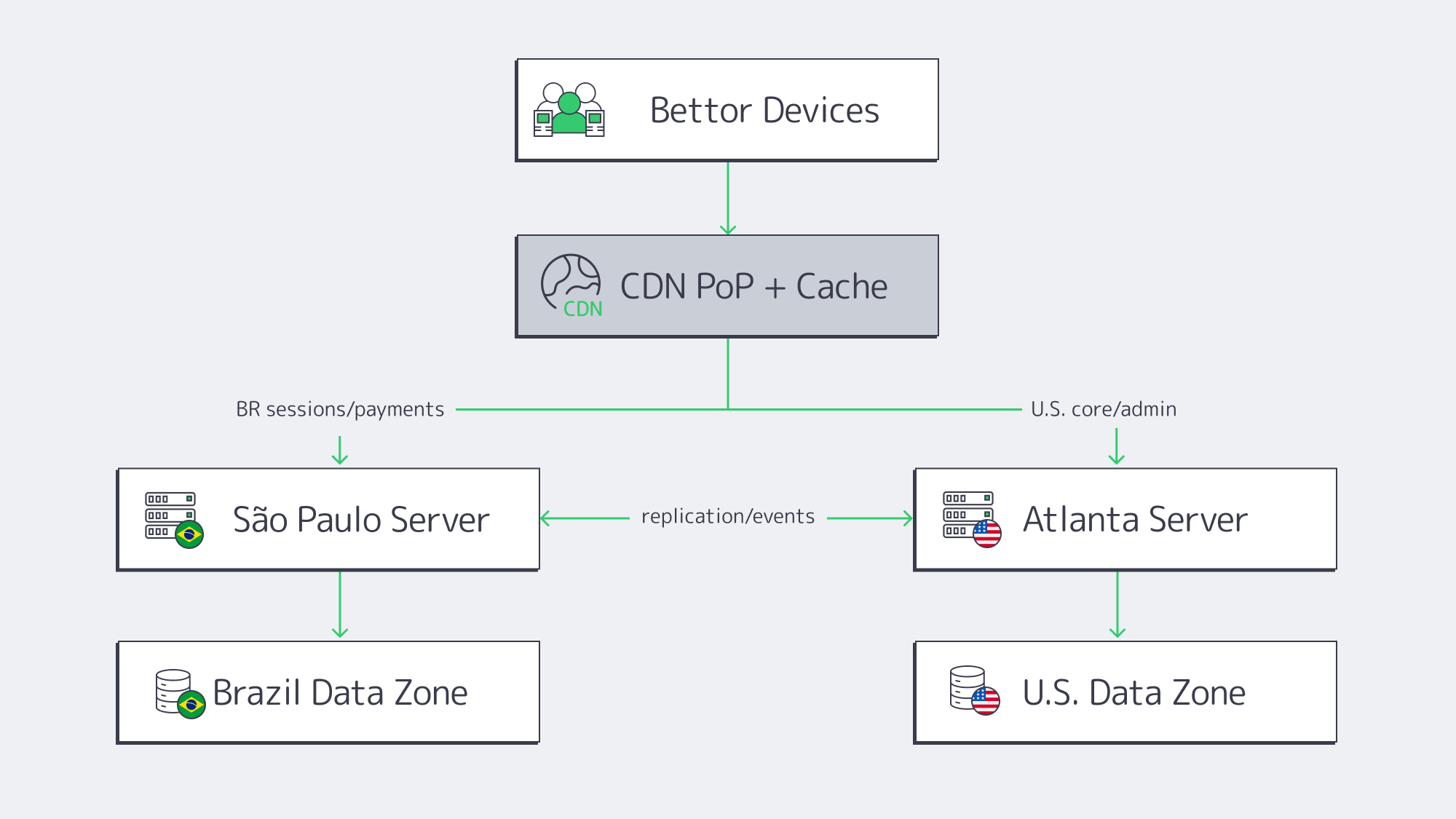
The winning pattern is a dual-region core with the CDN edge acting as a traffic governor. Use Atlanta for the U.S.-native platform gravity (core services, analytics, global backoffice), and São Paulo for Brazil-first latency, payment conversion, and LGPD-aligned residency. Then let the CDN absorb bursty reads—especially around live odds and promo pushes.
São Paulo Dedicated Server: What Must Stay Local
A dedicated server in São Paulo isn’t just “closer compute.” It’s where you park the request paths that punish latency and jitter: Brazil login/session edges, cashier initiation, fraud/risk checks that must answer quickly, and the parts of the platform that touch regulated identity data.
CDN in LatAm: Burst Control, Not Just Static
CDN in South America is where you win peak moments: high-concurrency bursts during marquee matches, promo banners flipping, and “refresh the odds” behavior that looks like a denial-of-wallet if you serve it all from origin. Melbicom’s CDN has 55+ PoPs in 36 countries (including Chile, Columbia, Peru, Argentina, and Mexico), which is the baseline you need to keep cache near bettors while the origins stay deterministic.
Atlanta Origin: Where to Consolidate Without Penalizing LatAm
Atlanta works because it’s a U.S. Southeast anchor with strong interconnect potential—and because it lets you treat LatAm as an extension of a U.S. control plane without forcing every bettor’s click to cross an ocean.
How to Reach Sub-150 ms Latency in LatAm?
Sub‑150 ms play comes from pinning Brazil’s latency-sensitive flows to São Paulo, then using the CDN edge to suppress bursty reads across LatAm so that only state-changing requests reach origin. Atlanta remains the system’s authority, but São Paulo becomes the regional execution point for sessions, cashiers, and regulated identity paths.
What “Real Routing” Looks Like in Practice
The goal isn’t a single magical RTT number. It’s ensuring that the longest path is the least frequent path, especially during live events when every extra origin trip stacks.
Brazil: Edge → São Paulo (Regional Origin) → Atlanta (Only When Needed)
For bettors in Brazil, the cleanest route is:
- Nearest CDN Brazil PoP → serves static assets + safe cached API responses
- Misses / state-changing calls → routed to São Paulo dedicated server
- Selective replication → São Paulo emits events upstream to Atlanta (not the reverse)
The São Paulo page calls out direct subsea connectivity and positions São Paulo as LatAm’s interconnect hub. That matters because even when Atlanta is the authority, São Paulo must be able to “phone home” reliably under load.
Chile, Peru, Colombia, Mexico: Edge → Decision Point (São Paulo vs. Atlanta)
For Chile/Peru/Colombia, don’t hardcode everything to São Paulo. Use a simple rule:
- If the flow is cashier/KYC/identity for Brazil accounts → São Paulo
- If the flow is global account management, CMS, reporting → Atlanta
- If the flow is real-time odds reads → edge microcache (and only revalidate as needed)
Latency Budgeting Without Guesswork: Use Floors, Then Engineer for Variance
Measured RTT varies by ISP and peering. But physics gives you a floor—use it to sanity-check whether a proposed routing plan is even plausible.
Hypothetical sample (computed floor; real RTT is higher):
| Market (Anchor City) | RTT Floor to São Paulo (ms) | RTT Floor to Atlanta (ms) | Practical Implication |
|---|---|---|---|
| Brazil (São Paulo) | ~0 | ~75 | Keep “hot path” in São Paulo; don’t bounce through Atlanta |
| Colombia (Bogotá) | ~43 | ~34 | Split by data-class; steer odds reads to edge, writes to appropriate region |
| Peru (Lima) | ~35 | ~52 | São Paulo often wins for LatAm-facing real-time flows |
| Chile (Santiago) | ~26 | ~76 | São Paulo is a strong regional origin; edge does burst suppression |
Which Dual-Region Failover Cuts Downtime?
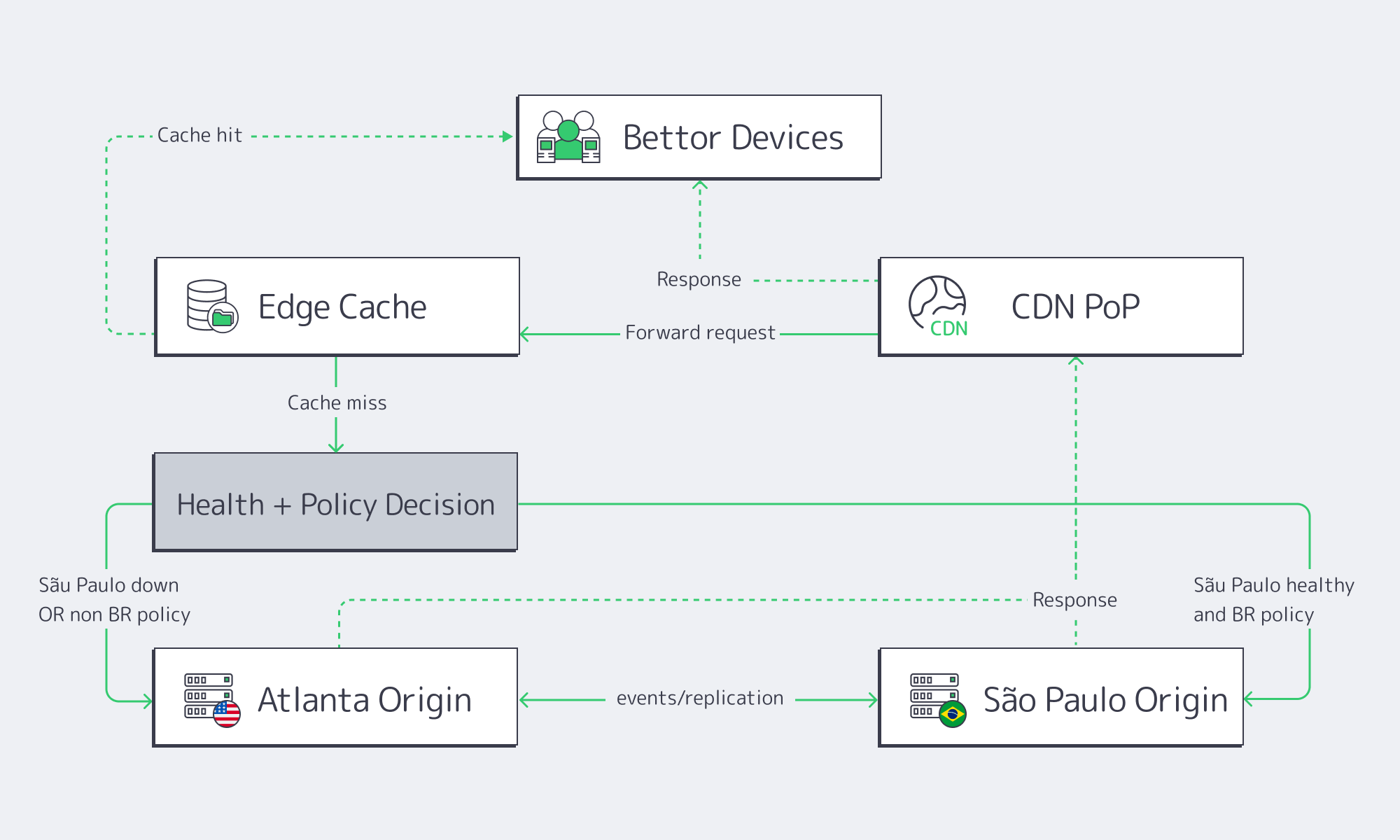
Use active service in both regions, but don’t force symmetric data ownership. Keep Atlanta as the system authority while São Paulo runs Brazil-first execution paths with replicated state that’s sufficient for continuity. Failover should be edge-driven (CDN + DNS steering), with degraded modes that preserve wagering integrity.
Failover That Doesn’t Create a Second Outage
A dual-region system fails when the failover process triggers its own incidents: cold caches, exploding origin load, inconsistent sessions, or payment retries that double-charge.
The safer failover topology:
- CDN as traffic valve: During São Paulo impairment, edge stops revalidation storms by widening TTLs for non-critical reads and serving “last known good” promo assets.
- Two origins behind one hostname: CDN can route misses to the healthier origin.
- Session strategy that survives a region swap: Store only what must be consistent globally in the shared plane; keep per-region session state small.
On Melbicom’s side, the “2-hour activation” and “3–5‑day custom builds” claim exists as an operational lever for capacity planning around known peak events—especially when you want pre-staged headroom in São Paulo before a live spike.
Peak Events: How São Paulo Dedicated Servers and CDN PoPs Work Together
Peak load in iGaming is not just “more traffic.” It’s more volatility: odds flip, promos rotate, and bettors refresh like humans trying to DoS reality. Here’s the collaboration model:
CDN PoPs cache:
- app shells, static assets
- promotion creatives
- “safe-to-cache” API reads
São Paulo dedicated server handles:
- regional “truth” for Brazil-facing reads (odds snapshots, wallet pre-checks)
- write paths (bets, wallet debits, KYC flows)
Atlanta remains:
- authoritative ledger replication target
- global reporting, segmentation, long-tail service mesh
This avoids the classic peak-event failure where edge handles nothing meaningful and São Paulo becomes a single hot pipe.
Brazil Deploy Guide— Avoid costly mistakes — Real RTT & backbone insights — Architecture playbook for LATAM |
 |
What Data Zoning Meets LGPD?
Zone by data class, not by service name. Keep KYC/PII and Brazil-regulated identity paths in São Paulo, and replicate tokenized, minimized, and audit-safe records to Atlanta. Your CDN should never cache PII; it should cache public assets and strictly controlled “safe reads” with rapid invalidation.
Zoning Blueprint: A Data Map You Can Defend
The practical interpretation is: decide what must remain in Brazil versus what can cross borders as minimized data. Recommended split:
Brazil zone (São Paulo)
- PII and KYC artifacts
- identity verification outcomes
- payment initiation metadata (especially PIX rails)
- session attributes that materially identify a person
U.S. zone (Atlanta)
- anonymized gameplay telemetry
- fraud signals that are not directly identifying
- aggregated reporting events
- operational metrics, SLO-style indicators
Payment Gateway Proximity: Why PIX and Cards Belong in the Brazil Hot Path
Payments have a different tolerance curve than gameplay. You can “hide” latency with client-side prediction in some interaction patterns. You can’t hide it when:
- a PIX QR payload is generated and expires,
- a card auth window closes,
- a cashier retries and creates duplicate intents.
The operational advice is simple: terminate Brazil payment orchestration in São Paulo, even if the ledger authority is Atlanta. São Paulo should be close enough to answer fast and avoid jitter-driven timeouts—then replicate the minimal payment event upstream.
High-Frequency Cache Purges for Odds and Promos (Without Melting the Origin)
Odds and promotions are the edge-case where the CDN can either save you or ruin you.
Treat them differently:
- Promos: rotate a version token in the URL so you can publish without broad purges.
- Odds: cache for seconds at the edge; revalidate against São Paulo; keep Atlanta out of the revalidation loop.
- Cache purge storms: use scoped purges by tag/key class; never purge “everything” during live events.
This is where the São Paulo region acts as a regional origin so that cache misses don’t bounce across continents.
FAQ
Do we need two full copies of every service in both regions? No. Duplicate what is required for continuity and compliance. The high-availability goal is consistent wagering integrity, not perfect symmetry. Keep authority in one place (Atlanta), and ensure São Paulo has enough state to serve Brazil hot paths.
What should the CDN cache in iGaming without creating compliance risk? Static assets and tightly controlled read endpoints that are non-identifying. Avoid caching anything that can reveal identity, wallet state, or KYC status. Use microcaching for odds snapshots and short-lived promo metadata.
How do we prevent payment retries from double-charging during failover? Make cashier intentions idempotent and region-aware. São Paulo should mint the intent for Brazil flows; Atlanta should accept replicated intent events and treat repeats as retries, not new purchases.
Does São Paulo help non-Brazil LatAm markets? Often, yes—especially when your alternative is a full U.S. hop. But you still steer by data-class: Brazil KYC and cashier flows to São Paulo; global admin/reporting and non-sensitive flows can remain in Atlanta.
Conclusion: LatAm Should Feel Local Even When Your Stack Is U.S.-Native
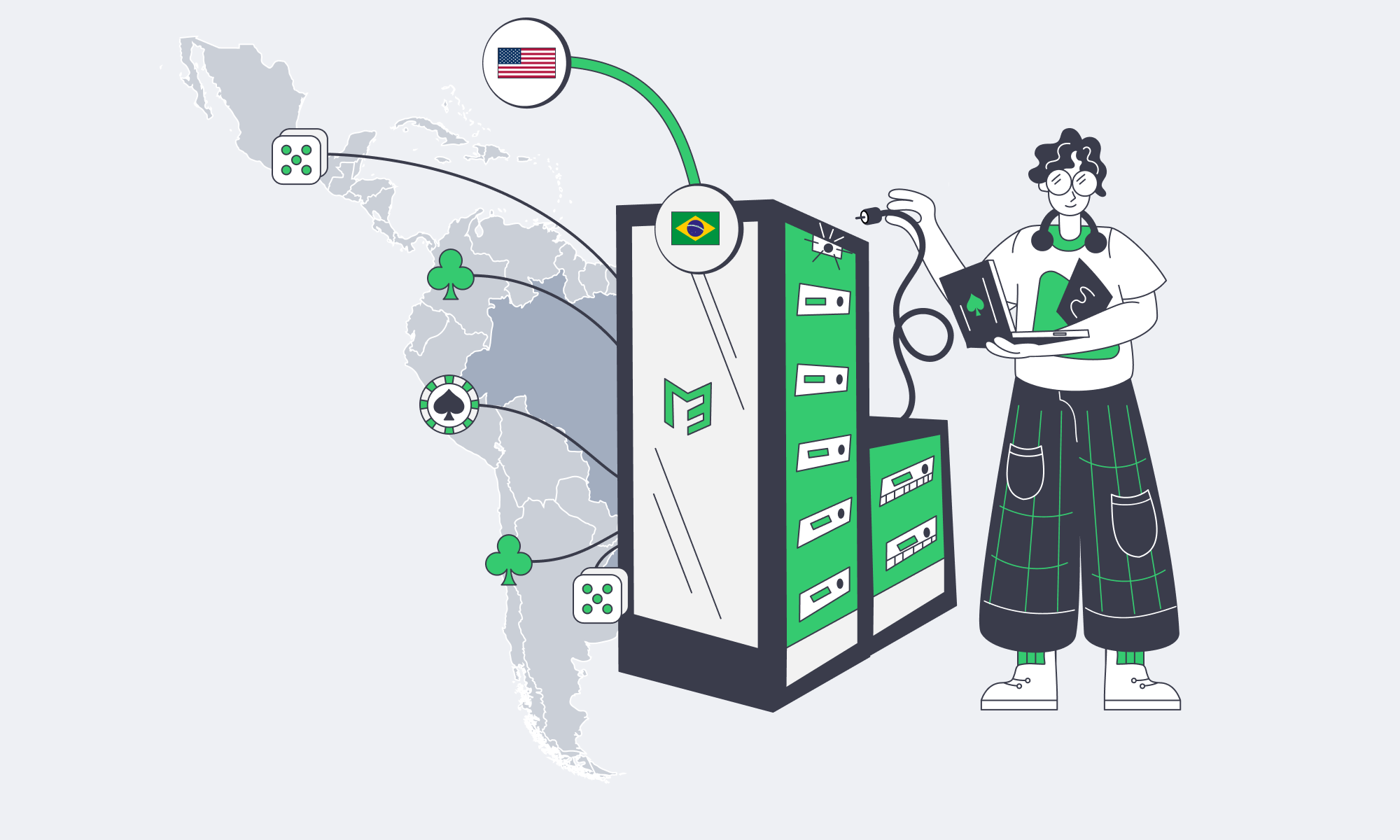
Atlanta + São Paulo isn’t about splitting your platform in half. It’s about deciding which flows are latency-sensitive, which flows are compliance-sensitive, and which flows are just bursty—then assigning each to the right layer (edge, São Paulo, or Atlanta) so peak events don’t rewrite your reliability story.
The operational pattern that holds up under real match-day behavior is consistent: edge suppresses reads, São Paulo executes Brazil’s hot paths, and Atlanta stays authoritative without becoming the bottleneck.
Practical Guardrails
- Treat Brazil payments (PIX + cards) as a first-class regional workflow; don’t backhaul cashier orchestration to the U.S.
- Split traffic by data class, not by “service name”; zone KYC/PII and identity artifacts in Brazil, replicate minimized events to the U.S.
- Engineer odds and promos as cache-native: versioned promo assets, microcached odds reads, scoped purges—no global “flush it all” during live spikes.
- Design failover to protect the origin from the edge: widen TTLs and serve last-known-good when regions wobble; recover gradually.
- Keep São Paulo “hot” ahead of predictable peaks: pre-warm caches, stage capacity, and rehearse cache-invalidation mechanics under load.
Design your LatAm iGaming footprint
Get a technical consult on Atlanta + São Paulo architectures, CDN tuning, and LGPD-ready data zoning to keep latency under 150 ms across Brazil and LatAm.