
Blog

From São Paulo to a Five‑City Production Mesh
For businesses that already work in Europe or North America, South America is no longer an optional region. Latin America’s cloud infrastructure market is expected to grow at 21.7% CAGR from 2024 to 2031, reaching about USD 131 billion by 2031, with Brazil alone over USD 12.9 billion in 2024.
Mobile gaming is on a similar trajectory: South America’s mobile gaming market is about USD 3.23 billion in 2025 and forecast to reach USD 5.21 billion by 2030. iGaming and Web3 traffic are following the same arc, with SOFTSWISS reporting portfolio and jackpot programs that boost player turnover by up to 50% in the region.
At the same time, Brazil’s IX.br system has become a gravity center for the entire continent. Aggregated traffic across IX.br exchanges has exceeded 31 Tbit/s, with São Paulo alone crossing 22 Tbit/s and connecting more than 2,400 ASNs. If you care about deposits, bets, or on-chain events clearing in real time, your South America story starts in São Paulo.
Choose Melbicom— Reserve dedicated servers in Brazil — CDN PoPs across 5 LATAM countries — 21 Tier III & IV DCs, including Brazil |
 |
This article lays out a practical expansion path: starting with a single dedicated server in São Paulo, then layering CDN South America coverage and additional cities—Buenos Aires, Santiago, Bogotá, Lima—while balancing dedicated hosting in South America against caching, routing, and data‑residency constraints.
Why São Paulo Should Be Your First South American Dedicated Server Location
IX.br São Paulo is the region’s switchboard: top‑three IXP globally by traffic, with local paths between São Paulo and Rio typically in the low‑single‑digit millisecond range when you sit inside the ecosystem. That makes a dedicated server in South America, located in São Paulo, the logical first origin for anything latency‑sensitive.
We at Melbicom are building Brazil as a full‑fledged hub: São Paulo capacity is anchored in a robust data center, with integration into IX.br for dense local peering. From there, your flows can either stay entirely within Brazil or exit toward Atlanta (US‑Southeast) and Madrid on tuned, Tier 1‑backed paths via our 23 transit providers and 29 IXPs worldwide.
Once you have that first node, the question shifts from “Should we be in Brazil?” to a more detailed series of questions: Where do we rely on CDN? How do we keep data compliant and routes sane as we expand beyond São Paulo?
Which Cities Need Dedicated Server vs CDN?
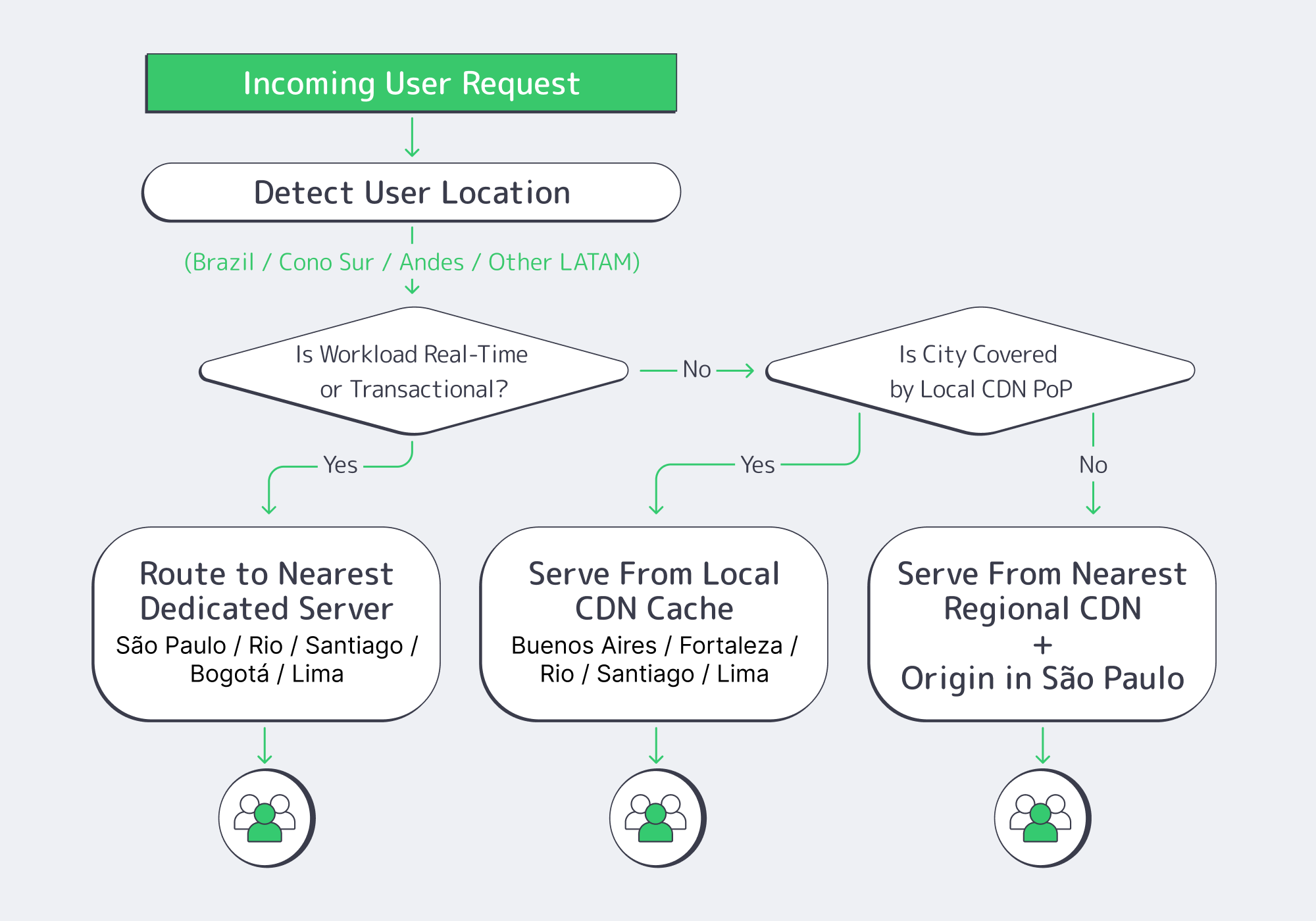 Use São Paulo for dedicated servers that handle stateful, money‑moving, or real‑time gameplay, and lean on CDN in Buenos Aires, Santiago, Bogotá, and Lima for static and semi‑static content. As volumes grow, graduate CDN‑only cities into mixed models by watching latency, rebuffering, and conversion curves.
The practical rule: dedicated hosting South America is for write‑heavy, high‑value flows that cannot tolerate extra round trips (bets, on‑chain events, stateful matchmaking, KYC flows). CDN South America is for media, assets, and any API call that tolerates a tiny bit of cache staleness or regional aggregation.
Today Melbicom’s CDN runs PoPs in Buenos Aires, Bogotá, Santiago, and Lima, among others, giving you a regional mesh even before you deploy new origin nodes.
A common pattern looks like this:
- Dedicated servers in São Paulo handle core transactional workloads for Brazil and, initially, much of the continent.
- CDN PoPs in Buenos Aires, Santiago, Bogotá, Lima terminate static and semi‑static traffic locally: game assets, static API responses, images, on‑chain state snapshots.
The outcome: Brazil‑origin traffic stays inside Brazil; Southern Cone traffic uses Santiago/Buenos Aires edges that shield the origin; Andean flows get localized reads while writes traverse optimized paths to São Paulo or your upstream hubs in Atlanta and Madrid.
Brazil Deploy Guide— Avoid costly mistakes — Real RTT & backbone insights — Architecture playbook for LATAM |
 |
Which South American Location to Choose After São Paulo?
After a single São Paulo origin, typical sequencing is Baires for Southeast, Santiago for Cono Sur, then Bogotá and Lima for Andean mobile usage. Each step should follow measured demand and regulatory checks, not a single launch date, so you avoid stranded capacity or surprise compliance gaps.
A practical South America dedicated server build‑out usually goes through five stages:
| Stage | Trigger Signal (Business / Ops) | Recommended Move (Dedicated vs CDN) |
|---|---|---|
| 1 – São Paulo MVP | Brazil is ≥15–20% of revenue; high complaint rate about Brazil latency. | Deploy 1–2 dedicated servers in São Paulo as the regional origin; use CDN for rest of LATAM. |
| 2 – Cono Sur Expansion | Material user base in Chile/Argentina; streaming or live‑ops uptake. | Deepen CDN use in Santiago/Buenos Aires; keep origin in São Paulo unless origin RTT visibly hurts conversion or retention. |
| 3 – Andean Focus | Colombia/Peru traffic growing faster than Brazil; mobile‑only cohorts dominate. | Use Lima and Bogotá PoPs heavily; plan dedicated servers in at least one Andean capital when active user concurrency and regulatory needs converge. |
| 4 – Five‑City Mesh | Region behaves like 3–5 distinct markets; local compliance pressures increase. | Run dedicated servers in Brazil plus at least one origin per sub‑region, with CDN layering everywhere. |
This staged approach mirrors the broader cloud infrastructure story: Latin America’s cloud infrastructure market already exceeds USD 30 billion and is growing at 21.7% CAGR, but investments are far from evenly distributed. You buy time and optionality, not just capacity.
Early on, CDN buy you coverage and cost-effective offload. As TCP handshakes and stateful latency start to drag KPIs—bet confirmation lag, in-app purchase completion, or Web3 transaction finality—you promote a city from “edge-only” to “edge + dedicated origin.”
Local Data Residency, LGPD, and Cross‑Border Patterns

Infrastructure decisions in South America are now inseparable from data‑residency questions. Brazil’s LGPD has been in force since 2020; recent regulations (ANPD Resolution 19/2024) clarify cross‑border transfers via standard contractual clauses and adequacy‑style mechanisms, rather than imposing blanket data localization.
For many platforms, that translates into a simple playbook:
- Keep primary Brazilian PII in Brazil. Store customer profiles, KYC data, and transactional logs on dedicated servers in São Paulo, potentially with encrypted replicas in another jurisdiction.
- Move telemetry and aggregates freely. Anonymized analytics and gameplay metrics can safely live in Atlanta or Madrid, provided your legal basis and contracts are aligned.
- Treat other LATAM countries as “regulated but pragmatic.” Argentina and Mexico, for example, emphasize purpose limitation and cross‑border safeguards rather than hard localization rules; regulators still expect you to know where your primary stores sit and how you handle international transfers.
Routing ties this together. Without tuning, flows from Chile or Peru to Brazil can hairpin via the United States. With BGP sessions on your dedicated servers (free on Melbicom’s dedicated platform), you can:
- Prefer routes that keep Brazilian data inside Brazil when possible.
- Use regional peers so Santiago/Baires traffic reaches São Paulo directly, not via Miami.
- Steer non‑sensitive analytics toward Atlanta or Madrid where your global data lakes live.
The goal is to make South America dedicated hosting feel local to users and regulators while still benefiting from global hubs.
Who Can Design a Brazil‑First Mesh?
You want a provider that combines both dedicated hosting and CDN coverage in South America, and BGP expertise, plus the ability to ship custom servers in days, not months. Melbicom fits that profile, aligning São Paulo capacity, CDN PoPs, and procurement planning with your release roadmap.
Melbicom operates 21 Tier III/IV data centers worldwide and a CDN with 39 CDN PoPs across 35 countries, including South American locations such as Baires, Bogotá, Santiago, or Lima. That combo lets us treat origin + edge as one fabric rather than two disconnected systems.
Custom server configurations are typically delivered in 3–5 business days (including Ryzen/Xeon/EPYC CPUs, DDR4/DDR5 RAM, NVMe storage, with optional GPU) and free BGP sessions on dedicated servers give your network team full routing control.
Because Melbicom runs both the CDN and the dedicated hosting stack, cache misses stay on‑net: a Lima or Santiago PoP pulling from a São Paulo origin uses regional paths, not surprise trans‑oceanic backhaul. That simplifies latency tuning and cost control for Web3, iGaming, and mobile gaming workloads.
Key Steps to Expanding in South America (without the Big Bang)
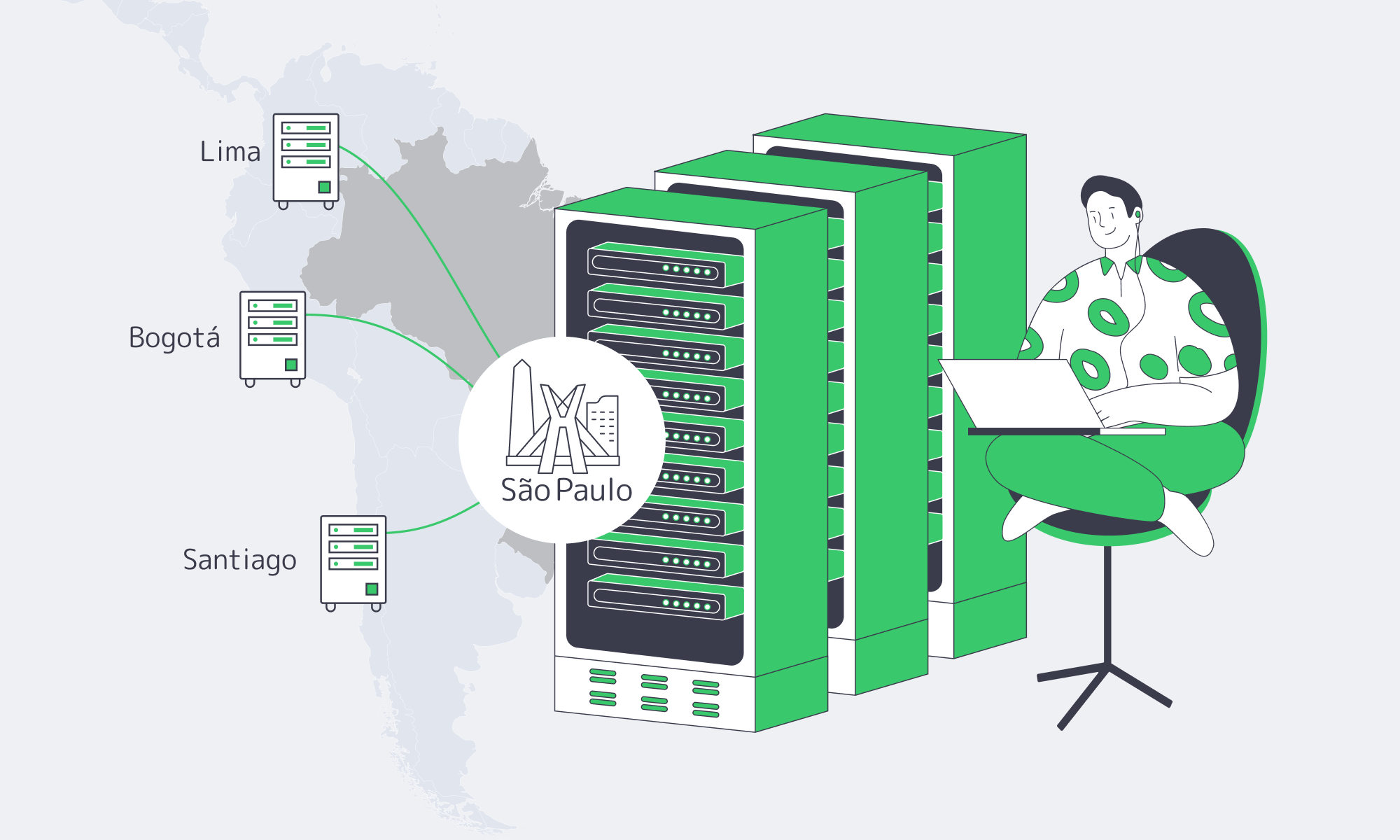
Rather than lighting up five cities at once, treat South America as a rolling program with explicit decision gates. In practice, a low‑risk plan for dedicated hosting in South America and regional caching looks like this:
- Start with a single, well‑provisioned São Paulo origin. Give yourself headroom on CPU, NVMe, and bandwidth so you are not rebuilding hardware during your initial Brazil launch window.
- Lean hard on the existing CDN mesh. Use PoPs in Buenos Aires, Bogotá, Santiago, and Lima as your first line of defense for assets and semi‑static APIs. Watch hit ratios, TTFB, and rebuffering before ordering new servers.
- Promote cities based on lived metrics. When a metro’s concurrency, transaction value, or regulatory exposure crosses your internal threshold, move it from CDN‑only to a combination of CDN plus dedicated origin.
- Tie procurement to milestones, not dates. Map hardware orders to growth signals (DAU, GGR, or TVL bands) and regulatory inflection points, so you avoid shipping racks into cities that never quite materialize in your revenue mix.
- Make BGP and data‑residency part of the design, not a retrofit. Decide early which flows must remain in‑country, which can land in Atlanta or Madrid, and how you prefer routes between Brazil and its neighbors.
These are infrastructure decisions, but they are really business risk decisions: you are trading capital outlay, regulatory exposure, and performance headroom against each other at every step.
Planning Your South America Dedicated Server Mesh
By the time you reach a five‑city mesh—São Paulo, Baires, Santiago, Bogotá, Lima—your region behaves more like a mini‑continent than a single “LatAm” market. Users expect local responsiveness; regulators expect clarity on where data lives; and finance expects that your capacity curve tracks revenue, not hope.
A good South America dedicated server strategy keeps three constraints in balance:
- Latency: Keep real‑time traffic on origins as close as possible to users, with São Paulo as the anchor and regional hubs for Cono Sur and the Andes.
- Compliance: Align data stores and cross‑border routes with LGPD and local rules; don’t let operational convenience accidentally dictate your residency story.
- Capital discipline: Use CDN and BGP tuning to delay expensive moves, but not so long that latency and uptime begin to erode user trust and lifetime value.
Done well, your footprint evolves from a single Brazilian node into a resilient mesh where São Paulo, Buenos Aires, Santiago, Bogotá, and Lima each play defined roles, some as heavy origins, some as cache-first edge cities, all connected via predictable routes to the USA and Europe where your main customer base is located.
Plan your Brazil‑first server rollout
Get a tailored plan for São Paulo origins, CDN coverage, and BGP routing across South America. Our team maps latency, compliance, and capacity milestones to a phased buildout.