
Blog

Choosing a Solana Validator Host: Hardware Replacement, Replay and Failure-Domain Tests
A Solana validator host can look excellent on paper and still fail the test that matters: recovering when something breaks.
Once baseline hardware requirements are satisfied, the procurement question changes. How quickly can a failed storage unit be replaced? Can operators reach the machine when SSH disappears? Can the validator catch up faster than the cluster advances?
Recovery capacity needs to be measured against actual progress on the evaluation cluster, not historical slot-time assumptions. As the Solana Foundation's reduced-slot-time guidance illustrates, slot timing can change, making fixed assumptions unreliable for estimating recovery duration.
Choosing among Solana validator hosting providers requires a written RFP and reproducible acceptance tests—not just specifications.
Dedicated Servers– 1100+ ready-to-go configs – IPMI remote access – 24/7 infrastructure support |

|
Which Operational Commitments Should Solana Validator Hosting Providers Document Before Purchase?
Solana validator hosting providers should document hardware replacement triggers, completion deadlines, covered failures, spare-part availability, management access, and shared infrastructure dependencies. Every replacement commitment needs an observable start and finish. Buyers should reject ambiguous recovery language and require written evidence that the proposed infrastructure supports their recovery objectives.
Define Hardware Replacement Times
“Four-hour replacement” means little without specifying when those four hours begin.
Does the clock start when a ticket opens, when support confirms the fault, or after diagnosis? Does it stop when a component is installed or when the customer can access the repaired machine?
A useful completion criterion requires replacement hardware to be installed, powered, recognized by the system, and accessible through the agreed management interface.
The RFP should distinguish component swaps from whole-server replacements. Replacing an NVMe drive may preserve the surrounding system. Replacing a chassis can change network interfaces, management credentials, and available local state.
Melbicom's Web3 infrastructure includes defective-component replacement within 4 hours and IPMI out-of-band access, supported by 24/7 engineering availability.
Three recovery clocks must remain separate:
Infrastructure recovery: Incident trigger → Usable replacement hardware
Validator recovery: Usable hardware → Validated validator participation
Total interruption: Incident trigger → Validated validator participation
Melbicom's infrastructure support covers server hardware and in-data-center connectivity, while customers retain responsibility for data restoration, resynchronization, validator software, and safe return to participation, unless separately agreed.
Compare Replacement Terms, Management Access and Failure Domains
Comparing Solana validator hosting providers requires testing whether operators can regain control after hardware or network failure and whether recovery hosts share critical dependencies. A useful acceptance gate combines documented replacement conditions, functional out-of-band access during simulated host failure, and a dependency map matching the buyer's required rack, facility, or geographic separation.
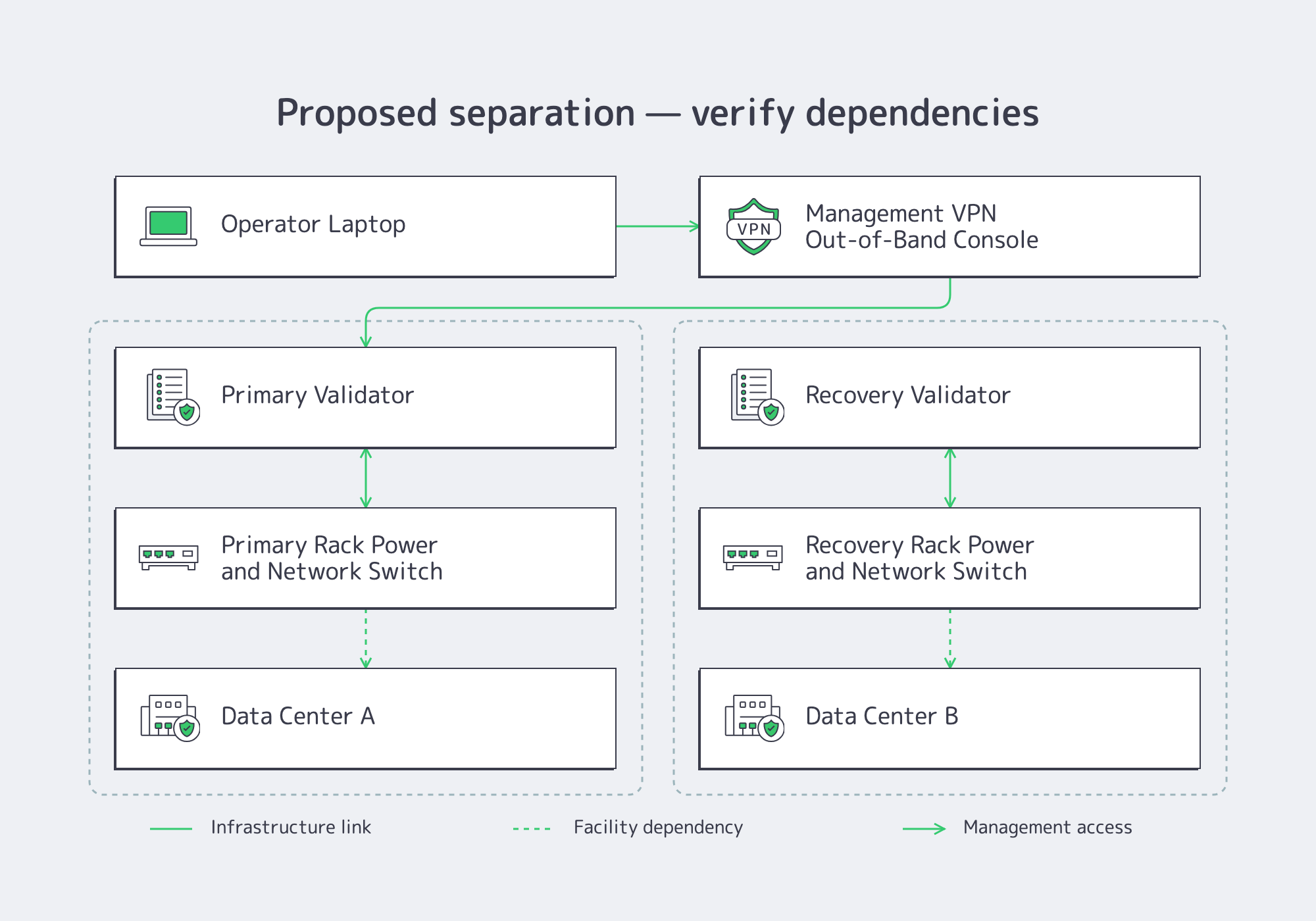
SSH depends on the installed operating system and production connectivity. A damaged bootloader, broken firewall configuration, or unavailable network interface can eliminate SSH during an incident.
Out-of-band management should remain usable without the host operating system.
Test Management Access Under Failure Conditions
During an authorized maintenance window, establish remote console access, deliberately disable the normal administrative path through a reversible change, and verify that the console remains functional.
The operator should be able to observe boot output, initiate an authorized reboot, and restore access without relying on the installed OS.
Define the acceptable console-access time before testing. The threshold should reflect the operator's outage budget and the time needed for subsequent recovery work.
Melbicom's network architecture includes IP-KVM access through a dedicated control port connected to an isolated management network, accessible through VPN.
The acceptance test for this architecture is concrete: establish the management VPN, interrupt normal host access, verify console continuity, and record timestamps.
Repeat using an independent operator connection where practical.
Validate Hosting Failure Domains
Two servers are not necessarily independent. Separate chassis may share rack power, switching equipment, aggregation infrastructure, or an entire facility. Geographically separated machines can still share management systems or operational dependencies.
NIST SP 800-34 Revision 1 provides contingency guidance on alternate sites and common hazards. Physical separation alone does not eliminate shared dependencies.
The provider should identify shared dependencies across chassis, rack power, switching, facilities, connectivity, and management access.
A rack-level recovery requirement needs separation beyond individual chassis. A facility-outage requirement needs different facilities. Different cities, IP addresses, or autonomous systems alone do not establish complete independence.
Monitoring requires similar discipline. Anza recommends running agave-watchtower on another machine so a validator outage does not simultaneously eliminate monitoring.
Melbicom's data-center locations provide geographic placement options for primary and recovery environments. Operators can select locations according to the failure boundary they need to survive, then document the dependencies of the chosen deployment.
Validate Recovery and Replay Timing After NVMe Loss With Reproducible Tests
A Solana NVMe recovery test should measure how quickly a validator reconstructs valid state, closes its slot backlog, and safely resumes participation. Separate physical replacement, snapshot acquisition, state loading, and catch-up. Use an isolated test identity, synchronized timestamps, and measurable success criteria. A logical storage-loss simulation cannot establish physical replacement performance.
Solana NVMe Recovery Test: Three Scenarios
Anza's validator documentation recommends separating ledger and AccountsDB storage. Recovery therefore depends on which device fails and where snapshots reside.
The acceptance protocol should exercise three scenarios:
- Intact-storage restart: Establish normal startup time as the control, preserving usable local ledger state rather than automatically downloading another snapshot.
- AccountsDB-device loss: Replace the affected test volume while preserving usable state elsewhere, where the deployment's storage topology permits.
- Ledger-device loss: Remove the test ledger and any co-located snapshots, exercising the configured snapshot/bootstrap recovery path.
Use a disposable, non-voting lab instance or an appropriately fenced controlled test with a safe identity and rollback plan. Never wipe a production validator or allow duplicate active voting identities.
A logical disk-loss simulation tests validator recovery, not physical replacement. Measure an actual provider-performed replacement separately when available.
Define Recovery Tests and Success
Freeze the validator client version, executable checksum, consensus mode, kernel, configuration, cluster, snapshot policy, storage paths, and validator arguments.
Record the applicable recovery-state requirements for the selected client and consensus mode. Anza's failover guidance distinguishes Tower BFT tower files from Alpenglow vote-history state; neither recovery procedure should be assumed universal.
Allow normal operation, then impose a controlled outage long enough to create a measurable backlog. Select the outage duration from the recovery scenarios and interruption budget the deployment must tolerate.
During recovery, sample local and reference-cluster slot progression at a predefined interval. The interval should be short enough to reveal sustained stalls and changes in catch-up behavior without relying on isolated, noisy samples.
Catch-up factor = Δ local slots / Δ reference-cluster slots.
This factor measures relative catch-up progress, not pure replay CPU performance.
Compare consistent slot semantics over a stable, monotonic interval after snapshot loading, with a positive denominator. Exclude or flag snapshot jumps, resets, cluster pauses, and discontinuities.
A factor above 1.0 closes lag during that interval. At 1.0, the gap remains approximately unchanged. Below 1.0, it grows.
Set the acceptance criterion using the initial slot backlog, remaining outage budget, and observed net catch-up rate. The validator must advance faster than the reference cluster for long enough to close the backlog within the available recovery window. Evaluate sustained progress and stalls, not just the median factor.
Under approximately steady rates, estimated remaining catch-up time is:
Estimated remaining catch-up time (seconds) ≈ remaining lag (slots) / [local rate − cluster rate] (slots per second).
Both rates must use slots per second, and the net catch-up rate must be positive. This approximation does not predict changing cluster load or future performance.
Record snapshot transfer, loading, ledger processing, and catch-up separately. Keep UTC times for startup, gossip visibility, gap convergence, and validated participation.
Successful recovery requires valid reconstructed state, no unexplained state errors, a closing slot gap, and evidence of safe validator participation. Gossip visibility or a healthy process alone does not prove voting.
Repeat destructive scenarios to assess variation across relevant conditions.
A Solana Validator Acceptance Test
The RFP defines disclosures; acceptance tests measure performance.

The worksheet combines evidence requirements with acceptance criteria derived from the operator's recovery objectives.
| RFP Requirement | Required Evidence | Acceptance Criterion |
|---|---|---|
| Hardware replacement | Written fault scope, clock trigger, completion event, escalation path | Unambiguous terms; physical replacement measured separately |
| NVMe recovery | Storage layout, recovery logs, replacement-media details | Valid state reconstructed and participation safely restored |
| Management access | Console logs and timestamps | Console available within the time allocated for management recovery in the outage budget |
| Catch-up performance | Timestamped local/reference slot samples at predefined resolution | Sustained net-positive catch-up; backlog closes within the allocated recovery window |
| Total recovery | UTC infrastructure and validator timelines | Within the operator's defined outage budget |
| Failure domains | Written shared-dependency declaration | Separation matches the specified outage scenario |
| Monitoring | External observer records | Monitoring survives the tested host outage |
| Reproducibility | Configuration hashes, logs, test records | Independent engineer can repeat the procedure under the defined conditions |
The test plan should specify outage duration, measurement resolution, recovery-stage time allocations, and relevant operating conditions before execution. These inputs make results comparable and tie acceptance to operational needs.
Preserve the Complete Evidence Package
Collect validator logs, service-manager logs, kernel events, device inventories, mount states, configuration checksums, catch-up observations, external cluster measurements, and provider ticket timestamps.
Use the measurement commands and metric definitions supported by the pinned client version. Anza's operational guidance emphasizes preserving usable local state and verifying catch-up rather than treating every restart as a fresh bootstrap.
Report recovery durations using synchronized timestamps:
T_infrastructure = t_usable_hardware – t_incident
T_validator = t_validated_participation – t_usable_hardware
T_total = t_validated_participation – t_incident
For these contiguous definitions, T_total = T_infrastructure + T_validator.
Break validator recovery into snapshot acquisition, state loading, ledger processing, catch-up, and participation validation. Report observed overlap rather than assuming stages are independent or strictly sequential.
Include the maximum observed slot gap, catch-up factors, and individual run durations.
Use the same workload and measurement method for each offer. Snapshot sources and cluster conditions can vary, so record those differences rather than attributing every timing change to host performance.
A provider support drill should use a prearranged ticket, not a fabricated emergency.
Separating Contractual Commitments From Observed Trial Results
A successful trial is evidence of performance under particular conditions. It is not a contractual promise.
Keep three evidence categories distinct.
Written commitments establish what the provider has agreed to deliver, including applicable hardware replacement conditions.
Observed results establish what happened on a specific configuration, date, and workload.
Architecture evidence identifies dependencies that cannot safely be tested through deliberate facility, power, or network disruption.
A three-hour observed replacement does not redefine a written four-hour commitment. Likewise, documented management-network isolation does not replace a successful console-access test.
Every evaluation record should identify the configuration, date, location, failure scenario, predefined thresholds, measurements, anomalies, and evidence classification.
For a small number of trials, report individual durations, the observed median, or the observed maximum. Do not present an unsupported p95, statistically reliable worst-case estimate, or guaranteed future recovery time.
Choosing a Solana Validator Host Means Buying a Recovery Envelope
The strongest hosting decision rests on reproducible evidence, not a benchmark alone.

Before approving a provider, apply these operational decision rules:
- Reject undefined recovery clocks. Written hardware replacement terms should identify exactly when responsibility begins and when usable infrastructure is returned.
- Prioritize controllability during failure. Test management access with normal host connectivity unavailable, not only during healthy operation.
- Separate recovery bottlenecks. A slow snapshot transfer, slow state load, and inadequate catch-up headroom require different responses.
- Match redundancy to the intended outage. Independent chassis cannot satisfy a facility-level recovery requirement.
- Preserve evidence categories. A successful trial, architectural declaration, and written commitment answer different procurement questions.
Once baseline specifications are adequate, operational recoverability becomes the deciding factor. A host must remain controllable during failure, support predictable infrastructure restoration, and provide sufficient measured catch-up capacity to return the validator safely to participation.
Plan Your Solana Deployment
Use these replacement terms, management-access requirements, recovery tests, and failure-domain criteria to choose a Melbicom dedicated server and location for your validator.